


| CARVIEW |
Some themes and resources in this talk are consistent with the Social Justice Summit posts I shared some time ago, but stick with it and the content will diverge/clarify. The video is below and you can see the slide deck if desired. A reference/works consulted list follows at the end.
For the Greater (Not) Good (Enough): Open Access and Information Privilege
The title of my talk is For the Greater (Not) Good (Enough): Open Access and Information Privilege. This is a lot of heavy stuff, right? Open access (OA) is a huge topic, information privilege is a huge topic. What I want to do is begin with an image that I think can sum up how I’m going to come at these two giant ideas, both of which can be a little – let’s face it – depressing.

This is one of my favorite images. I took it in West Texas – I’m from Texas originally. I was driving through this little tiny ghost town on a sad highway, and the oil industry had dried up at this point – this was about 10-12 years ago. There was a lot of economic degradation, and you could tell there were not many opportunities available. Yet there was an old sign printing shop that somehow, someone had taken the time – in this store that didn’t even look like it was operating – to put up this message (“happiness is attainable”) letter by letter even though the thing’s rusted and the town’s falling apart.
The incongruity of this has always struck me as amazing. It’s it’s a way to encourage ourselves to acknowledge that there are hard things but that there are also very positive, resilient messages that can be seen within the challenging spaces. So remember that sign no matter how heavy I get. I promise that I’ll wrap it back around to this place by the end of the presentation.
Before I get any further I want to say so many thanks to OCLC for having me here – to Rachel (Frick) of course – Lorcan (Dempsey). Also, Nancy Lenssenmayer is literally the most effective person I have ever worked with in my life. She’s amazing. Thank you, Nancy. I also want to thank all the people who came today, all the people who are online spending the time to listen to this talk and hopefully ask some good questions after I’m done spewing up here. And thanks of course to all the people who have inspired this presentation. There have been a lot of scholarly communications librarians that I’ve worked with over the course of my life – I am not one – and I’ll talk a little bit about that in a moment. First off, of course Carmen Mitchell at my own institution, CSU San Marcos. I have learned a lot from her. I also want to give a shout out to Amy Buckland, and also to Allegra Swift who works at UCSD. Thank you for all the learning that you’ve helped me do in preparation.
Back to the presentation. It’s wonderful to be invited to this series. As Rachel mentioned, I started my career at Ohio University as a librarian. It was my first job, and this is the cabin that I lived in the woods in the complete sticks north of Athens [referring to slide 8]. I loved it there. One of the things that was interesting about having this as a first job is that I was indoctrinated into the collaborative library culture of Ohio, which is fierce. For those of you who have been here for a long time I see some head nods – OCLC was established back when the first word in its name was “Ohio” to begin a process of harnessing collective energy through collaborative cataloging. The library I was in had memories of that as OCLC’s original role. That harnessing of the collective energy of our profession is something that is very central to what I’m talking about today. The need for it and the continuation of it, particularly in a non-profit space, and a space that does not have a profit imperative or a profit motive. Because we are libraries and librarians, and we do not work for profit… we work for the greater good. The public good.
I also wanted to say thanks for stressing me out by calling this the “distinguished” seminar series. I’m following two people that I respect very much – Trevor Dawes and Dr. Kim Christen. I watched their presentations; they were excellent. So all I’m going to try to do today is bring as much energy and insight as they did to this stage, and hopefully address any questions you have to continue this dialogue. It’s a little bit stressful but I’m also honored, so I’m gonna bring it. I promise.
One good thing about being “distinguished” is that you get to get up on a stage and talk about what matters to you. I use this image [referring to slide 10] a lot of presentations because I think it’s very evocative of the way that I tend to approach opportunities like this. I like to get up on my soapbox and holler – not quite holler exactly, but I love to discuss ideas that are challenging to our profession, that are important to the public good. And because I’m up here y’all have to listen to me, so here we go.
The funny thing in my preparation for this presentation – and I already mentioned this – is that I’m not a scholarly communications librarian. I have done a lot of things in my library career, but this topic is not my precise area of expertise. I took a picture of the coffee table in my hotel room this morning to give y’all a sense of how much I’ve been cramming for this for this talk.
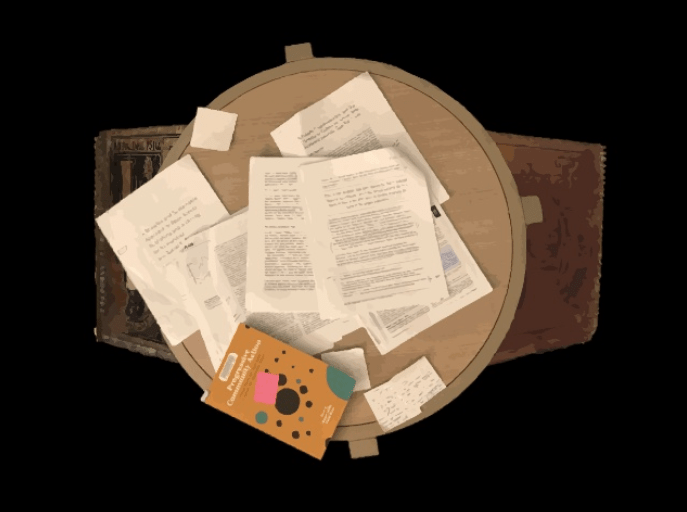
It’s been a fascinating journey. It’s confirmed a lot of my assumptions about how OA interacts with information privilege. And it’s also tested a lot of my assumptions, taught me many things I did not know, and has given rise to some ideas that I want to throw out there that I think might be interesting.
So where do I come from in libraries? I’m a teacher. I started off as a Reference & Instruction librarian at Ohio University. This is the primary perspective I tend to bring to my work, teaching and learning, information literacy and how to challenge people to use their noodles (for lack of a better word). For the last five-to-seven years I’ve been in management and administration: I used to focus on learning exclusively, and now it’s about how to get things done and use the tools at our disposal in libraries to be sustainable and above all else support our students. And that’s where I get my inspiration, that last line – supporting students. Student learning is my primary motivation and it’s something that grounds the ideas I want to share with you today. So that’s where I get my fire.
I want to establish a central premise for this talk – it’s something that I’ve alluded to a couple of times already. This is a quote from OA advocate John Wilinsky:
“Access to knowledge is a human right that is closely associated with the ability to defend as well as advocate for other rights.”
For context, he’s won awards from SPARC, a foundation that deals with the promotion and proliferation of OA, and wrote a book called The Access Principle in 2006 that I recommend to people. It’s free, no surprise there.
I think this quote is a perfect encapsulation of how I want to come at the the two topics of OA and information privilege. This should simply be true for people in our field. Information professionals, librarians, knowledge workers – our work is predicated upon this idea. I hold it very strongly and I hope that you do too.
I want to give you quick definitions of these two concepts before I go any further. Information privilege is a relatively simple idea. Privilege itself means that – just to give you an example – I’m standing up here with my fancy shoes and I had a great breakfast and I got flown out here by OCLC, which I’m very grateful for… these are incredible advantages that I have had and accumulated over the course of my life. There was some hard work in there but the way I look, where I come from, the educational opportunities I had, the white middle-class background that I grew up in – that is the accumulation of my privilege, and I use it and I feel it every day.
Transfer that concept to the the area of information access, and people who are poor, people who are minoritized, people who are incarcerated, people who don’t have an institutional affiliation with a particular school, or have a public library close to them that offers anything like free interlibrary loan: these people are are information underprivileged, information impoverished. And OA – for this audience I don’t need to be defining it at length, but I do like the Budapest Open Access Initiative‘s definition as “the right of users to read, download, copy, distribute, print, search, or link to the full text of content.” So, not having to pay for stuff in the simplest words possible.
Like I mentioned at the beginning, these are huge concepts. At the stratospheric level ideas of OA and information privilege can seem a little bit oblique… confusing… not really that tangible. What I want to do is bring these things down closer and closer to earth, to the point at which people who work in libraries – maybe if these aren’t your motivating factors yet – can begin to grapple with them on the ground and put activities into action that can actually help manifest more information equity and more OA that is truly open. I’ll get to that little qualifier by the end – how open is open? It’s a good question.
I like to tell stories, and I like to speak for myself. So from my own vantage point I’m going to tell you a couple of vignettes that illustrate what information privilege looks like, what information underprivilege looks like, the responsibilities of the former, and the negative effects of the latter.
I’ve lived all over the country and have had a lot of jobs – I like to move around. What I really want to talk about is the way that I was raised. That’s my mom – she’s amazing – I hope she’s watching (sometimes she is). Once Rachel [Frick] invited me to give the keynote at the 2013 Digital Library Federation conference in Austin: my mom lives in there, and she was in the audience smiling. My mom raised me with a real love of learning – she was an ESL teacher at the college level, a Spanish teacher at the college level, and she raised her kids to be autodidacts – to know how to teach ourselves. The way she did this was to instill in us an absolute love of libraries and reading.
At the same time, living in Texas I had a very difficult experience growing up. Being a queer person, I came out very young and was in a very conservative place. The instant I could liberate myself I shot across the country at light speed and landed in Portland, Oregon at Reed College, a place that encapsulated what I wanted in furthering my education. It was an extremely rigorous, self-directed, maniacally difficult place to study. Here’s another aspect of my privilege – this was expensive. I had help, and without it I wouldn’t have been able to get out of the bad situation I was in. So I’m grateful for that.
I go back home to Austin and begin the process of getting my library degree at UT, learning how to do the work. I had the opportunity to work at Perry-Castañeda Library, and shout out to all my colleagues there. At the same time I started to do the thing that sometimes one does when they’re surrounded by a community of activists and artists – I started to develop more of a political consciousness. This was growing in me from my experiences as a queer person who experienced a lot of trouble based on my identity. Combining social justice activism and libraries led me to work with a books to prisoners project called Inside Books.
Prison libraries are an established sector of our profession, but unfortunately are shrinking with the privatization of incarceration, wherein “special programs” focused on education and literacy are often eliminated. Those special programs are essential to prisoners who not only have to spend their time in these horrible boxes, but need to be able to advocate for themselves in and through the judicial system. A number of court cases enshrined the right to access to prison libraries and then knocked it back down again[1]. Prison libraries have been in trouble for a long time, and for that reason there are organizations across the country (and I assume across the world) that have programs for distributing reading material to incarcerated folks.

At Inside Books we received letters from all over prisons in Texas with notes that would say, “I’d really like this kind of book, can you please send me xyz?” We’d get requests for Spanish-language dictionaries, westerns, romance novels, chemistry textbooks – anything under the sun – and we would fulfill those requests, write a note back, and mail it off. What was so unfortunate is that a lot of the items got returned for no reason. We’d pay postage to put these books in the mail, they’d go to the prisons, and for some arbitrary reason a lot of them would get kicked back to us with “return to sender” without any rationale.
For these incarcerated people, even when external actors were trying to support them with direct donations, disenfranchisement was going on. Systematic rejection of reading materials for prisoners because… why? It’s dangerous? You tell me. The systematic rejection of books to prisoners work is an excellent example of information poverty, a concept that’s been discussed at length in our profession. It’s not just about information privilege – the flip side is that some people just simply can’t get access to the knowledge that they need in order to be able to advocate for justice for themselves and others.
Switching gears, going back to Ohio where I’m standing now. A lot of information poverty has to do with isolation. When I lived in the woods in Ohio, I had my fancy library job but I was trying to complete an online degree at the time and that house didn’t have internet. I don’t even think we could get dial-up out there. So I was like okay, online degree and no internet: this is going to be interesting. I would load up a laptop at the end of my workday with all the tabs I needed to read, and I would go home and think to myself “I hope nothing crashes” and attempt to write out my assignments in Word and then paste them into the discussion forums the next day. This is the most vanilla example of information underprivilege possible, but it goes to show you that being incarcerated isn’t the only way to not have information privilege. If you are isolated, if you live in a rural community, if you do not have proximity to libraries that have robust collections, or if you’re in communities that are having their public library budgets cut.
I wanted to tell my favorite story about triumph over information isolation. This individual [Sandor Katz] is someone I met while doing the Inside Books volunteer work – this person lived on a radical fairy land trust in the middle of nowhere in Tennessee, and his thing is fermentation. He was also ill, especially at the time that he was on this journey of figuring out how to ferment foods, and teaching other people how to do it – trying to figure out how to keep his gut bacteria healthy and feel better. This individual also has a huge brain and a lot of curiosity, so over the course of this work of figuring out how to make different kinds of fermented food he realized that a lot of the articles he needed weren’t going to be available to them, particularly not in his isolation in the woods. Over the course of his travels he had interacted with librarians, so I started getting emails from him years ago saying, “hey Char, can you maybe find me this article from the Journal of Viral Bacteriology?” or whatever. And because I was at Berkeley I was like “yeah, I’ll just send it to you.” If he hadn’t had those connections with librarians across the country to begin to lift these paywalls for him, he never would have been able to do this incredible thing that he ended up doing, which was writing a New York Times bestselling book called The Art of Fermentation, which some of you have probably read.
Okay, let’s return to an important point. This individual had to ask librarians to literally break the law for him in order to produce that book. A point I’m going to come back to again is that even though it’s ten years after this example and the OA movement has made so much progress, the same situation still exists: this is what we need to work on. And of course Sandy outed every single librarian who had helped him in his acknowledgments, which is rad because it just goes to show what we’re about and the lengths we’ll to go to to help people get that information that they need.
We have information privilege, and how are we going to use it? A good way to think about this kind of work is to:
“explain what is wrong with current social reality, identify the actors to change it, and provide achievable, attainable, practical goals for social transformation.” – James Bowman
This is a mode of thinking that helps you analyze and deconstruct power and privilege and the intersectionality of different identities that give people more and less power, more and less privilege. I like this allegory to library and information work. In order to understand and act upon a situation like Sandy’s, we need to be able to explain what is wrong (and let’s face it, there’s a lot wrong) with current social reality, identify the actors to change it, and provide achievable, attainable, practical goals for social transformation.
This is our mission, and this is what I’m going to be talking about for the rest of the presentation. How do we do this? What does this look like, and how do these two massive stratospheric ideas of OA and information privilege collide toward this goal? I’m already twenty minutes in, and because I could talk about this stuff literally until you all fall asleep and/or die I’m going to focus it down.
A thing I like to do when I’m confronted with this impossible of a topic is ask myself hard questions, which helps focus on the most meaningful things to engage during this limited amount of time we have together. The first question is important – why do we do this work? I hope that you have a good answer to this question. Think about it. I’ve begun to tell you why I do this work, but I challenge you to think about your own motivations for the energy that you put in when you’re not sitting in these chairs. Equally and more important, what values are most important to our communities? We’re libraries, and the reason we exist is to hold a mirror up to our communities and augment everything that they are and need. We should match the people we serve. We should see them, value them, and give them the things they need to thrive and be able to advocate.
And my favorite question of all – what’s broken that we can help mend or fix? I have a brilliant friend named Pascal Emmer. He’s an amazing activist and human being, and also happens to be a ceramicist that makes objects I can’t quite believe are possible. Every once in a while Pascal will fire something that explodes. This is a thing that happens to people who make pottery – my wife Lia, she’s also a ceramicist and I’ve seen her lament many an exploded piece over the course of our marriage. But that just part of it. There’s a beautiful Japanese ceramics technique called kintsugi – if your piece breaks in such a way, instead of only gluing it together you can paint the cracks over with gold to highlight the flaws. In order to make it that much more beautiful.
I want to use this broken object with obvious flaws as a metaphor for the work that we can do around information privilege and OA. I want to characterize it with this phrase – “the politics of and imperfection and responsibility.” An article came out recently by Frances Lee called Why I’ve started to fear my social with my fellow social justice activists. What this article talks about is an ethics of activism. We’re all imperfect. Our institutions are imperfect, every single thing is imperfect. We have to be able to recognize imperfection, see the cracks, and then take responsibility for fixing them. Not only fixing them, but highlighting the work that we did to fix them. Which is where the kintsugi metaphor comes back in: we want to demonstrate the brilliance of what has been broken and been put back together.
Now I get to talk about CSU San Marcos, which is a place I love very much. This is my library – it’s a huge beautiful new building and I, for most of my career, have worked in older crappy libraries that were falling apart bit by bit. It feels incredible to be in a facility that is operational, and shiny, with the carpets that are, like, decent. Tt’s great, but that’s not all there is to it. The thing about the students that I work with, and the students that the CSU system as a whole serves, is that these are students who have been minoritized for many reasons: poor students, underrepresented students. We’re an Hispanic Serving Institution with a large proportion Pell Grant recipients. It’s because of those factors that information underprivilege is a fact of life. It’s just a reality. A lot of the work that we do at my institution is geared towards what kind of economic impact that we can have on our students’ educational experience in order to help them persist.
I want to acknowledge and attribute Carmen Mitchell, who I gave a shout out to earlier. This image [of sticky notes on a whiteboard] is part of the #textbookbroke campaign that started a couple of years ago – Carmen worked on this at CSUSM. A lot of people are wise to the fact that textbooks are too expensive. Students cannot afford them, and sometimes drop out of school because of the cost. Students don’t get the textbooks they need for classes, and therefore their experience and performance is affected. So, we put up whiteboards in the entrance of our library and asked this question – “what would you be able to afford if you didn’t have to buy your textbooks?” We got hundreds of responses. Carmen did an analysis and a bit of visualization, and what we saw is things like this: “new teeth, food, housing, gas, rent”. These are basic human needs, and these are what our students have to forego – not just our students but many students in this country and internationally – in order to afford the materials of their education.
There’s a professor at CSU San Marcos that I respect named Jill Weigt, and in preparation for a panel on food insecurity she created an extra credit assignment in one of her classes. She asked students (and these were second year sophomores) “What are the three barriers to your academic success? What do you want to call out as the hardest things that confront you?” Without fail, things like “due losing my job I became homeless”, “I lack transportation”, “I was paroled from prison and I had to do all these parole things and I couldn’t make it to class,” “family obligations at home”, “stress and allocating finances to pay for school”, and, simplest of all: “culture, race, economic background.” This is reality, and as librarians and people who work in the world of information we should be focused on fixing this, because it is killing our students.
Students are experiencing external challenges, and, frankly, violence. We’re finding white supremacist recruitment posters all over my campus – these organizations are targeting schools that have a lot of underrepresented minorities. Our students are challenged from so many structural directions that they cannot control, and now this on top of all of it? It’s crushing, and it has a lot of synchronicity with the topic at hand. “Fake news”, the warping of the idea of truth itself, is feeding into this culture, and that culture is feeding into our institutions. I think libraries have the responsibility to help stem this tide, and speaking of responsibility — thanks to OCLC for my speaking fee. I donated it to an organization called Life after Hate. If anyone is interested in supporting a group that helps people who have been white supremacists rehabilitate themselves, please give them money. They were slated to get a huge federal grant a few years ago, but in the new administration that grant got cancelled, so they need money.
So can we all agree that there are cracks in the system? Can we all agree that it’s our responsibility to shine a light on these cracks and try to make them beautiful when we fix them? Excellent, I’m hearing lots of “yeses”. If the principle of our institutions is that “libraries are for everyone”, if our Bill of Rights says that libraries are about access, advocacy, openness, freedom, and inquiry, we have to acknowledge the flipside. This is the piece of the “happiness is attainable” sign that’s covered in rust. Libraries have a history of – and this was addressed in Kim Christen’s talk before me – encouraging assimilation of different cultures into American culture, of perpetuating colonialism, of being party to censorship that still happens today, biased description in our cataloging and metadata, and frankly complicity – we segregated. And the way this behavior comes out today is often in the form of fees, fines, polices, “neutrality,” and apathy on the part of library employees.
What can we possibly do to attack these big problems? Well, it’s simple – we identify and overcome the barriers that we perceive, systematically, in our institutions for our communities on the ground. I gave a talk recently at this event at CSUSM called the Social Justice Summit. It’s a group of 40 students at CSU San Marcos who sign up for an intensive three-day training in how to be effective activists. It’s about communication, fundamentals of social justice theory and criticism, and just generally being awesome. These people were very inspiring to me, and what I talked to them about is how libraries can act as allies to them, how the library itself can be an institutional ally. I want to give a couple of quick examples of the way we’re doing this at CSU San Marcos, and again this is not “my” work, this is the work of the collective and it’s something that’s very important to acknowledge. It’s never just about an individual in libraries.
So if money’s part of the barrier, what can we do? One of the proudest things that I’ve done at San Marcos is blow open the wage structure for Student Assistants at our library. Student Assistants do a huge amount of the work in libraries, and they often get paid poor wages. Federal Work Study farm, does that sound familiar than anyone? Yeah, no. That’s not cool. Our campus didn’t really allow us to give raises to students unless they’d worked a certain number of hours, and so I in my administrative privilege became very annoying to our Human Resources office and forced them to rethink because of my polite persistence about asking, Can’t we give merit raises? Can’t we hire people at at different rates?? The answer was no, but now it’s changed for the whole campus. I didn’t know that’s what was going to happen, but it’s a great thing. If you administrators out there don’t think you can do anything, you’re wrong.
And of course, affordable learning materials programs. Again, a hat tip to Carmen Mitchell. Being able to figure out ways to save our students money on textbooks, including the library renting them for a semester and checking them out on reserve. Also, eliminating fines and fees – this is a big one. We still charge people when books are lost, but why are you going to penalize someone for having a book too long? If it’s not lost, we don’t need to do that. Opening a 24 hour area in our library – this is a student-funded initiative: our student government ran a ballot referendum that pays for it. Based on the data that shows that 20% of our students are housing insecure and up to 50% of our students have experienced food insecurity, we have food, we have a comfortable situation in there and trying to make that that space as hospitable as possible. Other things we’re doing include attempting to have arts and culture programs that are representative of minoritized identities. We recently featured a Black Panthers exhibit, and hat tip to Mel Chu, Talitha Matlin, and Kate Crocker for the awesome work they did on it. We make sure that our Common Read books are representative of diverse identities and challenging topics, and are also trying to get some mural art in our building that will align with the muralist culture and tradition in San Diego.
Those are the on-the-ground examples that I wanted to give about the idea of an information justice that comes from libraries, from the work that we do on the ground, and the way that we perceive our users. This idea of information justice is a familiar one to libraries and librarians and people who work in allied nonprofit fields, and it is absolutely essential to integrate this with the idea of OA itself. I’m not going to regale you with all the figures about how many materials are published OA and how much content is available – it’s a lot. So much work has been done to create repositories where people can self-archive their content, to create advocacy organizations that promote legislation such as FASTR that mandate that people who have state or federally funded research deposit their work so that the public can find it. I do think it’s important to acknowledge the most important voices in the OA movement, including Aaron Swartz, who was famously arrested in 2011 for downloading ton of JSTOR articles at MIT, and then, extremely tragically, took his own life in 2013. Some people associate that with the legal trouble he got in, and while I cannot speak for him it was a tragic event. Aaron has this quote that I think draws us right back to our responsibility as librarians and people with so much access privilege ourselves:
“Those with access to these resources — students, librarians, scientists — you have been given a privilege. You get to feed at this banquet of knowledge while the rest of the world is locked out… But you need not — indeed, morally, you cannot — keep this privilege for yourselves. You have a duty to share it with the world.”– Guerrilla Open Access Manifesto, 2008
We have a moral obligation to share the information we have access to, and to determine how it can be shared most effectively.
In my teaching I’ve found that information literacy doesn’t resonate strongly with students unless I connect it to information privilege. I think it is fascinating that after years of teaching to people who are basically falling asleep in classrooms, the second I started talking about money – how if you’re at this school we pay x million dollars so you can have access to y amount of content, and once you’re out of here you’re cut off – they start listening. Then it becomes a structural, systemic, societal issue. This is important for the interventions we can come up with to create an effective and pervasive OA information culture. We need to be able to leverage the policy and legislation initiatives that are happening such as FASTR, which I mentioned – discovery platforms such as the DOAJ which has something like 2.6 million articles at this point from 10,000 certified legitimate non-predatory journals. Open educational resources, which I’ve talked about a couple of times. And of course digitized collections such as Hathi Trust and the Digital Public Library of America. These are quick examples, because it would take me three days to talk about all the good content that’s being developed.
But here’s where it gets dark – we have to talk about the flip side. It’s estimated that by now about 25 percent of all the academic scholarly content that’s published is available in some form of OA, and that’s that’s huge. But it still means 75% of the content is behind a paywall. Over 700 mandated OA publishing agreements have been created by research organizations institutions that basically force their faculty to put items in OA repositories or to publish gold OA (which is paying an article processing charge). Unfortunately, even with that, only 25% of content is OA, and libraries in this country still spend 3 billion dollars a year paying the top five publishers for their huge profit margins. This is an amazing statistic: since the rise of OA content (say around 2010) the profit margins of publishers like Elsevier, Blackwell, and Wiley have gone up 10%. Their margins started at 30% and now they’re hovering around 40% – this makes inverse proportional sense. What it means is that there’s a there’s a co-opting of OA by these monster publishers. It highlights a pressing need in our field and allied fields – nonprofit, information-focused fields – to figure out why publishers are profiting so much from OA content, and how it is that a larger and larger share of our purchasing budgets are going to them.
Now that I’m an administrator I truly see the impact this has on our institution. We want to be able to hire more teaching faculty, we want to be able to do more cultural and public programming, but we’re curtailed by the meteoric inflation rise like everyone else. This doesn’t only affect academic institutions. I wanted to quote Roger Schonfeld of Ithaka S&R – “publishers appear to have largely co-opted open access… there’s little evidence that a way has led to decreased licensing expenditures, and it is almost certainly led to a boom at least for the short term in content revenues for some of the largest publishers.” So if journal content prices have outpaced inflation by 250% in the last 30 years – this is intense – what are we going to do about it? And what are other people doing about it out there in the world?
I’ll tell you one thing they’re doing: they’re pirating the hell out of it. Does anyone know who this is this is? It’s Alexandra Elbakyan. She’s the neuroscientist who invented SciHub. There’s a movement on Twitter called #icanhazpdf, which is like an army of Sandys requesting PDFs from colleagues and people trading articles informally online. Along comes Alexandra Elbakyan, who and invents a way to steal 50 million academic articles and make them freely available on the open web. The programming behind this is so diabolical that it’s ingenious. The program is pilfering our own licensed content and adding it to SciHub. There’s an allied site called Library Genesis that has two million volumes of mostly humanities content. Of course SciHub and Library Genesis get a lot of challenges from publishers in the form of lawsuits. One in 2015 ordered SCI hub to come down – it went down and came right back up at about two weeks under a different domain.
Academics are grappling with what it means to have all this pirated content out there, and our relationship to these movements that are literally trying to free information but doing so in very much illegal and illegitimate ways. I encourage anyone who’s interested in this topic to read Who’s downloading pirated papers? Everyone, which came out in Science. It shares statistics like the fact that 28 million papers were downloaded from SCI hub over a period of six months in 2016, that fifty million papers have been indexed by that date – and here’s the most important part for librarians – a lot of this activity is happening at our colleges and universities, in our buildings. They created a heat map analysis of where the highest number of downloads are happening – near and at major research universities around the world and in the United States. Think about that for a minute. Three billion dollars annual in annual expenditures on journal content, and there are folks on our own campuses downloading illegally for free. Why? Because it’s easy. Because it’s discoverable, because there’s one place – only one place – that they have to go to search and download instantly. It’s illegal, but it’s easy.
I think this points to a huge challenge – and also a huge opportunity – for libraries and the organizations that work with us, to address this problem. Closed content is more readily available than the content we license. The open content we license is so challenging to access. Also, the legitimate OA content is challenging to access – because of all of those repositories and discovery tools and layers, it’s basically diffused throughout the universe. I had to do so much research for this presentation (and I’m a librarian) just to figure out what these things are called. ROAR, SOAR, etc. – I imagined being an undergraduate student basically standing out in the woods saying, “what is this? What am I searching? It’s still very confusing. I don’t mean to knock any of the efforts that have been done around OA to date. That said, I don’t think that we have yet addressed this challenge: why is the illegal stuff so much easier to get to than A) our own licensed content and B) the open content that’s sitting around in repositories, paid for through exorbitant article processing charges (APCs)? This is indeed a big challenge, and we need to figure out how to solve it.
I wanted to profile a couple of people who are already doing this – shout out to Open Access Button. We’re evaluating our interlibrary loan workflows using this tool, which is kindof like a legal analogue to SciHub. It crawls green open access publications (which of course are the ones that people self archive as opposed to gold, wherein publishers making something OA funded by APCs. The OA Button is great because if you click it and the article that you’re searching for (using a DOI or a title) isn’t available, they have a workflow that seeks out and pings that author who created the content it tries to guilt-trip them into making it available. It works. I looked through the requests and there’s a bunch of them that are successful. You can see who’s denied and who’s pending, and librarians can contribute to this project.
There are other services that do similar work, like OAdoi. There’s a SFX discovery layer that can help prioritize and push up away content in a library’s own holdings, but we still come back to this idea that these tools only cover about half of the OA universe – only the green content, only the things that article that authors have taken upon themselves to archive. Not the gold stuff, the stuff that the publishers have figured out how to co-opt and produce, the stuff that Roger Schonfeld was talking about. We need to figure out as a collective how to tackle this problem. How to have a discovery tool, layers, methods, workflows, and funding infrastructures that allow us to represent easily and in readily available sources the entire universe of OA content. This is the way to actually and actively combat information privilege especially, in our academic institutions.
So how does it happen? There has been good work done on this question. John Wenzler describes the issue as the “collective action dilemma.” This is one of the barriers that he sees to why libraries haven’t solved this problem yet. It’s the tragedy of the commons: who’s going to pay for it, who’s going to organize it, who’s going to make this work sustainable. K | N consultants – that’s Rebecca Kinnison and Karen Norburg – created a whitepaper that proposes how to revitalize and change the infrastructure of scholarly communication via institutions paying flat annual fees into a giant pool. They did the math in this huge spreadsheet – it’s beautiful – with the price breakdown for the thousand schools they index, and it comes out to about sixty million dollars annually. So instead of paying increasing inflation charges, maybe we can start banding together privileged OA content creation tools that actually help people discover this content easily. This will give us more leverage to negotiate with publishers who keep jacking up prices, and help give people OA content that they’ll actually be able to keep after they leave our institutions.
If there’s a collective action dilemma, then we have to work together to solve it. This work is ongoing, and the content foundation of OA has been laid and is here to stay. There are thousands of repositories and hundreds of agreements helping authors archive, but discovery is still a problem. It’s so much of a problem that our own faculty can’t even figure it out, and they go through more nefarious means to get their information.
To wrap up: if we acknowledge the politics of imperfection and responsibility, if we’re looking for cracks in the system and ways to take responsibility for and challenge information privilege and information poverty by creating a reliable and sustainable infrastructure for OA, then we have to use the same logic that libraries around the world do: figure out how to help patrons overcome the barriers in their lives. If discovery is a problem, if collective action is a problem, who’s going to take up the charge? This is a question we’re still trying to answer, but it’s all geared towards the end goal I began with: information equity.
To close on a positive note, I wanted to give it quote from Toni Morrison. This is where I try to eject you from your seats so you run back to your desks get this thing done, right now:
“When you get these jobs that you’ve been so brilliantly trained for, just remember that your real job is that if you are free, you need to free somebody else. If you have some power, then your job is to empower somebody else.” – Toni Morrison
And that is my presentation.
[1] Bounds v. Smith, 430 U.S. 817 (1977), mandated that prisons provide incarcerated people with access to legal professionals or law library collections – this preserved the right of “meaningful access to the courts.” Lewis v. Casey, 518 U.S. 343 (1996), rolled this requirement back. A discussion of impacts of these cases and other trends in US prison libraries is available in Lehmann, V. (2011). Challenges and accomplishments in U.S. prison libraries. Library Trends, 59(3), p. 490–508.
References/Works Consulted:
Bergstrom, T. C., Courant, P. N., McAfee, R. P., & Williams, M. A. (2014). Evaluating big deal journal bundles. Proceedings of the National Academy of Sciences, 111(26), 9425-9430. Retrieved from https://www.pnas.org/content/111/26/9425.full.pdf
Bohannon, J. (2016). Who’s downloading pirated papers? Everyone. Science, 352(6285), 508-512.
Britz, J. J. (2004). To know or not to know: A moral reflection on information poverty. Journal of Information Science, 30(3), 192-204. Retrieved from https://journals.sagepub.com/doi/pdf/10.1177/0165551504044666
Cope, J. (2016). The labor of informational democracy: A library and information science framework for evaluating the democratic potential in socially-generated information. In B. Mehra & K. Rioux (Eds.), Progressive community action: Critical theory and social justice in library and information science. Sacramento, CA: Library Juice Press.
Freire, P. (2017). Pedagogy of the oppressed. (Ramos, M. B., Trans.). London: Penguin Books.
Gardner, C. C., & Gardner, G. J. (2015). Bypassing interlibrary loan via Twitter: An exploration of #icanhazpdf requests. In Proceedings of ACRL 2015. Portland, Oregon, March 25-28, 2015. Retrieved from https://eprints.rclis.org/24847/
Hooks, B. (1994). Teaching to transgress: Education as the practice of freedom. New York: Routledge.
Kennison, R., & Norberg, L. (2014). A scalable and sustainable approach to open access publishing and archiving for humanities and social sciences. A white paper. New York: K|N Consultants. Retrieved from https:// https://knconsultants.org/toward-a-sustainable-approach-to-open-access-publishing-and-archiving/
Land, R., Meyer, J. H. F., & Smith, J. (Eds.) (2008). Threshold concepts within the disciplines. Rotterdam: Sense Publishers. Retrieved from https://www.sensepublishers.com/media/1179-threshold-concepts-within-the-disciplines.pdf
Larivière, V., Haustein, S., & Mongeon, P. (2015). The oligopoly of academic publishers in the digital era. PLoS ONE, 10(6): e0127502. Retrieved from https://doi.org/10.1371/journal.pone.0127502
Lewis, D. W. (2017). The 2.5% commitment. Retrieved from https://hdl.handle.net/1805/14063
Ruff, C. (2016). Librarians find themselves caught between journal pirates and publishers. The Chronicle of Higher Education 62(24). Retrieved from https://www.chronicle.com/article/Librarians-Find-Themselves/235353
Schonfeld, R. (2017). Red light, green light: Aligning the library to support licensing. Ithaka S+R, Issue Brief. Retrieved from https://doi.org/10.18665/sr.304419
Suber, P. (2012). Open access. Cambridge, MA: MIT Press. Retrieved from https://mitpress.mit.edu/sites/default/files/9780262517638_Open_Access_PDF_Version.pdf
Swartz, A. (2008). Guerilla open access manifesto [Online resource]. Retrieved from https://openscience.ens.fr/DECLARATIONS/2008_07_01_Aaron_Swartz_Open_Access_Manifesto.pdf
Tennant, J. P., Waldner, F., Jacques, D. C., Masuzzo, P., Collister, L. B., & Hartgerink, C. H. (2016). The academic, economic and societal impacts of open access: An evidence-based review. F1000Research, 5. Retrieved from https://www.ncbi.nlm.nih.gov/pmc/articles/PMC4837983/
Wenzler, J. M. (2017). Scholarly communication and the dilemma of collective action: Why academic journals cost too much. College & Research Libraries, 78(2), 183-200. Retrieved from https://doi.org/10.5860/crl.78.2.16581
Willinsky, J. (2006). The access principle: The case for open access to research and scholarship. Cambridge, MA: MIT Press. Retrieved from https://arizona.openrepository.com/arizona/handle/10150/10652
I had so much fun breaking myself into tiny pieces the first time around, I’ve decided to revise and expand RTEL into a 2nd edition that will be available in 2019. While much of the foundational content of the 2011 version (e.g., instructional design) is sill relevant/solid, many parts are temporally and experientially outdated.
Specific technologies referenced have reached the point of near-irrelevance, but more pressingly I wrote from a personal narrative perspective that represented my experiences in the jobs I’d held to date at Ohio University and UC Berkeley. The first edition therefore leaves out years of productive experimentation by myself and my colleagues at the Claremont Colleges, perspectives I’ve gained as an ACRL Immersion faculty member and administrator at CSUSM, and a lot of consciousness-raising and pedagogical/theoretical grounding that I simply did not possess due to gaps in my own early knowledge base. This accumulation of experience gives me an opportunity to address and expand essential components that received short shrift the first time around, such as critical/feminist pedagogy, program/project planning, and many more facets of learning assessment and technology.
When you write something, you (hopefully) want it to be of a) use and b) quality – this book is used as a course text in a fair number of IL-focused LIS classes, so I also figure it’s in our collective best interest to not mess around. To revise RTEL in alignment with these principles, I’m asking for libraryland’s brainpower in two ways:
1) If you’ve ever read some or all of RTEL and want to communicate your impressions/critiques/suggestions to help inform the 2nd edition, please do so via this survey (also embedded below). It should take 10 minutes or less:
2) Whether you’ve read the book or not, please share your insights into how you were (or weren’t) trained to be a teaching librarian. This one is a bit longer, 15-20 mins max – survey available here and is embedded below:
Participating in these by March 1st would be hugely useful. By way of incentive, if you complete one or both of the surveys send your email address to charbooth at gmail dot com to let me know. For each completed survey you’ll be entered into a drawing for one of 10 preorder copies of the new edition, paper or digital (emailing me directly helps preserve anonymity of responses).
In sum: thanks a million for helping me practice what I preach, and I’m looking forward to integrating your ideas into RTEL redux – your time/energy/wisdom are much appreciated, as always.
]]>allyship, community, and tools for change: social justice summit keynote transcript (part 3 of 3). See the full slide deck here, and this part of the transcription begins at slide 69.
Char: “Now I want to talk about a few things that are meaningful in the way that I work with my colleagues at CSUSM in terms of this idea of seeing the flaws in the system. Seeing the cracks inside of the people in our community, and doing the work that we can in our jobs to help address those problems and make social change out of those hurts and those flaws.
I already said that my job is to keep the building from catching fire and make sure that everyone gets a paycheck. But the more important part of it is for me to constantly interrogate myself about what values are most essential to our communities at CSUSM – among you – and ask what can allyship do to inform and inspire our Library and the way that it works and the programs that it creates. I see Josh Foronda (Student at Large Representative for Diversity & Inclusion, Associated Students Inc.) nodding over there, we’ve been though this conversation together on an accessible tech project. That’s good.

A couple of years ago we had this photography exhibit up in the Library lobby called the (in)visible project, I don’t know if y’all remember this, it was portraits of homeless people in San Diego, big beautiful black-and-white photographs by Bear Guerra, humanizing homeless subjects [nods around the room]. We had a panel associated with the exhibit and Prof. Jill Weigt was on it, and she had been doing these activities about food and general resource insecurity among her CSUSM students. She had an extra credit exercise where she asked students to answer the question, “What are the three barriers to your academic success?”

Over and over and over again what she ended up hearing was “due to my employment situation I can’t always make it to class,” “I’m in poverty,” “I have food insecurity,” I don’t have anywhere to live,” I’m on parole, I just got it out of prison.” This person summed it up best of all – “my culture, my economic background, and my race.” A library’s job is to help people gain access and empowerment and be successful in spite of these things. What we do at our library, and I hope I have something to do with this, is constantly look for the ways we can help people deal with those barriers and find themselves represented in our building.
 Something that my administrative privilege allowed me to make happen on campus speaks directly to this. When I started out at our Library there was only one way to give students employees a raise: if they’d worked 500 hours, and this was a campus-wide rule. I was like, “no, absolutely not” because the minimum wage in California was fixing to start going up [1], so people who were making $10.50 an hour who had worked for us for a while but not quite that long were all of a sudden going to be making the same amount of money as those who were just hired. That’s not fair, that’s not equitable. So I went to HR and said “do you know there’s this problem with student employee wages where you can only give people raises if they’ve worked a million hours?” and then explained the challenge with the equity raises.
They said “ah yes, that’s a thing” and went off and discussed it and actually changed the rules – raises and starting salaries [for student employees] can now be based on equity, job complexity, prior experience, and other factors beyond accumulation of hours. Which was a big change, and which I was so thankful for. What it took was me hammering away at them – politely, mind you – for months to keep the issue on the radar and make the case that we needed the rules change to be able to do what was right.
Each year when the new wage kicks in we give all Library students not affected directly by the wage increase an equity bump to keep things fair and balanced. We wanted to analyze this annually to make sure it was correct. And so the only way we were going to have a progressive, equitable wage strategy as the minimum wage increased was if we got campus to change the rules. It’s probably my proudest achievement in this job – why was it that way? I knew it could change, I stuck with it, and they changed it. So, anyway, you can ask for a raise in your campus jobs now… you can ask. Word to the wise. [Participants and facilitators hollering and pointing at Floyd Lai, Cross-Cultural Center Director, followed by laughter].
Another thing we do is around textbook affordability. A few semesters ago my colleague Carmen Mitchell got inspiration from the #textbookbroke project and set up an activity where we put up bulletin boards in the front of the library and asked students what they could afford if they didn’t have to buy textbooks. We got hundreds of notes and the ones that were legit were really telling – “I could get a life”, “I could buy some food,” “I could get a parking pass,” “I could fix my teeth.”

Textbooks cost thousands and thousands of dollars – you know this. What’s the Library going to do about it? We’re going to do something about it. This is a huge challenge to success at CSUSM, and our institution has the ability to flip that on its head and say “here are your textbooks for free.” That’s what we’re trying to do, and it’s about economic justice. Check if your textbook is on reserve at the checkout desk in Kellogg – each semester we’re systematically renting textbooks for the 50 highest-enrollment classes as well as the most expensive textbooks assigned, and you can check them out for free, two hours at a time. There’s a great chance we’ll have your books for at least one class if not more. When we focus on the economic insecurity of our learning population, like with the the Cougars Affordable Learning Materials (CALM) program, we also work with professors to make your readings free. We’re working on another where people can donate their old textbooks to the Library and we’ll have a textbook swap. In the future there will be a chance to go up to a row of donated textbooks in the Library and pull the ones you need for free.

A couple other things that I’m super stoked we’re doing when we focus on economic insecurity: we don’t charge late fees anymore. I think late fees are messed up… so, why are we going to penalize you for checking out a book? It’s counterintuitive and doesn’t support the economic justice mission of our university. If you’re having challenges getting through school because of funds, it’s like salt in a wound to charge you a late fee for having a book checked out. Now the only thing we charge for is reserve books, which are high demand, and lost items, which we have to do because it’s our bottom line. Also, working with Associated Students, Inc. (ASI) – totally funded by students by the way – to make sure we’re open 24 hours Sunday through Thursday. [Sustained snaps and applause.] This is a project I’ve led and I’m super proud of it. It’s going so well, so many people are using this space. [Audible agreement from participants and facilitators.] We’re also working with ASI to get free food from the Cougar Pantry to put out overnight, and we have a hot kettle and microwave – this is the stuff that brings me joy. To be able to say, “come on in, it’s a safe place to study, access to the Academic Success Center, seven study rooms, a huge computer lab, it’s amazing.”
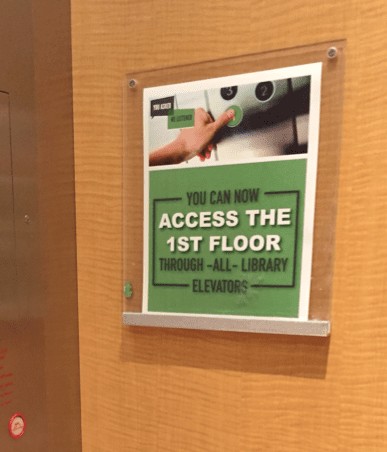
Just removing barriers. Do you see where I’m coming from? [Audible agreement from participants and facilitators.] Allyship in work is removing barriers. Stupid barriers that don’t need to exist that people just didn’t even realize were there because they didn’t see it with the right perspective or the perspective that came from having been challenged in that way.
Here’s a perfect example. When I got to the Library in 2015 people couldn’t take the elevator down to the first floor of the library building from the upper floors. You know, the first floor where there were three campus classrooms and like five learning and tutoring centers. This is now a fading and distant memory, but at my job interview I was like “this is challenge number one for me when I get hired, this is not going to happen anymore, this is awful and we’re going to fix this.” Originally I think the decision was made to restrict elevator access to the first floor out of concern for lost materials, but the argument I and my colleagues tried to make is that a few lost items is the cost of doing business and less important than ease of access. People need to be able to get from the 5th floor to their classrooms and centers on the 1st floor without going outside and walking around to the outside elevator or stairs. What about people who use mobility assistance? How are we treating them? We’re displacing them. So that’s fixed now and people can go straight down to 1 without any drama of being kicked out of the building on the way. That was a big one, and a big win, for me.
So this principle of simply recognizing barriers, removing barriers. Recognizing problems, fixing problems. Problems are not always going to be fixable, but if you don’t try nothing’s going to happen. This is solidarity, this is allyship in work. Same goes with the physical accessibility of our building – it’s not good enough yet, and I’m working on it, and it’s going to get better. I’m working on it in conjunction with something like eight departments across the University. You have to be able to create these big networks of different stakeholders – Facilities, Planning Design & Construction, Human Resources, Disabled Student Services, Title 9. It’s a big undertaking. But again, if you don’t figure out how to find those cracks and paint gold on those cracks and say “this is a problem and we need to fix it,” then it’s not going to happen.
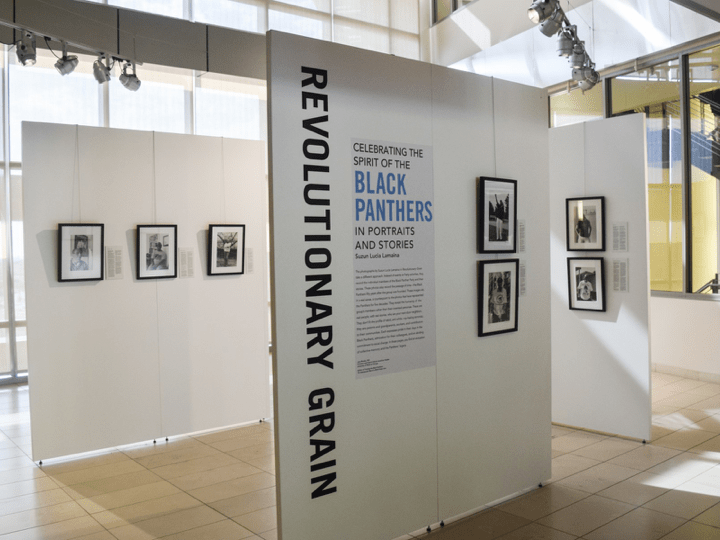
So that’s allyship. It’s about seeing those barriers and taking the time and the energy to make it your job – your actual job – to fix those things. I already mentioned the Context Library series – we have a mission and a dedication in our library to make sure that justice movements are represented and that students of color see themselves in our lobby when they walk in. We organize panels that are amazingly political. Most libraries would be afraid to do things like this. We sponsor the Common Read every year, and without fail the Common Read is voted to be an amazing book. This year Between the World and Me by Ta-Nehisi Coates, last year Sal Si Puedes by Peter Matthiessen. They’re always incredible. Doing this work to lead the community in this conversation around common justice-oriented ideas and narratives. We don’t have to do this work but we do because it’s right and it’s important.
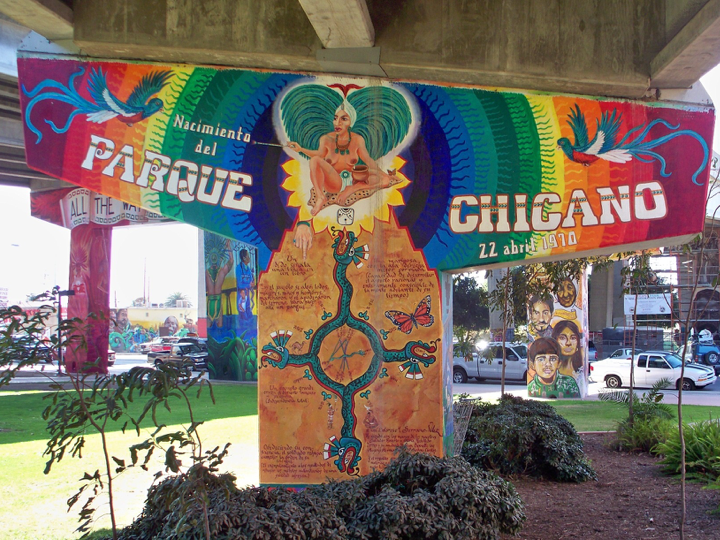
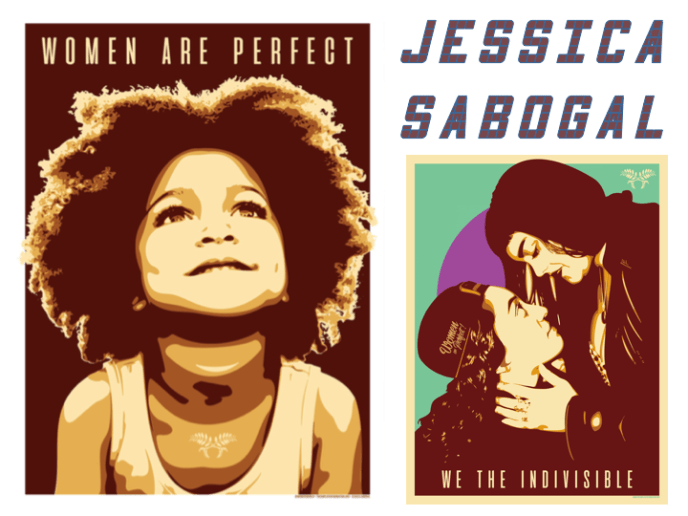
Some other things are underway that you can’t see yet but hopefully you’ll see someday. I’m trying to get some murals painted in the Library, some big beautiful permanent murals to honor the incredible spirit of Chicano Park and the art that’s come out of this county [snaps and applause]. We’re working with a couple of very talented artists on this proposal. Getting public art done is always challenging, but we’re working on it and I hope will be successful. We have to convince people that the risk of this amazingness is worth it. Another friend, and please look her work up – Jessica Sabogal, she’s visionary muralist who has different campaigns, one’s called “Women are Perfect” and another “White Supremacy is Killing Me” – she makes these massive outdoor murals, beautiful representations of women of color in struggle. And that’s what I want in our library and I’m working to make it happen. We’re looking at different spaces in our building, we’re identifying artists who are inspiring, and we’re working through the system to try and get this done.
This is my attempt to say that you can’t always see the work in progress, or the effect, or the outcome. And some things crash and burn, you know, but they’re still worth trying even though they’re frustrating. [Comment from Ariel Stevenson, CSUSM Diversity Coordinator: “And we keep trying anyway.”] And that’s right, we keep trying anyway. Because that’s the hard work, and that’s the love we bring to the hard work from our places of pain and other people’s places of pain. Recognizing them, seeing their barriers, seeing the cracks and the pain that makes them beautiful, and doing what we can to rectify that and to represent the people who are marginalized and oppressed.

Okay. I’m going to leave y’all with a couple of lil’ thoughts, lil’ insights that I feel like I wanted to encapsulate about what being a working ally looks like. And I want to bring us back to this politics of imperfection and responsibility. You see imperfection and it’s your responsibility to do something about it. We’re all imperfect, and it’s our responsibility to work on our own imperfections and educate ourselves and become better allies.
And I think in one’s life you have to focus on what you can affect. Focus on what you can change. If you go too far up and too far out the weight of it becomes crushing. You cannot fix everything, but you can see things in your environment that can get better. You can overhear an interaction, or someone says something offensive, and you can step in and help that person learn how not to do that again. With grace. With grace. Because that’s when things work.

Sing each others’ praises. You’re amazing, let each other know. Identify those amazing members of your communities that are doing good work and doing beautiful work and signal boost them. Help their names get out there, help people know about who they are because that helps them be more successful and have greater impact. Name dropping is the funnest thing in the world – do it.
Here’s one that’s hard. It’s the hardest one of all. Try to humanize your antagonists. Like I said, when I was young and being subject to a lot of violence I tried to understand why it was happening. This is not something you have to or should do if it’s not safe, but you can try to do it if it’s safe for you to do so. There’s a podcast I wanted to mention called Conversations with People Who Hate Me, it’s by this person Dylan Marron, who is a media activist and has other series like Unboxing where he physically unpacks things like white supremacy culture. This podcast is so fascinating, he finds people who have doxxed him online, or given him abuse in social media – I don’t even want to go into what they say – but he’ll identify the people and have long consensual recorded conversations with them about why they said the things they did and do they really hate them and what’s their background. I swear, if there’s anything you listen to this year let it be this. It humanizes these people who have hurt him, it shows you that each and every one of them has pain of their own that’s creating this aggression toward other groups. Invariably these conversations are peaceful and generative. They come to a place of greater understanding.
Finally y’all, believe in resilience. We all have it – we’re all suffused with it. And if you’re in this room, you have more than most people. [Facilitator applause.] Resilience is what lets you continue to be an ally even when it’s hard, even when stuff doesn’t work out. To work in community and believe in the resilience of that community even when it’s under assault, because let’s face it: our communities are under assault and we have to be resilient with one another. And lean on each other and celebrate each other. And try to see what’s behind that antagonism that’s coming at us.
That was my presentation. [Appaluse.]
Question from Diversity Coordinator Ariel Stevenson: So who wants to be a librarian?
Answer from Char: That was my secret mission, to convert all of you. We recruit!
Comment from Floyd Lai: We have a few minutes, I think one of the benefits of inviting faculty from campus to come is for you all to get to know some of the folks that are working and doing amazing work. I appreciate the connection, because now when you walk into the library you might have a very different perspective on what’s happening there. We have about 5-7 minutes if you want to ask questions of Char.
Question: What was that image of the shirt and the heart?
Answer: Ah yes, that’s an image I use in presentations to represent that I wear my heart on my sleeve and work hard. I really do love the work that I do and you have to put your heart into your work or you become a zombie. The day in and day out of administrative work can be challenging, but if you keep focused on that love and that good outcome then it motivates you to continue doing the important stuff and the good stuff, like 24 hour access and helping to solve food insecurity on campus.
Question: You said that there are gender neutral bathrooms now in the Library? Where are they?
Answer: If you’re in the elevator lobby by the Context exhibit space on the 3rd floor, you’ll see a sign that says “gender inclusive restrooms” pointed at a hallway and in that hallway there are three of them. We’re also working with different offices on campus to construct two new gender inclusive restrooms on the 2nd floor as well, because the one thing that the 24/5 space doesn’t have yet is a gender inclusive restroom and that’s not acceptable to me. That’ll happen hopefully by the beginning of next year.
Question: I have a comment about the exhibits, they’re amazing and I loved the one about banned books. Whoever is doing that is awesome.
Answer: Thank you, I’ll pass that along.
Same student: Also, the staplers in the copy rooms are always empty. [Laughter.]
Answer: You’re breaking my heart with that, you know? [Laughter.] It’s literally my job to fix that and I will, I promise. [Note – I’ve since increased student assistant stapler filling from every other day to daily].
Question: You probably already answered this but, every morning when you wake up what is your drive to continue? I know that you want to make sure that there is a change, but some days it’s just like “what the hell, I’m exhausted and I’ve ben fighting these people for months now and they’re still not doing it.” What’s that spark that keeps you going and looking for that light in a dark room.
Answer: That’s such a great question. I give it space. If I have a hard situation or I get a bummer answer to something I’ve been working on, I’m going to let that situation sit there for a couple of days until my spirit heals, and in the interim I’m going to take care of myself, something I can get done, like fill the staplers or something. [Laughter]. You’ve got to give yourself breaks as you’re hammering on this stuff. Take care: rest, rejuvenate, go back to the fight. Rest, rejuvenate, go back to the fight. And I just know that this is all the right thing to do – I would be ashamed of myself if I just let these problems sit there and persist. It is my responsibility and it’s very clear to me. I can’t fix everything, no one can fix everything, that’s grandiosity and it doesn’t work. But if you see a problem, work on the problem. There’s a lot of problems – see it, work on it, figure out how to work on it.
Question: How do you – you mentioned some things about your whiteness – how did you navigate in between those spaces of activism, and knowing when to step up when to step back and when to give space. How did you navigate between those different processes and maybe even pushback from others?
Answer: It’s such a hard question and such a good question. I am quiet and I listen and I learn. I don’t know if this is an intuitive thing or a learned thing, but I know when to keep my mouth shut and I know when to be really loud. I know that I will make mistakes in communities that I am not of. I know that others who are not of my communities will also make mistakes. I have solidarity in that experience of messing up badly. I am willing to have that incredibly discomfiting experience of being taught and being told that I need to learn. For me, in my workplace is where I step up loud and hard and get this stuff done because that is the space that I inhabit on my day-to-day, and I’m in a group of colleagues who are focused on a similar mission. And because I have class and race and positional privilege in that it’s my time to step up and advocate for others. When I’m in other activist spaces, spaces that are predominately POC working on issues that affect POC, I’m much more quiet and I hang back and I don’t jump out and try to say “I’m queer I’m trans, look at me” – there’s no need for me to throw out my oppression credibility every time I’m in an activist space. I did that here because I was asked to, because I needed to. So I try and I think other white folks should try and navigate with grace and humility and care and an utter sharp awareness of what you have, who you are, what you’re comprised ,of and how it affects other people, even without you intending it to. It’s like a sensitivity, a dial. Like a literal environmental sensitivity. I think that social justice activism helps you develop a sensitivity to these dynamics, knowing when to be quiet, go home, read up, and not constantly be asking the people are impacted to tell you what’s up.
Okay, it’s time. Y’all are so awesome, thank you so much.”
This was part 3 of a three-installment series. If you’re just realizing this, go back and read parts 1 and 2.
—
[1] California’s minimum wage is increasing incrementally each January to a living wage threshold of $15 in 2023. Which is a very good thing, and I’ll write about student assistant employment practices/wage justice in a future post.
—
Postscript: I have a new website at charbooth.com for updated presentation, publication, cv etc. content but will keep info-mational active for blog type things.
]]>You can see the full slide deck here, and this transcript begins at slide 23.
allyship, community, and tools for change: social justice summit keynote transcript (part 2 of 3).
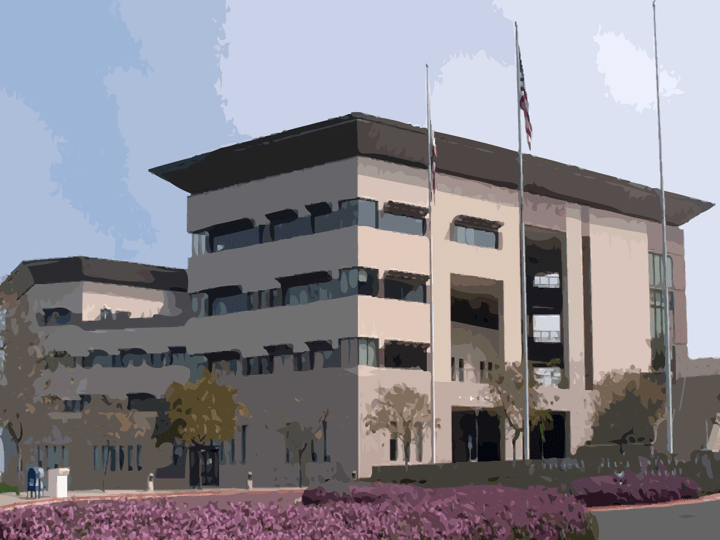
Char: “So, I work in Kellogg Library as an administrator. Social change and social justice are not actually in my job description. So I have to put them in there, I have to make these things part of my day-to-day work and justify my rationale for doing so to the benefit of the institution. My job, in its simplest form, is to make sure people are paid and that our building doesn’t fall over [laughter]. There’s some other stuff in there too, like, being on committees. So I could just do that and we’d have people with paychecks, a library that’s standing, and way less awesome things happening on my watch. I would still get paid the same amount of money, but I’d have no self-respect because I wasn’t using my position to make things better in the world and in my community.

One of the things that I’ve managed to do as an activist administrator is to try and improve the visibility of resources for trans and gender non-conforming people on this campus. Here’s another person I want to call out in my community orbit who does incredibly important art and design work as an activist – Micah Bazant, who created this graphic and is one of the founders of the Trans Life and Liberation Art Series.
When I got to our Library a couple of years ago I noticed that we have three awesome single stall de facto all-gender restrooms on the third floor that just said “restroom” on them. Then I noticed that the door leading back to the restrooms was always closed and locked. And I asked “why is this like this?” “Oh, anyone can use those but they just can’t find them so no worries.” To me, that’s completely unacceptable. So instantly, it’s my job to figure out how to fix that. To get that hallway door unlocked and propped open, get those restrooms labeled as gender inclusive, and raise awareness in the community that they exist.
 So I begin to figure out the different levers I had to pull to make that happen. What activism on the ground in an administrative job often looks like is being able to deal with the minutiae that it takes to make that happen. There’s so many different rules and regulations and groups and people you have to convince and costs you have to pay but if you just keep at it it happens… eventually. Not always, granted, but you can make it happen. So seeing that as a need our organization was not being a good enough ally to trans and GNC people – I saw that because I’m one of them, I didn’t have to be one of them to see it, but I saw it, and I fixed it, and that is a good thing. And every day I try to see something like that and fix it and keep moving toward that goal.
Partly because of this effort I was asked to Chair a campus-wide Trans and Gender Non-Conforming Task Force this last winter. This was an intensive process – we were given about four months to do this herculean task of reviewing the university’s resources and how we can make them better for trans people. Instead of doing your normal, typical “we could improve the bathrooms a bit” or “make that name change thing a little easier” we went for it and tried to encourage the university to comprehensively address all of these issues. I know as a realist that it’s not all going to happen. When these things are implemented, not all the recommendations in our report will be done, but enough of them will be done to have actually achieved change. And while it’s hard as a trans person to be asked to do that work, to be asked to highlight the flaws and the ways you’re oppressed and how your institution could fix that oppression – in this case, I wanted to be the one doing that. Because another administrator who didn’t have the same experience might not know as well where to look for issues and solutions. In that case I felt responsible for being that ally, and recognizing that my position of privilege in the university allowed me to effectively advocate for people like me.

And so that’s one of those moments where I accepted the fact that looking through all these statistics about how much more trans women of color die than everyone else, literally crying as I’m writing this report, that I can take on because I think it will do something. It hurt me, it made me lose sleep, it made me feel pretty awful for a couple of months. But that’s alright with me this time, I made that choice because of my power and positionality in the university. I knew that delegated to someone else, perhaps I and the committee couldn’t have covered the same ground, or that some direct perspective could have been lost. When you’re confronted with the challenge of doing social justice work in the world, of doing this activism which you are obviously willing to do, you have to make calculations about what you can take on and the pain that you’re willing to endure to be responsible for making that change. And it’s not always going to be something you want to take on. And that’s okay.
I’m going to shift gears a little bit and talk about my past. Up til now has been my current story, but I want to go back some years and think about those early cracks, those early hurts that happened in my life and how I’m trying to turn and twist them around. And how I’ve survived that and learned from it and learned to take it forward.

I’ve lived all over the country for what feels like a million different jobs, but I mentioned that I come from Texas (and very much so). Long line of Anglos in Texas: teachers, preachers, and capitalists, basically. I also come from an incredibly rigid gender binary. So that’s my momma – she’s amazing – but that image is the embodiment of the culture I was raised in. Debutante city.
My first conscious memory as a child was realizing that I wasn’t a boy – it’s so vivid in my mind. From that point on, I was about four years old, I never fit this binary mold. I knew that I was different, I knew I was trans. By the time I was twelve I also came out as queer in this small bible belt town, and I endured a ferocious amount of persecution and violence. I was just that kid, I was that one kid that got attacked in that way. I never turned away from my identity, I never backed down from it, and I have the scars to prove it. Those years were so incredibly difficult for me. I managed to get out by the time I was seventeen. I had a couple of teachers that helped me graduate early from high school – kind of like, “you’re going to die, and we’re going to help you so you don’t have to.” This was an incredible privilege. I don’t know why these people did this for me, but they saw me struggling and touched me and said we’re going to work with you on this. Otherwise… [shrugs].
One of the things that I was able to realize throughout all of that torture is that the people who were perpetrating this violence against me were themselves struggling, were themselves victims of poverty and oppression. There is no oppressor without their own story, no antagonist without their own pain. So even at this young age I realized that “I’m a target, but these people are also targeted.” It’s a cycle that goes down, a cycle of oppression.
 So, wanting to escape those oppressions I went to Portland, Oregon. Another aspect of my class privilege is that I got to go to a fancy private school called Reed College. And the reason I wanted to go there was to get as far away as I could from that environment that had hurt me and into an environment full of queer people and trans people that I thought was going to support me. And it absolutely didn’t happen that way. What was so fascinating about this – and this goes back to Frances Lee’s article about fearing one’s fellow social justice activists – is that not every community that experiences oppression is going to be a community in solidarity. And the cycle of oppressions cuts both ways. I went into this queer scene with these people who were mean, and competitive, and judgmental, and shallow, and here I am this person who escaped, literally escaped with my life, and I’m like “how have you not been hurt? How can we not be holding each other up instead of pulling each other down? And that was, maybe more than anything, this may have been the hugest learning moment I’ve had as an activist and as a queer and trans person. That just because people are like me doesn’t mean they’re going to hold me up, doesn’t mean they’re my allies. I had this instant education that allyship isn’t just sameness, allyship is behavior; allyship is grace, and giving space, and holding space, and taking care of each other. We have to. Even as we learn, even as we make mistakes.
So, I graduate from college and I do not like the community I’m in in Portland. It hasn’t done anything for me except for make me feel like there must be a better way to be in solidarity with other humans. And this was a moment in my life that made me realize that you have to search for your support. You don’t just find it magically in your people and the people around you. You actualize that support network and you actualize that support community. You can pinpoint these important experiences – being hurt, being beaten up, whatever – and say, “I’m moving away from that” and then trace each ripple of that movement throughout your life.
Believe it or not, I went back to Texas but this time I went to a city with a little bit better reputation than the one I came from: Austin. And there I decided to go to library school. I’m a worker, I’m a person who loves to work and I wanted a craft, a profession. And libraries are wonderful places, in my mind and in my heart. They’re open to people. I’m going to talk about how this is problematic in a minute, but the upshot is that it’s good work and that’s why I wanted to do it. So I’m in Austin and as I’m learning how to do library work, and I find an actual supportive queer community and trans community full of people with open hearts. And I don’t know why this happened in this city instead of that other city, but it was true. And it opened my eyes to what it means to be in solidarity and to work in allyship and in grace with one another.
Here’s yet another person I wanted to shout out to – Roan Boucher. Dear friend of mine, and an amazing activist with fingers in so many different pies such as the AORTA Collective. This individual taught me to analyze and challenge my own class and race privilege. This individual comes from significant inherited wealth and over the course of our friendship I watched them give away their money to social justice organizations. This was a spectacular act – this person was and is motivated by the desire to make reparations for the funds that were accumulated by their family via privileged access to a capitalist economy. I am in awe of this action.
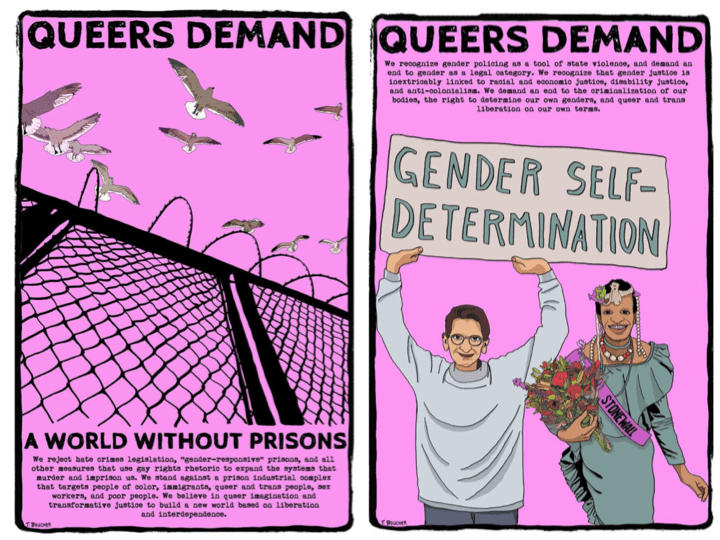
And this person is also a visual artist and helped me gain insight into the language of social justice and into the language of solidarity and be able to develop the vocabulary to express what I saw happening to my community and the communities around me in a way that allowed it to be an active community rather than just this infighting, backbiting style-oriented mess that I found in Portland. That’s an example of Roan’s beautiful art – look it up.
Libraries, as I mentioned earlier, are places for everyone, right? They’re open, they’re public, and the resources are free. This is so great, and it’s the reason I wanted to work in libraries. We actually have a Bill of Rights – librarians are this giant mass of people with principles and bills of rights and so forth, not sure if you knew that. There’s tens of thousands of us in this country, it’s kindof amazing. Our Bill of Rights says that we’re all about access and advocacy and openness and, basically, intellectual liberation. These are excellent ideals yet our libraries are still part of this oppressive society we live in. They are part of the colonialist legacy of this country, and we have to make sure as librarians that our institutions are truly open.

Here’s where this allyship comes into my day-to-day work. This is not about queer people. This is not about trans people. It’s about bigger and harder questions:
- Am I proud of my organization because it is a just organization?
- Is the work I do just, in and of itself?
- Is the work I do helping to address inequality, or is it perpetuating it and just calling itself awesome?
Because that is a big risk. If you have codes of ethics you use to say “we’re so awesome,” are you really? Are you testing that every day and making sure that work is actually occurring?
So one of the things I did in Austin that I think is an amazing project was volunteering with the Inside Books Project, a books to prisoners initiative. This is something I’d encourage those of you who are interested in incarceration and the different reasons why we have an enormous incarcerated population in this country (again, back to white supremacy) to look into. The thing is, because of privatization, budget cuts, and unfavorable court rulings, it’s getting less likely for prisons to be able to maintain libraries with staff and collections, even law libraries. This is a thing, and as a result incarcerated folks are increasingly penned up and trapped with limited access to knowledge building or legal self-advocacy tools – this is inhuman treatment. You can research this – prison libraries are in decline and book banning is a common practice [1]. People are challenging this, but not enough in my opinion.

All across the country there are these projects where incarcerated folks are able to write letters to organizations and request specific books. At Inside Books when I was involved we had this little lending library in a shared space called the Rhizome Collective, and we’d receive thousands and thousands of letters from prisoners across Texas. They’d say “I want a dictionary, I want history about x country, I want some westerns, I want a romance novel.” We’d pull the material from the library, write them a letter back saying “here’s your stuff, enjoy it, write again, this is free.” We had resource guides to put together all this information and make these book deliveries work.
One of the messed-up things is that as we’re sending these books and they’d often get sent right back to us. They were censored, they were rejected by prisons and sent back to us so we were double-charged for the postage. It got to feel like from some prisons that this was a systematic action. These books were being systematically returned to us for made-up reasons.
 What this work showed me, and what this has taught me over my life as a librarian, is that there is such as thing as information privilege. And information privilege is a massive challenge for people who work in information institutions like higher education and like libraries. Information costs money, and if you’re not in school and if you don’t have the money to pay for things like articles, you’re not going to be able to get them. There’s this paywall, this ceiling, that you can’t pass through. The example of prison libraries is an extreme, but we all experience this information privilege to different degrees based on who we are and where we are.
That’s just a reality. And what it’s meant for my life and work in libraries is that information privilege is the thing that I try to fight against in my work. I’m going to give you an example of one of the early ways that this allyship towards people without information privilege played out. I’m then going to talk about how I’m doing that at my library with all of my colleagues, because this is a shared value. This shifts from “I” to “we” in a few minutes.
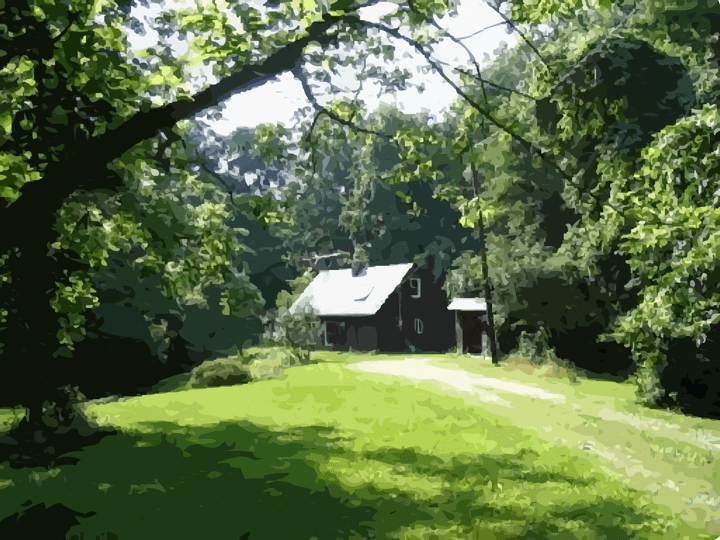
One of the first jobs I had as a librarian was in Athens, OH in the middle of Appalachia. Very rural, white, mining and logging area that had all the mines and logs disappear, lots of intergenerational poverty. I lived in this cabin in the woods by myself, it was so scary. [Laughter]. The first night I made curtains out of sheets to put over these big windows that looked out into the dark woods. I came to love this place, but what I did learn in this experience is that isolation is part of information privilege. And isolation is something that makes activism so hard. There were no queer people or out there in the woods with me – at least not that I could find [laughter]. My closest neighbor was this woman named Linda that I bought my eggs from, I had her on speed dial because she was the cops for me. There were no cops out there, but Linda would help me out if I needed it.
Through this experience of moving away from queer community I learned that I was a bit of a queer supremacist, if that makes sense. I was judgmental of straight people, I was judgmental of cis people, and I realized through proximity to people who were not like that that I had some unfortunate ideas that I needed to challenge. So this isolation was actually a big opportunity for me and helped inform my own sense of allyship and where I was using my arrogance, I had turned my oppression into arrogance and I needed to challenge that.
The reason I raised the idea of isolation and activism is that I wanted to introduce an amazing individual I met when I was in Austin, through Roan actually. This person lived on this radical fairie land trust, had AIDS, and was trying to benefit his health and prolong his life through diet. And so what he did was research different kinds of fermentation techniques and lead workshops around the country in making sauerkraut and kimchee – he wanted to eat fermented foods to help his gut bacteria and help him live a healthier life. He was also a rural person, and it’s a hard thing to be in isolation and sick. So he knew I was a librarian and worked in libraries, he started to ask me for articles – he’d say “there’s this journal called bacteriology of fermentation and there’s an article I need that would cost me like $60 and I can’t get it, can you send it?” And I’d say yes of course, find the article, download or scan it and send it via email, and if I hadn’t done that and if other librarians hadn’t done that for him he’d be in total isolation. Even with the internet he wouldn’t have been able to learn about this thing he needed to learn to heal himself, because he needed in-depth research information from behind the paywall.

Bit by bit we’re giving him the knowledge he needs through these one-on-one allyship connections. And the thing you probably don’t know is that it’s literally illegal for me to scan and send those articles to this individual who isn’t part of my school. Because of that paywall, that thing that separates those with information privilege and those without. How messed up is that? [Inaudible audience comments in agreement that this is indeed messed up]. So enough people broke the law for Sandor Katz that he was able to become the foremost expert on fermented foods, and he published this incredible book called The Art of Fermentation – New York Times bestseller list [laughter] – very awesome, he’s out there in the woods making his kimchee and in his acknowledgments he goes off and narcs all of us. [Laughter]. All of the librarians who sent him materials, he’s like “thank you Char, thank you whoever.” – he of course didn’t know that this was a narc move. It’s just perfect, it’s beautiful. This person in isolation needed information, we acted in solidarity, he outed us but that’s totally cool [laughter] because it highlights the problem here. How many other people are living in isolation and unable to get access to information they need. And is this harming their health?

Here’s where you see allyship in a profession start raising its head. I see these problems as a librarian and it’s my job to fix them. No matter who’s experiencing the problem, no matter if their difference is like my difference, this is now my job to fix. I’ve been using this idea of information privilege to teach students at previous institutions, which was fun and awesome and I’m super bummed I don’t get to do that anymore, but hey that’s okay – using theorists like bell hooks and Paolo Freire to make these ideas real to these learners and help show then that it is their responsibility as a part of these institutions of higher education to take this knowledge they have and share it. And to challenge to structures that make it inaccessible.

When I worked at the Claremont Colleges outside of LA for about five years before I came here, those are fancy private schools and there’s a lot of rich kids there. The way I came at this with them is that you have access to so much wealth, your tuition pays for so much information, and you have to take it and give it to other people who need it – it’s your responsibility. So we’d spend entire semesters writing Wikipedia articles, figuring out ways to make the citations free and linking to them, so that people could download that stuff and it wouldn’t just be trapped in a library that you have to be so fancy to get access to. Again, in institutions where there is a lot of privilege, this work of allyship has to translate to people being empowered to do that allyship work themselves. So I’m not just sitting there sending articles to all the Sandys, I want to make a collective of people who understand that this is something they can do in their lives.”
This is part 2 of a three-installment transcript of a closing keynote I gave at the 2017 CSU San Marcos Social Justice Summit Stay tuned for part 3, and if you’re feeling confused you should probably go back and read part 1.
[1] Bounds v. Smith, 430 U.S. 817 (1977), mandated that prisons provide incarcerated people with access to legal professionals or law library collections – this preserved the right of “meaningful access to the courts.” Lewis v. Casey, 518 U.S. 343 (1996), rolled this requirement back. A discussion of impacts of these cases and other trends in US prison libraries is available in Lehmann, V. (2011). Challenges and accomplishments in U.S. prison libraries. Library Trends, 59(3), p. 490–508.
Postscript:
I have a new website at charbooth.com for updated presentation, publication, cv etc. content but will keep info-mational active for blog type things.
]]>On to the task at hand: jumpstart this machinery while addressing a previously-not-awesome practice of mine. For as long as I’ve been presenting I’ve had requests to share transcripts: if a session isn’t recorded and openly available with closed captioning, my less-than-helpful practice has been to upload/share an un-annotated slide deck sans notes and be done with it. This was largely motivated by lack of time, but it was an accessibility nightmare and not one I want to perpetuate any longer. Moving forward I’ll transcribe the talks that seem worth sharing (and that I remember to record) here at info-mational. I’ll start by retro-ing a couple of recent ones: first the Social Justice Summit keynote I gave at my university in October, and then an OCLC Distinguished Seminar Series talk from November.
social justice summit
Each year, CSUSM’s fabulous social justice centers (e.g., Gender Equity Center, Cross-Cultural Center, LGBTQA Pride Center) and the Office of Inclusive Excellence work together to facilitate a three-day off campus seminar for 40 CSUSM undergraduates called the Social Justice Summit (SJS for short). The event intensively trains students “in a social justice framework for campus leadership, community engagement, and change activism … that creates a paradigm shift in thought and action to attain an equitable society free of oppression.” A CSUSM employee traditionally gives the closing keynote, and I was elated/honored to receive the invitation this year from colleagues I much respect. The prompt I was given by SJS organizers was quite broad, and is featured as the title of my talk: “allyship, community, and tools for change.”

There have been excellent critiques of the word ally of late, particularly by Black Lives Matter co-founder Alicia Garza. These center on the passive nature of the word and the baggage that comes with it (e.g., one can easily claim allyship without taking any action on behalf of oppressed folks, leading to guilt spirals and/or self-congratulatory posturing on the part of the ‘ally’). She discussed this at a recent talk at CSUSM organized by my Library in conjunction with our Common Read program, suggesting “co-conspirator” as an alternative to ally. ‘Comrade‘ is another alternative that’s been discussed as communicating a more courageous commitment toward a liberatory goal.
I fully understand the criticism of ally’s passivity and share it in some respects, but I do think that the focus on action in solidarity from a place of privilege and/or learning is what is crucial to empowering any of these signifiers (and thus toward redeeming the word “ally.”) In institutional contexts such as higher education that feature established hierarchies, structures, and populations, the idea of active allyship, of identifying means in which your organization can act in solidarity with minoritized populations and individuals, is particularly important to explore. Organizations and members of organizations are constantly engaged in the process of institutional ally-building in the more accustomed sense (e.g., toward resource generation, political capital, space development, etc.). The word itself therefore resonates, and so to work toward an active institutional allyship it is essential for us to identify means in which our connections and resources can be used to the benefit of those experiencing oppression within and beyond our walls.
library as ally
Library-as-ally is exactly the critical conversation I wanted to bring to the committed, bright, and courageous students I had the privilege of interacting with in my time at the SJS. As in, can allyship by organizations and individuals achieve real outcomes (even on an iceberg, even with fires)? How I as a person with my own experiences and perspectives try to apply a justice framework to the work of being an administrator at their university, in libraries, and in higher education more broadly. The talk integrates several of the concepts and actions I’ve been grappling with as I attempt to bring an justice-oriented mindset to new work in administration: how identity and experience can inform day-to-day actions that are more socially just, and how to recognize privilege and oppression in a way that supports a generative (as opposed to circular) dialogue and practice of activism within our (or any) profession.
I was at the event for about four hours on the final day, participating in activities and getting to know participants before the presentation. Highly active and peer facilitator/participant driven, the vibe at the SJS was one of intense energy and the (mostly) productive frustration that comes from analyzing power, privilege, and institutional oppression in a marathon setting. At $7 per student it was an incredible opportunity, and from what I observed the Summit is fully on point in terms of content and strategy. As for engagement, participants were deeply committed to doing the hard work of analyzing oppressions and identifying means of achieving progress in their own individual contexts.
Disclaimers:
- I talk fast, so even though the words below are accessible and delivered in a less convoluted and/or highfalutin tone than what comes out of me in written form, this would be a LOT of words for one post. For that reason I’ve broken it into three chunks: Part 1 follows below, and stay tuned for Parts 2 and 3 in the next couple of weeks.
- I spoke quite personally and from the heart on this one, meaning there are facets of self discussed that I’ve not written about in depth professionally before: Queerness! Gender! Hard times and amazing people as a result of queerness and gender!
- I nixed my fill words when they distracted from the content but left things otherwise verbatim. Participant reactions and comments are called out in the text.
- The recording of this one is way too poor to share, but I’ll include audio whenever possible in the future.
- I’ve added images of a few slides throughout, and if you’re interested you can see the full deck.
- I was not compensated for this talk, nor would I want to be – who would take money from these darlings? Not an ally, I don’t think.
social justice summit keynote transcript (part 1 of 3).
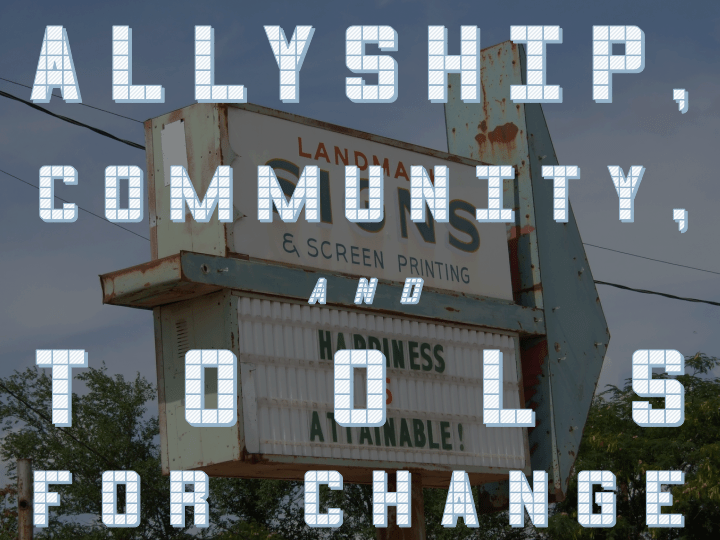
Char: “Alright, thank you so much. [Applause.] I haven’t even done anything to deserve that yet, so I’m out of here – bye. [Laughter.] Thank you for giving me this space and giving me this time to talk with you. Thank you to Ariel Stevenson (Diversity Coordinator), Abrahán Monzón (Assistant Director, ASI Community Centers), Floyd Lai (Associate Director of Multicultural Programs and Cross Cultural Center Director), and Erin Fischer (Graduate Intern for Multicultural Programs) for thinking to invite me to this event.
I do a ton of public speaking in my work, but I can tell you – just in terms of my preparation for this event and being able to be here with you today – that this is the most important talk I’ve ever given in my life, and I’m going to explain to you why I think that is. There are a couple of reasons. I exist on our campus for you, and because of you. Not just because you’re students, but because you’re the students who are committed to doing this incredibly hard work, the work of learning about yourselves and about who you are, and how that impacts other people, and how that can help you make social change. I consider that literally my job at the university and in libraries, to try to facilitate that social change, and I do that work because of you and I’m grateful to you for it.
I also want to acknowledge that I’m a white person in a position of a lot of privilege in this room. I’ve moved through my life in that way. And if there’s one thing that I’ve seen today that I’m disappointed by, it’s that I don’t see more white faces in this room. The demographic makeup of our campus is an incredible thing, and it’s another reason why I’m here at the University. [1] But, social change has to be owned by people who look like me for it to work, and for it to happen. This is not your job, and I’m speaking to all the people of color (POC) in the room. It makes me so inspired that you’re here to commit to this work and doing it yourselves, but it’s not only your job. It’s all of our jobs and it’s more of my job because I’m a beneficiary of what I truly believe to be white supremacy culture. I see it every day. And it’s more my responsibility to fight that and to figure out how to use my whiteness and my power and my privilege and all that comes with it to create change.
So those are few grounding things I wanted to say. I also wanted to say that I see the hard work you’ve been doing. I came early this morning in order to get a sense of the dynamic and what you’ve been talking about. It’s hard to come into a group sideways and just be like “haaay, I’m going to drop all this wisdom and just leave.” [Laughter.] That’s not possible. It makes me a stranger and makes me seem like I don’t know what I’m talking about. So thank you for doing the hard work and having the hard conversations.
I felt the dynamic in the room shift over the morning. There were some really hard interactions, and then by the end of it with this awesome 7 Cs exercise [2] I think folks are starting to feel a little bit more positive and hopeful. Which is in and of itself amazing, given the content y’all have been dealing with.
So, without further ado. I’m a really visual person, a visual thinker, so I use these slides to remind myself what I’m thinking about and talking about. And this image has always stuck out to me a lot in my life. I’m from Texas and I’ll talk a little bit about that later, but there was this one point where I was driving across Texas, West Texas specifically, and I drove through this little oil town – like a ghost town. Literally one stoplight, all these crappy boarded-up buildings, obvious super economic hardship because the oil industry had completely dried up. And I’m going through this one stoplight town and there’s this huge “happiness is attainable” sign on the side of the road. It’s at a reprographics screen printing shop, I can’t even tell if it’s still open or not. And someone had taken the time in this town, with no people and no economic opportunity, to walk up and put these letters on this sign. Right? It’s mind-boggling, I still can’t figure out why this existed. It’s not even a major highway, it’s a little weird road through this dusty down with this busted sign covered with rust. And someone took this upon themselves to make that message in the middle of this context.
It’s always amazed me, and I wanted to include this in this presentation because I think it’s an allegory for social justice activism. To say, look, this is a hard situation. There’s rust on this sign, things are falling off of my building, but I’m still capable of putting this sort of hopeful message on it and try to inspire people – whoever they are – who drive by to hold it in their heart even in the middle of their challenges and destitution.

Another thing that’s weird about this image is that where I am in my life and what’s happening in my life affects how I see it. In this current political moment, which is really heavy, and really depressing, what I tend to see in this sign is “how could someone even think to put that up there? What does that achieve – there’s rust all over it and this town is empty… what could possibly come of this situation?” But that’s part of it. You have to be able to get down and see that degradation and that pain and that hardest, lowest point – which is what I think y’all have done this weekend – in order to be able to say “okay, that’s not all there is.” There’s still the flip side of this message, and that’s where the good, hard work occurs is that individual who’s still able to say “yeah, wow, happiness is attainable in some way in this place.” And maybe we’re not talking about happiness, but we’re talking about impacts, and real things occurring. Real change occurring.
What I’m going to talk about is that change. What I think of allyship, what community has meant in my life, and the tools that can be used in the course of one’s day-to-day existence to achieve social change in, say, in a regular job or in your friendships or families. I’m going to focus on my job in libraries and as an Associate Dean at the university because I think so often this notion of allyship is interpreted as passive, and there are some smart critiques out there about that. But I think allyship doesn’t have to be passive, it can be about action. And you have to be able to perceive the potential actions in your environment, no matter what that is, and then take the steps that are available to you to achieve that change.
So, I’ve got an hour or so. That’s not very much time. It’s an enormous topic and it’s something I think about all the time. I struggled with how to come at these things, and it could take my whole life to explore these ideas with you and to hear from you what you believe of these ideas. Because that’s just as important as me jawing up here. But in order to focus for the next 45 minutes and be able to get anywhere of value, we have to keep asking these hard questions. Over the course of the last few hours I’ve heard y’all asking yourselves hard questions and offering answers that help focus us on that common purpose, that common change and value. Such as:
I’ve heard from a couple of you already why we’re here at this social justice summit. And I’d love to hear a couple more voices because I’m relatively new to this process. Why did you come to this?
Participant: I think social justice applies to every single person. As someone who enjoys being a leader, I think it’s my duty to educate myself so that I can be the change in my community.
Char: That’s great, thank you.
Participant: I thought it was a good opportunity to come and learn more about social justice, and I know some of the facilitators.
Char: So, your community is bringing you here. Awesome.
Participant: When you said by using your privilege or whatever, I agree like it’s not the job of people who are being oppressed to have to change the system, but I feel like I have a responsibility to educate myself and try to make a change.
Char: Thank you, and that’s also a perfect segue to my next slide.  That exact thing is why I do this hard work. There are so many motivations that can lead people to open themselves to the vulnerability of seeing other people’s pain, and the reason that our identities as individuals can cause that pain whether out of our own volition or out of our own intentions or not. We have to be able to see it and do something about it.
 Another thing it’s essential to ask is about the values we share as a community. And for me, as the Associate Dean of the Library, I have to think about this a lot. Because libraries are like mirrors of communities. We’re all different, every library is different and it should be different in the way that we’re paying so much attention to what you need from us as students as learners as faculty – even though you’re not faculty yet, right. [Laughter.] We have to be able to give this back to you in kind, and with a lot of earnestness and with a lot of hope and work. So values are definitely part of the way that I’ve thought about this talk and what I want to bring to the table.
  I already mentioned that I think it’s crucial to think about how being an ally can inform your day-to-day work whether that’s in a classroom, in your family, at a job, in your community. This doesn’t happen up here [gestures at ether above head], it happens on the ground in every interaction you have, in every project you take on, in every single thing you volunteer for or decide not to because you’re tired (and that’s cool). I want to focus in on the idea of allyship being actualized in work. Not just allyship to a particular community or the communities of difference that I come from, which I’ll also talk about in a moment. But, how can we actually take take allyship as a methodology of practice in our professions and in our work.

So I do love my work, I love being a librarian. It’s a profession that’s been very good to me – as a queer person and a trans person I’ve been able to exist in a community of professionals that have not ostracized me. I’ve had my own challenges but I’ve never been sorry that I’ve made the decision to go in the direction I have because it’s enabled me to use my strengths and not be held back by characteristics of that profession that might not welcome me.
I work in a very progressive profession that has radical elements and fringes to it, and I’m very much a part of those radical elements and fringes. And I’m grateful to that world for allowing me to exist within it. That was a conscious choice I made and a choice that used my privilege. I wanted to do good for the world and I also wanted to be able to thrive and not have to struggle to justify my existence, rather to focus on the real work if that makes sense. So, that is a challenge that confronts all people who come from backgrounds of difference is: do you have that agency to be able to make such a decision about where you’re going to put your efforts and what they’re going to achieve? I did, so I have a heightened responsibility to advocate.
I wanted to make an allegory in this presentation that is essential for activism and what it looks like in day-to-day life. I’m blessed to be part of a big talented community of queer and trans activists. Artists, people who do direct action, people who fight so many different kinds of oppression from places of utter devotion to their work. And I value this community more than anything because it educates me and informs the way I approach the world. It educates my experiences and how I can translate them to my own life and practice. And, it gives me awesome examples to be able point to in order to make connections between ideas and actual practice.

One of the activists in my life, a beloved old friend of mine, name is Pascal Emmer. He’s been engaged in HIV/AIDS activism and other social activism for a long time. He’s also a ceramicist, so he’s an artist and he does activism – there are multiple facets to our experience and these two are a particularly excellent combination. He made this beautiful piece once, this amazing difficult thing – if you know anything about ceramics you know that this kid is a genius. But, it exploded in the kiln. He’d put countless hours and weeks of work into this beautiful thing and then he fired it and it shattered into pieces. However, he knew of a ceramics tradition of Japanese origin called kintsugi, described as “the art of embracing damage.”
 In this tradition, when you have a piece that shatters you fix it back together and accent the repairs with gold. You highlight the flaws. And you want to highlight the flaws, because the flaws are what is beautiful, most beautiful, about this piece. You’ve taken a broken object, you’ve reconstituted it, and you’ve said I’m not hiding these cracks, these flaws, these are part of this piece and they make it what it is.
This is absolutely what being an ally is about. Being able to see other people’s cracks as beautiful difference, and being able to take the things that hurt and harm us as people of difference and harden them as strong points in our character. And take those experiences and not only feel wounded by them, but be able to learn from them and derive from them the power that we need to advocate for ourselves and to advocate for other oppressed people. This is certainly true in my life and it’s true in a lot of the lives of those around me who come from oppressed backgrounds who have managed to survive. They do this – they paint the cracks gold and they show them off to other people in different ways.
I read this article recently by an activist named Frances Lee. It has a clickbaity title and I’m going to tell it to you in case you want to read it: “Why I’ve Started to Fear my Fellow Social Justice Activists.” I can make a pretty good guess that this author didn’t necessarily want to give this article this title, they probably had to do it to get published. [Laughter]. This article is not about how social justice activists are scary, it’s about how our collective and individual pain can inadvertently create a toxic call-out culture that ends up hurting out own movements and our own communities. Through basically not being able to see and recognize and acknowledge that people have to continue to learn over the course of their lives, particularly in activist communities, and that those people still need to be embraced and drawn in and given the chance to learn and grow. The author calls our attention to an idea that can help confront this: “the politics of imperfection and responsibility” [3]. 
I love this. Right? We are all imperfect and we are all responsible for helping others heal their own imperfections and for healing the imperfections we see in the world around us. This is an individual responsibility looking in, and a collective one looking out.
I already talked a little bit about my positionality in this room as a white person, as an administrator at the university. We have lot of employees and as an administrator I have implicit power over many one of these individuals within an established structure. I am not a hierarchical person, but that is my reality, and I have to be very careful how I use that positionality and power in my organization – everyone does. And this is the same for any structure in the world, any society. Relative to who I am and my makeup and the experiences that have informed my life, my position is different than your position. This is one of the ways I inform myself about what allyship looks like and how power works.

Same with privilege. I’ve had a lot of hard experiences and I’ll go into more detail about that – not too much detail, because, you know – depressing. I come from a middle class background in a white area of Texas, and I had a lot of class and a lot of race privilege. And I recognize that every day, and I benefit from it every day, and so I do a lot to give that money away and to give that back and to try and work toward for some sort of change. You can’t just acknowledge privilege and walk off humming a tune. You have to give it back or you’re not helping.
Same thing with intersectional identities. I’m a queer person, I’m a trans person, and I had a hard first 17 years of my life or so. Not that it got all easier after that, but I went through some stuff. Yet, that “stuff” I was able to escape because of my class privilege and because of my whiteness. And I know that, And that increases again my allyship responsibilities. To be able to say “it gets better… for me,” but it doesn’t get better for everyone.
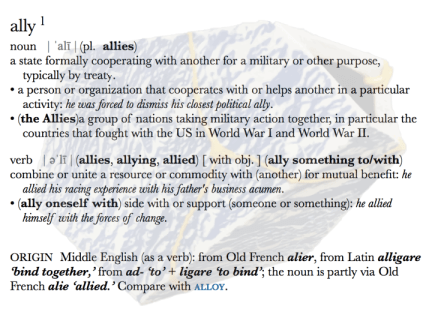 To be allies, we have to understand each others’ stories. We have to see each others positions, privilege, experiences, the hard things that have happened to us and the hurts that we have created and/or endured in our lives.
And I love the narrative of stories that y’all are working with – moving past the single story. For the rest of this presentation what I’m going to do is tell you a couple of stories about my experience making allyship real, and how what has happened to me in my life has strengthened my perspective of what allyship and community means, and how change can actually come, however daunting this moment in time is. We’re in an incredibly fraught moment in time. There are horrible things happening, violence every day, violence to my community, violence to your communities. And it is so distressing. But, if you focus only on that distress you’re going to despair – solely despair. So let’s celebrate our golden flaws together a little bit today.”
This is 1 of a three-part transcript series from a closing keynote I gave at the CSUSM Social Justice Summit in October of 2017. Stay tuned for Parts 2 and 3.
—
[1] CSUSM is extremely culturally diverse and over half of our students are first in their families to attend college.
[2] The “Social Change Model of Leadership Development” is presented by Astin, Helen S. and Alexander W. Astin in their A Social Change Model of Leadership Development Guidebook Version 3 (The National Clearinghouse of Leadership Programs) 1996. Used extensively in higher education leadership, Astin and Astin developed the model at HERI the (Higher Education Leadership Institute) at UCLA in the 90s. Also known as the “7Cs” of leadership development. See the 3rd edition of their Guidebook, shared in full text via HERI’s site, which I assume was an intentional/legit decision. You can find concise examples of how the model is applied in contexts similar to the SJS here and here.
[3] From Why I’ve started to Fear My Fellow Social Justice Activists by Frances Lee: “I have been mulling over sociologist Alexis Shotwell’s call for the left to adopt a “politics of imperfection and responsibility” as one way to move forward toward action and away from purity.”
—
Postscript: I have a new website at charbooth.com for updated presentation, publication, cv etc. content but will keep info-mational active for blog type things.
]]> The concept of information privilege situates information literacy in a sociocultural context of justice and access. Information as the media and messages that underlie individual and collective awareness and knowledge building; privilege as the advantages, opportunities, rights, and affordances granted by status and positionality via class, race, gender, culture, sexuality, occupation, institutional affiliation, and political perspective.
In an extended period of relative disengagement with writing I have started and stopped and restarted this post so many times that it’s become a bit ridiculous, but based on the interest generated by discussions of information privilege in my teaching and speaking contexts it’s clearly time to finish. An approach that’s guided my own work for some time, I explored this framing of information literacy in depth in a closing keynote address (see video and slides) at the 2013 Digital Library Federation Forum in Austin – easily one of the most satisfying talks I’ve given to date. Grounding my argument was the idea that information (and all) privilege must be recognized and challenged by those working in libraries and allied fields as problematic, and used as a guiding principle in the design of resources and methods that combat the division between those who can and cannot access what we create and curate.
information privilege in practice
A powerful example of the importance of circumventing information underprivilege in my own career came in the form of a friend of friends who made an avocation of traveling around the country leading workshops on fermentation, with a profoundly evidence-based orientation to the work. He lived in an isolated rural location without recourse to the research base he needed to inform an ongoing writing project, and so reached out to librarians and others with the necessary credentials to help him secure obscure articles from back issues of scientific journals. This content would have translated to untold thousands of dollars if he had followed the traditional routes available to him, and if those contacted for off-the-grid support had not taken the time to do him a series of modest solids he would not have been able to produce this amazing, best-selling fermentation bible.
For the institutionally unaffiliated and indefatigably curious this is a commonplace scenario, and librarians and other information professionals are best equipped to shift the dynamic towards a freer flow of knowledge unattached to markers of access privilege. Who among us has not had a similar experience and responded in kind? Our responses take institutional as well as individual forms – consider Radical Reference, Creative Commons, the Open Access movement, and countless acts of community support and defiance that attempt to liberate constraints to informed inquiry in spite of the potential consequences.
Any type of information worker can examine this phenomenon and develop strategies to counter it. Based on my educational orientation to librarianship I most often approach information privilege in teaching and learning scenarios, and in practice it is the most effective framework I have identified to engage learners and collaborators with a wide range of skills and perspectives that constitute (critical) information literacy. Presenting information literacy through a lens of privilege problematizes and connects individuals with what can easily become a worn, procedural, and overly didactic series of concepts (worse: tools). More importantly, it exposes the fallibility of assumptions about information and its ecology, identifies hidden injustices, encourages more open forms of participation in a knowledge polity, critiques the information-for-profit imperative, and demands the examination of personal and institutional privilege within scholarly (and not so scholarly) communication.
information privilege as pedagogy
A growing focus on critical and feminist pedagogies[1] in libraryland combined with the prevalence of threshold concepts in ACRL’s information literacy framework revision[2] creates the potential to connect our conceptual base to powerful dialogues across other fields of inquiry. Challenging unquestioned and entrenched social and structural systems through information privilege thus becomes a library application of feminist and critical pedagogy, and an on-the-ground means of encouraging IL threshold experiences among our learners, educators, and colleagues. Considering inquiry, evaluation, attribution, communication, and authority and other facets of information literacy through a critical lens has the potential to build important connections to larger frames of understanding.
It is important to share additional background on underlying ideas that can inform an educational orientation to information privilege. Feminist pedagogy attempts to expose, critique, and flatten power-based learning, gender, and social hierarchies, while the closely related construct of critical pedagogy seeks to disestablish ideological systems that oppress and repress. Critical and feminist positions play out directly in learning interactions by challenging behaviorist and cognitivist assumptions of authority in teaching, extending their critiques of social and power dynamics to learning spaces. This results in a far more revolutionary classroom ‘flip’ than its oft-discussed technological counterpart: learners become facilitators in the sense that they are challenged to enrich educational spaces in pursuit of critical insight into the systems that surround them.
In the simplest terms, we are critical educators when we compel ourselves and others to think about power and privilege, and we are feminist educators when we dig beneath the status quo of our content and identify justice-focused approaches to engaging learners in a process of safe/radical self- and system-examination. These are beautiful ideas, but like any theory they can feel detached from immediate practice. Rather than adopting a completely new set of beliefs and approaches, implementing information privilege as an element of library discourse can be as simple as examining how you understand and approach information literacy, and identifying ways to explore underlying assumptions in dialogue with learners and/or colleagues in order to encourage this process of questioning more broadly. A few examples from my own experience follow.
scaling the paywall
This semester I’ve been lucky enough to collaborate with a fabulous Pomona mathematics professor, Gizem Karaali, on a new first-year seminar course called Education and its Discontents. My role in this course ranged from contributing to the development of the syllabus to co-facilitating discussions as well as workshops related to specific research-based writing assignments.
I am not often able to embed with a group of students to this depth, and combined with the subject matter this context offered an opportunity to examine information privilege as a process of inquiry informed by social justice and as an applied critical pedagogy. Several early weeks of course readings were devoted to critical/feminist/progressive theorists such as bell hooks, Paulo Freire, and John Dewey, which provided a foundation of questioning privilege and the role of education in liberation, anti-racism, and fostering functional democracies. Listening to students grapple with education from perspectives in conflict with their personal experience as learners has been fascinating, especially so in a seminar environment that encouraged all contributions as valid to discourse by a professor likewise engaged in a process of self-education about the subject matter (embodying critical and feminist pedagogy, in other words).
hooks and Freire provided a perfect segue to our first IL-related workshop, which I opened by challenging the fallacy that information is free by diagramming the library’s multi-million dollar materials budget against the “open web,” then facilitated a discussion about the implications of a system in which significant areas of knowledge are available to a privileged few (e.g., them). This may seem like a counterintuitive approach, but among my students it was a literally jaw-dropping illustration of a paywall that none of them knew existed. Choice responses (mirrored in other classrooms where I’ve used this approach) included:
“Why in the world does it cost so much?”
“It doesn’t make sense!”
“You mean all libraries have to pay like this?”
“Why can’t we use this stuff after we graduate?”
And so forth – this is a perfect illustration of a threshold concept at work. Problematizing assumptions about information access isn’t really possible without examining the profit drivers that exist beneath the mechanism of scholarship, which opens topics ranging from open access to privacy to intellectual freedom to the digital divide – all easily identifiable incarnations of information privilege in lived experience. From this point in the workshop, discovering and evaluating scholarship in support of an assignment took a very different tone, undergirded by a sense of responsibility afforded to students by their own institutional privilege. Call it information gravitas.
wikipedia as participatory action
I have long held the opinion that far too much student work disappears into a sort of curricular black box; learners in higher education are typically asked to create isolated products meant not to inform but to mimic a scholarly conversation going on somewhere just above their heads. One facet of challenging information privilege is involving students in a process of leveraging institutional resources to create products that contribute to a broader public discourse (as opposed to ending up in recycling bins and/or behind closed institutional doors). In its dual role as public knowledgebase and lightning rod for skeptical scholars, Wikipedia provides a touchstone for conversations about accuracy and authority and a means to engage students with these questions in their own work.
In Spring of 2014 I had the pleasure of watching the most recent crop of student-created Wikipedia articles come to fruition in a long-running course collaboration with my Claremont Colleges Library colleague Sara Lowe and Prof. Amanda Hollis-Brusky of Pomona College. The articles, all expanded “stubs” from the Wikipedia Politics portal, were painstakingly crafted through multiple rounds of feedback in the most intensive and effective information literacy assignment I have ever had a hand in designing. The LA Times did a wonderful student-focused write-up of this and similar projects this summer, and I’ve discussed the Wikipedia collaboration several times before as well. I encourage you to take a look at the assignment structure via our Wikipedia Education Program course page. These articles have been viewed hundreds to thousands of times since their completion:
1 – FairVote
4 – Consent decree
5 – Bob Jones University v. Simon
6 – First National Bank of Boston v. Bellotti
The reality of a reading public predominantly without institutional entrées makes Wikipedia-based assignments excellent fodder for engaging information privilege, not to mention strong motivators for the production of quality work. The power of this process is the mind-bending leaps students must master to do it well, including “neutral” and non-argumentative writing, rigorous and impartial substantiation, coding, OA sourcing where and whenever possible, and group content creation. To get a sense of the rigor that we expect of these first and second-year students, review the reference list on any of the articles, where you’ll see a breadth and depth of sourcing unusual even for advanced undergraduate research.
The Wiki Education Foundation is supporting these course collaborations to improve Wikipedia through student brainpower and institutional knowledge access, a smart move in a concerted effort to sharpen and deepen Wikipedia’s collective knowledgebase. Wikipedia editing is only one way to encourage students and faculty to produce participatory work that leverages paywalled information resources for the public good – encouraging capstone and other student project uploads to OA repositories is another (see 1 and 2 for more on this).
working through information privilege
Questioning underlying assumptions takes effort, but effort is far more compelling than internalizing and reproducing obligatory tasks. Due to prevailing cultural and media narratives, information is far too easily seen as universally accessible until its nuances are critically examined. By encouraging learners to wrap their minds around information imbalances from personal and relative perspectives, I have observed a greater sense of responsibility toward the effective application of IL concepts, as well as increased insight into the importance of open access.
At their best, libraries are an institutional form of social justice that equalize information availability and provide safe public space for learning and doing. At their worst, they perpetuate inequities and apportion resources among the intellectually sanctioned. In an increasingly activist profession, working with a recognition of information privilege can motivate those of us who labor to preserve access to information to take steps such as challenging draconian licensing agreements, moving accessible and usable design to the forefront of development processes, and supporting students, scholars, and all others identify strategies to circumvent their barriers (known and unknown) that keep certain ideas trapped behind paywalls or impenetrable design. It’s my belief that this ethic can and should support libraries in our fight to remain relevant at one of many pivotal moments in our trajectory.
Perhaps the best way to confront information privilege is to work from an understanding that it undergirds the efforts of libraries and wider knowledge production. If you seek to address structural information inequities, it is essential to develop a professional value system that perceives and opposes injustices not only within our institutions, but beyond them. In this sense information privilege is not just about asking our students to examine themselves and their position behind the paywall, it is about informing the way we collaborate, design, manage, lead, and advocate. For most of us, this will mean examining our own privilege and how we have been teaching and working in information contexts thus far. We can begin by asking ourselves simple questions – how do I approach access and authority in my practice? Do I broach subjects like inequity or justice? What can I do to develop a more open sense of access?
As always, onward and upward.
[1] See Accardi, Drabinski, & Kumbier (2010); Elmborg (2006); and Accardi (2013).
[2] See https://acrl.ala.org/ilstandards/?page_id=133.
—
Many thanks to Lia Friedman for her limitless editorial acumen.
]]> First confession: my library bought Google Glass about six months ago. Second confession: I have, shall we say, a conflicted relationship with Glass. Third confession: although my intrepid colleague and collaborator Dani Brecher and I just published a piece on the program we’ve developed at Claremont, I have strenuously avoided writing about it in this more personal venue. Fourth confession (more like revelation): our user community is seriously into the technology. This post is my attempt to reconcile these confessions.
fraught process
Google Glass has gotten a ton of press spanning from rhapsodic to horrified to hilarious, so I won’t rehash beyond a few basics: it’s a wearable smart device that sits on your face and projects a tiny screen slightly above the horizon-line of your right eye. It’s controlled by voice, touch, and gesture, and desperately requires a data connection to function properly due to the extent that it relies upon the cloud. Its inherent memory capacity is limited (12 GB), and its core uses are documentation (photo/video/audio), navigation, communication, and modest augmentation of reality. This infographic sums it up well.
My subjective reaction to Glass when it was released was similar to what I experience with most proto-technologies: interest in implications and functionality mixed with skeptical vexation about various design and implementation factors. In this case, the latter was directed toward Glass’ corrective vision incompatibility (since addressed with the release of prescription-ready frames), cost (circa $1600 retail and perhaps a tenth that much to make), the limited scope of its availability (not to the hoi polloi until just yesterday), and the disconcerting sociocultural, physiological, and privacy connotations of face-bound wearable technology (legion). Wrap this up with the inevitable mental projection to the time in which we will all look back on this particular model as though it was an Atari 64 (relatively soon), I did not feel the slightest bit of desire to own a pair[1] of Glass. Despite these compunctions, I also recognized the practical affordances of a device that allows for hands-free and connected visual engagement with experience – from the perspective of an educator, applications in teaching, learning, coaching, tutoring, exploring, and reflective practice are most interesting.
Needless to say, I found myself pulled in several directions late in 2013 when I received an Explorer invite from a librarian who had created a Glass program at the University of Colorado at Boulder Libraries, which has provided much of the inspiration for our own. Because of my complicated feelings toward the device and memories of ill-fated technology programs past, I chewed on a strong sense of distaste at joining the hordes that either covet or flaunt Glass. While I certainly didn’t want Glass for myself, I had to consider whether my organization could figure out a way to make it useful and used. Pressured by a two-week window in which to make the purchase (a brilliant hard sell technique), after some lightning processing and community polling Dani and I proposed a Glass lending and demo program. We were met with an organizational mixture of enthusiastic support and (mostly) reasonable resistance focused on cost and dubious local use cases, including the most thorough mansplanation I have ever received on the intricacies of the hype cycle-nee-curve, which, of course, I had never heard of.
not so much, but maybe a bit more.
I well understand caution, but I also believe that the partialities of myself and others should not guide decisions about what to make available to those who use our libraries. Rather, our decisions should be directed by a balance of informed and democratic pragmatism. My institution is privileged enough to be able to give our community the ability to imagine/test academic applications of this particular wearable technology. I am a believer in the notion that with privilege comes responsibility, so creating an open environment in which my community could test Glass while engaging in critical discourse about its broader implications was an important component of this decision. Ultimately the powers that be supported this notion (thanks, powers!)
Our Glass program is simple. We had about two months of hands-on demo/discussion workshops followed by short loans to IT departments around the Colleges and in-class uses by faculty, and have now opened Glass to 5-day lending to students, staff, and faculty via an online application form. There have been a couple of awesome stories in student (1 and 2 in particular!) and also campus venues, and so much demand has resulted that we justified buying a second unit on Google’s recent limited Glass public release day. The C&RL News article has more details on program specifics, if you’re interested.
Judging from workshop discussion and borrower feedback, user reactions to Glass are wildly varied. There is a shared perception that the technology is a true innovation, but also one that it falls short of expectations and has a number of design flaws. There is also a phenomenon of rampant Glass selfieism – people seem to really want to take photos of themselves wearing it. Here are my own impressions of Glass through experience largely in testing and teaching contexts:
1 The physical experience of this design is unpleasant for me, as in uncomfortable. Plus, I see a pronounced retinal afterimage of the screen and my eyes feel pulled a little crossways after I take it off.
2 I don’t love the various control methods, as in talking to myself, whapping/stroking at my face, and whiplashing my head up and down – additional ocular and voice control would be more graceful and far less embarrassing. As opposed to gesture control, which, as demonstrated in this app developer’s video (which is most definitely not a parody), could lead to forceful interventions.
3 I wish it did more. From the perspective of people developing apps for Glass and those making it useful in their own contexts I can see tantalizing potential radness, but it’s still limited for the majority.
4 Glass doesn’t let you log into dual-authentication wireless networks, as in the things most campuses have. Duly reported.
5 Battery life barely lasts through a hands-on workshop, and Glass gets very hot when heavily used.
6 When I started testing Glass, unbeknownst to me it began uploading all of the random pictures and videos I was (accidentally) taking to my Google+ account, which had very open (default) privacy settings enabled. I don’t really use Google+, which meant that this unknown Glass activity led to hilarity and embarrassment (thanks for the heads-up, Jenny). You intensely sign in to all things Google when you wear Glass, and there’s no avoiding it unless you closely manage settings and/or apply obvious workarounds (as in, creating a ‘mothership’ Google identity for an institution or another Google ID).
7 Extreme sports might sell, but Glass is by no means indestructible. I’m hard on things and I obviously can’t take it in the ocean like I might other capture tools. Then there’s this: “Oh, you broke it skydiving/mountainbiking/stuntflying/basejumping/pythonhandling like in our promo videos? Well, you can buy another for $1600 via our special one-chance replacement offer.”
8 Glass’s voice recognition technology is generally impressive in terms of its accuracy. That said, it picks up environmental noise – as in EVERYONE’s voice – and sometimes doesn’t work so well with heavily accented or slurred English. This leads to more hilarity and belies the assumption that Glass is trained to recognize a specific individual. Here’s a choice example of Glass garbling from one of our workshops, in which I sent Dani (or should I say daddy) a test email…
Of course, you should douse these opinions with plenty of salt: our campus users tend to be most enthusiastic, even when they pan Glass’ lack of current utility and social awkwardness. Loan applications have been super interesting and varied – for example, Tracy Seipser of CGU went on an epic Glass testing adventure, complete with a documentary of her woodwind group and guided gallery tours – take a look at the Prezi she developed to chronicle her process.
interest trumps aversion.
I have a bit of a history with developing tech-based programs that end up crashing and burning, which is fine by me in the end: one learns a great deal from sifting through the wreckage. When you accumulate experience with emerging tools, a layer of scar tissue (otherwise known as ‘character’) cannot help but build, making one cautious about the equation wherein Library X immediately buys/develops/subscribes to Shiny Gadget Y and attempts to reactively justify the decision rather than apply it to the greater good. With this caveat in mind I truly believe that fortune can favor the brave, especially when the brave are mindful of their impact on others.
Despite initial concerns that we might have purchased an expensive nose-weight, user reception has totally allayed those fears. Interest in our community is clearly based on a powerful confluence of scarcity and curiosity. Our workshops have been packed and highly engaged, and have worked well with a respective good-cop/bad-cop dynamic between Dani and myself that has allowed for an honest critical exploration of Glass’ (dys)functionality. Practical ideas for use in an academic context have flourished through user applications and discussions – everything from a reflective teaching tool (capture your teaching experience and review later, or ask a student to do the same) to reducing documentary discomfort that consenting subjects (particularly children) in educational, psychological, anthropological, and sociological research scenarios feel when they are aware of being filmed. And on and on.
The lending and discourse aspects are key here – instead of reserving the tool for our own explorations, we’re attempting to make access to and discussions about Glass meaningful beyond a fad sense. What is clear is that in a limited access or high expense scenario, creating a program that engages both the critical and applied nature of a tool like Glass has the potential to be successful.
anomie v. engagement.
Glassholeism is a thing, and I personally don’t want to go there. I have friends battling the creeping gentrification effects of Silicon Valley on communities losing the purchasing power to pay their rent, let alone walk around carrying on a public/private conversation with a tool of dubious current practicality. And I very much support them.
That said, providing access to a technology is not the same as advocating for it (an important lesson for alpha cynics like myself to remember, particularly in a library context). I don’t personally support everything we offer on our physical and digital shelves, so why should I expect to feel the same way about the tools we provide to our community? Through our inherent ingenuity, humans translate the objects in their environments to nefarious and glorious ends. And the interpretation of those ends is entirely dependent on another human capacity: perspective.
To fulfill their missions, libraries inevitably give their money to questionable sources depending on your particular POV. Like many other expensive things in this world, Glass is limited to a very, very few. As I see it, when libraries purchase and distribute Glass we’re helping make access more egalitarian, which is what libraries are all about. And most importantly, we’re trying to making sure the libary is reflecting its core responsibility as a consumer and purveyor of technology: enabling others to access and understand what they might not otherwise, whether due to cost factors or the fine line of interest that, when uninformed by direct engagement, usually tips toward -dis.
in sum
When we ask classes and workshop participants, “is Glass worth it?”, we get a resounding chorus of “not yet, not for that much” – a few have said they’d buy Glass it for about the same price as an iPad, about a third of what it now goes for. But when we ask, “are you glad we bought it?”, there is an equally resounding chorus of “totally.” Without exception, people have been appreciative of the opportunity to, for lack of a less puntastic phrase, see Glass for themselves.
I don’t love Glass, but I get it. Many in the profession are doing amazing things with Glass, and I stand behind our and other libraries’ plans for helping people explore emerging tools in the way we have for millennia with more conventional materials: by offering the fairest and most clear-eyed access possible and leaving the interpretation to the user. Interest in Glass will inevitably wane and our version of the technology will obsolesce, leading to a reevaluation of the utility of the program in its current form. But that’s the nature of the curve.
—
[1] Unit? Device? Pair? Contraption? For the sake of avoiding repetition, I will use the first three interchangeably.
—
Endless gratitude to Dani Brecher and Lia Friedman, who helped kick this post into shape: I’m picking out a Thermos for each of you.
]]>
Lovely, no? Clean, clear, and comfortably confining. Not only that, but a satisfying legitimate excuse to use a papercutter or other sharp object. Have at it!
PS Many thanks to my colleague Natalie Tagge for finding the original full page version somewhere in the depths of our office suite and passing it along.
PPS More writing soon, I promise.
]]>“ONE DIVA, ONE MIC Please, one person speak at a time. (It can also be useful to ask people to leave space in between speakers, for those who need more time to process words, or are less comfortable fighting for airtime in a conversation.) NO ONE KNOWS EVERYTHING; TOGETHER WE KNOW A LOT This means we all get to practice being humble, because we have something to learn from everyone in the room. It also means we all have a responsibility to share what we know, as well as our question, so that others may learn from us. MOVE UP, MOVE UP If you’re someone who tends to not speak a lot, please move up into a role of speaking more. If you tend to speak a lot, please move up into a role of listening more. This is a twist on the on the more commonly heard “step up, step back.” The “up/up” confirms that in both experiences, growth is happening. (You don’t go “back” by learning to be a better listener.) Saying “move” instead of “step” recognizes that not everyone can step. WE CAN’T BE ARTICULATE ALL THE TIME As much as we’d like, we just can’t. Often people feel hesitant to participate in a workshop or meeting for fear of “messing up” or stumbling over their words. We want everyone to feel comfortable participating, even if you can’t be as articulate as you’d like. BE AWARE OF TIME This is helpful for your facilitator, and helps to respect everyone’s time and commitment. Please come back on time from breaks, and refrain from speaking in long monologues… BE CURIOUS We make better decisions when we approach our problems and challenges with questions (“What if we…?”) and curiosity. Allow space for play, curiosity, and creative thinking.”
Among other things, they share strategies for not letting non-inclusive practices creep into meeting spaces. Most, if not all, of this content can be directly translated to teaching spaces, wherein elevating the learner voice to the same plane as the educator’s is central to a more critical and feminist pedagogy. Similarly, I find that many strategies that enable strong public speaking can support facilitation, as in all of these it is important to remember that the focus should be on the collective, not the individual. Case in point, you’ll notice that AORTA’s list puts equal emphasis/responsibility on participants. Moral + rule five of facilitation: it’s everyone’s job. For the introverted among us, it can be easy to withdraw and over rely on the person nominally in charge (who can without exception use our support in making things run smoothly). Dissociating, working excessively on a device, basking smugly in the relief of not being on deck, and/or withdrawing into nervousness are tendencies to be challenged. Moreover, if they are an passive or active protest measure against an individual, initiative, or organization (betting we’re all guilty of this from time to time), the underlying issues behind this unproductive behavior can and should be examined and confronted with skillful and intentional means. Thanks again to AORTA for developing this toolkit, and I encourage you to avail yourself of their services as a measure of gratitude. Similarly, Roan’s beautiful artwork is available on Etsy. As always, onward and upward. — Post-script: Did you make it through this post? Claim your bitter end badge. And gratitude to Lia Friedman for her endless editorial acumen.
]]> I am in the position of talking at people in formal settings far more frequently than I ever expected, as a teacher, facilitator, panelist, and/or speaker. One thing I have come to know is that just as one can cultivate a healthier relationship to the certainty that life ends, so can one develop an easier co-existence with the complex (and not altogether unpleasant) sensations of being in front of an audience of one or one thousand.
I won’t downplay the anxiety that attends public address, nor its incredible array of physical and psychological symptoms: hyperventilation, nausea, panic, compulsive movements, speech fillers, rapid heartbeat, mania, and dissociation (or all of the above, for the very unlucky). I have experienced each in my turn, often in diabolically unpredictable combinations. I have also discovered (adage alert) that their severity decreases as experience increases.
Unfortunately, alleviation does not often lead to eradication. Managing the manifestations of fear is crucial to becoming a decent public speaker, but it is only one aspect of a much larger enterprise: communication skill and information design are just as important. You have to work at all of these things, as well psychologically reorient youself to being the subject of an audience’s attention.
adviceorisms
I’ve benefited hugely from the suggestions of others (solicited and unsolicited, anonymous and identified). I tend to ask people to write down takeaways or suggestions after my talks, and I once received a scrap of paper that said simply “bigger is better, less is more.” This cut directly to my two most persistent challenges in presentations: far too much content, and migraine-inducing font sizes. Since reading the note I’ve used it as a mantra… belated gratitude to this unknown benefactor of priceless advice.
In this tradition, I offer you exactly 38 accumulated observations that may ease discomfort and augment effectiveness in public speaking scenarios. Disclaimer: Not all apply in every context, and some readers may disagree based on contrary experience… which is all well and good, as this is a very personal process. Please add your own adviceorisms as comments if I’ve left anything out, or if your experience dictates otherwise.
1. Believe (in) yourself. First and foremost, accept that you have something worthwhile to say. This phrase in its entirety is an acknowledged cliche, but remove the (in) and consider whether you have any faith in your ability to contribute to the forum at hand. Next, think about how you tend to judge the words coming out of your mouth during presentations: complete bullshit, half-baked conjecture, or fascinating genius? A notch below fascinating genius is a good target.
2. Have faith in your (hard-earned) knowledge. This follows directly from #1. Yes, you actually do know what you’re talking about. Because you prepared, right? Your mind will tell you repeatedly that you don’t/didn’t, but reject this thought out of hand as universally experienced and ridiculous, and justify its rejection by knowing your content well.
3. What you are saying has been said before, but not quite this way. Very few things are new under the sun, but each of us has the ability to foster a unique angle, message, story, interpretation, dedication. The latter will guide you much better than the former.
4. Overpreparation is sabotage. As important as preparation can be, sleep is actually a presenter’s best friend. So are meditation and exercise. Practicing too many times can lead to confusion about what you have and haven’t said during the actual event, and writing out every syllable can make you sound robotic or lead to panic when you think you’ve forgotten something (which always happens, but you’re the only one who notices. How could someone anticipate what you haven’t said?)
5. Create structure. Outlining is an excellent habit when giving presentations, as it helps with time management, narrative flow, argumentative purpose, and succinctness. Sharing this structure with your audience will help ground them in the content to come. However, try to resist the impulse to share your outline in a bulleted list – there are more compelling ways to convey this information.
6. Have a point. Try to be able to sum up the purpose of a presentation in a sentence or two. If you can’t, it’s likely too complicated. Telling your audience the point is a great strategy up front, in the middle, and again at the end.
7. Participants will absorb your (prevailing) energy. If you’re nervous, an audience will feel nervous. If you’re stoked, an audience will feel stoked. If you are both nervous and stoked, rest assured that no one prefers to feel unpleasant sensations so an audience is far likelier to experience the positives you are giving off. Of course, participants will have unique emotional experiences at the same time, but there is a certain amount of conscious or unconscious empathy at work.
8. Don’t apologize for your content, your slides, your self-perceived ignorance, your anything. Ever. You have far less to apologize for than you think you do – this is your impostor talking, yet again. Unless, that is, you inadvertently offer insult or say something generally effed up. Graciously acknowledging when you’ve offended someone without escalating a confrontation is a priceless skill, but unnecessary self-deprecation makes you look like you lack confidence. It also makes the audience uncomfortable, which kicks their negative energy osmosis into overdrive.
9. Mind your tics. Become familiar with your verbal and physical delivery symptoms – we all have them, and they wax and wane given the day and venue. For example, the DLF keynote I gave recently involved a bizarre amount of compulsive computer and microphone touching, which I was dimly aware of but didn’t control as well as I would have liked. Not my typical habit, but there you go – back to the drawing board. Suppress powerful impulses to fidget and ‘um’ by developing tricks like clutching the podium, holding a pen, keeping your hands behind your back, and slowing down and pausing your speech to avoid excessive fillers.
10. A congregation is preferable to a firing squad. I come from a long line of preachers and no matter your belief system I highly recommend cultivating of a sense of stage as pulpit or soapbox rather than as gallows. These are not your last words, nor is the audience silently administering last rites.
11. Find your friendlies. Locate two to three people in the audience who are paying active attention (there will almost always be at least one) and have pleasant resting facial expressions. Focus on them. Make periodic eye contact with these people and watch more broadly for nods of agreement and/or fatigue – both are important cues. Equally important to this point is to not let unfriendlies throw you, as unlikely as they are to actually exist – if someone is nonverbally disrespectful or rolling their eyes around, get their attention to make sure they know you’re aware of their attitude and not afraid of them. If someone is verbally disrespectful, use patience, seek allies to help manage the situation, don’t be intimidated, and try not to escalate an argument from a podium.
12. Limit screen staring. As in, your device screen AND the projection screen. This is almost impossible to stop yourself from doing completely, but is oddly distracting to the audience. Glancing, gesturing, and inclining your head are perfectly serviceable substitutes.
13. Engage through interaction. Ask questions and wait for real answers. Build in back and forth communication during the presentation and/or at the end if at all possible, whether between participants or between you and the audience. It livens things up, but you should also be prepared to handle unexpected responses.
14. Curb reflexive criticism. People mask perceived self-ignorance with arrogance and position themselves ahead by pointing out weakness. Confidence and creative/intelligent critique are very different things.
15. Conversation is cubed. Think of it like this: you are simply having a conversation on a bigger scale and talking to every person in the audience as singular individuals writ large. This can lessen the sensation of an unknown and unknowable horde.
16. Reverse roles. Unless they’re evil, people generally want speakers to succeed. Imagine you are watching yourself as though you were watching your BFF. Encourage your inner BFF.
17. If you stumble, recover with humor. This usually works like a charm be your stumble verbal, technological, and/or physical. People like to forget unpleasant gaffes (remember the empathy thing), and humor is the best way to help them forget and dissipate their (and your) tension.
18. Try not to assume prior knowledge in the audience, but don’t patronize people by rehashing common knowledge. There is a fine line between the two, but one that can be tread wisely, particularly if you know your audience and their general level of likely understanding. Above all else, define unfamiliar terms and acronyms and give examples of further reading, etc. that people can follow up with as you go.
19. Take pains with design. People universally love nice graphics and interesting fonts. If this isn’t a strength of yours, teach yourself about universal design principles and download some free fonts from the thousands that are available. Break out of suggested presentation hegemonies (i.e., templates) that have become overly predictable and start from a blankish slate. Clean and clear are great rules to follow, while loud, whirling, and/or busy are wonderful things to avoid. Last word on this: color palettes are immensely helpful.
20. Customize to context. Respect your audience and the venue by connecting your content and messages with their purpose and meaning. People will appreciate your understanding of why they are there in the first place.
21. Know your privilege. You don’t speak for everyone, you speak for yourself. Know yourself and how who you are affects your interaction with the world and its interaction with you. This helps you avoid classism, racism, sexism, ableism, and all sorts of un/intentional expressions of oppression. And, as a personal favor to me any everyone else on the planet, never tell someone they are being ‘too sensitive’ if you get called out on any of the above.
22. Tell stories. About yourself. About other people (with their consent). About real life and lived experience. Successes and failures, or preferably both. This is humanizing and cuts down on the boredom factor by changing the flow and focus of your talk and gives practical application insight into your content.
23. Be real(istic). You have a personality, and things have happened to you in your life – see #22. To suppress this completely makes you come off as an automoton. It’s far easier to relate and listen to another person than a machine. That said, TMI is not good.
24. Talk about things you have actually worked on and contributed to. As in, do good things in your life/career and talk about them from experience. It’s great to showcase the contributions of others and acknowledge them soundly, but don’t inadvertently take credit or show yourself as a non-doer by focusing on all the things others have done.
25. Give shout outs. This goes back to #24, reinforces good working and personal relationships, makes people feel proud of themselves, and grounds you in a reality well beyond your presentation. Also, let them know you’re planning to do so.
26. Use evidence. Multiple layers of proof or justification are good things.
27. Have (visible) conviction. This goes back to believing you have something to say and knowing what you are talking about (1 and 2). Why the hell are you giving a presentation? Because you want to, and because you care about what you’re saying. This makes other people care too.
28. Don’t assume accessibility. Some people have limited sight and/or hearing, among other disabilities that could affect how they encounter your content. Make sure you are serving these people as well as those without disabilities. Do this by creating strong visual cues as well as giving a clear narrative. Subtitle and translate presentations when you share them afterwards if you can. Interpreters are great – see if the venue can provide one.
29. Control your own technology. If at all possible, negotiate to use a personal computer, tablet, etc. so that you know how to predict it. Not to mention that those amazing free fonts you just downloaded almost certainly aren’t installed on the provided computer, and you really don’t want to see what your presentation will look like without them. If you’re a Mac user, BRING A DONGLE.
30. Back everything up three ways. Online, PDF and presentation platform. Always.
31. Recycle intelligently. Use your own templates and images, etc. judiciously to save time and effort, but don’t give canned talks over and over again. People will notice and will not be amused.
32. Share your slides, prezi, whatever. Beforehand, preferably. Participants will appreciate being able to follow along, particularly if lighting is bad and screens are too small (which there is an excellent chance of). Same goes with hashtags: at the beginning is the useful moment.
33. Test slide and screen visibility. Do so well beforehand, from the absolute back of the space if possible or using the online presentation platform. If your text and graphics are challenging, make tweaks to improve legibility.
34. Please, please, please list your photo credits at the end. Full image URLs on slides are simply bad design, and unnecessary – I promise you that no one in the audience is rushing directly to the source and slight delay is not tantamount to stealing. Share photo acknowledgements in a final credits slide you will clean things up immensely.
35. Don’t drink kombucha immediately before or during. For obvious gastrointestinal reasons. Same goes for fizzy water, soda, beer, mead, tej, framboise, and so forth.
36. Dress the part. Look good in whatever way suits you, and you will feel better. That said, don’t wear overly tight clothes (sweat factor), crazy/unfamiliar shoes (trip factor) or things that will ride up/fall strangely when you move (failure to suppress your physical tics factor).
37. If it’s flat, barrel through. Sometimes it’s simply destined not to go well, and all you can do in this scenario is grit your teeth with a light heart and get on with it.
38. Don’t nitpick your performance in hindsight. Try with all of your might not to dwell on or regret things you (think) you didn’t do well – that presentation is over and done, so move on to better things in the present and future. Seek feedback and focus on improving what you can. Also, learn to distinguish between positive feedback and platitudes. Same goes for constructive criticism and calculated gouging… internally and externally.
In sum: You are definitely going to die, but it’s highly unlikely that you will die giving your next presentation. Onward and upward.
]]>