Category Archives: Classics

A thousand pages brought me back

Reader’s block is a disease. I hope no reader suffers from it for more than a month because for those whose joy lies on the written word, this deprivation can be absolutely lonely. Ever since I finished Saint Augustine’s Confessions around December of last year (it took me four months to finish that!), I had not had the heart to pick up another one. I flitted from one book to another, hiding each under my bed when the first couple of paragraphs could not capture my attention, until I completely gave up.

However, in light of current events, one simply could not ignore books any longer. I once savagely thought that maybe I was locked down just so I could get re-started on my unread pile.
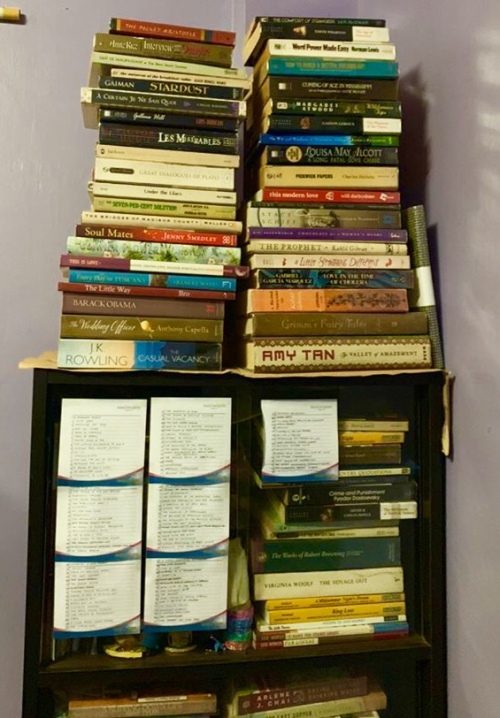
They call me.

The saving tome was no less than Margaret Mitchell’s Gone with the Wind. I was initially apprehensive because a thousand-page book just seemed too intimidating for someone who was testing the waters of reading once again. But after one chapter, I was hooked! I found myself annoyed at Scarlett plenty of times throughout the novel but I also could not help rooting for her. In between chapters, I would look up Gone with the Wind movie clips, Scarlett O’Hara’s barbecue dress, Vivien Leigh, imaginings of Tara, cotton plantations, the Confederate flag, KKK, etc. (Did you know that the last surviving cast member, Olivia de Havilland, who played Melanie Wilkes, is now over a hundred years old?)

This habit of discovering interesting bits of trivia through the wonderful world of reading brought to mind a quote from The Guernsey Literary and Potato Peel Pie Society by Mary Ann Schaffer and Annie Barrows:

That’s what I love about reading: one tiny thing will interest you in a book, and that tiny thing will lead you to another book, and another bit there will lead you onto a third book. It’s geometrically progressive – all with no end in sight, and for no other reason than sheer enjoyment.

When I finished the novel, however, I found myself apprehensive again. What if that was just beginner’s luck? What if it does not happen a second time? What if I could not find another book to pique my interest again? Boy, was I wrong. It seems like April is personally a month for classics because from Atlanta, I then went all the way to Colombia to witness Florentino Ariza’s lifelong pining for Fermina Daza. I don’t know about you but it didn’t work well enough for me. I finished it, all right, but I found it a little odd. Florentino Ariza was odd.

Anyway, I have nothing much to say at present – only to report that I have returned to reading and am now enjoying Kahlil Gibran’s The Prophet.

Let me just end this post with a couple of lines from Gone with the Wind:

I was right when I said I’d never look back. It hurts too much, it drags at your heart till you can’t ever do anything else except look back.

And apologies, once postponed, become harder and harder to make, and finally impossible.

What is broken is broken – and I’d rather remember it as it was at its best than mend it and see the broken places as long as I lived.

And just this one from Gabriel Garcia Marquez’s Love in the Time of Cholera:

… the heart’s memory eliminates the bad and magnifies the good, and that thanks to this artifice we manage to endure the burden of the past.

Keep sane, everybody. I mean, safe. Keep safe.

What could have been

A few weeks ago, I was musing on whether there was such a condition as reader’s block and whether it afflicts as many readers as I assumed. A few passed-up books and empty sentences later, I looked it up and found that indeed such a condition exists! Who knew? I can be a little outdated at times.

So I found this site that somehow enlightened me on my predicament and there was one point that stood out among the rest – one that I am bound to do should I find myself in this dreadful state again – and it was this – read an old favorite.

Of course, favorite doesn’t just mean favorite book alone although resorting to Pride and Prejudice is greatly enticing. No, I’m afraid it was too soon to be exploring Pemberley again (I had only visited it shortly before Christmas). So I thought, why not explore another Austen abode that is slightly less visited? Brilliant idea. I had recently bought an Oxford edition of Northanger Abbey with the surprising additions of Austen’s lesser known works, Lady Susan, The Watsons, and Sanditon, so what better way to dodge this block than by being entertained by dear Jane herself?

It’s never a bad time for Austen.

It had been a few years since I first and last read Northanger Abbey, so reading it again seemed a bit like reading it for the first time. There were moments in the story that I don’t remember from my first reading (Henry Tilney having himself introduced to Catherine through the Master of Ceremonies) and there were moments that I dreaded coming upon because of what they would entail (Catherine’s insistence on exploring the late Mrs. Tilney’s bedroom). On this second perusal, I found that I hadn’t really thought of Catherine as a heroine as I ought. I must have unconsciously set up Elizabeth Bennet as the ultimate standard which other Austen heroines failed to live up to. I remember dismissing Fanny Price like this when after some deliberation, I realized that she wasn’t so bad after all. And so it is with Catherine Morland. Indeed, my seventeen-year-old self would have related more to her than my twenty-year-old self (or even my present twenty-seven-year-old self!) would have to Elizabeth.

Anyway, I intended to write more about her other works so on to them.

Lady Susan is a short novel written as a series of correspondence among the main characters. Used to Austen’s lively protagonists, I expected Lady Susan to be the same. Er … Well, she is lively in her own right but completely different than what we expect of her usual heroines. I was personally scandalized by her behavior all throughout the novel and I was in disbelief at Reginald de Courcy’s complete gullibility despite his initial prejudices. Oh the things that beauty could do. I was reminded by a passage from Agnes Grey:

We are naturally disposed to love what gives us pleasure, and what more pleasing than a beautiful face – when we know no harm of the possessor at least?

The Watsons, on the other hand, was treading on familiar ground. It’s about an impoverished family figuring out how to rise above their poverty. Our main heroine is Emma Watson, pretty, compassionate, who apparently has caught the eye of some of her neighborhood’s eligible men. I was starting to really like her but – alas – Austen didn’t think it good enough to finish. So I, along with her countless fans throughout the ages, am left wondering what could have happened.

The same goes for Sanditon. I was a little confused at first as to who the main character really was and just when I was introduced to a really interesting character, it just had to end abruptly.

Sad, really. Plenty of times I wish Jane Austen didn’t have to die so young. Think of all the stories that might have continued to entertain us today. Of the fanbase she has unknowingly created with her six most popular novels, just think of how delighted that fanbase would even be if Emma Watson and Charlotte Heywood joined the ranks of Elizabeth Bennett, Catherine Morland, Anne Elliot, and the rest.

Romantic quote #5

February is drawing to a close and I’m glad to present my fifth and last quote for the month of love. This was taken from Amy March’s letter to her mother on her engagement to Laurie. Honestly, Amy is my least liked March sister because I still feel bitter that she ended up being Mrs. Theodore Laurence — and not our dear Jo — but the way she conveyed her love for him was really selfless and genuine that I think I should give her a chance. I may be denying this but perhaps deep down, Amy might actually be my favorite March sister… Oh no, forget I said that. Jo all the way!

quote5

Romantic quote #3

Why can’t I find other  quotes by other authors? The first two are both by Austen and this third one is still by her so it’s high time I should post something else already.  Her words are nonetheless great so I don’t think I should restrain from sharing. Besides, it’s Mr. Darcy (the one and only) who said these words so there should definitely be no qualms on posting it.

quote3

Romantic quote #2

I was going to save this for last but it melts my heart too much that I can’t hold it back any longer. This was written by Frederick Wentworth to Anne Elliot on Persuasion.

quote2