


| CARVIEW |

Image Courtesy : one-ipswich.com
Dear Readers
We to let you know that Aavaas is being migrated to a new server as we speak. During this period, you may have some difficulties in accessing the content on our portal. We apologize for any inconvenience caused due to this migration. The newly hosted site promises to deliver more features so stay tuned.
Thank you for reading .
Happy Homemaking
Team Aavaas
]]>
The car is amazingly small in size compared with the conventional choices available from the more established car manufacturers. This makes it a dream vehicle to commute about in the intensely crowded Indian city streets. However, I would not recommend it for long distance drives on the Indian Highways. The fact that its commutation distance is only 80 km (under ideal conditions) is only part of the reason; the real reason is that safety wise Reva is not as sturdy as its conventional cousins and driving on the highway is a far more risky proposition than driving in your typical evening traffic jams.
Interestingly, it is being sold aggressively in London recently under the brand name of G-Wiz. Apparently, the response has been overwhelmingly positive since certain restrictions in London make owning cars there a very expensive proposition. The car is so tiny that it actually qualified to be sold as a quadricycle, thus bypassing many of the existing car regulations there!
I think Reva is a very decent choice for an urban setting, especially if it is a family’s second car purchase. If the electricity you use to charge the car is coming from renewable sources, the usage of the car is carbon neutral. If the electricity is from more traditional sources, the carbon emissions are two thirds lower than normal and the power consumption is 75% lower than normal.
Not to mention, the cost per distance travelled is as low as 40 paise per km !
It was not a long while back that I said in a post here that we Indians are not getting enough options to get into a carbon neutral lifestyle in India (unlike say in America). Well, this just goes to show what a ridiculous statement that was. No doubt, I’ll make more ridiculous claims in future as well.. 
 Email a friend!
Yesterday we gave you a brief list of brands that sell DVD players in India. We promised you that the next post would have a list of features which would help you choose a player appropriately. So let us go right into it.
Video output
The first and the foremost quality that is associated with a DVD player is “Picture” quality. This is directly related to the type of video output that you are using from your DVD player.
There are about 4 types of video output signals that exist. Atleast one of these would be present in any player. Some models may have two, three or all four of them. They are:
(in the order of clarity – least to most)
- Composite output – denoted by a yellow color socket (see picture below)
- S-Video Output
- Component Output – denoted by three sockets , blue red and green (see picture)
- HDMI Output
What is the most important aspect here is that your television should also support the type of output that your DVD player is sending out.
Please check this before purchasing the player.

Image Courtesy : about.com
Most common CRT televisions have only “composite video input”. Slightly higher end versions have “s-video” inputs and the larger CRT televisions like 29″ models even have “component” video inputs.
Latest plasma and LCD televisions will have the HDMI ports as well. If you have all of these present in your system, choose the one which is the best to appreciate smooth, rich and vivid picture quality.
Audio output
The next important aspect is the audio quality that is produced by your player. Just like video output, there are some formats available in DVD players by which you can connect your television or home theatre to the DVD player.
- Stereo sound – Denoted as “L” and “R” (white and red sockets) at the rear of the player
- Surround sound – Here you can see 6 sockets with markings.
- Front Left
- Front Right
- Center Channel
- Rear Left
- Rear Right
- Sub Woofer
- Coaxial digital output
- Optical digital output
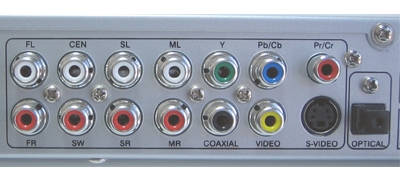
Image Courtesy : barrel-of-monkeys.com
If you are having just a television to be connected to the DVD player, only the stereo connection should be used. Just connect the left and right sockets to the appropriate colored sockets in your television set. In case your TV has more than one pair, make sure it is connected to the same channel source as is your video output. Some televisions have AV1 and AV2 channels.
If you plan to use a 5.1 channel amplifier, then you can connect all channel outputs individually to the respective sockets on the amplifier and use the supplied speakers to enjoy your movies/music.
If you amplifier/home theatre supports coaxial cable input or optical cable inputs , use them instead as they prevent cable mess. The audio signal is transferred in an encoded manner and the receiving home theatre equipment has the intelligence to decode it.
 ::
:: ::
:: ::
:: ::
:: ::
::
Region Code Setting
Every DVD player has a region code setting. Make sure you are aware of what your player’s code is. You have to purchase DVD which have the same region coding. Else the disc will fail to play back on your player.


Images Courtesy : kfccinema.com
Playback Options
Most players in the market are designed only to play VCD and DVD discs.
Advance players can play MP3 and WMA discs. If you would like to have these audio playback features, make sure you check for them.
Divx Support
Divx is a popular format for video compression. It is based on MPEG-4 like standards and promises high compression rates. This means you can store more movies on a single DVD disk without compromise on quality. If you have such content and would like to play the same on your player, make sure it can support Divx playback.
You can check some of the players here – – > https://www.divx.com/products/
Other features to look for
Some of the other things you may want to check before buying a player are:

Image Courtesy : Overstock.com
- Support for remote control – 90% of the players have a remote control
- Display – Most players have a digital display to show time elapsed and other such details
- Karaoke – If you have karaoke ready tracks, you may want this option. Here you can plug in your microphone and sing along with the video !
Advanced Options
- Some players allow you to playback CDs with pictures on them. You can watch a slideshow with MP3 music playing in the background.
- Advanced modern players have USB connectivity. This would help you to connect your digital camera or flash drive on the dvd player and listen to music, watch pictures or even movies on your TV screen.
- Memory card slot – This is similar to the USB option, only that you can insert a specified memory card into the player.
We hope you found this article informative and make the right choice for your player.
]]>Email a friend!
Continuing our brand series where we covered televisions and mattresses before, today we touch upon DVD players.

Image Courtesy : msu.edu
Japanese DVD player brands


Chinese DVD player brands


Korean DVD player brands


Other DVD player brands

Indian DVD player brands


Wow, that is quite a long list isnt it? How to know which brand to choose from this? Stay tuned for our next article on features of DVD to look out for. Hopefully this would get some clarity and shortlist your choices.
We will end this article with some trivia on DVD players :
> DVD stands for Digital Versatile Disc and not digital video disc as perceived!
> A single layer DVD can hold 4.7GB of data and a dual layer disc can hold twice as much.
> All commercially available DVD titles would contain only one movie to maintain picture quality.
> DVD have region coding to prevent piracy.
> DVD audio is usually encoded with multi channel support for surround sound effect.
> One of the primary feature of DVD is to have multiple audio tracks (languages) and various subtitle support.
> Additionally, some DVD have various camera angles for the same sequence.
> Blue-ray and HD-DVD are the successors for DVD technology.
:: :: :: :: ::
Email a friend!
Hey everyone. Sometimes I guess it is necessary to start getting creative and stop writing. (If you know what I mean!)
So like our friend Krish Ashok suggested this a few months back, we are now presenting our first concept using Floor Planner.
What is shown below is a concept living room. Your suggestions and comments on this would be wonderful.

Let us know what comes to your mind when you have a look at this.
Ofcourse you are welcome to submit your own concepts here at Aavaas too. Cheers.
:: :: :: :: ::
Email a friend!
There is always some inspiration for an article. Needless to say, the heavy rainfall today at Chennai which lead to wet clothes hanging inside our home was a reason to write this piece.
The most common way of drying clothes after either washing manually or with the aid of a washing machine, is to spread them out on a clothes line. (as shown below)

Image Courtesy : bownet.org
This clothes line is typically situated on the terrace of the home/apartment. And this is exactly why the system fails on a rainy or overcast day as there is not enough sunshine.
So what is the workaround for this? We know that many people tie temporary clothes line inside the house, from one window grill to another, but this can only be a mess. With the possibilities of water dripping, people finding it difficult to move about, the problems are endless.
The best thing to do is to use a “Clothes Drying Rack“

Image Courtesy : made-in-china.com
These ultra portable, ultra light stands are a saving gadget for all our problems. And the best part is that their usage is not limited to rainy days!
Drying clothes on such racks can help prevent color losses which result from drying clothes in direct sunshine.
The rack itself is made up of a grill like structure where each rod can be used to hang clothes on. Since it is indoor, we do not need to add the customary clips to prevent them from flying away.
There are many varieties of racks in the market which can suit your needs. Number of fold-able arms, grill sizes, color and height are some of the differentiating factors.
There is even an electric rack which warms up and speeds the process of cloth drying !!
Some more types or racks can be seen here and here.
Comments are welcome.
:: :: :: :: ::
Email a friend!
Here are the answers for yesterday’s jumble !
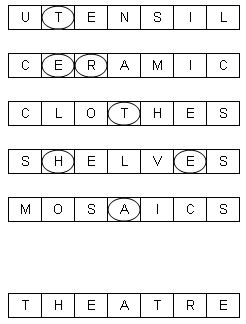
Super Word Solution:
Your neighbours may start complaining if you have one of these:
Answer : Home- THEATRE
Do drop a comment if you liked this game. Cheers
:: :: :: :: ::
Email a friend!
The first edition of Jumble on Aavaas was posted on 4 November. Today we are happy to give you the second.

Clue for the super word : “Home- _______ : Your neighbours may start complaining if you have one of these”
Happy solving and do post your answers via comments.
:: :: :: :: ::
Mukesh Ambani’s new house – Antilla
Videocon to acquire Onida – Rumor
We have crossed 10,000 Views ! – Thank you
Diwali/Deepavali wishes to all
Home Loan insight – Interview with Bank of Baroda
Press Coverage from Indian Express for Aavaas
Defrosting your refrigerator- A small guide
]]>Email a friend!
We had recently written an article about the house being constructed by Mukesh Ambani in South Mumbai. Quite a few people have been landing up at the article after having searched in Google using the keywords containing “most expensive house”. This started me out on an interesting search… Is it really the most expensive home ever built?
The answer wasn’t hard to find. It isn’t. Not by a long shot. Not even by Indian standards. In fact all of us are already familiar with a more expensive house built in India – our very own ‘Rashtrapati Bhavan’.

Here are some interesting facts about it:
- 17 long years were required to complete (1912-1929) its construction. Then on its 18th year, India became independent. Interesting, because the house was built as a symbol of British Imperial strength. J
- The cost of construction was an astounding 14 million rupees. Not sure how much that would be in today’s prices, but that is astronomical by the standards of pre-independent India.
- At today’s real estate prices, the land itself will be worth more than 16,000 crores ($4 Billion). The house is built on an area of 335 acres or so, right in the heart of New Delhi. After all, New Delhi itself was designed by Lutyens with Viceroy’s house as its centre.
- The building has 340 rooms within its 4 storeyed structure.
- At one time 2000 people were required to look after it. Not sure whether that is still the case though. Might have been a colonial time extravaganza.
- Although Lutyens and Baker – the two main architects, quarreled bitterly over the details of New Delhi and Viceroy’s house (they actually ceased speaking to each other), the eventual results is considered to be an elegant mix of Western and Indian styles. Indian architectural patterns such as Buddhist railings, chhajjas, chhatris and jaalis are found in the building. Chhajjas are stone slabs designed for preventing the sunrays from falling on the windows and protecting the walls from the rains. Chhatris adorn the rooftops of the building through their elevated positions. Jaalis are stone slabs designed with delicate floral / geometric patterns.
- At 630 feet long, it is longer than the Versailles Palace.
- By the way, the place also has nine tennis courts, a polo ground, a 14-hole golf course and a cricket field.
To the west of Rashtrapathi Bhavan is the elegant Mughal Gardens, which occupies an area of 13 acres. It has Mughal style canals, fountains and terraces at different levels with flowering shrubs and Western style lawns, hedges and flower beds.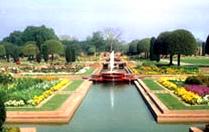
To the east lies a vast court with the huge Jaipur column of red sandstone. It is topped with a bronze lotus and the six pointed glass star of India, in the centre. 
You can also view the Satellite image and the roadmap of the area.
To all Indian Presidents’ credit, none of them have ever occupied the actual Viceroy quarters, deeming it to be too extravagant in nature. Instead all have occupied certain portions of the guest enclave of the building.
By the way, I can think of at least one other home building which might be even more expensive than the Rashtrapati Bhavan (not in India, though). Will cover that after some more research.
:: :: :: :: ::