

|

|
| CARVIEW |


























Interview préparée par Lionel Dumarty et Chloé Laplantine
enregistrée à Paris le 27 juin 2024 à l’université Paris Cité par Thomas Zoritchak
(version PDF)
C. Laplantine — Bonjour. Bienvenue dans ce nouvel entretien d’History and Philosophy of the Language Sciences. Je suis Chloé Laplantine, et je suis aujourd’hui accompagnée par Lionel Dumarty. Bonjour Lionel.
L. Dumarty — Bonjour Chloé.
C. Laplantine — Aujourd’hui, nous nous entretenons avec Bernard Colombat et Jean-Marie Fournier. Bonjour Bernard, bonjour Jean-Marie.
B. Colombat et J.-M. Fournier — Bonjour Chloé.
C. Laplantine — Merci d’avoir accepté cet entretien. Bernard Colombat, vous êtes professeur émérite à l’université Paris Cité ; Jean-Marie Fournier vous êtes Professeur à l’université Sorbonne Nouvelle ; et vous êtes tous deux membres du laboratoire d’Histoire des théories linguistiques.
*
L. Dumarty — Bernard, Jean-Marie, vous avez publié en 2023 une nouvelle édition de la Grammaire générale et raisonnée d’Arnauld et Lancelot chez Classique Garnier. Cette édition, il faut d’emblée le souligner, est assortie d’une volumineuse introduction de 280 pages et de près de 700 notes de commentaire. Nous voudrions, dans cet entretien, faire la lumière à la fois sur cet important travail et sur l’œuvre des Messieurs de Port-Royal. — Alors voici une première question : Pourriez-vous, pour les personnes qui nous écoutent, retracer la genèse de cet impressionnant projet d’édition commentée de la Grammaire générale et raisonnée et nous dire ce qui en fait l’originalité ?
B. Colombat — Ce projet d’édition de la Grammaire générale et raisonnée est un projet de longue haleine. Un contrat avait été signé avec les éditions Klincksieck en 1995 – qui est fort loin, maintenant. Le projet est resté sans suite immédiate avant d’être intégré dans un double programme de publication, à la fois numérique, avec le Grand Corpus des grammaires françaises, des remarques et des traités sur la langue, paru chez Classiques Garnier Numérique en 2011, et augmenté en 2022, et sous forme papier dans la collection Descriptions et théories de la langue française, dont le premier ouvrage, une édition de la grammaire de Mauger, est paru en 2014. Depuis, d’autres ouvrages sont parus, les éditions critiques des grammaires de Maupas et de Chiflet (en 2021), alors que parallèlement étaient publiés des textes de « remarqueurs », c’est-à-dire d’auteurs de remarques sur la langue française, à savoir les ouvrages de Vaugelas, Dupleix et Ménage, dans une série dirigée par Wendy Ayres-Bennett. Le directeur de Classiques Garnier, Claude Blum, avait depuis longtemps initié une série de publications de grammaires françaises de la Renaissance, série dont il avait confié la direction à Colette Demaizière, avec l’idée de les réunir dans un « cédérom », comme on le disait alors. La série a été étendue au XVIIe siècle, avec les ouvrages déjà évoqués, et doit l’être encore au XVIIIe siècle, avec, en prévision, la publication des œuvres de Régnier-Desmarais, Girard, Du Marsais, Wailly, Lhomond, etc. Parallèlement sont prévues des éditions de la Nouvelle Méthode italienne et de la Nouvelle Méthode espagnole de Port-Royal. Pour les grammaires de la Renaissance, les éditions papier ont précédé les éditions en ligne, pour celles des XVIIe et XVIIIe siècles, c’est l’inverse : les publications papier, assorties d’un appareil critique important, suivent les éditions en ligne, qui, elles, ne comportent que le texte original. À vrai dire, l’édition de la Grammaire générale et raisonnée a longtemps servi de prototype aux travaux de l’équipe : nous avons eu de nombreuses réunions pour lesquelles nous annotions un chapitre avant de le soumettre au groupe de travail. Il nous a fallu, à un moment donné, « basculer » ces notes dans une introduction divisée en huit sections, et qui occupe 280 pages, alors que le texte original, très court (160 p. dans l’édition de 1676) n’en occupe que 200 dans l’édition annotée. D’une certaine façon, nous avions, comme on dit, « mis la charrue avant les bœufs », nous avons démultiplié le travail, mais cela ne nous semble pas trop grave, car la Grammaire générale a été un axe structurant dans l’équipe d’Histoire des théories linguistiques, comme va vous le dire Jean-Marie.
J.-M. Fournier — En effet, cette édition de la Grammaire générale et raisonnée – nous disons, pour abréger le titre généralement entre nous, « GGR » : c’est peut-être le sigle que je vais utiliser désormais – se présente finalement (c’est un peu la conséquence du côté prototype du projet au sein de la collection dont vient de parler Bernard Colombat) comme la synthèse des travaux disponibles, menés au sein du laboratoire d’Histoire des théories linguistiques – mais évidemment pas seulement –, sur la tradition des grammaires françaises, et souvent au-delà, des grammaires des langues romanes. Cette édition, avec ses notes abondantes et son introduction développée tend à présenter en quelque sorte une histoire générale de la Grammaire générale et raisonnée, dans le contexte élargi de ses sources, du contexte de la grammatisation des vernaculaires européens, et de sa postérité. Cela nous paraissait souhaitable pour au moins deux raisons : l’importance du texte, d’une part, dans l’histoire de la pensée grammaticale, et, d’autre part, dans le processus de construction du champ de l’histoire des théories linguistiques lui-même. Enfin une autre dimension qui fait l’importance et la difficulté du texte, qui explique l’abondance de l’apparat critique, est sa relation à un autre ouvrage des Messieurs, très important pour l’histoire de la pensée, La logique ou l’art de penser, qui fait diptyque avec la GGR et dont Arnauld est aussi un co-auteur avec Pierre Nicole.
*
C. Laplantine — Pourriez-vous nous dire, à présent, qui étaient Antoine Arnauld et Claude Lancelot, ces « Messieurs » de Port-Royal, qui signent la Grammaire générale et raisonnée ?
B. Colombat — En fait, ni Lancelot, ni Arnauld ne « signent » la Grammaire générale, puisque conformément à la tradition janséniste, à Port-Royal, les auteurs ne signent pas leurs ouvrages. Ils se cachent parfois derrière des pseudonymes, comme « le sieur de Trégny » pour Lancelot. On sait en fait qui tient la plume : c’est Lancelot, qui dans la Préface écrit (c’est un peu long, mais je pense que cela vaut le coup de citer ce texte, parce qu’il est important pour comprendre le projet) :
L’ENGAGEMENT où je me suis trouvé, plustost par rencontre que par mon choix, de travailler aux Grammaires de diverses Langues, m’a souvent porté à rechercher les raisons de plusieurs choses qui sont, ou communes à toutes les langues, ou particulieres à quelques-unes. Mais y ayant quelquefois trouvé des difficultez qui m’arrestoient, je les ay communiquées dans les rencontres à un de mes Amis, qui ne s’estant jamais appliqué à cette sorte de science, n’a pas laissé de me donner beaucoup d’ouvertures pour resoudre mes doutes. Et mes questions mesme ont esté cause qu’il a fait diverses reflexions sur les vrais fondemens de l’Art de parler, dont m’ayant entretenu dans la conversation, je les trouvay si solides, que je fis conscience de les laisser perdre n’ayant rien veu dans les anciens Grammairiens, ny dans les nouveaux, qui fust plus curieux ou plus juste sur cette matiere. C’est pourquoy j’obtins encore de la bonté qu’il a pour moy, qu’il me les dictast à des heures perduës : Et ainsi les ayant recueillies & mises en ordre, j’en ay composé ce petit Traité. » (p. 285-287)
Il y a donc une énigme : quel est le vrai auteur de la Grammaire générale ? Claude Lancelot ou Antoine Arnauld ? La critique a beaucoup varié sur cette question (nous nous en sommes fait l’écho dans l’introduction), certains tirant plutôt vers Arnauld (c’est lui qui a les idées force, Lancelot n’étant que le rédacteur), d’autres vers Lancelot. Si on analyse le « je » et le « nous » dans l’ouvrage, on voit que le « je » semble bien désigner Lancelot, mais un Lancelot entièrement acquis aux idées d’Arnauld, dont il ne se fait que le simple porte-parole, alors que le « nous » est plutôt un nous récapitulatif associant le lecteur à la démonstration : « Nous avons dit… » ; mais aussi « Nous dirons », « Nous allons dire » (p. 23). Alors, qui est ce Lancelot, né aux environs de 1615 et décédé en 1695 ? C’est un auteur relativement prolifique, chronologiste, mémorialiste, mais surtout pédagogue, qui a publié des grammaires ou des lexiques dont, surtout, une Nouvelle Méthode latine, sans cesse revue (la première édition date de 1644 ; en 1681 paraît la huitième), et, en interaction avec les éditions successives de la Grammaire générale et raisonnée, une Nouvelle Méthode grecque (première édition 1655 ; neuvième édition 1696). La Grammaire générale et raisonnée connaît de son côté trois éditions principales : 1660, 1664 (comme une bière célèbre), 1676, avec des remaniements assez significatifs. Nous avons retenu l’édition de 1676, mais en signalant les différences par rapport aux éditions précédentes. Alors, quelles sont les sources citées de Lancelot et d’Arnauld ? Elles sont très peu nombreuses, ce qui n’étonne pas dans un texte très court. Alors, les auteurs cités sont Aristote, Buxtorf (qui est l’auteur d’une grammaire hébraïque), Malherbe (cité quatre fois), Priscien, Ramus, Scaliger (trois fois), Vaugelas (huit fois). En revanche, et cela, c’est tout à fait notable, il y a des renvois à la Nouvelle Méthode latine et à la Nouvelle Méthode grecque : dans l’édition de 1660, sept à la Nouvelle Méthode latine, trois à la Nouvelle Méthode grecque ; et dans l’éd. de 1676, treize à la Nouvelle Méthode latine, et cinq à la Nouvelle Méthode grecque – ce qui montre que, en fait, l’interaction a été constante entre ces ouvrages.
J.-M. Fournier — À propos du fonctionnement de la collaboration des deux auteurs et du rôle de chacun, on peut souligner que la première phrase de la préface (que Bernard Colombat vient de lire en partie), qui décrit la genèse et le processus d’élaboration de l’œuvre, campent un Lancelot spécialiste – je reprends ce mot qui figure dans le texte – de diverses langues, dont l’expérience et l’expertise sont à la racine du questionnement fondamental de la Grammaire générale et raisonnée, et – je reprends le texte littéralement, et je le cite – l’ont « porté à rechercher les raisons de plusieurs choses qui sont, ou communes à toutes les langues, ou particulières à quelques-unes » (p. 285). Lancelot est donc un peu plus que le secrétaire d’Arnauld qui aurait seul « pensé » – on l’a écrit, parfois – la GGR. Il se présente, ici, dans cette phrase liminaire, qui lance la préface, un peu comme son inventeur. Le projet est également donné dans ce texte liminaire – et je crois que c’est intéressant à souligner – comme la conséquence intellectuelle d’une certaine expérience théorique de la diversité des langues, qui est bien l’expérience de Lancelot, auteur des grammaires que vient de lister Bernard Colombat. D’un autre côté, nous citons et commentons également un document, bien connu mais assez peu exploité jusqu’ici : la lettre qu’Arnauld adresse à la Marquise de Sablé en novembre 1659, dans laquelle il développe de façon très détaillée un ensemble de démonstrations précises, qui figurent bien dans le texte définitif, mais qui sont présentées, dans ce document, dans un ordre et une configuration, parfois même une version, un peu différents. Ce document atteste d’un intérêt manifeste du grand Arnauld, philosophe et théologien reconnu de son temps, pour certaines minuties grammaticales du français – intérêt qui peut surprendre –, et non pour les seules questions générales de philosophie et de logique. Ces deux remarques que je viens de faire sont là pour introduire ici un peu de complexité dans la répartition des rôles des deux auteurs, tels qu’on les a très souvent présentés. Nous nous sommes efforcés aussi de synthétiser les nombreux travaux d’historiens qui interrogent les sources (qui sont médiévales, augustiniennes, sanctiennes, cartésiennes) qui se sont développés surtout depuis la publication de Cartesian Linguistics de Chomsky en 1966 (traduit trois ans plus tard en français), le but de notre travail, dans les notes et l’introduction, étant ici moins d’apporter du nouveau sur cette question que de rendre compte du débat historiographique qui s’est développé chez les historiens. Enfin, quant aux liens entre la GGR et la Logique – la Logique et l’art de penser, dont je parlais tout à l’heure –, ils ont très nombreux et bien documentés également. Nous les signalons et les commentons systématiquement : par exemple, sur la théorie de la proposition, sur la détermination (nominale), sur l’analyse des termes complexes, la théorie des incidentes, etc.
*
L. Dumarty — Alors, si nous nous arrêtons sur le titre de ce traité : quel est au juste l’objet d’une grammaire « générale » et « raisonnée » ?
B. Colombat — En fait, il existe des « grammaires générales », ou plutôt des ouvrages généraux sur les langues avant la Grammaire générale. Qu’on pense, par exemple, aux grammaires qu’on appelle « causistes », c’est-à-dire qui étudient les causes et les fondements de la langue latine, celle par exemple de Scaliger (en 1540), ou la Minerve ou les causes de la langue latine de Sanctius (qui date de 1587). Ces ouvrages étudient dans une optique générale la langue latine, si bien que d’une certaine façon, ce sont un peu des grammaires générales avant la lettre. Mais il y a d’autres types d’ouvrages. Il y a, par exemple, des « Portes des langues » (Januae linguarum, de William Bathe, par exemple, ou de Comenius) ; il y a des grammaires « philosophiques » (celle de Caramuel, par exemple, ou celle de Campanella) ; il y a aussi les Mithridate (ou Mithridates), recueils offrant des échantillons de langue, dont le premier est celui de Gessner (1555) ; il y a aussi des Méthodes pour toutes les langues (comme la Méthode de Roboredo, qui date de 1619). Et, plus près de la date de parution de la Grammaire générale et raisonnée, des ouvrages, ou plutôt des parties d’ouvrages, qui s’intitulent Grammaire générale et raisonnée : ainsi, dans la Méthode pour apprendre les langues de Jean Macé (qui date de 1651, et ce n’est pas la première édition), Méthode exhumée par Francine Mazière, ou encore une petite « Grammaire générale », insérée dans le Dessein d’une institution universelle de Jacques Du Roure, paru le premier janvier 1661. Donc, en 1660, la notion de grammaire générale n’est pas une nouveauté : elle est déjà dans l’air du temps.
J.-M. Fournier — L’édition que nous avons préparée n’est certes pas un livre de plus sur Port-Royal. Néanmoins, il y a, au moins, une question que le format de l’édition pourvue d’un appareil de notes conséquent permet d’explorer au fil du texte, c’est celle précisément de la « généralité », dans toutes ses dimensions discursives et épistémologiques. Nous avons cherché à montrer comment est construite la notion au gré des chapitres et des problèmes traités. La question du général ne se pose pas en effet de la même façon selon que les Messieurs étudient les sons, le temps, la proposition (comme forme linguistique du jugement), telle ou telle partie du discours (comme le pronom), ou encore l’usage des auxiliaires, en français ou dans les « langues européennes », comme les auteurs le disent, et les accords complexes du participe qu’ils déclenchent. Nous n’avons pas le temps ici d’entrer dans le détail de ces analyses, mais je voudrais prendre un exemple qui nous a semblé très intéressant et qui a été peu remarqué jusqu’ici. C’est l’usage récurrent dans différents chapitres, de formules qui présentent les faits linguistiques dans le processus de leur genèse supposée. Je prends un seul exemple, au tout début du texte, dans le premier chapitre de la première partie, consacré à la présentation des sons du langage – du français, en fait, ici –, plus précisément même des voyelles. On lit ceci :
Les divers ſons dont on ſe ſert pour parler, & qu’on appelle Lettres, ont eſté trouvez d’vne maniere toute naturelle […]. Car comme la bouche eſt l’organe qui les forme: on a veu qu’il y en avoit de ſi ſimples, qu’ils n’avoient beſoin que de ſa ſeule ouverture, pour ſe faire entendre & pour former vne voix diſtincte, d’où vient qu’on les a appellez voyelles.
Et un peu plus loin, même usage du passé composé, pour introduire les consonnes :
Et on a auſſi veu, qu’il y en avoit d’autres qui dépendant de l’application particuliere de quelqu’vne de ſes parties, comme des dents…
La Grammaire générale et raisonnée est, comme les ouvrages que Bernard Colombat vient de décrire, en effet, aussi, une grammaire causiste, d’une certaine façon, qui tend, toujours, à donner une explication des faits. Si l’explication mobilise différents ressorts selon les cas, on en voit ici, dans le passage que je viens de citer rapidement, une forme en quelque sorte minimale, proprement discursive – elle n’est pas thématisée en tant que telle ; encore moins théorisée –, qui consiste à scénariser la description et postuler l’invention des formes linguistiques comme le résultat de l’enchaînement naturel et nécessaire de causes et de conséquences. Ce thème de l’invention et de la genèse des formes est appelé à prendre beaucoup d’importance dans les grammaires générales du siècle suivant.
*
C. Laplantine — Le sous-titre de la Grammaire générale et raisonnée mentionne entre autres « les raisons de ce qui est commun à toutes les langues, et des principales différences qui s’y rencontrent » : qu’en est-il du projet de généralité, si on le rapporte à la question des langues – de leur diversité et de leur part respective – dans l’ouvrage ?
B. Colombat — Il ne faut pas s’attendre à voir étudiée dans le détail la diversité des langues par des échantillons variés. Les langues les plus étudiées ou illustrées sont dans l’ordre : le français (dans son titre complet, la Grammaire générale et raisonnée annonce d’ailleurs, je cite, « plusieurs remarques nouvelles sur la langue française ») ; donc, après le français, le latin, qui constitue souvent le substrat de l’analyse, base grammaticale ; le grec (il y a 41 citations du terme « grec » avec ses variantes, dans la Grammaire générale) ; l’hébreu ; les langues romanes ; les autres langues (les « langues du Nord », parfois appelées simplement sous ce terme générique). Nous avons étudié, avec l’aide de Judith Kogel, d’un peu près les allusions ou les analyses ayant trait à l’hébreu, qui sont relativement nombreuses. Un cas très intéressant par exemple est l’utilisation du scheva, que les Messieurs supposent nécessaire dans la prononciation du mot latin scamnum (scam-, –num : il faut une voyelle d’appui entre le m et le n, selon eux). C’est à l’origine, évidemment, de la notion de voyelle centrale désonorisée qu’on appelle encore schwa. Il est important d’analyser le jeu sur les langues dans les exemples : si on prend les exemples en binôme français/latin, on voit que leur fonction varie : a) ils servent à illustrer les deux langues, chacune de leur côté, b) mais ils servent aussi à montrer les différences entre ces deux langues, c) ou au contraire, parfois, leurs ressemblances ; d) le français est utilisé pour expliciter – ainsi un texte grec de l’Apocalypse de Jean est traduit en latin, puis explicité à la fois en latin et en français ; e) et la traduction peut être éloignée ou adaptée du texte original. L’analyse des exemples nous a conduits à dresser, comme l’avait fait Jean-Claude Pariente pour son livre L’analyse du langage à Port-Royal, un index des exemples et des citations au fil du texte, avec les exemples français, puis les exemples latins, enfin les exemples traduits, bi- ou multilingues.
J.-M. Fournier — Les exemples en français, néanmoins, sont sans doute les plus nombreux. Il arrive même que certains chapitres soient centrés quasi exclusivement sur le français, auquel les Messieurs ajoutent les langues d’Europe, comme dans le chapitre sur les auxiliaires, voire sur un détail de la grammaire du français, comme dans le chapitre 10 de la deuxième partie, consacré à la réfutation d’une règle proposée par Vaugelas qui concerne l’usage prétendument obligatoire d’un article devant les noms suivis d’une relative, comme dans la phrase : il a été traité avec une violence qui est tout à fait inhumaine (on ne peut pas dire, en effet, *il a été traité avec violence qui est tout à fait inhumaine). Et les Messieurs font également remarquer que, dans la phrase il est accusé de crimes qui méritent la mort, on a bien un nom – donc crimes – suivi une relative. Eh bien, devant ce nom crimes, on a le mot de, qui ne paraît pas être un article. Voilà, disons, pour le problème linguistique. Alors, à cet égard, je pense qu’il ne faut pas oublier que l’ouvrage comporte un troisième sous-titre – un peu surprenant et apparemment peu compatible avec le projet initial de grammaire générale, annoncé dès la préface –, qui annonce « plusieurs remarques nouvelles sur la langue française », évidemment en écho aux Remarques sur la langue française de Vaugelas, parue quelques années plus tôt, en 1647. Outre le fait dont on peut prendre acte de l’importance de la référence manifestement incontournable à Vaugelas dont ces développements témoignent, ceux-ci – ces développements – ont un rôle particulier dans l’économie d’ensemble de l’ouvrage. Ils donnent l’occasion de présenter des réflexions d’ordre, en quelque sorte, métathéorique et donnent à voir, certes, « un échantillon de la langue française » (je reprends là, encore une fois, une expression des Messieurs), mais il permet surtout (je cite à nouveau) « de parler en paſſant de beaucoup de choſes aſſez importantes pour bien raisonner sur les langues » (p. 385). Il s’agit alors pour les Messieurs de montrer, par exemple, que la règle formulée par Vaugelas, que j’évoquais il y a une seconde, est mal construite (ils montreront que l’article n’est pas obligatoire mais que ce qui est obligatoire c’est que le nom soit déterminé, et ils construiront alors la notion de détermination). Ils soulignent également, par exemple, avec force, un principe de méthode empirique (je cite le texte encore), principe « que ceux qui travaillent ſur vne langue vivante, doivent toûjours avoir devant les yeux; Que les façons de parler qui ſont autoriſées par vn vſage general & non conteſté, doivent paſſer pour bonnes, encore qu’elles ſoient contraires aux regles & à l’analogie de la Langue » (p. 391). La Grammaire générale et raisonnée se présente ainsi comme une grammaire de l’usage général et non contesté. On peut noter qu’ils enchaînent en énonçant, un peu plus loin dans la même partie, un autre principe, qui est cette fois éthique, selon lequel les formes déviantes (contraires aux règles), dans une certaine langue, ne doivent pas être alléguées pour faire douter des règles et troubler l’analogie. Principe à mettre en œuvre chaque fois qu’il est souhaité – ou quand on envisage, disons, la codification de l’idiôme, ce qui est bien le cas au XVIIe siècle, au moment où, donc, la Grammaire générale paraît.
*
L. Dumarty — On considère la Grammaire générale et raisonnée comme un « texte fondateur » de l’histoire de la linguistique. A-t-elle eu ce statut dès sa première parution ? — Comment expliquer le regain d’intérêt qu’elle a connu dans la seconde moitié du XXe siècle ?
B. Colombat — J’évoquerai seulement la première réception, et Jean-Marie Fournier se chargera de la réception plus globale, bien plus importante. En fait, il y a eu des répercutions très tôt, comme le montre, par exemple, la reconfiguration de la Grammaire française d’Irson, qui est parue en 1656, et qui est remaniée dans l’édition de 1662, à la suite de la parution de la Grammaire générale. L’oratorien Bernard Lamy fait aussi référence à la Grammaire générale dans sa Rhétorique ou l’art de parler. Régnier-Desmarais, en 1706, également ; Buffier, en 1709, se propose d’en faire une application pratique à la langue française. Tant Restaut que Wailly se placent dans la lignée de Port-Royal. Les grammairiens de l’Encyclopédie y font allusion, même si c’est la Nouvelle Méthode latine qui est de loin l’ouvrage le plus cité et le plus utilisé. Duclos publie une édition de la Grammaire générale en 1754, avant que Fromant ne lui fasse remarquer qu’il s’est appuyé sur la deuxième édition, de 1664, et non pas sur la troisième, ce qui est l’occasion d’une nouvelle édition conjointe – Duclos et Fromant –, en 1756, republiée en 1846 (qu’on trouve disponible aux éditions Slatkine, en 1968). Il y aura une édition en 1810, avec un Essai de l’inspecteur général Petitot.
J.-M. Fournier — On peut peut-être distinguer deux choses concernant l’influence du texte dans la période qui suit immédiatement sa parution. D’une part, le fait que dès la deuxième moitié du XVIIe siècle, le matériel conceptuel mobilisé par les auteurs, les innovations multiples que le texte présente dans différents chapitres – le chapitre « Temps », le chapitre sur les articles, etc. Ces innovations sont très souvent reprises, et le texte cité – anonymement, puisque le texte paraît sans nom d’auteur. Mais l’influence de la GGR comme texte fondateur d’une école ne démarre véritablement qu’au XVIIIe siècle, puisque c’est en effet au XVIIIe siècle que des ouvrages reprennent le titre et s’intitulent Grammaire générale. Donc on peut constater cela, l’apparition d’un véritable mouvement, d’une véritable école qui s’appellera ainsi, qui se poursuit largement jusqu’à la fin du XVIIIe siècle et même très avant dans le XIXe siècle, jusque vers les années 1860. Alors, influence donc, qui connaît également différentes époques, dans lesquelles on peut distinguer des étapes, en quelque sorte. La grammaire des idéologues, par exemple, à la charnière des XVIIIe et XIXe siècles, la grammaire générale tardive, comme on l’appelle parfois, donc, pour désigner ces textes publiés vers le milieu du XIXe siècle. Et puis, parallèlement à tout cela, il faut noter l’émergence du paradigme de la grammaire scolaire, chez Lhomond, d’une part, chez Noël et Chapsal, également, qui constitue donc un paradigme qui est également largement sous l’influence de Port-Royat de la Grammaire générale, qui constitue donc, globalement, ce qu’on pourrait appeler une seconde réception. Mais en réaction à cette longue et durable imprégnation des théories grammaticales, il y aura une troisième réception – on peut risquer le terme –, critique cette fois, dont Ferdinand Brunot est un des acteurs majeurs, au début du XXe siècle, d’abord dans son Histoire de la langue française, histoire monumentale, où il évalue négativement ce qu’il appelle le logicisme de la Grammaire générale, dont les Messieurs seraient les initiateurs ; puis à travers ses interventions dans le champ scolaire et didactique et, par exemple, la mise en place de la nomenclature grammaticale de 1911, qui vise précisément à éliminer de l’enseignement toute trace du modèle tripartite d’analyse de la proposition qui continuait alors de structurer l’analyse syntaxique scolaire. Enfin depuis les années 1960 se sont succédé des ouvrages qui visent à évaluer l’apport de ce texte à l’échelle du temps long. Le coup d’envoi de cette réflexion est sans doute donné par Cartesian Linguistics de Chomsky en 1966, comme nous l’indiquions plus haut, mais on note que, la même année, Foucault fait paraître son livre célèbre, Les mots et les choses, et que, l’année suivante, la Grammaire générale et raisonnée est l’objet d’une étude spécifique, conduite par Roland Donzé, dans un livre intitulé La Grammaire générale et raisonnée de Port-Royal, Contribution à l’histoire des idées grammaticales en France. Puis viendront les ouvrages fondateurs, aussi, cette fois du champ de l’histoire des théories linguistiques, de Jean-Claude Chevalier en 1969, L’invention du complément, dans lequel la GGR est décrite comme une étape décisive de l’émergence d’une grammaire des significations. L’ouvrage de Marc Dominicy, intitulé La naissance de la grammaire moderne, paru en 1984 – dont le titre est explicite : la naissance de la grammaire moderne, ce serait ce qui se passe avec l’apparition de la grammaire générale de Port-Royal ; ou encore donc l’ouvrage de Pariente, L’analyse du langage à Port-Royal, juste l’année suivante, 1985. Une partie des travaux de Sylvain Auroux peut aussi être placée dans cette série qui consiste à évaluer – au sens de produire une analyse épistémologique et historique – la grammaire et la logique de Port-Royal. Je pense à La sémiotique des Encyclopédistes (1977) et à La logique des idées (1993). Ce questionnement de Port-Royal (avec notamment celui de Saussure) est un de ces questionnements inauguraux du champ de recherche alors en émergence de l’histoire des théories linguistiques.
*
C. Laplantine — Le chapitre I de la seconde partie est intitulé : « Que la connaissance de ce qui se passe dans notre esprit est nécessaire pour comprendre les fondements de la grammaire ». Par ce lien entre la grammaire et les opérations de pensées peut-on dire que la Grammaire générale et raisonnée innove ou qu’elle s’inscrit dans une longue tradition ?
J.-M. Fournier — Elle s’inscrit dans une longue tradition, c’est incontestable – les analyses, ou plutôt les débats relatifs à la linguistique cartésienne décrite par Chomsky ont porté précisément sur ce point. Cette longue tradition, c’est notamment celle de l’analyse de la prédication, mais c’est aussi une innovation importante. En premier lieu c’est une des modalités fondamentales de la généralité (même si ce n’est pas la seule), comme l’indique explicitement le titre du chapitre : les fondements de la grammaire s’expliquent par ce qui se passe dans notre esprit, et en particulier par les opérations concevoir et juger, articulées dans cet ordre. L’analyse de l’énoncé comme une structure prédicative remonte à l’Antiquité, c’est incontestable ; mais ce qui est novateur, au milieu du XVIIe siècle, c’est de donner à cette structure la forme d’un véritable modèle (tripartite) sous-jacent à toute proposition, et de placer ou replacer cette problématique, je dirais, au centre de la discipline. Avec la Grammaire générale et raisonnée, l’analyse syntaxique de la proposition devient (durablement) un objet central dans la grammaire, et suscite alors toute une série d’inventions qui aboutiront à celle du complément et à celle de l’émergence d’une véritable syntaxe sémantique, comme l’ont montré les travaux menés depuis une quarantaine d’années, au premier rang desquels ceux de Jean-Claude Chevalier.
*
L. Dumarty — La Grammaire générale et raisonnée est structurée en deux parties, respectivement 6 et 24 chapitres. Que pourriez-vous nous dire de cette structure, de l’enchaînement de ses parties ? Suit-elle un ordre canonique ou, au contraire, rompt-elle avec une certaine tradition grammaticale ?
J.-M. Fournier — Beaucoup de grammaires commencent par la présentation des éléments, ou des lettres. La Grammaire générale et raisonnée ne déroge pas à cette façon topique de commencer l’exposé disciplinaire. Mais ces courts chapitres soulèvent des questions très intéressantes. Outre la topique de l’invention des formes que l’on voit apparaître (dont je parlais tout à l’heure), les Messieurs posent, à propos des voyelles, le problème de l’inventaire et du classement des unités – à propos des voyelles et des consonnes, à propos des éléments du langage. C’est en effet, à ce titre, une question générale : comment arrêter et stabiliser l’inventaire des sons ? Comment identifier les unités sonores, et selon quels critères ? À propos des voyelles, par exemple, en s’appuyant sur le critère de la longueur ? sur celui du degré d’ouverture ? pourquoi celui-ci plutôt que celui-là ? Ce sont des questions que ne posaient pas les grammaires précédentes. On y reconnaît une préoccupation qui sera celle, beaucoup plus tard, de la phonologie. Le chapitre sur les graphies, qui suit de peu celui que j’évoque ici, – les Messieurs disent les caractères – présente également des vues étonnantes sur l’écriture et se démarque de façon intéressante des débats qui font rage à l’époque entre tenants de l’orthographe nouvelle et de l’orthographe étymologique. Les auteurs soulignent, par exemple, que les signes graphiques, au-delà de leur fonction de représentation des sons, peuvent également être considérés comme (je cite) « aidant à concevoir ce que le son signifie », autrement dit la chose même. Le point de vue général adopté dans ce chapitre peu commenté déplace ainsi les enjeux anecdotiques et nationaux de la querelle orthographique qui agite les contemporains et inaugure une réflexion sur les ressorts fondamentaux et les fonctions du système graphique. Il mériterait ainsi d’être placé dans la longue série de ceux qui préparent l’émergence des thèses développées, plusieurs siècles plus tard, par les promoteurs d’une linguistique autonome de l’écrit.
B. Colombat — Très souvent, quand on renvoie à la Grammaire générale de Port-Royal, on a tendance à oublier qu’elle a deux parties, et on renvoie à un chapitre de la deuxième partie, sans préciser, à tort, qu’il s’agit de la deuxième partie – parce qu’elle est considérée comme nettement plus importante en volume et en importance, mais Jean-Marie a bien montré que la première partie est importante aussi. Le premier chapitre de cette deuxième partie est ainsi intitulé : « Que la connaissance de ce qui se passe dans notre esprit est necessaire pour comprendre les fondemens de la Grammaire ; & que c’est de là que dépend la diversité des mots qui composent le discours ». Son objet est donc d’étudier le mécanisme qui produit les mots dans leur diversité, et pour connaitre cette diversité, il faut savoir ce qui se passe dans notre esprit : les Messieurs distinguent « trois opérations de nostre esprit : Concevoir, Juger, Raisonner » (p. 324). Seules, les deux premières concernent la grammaire ; la troisième est plutôt traitée par la logique. Mais la seconde est centrale, car (je cite) « les hommes ne parlent gueres pour exprimer simplement ce qu’ils conçoivent ; mais c’est presque toujours pour exprimer les jugemens qu’ils font des choses qu’ils conçoivent » (p. 325). C’est là que s’installe la proposition, conçue comme composée d’un sujet, « ce dont on affirme » et d’un attribut, ce qui est affirmé, « & de plus la liaison entre ces deux termes », à savoir le verbe est dans l’exemple donné la terre est ronde. Cela entraîne une partition tout à fait originale des mots, entre ceux qui (je cite) « signifient les objets des pensées » – ce sont les noms, les articles, les pronoms, les participes, les prépositions, les adverbes, et les mots qui en expriment (je cite à nouveau) « la forme et la manière » (p. 326), à savoir, les verbes, les conjonctions et les interjections. Cela va dicter le plan suivi dans cette deuxième partie, qui comporte plus de chapitres que les neuf parties du discours ci-dessus énumérées : en effet, pour le seul nom, il faut cinq chapitres, consacrés à l’opposition substantif/adjectif, à celle de propre/appellatif (c’est-à-dire notre nom commun), au nombre, au genre, au cas, ce qu’on appelle les accidents des parties du discours ; suivent les articles (un chapitre), les pronoms (pour lesquels il faut trois chapitres, dont un pour le relatif et un autre pour une règle spécifique de la grammaire française, comme l’a signalé Jean-Marie tout à l’heure), les prépositions, les adverbes. Pour le seul verbe, il faut dix chapitres (si l’on considère que participes, gérondifs et supins entrent dans la catégorie du verbe, ce qui aujourd’hui est facilement admis, mais qui ne va pas de soi en 1660, parce que le participe, justement, c’est celui qui participe du nom et du verbe, et qui donc a un statut tout à fait à part). Donc, pour ce seul verbe, il y a un premier chapitre (le chapitre II, 13) sur ce qui lui est « propre & essentiel », trois chapitres sur ses attributs (les personnes, le nombre, le temps, les modes) et encore six chapitres, dont deux sont particulièrement remarquables : le chapitre II, 18, consacré aux verbes (je cite) « qu’on peut appeler Adjectifs et (… à) leurs differentes especes : Actifs, Passifs, Neutres » (là, on a un début de syntaxe du verbe) et le chapitre II, 22, consacré aux « Verbes Auxiliaires des Langues vulgaires ». Il ne reste plus que deux chapitres, très courts, pour conjonctions et interjections (II, 23) et la syntaxe (II, 24), construite sur l’opposition, couramment admise alors, convenance (c’est-à-dire accord) / régime, avec un appendice sur les figures de construction. Ce plan est original : c’est sans doute la première fois dans la tradition occidentale que l’adverbe est traité avant le verbe (adverbe, cela veut dire qui se met à côté du verbe, à l’origine, même si l’adverbe se met parfois à côté de l’adjectif ; mais l’adverbe, ici, précède le verbe). La répartition du contenu ne l’est pas moins : le verbe, bien que reporté à la fin, est une partie du discours majeure, et amplement traitée (avec, notamment, un historique de ses définitions) ; au contraire, la syntaxe, traitée de façon si approfondie par Sanctius, par exemple, est expédiée en quelques pages. Je cite : « Il reste à dire un mot de la Syntaxe ou Construction des mots ensemble, dont il ne sera pas difficile de donner des notions generales, suivant les principes que nous avons establis » (p. 469) – et ceci, alors que l’analyse initiale du jugement (qu’on trouve dans le premier chapitre de la deuxième partie) place la syntaxe au cœur du dispositif – par l’organisation {sujet – verbe (être) – attribut ou prédicat}. C’est un peu comme si les Messieurs n’avaient pas encore tiré toutes les conséquences du renouvellement qu’ils opèrent sur le plan de l’analyse de l’énoncé.
*
C. Laplantine — Pourriez-vous nous dire, à présent, s’il y a des innovations grammaticales importantes proposées par cette grammaire ? Et pourriez-vous également nous en donner un exemple ?
J.-M. Fournier — Il y en a beaucoup. L’analyse de la proposition est un des exemples majeurs, Bernard vient d’en parler à nouveau. Elle a un rôle décisif dans ce que Jean-Claude Chevalier a appelé l’invention du complément, voire l’invention de la syntaxe, au sens moderne, au sens où traiteront de la syntaxe les grammaires modernes. On peut noter aussi la théorie des temps, qui unifie la sémantique temporelle en la ramenant à la combinatoire (calculable) de trois repères – l’instant de la parole, l’instant de l’événement, et un point de repère supplémentaire que les auteurs inventent, avant Reichenbach, qui reprendra le même dispositif au milieu du XXe siècle. Cette façon de traiter la sémantique temporelle fera école, c’est une de ces choses théoriques qui feront école, chez les auteurs de grammaires générales au XVIIIe et au XIXe siècle, ces auteurs ne cessant de la perfectionner et de l’enrichir. Et puis, on peut aussi noter, par exemple, la théorie de la détermination nominale, qui sera également perfectionnée et raffinée, pendant tout le XVIIIe siècle jusqu’à la création de la catégorie du déterminant, à partir, je dirais, de l’analyse traditionnelle de l’article comme partie du discours.
B. Colombat — Comme exemple particulier d’innovation, on peut prendre, par exemple, la naissance de la notion de subordination. On la trouve dans l’analyse que les Messieurs font du pronom relatif et de ce qu’ils appellent « la proposition incidente » – c’est ainsi qu’on appelle la relative à cette époque. On n’entrera pas dans le détail de l’analyse, d’autant plus complexe que le passage a été modifié, d’abord en 1664, puis en 1676 (dans notre édition, nous avons signalé les passages modifiés par un trait en marge), avec l’ajout d’un titre « Suite du même chapitre », qui ne dit pas grand-chose en soi et qui montre qu’il faut poursuivre la réflexion, et de plusieurs paragraphes. Sur cette question, il semble que la réflexion soit due surtout à Lancelot, un Lancelot fortement influencé par Sanctius qui considère qu’il faut partir, pour l’analyse du relatif, d’une structure à trois termes {antécédent – relatif – réoccurrence de l’antécédent}. Le relatif cumule ainsi deux fonctions : celle d’être pronom et celle de marquer l’union d’une proposition avec une autre. Cela semble simple en apparence, mais comment expliquer que dans le cas de la complétive (Lancelot analyse les subordonnées latines introduite par quod et les subordonnées grecques introduites par ὅτι – qui est une conjonction de subordination qui correspond à quod), alors comment expliquer que, dans ce cas-là, on n’ait pas d’antécédent pour ce relatif ? C’est un débat dans lequel nous n’entrerons pas, parce qu’il est complexe, et nous nous contentons de renvoyer à notre introduction. Mais, ce qui est intéressant, c’est que cette question est constamment reprise par Lancelot, non seulement dans la Grammaire générale et raisonnée, mais aussi dans ses deux Méthodes, la Méthode latine et la Méthode grecque, avec des modifications au fil des éditions, avant même que le problème soit repris dans la Logique, mais dans une optique assez différente, parce que, là, ce n’est plus le grammairien inspiré par Sanctius qui parle, mais c’est le logicien Nicole, qui est beaucoup moins intéressé par les questions de technique grammaticale.
*
L. Dumarty — Enfin, on voudrait vous poser une question peut-être un peu impertinente : pourquoi rééditer la Grammaire générale et raisonnée aujourd’hui ?
B. Colombat — Je réponds par une question. Ce texte ne mériterait-il pas une édition critique quand on connaît son influence sur la tradition grammaticale occidentale ? Jean-Marie l’a amplement montré. Si on regarde, d’ailleurs, c’est un texte qui a été traduit : il a été traduit en anglais en 1753, et plus récemment en 1975, en néerlandais, en 1740, en italien, en 1969, en espagnol, en 1980, en russe, 1991 et 1990 (et 1998 : il y a deux éditions successives d’une même traduction), en chinois, en 2011. Et nous ne sommes pas sûrs d’avoir répertorié toutes les traductions. Il existe des éditions du texte original, qui sont estimables, mais ce ne sont pas vraiment des éditions critiques : elles ne comportent que quelques pages d’introduction, au demeurant fort utiles et stimulantes (qu’on pense à l’édition Brekle, en 1966, par exemple, l’édition Michel Foucault, 1969, et l’édition Mandosio, plus proche de nous, qui a connu un grand succès, puisque l’ouvrage a été édité en 1997, puis réédité en 2010 et 2016). Mais pour nous il s’agissait de resituer la Grammaire générale et raisonnée dans la continuité de l’histoire longue, avec notamment une importante introduction dont la 7e partie, divisée elle-même en 9 sections, représentant 185 pages et consacrée à l’analyse du contenu. Cela nous semble important. Nous avons également essayé de fournir un apparat critique de qualité, en le répartissant entre cette introduction et les notes. Soulignons l’importance des textes périphériques : deux annexes, dont l’une pour la reproduction de cette lettre d’Arnauld à la marquise de Sablé, qui éclaire bien les sujets proprement linguistiques qui le préoccupent en 1659 – Jean-Marie en a parlé ; la seconde annexe fournit les passages correspondant de la Logique sur le traitement des parties du discours. Il y a sept index, avec notamment un index du métalangage, qui porte sur la terminologie originelle mise en œuvre par Lancelot lui-même dans l’édition de 1676 – c’est-à-dire que ce premier index porte sur les termes qui sont utilisés, alors qu’il nous a semblé nécessaire de faire aussi un index général des matières, qui est plus globalisant, qui inclut aussi la terminologue moderne. Cet index général porte sur l’ensemble de l’édition. Alors, nous espérons qu’un petit texte de 160 pages, à l’origine, tel qu’il est sous ces 600 pages de l’édition définitive, ne sera, peut-être, pas inutile pour éclairer un texte qui garde encore beaucoup de mystères pour nous.
J.-M. Fournier — Peut-être ajouter une dernière remarque sur le « aujourd’hui » qui figure dans la question : « pourquoi rééditer la Grammaire générale aujourd’hui ? » Alors, peut-être pas en répondant exactement à cet aspect-là de la question, mais plutôt en soulignant ceci : c’est que l’édition de la Grammaire générale aujourd’hui présente des travaux dont nous ne disposions pas il y a quelques années, et cela nous a paru très important. C’est-à-dire que cette édition, nous l’avons conçue, nous le disions au début de cet entretien, comme appuyé sur la somme considérable de travaux cumulés, au cours de la période, sur différents chapitres de la pensée grammaticale sur les langues vernaculaires en Europe, en France – enfin, sur le français –, dans le domaine de l’histoire des théories linguistiques. Et un travail aussi précis que ce que nous avons essayé de faire, avec des analyses techniques très documentées, il me semble, était peut-être moins possible qu’il ne l’a été pour la préparation de cette édition.
L. Dumarty — Merci beaucoup, Jean-Marie Fournier, merci Bernard Colombat, merci à vous deux d’avoir accepté de répondre à nos questions et encore merci pour ce très beau livre.
Bibliographie
Quelques éditions de la Grammaire générale et raisonnée
Arnauld, Antoine & Claude Lancelot. 1660. Grammaire générale et raisonnée. Paris : Pierre Le Petit.
Arnauld, Antoine & Claude Lancelot. 1676. Grammaire générale et raisonnée. Paris : Pierre Le Petit.
Arnauld, Antoine & Claude Lancelot. 1966 [1676]. Grammaire générale et raisonnée. Édition critique par Herbert E. Brekle Stuttgart, Bad Cannstatt : Friedrich Frommann Verlag (Günther Holzboog).
Arnauld, Antoine & Claude Lancelot. 1969 [1676]. Grammaire générale et raisonnée. Édition par Michel Foucault. Paris : Republications Paulet.
Arnauld, Antoine & Claude Lancelot. 1997 [1676]. Grammaire générale et raisonnée. Édition de Jean-Marc Mandosio. Paris : Éditions Allia.
Arnauld, Antoine & Claude Lancelot. 2023 [1676]. Grammaire générale et raisonnée. Édition de Bernard Colombat et Jean-Marie Fournier. Paris : Classiques Garnier (Descriptions et théories de la langue française, 7).
Quelques ouvrages d’Antoine Arnauld et Claude Lancelot
Arnauld, Antoine & Pierre Nicole. 1965 [1662]. La Logique ou l’art de penser. Édition critique par Pierre Clair et François Girbal. Paris : Vrin.
Lancelot, Claude. 1644. Nouvelle Méthode pour apprendre facilement, & en peu de temps la langue latine, contenant les Rudiments et les Regles des Genres, des Declinaisons, des Preterits, de la Syntaxe, & de la Quantité. Paris : A. Vitré.
Lancelot, Claude. 1660. Nouvelle Méthode pour apprendre facilement et en peu de temps la langue espagnole. Paris : Pierre le Petit.
Lancelot, Claude. 1660. Nouvelle Méthode pour apprendre facilement et en peu de temps la langue italienne. Paris : Pierre le Petit.
Lancelot, Claude. 1665. Nouvelle Méthode […] grecque. Paris : A. Vitré.
Autres références
Auroux, Sylvain. 1979.La Sémiotique des Encyclopédistes. Essai d’Épistémologie historique des sciences du langage. Paris : Payot.
Auroux, Sylvain. 2008 [1993]. La logique des idées. Montréal : Bellarmin & Paris, Vrin.
Chomsky, Noam. 1966. Cartesian Linguistics. A Chapter in the History of Rationalist Thought. New York : Harper and Row.
Chevalier, Jean-Claude. 2006 [1968]. Histoire de la syntaxe : Naissance de la notion de complément dans la grammaire française (1530-1750). Paris : Champion.
Colombat Bernard, Wendy Ayres-Bennett & Jean-Marie Fournier, éd. 2022. Grand Corpus des grammaires françaises, des remarques et des traités sur la langue (xive-xviiie s.) [https://classiques-garnier.com/index.php/grand-corpus-des-grammaires-fran%C3%A7aises-des-remarques-et-des-trait%C3%A9s-sur-la-langue-xive-xviiie-s.html, consulté le 12/07/2024].
Dominicy, Marc. 1984. La naissance de la grammaire moderne. Langage, logique et philosophie à Port-Royal. Bruxelles & Liège : Mardaga.
Donzé, Roland. 1971 [1967]. La Grammaire générale et raisonnée de Port-Royal, Contribution à l’histoire des idées grammaticales en France. Berne : Francke.
Pariente, Jean-Claude. 1985. L’analyse du langage à Port-Royal : six études logico-grammaticales. Paris : Éditions de Minuit.
*Pour les autres références, se reporter à bibliographie de l’édition Colombat-Fournier, p. 499-542.
]]>Publisher’s website

Die Fachdidaktik hat sich in den letzten Jahrzehnten in der deutschsprachigen Romanistik als eigenständige Teildisziplin neben Linguistik, Literatur- und Kulturwissenschaft etablieren können. Die Fachgeschichte dieser Teildisziplin bleibt indes zu schreiben. Während die Geschichte des Fremdsprachenunterrichts selbst – die bis ins 19. Jhd. hinein ganz überwiegend eine Geschichte des Unterrichts der romanischen Sprachen, insbesondere des Französischen, war – bereits relativ gut erforscht ist, bestehen im Bereich der Erforschung der Geschichte der Lehrkräftebildung in den romanischen Sprachen und der Geschichte der akademischen Disziplin Fachdidaktik noch große Lücken. Diesen Desiderata möchte der vorliegende Band begegnen, indem er unterschiedliche Untersuchungen und Einzelfallstudien zur Geschichte der romanistischen Fachdidaktik und Lehrkräftebildung seit dem 19. Jhd. vereint.
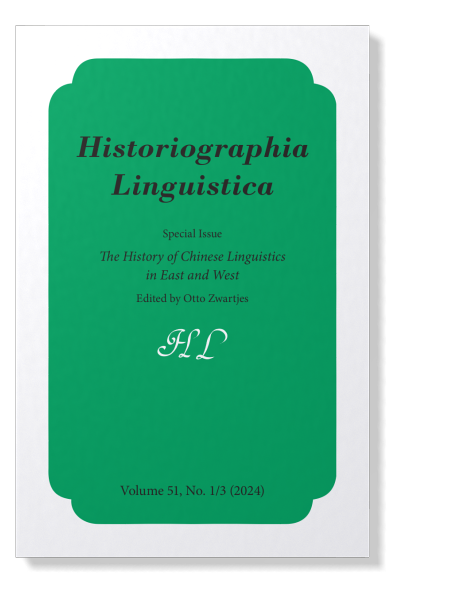
Charity Hudley, Anne H., Christine Mallinson, & Mary Bucholtz, ed. 2024. Decolonizing Linguistics. Oxford: Oxford University Press. 486 p. ISBN : 9780197755259
Publisher’s website
Book in open access
Decolonizing Linguistics, the companion volume to Inclusion in Linguistics, is designed to uncover and intervene in the history and ongoing legacy of colonization and colonial thinking in linguistics and related fields. Taken together, the two volumes are the first comprehensive, action-oriented, book-length discussions of how to advance social justice in all aspects of the discipline.
The introduction to Decolonizing Linguistics theorizes decolonization as the process of centering Black, Native, and Indigenous perspectives, describes the extensive dialogic and collaborative process through which the volume was developed, and lays out key principles for decolonizing linguistic research and teaching. The twenty chapters cover a wide range of languages and linguistic contexts (e.g., Bantu languages, Creoles, Dominican Spanish, Francophone Africa, Zapotec) as well as various disciplines and subfields (applied linguistics, communication, historical linguistics, language documentation and revitalization/reclamation, psycholinguistics, sociolinguistics, syntax).
Contributors address such topics as refusing settler-colonial practices and centering community goals in research on Indigenous languages; decolonizing research partnerships between the Global South and the Global North; and prioritizing Black Diasporic perspectives in linguistics. The volume’s conclusion lays out specific actions that linguists can take through research, teaching, and institutional structures to refuse coloniality in linguistics and to move the field toward a decolonized future.
De Waal, Cornelis, ed. 2024. The Oxford Handbook of Charles S. Peirce. Oxford: Oxford University Press. 696 p. ISBN 9780197548561
Page de l’éditeur
Charles Sanders Peirce (1839-1914) is likely the greatest philosophical thinker America has ever produced. His contributions to philosophy would inspire other American philosophers such as William James and John Dewey. Peirce’s contributions, however, extend far beyond philosophy proper. Interpreting logic as the discipline that is devoted to the question of how one should reason, he saw himself first and foremost as a logician, one inspired by the desire to penetrate into the logic of things. This, more than anything, enabled him to do ground-breaking work in a great variety of areas, including several that were yet to develop. In part because of this, Peirce has been called the American Aristotle and the American da Vinci. It is precisely this attitude of wanting to penetrate into the logic of things, and to develop the tools for doing so, that keeps Peirce relevant today.
The Oxford Handbook of Charles S. Peirce brings together thirty-four original essays on his work, showcasing state-of-the-art research in a broad variety of areas. Among other things, the Handbook touches upon phenomenology, logic, aesthetics, ethics, semiotics, physics, mathematics—and, of course, the tradition of pragmatism for which Peirce is well known as the founder, and which has enjoyed increased attention in recent years.
Danos, Félix & Simon Levesque, ed. 2024. Anthropologie sémiotique [thematic issue]. Cygne noir – Revue d’exploration sémiotique, 12. 172 p. ISSN 1929-0896
Publisher’s website
Journal in open access

Anthropologie sémiotique : interlocution transatlantique : introduction au 12e numéro du Cygne noir
Félix Danos et Simon Levesque
Sémiotique de la forme dialogique de la pensée : dialogues et interlocution comme objets d’enquête dans l’anthropologie linguistique française au xxie siècle
Bertrand Masquelier
Silverstein et Rancière : anthropologie sémiotique et politique
Quentin Boitel et Félix Danos
Sur l’idéologie sémiotique
Webb Keane
Un « corps » n’est pas qu’un corps. Catégories et sémiotique des instanciations corporées à Wallis
Sophie Chave-Dartoen
« Sì, pezzo di merda, tutto a posto » : analyse sociosémiotique d’un petit chahut en classe de français langue seconde
Annabelle Cara
Richardson, Alan & Adam Tamas Tuboly, ed. 2024. Interpreting Carnap. Critical Essays. Cambridge: Cambridge University Press. 324 p. ISBN 9781009098205
Publisher’s website
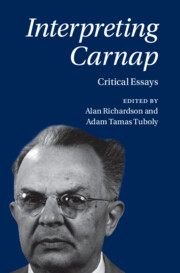
Rudolf Carnap (1891–1970), one of the most important philosophers of the twentieth century, helped found logical positivism, was one of the originators of the field of philosophy of science, and was a leading contributor to semantics and inductive logic. This volume of new essays, written by leading international experts, places Carnap in his philosophical context and studies his topics, his interests, and the major stages of his thought. The essays reassess Carnap’s place in the history of analytic philosophy through his approach to metaphysics, values, politics, epistemology and philosophy of science. They delve into important topics of Carnap’s mature thought, namely explication, naturalism, and his defence of analyticity; and they recover the logical and the linguistic components of philosophy and how they unfolded in the syntax-semantics relation, induction, and language-planning. The resulting interpretation of Carnap will be illuminating for both current and future research.
Akujärvi, Johanna & Kristiina Savin, ed. 2024. Reading, Writing, Translating: Greek in Early Modern Schools, Universities, and beyond. Lund: Faculty of Humanities and Theology, Lund University (Studia Graeca et Latina Lundensia, 29). 388 p. ISBN 978-91-89874-37-4 ; URN : urn:nbn:se:uu:diva-536295
Publisher’s website
Book in open access

This volume collects eleven studies that investigate different aspects ofthe teaching and learning of Greek in early modern northern Europe (c.1500–1750), from France in the west to Lithuania in the east. They giveimportant insights that advance our understanding of the homogeneitydespite diversity in the complex developments of classical reception, thestudy of Greek, its significance, and the practice of Greek in the variousreligious, cultural, and socio-political environments of the complicatedspatio-temporal and geopolitical realities of Europe.
Enenkel, Karl A. E. 2024. IV-5A Ordinis Quarti Tomus Quintus A: Apophthegmata (Liber V). Leyde : Brill (Opera Omnia Desiderii Erasmi – Erasmus, Opera Omnia). ISBN 978-90-04-44831-5
Publisher’s website
Enenkel, Karl A. E. 2024. IV-5B Ordinis Quarti Tomus Quintus B: Apophthegmata (Liber VI). Leyde : Brill. (Opera Omnia Desiderii Erasmi – Erasmus, Opera Omnia). ISBN 978-90-04-69064-6
Publisher’s website
Enenkel, Karl A. E. 2024. IV-6 Ordinis quarti tomus sextus. Apophthegmata I (Libri VII-VIII). Leyde : Brill. (Opera Omnia Desiderii Erasmi – Erasmus, Opera Omnia). ISBN 978-90-04-44832-2
Publisher’s website

This work provides a commented critical edition of Erasmus’s Apophthegmata (books V–VIII), the most successful early modern collection of memorable sayings and anecdotes. The substantial introduction analyses the genre of apophthegmata in antiquity, and the genesis, composition, sources and particularities of Erasmus’s work.
Haberpeuntner, Birgit. 2024. Walter Benjamin and Cultural Translation. Examining a Controversial Legacy. London: Bloomsbury Academic. (Bloomsbury Advances in Translation). 216 p. ISBN 9781350387188
Publisher’s website

Dissecting the radical impact of Walter Benjamin on contemporary cultural, postcolonial and translation theory, this book investigates the translation and reception of Benjamin’s most famous text about translation, “The Task of the Translator,” in English language debates around ‘cultural translation’.
For years now, there has been a pronounced interest in translation throughout the Humanities, which has come with an increasing detachment of translation from linguistic-textual parameters. It has generated a broad spectrum of discussions subsumed under the heading of ‘cultural translation’, a concept that is constantly re-invented and manifests in often heavily diverging expressions. However, there seems to be a distinct constant: In their own (re-)formulations of this concept, a remarkable number of scholars-Bhabha, Chow, Niranjana, to name but a few-explicitly refer to Walter Benjamin’s “The Task of the Translator.”
In its first part, this book considers Benjamin and the way in which he thought about, theorized and practiced translation throughout his writings. In a second part, Walter Benjamin meets ‘cultural translation’: tracing various paths of translation and reception, this part also tackles the issues and debates that result from the omnipresence of Walter Benjamin in contemporary theories and discussions of ‘cultural translation’. The result is a clearer picture of the translation and reception processes that have generated the immense impact of Benjamin on contemporary cultural theory, as well as new perspectives for a way of reading that re-shapes the canonized texts themselves and holds the potential of disturbing, shifting and enriching their more ‘traditional’ readings.
Rose, David. 2024. Languages of Australia’s First Peoples in Narrative. Australian Stories. London: Bloomsbury Academic (Bloomsbury Studies in Systemic Functional Linguistics). 400 p. ISBN 9781350413894
Publisher’s website

Celebrating the diverse languages of Australia’s First Peoples, this book presents stories told by elders in eighteen languages from around the continent, and explores their patterns of meaning.
The stories recount the experiences of the tellers and histories of their communities, from tales of anti-colonial resistance to origin stories of the Dreaming. The book aims to make the languages accessible and engaging through the voices of the elders, while building readers’ knowledge about language and language learning. It opens with some basic language knowledge for reading the stories. Each chapter then begins with the cultural and historical contexts of the stories, which are first previewed in English translation, then presented sentence-by-sentence, setting out the original sounds and wordings, glossed with plain English. Extracts are selected to illustrate patterns of meanings that are characteristic of each language. The final chapter sums up the various meaning patterns the stories use, and interprets their evolution in the light of First Peoples’ deep histories, as recorded by archaeology and traditional knowledge.
The book will be useful for language learning programs in communities and schools, for researchers of language and language teaching, and for any reader with an interest in the languages and cultures of Australia’s First Peoples.
Riley, Kathleen C., Bernard C. Perley, Inmaculada M. García-Sánchez, ed. 2024. Language and Social Justice. Global Perspectives. London: Bloomsbury Academic. (Contemporary Studies in Linguistics). 520 p. ISBN 9781350156241
Publisher’s website
Language, whether spoken, written, or signed, is a powerful resource that is used to facilitate social justice or undermine it. The first reference resource to use an explicitly global lens to explore the interface between language and social justice, this volume expands our understanding of how language symbolizes, frames, and expresses political, economic, and psychic problems in society, thus contributing to visions for social justice.
Investigating specific case studies in which language is used to instantiate and/or challenge social injustices, each chapter provides a unique perspective on how language carries value and enacts power by presenting the historical contexts and ethnographic background for understanding how language engenders and/or negotiates specific social justice issues. Case studies are drawn from Africa, Asia, Europe, North and South America and the Pacific Islands, with leading experts tackling a broad range of themes, such as equality, sovereignty, communal well-being, and the recognition of complex intersectional identities and relationships within and beyond the human world.
Putting issues of language and social justice on a global stage and casting light on these processes in communities increasingly impacted by ongoing colonial, neoliberal, and neofascist forms of globalization, Language and Social Justice is an essential resource for anyone interested in this area of research.
Vakoch, Douglas A. & Jeffrey Punske, ed. 2023. Xenolinguistics: Towards a Science of Extraterrestrial Language. London: Routledge. 248 p. ISBN 9781003352174.
Publisher’s website

Xenolinguistics brings together biologists, anthropologists, linguists, and other experts specializing in language and communication to explore what non-human, non-Earthbound language might look like. The 18 chapters examine what is known about human language and animal communication systems to provide reasonable hypotheses about what we may find if we encounter non-Earth intelligence.
Showcasing an interdisciplinary dialogue between a set of highly established scholars, this volume:
- Clarifies what is and is not known about human language and animal communication systems
- Presents speculative arguments as a philosophical exercise to help define the boundaries of what our current science can tell us about non-speculative areas of investigation
- Provides readers with a clearer sense of how our knowledge about language is better informed through a cross-disciplinary investigation
- Offers a better understanding of future avenues of research on language
This rich interdisciplinary collection, with chapter authors including Noam Chomsky, Derek Ball, Denise Herzing, and Irene Pepperberg, will be of interest to researchers and students studying non-human communication, astrobiology, and language invention.
]]>Université Paris-Cité, Laboratoire HTL. Bâtiment Olympe de Gouges, salle 533, and online via Zoom.
9h30-11h30, 20 September 2024
During this presentation, several relevant topics will be selected, which are important for “Task 5” (Western manuscript dictionaries in the History of Chinese Linguistics) of the Chedil project (ANR): Chinese-European Dictionaries: Lexicographical Manuscripts for the Historical Study of Exchanges between China and Europe (end of 16th – beginning of the 19th centuries (PI: Michela Bussotti), such as:
- The role played by Western manuscript dictionaries in the histories of Chinese Linguistics and missionary linguistics,
- The different systems used to transcribe the sounds in Latin letters,
- Lemma arrangement of the dictionaries,
- Interaction between lexicographical traditions (East and West),
- Microstructural level of the lemmas,
- The junction between dictionaries and grammars.
Zoom link and further information: https://htl.cnrs.fr/20-septembre-2024-otto-zwartjes-missionary-grammars-and-dictionaries-of-chinese-the-contribution-of-seventeenth-century-spanish-dominicans/
]]>
Download | Spotify | Apple Podcasts | YouTube
References for Episode 41
Radical Anthropology Group. YouTube channel | Vimeo channel
Allot, Nicholas, Chris Knight and Neil Smith. 2019. The Responsibility of Intellectuals; Reflections by Noam Chomsky and Others after 50 years, with commentaries by Noam Chomsky. London: UCL Press. Open access
Chomsky, Noam. 2016. ‘Chomsky responds to Chris Knight’s book, Decoding Chomsky’ Libcom
Chomsky, Noam, and Chris Knight. 2019. ‘Chomsky’s response to Chris Knight’s chapter in the new Responsibility of Intellectuals book’. Libcom
Knight, Chris. 2016. ‘John Deutch – Chomsky’s friend in the Pentagon and the CIA’. Libcom
Knight, Chris. 2016. Decoding Chomsky: Science and Revolutionary Politics. Newhaven: Yale University Press Google Books
Knight, Chris. 2023. ‘The Two Chomskys: The US military’s greatest enemy worked in an institution saturated with military funding. How did it shape his thought?’ Aeon
Newmeyer, Frederick J. 1988. The Politics of Linguistics. Chicago: University of Chicago Press.
Transcript by Luca Dinu
JMc: Hi, I’m James McElvenny, and you’re listening to the History and Philosophy of the Language Sciences podcast, online at hiphilangsci.net. [00:18] There you can find links and references to all the literature we discuss. [00:22] Today we’re joined by Chris Knight, who is a senior research fellow in anthropology at University College London and a long-standing political activist. [00:33] These two strands of his work and striving come together in the Radical Anthropology Group, which Chris co-founded. [00:41] Among the group’s activities are a regular series of talks and lectures, which can be watched online on the group’s Vimeo channel. [00:49] The link is available on the podcast page. [00:52]
In a recent update on the podcast, we promised that we’d look at the history of linguistics in the Cold War period, [00:59] with a focus on how the social and political climate of the time may have helped to shape the field of linguistics [01:06] — that is, how this climate influenced what linguists took an interest in, how they approached their subject matter, human language, [01:13] and how they marketed themselves and their work. [01:17] Chris has produced some very provocative work that explores the relationship of the research of Noam Chomsky, perhaps the key figure of linguistics in this period, [01:27] to the U.S. military-industrial complex of the Cold War. [01:31] Chris has written about this most extensively in his 2016 book Decoding Chomsky, [01:37] but also in a number of articles that are referenced on the podcast page. [01:41] The great conundrum Chris seeks to resolve in these texts is how Chomsky could reconcile the fact that his research was paid for largely by the U.S. military [01:51] with his activism in opposition to the Vietnam War and in support of other left-wing causes. [01:58] So Chris, could you outline your views for us? [02:01] What was the relationship of Chomsky’s linguistic research at MIT to the U.S. military-industrial complex, [02:09] and what effect did this have on Chomsky’s approach to studying language? [02:15]
CK: Well, Chomsky was initially employed at MIT rather than, say, a more posh place such as Harvard because, being Jewish — and, as Chomsky put it, the anti-Semitism around being as thick as soup — it was easier for him to get a job at MIT, [02:33] and his initial employment was to work on a kind of craze of the time, actually: machine translation. [02:39] Chomsky, from the outset, realized that for machine translation to work, you’d have to have computers far more powerful with far greater memory than anything that was around at the time, [02:51] and he realized that, really, you just need a vast number of sentences, and you kind of average them out and work out what the probable meaning of it is. [03:00] I say “you,” “you” being a computer here. [03:04] And he wasn’t interested at all, and what was much more exciting to him, but also very exciting to the U.S. military, [03:12] was the idea that just possibly the human mind is itself a digital computer of some sort, [03:19] and that underlying all the world’s different languages was this simple code. [03:25] So Warren Weaver had — this great fixer and founder of all sorts of things going on in U.S. military, industrial plus intellectual relationships — argued that possibly… [03:37] He actually used the analogy of the Tower of Babel, that underneath all the differences, if you delve right down to the very basis of language, you’d find a simple kind of underlying code, [03:47] which Chomsky before long called universal grammar. [03:51] And why that was exciting to the military would mean that you could just possibly ask the generals during, say, a nuclear war to kind of talk to their missiles. [04:03] I say talk, probably they meant type on a keyboard to their missiles, [04:07] but you could talk in any of the world’s languages, and the missiles would kind of get it [04:11] because installed inside the missile or inside the bomber or other form of technology would be this kind of black box containing the principles of all the world’s different languages. [04:23] So that was an extraordinarily exciting and ambitious idea, and when Chomsky was invited to work on it, he more or less said, [04:31] “Well, I’ll work on the principle. I’ll work on the science. I won’t work on any practical applications. I won’t try to operationalize what I’m doing. [04:41] Anyone else wants to do that, that’s up to them.” [04:44] But because this is intellectually exciting and thrilling, in fact, that underlying all the world’s languages is a simple universal grammar, he promised to work on that. [04:54]
JMc: But isn’t it the case that Chomsky’s approach is rather formalist and that he’s interested in the structures of languages, [05:02] not necessarily in any semantic aspects? [05:05] So even if he could describe an underlying universal grammar of all languages, it would actually not be something that could be used in practice for the purposes of communication or for instructing machines. [05:20]
CK: Well, exactly. And actually, in order to clarify this, Chomsky was very anxious to draw a very sharp distinction between language’s social use — social conversation, social communication — and language as formal structure, [05:39] and in fact, sometimes argued that possibly the very word “language” was misleading. [05:43] His interest was, if you like, grammar. [05:46] And yes, I mean, that’s absolutely right, but the point I think I would make is that there was a cost to this, [05:55] because in the end, in order to draw the sharpest possible distinction between language as use and language as grammar, [06:05] he argued that language is essentially not communicative, that essentially language is the language of thought [06:12] and that the first human on the planet ever to, if you like, [06:16] speak in his own words was talking to itself. [06:20] So in order to absolutely ensure that he kept his politics apart from his work for the military, he stripped language of everything social. [06:31] And you can sort of see why that was kind of necessary, because anything social in language is likely to be not just social, but political, [06:39] and if it’s political, it’ll be political in a context which Chomsky would have thoroughly disapproved. [06:47] So to make quite sure that he wasn’t colluding with the U.S. military on a political or social level, strip out the social from language and leave just the forms. [06:58] And so language is, if you like, the language of thought. [07:01] Language isn’t for communication. [07:03] But of course, the moment you do that, you then wonder, well, [07:06] what’s grammar for, if it isn’t to make thinking externalised and therefore accessible to others? [07:12] I mean, do we really need grammar when we’re thinking to ourselves? [07:15] Obviously, that’s a huge philosophical debate, but I think most cognitive scientists these days would say, well, no, [07:21] grammar is precisely to make sure that what’s in your head gets out to other people — in other words, make sure that it’s externalised. [07:29] And of course, language for Chomsky is I-language, internal language. It doesn’t get externalised. [07:34]
JMc: But the formalist turn that Chomsky made wasn’t necessarily original to him, was it? [07:40] I mean, you know, what is often called American structuralism that immediately preceded his work in generative grammar – in particular, the school of the Bloomfieldians – already had a very formalist approach to language, [07:53] and that was couched in behaviourist terms, which Chomsky argued against. [07:57] But the actual processes of analysis where you concentrate just on the forms of language and describe the distribution as the Bloomfieldians did, [08:06] but then Zellig Harris, Chomsky’s teacher, and Chomsky himself, you know, talking about it in transformational terms, [08:12] this focus on pure form in language, without any consideration of meaning or use, you know, was something that the Bloomfieldians were already doing. [08:23]
CK: Well, yes, no doubt about that. [08:25] And of course, Zellig Harris, in many ways Chomsky’s teacher, [08:30] his project was to make text accessible to a computer, to make texts legible, and that was the whole point of his formalism. [08:39] So there’s no doubt that different forms of formalism were around. [08:43] And of course, in my book, I explain how actually you can trace that right, right back through Jakobson, right back to the Russian formalists, Russian formalism, [08:52] including the extraordinary poet Velimir Khlebnikov. [08:56] And that whole idea of formalism is to try at all costs to kind of rescue science, and linguistic science in particular, rescue it from politics, [09:06] because if you just have pure form, you can argue that you’re doing something on the level of astronomy. [09:13] I mean, E=MC2; is not politics, it’s just pure science. [09:17] And there’s something clearly liberating and inspiring about the idea of doing pure science uncontaminated by politics. [09:26] The point I’m making is that if we go to the extreme in that direction, [09:32] you just haven’t got language. [09:35] I mean, all I’m saying is that at the end of the day, language is social, it is communicative, [09:41] and if you strip away not only the politics, [09:43] but the social dimensions, what you’ve got is some form of computation. [09:49] But I would argue, and I think most people these days would argue as well… Including people who’ve been taught by Chomsky. I mean, Steven Pinker, I can think of hardly any linguist these days who would argue that language hasn’t got some necessary and intrinsic connection with communication. [10:04] So if we take it too far, what you’ve got might be interesting, but it’s just not language. [10:10]
JMc: Has Chomsky responded at all to your account? [10:14]
CK: Yes. I mean, we’ve had a very difficult relationship over the years. [10:20] I was one of the founders of EvoLang, along with Jim Hurford, and we had a big conference in 2002 in Boston at which Chomsky made the final sort of massive contribution at the end of the whole week. [10:32] And yes, he has responded. [10:35] When my book came out, he described it as a “vulgar exercise of defamation, a web of deceit and misinformation”. [10:44] “The whole story is a wreck… complete nonsense throughout.” [10:48]
JMc: That’s a direct quote, I take it. [10:50]
CK: These are direct quotes, yes. That’s right. [10:53] And I kind of rather proudly put those comments in the front of my book, because at least it was a response from Chomsky. [11:02] He argued that the reason why he’s legitimately describing it as a wreck is because, quote, no military work was being done on campus during his time at MIT. [11:16] Which is fine, except that he also says the following: [11:19] “There was extensive military research on the MIT campus. In fact, a good deal of the nuclear missile guidance technology was developed right on the MIT campus.” [11:29] So what I’m saying is, the point I’m making about the just inescapable involvement with military technology and missile guidance technology, it’s not a point that Chris Knight makes. [11:42] It’s a point that Chomsky makes on numerous occasions. [11:45] And for some reason, I don’t know how to put this exactly, but Chomsky’s political admirers [11:51] — and of course I’m a huge admirer of his politics — [11:55] they’re always trying to find some connection between his linguistics and his politics. [12:00] They’re always trying to sort of say, Well, there must be something liberating about his linguistics and left-wing about his linguistics, in many cases. [12:07] And every time Chomsky came across activist supporters who asked him to explain that connection, he just got more and more impatient. [12:13] He just sort of shook his head. [12:14] “You’re not going to find anything politically inspiring in my linguistics. Forget it.” [12:18] And the Left just couldn’t kind of cope with this. [12:22] So how do I put this? [12:24] I mean, what I’m saying is that if you are a left-wing activist working in this military lab, [12:30] you’re going to need to draw a line between the two sides of your work. [12:38] I mean, just let me… I mean, a passage from my book, actually. [12:42] I describe how he became a friend of somebody called John Deutch, who before long was to become director of the CIA. [12:55] And Chomsky recalls, “We were actually friends and got along fine, although we disagreed on about as many things as two human beings can disagree about. [13:02] I liked him. We got along very well together. [13:03] He’s very honest, very direct. You know where you stand with him. We talked to each other. When we had disagreements, they were open, sharp, clear, honestly dealt with. I had no problem with him. I was one of the very few people on the faculty, I’m told, who was supporting his candidacy for the President of MIT.” [13:05] And so I’m just saying we need to appreciate the glaring contradiction here, because this is Chomsky’s view of the CIA. [13:31] “The CIA does what it wants. [13:33] It carries out assassinations, systematic torture, bombings, invasions, mass murder of civilians, multiple other crimes.” [13:39] In Indonesia, as Chomsky rightly points out, in 1965, the CIA organized a military coup to prevent the Communist party, described by Chomsky as the “party of the poor,” from winning a key general election. [13:53] The ensuing repression resulted in a staggering mass slaughter of perhaps half a million people. [13:58] So I mean, you know, you’re friends with a future director of the CIA, who’s a chemist involved in fuel-air explosives and other weapons of mass destruction. [14:10] You’re aware that the CIA is, from Chomsky’s point of view, a criminal organization. [14:16] You’re friends with, you have lunch with these people. [14:21] And then in the evening, you have a meeting with anarchists and revolutionaries and anti-capitalists and anti-militarists. [14:29] And I’m simply saying, can you see, you’re meeting with these people at lunchtime, in the evening, [14:34] you’re meeting with the opposite camps. [14:36] You wouldn’t want the anarchists present in your discussions with the future director of the CIA. [14:41] And when you’re at your anarchist meeting in the evening, I don’t think you’d want the director of the CIA to be publicly present in that meeting either. [14:47] You’ve just got to keep those two things apart, [14:50] and keeping them apart meant keeping apart different parts of Chomsky’s passion, Chomsky’s, if you like, his mind, his brain [14:59] — to the extent that when an interviewer said to him, “Well, there seem to be two Noam Chomskys. What do they say to each other when they meet?” [15:07] And Chomsky says there’s no connection. [15:10] There’s no connection between the two of them. [15:13] The connection is almost non-existent. [15:15] There is a kind of loose, abstract connection in the background, but practical connections are non-existent. [15:20] So he’s basically telling us that the two Noam Chomskys aren’t really on speaking terms. [15:26]
Okay, I mean, you’re in a difficult situation. [15:29] You want your job. You can do very good work in that job, but there are institutional contradictions. [15:34] And I’m not even saying that Chomsky should have not taken the job. [15:38] I mean, because by taking that job and becoming such a star figure in linguistics based in MIT, he then gained a platform from which to launch his assault on the U.S. military, beginning with the invasion of Vietnam. [15:53] So had he not had that job, he might have been like any other sort of activist on the street somewhere without that powerful voice. [16:00] By the way, I need to say how much we right now miss that voice. [16:06] It’s well known, of course, that for over a year now, Noam has been not well, and we have lost a voice of sanity in what I regard as an increasingly deranged political world. [16:21] It’s a huge loss. We would have benefited so much from Chomsky’s voice, [16:25] particularly in connection with Palestine and what’s going on today in Gaza. [16:30] I’m saying that simply to stress, I’m not even criticizing Chomsky. [16:34] I’m saying in a difficult situation, all of us have to make a living. [16:37] We all have to have a job. Whatever job we take, mostly it’ll be financed by some kind of corporation or capitalist outfit or another. [16:45] More than others, perhaps, Chomsky is just, his contradictions, if you like, all of us experience those contradictions — in his case, to an extreme extent. [16:57]
JMc: But I think Chomsky would perhaps argue, and you’ve touched on this point in a few of the things that you’ve said, [17:03] I think Chomsky would argue that there is such a thing as pure science, [17:08] that is, science as an activity that’s pursued without any political implications or interference, [17:15] and that whether someone is a good or a bad scientist has nothing to do with their politics. [17:22] And, I mean, if we follow this line of reasoning, we might even say that explicitly mixing politics and science [17:29] leads to such ridiculous outrages as the German physics of Nazi Germany, [17:34] the Lysenkoism of Stalinist times, or in linguistics to such things as Marrism. [17:40] So do you think that Chomsky is being disingenuous in insisting on pure science, [17:45] or do you think that he’s just mistaken? [17:49]
CK: I think the most important thing today is the autonomy of science. [17:56] Science is a collectivist form of knowledge. It’s accountable. It works on the basis of peer review. [18:02] If you take, say, for example, climate science, I mean, how much do we need science these days to have its own autonomous, independent voice? [18:13] I would think, and Chomsky would certainly agree with this point, which is that probably the survival of our species as well as the rest of the planet may depend on freeing science from politics, [18:25] and in particular making sure that genuine scientists accountable to one another, [18:30] to the scientific community, have a voice. [18:34] In order for climate science to have its voice, climate science itself has to be respected by political activists as the source of their inspiration. [18:45] In other words, we need politics to be subordinated to science. I think science needs to guide politics. [18:53] When it’s the other way around, when it’s politics which distorts and guides science for its own purposes, [18:58] of course that leads to the idiocies of Stalinism, Lysenko being, of course, the most famous example. [19:05] But how can science be autonomous without having some, if you like, political agency? [19:12] That’s the point I’m trying to make. [19:14] Now, Chomsky certainly wanted science to be autonomous, but he said that science has got no relevance to politics, [19:22] it’s another thing altogether. [19:24] Science, he argued, can make contributions as tiny fragments of knowledge, but it can’t put together any kind of big picture. [19:31] Climate science is putting together a big picture of what it means to be a living planet, what it means to be alive, [19:37] how we humans even exist today with our minds and bodies and languages as one of the many species on this planet going right back to the origin of life four billion years ago. [19:46]
JMc: So is your account of Chomsky’s linguistics essentially psychoanalytic in nature? [19:53] And by that I mean, do you think that Chomsky has subconsciously moved into abstract theorising to escape the possibility of his work ever being used in practice, for military purposes, [20:03] or do you think that he actually made a conscious decision to move into the abstract and away from any practical applications? [20:11]
CK: Well, I certainly don’t feel we need psychoanalysts to work these things out. [20:16]
JMc: I just mean, do you think that he’s made a conscious decision, or do you think that he’s not even aware of it himself [20:22] and you have revealed this underlying conflict taking place in his brain subconsciously? [20:28]
CK: I think Chomsky himself found it easier to do his science and to do his politics [20:37] and not worry too much about the connection. [20:41] When he was asked about it, he would usually discourage people from thinking there was a connection. [20:47] As you know, I regard the connection as not a simple one. [20:51] It’s a connection between opposites. [20:53] His science is doing one thing, his activism is doing a different thing. [20:58] His science is for one part of society, essentially for the U.S. military. [21:01] His activism is to contribute to the opposition to that same military. [21:08] And so we have a connection between opposites, if you like. [21:11] We have, of course, the classic term for that is the dialectic. [21:14] I quote in my book, Chomsky is saying that when he hears the term “dialectic,” he says, “I reach for my gun.” [21:20] He doesn’t like that whole concept. [21:21] Well, okay, I can see why you wouldn’t want to think that your science is the opposite of your politics. [21:27] But okay, to me, it’s just crystal clear that he’s right to say they have no connection, but he’s wrong to sort of deny this paradoxical connection. [21:38] Okay, Chomsky does say — and again, I quote it in the book — [21:42] he says, “One of the things about my brain,” his brain, “is, it seems to have separate buffers, like separate modules within a computer. [21:50] I can be on an aeroplane going to a scientific conference, and meanwhile, [21:55] I’m writing notes about the speech I’m to make at an activist event. [21:59] So my brain can be doing these opposite things at once.” [22:02] I mean, all of us can do that to an extent, of course, [22:04] but I would simply say, again, it’s not explicitly conscious. [22:08] It’s not out there. If it was out there, Chomsky would be proud of it, happy about it, explain it. [22:13] But you can see, can’t you, it would be very difficult for him to be public about it and out there. [22:19] I mean, it’d be very difficult for him to be explaining to an activist audience what he’s doing for the U.S. military. [22:24] It’d be very difficult for him to be having a meal with John Deutch and discussing his political activism against everything that John Deutch stands for. [22:32] It’s difficult. I can do it because I’m not directly involved. [22:35] I think for Chomsky it was difficult, but not for psychological reasons. [22:38] I think for essentially social, political, I think the best word is “institutional.” [22:42] I think it was an institutional conflict. [22:45] To some extent, all of us are involved in those conflicts. [22:47] We live in a certain kind of society, conflict-ridden society. [22:50] But Chomsky is probably the most extreme example of the consequences of those institutional contradictions and conflicts. [22:59]
JMc: So are the facts of your account contested at all? [23:01]
CK: No, not really. It’s all on record. [23:05] I don’t think there’s a single thing I’ve said about the military priorities of MIT’s Research Laboratory of Electronics, [23:14] I don’t think there’s a single thing in my book that hasn’t been said perhaps more cogently and powerfully by Chomsky himself. [23:24] But I first became aware of it many years ago, and it was Fritz Newmeyer’s book, The Politics of Linguistics, which drew my attention to all of this. [23:34] He quoted Colonel Edmund Gaines. [23:36] He interviewed this colonel to ask why the U.S. military at the time was sponsoring transformational grammar, Chomsky’s research and the research conducted by Chomsky’s colleagues, [23:50] and he said, “We sponsored linguistic research in order to learn how to build command and control systems that could understand English queries directly.” [24:01] So in the course of writing my book, I decided to ask some of Chomsky’s students working in the MITRE Corporation. [24:09] And of course, the MITRE Corporation is not exactly the same thing as MIT, but it’s closely connected with MIT. [24:15] It’s where the theoretical accomplishments in the Massachusetts Institute of Technology, particularly the Electronics Research Laboratory, [24:23] get operationalized, get turned into practical applications. [24:26] I asked Barbara Partee what she was doing supervised by Noam in the MITRE Corporation, [24:32] and she told me that the idea was that “in the event of a nuclear war, the generals would be underground with some computers trying to manage things,” [24:41] and “it would probably be easier to teach computers to understand English than teach the generals how to program.” [laughs] [24:49] It’s just such a beautiful quote. I mean, really, everybody knew what they were doing. [24:54] And Barbara Partee said that “we had sort of feelings of anxiety about the work we were doing,” because Barbara, as all Chomsky’s students, I think, were all pretty anti-militarist, [25:05] weren’t at all happy about what was going on in Vietnam at the time. [25:08] But there you are, they were doing this, and somehow, they managed to square what they were doing with their consciences [25:14] on the basis that it would be a very long time before you could actually, in practice, kind of talk to a missile and tell it, [25:22] “Go right. Go left. Hit the Viet Cong. Not there, you idiot. Go there,” [25:25] and talk to it in any language or type out on a keyboard in any language. [25:30] It was so far off in the future that somehow it didn’t matter too much that what they were doing was politically suspect. [25:37]
JMc: Well, thank you very much for answering those questions. [25:40]
CK: Thank you very much, James. [25:42]
]]>
Interview recorded by Zoom on 11 June, 2022.
Music: Chief Dan Cranmer, “Feast Song”, recorded by Franz Boas and George Herzog in 1938, in New York. National Recording Registry, Librarian of Congress, 54-235-F.
Chloé Laplantine – Hello and welcome in this new Interview of History and philosophy of the language sciences. I am Chloé Laplantine. Today we are joined by Regna Darnell, who is a Distinguished Professor at the department of anthropology of the University of Western Ontario.
Hello Regna. thank you very much for accepting my invitation.
By way of introduction, I would say that you are both an anthropologist and a historian of anthropology
Some of your books and contributions are standard works for the historian of anthropology but also for the historian of linguistics, such as your book on Brinton, your numerous articles on Boas’s work and legacy, your biography of Sapir, and many articles on different aspects of what we usually call the Boasian tradition, which is often defined as a linguistic anthropology.
We can find some of your articles collected in two recent volumes published by the University of Nebraska Press, The History of Anthropology. A Critical Window on the Discipline in North America in 2021, and History of Theory and Method in Anthropology in 2022.
Could you tell us how you first became interested in the history of anthropology? And also, about the people you have encountered or collaborated with during your career, like Frederica de Laguna, “Pete” Hallowell, George Stocking, Dell Hymes, William Labov, or Erving Goffman?
Regna Darnell – I would like to start by saying that I am both anthropologist and historian of anthropology. I do not see them as separate. The two volumes of my selected writings (Darnell 2021, 2022) are more than collected versions of my articles. The language is rewritten to reflect contemporary language and to be intelligible to a contemporary audience. These versions supersede the originals. It is not simply a reprinting of past work. The reflexive commentary on the emergence of each piece as it worked until it appeared in a book is the reason that I have done these volumes and I envision a third one coming forward soon. I would say that this is a palimpsest – a word I love, for mindful reflexivity – that is that it gives us a chance in these two volumes to think about how things get from being an article to being a book. That’s somewhat different from a book like Invisible Genealogies (Darnell 2001), which identified key Boasian figures and revisited each. That was a less reflexive project in some ways, but it has been the basis for what I have learned about these various folks. There has been a pattern, which I’m sure you’ve noticed, throughout my work of co-editing. I treasure co-editing because it makes the work that one does a collaboration or a conversation. And that keeps me from getting stuck in a rut where I see my own starting position as the only possible one. And it rarely is. So, I changed my mind a lot after I listened to what people tell me in response. And working with co-editors is one way of doing that effectively, one that I have enjoyed immensely.
You will note two volumes of the collected works of Edward Sapir (Darnell et al, ed. 1994, Darnell et al, ed. 1999) that I did with Judith Irvine, a fellow graduate student at Penn, so I call her Judy, but she doesn’t do that formally anymore. She was part of the linguistic anthropology cohort around Hymes. She too is an editor. The ambiguous authorship of her reconstruction of Sapir class notes by different students (Sapir 1994) caused us all sorts of reference problems when I was doing the two Nebraska History of Anthropology volumes recently, because they didn’t know whether to list it under Irvine or Sapir. I think we decided to list it under Irvine, because it is in fact her work. What she did was to take all of the remaining class notes by students of Sapir in his classes and try to reconstruct from them what the volume he never got around to writing might have looked like. And that I think would be his statement of what he wanted to say about culture and language. It’s a brilliant piece of work which I think puts her in the category of significant editors. That hasn’t been the major thrust of her work, but that is a terribly important contribution. And we work together effectively and continue to on the grounds that she comes from a very different background. She’s an Africanist, she is a social anthropologist with interests in music and various other things that are just not my thing. And much more social anthropology than my cultural anthropology. So, it has been a give and take relationship over decades.
I’m going to note as I speak in general about the intersectionality of my connections and how they put me in contact with others. This is cumulative. Those connections also become my own connections and lead me to new collaborations and networks. So, I find myself with a huge spread across disciplines and institutions and national traditions that I find really fun. And I think fun is an important word to keep in mind.
My early connections for obvious reasons are largely through the University of Pennsylvania. Now, the University of Pennsylvania for me has become the American Philosophical Society archives as my home base rather than the University of Pennsylvania as such. I have no reason to really be on a continuing engagement with them. But I do with the APS library because I remain very active in their archival work and in the various ways that they fund scholarship.
I did the American Anthropological Association, that is the flagship journal, obituaries of Frederica de Laguna, (Darnell 2005), A. F. C. Wallace (Darnell 2017), and George Stocking (Darnell 2014), which I will discuss below. Maybe I’ll start with Wallace because he’s the one who is not well known, and that’s one of the places where I really think there is work of retrieval to be done. There are a couple of reasons for that. Tony Wallace was a very quiet man and self-contained. He doesn’t volunteer personal information, he doesn’t volunteer much of anything unless you ask him a direct question, actually. It’s a style. He is an interdisciplinary scholar, which I think has diluted his potential audience. He works across history, Canada-US border, anthropology, history, and various other things. His father, Paul Wallace, was a historian. And I think Tony’s continuing loyalty to the tradition of his father is extremely important. When Tony prepared his papers to donate to the American Philosophical Library, he prepared a Wallace’s collection, which included his father’s papers. And I think that’s a critical connection. Wallace’s papers were edited in two volumes (Wallace 2003, 2004) for a Nebraska series by Robert S. Grumet. And I think Grumet goes in our, again, collection of editors who have done Yeoman’s labor in making things available and on the record long term. I also met Tony later in his life after his retirement and the death of his wife Betty at the Iroquois conference, because he returned to Tuscarora where he had done his first fieldwork or to the outskirts of the reserve in Winston, Pennsylvania and was from there able to be involved again with things like the annual Iroquois Conference, for which I picked him up and drove him to Philadelphia for those meetings a number of times. So, we chatted on those occasions as well as others. It’s a long complicated kind of trajectory, which I think most of these stories are.
Turning to Pete Hallowell. I had a lot of trouble learning to call him “Pete” because I was raised to say, “Mr. and Mrs. So-and-So” or “Dr. and Mrs. So-and-So”, just, you know, that was what you did in my generation. But he made it very clear to me that that made him feel old. And he didn’t like that. So, he became “Pete” to me ever thereafter. When I was at Bryn Mawr as an undergraduate, I took courses with Freddie de Laguna and with Pete Hallowell in my last year. I took “Culture and personality”, I think it was called, and I took “History of anthropology” with Freddie. Now, you would think that it would be the other way around, that is, that Pete would teach the history of anthropology course, and Freddie would teach the culture and personality course. But it didn’t work that way for a number of crazy reasons. And the fact that it didn’t meant that there was a synergy between the two of them on the way in which they put together their ideas. And I think that that was a terribly important kind of thing. I will return to talking about Freddie a bit later, because there are a number of other things I would like to say about her, but that is an important starting point and her connection with Pete, the history of anthropology, is significant for me.
Turning to Stocking, George Stocking was on the faculty at the University of Pennsylvania for one semester in the last year of my MA and the first year of my PhD and thus served on the examining committee. He is a self-appointed gatekeeper for the history of anthropology, and as I have said on various occasions, he is a master of the vignette. That is not the whole book, but here’s a piece from which we can read the history of something much larger. I have always seen George in some sense as my nemesis and foil. In some sense, I’ve had to define my career as independent of his, and to mean something different when I say “history of anthropology” than he does. And the volume History of Theory and Method in Anthropology spends a lot of time talking about that because I have presented both what I said about him in the flagship obituary (Darnell 2014), which should not be critical, in my opinion. That’s not the place of the flagship obituary, but I also reviewed it, and I reviewed it expressing much more of this ambiguity. I will say about George that he did not take criticism well on any possible kind of front. It had to be his road or not at all. I think that he spent a lot of time trying to make sure that I was not direct competition for him and his role as the gatekeeper of history of anthropology. He was a chauvinist, although it doesn’t sound that way on the surface and he would say he wasn’t. But come on. There just haven’t been any women that he has put forward seriously. And I think that’s a real flaw in the way he proceeds. When I talk about my role as a gatekeeper for the history of anthropology, I do it in a very different sense. What I mean by that is that I have an inclusive approach to that gatekeeper role at Nebraska and I will come back to that.
Dell Hymes. The most recent and pending issue is that Hymes is now under sexual harassment charges from the University of Virginia where he moved after his retirement from Penn and they have removed him from their website and from various other links. I was completely unaware of these events because what I knew about Hymes’s contributions to the discipline were about events that occurred before I left the University of Pennsylvania in 1969 to move to Canada. I would not have written that obituary today, but given that I did write it, I think that it belongs on the record with the disclaimer that this is a problem and that it’s a problem I take very seriously. And I think that there is one thing to be said for having something on the record and another thing I realize that it may cause some distress to some of the people who see it in North America, given the contemporary climate here. But I think that they have fair warning that they might not want to read it and that’s okay with me. The other thing I wanted to say about Dell is that his roommate at Reed College as an undergraduate in Oregon was Gary Snyder, who is a poet of the Northwest. And they both went from Oregon, graduating from Reed as roommates, to Indiana. Indiana University has programs which combine folklore, linguistics, and anthropology. And by way of those series of links, I got involved with a number of folklorists and a number of linguists, again, in addition to the other connections I already had. I haven’t had any particular direct connection with Gary Snyder, except that he spoke at a session at the AAA once that I participated in, and all the anthropologists were reading their poetry, and then he read his, and I want to say it was clear who was the professional poet. But the fact that some anthropologists write poetry is, I think, something that we need to see as an important commitment on their part. The linguists who write poetry do not seem to write about the process of their making poetry. They just write about the poetry. It’s commentary on it. The anthropologists will have all sorts of complicated intersections with the material as they go through it. And again, I think that’s the characteristic style of the two disciplines.
Moving to William Labov, who I know married Gillian Sankoff, a colleague of mine from Canadian anthropology, who was active in establishing various associations, the Canadian Association of Sociology and Anthropology, versus the Canadian Ethnology Society. The Canadian Ethnology Society was renamed the Canadian Anthropological Society, cast up, years later, under the presidency of Michael Asch. But that took a long time to come around. The anthropologists do not so easily identify with the term ethnology. And I think that made it extremely difficult to expect that there would be use of these materials. So that’s an interesting process.
Now William Labov, Erving Goffman and Dell Hymes were colleagues at the Graduate School of Education Center for Urban Ethnography. And I’ll say some more about that under Goffman. But I think that that connection was an important one.
Turning to Goffman, Gillian is an important link here too. Her ex-husband, David Sankoff, has a different network in Canada to which I have had access moving between Montreal and Ottawa. So, it’s a kind of poster child for Canadian bilingualism and how it works or doesn’t work. They would sign up for a session and you never knew who would turn up to actually read the paper until someone showed up at the conference. And that meant you couldn’t tell whether to expect that it would be read in French or English. Erving Goffman interviewed at Penn before he moved to Penn. I remember the reception at the Hymes home for Goffman, in which he was standing in a group with several of us, which I walked up to, and he had just made the announcement that it was a rule of our society that one cannot drink out of someone else’s glass. And being the contankerous soul that I am, I decided to demonstrate that that wasn’t actually true in the context of relationships, as opposed to general rules. On one side of me was George Stocking, and on the other was Ray Fogelsen, as I recall. George was a klutz, so you got used to rescuing him. And nobody’d be surprised if you sort of, you know, he’s gonna miss the step when he moves down from the museum to the main floor of the museum. So, to take his glass so we wouldn’t spill it was entirely reasonable. George just muttered about – I took the glass from him and had a sip of it – and muttered about how I don’t like scotch and soda, which is his libation of choice. And he didn’t object. So, I think that was leaving Goffman wondering what just happened here. I then audited a Goffman seminar where we analyzed small behavior. And the piece that he chose to analyze was one which was as simple as possible. Rather than one that had all sorts of neat things one would like to pursue. And his point of course was that you could see the variables if it was a limited case. I think that’s sort of like the logic that Durkheim used when he wanted to talk about a small number of cases rather than everything under the sun. So, the variables and that kind of seminar link led me to the Annenberg School of Communication and Connections with Saul Worth, who got me involved with film in the Southwest somewhat later, and with John F. Szwed, who wasn’t there long, but went on to Yale and various other kinds of things. So, it was a brief moment at which those people were together at Penn and various interesting things came of it.
Now, turning to my interest in history of anthropology for my Penn MA, I wanted to make a contribution to scholarship, not to write a book review as literary critics mostly did in those days. And that seemed to take me, as I chose to do the piece on Brinton (Darnell 1987), that took me to a place where I was working in the American Philosophical Society archives on the documentary editing, and was in fact, I think, a major contribution. That would not have happened had I picked something where I could just write a book review, I think. The contrasting expectations for English, as it was in those days of my double major, where that you would be restricted to text. And there are some in English departments in Canada who still take that kind of narrow position, whereas there are others who will go out into the community and talk to people about the things that they are doing in a way that I would be much more comfortable with. But in those days, that wasn’t an open possibility. I have more recently gone back to connections that I made initially through the Faculty Association at the University of Western Ontario with a colleague on the same wavelength in the English department who put me in touch with a number of links to documentary editing as it is now. She got me involved in a webinar with some people where I expected them to approach the matter as they had done 30 years before and found that they actually were pretty much the same wavelength like I was. So, it was startling. And I would now find it harder to make a choice of where I ought to land, which I think is an interesting set of problematics.
Chloé Laplantine – In 1998, in your book And Along Came Boas: Continuity and Revolution in Americanist Anthropology, you tried to give a more complex picture of the history of American anthropology, to go beyond the simplified representation that it was all invented by Franz Boas. In 2001, in Invisible Genealogies: A History of American Anthropology, you tried to make the anthropologist more aware of his or her origins, to show the importance of history for understanding his or her own practice, and so the need for reflexivity.
I would also like to emphasize the way you have contributed to making the history of anthropology a recognized field of studies, through your work as an editor. You co-founded and are now a co-editor of the series “Critical studies in the history of anthropology” and of the journal “Histories of Anthropology Annual”, both published by the University of Nebraska Press. To draw a parallel with the history of linguistics, people like Konrad Koerner or Sylvain Auroux, among others, worked hard to establish book series, journals, international conferences, international networks, and even research teams.
According to you, does the history of anthropology, as a field of study, get enough attention?
Is it a field that needs to be defended, like the history of linguistics?
Regna Darnell – Turning to the simplified interdisciplinary invention by Boas of the history of anthropology and such things, my work in 1998 was a trilogy. I started with the (Darnell 1998) publication that you cite. I then went on to get some other people to intersect with it and talk about what they meant by those issues in Valentine and Darnell 1999. And that was the kind of thing that I’m talking about for setting up a conversation already implicitly. And in Invisible Genealogies in 2021, that’s the sort of third piece of how things came together. I think that it’s quite parallel to the way in which I have set up the two volumes of my selected writings, talking about Boas in terms of his German connections and in terms of his shifting disciplinary alliances. It seems to me that history is something which needs to be reflexive in order for us to understand our own practice.
You asked if we need to defend history of anthropology as a field. Yes, probably. And that’s one of the reasons that I have insisted that we do not distinguish the history of anthropology from the practice of anthropology. I knew that that was restricting my audience. And so, I found a way to try and make it possible to not do that. And it’s a question of what happens when you Google search things. At the moment, if you search “History of Anthropology”, you get “George W. Stocking Jr.”, because those are the most recent. The stuff that’s starting to come out under my author and editorship with “History of Anthropology” and the title is going to give us a different set of links that are much more contemporary. And that I think is the biggest reason that Nebraska has been so eager to support this series that I’m doing. It is really a question of audience and of keeping institutions afloat.
Konrad Koerner, I knew Konrad first in Canada, where he was one of those people that crossed the boundary between Québec and Ontario. And that seemed to me an important kind of thing. It seems to me that Konrad’s own scholarship has been minimal, but his work as an editor and the way that he has sponsored edited publications is astronomically important. I was the one that nominated Konrad for the Royal Society of Canada at his request and I said, “Well, okay, why not”. It wouldn’t have occurred to me to do that otherwise, but I did and he was elected.
I also nominated Michael Asch for the Royal Society of Canada. I can’t remember if that was of his request or not. But one of the people I wanted a letter from was someone I had known as Steve Greymorning when he was at the University of Victoria in the IGov [= Indigenous Governance] interdisciplinary program. And when he surfaced again at the University of Montana as S. Neyooxet Greymorning, I did not realize this was the same person. That of course being his traditional name in his own language. And I have since found that connection incredibly important and have been doing a great deal of collaborative work with him because he runs something called the Rivas Conference[1], which is a way of trying to give Indigenous scholars a chance to give papers foregrounding their work and to make them available on the internet. And in order to get that to be widely accessible, we have needed to have donations and logos and things on the bottom. It’s hard to get people to sign up for things because we all get invitations. I mean, I get 50 emails a day, which are just, “Wouldn’t you like to do this?”. “And I can’t”. In a simpler world, I would have done some of them, but you’ve got to be kidding. I just can’t.
I think that there has been less work in the history of anthropology in recent years and that it’s really important that we defended in that kind of sense. One of the biggest issues in that is where to publish or where to find the links. You say “even research teams” with a critical kind of engagement. Research teams are critical. Those are the collaborations that make it possible for networks to expand and people to interact and I’ll talk about that.
Chloé Laplantine – Now I would like to talk about the relations between your work as an anthropologist and your work as an historian. Frederica de Laguna was not an historian of archeology or anthropology, but if one looks into her books, for example Under Mount Saint Elias where she tries to give an account of the history and culture of the Yakutat Tlingit, one would immediately say “oh this work is thoroughly Boasian”, especially in the way it is written, in the way you can feel that she is in a real relation with the people she wants to talk about. It’s not even a talking about, it is a talking with other individuals.
Could you tell us about your own experience? Are you conscious of an interaction between your work as an historian of anthropology and your practice of anthropology, your anthropological writing and your fieldwork?
Regna Darnell – Freddie’s Under Mount Saint Elias (de Laguna 1972). You note that she was not a historian of anthropology, but that she frames her argument through time. It seems to me that most of us do that in all of our work. It’s not unique. It is a skill that all anthropologists need, particularly in the classroom, because if you’re teaching and your students don’t have any place to start, you have to be able to show them how this has evolved over time. It’s not going to make any sense otherwise.
I always found Freddie the quintessential Boasian, when I was a student and I still do and I said that in my flagship obituary of her (Darnell 2005). She does not like Franz Boas. She does not state her conclusion but leaves the reader to draw the point. And I think it’s precisely that strategy of communication with a hopefully critically responding public, that is the issue at stake. What you say about Freddie and her relation to the people she wants to talk about is really important, I think. I remember one occasion on which she was trying to explain to her introductory class, the 8-class Arunta system of kinship, which is complicated. And the entire class put down their pens and gave up, trying to follow what she was doing. She noticed that being the kind of teacher that she is. And she put down her glasses and began to talk to us and to tell us stories about her time with the Tlingit. And that, I think, was the moment at which I decided to be an anthropologist. I wanted to do that kind of work. And I did not think that I could do it in an English department, although I had seen myself as primarily an English scholar until then. I also love that Freddie wrote novels to finance her fieldwork. Women had a very difficult time getting funding for anything in those days. And she resented throughout her life the fact that she was never elected to the American Philosophical Society. Recently, Northern Books under her executor, Marie-François Guédon, also a Tlingit scholar, has undertaken to publish her material and that of others using the fund that remains from Freddie’s estate. And that I think is going to be a really important kind of editorship through which to keep things in print long term because it has the funding not to end when Marie Francoise is either gone or seriously retired.
These are the chains of connections that link my work in history of anthropology, my writing, and my fieldwork. I haven’t said much about how the writing reveals that. I think that by writing about this process of the relationship between HOA and my fieldwork, I am able to reveal the process of things getting to the way they are now to a larger audience. And that’s my goal.
Another important recent connection that I mentioned before was to Bérose encyclopedia for the history of anthropology. Interestingly, Christine Laurière and Frederico Delgado Rosa asked my permission to use the plural “histories of anthropology”, seeing it as proprietary from the way that I had used it in my publications at Nebraska. I was delighted to tell them I would be delighted to have them do so! And I think that’s one more place where one can find this sort of request for a new kind of paradigm in which we do see things as changing and evolving and going on.
It has two separate kinds of publication links. I have drafts in progress of both of them and have for a long time. So, one is a biography of Franz Boas and the other is a book based on my research into Franz Boas. And I think I’ve used the phrase “protein complexity” to describe that one as a title. And I like that very much. So, you can perhaps see that I really like titles because I think if you get the right thing to catch a reader’s attention with the title or with some term that appears in it, you have a much better chance that they will actually look at what was said about it. And so, I spend a lot of time trying to come up with catchy phrases that can be used for such purposes, not always successfully, but often I think I have been.
But I might also cite Lawrence Straus and his contributions as an editor to the Journal of Anthropological Research, JAR. He is an archeologist working in the Southwest and there has been a grand continuity of his editorship over decades leading to alternatives to conventional presses. I think online open access platforms like Bérose are extremely important. And in the long run, I think they’re going to be what we have and that conventional presses will have to buy into that also. But at the moment, it is important that we find ways of preserving the traditional presses in their conventional form. And the reason for that is that I get a lot of requests for references, for promotion, for graduate students applying for things and so on. And when they list a publication that appears only online, it is not taken as seriously by evaluation committees as it would be otherwise. And for that reason, I continue to think that a lot of things – I just persuaded a colleague on something we’re working on that we need to do it first and primarily in the hard copy format. And I continue to think that’s right, although it won’t always be. That’s a way of keeping the University of Nebraska Press afloat.
Now on the question of co-editing synergy, I want to talk about a number of those and the way they come out in my work at Nebraska. First with Matt Bokovoy as the editor for History of Anthropology Borderlands, a number of other things too, but he has certainly been spearheading my History of Anthropology series, all three of them, for a good many years now. And the feedback that I get from him both as an editor, in which case I defer to his judgment about what will sell books and what will not because he has to care about that and I try to live with it or to find ways of satisfying us both. That’s a fair division of labor, but he also has a background in labor relations and various kinds of union activities from his PhD work which allows him to comment on some of the manuscript materials in ways that I don’t have any other access to, and that’s been extremely useful to me over a number of years again.
Now if we turn to the three Theories in History of Anthropology, I think have a collective impact as well as the one of each particular volume or of its contents. That’s particularly the case for HOAA. But I think for all of them, some of the topics may appear to be rather narrow. But when you look at, for example, HOAA, Histories of Anthropology Annual, it is not officially a journal on the list anymore, but it is in practice. From my point of view, it gets sold as both a book and a journal. That has been an important occasion to redefine history, to include Indigenous voices. That is, history is something that can be ongoing and oral and emergent, not something which is closed in a box and comes in binary categories. And I think that’s exactly what I want to get. I have done that series with Frederic W. Gleach at Cornell University now for a number of years, and we continue to do that, although I think he swamped in ways that make it hard for him to keep up and we’re trying to find him some assistance in doing that at present.
In the CSHOA, Critical Studies in the History of Anthropology, there are 36 volumes that have actually appeared and several more, including some of my own, that are underway, some of which are really literally moving forward for immediate production. I edited that for a very long time with the late Stephen O. Murray. And if there is one colleague over the course of my career who has been my most constant interlocutor and foil for my own ideas, it is Steve. He’s a sociologist by training. And we always seem to disagree about everything because he wants to use sociological standards of evidence in ways that I don’t much care about. So, we have always had to negotiate various things. When Steve knew that he was dying, I asked him who he wanted as his replacement, and he chose Robert Oppenheim. And Rob, to me, has been a treasure. He works with Asian materials in a way that we have not had easy contact with previously. And he also has South American connections, because he’s based in Texas, in ways that I think have been extremely important. I have recently managed to negotiate an endowment to continue that series from Steve’s longtime partner. They established a joint trust fund, which is supporting a number of things besides this project, but it is in fact also supporting an endowment for this series and possibly other things on request. That is with Keelung Hong, whom again I met through Steve. We had many interactions when I visited in San Francisco physically and he’s a very special person. Steve has also been my connection to communications through Wendy Leeds-Hurwitz, who was a communications scholar who co-authored a paper with him in a conference that I was participating in and we both published in some years back. And that led to a connection through Wendy with Yves Winkin, who is a French scholar and who has a lot of ties that I do not.
Chloé Laplantine – You are Project Director and General Series Editor of the Franz Boas Papers project. Could you tell us about this important ongoing project? About its aim, and about the new materials that will be published?
In what way will this project shed new light on Franz Boas?
Will it tell us more about his fieldwork and his collection of texts, issues which raise interesting and sometimes controversial questions?
Could you tell us also about the present-day use of Boas’s linguistic materials in Indigenous communities in British Columbia?
Regna Darnell – Turning to the Frans Boas papers documentary edition, which you asked about, and I can understand why because on paper and anything that comes up it says only one volume has been published (Darnell, Smith, Hamilton & Hancock, ed. 2015) and that volume is one reproducing the papers from a conference where we all talked about whether this was feasible and how we would go about it and that is not in fact a normal volume of the documentary edition and the reason that there haven’t been further volumes that have come out in print is that we have been delayed by a directive from our governing body, which is the Indigenous Advisory Council. They have required us or have requested us, and I take it as a you will do this, that we do this first online so that it can be shared with each set of editors at their home base. That is that we can send them materials that are held at the American Philosophical Society and have them be able to actually read them in BC where they are located. And the specs necessary to do that have been complicated, shall we say.
So, to get back to the print editions, which we are now doing, but slowly, has been a struggle. The example volume, and I will talk about it here, but I think gives us the most important link is Andrea Laforet and her team of two Indigenous and three non-Indigenous authors that have worked together to produce this volume on Boas and James Teit (Laforet, Bain, Haugen, Moritz & Palmer, ed. 2024). And the Indigenous partners are Angie Bain, who is at the Union of British Columbia Indian Chiefs. She’s not an academic, which has caused all sorts of problems in getting her access to the American Philosophical Society, we did eventually sort that out. They don’t usually want to see people who aren’t affiliated. And John Haugen, who is again based on a community and who has all the connections to the people that Boas and Teit interviewed and to the maps that should be included and to all the kind of data that we need to acknowledge. And Andrea as editor has been able to negotiate the collaborations among all of those people. I think absolutely elegantly. John is telling us what the maps encompass and how they lead to stories and how that helps us to understand the roles of Boas and Teit. We are now on the last minute details of submission for production and the last issue appears to be what we’re going to use for the the cover design because our specs require us to have a picture of Boas. And there’s no picture we can find of Boas and Teit together. We can find pictures of Teit. I proposed a split screen and they produced something in which another photograph of Teit has Boas in the background[2]. Because in order to market it in British Columbia, where there has been some backlash against Boas, spearheaded largely by Wendy Wickwire[3]. … That’s just awkward. … So, I think that we have had to work around all of that stuff. And it continues to be really important that we present the material so that when you Google it, it will come up under Teit before it comes up under Boas. Because in the communities, that will mean they’re willing to access it. And that’s the nature of the contemporary climate. They don’t want to hear about Boas. They see him as someone who used them. I do not. And I think I’ve made the argument that that’s not a good way to think about it in various places, including in the history of anthropology volumes. But it’s absolutely true that Andrea’s volume needs to be worked out in that sense. I don’t think they’ve made a decision on that yet. I haven’t been informed if they have. I do not get informed of editorial decisions until they’re actually made. However, I think that Andrea is another person. She used to be the director of the Canadian Museum of History as it is now called. It’s been through several name changes. I got in touch with her for some reason I don’t remember anymore. And she showed some enthusiasm for wanting to take on some of this work. So, I think she has proved her skill as an editor many times her weight in gold, to use a metaphor that’s common on this side of the Atlantic anyway. And her editorial skill has put her in this list of people who really do continue to make things accessible, not just this, but other things as well. She’s a very special person.
There are several other volumes of the Franz Boas Papers coming forward. I am trying to complete a revised edition of the The Mind of Primitive Man (Boas 1911, 1938), looking at the actually quite minimal changes that Boas made from the 1911 to 1938 editions. And that means using the original as the source text because it’s in the public domain and then showing the changes that are made and providing the context to make that intelligible. That’s going to be fun. I just haven’t had time to get away from this other stuff to return to it. And there are several other volumes that are near completion. I’ll spare you the list because we don’t know what order they will appear in or when the final versions will be produced. But I would guess that six or seven volumes in the near future are likely. It is a guess, which is why I don’t want to commit myself to that in any formal way. Each of these involves different collaborations and different collaborations over time and the people you’re working with on the same volume change and their locations change and their openness to being able to work on things changes. So, you get back in touch and say, okay, we’re ready to do something about this now. And well, they aren’t now. So, it’s very complicated. And I’m doing the best I can. We are hoping to get some of the print editions moving in the foreseeable future. Now, one of the wrinkles in that, however, is that Matt Bokovoy has been muttering about the possibility of switching the base of history of anthropology materials, all three series, from anthropology to history. And he has various reasons for that. It makes me nervous given my affiliations to anthropology, but we seem to have six years to get that figured out. So, I am letting that ride for the moment.
Chloé Laplantine – You were already working on the history of American anthropology at the end of the sixties.
Much work has been done since then, in large part thanks to your involvement. As a result, people are still interested in studying Boas or Sapir, their archives, or the texts they collected with the assistance of Indigenous people.
According to you, how has the discipline changed since then? Are there new questions? What work remains to be done?
Regna Darnell – Well, I would no longer separate out the history of American anthropology from the history of anthropology more generally. And I’m not sure I ever did in my own mind. But you do seem to have felt that that’s an issue. And I think the way that I’m conceiving it now and have discussed it above, that you will see why I don’t think so and why the stuff we’re doing now, the material we’re working with now does not do that. You ask how much I think has been because of me. I don’t know. Others will have to judge that. There are certainly people who are still interested in studying Boas, Sapir, and their archives or texts collected with the help of Indigenous people. But I want to note that that’s not people, that’s some people. Other people are utterly oblivious. I think that the best potential audience is among those who teach because they have to explain to their students where all this comes from. And that does mean a review of the past history, as I discussed with Freddie de Laguna in Under Mount St. Elias. When I look at current events, I am less sanguine about the immediate impact. I think that we are writing largely for the future. And I note that this is what Boas did with Anthropology and Modern Life and other later collections of his work, like the selected papers in Race, Language, and Culture edited (Boas 1940). I think that he wanted to be on the record when the short-term attention to his work, particularly at Columbia as his own institution, was really minimal due to various fractionalisms. So, there is that concern with legacy that I think senior scholars properly have. And as I find myself explaining to various people on various occasions, I’m not trying to do this because I want to blow my own horn. I’m trying to do it because I think that it will increase the possibility of a larger audience for this work in the shorter term and that it will maintain the records in the longer term for use by whoever and that the whoever at some time in the future will be able to go back to those and see what the context was that made them make sense at the time that I wrote about them. Because that context is going to change. It’s we’re not standing still. And when the underlying logic that I presented and the the volumes I have collected and provided commentaries on are very in this moment, that’s going to change. So, we want to have that on the record so that people can go back to it and we’ll be able to see what it was like then, but we’ll also be able to look at how they want to use it now. One example that’s come up recently is the American Ethnological Association where their editorial board has been, shall we say, unfriendly to the history of anthropology. They just really don’t care. And Ed Liebow, who moderates the whole mess, has been around for a long time and he does[4]. So, he’s been helping us and has helped us to set up a separate network in which historians of anthropology can meet and discuss their stuff, because the editorial comments before you can post something on the AA website in response to something have to be flattering to the AAA and to its authors. And sometimes that’s not what one wants to do. There are places where critique is appropriate, I think. Not disrespectful critique, but pointing out of the limitations of the positions that people have taken. And that has been possible on the independent history of anthropology network, which is linked to several organizations and several complicated ways. And I’ll spare you that too. It is complicated.
Public engagement is crucial to put the spotlight on an issue because politicians control funding. Politicians are motivated to be unique and contemporary. That’s a conflict of interest with any history of anthropology perspective that says, hey, you know, we said that 30 years ago. I said it 30 years ago. How come you look like you invented it? And it always seems to be the case that the person who was doing the commentary thinks they invented something, but they really did not. And going back to the original has a context that changes the accuracy of what can be gotten from contemporary links, which is why I feel so strongly about documentary editing in the first place. On the subject of residential schools in British Columbia, which is a good example, there is a new commissioner this week who is going to look into this issue in British Columbia. And she says she will do her best. And I believe that that’s true. It’s in her mandate letter from the Prime Minister appointing her to the position. But we have no guarantee that the government will act on her recommendations when she makes them.
The same issue arose and is discussed by Michael Asch in his 2014 On Being Here to Stay (Asch 2014). Michael is another facilitator, though not particularly as an editor, but he’s certainly someone who puts people in contact with each other. He has ties to a number of institutions, including several in British Columbia. He’s going back and forth between UBC and the University of Victoria for years. What he does in being here to stay is to conclude that the result of all of these efforts has not been to revise the residential school position. But the recommendations that were made by the people who wanted to do it, who were in the field were responsible. And he sees the sincerity, his term, of these facilitators, of these fieldworking anthropologists or whatever other discipline they may come from. And then they report back to their bosses and no action is taken on it, that’s not their fault. And I think it’s really important that we notice that.
And I think it’s the same kind of problem that Boas ran into interestingly, and I didn’t say anything about it, Boas is sensitive to a lot of these issues and to legacy. Sapir is not. Sapir said he wanted to burn his correspondence. There are various go-arounds on that. I have weighed into that in various ways. I think that what were concerns when he was making those objections had to do with his own unwillingness to face his own past, essentially. He did not want to drag out all the things that happened in his childhood. And that was his decision. But I think today it’s not an issue, and I think we should be able to to work again with those materials.
All right, now you ask if new questions will continue to arise. I can’t predict that. And increasingly, I have to step back and let others work out what’s going to happen. It won’t be me. In the meantime, I am going to continue doing what I know how to do, which is the kind of commitment that I’ve been talking to you about for the last few minutes.
References
Asch, Michael. 2014. On Being Here to Stay: Treaties and Aboriginal Rights in Canada. Toronto: University of Toronto Press.
Boas, Franz. 1911. The Mind of Primitive Man. New York. Macmillan Company.
Boas, Franz. 1938 [1911]. The Mind of Primitive Man. Revised Edition. New York. Macmillan Company.
Boas, Franz. 1940. Race, Language, and Culture. Chicago: The University of Chicago Press.
Darnell, Regna. 1987. Daniel Garrison Brinton: The “fearless critic” of Philadelphia. Philadelphia: Dept. of Anthropology, University of Pennsylvania (University of Pennsylvania publications in anthropology, 3).
Darnell, Regna. 1998. And Along Came Boas: Continuity and Revolution in Americanist Anthropology. Amsterdam: John Benjamins (Studies in the History of the Language Sciences, 86). DOI: https://doi.org/10.1075/sihols.86
Darnell, Regna. 2001. Invisible Genealogies: A History of Americanist Anthropology. Lincoln: University of Nebraska Press (Critical Studies in the History of Anthropology).
Darnell, Regna. 2005. Frederica de Laguna (1906-2004). American Anthropologist 107(3). 554-562. DOI : https://doi.org/10.1525/aa.2005.107.3.554
Darnell, Regna. 2011. Dell Hathaway Hymes (1927–2009). American Anthropologist 113(1). 192-195. DOI: https://doi.org/10.1111/j.1548-1433.2010.01322.x
Darnell, Regna. 2014. George Ward Stocking Jr. (1928–2013). American Anthropologist 116(3). 712-714. DOI: https://doi.org/10.1111/aman.12133
Darnell, Regna. 2017. Anthony F. C. Wallace (1923–2015). American Anthropologist 119(4). 785-787. DOI: https://doi.org/10.1111/aman.12962
Darnell, Regna. 2021. The History of Anthropology. A Critical Window on the Discipline in North America. Lincoln: University of Nebraska Press (Critical Studies in the History of Anthropology).
Darnell, Regna. 2022. The History of Anthropology: A Critical Window on the Discipline in North America. Lincoln: University of Nebraska Press (Critical Studies in the History of Anthropology).
Darnell, Regna & Judith Irvine, ed. 1994. The Collected Works of Edward Sapir (vol. 4: Ethnology). Berlin, New York: De Gruyter Mouton, 1994. https://doi.org/10.1515/9783110883107
Darnell, Regna, Judith T. Irvine, & Richard Handler, ed. 1999. The Collected Works of Edward Sapir (vol. 3: Culture). Berlin, Boston: De Gruyter Mouton. DOI: https://doi.org/10.1515/9783110816099
Darnell, Regna, Joshua Smith, Michelle Hamilton & Robert L. A. Hancock, ed. 2015. The Franz Boas Papers, Volume 1: Franz Boas as Public Intellectual—Theory, Ethnography, Activism. Lincoln: University of Nebraska Press (Franz Boas Papers Documentary Edition, 1).
De Laguna, Frederica. 1972. Under Mount Saint Elias: The History and Culture of the Yakutat Tlingit. (3 volumes) Washington, D.C.: Smithsonian Institution Press (Smithsonian Contributions to Anthropology, 7(1)). DOI: https://doi.org/10.5479/si.00810223.7.1.
Laforet, Andrea, Angie Bain, John Haugen, Sarah Moritz & Andie Diane Palmer, ed. 2024. The Franz Boas Papers, Volume 2: Franz Boas, James Teit, and Early Twentieth-Century Salish Ethnography. Lincoln: University of Nebraska Press (Franz Boas Papers Documentary Edition, 2).
Sapir, Edward. 1994. The Psychology of Culture : A Course of Lectures. Reconstructed and edited by Judith T. Irvine. Berlin: Mouton de Gruyter.
Valentine, Lisa Phillips & Regna Darnell, ed. 1999. Theorizing the Americanist Tradition. Toronto: The University of Toronto Press (Heritage).
Wallace, Anthony F. C. 2003. Revitalizations and Mazeways: Essays on Culture Change, Volume 1. Edited by Robert S. Grumet. Lincoln: University of Nebraska Press.
Wallace, Anthony F. C. 2004. Modernity and Mind: Essays on Culture Change, Volume 2, Volume 2. Edited by Robert S. Grumet. Lincoln: University of Nebraska Press.
Wickwire, Wendy. 2019. At the Bridge: James Teit and an Anthropology of Belonging. Vancouver & Toronto: University of British Columbia Press.
[1] https://www.umt.edu/natives-strengthening-indigenous-languages-cultures/basepage.php
[2] Eventually a picture of Teit was chosen for the cover of the volume.
[3] Cf. Wickwire 2019.
[4] Since his retirement, the new team places no priority on disciplinary history.
]]>Publisher’s websit
This monograph aims to shed light on the linguistic endeavors and educational practices employed by 17th century Spanish Dominicans in their efforts to understand and disseminate knowledge of the Chinese language during this historical period. Ample attention is dedicated to the evolution of Chinese grammars and dictionaries by these authors. Central to the monograph is the manuscript “Marsh 696”, which comprises a Chinese-Spanish dictionary and a fragmentary Spanish grammar of Mandarin Chinese, a hitherto unknown and unpublished anonymous and undated text entitled Arte de lengua mandarina. This text is probably a fragment of the earliest grammar written by a Westerner of Mandarin Chinese (completed in Manila in c.1641), previously presumed lost. It is presented here as a facsimile, a transcription of the Spanish text and an English translation alongside a detailed linguistic analysis. The historical framework outlined in this monograph spans from the predecessors of Francisco Díaz (1606–1646) around 1620, including the Jesuit linguistic production in mainland China and Early Manila Hokkien sources, to the era wherein Antonio Díaz (1667–1715) finalized his revised version of Francisco Díaz’s dictionary. The monograph scrutinizes these texts in relation to the linguistic contributions of Francisco Varo (1627–1687). Additionally, the monograph incorporates other unpublished texts that are significant for reconstructing the educational curriculum for teaching and learning Chinese by Dominican friars during this period.
Langkabel, Isabel. 2024. Karl Kraus und seine späte “Sprachlehre”: Kontext, Edition und Erläuterung zu Texten aus dem Nachlass. Vienna: Böhlau Verlag ; Brill Österreich GmbH. 342 p. ISBN 978-3-205-22034-3
Publisher’s website
Die Publikation widmet sich sprachkritischen Texten, die von Karl Kraus in den 1930er Jahren für seine „Fackel“-Rubrik „Zur Sprachlehre“ verfasst, aber nie veröffentlicht wurden. Die bislang unausgewerteten Dokumente sind vor allem deshalb von Bedeutung, weil sie im Kontext eines 1934 in der „Fackel“ erwähnten Plans zur Bekämpfung des Nationalsozialismus stehen und für Kraus’ Sprachverständnis zentral sind. Die selbst der Forschung bislang unbekannten Texte liegen nun erstmals ediert vor. Eine kontextualisierende Erläuterung führt in die Nachlassgeschichte und Sprachthematik ein. Der anschließenden Edition folgen umfangreiche interpretatorische Kommentare, die Kraus’ Kritik am zeitgenössischen Sprachgebrauch reflektieren.
Hassler, Gerda, ed. 2024. Le contexte en question. London: ISTE Group (Sciences cognitives ; Les concepts fondateurs de la philosophie du langage). 354 p. ISBN 9781836120032
Publisher’s website
Book in open access
Le mot « contexte » désigne les contenus conceptuels les plus divers. Une classification globale permet de distinguer deux utilisations différentes de la notion de contexte : la désignation de l’ensemble du texte qui entoure un élément de la langue et l’ensemble des circonstances dans lesquelles se produit un fait ou un processus.
Le contexte en question présente le « contexte » sous tous les aspects pertinents pour les théories du langage. Une approche historique est adoptée, elle retrace son émergence et évolution de l’Antiquité à nos jours.
Les chapitres de cet ouvrage représentent des disciplines aussi diverses que la philosophie, la philosophie du langage, la linguistique, la linguistique computationnelle ou l’histoire des sciences du langage, et apportent leur point de vue sur l’objet qu’est le contexte. Les objectifs sont d’expliquer l’importance du contexte à travers la signification des signes et des énoncés linguistiques, ainsi que de présenter l’évolution de cette compréhension sur une longue période historique.
Publisher’s webpage
Open access
Hommage
Irène Rosier-Catach
C. H. J. M. Kneepkens (1944-2023)
Le Notre Père, outil linguistique et objet de savoirs (XVIe-XIXe siècle)
Dossier thématique dirigé par Fabien Simon
Fabien Simon
Présentation
Capucine Boidin, Cândida Barros & Ruth Monserrat
« Tupi or not guarani ». Les Notre Père des XVIe -XVIIe siècles. Entre corpus brésilien et paraguayen
Charlotte de Castelnau L’Estoile
Le Notre Père en langue amérindienne dans le Brésil des XVIe et XVIIe siècles : interactions, circulations, usages
Bernard Colombat
Le Notre Père est-il un bon échantillon linguistique ? (d’après le Mithridates de Conrad Gessner)
Sven Osterkamp
East Asian Languages in Lord’s Prayer Collections, ca. 1600–1900
Michail Sergeev & Toon Van Hal
Un spécimen qui parle de lui-même : les fonctions des collections multilingues du Notre Père au XVIe siècle
Fabien Simon
Une oraison mobile : itinéraire d’un Notre Père en « langue des Sauvages ». De la Cosmographie universelle d’André Thevet (1575) au Mithridates d’Adelung et Vater (1806-1817)
Varia
Lorenzo Cigana
Coseriu et Hjelmslev sur la théorie de la marque. Éléments pour continuer le dialogue
Lectures et critiques
Varron. 2024. La Langue latine. Tome VI : Livre X. Texte établi, traduit et commenté par Guillaume Bonnet. Paris: Les Belles Lettres (Collection Budé). 160 p. ISBN : 978-2-251-01501-9
Publisher’s website

Après un livre VIII attaquant le rôle moteur de l’analogie, puis la réplique donnée dans le livre suivant, voici donc venu le temps d’une reprise de la question : c’est le sujet du livre X, incontestablement le plus important de toute La langue latine. Les modernes, habitués à la structure dialectique thèse-antithèse-synthèse, attendraient, en guise de conclusion, une reprise équilibrée des deux points de vue. Est-ce ce qu’il faut lire ici ? Non, sans doute, et d’abord parce que Varron, dans ce troisième temps, ne concède cependant que fort peu aux arguments anomalistes, ce qui écarte l’idée d’une synthèse prenant à l’un et à l’autre camp de manière plus ou moins équilibrée. On a vu par ailleurs (cf. l’introduction au livre IX) que Varron a inversé l’ordre qui nous serait naturel, en présentant d’abord les arguments contre l’analogie. Alors qu’il comptait globalement s’y ranger, on aurait attendu en ouverture une défense de l’analogie, contrebattue, puis finalement enrichie dans le livre X ; au lieu de quoi, il donne deux livres consécutifs sur l’analogie, IX puis X. Sans doute respectait-il, ce faisant, la chronologie de la querelle, qui a vu les tenants de l’anomalie se positionner contre un discours en place, lequel réagit alors à leurs attaques ; mais cette disposition a aussi un intérêt stratégique. En effet, constituant sous une forme assez intuitive le fond général du tableau, l’analogie contestée par les anomalistes du livre VIII a été d’abord rétablie dans ses droits par les Alexandrins du livre IX. Il est alors loisible à Varron de reprendre la question pour développer une version plus riche et nuancée, et par là d’autant plus incontestable : la sienne.
« Sur la question de savoir si, en ce qui concerne la dérivation des mots, l’enseignement de la langue devait suivre la ressemblance ou la dissemblance, beaucoup se sont interrogés, les personnes impliquées parlant d’analogie pour le principe qui se développe à partir de la ressemblance, et l’autre étant nommé anomalie. Sur cette question j’ai, dans un premier livre, développé les arguments selon lesquels on devait suivre pour guide la dissemblance et, dans un second, au contraire, les arguments en faveur d’une préférence à donner plutôt à la ressemblance. Mais puisque personne n’a présenté les bases de ces positions comme il convenait, et que leur organisation et leur consistance n’ont pas été explicitées, je vais moi-même 2 exposer les contours de la question. Je parlerai de quatre points touchés par la dérivation des mots : ce que c’est que le ressemblant et le dissemblable, ce que c’est que le principe appelé λόγος, ce qu’on entend par notre « proportionnalité », qu’ils disent ἀνὰ λόγον, et ce que c’est que l’usage. Une fois éclaircies, ces notions feront comprendre analogie et anomalie : leur origine, leur nature et leur modalité. » Varron, La langue latine. Tome VI. Livre X, Introduction : de la ressemblance a l’analogie.
Slavica Occitania 59. 2024. Les mondes de Nikolaï Marr, ed. by Sébastien Moret. Toulouse: Laboratoire Lettres, Langages et Arts. 335 p. ISSN 1245-2491
Publisher’s website

Sébastien Moret
Les mondes de Nikolaï Marr : introduction
Vittorio S. Tomelleri
Les différents mondes de Nikolaï Marr. Paradoxes disciplinaires (et pas seulement) d’un indiscipliné
I. Les voyages
François Djindjian
Nikolaï Marr et les fouilles de la cité d’Ani, œuvre majeure ou péché d’adolescent ?
Yves Le Berre
Nikolaï Marr, la Bretagne et le breton
Elena Simonato
Le monde abkhaze de Nikolaï Marr
Natalia M. Zaika
La langue basque et le Pays basque dans la vie et l’œuvre de Nikolaï Marr
II. Les mondes
Roger Comtet
Nikolaï Marr et le folklore
Patrick Sériot
Le monde primitif de Nikolaï Marr, ou la nostalgie des origines
III. Autour de Nikolaï Marr
Anastasiia Mykolenko et Kevin Tuite
Evdokia (Dina) Kojevnikova, disciple de Nikolaï Marr et ethnographe de la Svanétie soviétique
Vladimir A. Kurdyumov (Geng Hua)
La théorie de Marr et la sinologie soviétique
Annexe
V.M. Babak
À propos de l’évolution historique de la langue ukrainienne (1936)
Notes de lecture
Ida, Manuel Said Ali. 2024. Primeiros Escritos & Outros Textos (1886-1945), ed. by Thaís de Araujo da Costa & Daniele Barros de Souza. São Carlos: Pedro & João Editores. 310 p. ISBN 978-65-265-1253-1
Publisher’s website
Open access

Manuel Said Ali Ida é uma das maiores glórias do magistério brasileiro. Depois de tentar a carreira de pintor e a de médico, acabou abraçando o magistério onde se notabilizou no ensino de alemão, de geografia e, como pesquisador de língua portuguesa, empreendeu estudos que marcaram uma nova fase de avanço entre nós. Entretanto, como os verdadeiros mestres, sua obra não se encerra nas letras impressas nos livros publicados; Said Ali plantou amizades puras e disseminou discípulos que levaram avante o bastão da grande e ininterrupta maratona da cultura. Felizes os que puderam com ele conviver, usufruir de seu convívio humano.
Langages 234. 2024. Voix et émotions, dir par Mohamed Embarki & Claire Pillot-Loiseau. Paris: Armand Colin. 172 p. ISSN 0458-726X
Publisher’s webpage

Catherine Schnedecker, Céline Vaguer-Fekete
Éditorial
Mohamed Embarki, Claire Pillot-Loiseau
Voix et émotions : considérations théoriques et nouvelles perspectives interdisciplinaires
Melissa Barkat-Defradas
L’expression vocale des émotions chez le primate humain et non humain : une approche évolutive
Claudia Schweitzer
L’émotion transmise par les voix parlée et chantée : l’exemple de l’interjection (France, XVIIIe siècle)
Claire Pillot-Loiseau, Camille Schuermans, Pauline Behaghel, Gaétane Le Pape
Intonation et émotions chez des patients dysphoniques : quand la voix et la parole s’en mêlent
Anne Lacheret-Dujour
Marquage de l’intensité émotionnelle en françaJis parlé : quand la syntaxe fait entendre sa voix
Freiderikos Valetopoulos
Voix et émotions : que nous apprennent les manuels de français langue étrangère ?
Laurence Devillers, Théo Deschamps-Berger, Lori Lamel
Les émotions ‹in the wild› des appelants d’un centre d’appels d’urgence : vers un système de détection des émotions dans la voix
Mohamed Embarki, Dongjun Wei, Coralie Vaucherey, Oussama Barakat, Omar Elfahim, Kokou Laris Edjinedja, Thibaut Desmettre, Stephan Robert-Nicoud
Extraction de la prosodie émotionnelle des appels téléphoniques aux services de régulation médicale des urgences des hôpitaux en France et en Suisse
Anne Lacheret-Dujour, Mohamed Embarki, Jacques François, Claire Pillot-Loiseau
De la voix individuelle à la voix des langues. In memoriam Didier Bottineau
Le français moderne. 2024. La notion de trace en sciences du langage, dir par Claire Badiou-Monferran & Daniéla Capin. Paris: Conseil international de la langue française. ISSN :
0015-9409
Publisher’s website

Claire Badiou-Monferran et Daniéla Capin
Présentation. La notion de trace en sciences du langage
Gilles Siouffi
De la trace au renoncement à la trace : avant et après Saussure
Hélène Merlin-Kajman
E, signe insigne. Le français en quête d’empreintes gauloises
Claire Badiou-Monferran et Daniéla Capin
Le rôle des traces dans le processus de transcatégorisation des conjonctifs : l’exemple de et aussi
Dominique Legallois
Traces intertextuelles et intertexte de traces dans la prosodie sémantique des constructions grammaticales
Olivier Soutet
La tension guillaumienne entre trace et tracé
Joaquim Brandão de Carvalho
Phonèmes flottants et positions vides : des traces très utiles
In Memoriam Jean-Claude Chevalier (1925-2018), par Gabriel Bergounioux
Comptes rendus
Lttr13. 2024. Le discours de la linguistique: Gestes et imaginaires du savoir. Lyon: ENS Éditions (Langages). 262 p. ISBN 979-10-362-0697-9
Publisher’s website

Qu’est-ce qui anime les linguistes ? Comme toute discipline scientifique, la linguistique a fait l’objet de nombreuses histoires, qui en racontent les vicissitudes et les progrès. Le présent ouvrage prend les choses par un autre bout : celui des manières de faire, et plus précisément des manières de dire. La linguistique est ici envisagée comme un discours, qui construit du savoir par le biais de gestes précis (dénommer, expliquer, modéliser, etc.) et qui se nourrit d’imaginaires variés (la Vie, le Progrès, le Bien, etc.). Ces gestes et ces imaginaires sont analysés à travers des études de cas concrets, portant sur des figures paradigmatiques comme Benveniste ou Chomsky, sur des projets disciplinaires comme la biolinguistique ou la typologie des langues, et sur des objets théorisés comme l’accent et les termes métalinguistiques, tant dans le domaine francophone que dans le domaine anglo-saxon. En révélant l’artisanat discursif sur lequel repose le faire linguistique, cette enquête richement documentée servira autant des usages de recherche que d’enseignement, pour tous les linguistes et plus largement pour tous les praticiens des Humanités.
Ayres-Bennett, Wendy & Mairi McLaughlin, ed. 2024. The Oxford Handbook of the French Language. Oxford: Oxford University Press. 1056 pages. ISBN 9780198865131
Publisher’s website

This volume provides the first comprehensive reference work in English on the French language in all its facets. It offers a wide-ranging approach to the rich, varied, and exciting research across multiple subfields, with seven broad thematic sections covering the structures of French; the history of French; axes of variation; French around the world; French in contact with other languages; second language acquisition; and French in literature, culture, arts, and the media. Each chapter presents the state of the art and directs readers to canonical studies and essential works, while also exploring cutting-edge research and outlining future directions.
The Oxford Handbook of the French Language serves both as a reference work for people who are curious to know more about the French language and as a starting point for those carrying out new research on the language and its many varieties. It will appeal to undergraduate and graduate students as well as established scholars, whether they are specialists in French linguistics or researchers in a related field looking to learn more about the language. The diversity of frameworks, approaches, and scholars in the volume demonstrates above all the variety, vitality, and vibrancy of work on the French language today.
Publisher’s website

Philosophical language schemes: crossroads for study
David Cram
Word as definition. A key principle of the Comenian project for universal language: its sources and contexts
Petr Pavlas
John Wallis on sound symbolism
David Cram
Early modern Europe’s other real characters
Sean O’Neil
Effable characters: the problem of language and its media in seventeenth-century linguistic thought
Kelly Minot McCay
Romanelli, Norma. 2024. Les grammaires de l’italien à l’usage des Français (1660-1900). « Pour entretenir noblesse ». Paris: Honoré Champion. (Linguistique historique, 17). 478 p. ISBN 9782745361509
Publisher’s website

Inscrit depuis la Renaissance dans un fort héritage culturel et littéraire, l’intérêt pour la langue italienne en dehors de la Péninsule évolue au fil des siècles, tout comme les modèles linguistiques et pédagogiques utilisés pour favoriser son apprentissage. Ce travail étudie un corpus représentatif de grammaires de l’italien à l’usage des Français publiées en France entre 1660 et la fin du XIXe siècle, dans le but de vérifier dans quelle mesure des ouvrages éminemment pédagogiques arrivent à restituer l’image de cette langue à un moment donné de son histoire. La première partie présente les ouvrages et leurs critères de sélection, le profil biobibliographique des auteurs ainsi que le rôle qu’ils attribuent à l’italien, langue sans nation, morte et vivante à la fois, étrangère pour la plupart des habitants de la Péninsule. La deuxième partie s’interroge sur le traitement de la matière grammaticale dans des textes qui se situent au croisement des traditions grammaticographiques italienne et française. L’analyse s’oriente sur les catégories de l’article et du verbe, ainsi que sur quelques aspects de la syntaxe, en vue de tenter de reconstituer le modèle d’italien proposé par les auteurs de notre corpus.
Proceedings of the Linguistic Society of America 9(2). 2024. [Special Issue] Teaching History of Linguistics in the 21st Century. ISSN: 2473-8689
Publisher’s website
Foreword: Special issue on teaching history of linguistics in the 21st century
Stanley Dubinsky
Articles
History of linguistics as a path to dissertation progress and contextualization of research
Stanley Dubinsky
Graphs and networks in teaching the history of linguistics
John A. Goldsmith
Presentist, trajectorial and heliocentric approaches to teaching the history of linguistics
John E. Joseph
Goals for teaching the history of linguistics
Sam Rosenthall
Representation of the history of linguistics in American college textbooks, 1950–2020
Margaret Thomas
Goals in teaching the history of linguistics
Stephen R. Anderson
Who do we have to convince of the purpose and utility of history of linguistics courses in the curriculum?
Heather Newell
O’Donnell, Thomas, Jane Gilbert and Brian J. Reilly, ed. 2024. Medieval French Interlocutions: Shifting Perspectives on a Language in Contact. Rochester, NY: Boydell & Brewer. 368 p. ISBN 9781914049149
Publisher’s website

French came into contact with many other languages in the Middle Ages: not just English, Italian and Latin, but also Arabic, Dutch, German, Greek, Hebrew, Irish, Occitan, Sicilian, Spanish and Welsh. Its movement was impelled by trade, pilgrimage, crusade, migration, colonisation and conquest, and its contact zones included Muslim, Jewish and Christian communities, among others. Writers in these contact zones often expressed themselves and their worlds in French; but other languages and cultural settings could also challenge, reframe or even ignore French-users’ prestige and self-understanding.
The essays collected here offer cross-disciplinary perspectives on the use of French in the medieval world, moving away from canonical texts, well-known controversies and conventional framings. Whether considering theories of the vernacular in Outremer, Marco Polo and the global Middle Ages, or the literary patronage of aristocrats and urban patricians, their interlocutions throw new light on connected and contested literary cultures in Europe and beyond.
Velmezova, Ekaterina. 2024. La “Nueva Teoría del Lenguaje” de N. Ia. Marr: cien años después. Refracción [Número especial]. ISSN: 2695-6918
Publisher’s website

Introducción. La “Nueva Teoría del Lenguaje” de N. Ia. Marr: cien años después. Punto(s) de vista de una historiadora de la lingüística
La “Nueva Teoría del lenguaje” de N. Ia. Marr Retos y Nuevos Enfoques
¿‘Primitivo’ o ‘inferior’? Una traducción “marrista” de L. Lévy-Bruhl en ruso
Las “leyes del sentido difuso” de N. Marr
Pueblos y lenguas eslavas: ¿una “aberración” de la “lingüística tradicional”? La eslavística fantástica de N. Ia. Marr
La “cuestión eslava” en la “discusión libre sobre lingüística” en la URSS en 1950: un episodio de la historia de las ideas lingüísticas reflejado en la literatura
De una “teoría lingüística descabellada” a la enseñanza del ruso y de la lingüística en la escuela: un episodio de la disciplinarización de la semántica en la URSS
Posfacio
Pérez, Francisco Javier. 2024. Los jesuitas venezolanos y el lenguaje : la invención de las lenguas y la construcción de una lingüística misionera, siglos XVII y XVIII. Madrid : Iberoamericana ; Frankfurt : Vervuert. (Lingüística misionera, 10). 342 pages. ISBN 9788491924371
Publisher’s website

Los jesuitas creyeron que no era posible conocer las culturas y las sociedades sin tener antes un conocimiento material y espiritual de las lenguas. Por ello, prestaron una especial atención a lo que en ellas hay de creación, tanto literaria como cultural. La lingüística de los jesuitas venezolanos del tiempo hispánico no hizo sino hacerse eco de estos principios para producir el cuerpo de materiales más original que pueda recordarse en toda la historia de los estudios venezolanos sobre el lenguaje. A la evaluación sobre el aporte de estos corpus de materiales e ideas está dedicado el presente libro. También, a los que construyeron una lingüística misionera humanística y científica sobre la invención de las lenguas y cuya influencia llega hasta el presente.
]]>
Download | Spotify | Apple Podcasts
References for Episode 40
Ahmed, Sara. 2012. On being included: Racism and diversity in institutional life. Durham, NC: Duke University Press.
Althusser, Louis 1996 [1965]. Marxism and Humanism. In For Marx (B. Brewtser, tr.), London: Verso, 218–238.
Althusser, Louis 2014 [1970]. Ideology and Ideological State Apparatuses (Notes towards an Investigation) (B. Brewster, tr.). In Louis Althusser, On the Reproduction of Capitalism: Ideology and Ideological State Apparatuses. London: Verso, 232–272.
Althusser, Louis. 2015 [1976]. Être marxiste en philosophie. Paris: PUF.
Auroux, Sylvain 1994. La révolution technologique de la grammatisation. Liège: Mardaga
Barsky Robert F. 2007. The Chomsky Effect. A Radical Works Beyond the Ivory Tower. Cambridge: MIT.
Bauman, Richard and Charles L. Briggs 2003. Voices of Modernity. Language Ideologies and the Politics of Inequality. Cambridge: Cambridge University Press.
Bourdieu, Pierre 1991. Language and Symbolic Power (G. Raymond and M. Adamson, tr.). Cambridge: Polity.
Calvet, Louis-Jean 2002. Linguistique et colonialisme. Paris : Payot.
Canut, Cécile 2021. Provincialiser la langue. Langage et colonialisme. Paris: Éditions Amsterdam
Charity Hudley, Anne H., Christine Mallinson, Mary Bucholtz 2020. Toward racial justice in linguistics: Interdisciplinary insights into theorizing race in the discipline and diversifying the profession. Language 96: e200-e235. DOI: https://doi.org/10.1353/lan.2020.0074
Chevalier Jean-Claude, Encrevé Pierre, 2006. Combats pour la linguistique, de Martinet à Kristeva. Essai de dramaturgie épistémologique. Lyon : ENS Éditions.
Chomsky, Noam 2004. Language and Politics (C.P. Otero, ed.). Expanded edition. Oakland, AK Press.
DeGraff, Michel. 2005. Linguists’ most dangerous myth: the fallacy of creole exceptionalism. Language in Society 34: 533-591.
DeGraff, Michel 2020. Toward racial justice in linguistics: The case of Creole Studies (response to Charity Hudley et al.). Language 96: e292-e306.
Eagleton, Terry 1991. Ideology: An Introduction. London: Verso.
Errington, Joseph 2008. Linguistics in a colonial world: a story of language, meaning, and power. Malden, MA: Blackwell.
Flores, Nelson Jonathan Rosa 2015. Undoing Appropriateness: Raciolinguistic Ideologies and Language Diversity in Education. Harvard Educational Review 85: 149-171.
Golumbia, David 2009. The Cultural Logic of Computation. Cambridge, MA: Harvard.
Greimas, Algirdas-Julien 1956. L’actualité du saussurisme. Le français moderne 24: 191-203.
Heller, Monica and Bonnie McElhinny 2017. Language, Capitalism, Colonialism: Toward a Critical History. Toronto: University of Toronto Press.
Hirschkop, Ken. 2019. Linguistic Turns, 1890–1950. Writing on Language as Social Theory. Oxford: OUP.
Honneth, Axel 2008. Reification. A new look at an old idea. New York, Oxford, OUP.
Horkheimer, Max. 1992 [1947]. Eclipse of reason. New York: Continuum.
Hutton, Christopher 1999. Linguistics and the Third Reich : mother-tongue fascism, race, and the science of language. London: Routledge.
Jones, Peter E. and Chik Collins 2006. Political analysis versus “Critical Discourse Analysis” in the treatment of ideology: some implications for the study of communication. Atlantic Journal of Communication 14: 28-50.
Knight, Chris 2016. Decoding Chomsky. Science and Revolutionary Politics. New Haven and London: Yale.
Makoni, Sinfree and Alastair Pennycook (eds) 2007. Disinventing and Reconstituting Languages. Clevedon: Multilingual Matters.
Marcuse, Herbert 2002 [1964]. One-Dimensional Man. Studies in the Ideology of Advanced Industrial Society. 2ed. London: Routledge.
Marx, Karl 1976 [1867]. Capital. Volume I (Ben Fowkes, tr.). Harmondsworth: Penguin.
Marx, Karl and Friedrich Engels 1976. The German Ideology. 3ed. Moscow: Progress.
Mbembe, Achille 2016. Decolonizing the University: New Directions. Arts and Humanities in Higher Education 15: 29-45.
Mbembe, Achille 2013. Critique de la raison nègre. Paris : La Découverte.
Rehmann, Jan 2013: Theories of Ideology: The Powers of Alienation and Subjection. Leiden: Brill.
Riemer, Nick 2019a. Cognitive Linguistics and the public mind : Idealist doctrines, materialist histories. Language and Communication 64: 38-52.
Riemer Nick 2019b. Linguistic form : a political epistemology. In James McElvenny (ed.), Form and formalism in linguistics, Berlin: Language Science Press, 225-264, DOI:10.5281/zenodo.2654369
Riemer Nick 2021. L’emprise de la grammaire. Propositions épistémologiques pour une linguistique mineure. Lyon: ENS Éditions. Open access : https://books.openedition.org/enseditions/38952.
Riemer Nick 2023. Boycott Theory and the Struggle for Palestine. Universities, Intellectualism and Liberation. Lanham, MA: Rowman and Littlefield.
Rosa, Jonathan and Nelson Flores 2017. Unsettling race and language: Toward a raciolinguistic perspective. Language in Society 46: 621-647.
Rudwick, Stephanie and Sinfree Makoni 2021. Southernizing and decolonizing the Sociology of Language: African scholarship matters. International Journal of the Sociology of Language 267-268 : 259–263.
Stockhammer Robert 2014. Grammatik. Wissen und Macht in der Geschichte einer sprachlichen Institution. Berlin: Suhrkamp.
Thiong’o, Ngũgĩ wa 1987. Decolonising the Mind. The Politics of Language in African Literature. Harare, Zimbabwe Publishing House.
Vološinov ,V. N. 1973 [1929]. Marxism and the Philosophy of Language (Ladislav Matejka and I. R. Titunik, tr.). New York: Seminar Press.
Žižek, Slavoj (ed.) 1994. Mapping Ideology. London: Verso.
Transcript by Luca Dinu
JMc: Hi, I’m James McElvenny, and you’re listening to the History and Philosophy of the Language Sciences podcast, online at hiphilangsci.net. [00:18] There you can find links and references to all the literature we discuss. [00:22] Today we’re joined by Nick Riemer, who’s lecturer in linguistics and English at the University of Sydney in Australia, and also associated with the Laboratory History of Linguistic Theories in Paris. [00:35] Nick has a broad range of interests in the study of language, [00:39] most notably in semantics, history and philosophy of linguistics, and the politics of linguistics. [00:45] It’s these political dimensions of linguistic scholarship that Nick is going to talk to us about today. [00:51] His current project is a monograph on the politics of linguistics since Saussure. [00:58] So Nick, what have the politics of linguistics been like since Saussure? [01:02]
NR: Thanks a lot for inviting me on the podcast, James, and obviously, there’s no single answer [01:09] to that question. In fact, many linguists since Saussure have denied that there is any [01:16] connection between linguistics and politics. It’s a surprisingly common declaration that [01:22] you come across linguists making throughout the 20th century that these two things actually [01:28] have no connection. And it’s sort of reflected, I think, in the conventional historiography of linguistics. [01:36] I mean, you can tell me whether you agree with this, but it seems to me that the way we usually [01:41] talk about linguistics and politics is by talking about how particular ideas and theories [01:46] and frameworks in linguistics might reflect external trends in society and politics. It’s [01:54] often struck me that that’s a sort of overly passive way of construing the relationship, and it ignores [02:00] the fact that linguistics doesn’t just reflect what’s going on outside. It also contributes [02:06] to it, shapes it, plays an ideological function in reinforcing or challenging it. And that’s what [02:13] I’m interested in, in the period after Saussure. And I think the… to answer, to try and answer, your question a little bit [02:22] because the connections are just so vast and manifold, I think the key is to seeing linguistics [02:27] as a social practice, to seeing it not in idealist terms as a body of doctrine or discoveries [02:36] which unfolds according to its own internal logic, and in which the theorists and the [02:43] participants are these purely disinterested truth-seekers, but to see it as something [02:50] which unfolds largely in the context of higher education, in a social context where the players [02:56] themselves are engaged in political tussles internally within the field, but where the [03:02] discipline also does arguably perform various ideological and political functions. [03:10]
JMc: But why focus on linguistics? I mean, it’s a fairly niche discipline, isn’t it, within the university landscape? [03:17]
NR: Because I had the misfortune or the folly to become a specialist in part of linguistics, [03:24] and from that got on to taking an interest in the history and the philosophy of the discipline. [03:29] So, you know, to the man with the hammer, everything looks like a nail. So I’m just, in embarking on [03:35] this project, I’m, as we all do, working on what I know and what I feel I can make some [03:40] contribution to. Obviously, you can’t separate the history of linguistics from the wider [03:45] history of the human sciences and from wider intellectual history, even though for much [03:51] of the 20th century, especially its later part, I would say there has been a certain [03:56] isolationism in the discipline. [03:59] And it’s certainly notable, I think, that linguistics in the West was, to a large and surprising [04:08] extent, immune, for instance, from the waves of social critique and political critique [04:15] that swept over the rest of the humanities and the social sciences from the 1960s. [04:19] I mean, there were versions of that that did touch linguistics, but it has been a quite [04:25] sort of technical and scientific and rather sort of isolationist discipline, and I think that [04:32] performs an ideological function in itself, actually. [04:35]
JMc: OK, but do you think that that represents linguistics as an entire discipline or just [04:39] particular schools of linguistics? [04:42] Because, I mean, you could argue that linguistics as [04:45] a field has actually served as a model science, as a model to many of the other human sciences, [04:52] especially in the 20th century, and in fact that a lot of post-structuralist theory is a reaction [04:57] to structuralism, a body of doctrines that have come out of linguistics. [05:03]
NR: Yeah, absolutely it is, and there’s no doubt that structuralism was a pilot science, as it was [05:09] often called for… and had a massive influence, and there was this sort of linguistification of [05:15] the world that happened in the wake of structural linguistics, where it looked as though for [05:21] a while everything could be treated as though it was a language which operated on structuralist principles. [05:27] I mean, I suppose Lacan is the most celebrated version of that. [05:31] But at one point in the ’60s and ’70s, it looked as though everything had a grammar. [05:37] Music had a grammar, dance had a grammar, urban planning had a grammar—everything had a grammar. [05:42] And I think that’s one of the things that makes asking questions about the politics [05:46] of our ideas about language interesting, that language is a sort of model, as you say, [05:54] for a whole lot of other symbolic and also maybe non-symbolic domains, [06:00] so it’s interesting to inquire into the underlying political assumptions that might drive research into language structure. [06:12] Because if I… Perhaps I can just elaborate on that slightly. [06:15] I mean, you know, when we talk about language and politics and language in society, I think we’re really used to looking [06:21] at the obvious things, so we’re looking, we look often at the contribution of language to, [06:26] of linguistics to colonialism. [06:28] So, you know, its use as part of expert knowledge among, [06:34] among colonizers in the, in the service of control of colonial populations. [06:39] We look at language standardization, which is about a similar dynamic within the West, [06:47] the dispossession, the linguistic dispossession of subaltern classes by particular, you know, [06:54] certified registers of national languages, which were typically not the ones that were [07:01] spoken by, you know, rural and working class populations, but which was imposed on them as part of the project of, you know, universal primary education. [07:12] Language planning, you know, the way that language planning is done to serve particular political ends. [07:17] So that’s all very interesting, and I think in linguistics in general, we do have [07:23] a reasonable understanding of that. [07:24] And it’s certainly very salient, you know, linguistics and racism, linguistics and class exploitation. [07:31] These are well understood, but what we have less of a interest in, I think, [07:35] and which I myself find really worth exploring [07:39] is the way in which our basic structural ideas about the nature of grammar might be the product of, and might also [07:47] reinforce, particular ideological settings, which play a role in, for want of a better word, [07:54] Western European or Anglo-European capitalist modernity, [07:57] and I think there are a lot of interesting things that we can say about that. [08:01]
JMc: So if I might just query the specifics of your historiographic scheme, why do you start your discussion of the modern field of linguistics [08:11] with Saussure’s Course in General Linguistics? [08:13] So, I mean, there’s, of course, a tradition of treating Saussure’s Course as the founding scripture of modern synchronic linguistics, [08:20] but there’s also plenty of historical scholarship that shows that this is largely a convenient myth, [08:26] that there’s a great deal of continuity between Saussure and what came before him—and what came immediately before him, that is—namely the Neogrammarians, [08:37] and also that a lot of what is considered Saussurean is, in fact, later interpretation that people have made in setting up [08:48] Saussure’s Course as the scripture that they base, you know, all of their ideas on. [08:54]
NR: Yeah, I mean, it’s clear that, you know, there are lots of continuities, as you say, between the [08:59] Course, which of course wasn’t from Saussure’s own pen, but which was a retrospective reconstruction [09:04] by his colleagues on the basis of lecture notes, as we all know. [09:09] There’s an obvious continuity between that and the Mémoire on the vowel system. [09:14] There are similar sort of structuralist, for want of a better term, ideas that you can see in both of them, I think. [09:21] But to the extent that any starting point for any project is arbitrary, as of course it is, [09:28] I still think there are good grounds for starting with Saussure, because [09:33] retrospectively that text was imbued with an enormous weight in the structuralist period. [09:39] You know, maybe not immediately, but, you know, in the ’50s, certainly, people looked back to, [09:45] and earlier as well, people did look back to, you know, Saussure as the sort of founding charter of [09:51] this new intellectual movement, which was by no means just Saussurian, but which did appeal to [09:58] many of the ideas in the Course in General Linguistics as the starting point for this [10:03] exciting new way of thinking about language. [10:06] And I mean, if we just look at two aspects of Saussure, [10:10] I think we can, you know, see that there is a reason to take the Course seriously as a starting point. [10:18] One is the concept of synchrony, you know, the idea that there needs to be a break with the [10:24] predominantly sort of historical mode of investigation of language, which was true of [10:31] the comparative-historical method and then of Neogrammarians, [10:36] and the other is this abstraction that Saussure, you know, really popularized, or that the Course really popularized, [10:44] which is langue, you know, the idea that there is some kind of abstract formal structure at the heart [10:53] of language which can be meaningfully studied out of connection with actual acts of language use, [11:00] actual discourse, actual linguistic interchange. [11:04] And that really set the stage, I think, in important ways for the whole formalization, for the whole abstraction that became such a feature and [11:14] hallmark of ‘linguistic science’, quote-unquote, in the subsequent decades. [11:21] And there’s really interesting things, I think, that we can say about the ideological valency of both of those things, [11:29] this divestment that Saussure accomplished of language from the historical flow, the situated [11:37] historical flow of temporal, you know, human interaction embedded in all of those things which, [11:45] you know, give human interaction its particular characteristics: you know, our gender, [11:50] our ethnic background, our particular position in whatever speech community and society we’re in. [11:56] All of these things, Saussure was seen as providing a licence to ignore, or at least to background, [12:04] and I think we can see in that, you know, a particular, a recognizable move that we see widely, I would say, in bourgeois culture, [12:16] which is just a backgrounding of social conflict and social tensions and the class character of society, [12:23] and also particularly the problems of racialization and the racialization of different linguistic subjects. [12:29] All of that is largely backgrounded by the decision to look at this thing which is called langue, and to take language out of [12:37] the social contexts that it really surely belongs in, in a significant way. [12:43] So that’s one, I think, interesting way in which what became doctrine in linguistics did contribute to this image that [12:50] liberal society, that bourgeois liberal society, has of itself in the West, which is this [12:56] fantasy of a social homogeneity, and this backgrounding of society as this dialectical, [13:03] conflict-ridden, intrinsically contradictory thing, out of which, you know, transformative social [13:09] change could arise if we only let it. [13:13]
JMc: OK, but I mean, a counter-argument, or perhaps it’s not a counter-argument, [13:18] but one thing that has been said about this idea of la langue, or as it later became, in generative theory, competence—or at least Chomsky has argued that his notion of competence is a version of la langue (although that, of course, is controversial)—but one argument that has been made in support of that, which you may simply dismiss as bourgeois rationalization, [13:43] is that having this notion that everyone, all people, have exactly the same [13:50] linguistic ability, which manifests itself in competence, or in a langue, means that everyone [13:57] is the same. [13:58] So it’s a radically egalitarian move. [14:01] One way in which this argument has been deployed is in defence of Creole languages. [14:06] So Michel DeGraff, who is a generativist at MIT, [14:10] has argued that all humans have this capacity for language, and that it’s the same, [14:16] means that Creole languages are legitimate languages of the same kind as any standard [14:21] European language that might have lexified them, or any other language in the world. [14:26] So what would you say to an argument like that? [14:29]
NR: I mean, I think that’s certainly true. [14:31] It’s certainly true that, you know, the starting hypothesis of the generative enterprise is that [14:37] there is this thing which we have in virtue of our membership of the human species, which is this [14:42] unique uniform language acquisition device, or universal grammar, or whatever we want to call it. [14:48] I mean, some people have interpreted that as a sort of anti-fascist gesture, or anti-racist gesture, and I think it certainly lends itself to that, [14:56] although Chomsky has been very sort of toey about strongly drawing that connection between what he thinks of as his scientific enterprise, [15:06] and any kind of ideological or political conclusions that you could draw from it. [15:10] But I think the connection is there, and it’s obvious, and he doesn’t deny it either. [15:14] It’s also worth saying that it’s not unique to generativism. [15:17] I mean, there are plenty of people you can find in the history of linguistics before Chomsky [15:21] asserting strongly the universality of human language, and challenging the idea that some languages were primitive or less developed than others, so… [15:32]
JMc: Sure, but I raised this question at this point because I think that it [15:37] ties into the critique you made of langue, and by extension competence, as a bourgeois rationalization. [15:46]
NR: Yeah, the extent to which I think… I mean, it’s interesting to see what [15:51] led Chomsky into his distinctive mode of approach to linguistics. [15:57] And of course, what got him into it in the first place was his connection with Zellig Harris, [16:04] who was strongly identified with socialistic politics in the US in the ’40s. [16:12] So the very impetus for Chomsky’s whole model was a stringently left-wing one, which was about collectivism, and which was an anti-Bolshevik kind of socialism, I think. [16:28] So historically, to tie it to bourgeois politics in that way [16:32] does miss something important about at least the impetus that Chomsky had to get involved with that whole sort of project or to initiate that project in the first place. [16:44] And even if we can recognize that there’s this hypothesis of equality, which is just embedded there in the generative approach, [16:52] there’s another way in which it really does buy in, I think, to a characteristic ideological formation in late capitalism, [17:01] which is just its individualism, right? [17:04] It’s a highly individualistic way of approaching language, to the extent that Chomsky has quite often said, or Chomskyans have quite often, I think, said, that really, [17:14] we all have an individual idiolect. [17:18] So there’s this disavowal of the shared nature of language. [17:22] There’s also this idea that language ultimately isn’t about communication at root; it’s about the expression of thought. [17:28] So these are ideas which really put the focus on the individual and background social determinants of linguistic behavior in a way [17:38] that, for example, conversation analysis, which you’ve discussed on the podcast recently, tried to address in some ways, at least. [17:47] So that sort of hyper-individualism is, I think… it buys into a standard default way of conceiving of society in our kind of world, which is society as an aggregate of individuals. [18:01] I mean, Thatcher famously said there’s no such thing as society, and it’s famous, [18:05] but in a way, linguists have been saying that for decades before it came out of Margaret Thatcher’s mouth. [18:12] And it’s interesting to think of linguists not just saying that, [18:17] but saying that in lectures to very large numbers of undergraduates and saying it with the authority [18:25] or claiming the authority of science for it in the way that Chomsky claims the authority of science. [18:30] And I think it’s interesting to ask what kind of ideological contribution our discipline is [18:37] making to the maintenance of this whole deeply exploitative, deeply ecocidal economic order, [18:45] which is catapulting us into environmental destruction and social upheaval and permanent war. [18:52] What is the contribution of linguists and of the discipline to that ideologically? [18:57] And that’s one of the questions that I want to ask—not blaming linguistics for everything by any means (that would be ludicrous), but just acknowledging that this thing we do, this [19:07] discipline that we’re in is caught up with all of these things in ways that have often been disavowed [19:13] or at least silenced under this claim of scientificity that we like to make. [19:19]
JMc: Sure. But I mean, radical individualism of the Chomskyan kind could also be an anarchist move, right? [19:25] It’s not necessarily neoliberal. [19:27]
NR: No, no, it’s not. And that is obviously the political affiliation that Chomsky has claimed for it. [19:33] And, you know, he’s said with respect to… I mean, he was a member of the [19:39] Industrial Workers of the World, the Wobblies. [19:41] So, you know, his political affiliations, formally speaking, absolutely aren’t in doubt, [19:46] but, you know, ideology has this nasty way of escaping from you. [19:50] And it is interesting to think about, you know, the… I mean, Chomsky has just been… [19:58] He’s had this schizophrenic split, of course, between his linguistic work and his political activism, which has been, in my view, you know, exemplary in many ways, [20:10] and he has… [20:11] He certainly cannot be accused and shouldn’t be accused of being on the wrong side. [20:15] I mean, you know, he has doggedly fought against, you know, US power, for example, doggedly fought against, [20:25] you know, the abuses of Zionism, to give another example, doggedly fought against, [20:29] you know, interference by the US in the governments of the developing world. [20:34] So, you know, his politics are not in doubt. [20:38] But what is in doubt is the ideological tenor or valency of this model that he contributed to. [20:44] And, you know, if we look at people like George Lakoff or Steven Pinker, for example, you know, they’re perhaps the two neo-Chomskyans or people with Chomskyan linguistics in their background [20:58] who’ve most explicitly contributed to political discourse and have tried to weigh into political debate in the US, [21:06] and it’s interesting to look at how they do that. [21:08] You know, Lakoff has done it in the favour of, in my view, [21:11] completely dead-end Democrat politics of the most sort of counterproductive kind. [21:21] Pinker is a neo-reactionary of a very clear stripe, yet they both have, you know, [21:29] adopted those individualistic, highly intellectualist approaches to politics, [21:34] which I think have their roots in Chomskyan ideas about the nature of the mind. [21:40]
JMc: So if I can just ask one more question, do you think these developments in linguistics of having [21:46] an abstract notion of la langue, which is examined synchronically, so separate from any notion of history, are entirely internal to the discipline, [21:55] or do you think that there are external forces [21:57] that might have helped to shape this image of language that linguists support, such as technological developments in the 20th century? [22:05]
NR: Yeah, well, that’s an interesting question, and obviously any kind of answer is speculative. [22:11] But one of the things that we can say about the context [22:14] in which, you know, important thinkers in the 20th century developed their ideas about language is [22:18] that it was a context of the progressive and sort of galloping autonomization of language from human speakers. [22:28] So you see that in the development of broadcast technology, of things like the telex, [22:34] of things like the networked computer, and then more recently of, you know, technological [22:40] innovations like, you know, automatic text generation, text translation, you know, AI. [22:48] So there is this sense in which throughout the 20th century language is being increasingly [22:53] separated from its base in live human interaction, and I don’t think we have to be, you know, [23:00] starry-eyed romantics to see that as the natural niche of language. [23:06] It is in embodied, socially situated interaction. [23:11] And ever since Gutenberg, or ever since the invention of writing, [23:13] in fact, linguistics has been in part of this dynamic of this increasing and now, as I said, [23:20] galloping autonomization, you know, the freeing of language from bondage to actual flesh-and-blood speakers, [23:27] you know, the emancipation of language from the spoken word, which has just gathered pace astonishingly. [23:35] And I do think that notions like langue and competence can be seen as part of that dynamic, this idea that language is at root an abstract system. [23:46] And I think it was, no doubt, in complicated ways, reinforced by that, at least. [23:52] And I also think that there’s another interesting angle here, maybe, which is that one of the things that we… [24:00] One of the ways we typically talk about language, we talk about ourselves as using language, [24:06] and this increasing reification of language, this way that linguists increasingly had [24:14] of hauling language out of its interactional basis in interaction between people, and of [24:21] treating it as this, you know, mathematizable formal system, this is reification writ large. [24:27] And what I mean by that is the treatment of something which is fundamentally a social process [24:33] as a thing, which can be, you know, manipulated by a sovereign subject, by a subject who is free [24:41] and rational, and able to just use this system to achieve its own goals and to achieve its own ends, [24:49] in the ideal case, and in the case that’s assumed, in a way that’s pretty much free of social determinants. [24:55] You know, we’ve got the linguistic system out there at the disposal of [25:01] the free linguistic subject, who’s like Homo economicus in the linguistic domain. [25:07] You know, they just make a rational means-end calculation. [25:10] They use whatever words best express whatever ideas they have in their head, which are aimed at achieving their particular interactional ends, [25:18] you know, getting what they want. [25:20] That, I think, has been the sort of model of language that is often not articulated as crassly as that, though sometimes it is. [25:28] But I think it underlies so much of the way we think about language, and it’s particularly not challenged by so much of, you know, scientific linguistics. [25:38] And that reification, I think, participates in this same sort of ideological complex that I’ve been talking about, in that it feeds in and reinforces, [25:47] and does reflect, this view we have of what society is under capitalism, [25:53] which is this collection of rational individuals who are unconstrained in using their intelligences to [26:01] improve their particular individual situations, in competition often with other people. [26:08] And our view of language just buys into that very uncritical, very, you know, unsociological, [26:18] very sort of Pollyannaish conception of the way society works, where society is not something [26:24] which is fundamentally riven with class conflict, but where it’s something where there are [26:29] free agents who, sure, are in competition with each other for various goods, but they’re in [26:34] competition on an individualistic basis, and everything that we need to say about them [26:39] can be understood as rational. [26:41] So, you know, that’s the other really striking thing about linguistics in the 20th century. [26:45] It’s hyper-rationalism, it’s hyper-intellectualism, [26:48] the way that emotions just got screened out, but maybe we can talk about that another day. [26:53]
JMc: Yeah, OK. Well, thank you very much for answering those questions. [26:56]
NR: Thanks very much for having me, James.
]]>Students will enroll in the Linguistics Department (https://u-paris.fr/linguistique/en/home/) and be supervised by a member of HTL.
For some possible PhD (or MA) topics and a list of HTL researchers able to supervise dissertations, please see https://htl.cnrs.fr/formation/theses/
Any other member of the research group (https://htl.cnrs.fr/equipe/) can co-supervise a PhD student.
Funding is for 3 years. Knowledge of French is helpful but not necessary. Dissertations can be written in English or French.
Please contact any member of the research group before June 7th if interested.
Finalized proposals must be submitted to the doctoral school by June 23rd; interviews (zoom possible) will be held on July 1st.
]]>Publisher’s website

At the intersection of Jewish studies and linguistic research, the essays assembled in this book approach the topic of the languages of Sephardic Jews from different perspectives, spanning chronologically from the Middle Ages to the present day. Drawing on diverse sources – from medical glossaries to inquisition archives, from rabbinic responsa to recordings of today’s speakers – the scholars collaborating on this project have endeavoured to reconstruct fragments of a complex and elusive linguistic reality, which over the centuries has been shaped by the historical experience of its speakers. An innovative collection of rigorously conducted synchronic and diachronic studies that contributes to expanding our knowledge and opening new perspectives on crucial issues, such as the effects of contact on the linguistic structures, the possibility of a norm for polycentric languages, the relationship between the lexicon of a language and the vitality of its speech community.
Welbers, Ulrich . 2024. Weltansichtenwelt Bd. I – Bd. II. Grundzüge einer semantischen Weltbeschreibung. Leiden: Brill. ISBN 978-3-7705-6844-4. DOI: https://doi.org/10.30965/9783846768440
Publisher’s website

Weltbeschreibungen haben vor allem in Zeiten von Wahrnehmungsumbrüchen ihre Konjunktur. Man erhofft sich von ihnen Übersicht und bestenfalls Hilfestellung für kommende Weltgestaltungen. So erscheint es sinnvoll, aus sprachwissenschaftlicher und gerade auch sprachphilosophisch-theoretischer Sicht genauer nachzuschauen, wie diese Ansichten sich historisch entwickelt haben und wie sie heutzutage den öffentlichen Sprachraum prägen. Hilfestellung dafür können Autoren wie Wilhelm und Alexander von Humboldt, Ferdinand de Saussure, Augustinus und Ludwig Wittgenstein geben. Wie ist unser heutiges Weltwissen entstanden und wie zeigt sich dies im öffentlichen Gespräch? Das zweibändige Werk bietet einen Antwortversuch auf der semantischen Langstrecke. >br/> Im ersten Teil des ersten Bandes steht zunächst der ›Welt‹-Begriff in einer begriffsgeschichtlich-hermeneutischen Sprachanschauung im Mittelpunkt. Zur Kritik und Erwartung strukturalistisch gedachter Weltanordnung schließt sich ein zweiter Teil an, der dazu den öffentlichen Sprachraum untersucht.
Nefdt, Ryan M. 2024. The Philosophy of Theoretical Linguistics: A Contemporary Outlook. Cambridge:
Cambridge University Press. 232 p. ISBN 9781009082853. DOI: https://doi.org/10.1017/9781009099103
Publisher’s website

What is the remit of theoretical linguistics? How are human languages different from animal calls or artificial languages? What philosophical insights about language can be gleaned from phonology, pragmatics, probabilistic linguistics, and deep learning? This book addresses the current philosophical issues at the heart of theoretical linguistics, which are widely debated not only by linguists, but also philosophers, psychologists, and computer scientists. It delves into hitherto uncharted territory, putting philosophy in direct conversation with phonology, sign language studies, supersemantics, computational linguistics, and language evolution. A range of theoretical positions are covered, from optimality theory and autosegmental phonology to generative syntax, dynamic semantics, and natural language processing with deep learning techniques. By both unwinding the complexities of natural language and delving into the nature of the science that studies it, this book ultimately improves our tools of discovery aimed at one of the most essential features of our humanity, our language.
Verheggen, Claudine, ed. 2024. Kripke’s Wittgenstein on Rules and Private Language at 40. Cambridge: Cambridge University Press. 277 p. ISBN 9781009099103. DOI: https://doi.org/10.1017/9781009099103
Publishers’website

Saul Kripke’s Wittgenstein on Rules and Private Language is one of the most celebrated and important books in philosophy of language and mind of the past forty years. It generated an avalanche of responses from the moment it was published and has revolutionized the way in which we think about meaning, intentionality, and the work of Ludwig Wittgenstein. It introduced a series of questions that had never been raised before concerning, most prominently, the normativity of meaning and the prospects for a reductionist account of meaning. This volume of new essays reassesses the continuing influence of Kripke’s book and demonstrates that many of the issues first raised by Kripke, both exegetical and philosophical, remain as thought-provoking and as relevant as they were when he first introduced them.
Boulanger, Jean-Claude. 2024. De la conception du lexique à sa dictionnarisation. Sous la responsabilité scientifique de Bruno Courbon. Préface de Pierre Auger. Limoges : Lambert Lucas ; Québec : Presses de l’université Laval. 584 p. ISBN 978-2-35935-401-0
Publisher’s website

Jean-Claude Boulanger (1946-2018) a consacré son œuvre à l’étude du lexique et de la créativité lexicale dans ses différentes formes, ses limitations, sa description, son enregistrement dans ce qu’il nommait « la dictionnarisation ».
Des décennies d’expérience pratique de la linguistique et de la lexicographie et une forte implication comme chercheur en sciences du langage rendent son parcours emblématique des évolutions de la linguistique québécoise depuis les années 1970 jusqu’au début du XXIe siècle. Comme lexicographe, Jean-Claude Boulanger est l’auteur du Dictionnaire québécois d’aujourd’hui (1992), coauteur de trois éditions du Dictionnaire CEC Jeunesse (1986, 1992, 1999) ; il a contribué à plusieurs éditions du Petit Larousse et du Petit Robert ainsi qu’au dictionnaire québécois en ligne Usito. Comme linguiste, il laisse quantité d’études sur des sujets aussi variés que l’interdiction dans les dictionnaires, le statut des termes spécialisés dans les dictionnaires de langue et l’histoire des dictionnaires, dictionnaires bilingues et dictionnaires pour enfants, sur les noms propres et leurs dérivés, sur les notions de régionalisme et de francophonie, sur le français du Québec.
Le présent ouvrage reprend un choix de textes de Jean-Claude Boulanger sélectionnés par des spécialistes de chacun des domaines retenus. Il permettra de découvrir ou de redécouvrir une pensée originale sur la langue ancrée dans l’histoire, dans les faits et dans les corpus linguistiques.
Boutet, Josiane. 2024. Marcel Cohen linguiste engagé dans son siècle (1884-1974). Limoges : Lambert-Lucas. 256 p. ISBN 978-2-35935-427-0
Publisher’s website

Marcel Cohen s’est construit une vie de savant et de citoyen d’une exceptionnelle densité. Syndicaliste et communiste enseignant aux Langues Orientales et à l’École Pratique des Hautes Études, il a laissé – entre livres, chapitres et articles – plus de deux mille titres. Linguiste de terrain, précurseur de la sociolinguistique, pionnier des enquêtes urbaines à Alger (1908), puis en Abyssinie, il a établi l’unité de la famille des langues chamito-sémitiques. Attaché à la diffusion des savoirs, il fut un vulgarisateur de renom, un écrivain à la plume robuste et acérée, entre autres dans ses chroniques au quotidien L’Humanité. Privé de ses enseignements par la politique raciale de Vichy, il rejoignit les FTP et participa aux combats de la Résistance. Par l’analyse de ses principaux ouvrages, des archives familiales et de nombreux documents inédits, cette biographie restitue ce que furent les rapports entre la recherche et la vie tout au long de sa riche existence.
Charaudeau, Patrick & Philippe Monneret, dir. 2024. De l’héritage des savoirs à leur transmission en sciences du langage. Actes du colloque ASL 2021. Limoges : Lambert-Lucas. 176 p. ISBN 978-2-35935-433-1
Publisher’s website

En matière de savoirs et de connaissances scientifiques, le passé n’est jamais obsolète. L’histoire des sciences du langage en témoigne, et l’on sait bien que certains des questionnements de la recherche actuelle trouvent des réponses dans ce passé. Cet ouvrage rassemble les textes issus du colloque « De l’héritage des savoirs à leur transmission en sciences du langage » organisé par l’Association des Sciences du Langage le 27 novembre 2021 à l’Université Sorbonne Nouvelle. Il examine la façon dont les écrits et courants théoriques nés dans les années 1960-1990 sont repris et réinterrogés aujourd’hui.
]]>
Download | Spotify | Apple Podcasts | Google Podcasts
References for Episode 39
Kachru, Braj B. 1985. ‘Standards, codification and sociolinguistic realism: The English language in the outer circle’, in English in the world: Teaching and learning the language and literatures, ed. Randolph Quirk and Henry George Widdowson, pp. 11–30. Cambridge: Cambridge University Press.
Piller, Ingrid. 2023. ‘Scholarly sisterhood: Collaboration is our academic superpower’. Language on the Move. https://www.languageonthemove.com/scholarly-sisterhood-collaboration-is-our-academic-superpower/
Transcript by Luca Dinu
JMc: Hi, I’m James McElvenny, and you’re listening to the History and Philosophy of the Language [00:13] Sciences Podcast, online at hiphilangsci.net. [00:18] There you can find links and references to all the literature we discuss. [00:22] Today we’re joined by Ingrid Piller, who’s Professor of Applied Linguistics at Macquarie University in Australia. [00:29] Ingrid has many different areas of expertise within the vast field of applied linguistics, [00:35] including in intercultural communication, language learning, multilingualism, and bilingual education. [00:42] Ingrid’s also the co-founder and one of the leading contributors to the multi-author scholarly [00:48] blog Language on the Move, which has recently branched out into a podcast, [00:54] and she’s going to talk to us today about her latest book project, a collective volume [00:59] that she’s co-edited with several colleagues from Language on the Move, about the experience [01:05] of learning a new language and making a new life in that language after migrating to another [01:10] country. [01:11] This book will appear soon with Oxford University Press under the title Life in a New Language. [01:18]
So Ingrid, to get us started, could you tell us a bit about your forthcoming book? What [01:22] is it about, and what approach does it take? [01:25]
IP: OK, well, thanks, James, for having me on the show. [01:29] So Life in a New Language, first thing I should say, it’s not a co-edited book, but a co-authored book. [01:35]
JMc: OK. [01:36]
IP: And I think that’s really special about it. [01:40] So it answers the question: what does it mean to start a new life through a new language [01:48] and what kind of settlement challenges do new migrants face? [01:53] And this is a question that myself and my students and my Language on the Move colleagues, [01:59] as you’ve said, has been a key research question for us over more than 20 years. [02:07] And in the late 2010s, a couple of us were getting together and were saying, ‘Well, look, [02:15] we’ve got a number of really interesting but separate studies, and we’ve collected all [02:21] these data, we’ve interviewed and sat with and spent time with and conducted participant [02:27] observation with so many migrants from so many different contexts over so many years. [02:35] Why don’t we actually get together and reanalyse those data?’ [02:39]
And so methodologically, it’s a real innovation in that we are actually reusing data from [02:46] existing sociolinguistic ethnographies, and so it’s a data-sharing project, and there [02:54] are six projects from which we bring together data. [03:01] So there is one that I started in the early 2000s at the University of Sydney, and that [03:11] was an ethnography with highly achieving second language learners. [03:16] So at the time, I was particularly interested in people who had learned English to such [03:22] high levels that they could pass for a native speaker, and so that was the first cohort of people who went into it. [03:31] Then another PhD, data from a PhD that focused on the experiences of European migrants to [03:38] Australia, that was done by Emily Farrell and completed in 2010. [03:46] Then three other PhDs completed here at Macquarie University, one by Vera Williams Tetteh about [03:54] the language learning and settlement experiences of African migrants to Australia, [03:59] one by Shiva Motaghi Tabari about the experiences of Iranian migrants, and she was particularly focusing [04:11] on parenting and heritage language maintenance in that context. [04:16] And then data from another sociolinguistic ethnography with female migrants and how… The focus [04:23] of the PhD was on how gender influences the migration experience. [04:29] And then the sixth project that went into it was a project that was funded by a New Staff Grant here at Macquarie University to Loy Lising [04:38] about the experiences of skilled migrants from the Philippines [04:44] who arrived here under a temporary skilled work visa and went [04:49] straight into workplaces and what their experiences were. [04:53]
And so we brought all these data together that we’d collected for separate projects. [04:58] I mean, I have to say, I was involved in all of these projects. [05:01] I either was the PhD supervisor or the researcher or the sponsor or mentor of the research. [05:08] So I was involved in all of these. Even so, they were actually… I mean, in hindsight, [05:13] they were very disparate and some of the challenges in terms of data sharing, you only notice [05:19] them like in hindsight. ‘Oh, if we’d done this more consistently or that more consistently, would have been easier.’ [05:26] But anyway, so we set ourselves the challenge of actually bringing all this data together [05:32] and reanalysing them with a new set of research questions focused on language learning experiences, [05:41] interactional practices, like how do you make friends, how do you actually find someone [05:45] to talk to? Which is a not trivial problem. Experiences of finding work; that was relevant [05:53] to everyone. Regardless of how we had originally set up the research, everyone wanted to talk [05:59] about… I mean, we have so many data about finding work and not finding work at the [06:03] level you want to find work, then experiences with making family in a new context because inevitably your family changes, right? [06:13] Some people are left behind, but even like the people with who you migrate, you know, [06:19] your relationship changes, new challenges arise like parenting, bilingual parenting, [06:24] do you pass on the heritage language, do you focus on English, experiences with racism [06:31] and experiences with belonging — how do you create belonging and a sense of connection? [06:37] And so these were the research questions we asked of these data and so overall now [06:44] we then have an analysis based on data with 130 migrants from 34 different countries [06:54] on all continents, pretty much over a period of 20 years, the earliest of these arrived [07:02] in Australia in 1970 and the last to arrive was someone who arrived in 2013. [07:12]
JMc: But in every case the country that they moved to is Australia, is that correct? [07:17]
IP: Yes, that’s correct, yeah. [07:18]
JMc: And do you think language is a key feature of the migrant experience that you’ve analysed? [07:25]
IP: Yeah, so, I mean, we’re only looking at migrants from non-English speaking backgrounds, so all of them had to learn English. [07:33] So that was a key feature of their experience because, you know, when you move to a new [07:41] country where even if you’ve learned the language for a long time, you now need to do things [07:48] through that language, and so that’s the dual challenge, right? [07:52] You need to still learn the language and extend your repertoire or some people arrive with [07:57] pretty much zero English, so you learn English, but at the same time it’s not like you’re [08:03] in a classroom. [08:04] You’re in real life. [08:06] You need to achieve things, you need to be able to rent a house, to find a job, to interact with customers, to, you know, go to the supermarket, [08:18] maybe go to hospital, maybe have an emergency, but even also accomplish really trivial things. [08:25]
We start with one trivial-sounding example that has really deep repercussions for the participants. [08:36] So this is the story of a young woman from Japan who arrived in Australia when she was [08:42] in her late teens, and the idea was for her to come here to, you know, improve her English, essentially. [08:49] So she had learned a bit of English back in Japan, and when we first met her, she had been [08:56] in Australia like 10 years or so, so after the study abroad experience, she had actually [09:02] settled down, and one of the… [09:04] She had this traumatic memory of the first year of her [09:10] time in Queensland that she was only able to drink apple juice and it was like this [09:16] absurd trauma, like, ‘Oh, I could only drink…’ No, sorry, not apple juice, orange juice. [09:22] So why only orange juice? [09:24] And she goes, ‘Well, I never liked orange juice, but whenever I asked for apple juice, no one ever understood me.’ [09:31] And so we kind of reconstructed that probably apple juice would have sounded something like, in a very Japanese accent, something like ‘apuru juice’. [09:41] And you know, I mean, she didn’t utter that word randomly. [09:45] She always asked it in the context of some hospitality encounter, but no one ever understood [09:51] her and so people would shout back like, ‘What?’ [09:54] And, you know, she imitated this like loud kind of people being rude or saying this rapid-fire, ‘What do you want?’ And, you know, so… [10:03] She never got… Or just, you know, ignoring her. [10:09]
So all she could ever drink for the longest of time was orange juice, but that was sort [10:13] of the example for actually being ignored, being, you know, not given opportunities [10:22] to learn the language when you are actually there in real life. [10:26] So people are not necessarily sympathetic to adult language learners. [10:31] I think that’s the other challenge because as adults, you know, we’re supposed to be competent. [10:36] You want to… You’re not focused on your language. [10:41] That’s for little kids. [10:43] You know, I mean, we set up the world for children so that they actually learn language [10:49] at the same time that they are being socialized into whatever it is that a child needs to do. [10:56] But a child really has, you know, huge responsibilities. [11:01] And so when, as an adult, you’re kind of thrown back to that language learning situation where [11:08] you’re basically in the shoes of the little child, except you have responsibilities, you [11:15] have serious things to do, and you’re supposed to be competent to know how to order a drink [11:21] in a restaurant, right? [11:22] I mean, that’s… No one gives you any… cuts you any slack there. [11:28] And so that sort of encapsulates the story, encapsulates the challenge that all our participants [11:36] experienced, really, to regain their adult competence through a medium that they were [11:45] still learning, going along, mastering. [11:49]
JMc: And do you think you could make any generalizations from these studies [11:52] to the migrant experience sort of internationally? [11:56] Because in some ways, maybe Australia and other English-speaking countries are a special [12:00] case, because English has this status today internationally as a sort of neutral default [12:07] language that is used in international encounters. [12:10] So do you think that the experience in Australia can be generalized more broadly? [12:14]
IP: Yes and no. [12:16] So no in the sense that, as you’ve pointed out correctly, English is a very different [12:23] beast than any other language, [12:25] and hardly any of our participants really arrived with zero English. [12:32] Some had learned English for years and years and years as a foreign language, and you and [12:40] your listeners are probably familiar with kind of Kachru’s circle model of English. [12:46] And we sort of used that as a guide because it was really quite helpful in the sense [12:51] that some people come from these postcolonial societies where English has some official [12:57] status and they had all encountered some English, [13:02] but in those contexts English is strongly associated with formal education. [13:08] And so we have people, particularly from African postcolonial countries, who actually had [13:15] a lot of oral proficiency in English, had a lot of experience actually communicating [13:21] multilingually, picking up new languages as they kind of went along. [13:28] And they arrive in Australia, and all of a sudden their English no longer counts. [13:36] That high oral proficiencies that they have, they’re not recognized, so all that people [13:43] seem to see in them is either that they are low literacy, because some of them had very [13:48] disrupted education, or if they did have good levels of formal education, still they were [13:56] often treated as if their English wasn’t real or as if no one could understand them. [14:01]
So we have this example, for instance, from a participant from Kenya who actually had [14:08] all her education through the medium of English. [14:12] I mean, her English was, she had a slight kind of East African accent, but essentially [14:18] it was British English. [14:19] I mean, it was more formal than the way most Australians speak English. [14:23] And she had this experience that she was applying for a job in some customer-facing role, and [14:33] then the person who interviewed her said, ‘You know, you’re fantastically qualified, [14:38] but you know what, I can’t actually give you that job because my clients won’t understand you.’ [14:46] And there really is no way this was a problem of understanding, because, I mean, if you [14:56] hadn’t seen her, then you would have understood. [15:01] So it’s this kind of McGurk effect problem that you judge the proficiency of people also [15:08] on their embodied identity and what kind of stereotypes you may have about that embodied identity. [15:18]
So going back to these multilingual experiences, the other thing that I’ve said about this [15:24] group from the postcolonial countries where English has an official status, so they were [15:30] highly multilingual, and they were really quite used to learning new languages. [15:35] There was nothing special to them, as it often is sort of in Western contexts. [15:41] However, in Australia, all of a sudden, that didn’t work anymore, because it wasn’t this [15:47] kind of multilingual repertoire that people could build on, but it was all this monolithic [15:54] monolingual English, [15:57] and so although they had a lot of English, still the kind of English that they brought [16:05] was very different from the kind of English that was needed here, [16:10] and so that created all kinds of challenges and mismatches, particularly in terms of education, [16:17] in terms of credentialing, in terms of finding jobs. [16:21]
And the other group that we had were from countries that would conventionally call countries [16:27] in the expanding circle. [16:29] So they had learned English through the school system, like as a school subject, often over many years. [16:36] They’d done tests and tests and tests. [16:38] In fact, the testing was reinforced by Australian migration regulations [16:44] that actually in order to get a Skilled Independent visa, you need to demonstrate a particular proficiency level of English. [16:53] So these people actually, they came to Australia, they felt, ‘My English has been certified [16:58] by the Australian state, you know. I’ve got a visa on the strength, amongst other things [17:05] of course, that my English is OK. [17:07] So I have certified competent English.’ That gets you like 10 points for the visa. [17:13] And then they arrived and they had this huge shock because they felt they couldn’t understand anything. [17:20] So they didn’t have the kind of oral proficiency or communicative competence. [17:24] And some of them were saying it’s because, you know, Australian accent is so different. [17:29] It’s not Oxford English or whatever kind of British or American English they’d learned. [17:34] But it was also just really, you know, being in different communicative situations. [17:41] Like for instance, one of our participants told us the story about how she arrived in Australia and needed to get a phone. [17:49] And she had very high IELTS level, goes to get a phone, and just, ‘I didn’t understand a word [18:01] of what that salesperson was saying to me.’ [18:03] Just couldn’t get a phone, right? [18:06] And that seems like a trivial thing, [18:09] but again, you know, the kind of English that people bring is very different from what you [18:15] actually need in real life, so to speak, or in this kind of real life. [18:22] So in that sense, English or the language learning and settlement challenges are also [18:27] similar to learning another language. [18:31] Whatever kind of proficiency you bring, you will have a whole lot of adaptation challenges. [18:38] But there’s no doubt about it that for most other languages, people start at zero or [18:46] are likely to start closer to zero than they are for English. [18:50]
JMc: Yeah. [18:51] Or perhaps other postcolonial languages like perhaps French. [18:55]
IP: That’s right. [18:56]
JMc: And you’ve sort of touched on this point, but do you think it’s fair to say that migration [19:01] is not just about a person or people being transplanted from one land to another, but [19:07] is a formative process that affects the identity not only of the person who’s migrated to the [19:14] new country, but of the society that they move into? [19:18] So are there any generalizations that we can make about that, [19:21] about how migration and identity and language interact with each other? [19:27]
IP: Yeah, look, absolutely. [19:29] So that’s what we try to say in the title. [19:32] You start a new life, right? [19:34] Migration, in many ways, is a break with your former life. [19:40] It’s a break with the daily habits you had. [19:43] It’s a break with the career you might have built. [19:49] It’s a break with your family and friends, your social circles, because they will be away. [19:58] I mean, even if nowadays where we have all these virtual contacts and social media, which [20:03] weren’t available for many of our people in the participants in the early migration [20:10] phase, even then, you no longer have this actual face-to-face contact, and having… [20:19] Even if you maintain daily contact with someone left behind on WhatsApp, it’s [20:23] very different from actually being in the same place with that person and being able [20:29] to do things together, to have a meal together, to just sit together. [20:34]
So in that sense, migration is a fundamental break. [20:38] And you have to re-establish yourself. [20:40] You have to re-establish your routines, understanding your neighborhood, all your financial, socioeconomic responsibilities. [20:52] You have to build a new home. You have to find new… So if you… [20:58] I mean, one other generalization I would say, I would make, is, there was a clear difference between [21:04] people who migrated as individuals and those who migrated with a partner or as part of [21:09] a couple or couple with children. [21:13] So that really makes a difference in terms of whether they had a ready-made partner available, [21:23] whether they maintained the language, and so on and so forth. [21:26] But even if you migrate as a couple, the couple relationship changes, because… [21:32] Like one thing that many of our African participants in particular said, at home, you have a lot [21:39] of support for looking after the children and keeping house, and there would always [21:45] be other family members and mothers and sisters, and that would be a lot of help, particularly for women. [21:54]
Many of the women really found themselves in more traditional gender roles post-migration [22:00] than they were pre-migration, regardless of where they were from. [22:04] Partly that had to do with, you know, that there’s just much more reproductive labor [22:10] that needs to be done after migration, because you may no longer have that help, but also… [22:19] like maids may no longer be affordable or something like that. [22:22] So there is more work to do, and it’s just the two of you or even the one of you. [22:27] So that was a problem then, because many, actually most, of our participants, if they [22:35] already had professional qualification, their professional qualification was unlikely to [22:41] be accepted or re-accredited at the same level in Australia, and women in particular ended [22:48] up either just kind of doing jobs instead of re-establishing their career or, you know, [22:57] deciding that actually this was now the time for them to become homemakers and just concentrate on their families. [23:06] And so that’s why so many women ended up in more traditional gender roles, very surprisingly. [23:14]
JMc: To get back to sort of the methodological questions about your study, could you tell [23:19] us a little bit more about the data you’ve recorded in the ethnographies that form the basis of the book? [23:25] So what form do the data take? [23:28] And you mentioned that you’ve tried to make the data open and reusable. [23:34] How does this work with qualitative data? [23:37] Because it’s not just numbers that you can run through a Python script. It’s something [23:41] that has to actually be read and interpreted. [23:43]
IP: OK, so when I say ‘open’, we’re not making the data openly accessible. [23:52] We were sharing the data amongst ourselves, if you will, so we created a joint dataset, [24:00] but we’re not going to make that openly available for all kinds of reasons, including that we [24:08] don’t have the ethics approval to do that and we have actually really no clue how we would anonymize that. [24:16] So there is no intention to make the full data set available as an open data set. [24:23] So the data sharing is sort of amongst our projects, the projects that came together in that book. [24:31] Now your other question, what kind of data do we actually have? [24:34] So that’s really sort of your whole gamut of ethnographic data from participant observation data, [24:45] recordings of naturally occurring conversations, interviews, lots and lots of individual and [24:53] group interviews, formal and informal interviews. [24:58] In some cases, we ask participants to keep diaries of particular experiences, so we have those data. [25:09] We have all kinds of artifacts that they engaged with or that they shared with us. [25:16] So yeah, that’s the corpus, essentially. [25:19]
JMc: So the sort of, the sharing within your group comes about through a shared practice of analysis [25:24] and discussion of how the various forms of data can be analysed. [25:30]
IP: That’s correct. [25:31] Plus we did actually create a specific corpus based on bringing together all these data. Yeah. [25:39]
JMc: Yeah. OK. Those are all the questions I was going to ask. [25:42] So thank you very much for answering them. [25:44]
IP: Well, can I just say the book will come out online in May, and then the actual physical [25:52] book should be out by June, so watch this space. [25:56]
]]>University of Bristol
Linguistic fieldwork in the Indonesian archipelago, throughout the 19th century, was largely the province of the Dutch Bible Society (NBG). Two Bible translators stand out for their contributions to linguistic scholarship: J.F.C. Gericke on Javanese in the late 1820s-1850s, and Herman Neubronner van der Tuuk on Toba Batak, Malay, Lampung, Balinese, and various other languages in the second half of the century. Their methods were as similar as their personalities were different. Gericke was pious, deferential, a bit naïve, and well liked by the colonial and Javanese elites; Van der Tuuk was an inveterate polemicist and open atheist who went half native, and whose eccentricities and vituperative letters earned him something of a legendary status. Here he is pouring out his heart to liberal theologian and orientalist Pieter Veth:
It is very sad that the bigoted part of the nation has to pay for the study of languages, the knowledge of which is of such interest to us. […] After all I was in the pay of a bunch of saints, who don’t give a cuss about study, and speculate on the pockets of the pious cheese-buyers.
I gave up, and hold my mission for a complete failure, even if we may have learned something. All that has been done so far for indigenous languages I hold for trash, and this will not change as long as languages are not studied for their own sake. Whoever studies a language to translate the Bible into it is a miserable wretch, and so I despise myself more than anyone else. It was a cruel twist of fate that drove me into the arms of the Bible Society. […] In the Indies the Bible translator’s job is anything but a honourable profession, as they always confuse you with a missionary, that is, a guy who has escaped from behind a counter; they even think you a pious figure, when they hear about your Biblical task. I don’t need to tell you that I am not at all flattered by the predicate pious, and hold it for a swear word.[Van der Tuuk to Pieter Veth, Amsterdam, 14 June 1864]
Both Gericke and Van der Tuuk figure prominently in J.L. Swellengrebel’s history of the NBG in Indonesia, In Leijdeckers Voetspoor (2 vols., 1974-78); but while little has been written about Gericke since, Van der Tuuk’s correspondence as preserved in the NBG archives has been edited not once but twice. The titles of both collections are telling: Rob Nieuwenhuis’ pocket volume of letters selected for their historical or literary merit is called De Pen in Gal Gedoopt (the pen dipped in bile, 1962/82), while Kees Groeneboer’s near-exhaustive annotated edition bears the title Een Vorst onder de Taalgeleerden (a king among linguists, 2002). Annoyingly enough, the sole passages that Groeneboer sometimes intentionally omits are about linguistic details.

What both Gericke and Van der Tuuk (as well as other NBG translators) did was set up a philological cottage industry with up to half a dozen local staff. Together with their writers and language teachers (guru bahasa), they collected and edited Indonesian manuscripts, compiled a grammar and a dictionary of the target language before setting to translation work. In Gericke’s case, the preparatory work also included setting up a short-lived Javanese language institute at Surakarta (1832-42) modelled on Fort William College; Van der Tuuk devoted part of his energies to the revision of the main Dutch-Malay dictionary. On their deaths they left two of the richest collections of Indonesian manuscripts, now in Leiden University Library. But it is particularly through their periodical, lengthy letters to the NBG, now in the Utrecht City Archives, that their work can be followed. In effect, these are among the most detailed (and in Gericke’s case, the first) linguistic fieldwork reports from the 19th century.
A Patchwork of Languages (and Religions)
The colonial language dynamics within which the NBG operated were quite complicated. Colonial Indonesia (or the ‘Dutch East Indies’) was a patchwork of hundreds of languages, of which a dozen had their own writing systems. Malay was the lingua franca of the archipelago, of which the high literary register, written in adapted Arabic Javi script, differed quite strongly from the trade language and local varieties. Javanese was the largest language in terms of native speakers, with a literary tradition going back to the 9th or 10th century CE; at the core of that tradition was a corpus in Old Javanese (Kawi, ‘poet’, from Sanskrit kāvya) largely derived from Hindu epics and enacted at wayang shadow puppet plays. The Kawi corpus and language, however, had been preserved better on Bali, which had remained (and still is) largely Hindu while most of Java had converted to Islam. Batak, on which Van der Tuuk worked, was a language cluster on Central Sumatra of which most speakers adhered to Indigenous religious traditions. These were only some of the larger languages within the sphere of Dutch colonial and missionary activities; by 1936, the NBG proclaimed to have translated the Bible into 33 languages.

That linguistic patchwork also clearly reflected religious rivalries and religious syncretism. All the Indonesian writing systems, like those of Southern India, derived from Brahmi, and had developed together with the spread of Hinduism and Buddhism. Malay, on the other hand, was strongly linked to the spread of Islam, still ongoing in the 19th century, and the preponderance of Malay is the main reason why Dutch, though officially the language of colonial administration, did not become a ‘world language’ like French or Spanish. But Indonesian and especially Javanese Islam was thoroughly syncretic, with Sufi, Hindu, and Buddhist elements. When Gericke arrived in Surakarta to translate the Bible into Javanese, the Java War (1825-30) was still raging, in which Dutch colonial rule was challenged by the charismatic prince Diponegoro, who styled himself as both a traditional wayang hero and a sufi seer. In an early letter, Gericke recounts a visit to a “Javanese Seminary [pesantrèn ≈ madrassa] for the formation of priests” from which a lot of Diponegoro’s following had been recruited (as well as, presumably, Gericke’s own language teachers):
The number of students before the war was nearly 3000; now there are barely 200. The Emperor of Surakarta has bequeathed 31 dessas (villages) to it for its maintenance. Teaching consists mainly of learning to read the Qu’ran and memorizing the five daily prayers. Moreover students are educated in the secrets of the Buddhists and Betoros [bataras = Hindu gods, from avatar], which have been preserved by the priests either through tradition or in their books after the conversion of the Javanese to Islam.
[Gericke to NBG, Surakarta (Java), 1 Sept. 1828]
The letter is telling in a number of ways, not only about religious syncretism and religious politics but also about Gericke’s own attitudes. Though loyal to the Dutch authorities – he argued that “nothing can be achieved without them” – he became increasingly critical of their offhand treatment of the Javanese, and gained a lot of prestige by getting the head of the pesantrèn out of prison. After that, he visited the ruins of the Buddhist temple complex Borobudur, speculated about Buddhism as a purely philosophical religion, and dreamed of a journey to Bali to learn proper Kawi. He stands in stark contrast to his predecessor/rival as a translator, the Baptist missionary Gottlob Brückner, whose entire edition of the New Testament in Javanese, printed at Serampore, was seized by the Dutch authorities because he was also distributing anti-Islamic tracts right after the end of the Java War.
Van der Tuuk’s attitudes were a lot more antagonistic than Gericke’s. He regarded Bible translation as a hopeless task because each language was so deeply ingrained with a specific – religious – worldview that any translation would go either against the spirit of the language or of Christianity. Yet while he loathed the task, the one positive role he saw for Christianity was as an antidote to Islam, which he loathed even more and which was rapidly making inroads in the Batak lands. (Nowadays, Batak religiosity is roughly 55% Christian / 45% Islam.) Nor did he have many kind words to spare for Chinese traders, Javanese servants, Lampung peasants, the local nobility, Dutch missionaries, or the Gouvernement. Ironically, after an early incident in which he tendered his leave in a heavy fit of tropical fever, his relations with the NBG remained quite good throughout, although they knew full well that he was not a ‘theologizer’: they tolerated his eccentricities and heterodoxies because of his unmistakable merits as a linguist. When he finally left the NBG for a much-better paid position in the civil service in 1873, his last letter to them a month later already expressed regrets because his new employers were much more narrow-minded and less respectful of his intellectual independence.
Van der Tuuk’s cottage industry was also decidedly more messy. While Gericke mainly interacted with Javanese clergy and nobility and worked in the proximity of the court of Surakarta, Van der Tuuk decided quickly that Batak as spoken in the district capital was too ‘contaminated’ with Malay and settled in another harbour town, welcoming and paying anyone who could provide him with stories, manuscripts, or instruction in the various Batak dialects. One visitor recounts the scene:
He started by taking a teacher – a Guru – into his house. This man soon became his loyal companion, who ate and drank with him and accompanied him on many walks. Van der Tuuk asserted that, by talking to this Guru in all circumstances, he would soonest find out all the subtleties of the language. And it turned out he was right, for soon he felt able to have long discussions with all kinds of people from the hinterlands. He used the evenings to begin with his grammar [spraakkunst]; most often he was working until late at night. When I knocked on his door at six to go to the bustling river, he was often very sleepy still. I sometimes wondered at the sight of a half a dozen Batak strangers sound asleep in his parlour.
[‘Athos’ (J. Kuijpers?), memories of Van der Tuuk, published in Insulinde: Weekblad gewijd aan Koloniale Zaken, 15 Nov1898]
Van der Tuuk even floated the idea of marrying a Batak girl to learn the language more intimately – itself an indication of how, even while going half native, he still thought from a colonial perspective. He complained about the difficulty of finding good writers and servants in Barus, and two of his Batak teachers left after one of his fits of ire. If Gericke’s relationship with his teachers was much more formal, we also know more about his longtime instructor, Mas Ngabehi Ranuwito, than about any of Van der Tuuk’s associates, whom he hardly ever mentions by name.
The Resurrection of Kawi
Although there had been 17th/18th-century colonial studies of Malay (including various dictionaries and a Bible translation), systematic study of the languages of Indonesia only started with the creation of a central government during the British occupation of Java (1811-16). Kawi, as the most ancient and high-prestige language, played a central role in it: a hundred pages in Vice Governor Stamford Raffles’ History of Java (1817) are devoted to Javanese literature and a translation/synopsis/ commentary of the Brata Yudha (the 12th-century Kawi adaptation of a section of the Mahabharata), based on manuscripts plundered from the kraton (palace) of Yogyakarta and made with the aid of two Javanese nobles. Wilhelm von Humboldt’s posthumous magnum opus on Malayo-Polynesian languages, Über die Kawi-Sprache auf der Insel Java (1836-39), used this material as the foundation for a historical-comparative grammar, often approvingly citing Gericke’s Javanese primer and grammar. The same is true for the equally massive, unpublished Kawi-Javanese dictionary by his secretary, Eduard Buschmann.
This philologization – also of living languages like Malay and Javanese, in which Raffles and his deputy John Crawfurd collected hundreds of manuscripts – formed the background for Gericke’s and Van der Tuuk’s work on Javanese and Balinese, and especially their dictionaries. What they sought to do was not only to study the lexicon but also to actively purify the language by singling out the Kawi elements. Gericke, who regarded Surakarta Javanese as the uniform standard and other varieties not merely as dialects but as a deformed ‘patois’, sought to cultivate the Kawi element and increase the understanding of it; at the Javanese Institute he hosted fully staged wayang performances. Van der Tuuk, conversely, sought to promote the study and use of Balinese for its own sake, without the pedantic use of half-understood Kawi expressions:
Some Balinese, especially the learned, despise Balinese literature, saying of this or that Balinese writ anjar (it’s new), which means as much as not worth reading. This is also why one searches in vain for useful Balinese texts, because all that is written is full of Kawi words, some of which rendered opaque by excess display of learning. The commentaries to Kawi poems cannot be understood by anyone who does not practice Kawi, for the desire to look learned makes the interpreter use words which are even harder to understand than those they are meant to explain. Here Byron’s quip applies: I wish he had explained his explanation.
[Van der Tuuk to NBG, Buleleng (Bali), 29 June 1871]
A complicating factor for Gericke, especially in Bible translation, was that the main division in Javanese (and in Balinese) is not between ‘elite’ and ‘common’ sociolects but between a ‘top-down’ register used towards people junior in age or rank (ngoko), and a more ornate and periphrastic ‘bottom-up’ register used to address superiors and elders (kromo). This prevades every aspect of the language, with parallel words for nearly everything. Gericke set out to translate the Bible in kromo which was more humble and dignified but changed his mind at a late stage in the translation process because ngoko was clearer and more succint, and because the humble register did not convey enough authority. In passages with shifts in speaker perspective, he was dragged into a game of language pingpong:
A small start that I have made with the translations of the Psalms convinces me of the difficulties. […] For example, the second Psalm has seven changes of speaker, which the language must adapt to.
Verse 1 and 2, the Poet speaks Kromo;
Verse 3, the enemies of the King upon Zion, as rebels, speak Ngoko;
Verse 4 and 5, the Poet again speaks Kromo;
Verse 6, God himself speaks Ngoko, differing from that of the rebels;
first half of Verse 7, the Anointed speaks Kromo; the other half of the seventh to the end of the ninth verse, containing the words of the Lord to his Anointed One, are Ngoko again;
in the final three verses, the Poet speaks Kromo in his admonition to the rebels.If one sought to use one and the same language in the entire Psalm, no Javanese would understand it. The difference between Kromo and Ngoko is often as big as between Dutch and Polish.
[Gericke to NBG, Surakarta, 20 Nov. 1828 – line breaks inserted]
Note that Psalms 2:8 is where God says, in one of the most colonial passages in the Bible, “Ask of Me, and I will give You / The nations for Your inheritance / And the ends of the Earth for Your possession”.
Legacies
Gericke was repatriated in 1857 in what his physician described as “a general state of debility”, and though he seemed to have recovered somewhat back in Europe, he died during a family visit in Düsseldorf towards the end of that year. His Javanese Bible translation, for all its philological merits, did not become the standard translation: it eventually lost out against a more accessible rival version made by the disgruntled missionary Pieter Jansz and published by the BFBS. Van der Tuuk’s Toba Batak Bible also did not establish a lasting standard, because the language changed too much through colonisation and evangelisation. This was as he had predicted, arguing that the Biblical register had to develop in religious practice; accordingly, his work was later revised and used as a matrix by Rhenish missionaries whom he had trained. Van der Tuuk spent his last two decades on Bali, increasingly isolated from Dutch colonial society, working on his four-volume Balinese-Kawi-Dutch dictionary that appeared posthumously. On his death the notary listed among his possessions nearly fl. 140.000 in bonds and assets, the richest manuscript collection in Indonesia, some pots and pans, two donkeys, a dozen chickens, and a hut valued at ten guilders.
This post originally appeared on the blog of the Global Bible project.
]]>
Download | Spotify | Apple Podcasts | Google Podcasts
References for Episode 38
Cole, David. 2023. “The Chinese Room Argument”, The Stanford Encyclopedia of Philosophy (Summer 2023 Edition), eds. Edward N. Zalta & Uri Nodelman. https://plato.stanford.edu/archives/sum2023/entries/chinese-room/
Everett, Daniel L. 2012. Language: The Cultural Tool. New York: Pantheon Books.
Everett, Daniel L. 2017. How Language Began: The Story of Humanity’s Greatest Invention. New York: Liveright.
Everett, Daniel L. 2023. ‘Underspecified temporal semantics in Pirahã: Compositional transparency and semiotic inference’, in Understanding Human Time, ed. Kasia M. Jaszczolt, pp. 276–318. Oxford: Oxford University Press.
Transcript by Luca Dinu
JMc: Hi, I’m James McElvenny, and you’re listening to the History and Philosophy of the Language Sciences podcast, [00:15] online at hiphilangsci.net. There you can find links and references to [00:19] all the literature we discuss. Today we’re joined by Dan Everett. Dan is Professor [00:25] of Cognitive Sciences at Bentley College in Massachusetts. His background is in field [00:31] linguistics and linguistic theory, and he’s of course best known for his work with the [00:37] Pirahã in the Brazilian Amazon. The conclusions he’s drawn about the structure of the Pirahã [00:43] language have significant consequences for much of mainstream linguistic theory, especially [00:49] for generative grammar in the Chomskyan tradition. These consequences have been debated extensively. [00:56]
At the moment, Dan is researching most keenly the life and work of the American philosopher [01:01] Charles Sanders Peirce. This project is not unrelated to his work on Pirahã and his previous [01:08] contributions to linguistic theory. These various threads are now coming together in Dan’s proposal [01:15] for a Peircean linguistics, and this is what he’s going to talk to us about today.
So to set the [01:22] scene for us, can you tell us, who was C.S. Peirce? What were his intellectual contributions, [01:29] and why are they important?
DE: I’m actually writing a biography of Charles Sanders Peirce for [01:35] Princeton University Press, and I’ve been interested in Peirce now for about six years [01:42] seriously, and before that I did cite him quite a bit in my How Language Began from 2017 and [01:51] also in my Language: The Cultural Tool from 2012, but I got seriously interested in Peirce [01:59] some years later. The first time I heard about Peirce, and then I’ll get to who he is, was [02:05] actually from Chomsky, who called him his favorite philosopher and talked about the [02:10] Peircean concept of abduction, which is the formalization of hypothesis formation. [02:16]
Charles Peirce was born in Cambridge, Massachusetts, to Benjamin and Sarah Peirce in 1839. [02:26] Benjamin was for 50 years professor of mathematics at Harvard and was considered the leading [02:33] mathematician in the United States and the person who put U.S. science on a nearly equal footing [02:41] with the European science of mid-19th century, and he was a very interesting person in his own [02:47] right, founder of the National Academy of Sciences and the American Association for the Advancement [02:53] of Science, co-founder.
Charles was raised in Harvard Yard. When he was a boy, they lived [03:02] actually in Harvard Yard, and his friends and his father’s friends were some of the leading [03:07] intellectuals of the United States, and later as Peirce grew, his own friends became leading [03:15] intellectuals and friends of people such as Thomas Huxley and others.
But Charles initially became [03:23] interested in logic and chemistry, and for most of his life… The only degree that he actually ever held [03:33] was in chemistry. He held a master’s degree and a bachelor’s degree in chemistry from [03:41] Harvard, and he was then hired as an astronomer and as a geophysicist with what was then called [03:51] the U.S. Coastal Survey, which is now NOAA. They actually launched a ship called C.S. Peirce. [03:59] So he got mainly interested in logic, but he was also one of the greatest polymaths in history. He [04:07] was the first person in the United States to do experimental psychology. He was the inventor of [04:15] propositional and first-order logic with quantifiers, nearly simultaneously with Frege. [04:20] They didn’t know about each other’s work. Peirce is also known as the inventor of American pragmatism, [04:26] or just pragmatism. That’s a philosophical school of America that is often associated with [04:30] William James. He is the inventor of semiotics, and there’s evidence that Saussure actually [04:38] was able to consult some of Peirce’s work on semiotics before he came out with his own work [04:44] on semiotics, which was very different and designed for a very different purpose. [04:51]
So in mathematics, Peirce took his father’s place as the number one mathematician in the United [04:57] States, and there are many articles on mathematics. So he was a phenomenal polymath. He was one of the [05:03] leading Egyptologists in the world, and he was… In his notebooks I have copied, there are analyses of [05:12] Tagalog syntax, and he was very interested in languages. He published about 127 articles on [05:21] linguistics or linguistic themes, including the first-ever phonetic study of Shakespearean [05:27] pronunciation. His father had produced the first formal study of phonetics in the United States, [05:33] or one of the first.
So he was this astounding person, but when he died, [05:40] he never held an academic post except for four years at Johns Hopkins. He was one of the first [05:46] professors hired at the new University of Johns Hopkins, but Peirce was a very egocentric person. [05:54] He thought he was smarter than everybody else. He probably was. He didn’t like to take orders. [05:59] So he lost his job at Johns Hopkins. Also from the fact that he liked to drink, and he was seen [06:06] coming out of a hotel with a woman who was not his wife, and that really got the trustees of [06:11] Johns Hopkins upset. He eventually married her. But he was fired. He was eventually fired from [06:17] his job at the U.S. Coastal Service after 31 years, and this was in the day before pensions, [06:22] before retirement plans.
So he was left penniless when he was roughly 60 years old, 62 years old. [06:31] He was left penniless and survived through the contributions of William James, who led a great [06:39] effort to round up people from Alexander Graham Bell to Andrew Carnegie to contribute monthly [06:46] to Peirce. But it was very pov… It was a poverty-level contribution, but it kept him from death, I mean, [06:53] and starvation.
Peirce, according to his diaries, was usually up at 7:30 in the morning and worked [06:59] till about midnight or 1 AM every day, seven days a week, and his neighbors said that the light [07:05] was always on in his study, and poverty did not keep him from working a tremendous amount. [07:11]
His papers originally were not well organized after his death. They were picked up and sold [07:17] for a very small price to Harvard, and Harvard took them and tried to organize them, but because [07:23] of his reputation for immorality, in part, Harvard wouldn’t allow access to those papers, [07:30] and so it was very hard to do work on Peirce. And one of the chairmen of the Harvard philosophy [07:36] department who had the control over the papers was Willard Van Orman Quine, who would not let [07:41] anyone see them. So it wasn’t until the work of Max Fisch and Paul Weiss and others that the [07:52] papers began to become organized and that we began to get access to them. Max Fisch worked for [07:59] 50 years on a Peirce biography that he never started, but he took over 70,000 notes on Peirce [08:08] and did a huge amount of historical research, and I have all of those on my computer now. [08:12] I made an effort to get to where they’re located in Indiana and copy them. So Peirce, in my opinion, [08:19] offers an exciting alternative to current views of linguistics, which, in my opinion, even if one [08:29] does not ultimately decide that they want to work within a Peircean linguistics, I think they will [08:36] find his ideas extremely interesting and relevant, even if they continue to work in the same model. [08:43]
JMc: So can I just ask you there, obviously he worked in pretty much every field of intellectual [08:49] endeavor, but you say he was the inventor of modern semiotics?
DE: Yes, Peirce was the inventor [08:56] of semiotics. He certainly wasn’t the first person to talk about the semeion and signs. [09:01] That goes back… You know, there’s great work on that by Sextus Empiricus, there’s work by [09:08] John Locke, and many others worked on signs, but Peirce was the first one to develop a formal [09:14] theory of semiotics. He actually saw logic as a branch of semiotics. And the big difference [09:20] between Peircean semiotics and other semiotics, such as Saussure’s, is that whereas Saussure’s, [09:27] for example, was dyadic — there was a form-meaning composite, which is what most linguists are used to; [09:36] you have a word “dog,” its form is d-o-g in English, and it means “canine,” “domesticated canine” — [09:44] but for Peirce, there were three components to any sign. There was the sign itself (the physical [09:51] form, which he called the representamen), there was the object of the sign (which was very crucial, [09:57] so “tree” has an object, this thing in nature), and there’s also the interpretant. Every sign [10:03] has to be interpreted by another sign. We can’t think without signs; we can’t talk without signs; [10:09] every sign needs another sign. So if I paraphrase what a tree is, I would still be using other [10:17] signs to interpret that sign. So in this sense, also for Peirce, semiotics is recursive. One sign [10:24] is interpreted by another sign, which is interpreted by another sign, so it’s signs all the way down. [10:29]
So that makes Peirce’s signs very different, and he developed a very elaborate system of signs. [10:35] The three most common signs for people who aren’t specialists in semiotics are the icon, [10:41] the index, and the symbol. And like many terms, those are very good terms. I mean, [10:48] people use them in various ways, not always the way Peirce used them, and there’s debate on how [10:55] Peirce used them, but there’s also a very strong consensus on how Peirce used these signs. [11:02] And, you know, an icon is something which has a correspondence that a speaker perceives [11:10] between the sign and the object. So a photograph is not just that it’s an image of [11:18] the object, but it corresponds. So in any photograph, no matter how vague, if I choose to see it as a [11:24] photograph of myself, I can point out the correspondences. A diagram is a correspondence; [11:30] a tree diagram in syntactic analysis is an icon. An index is something which is physically, [11:38] a sign which is physically connected to its object, such as smoke and fire and footprints, [11:43] and the person who made the footprints. And a symbol is something which is conventionally [11:49] determined, by and large. I’m simplifying in all of these, but it’s a simplified conventionality. [11:57] This has a lot of interest for linguistics and for neuroscience and for the evolution of language, [12:05] and I’ve talked about some of these, and I do plan to explore these in much more detail. [12:11] So the second book that I’m working on relevant to Peirce is Peircean Linguistics: A Chapter in the History of Pragmatist Thought, which you will see a similarity with [12:22] Cartesian Linguistics in the title. And in that volume, I plan to sort of, in part, [12:29] go through Cartesian linguistics and show the course how this would work, how this would be [12:33] in Peircean linguistics, and then outline some ideas. So Peirce, it’s difficult to think of [12:40] ways in which he couldn’t influence any part of linguistics, and I want to explore those. [12:46]
JMc: So your plan is basically to take Peircean semiotic theory and turn that into the basis [12:54] of linguistics? Is that the central idea of your Peircean linguistics? [12:57]
DE: No, not necessarily. Semiotics will be a major pillar of that, but more than anything else, [13:04] I mean, the semiotics is very important, but also Peircean inference is very important, because [13:10] one of the fundamental differences… I mean, when Russell and Whitehead wrote Principia Mathematica, they used Peirce’s logic, not Frege’s, but they mainly talked about Frege, [13:21] which was kind of funny, but they used Peirce’s logic, which had been slightly adapted by Peano. [13:28] Peirce introduced universal and existential quantifiers, but Peano just used slightly [13:33] different symbols for those, but that’s the system that Whitehead and Russell used, [13:38] and his inference is very important, whereas Frege introduced compositionality, you know, [13:44] the idea that the meaning of a sentence is the meaning of the parts and the way they were put [13:50] together, which has been by far one of the most influential ideas in modern linguistics. [13:57] Peirce did not propose that type of approach to meaning, and he developed an inferential [14:04] approach, which he formalized in his existential graphs. So, a large part of it will be to show [14:10] how existential graphs can handle not only sentences and propositions, but discourses, [14:17] and I think that counts as a serious advantage.
It also doesn’t require… This is one thing that [14:26] got me interested, in part. It doesn’t require syntactic recursion to get semantic recursion. [14:33] In other words, it’s not Montegovian. It doesn’t follow Richard Montague’s method [14:38] or Frege’s method, and I know that will be heresy to many, and certainly it doesn’t [14:45] imply any disrespect for those works that I think it’s worth exploring an alternative, [14:52] just to see that there is an alternative. I don’t think many linguists consider an alternative to [14:56] compositionality.
So, these are things I want to bring out in the theory, and the first thing I’ve [15:02] ever published sort of in an informal way about this is a chapter in the book Understanding Human Time, where I argue that in Pirahã, also in English, you can’t really understand temporal [15:16] interpretations if you don’t look at inference. And I mean inference across the elements of the [15:23] sentence, outside the sentence in the discourse, and in the context, the cultural-ecological [15:29] context. I give a lot of examples from English in that paper, and from Pirahã, and maybe other [15:36] languages in which I argue that inference is crucial.
JMc: Just on the question of semantics and [15:43] meaning, one of the things that you’ve written about Peirce is, and this is a quote: [15:48] “[F]rom a Peircean perspective, language is a tool […] to transfer information from one mind […] to another [15:54] through the facilitation of inference via an open-ended system of symbols. Language by this [16:00] view is a subtype of communication system. All communication is the transfer of information via [16:07] signs […]” But do you think that this account is faithful to Peirce’s conception of semiotics? [16:14] Because this idea of the transfer of information is a bit narrow, isn’t it? You know, this question [16:19] of exactly what the nature of meaning might be is one of the central questions of much of [16:23] semiotic scholarship. Meaning is often taken to be something much more than just definite [16:29] and determinate information that’s transferred from one mind to another. [16:32]
DE: Well, I absolutely agree with that, but I do think it’s compatible with Peirce. I think that we have [16:39] been influenced in many ways, extremely positively so, by the notion of information that is found [16:46] in computer science that comes out of Claude Shannon’s work. And in that view of information, [16:52] information is primarily based on the form of the message, and it doesn’t really get into meaning. [16:59] It looks at what does the form provide that we didn’t have before, but it doesn’t really get [17:04] into meaning. This is why I think John Searle’s Chinese room argument, which many people hate [17:11] but I like, is still valid, because what Searle tried to show in his Chinese room experiment is [17:17] that a computer using forms only is, in fact, exchanging information with the outside world [17:26] — there’s no question about that — but it’s not a meaning-based information. The interpretant [17:33] is missing. So, in a dyadic semiotics, such as a Saussurean semiotics, the computer is [17:40] performing just fine at a semiotic level. You stick in something from Chinese to the computer [17:47] and it spits out something in English, even though it doesn’t understand it.
But Searle had not read [17:53] much Peirce, and I was sharing an office with Searle, actually, at the time, right after he [17:59] came up with the Chinese room experiment in Brazil. We were in an office together for about [18:03] four months, and as we talked about it, he certainly never mentioned Peirce. He also said [18:08] that he was surprised there wasn’t an easy answer to that. He figured the computer scientists would [18:12] have an easy answer, but they don’t. But from a Peircean perspective, the interpretant is missing. [18:19] And so this is what makes Peircean information very different from Shannon information, and that is [18:26] that meaning really is part of information, and Peirce defines the growth of information as the [18:32] growth of symbols. Increasing the connotation and the denotation together is growth of symbols, [18:39] and so Peirce talks about meaning in a sophisticated way quite extensively. [18:45] So when I talk about information, I’m talking about information that is based on interpretant [18:52] meaning, how we deal with this, how we infer, and so it’s a much richer concept, perhaps not as [19:01] useful to some people as Shannon’s, but from a linguistic perspective, I see it as a much [19:05] richer concept than information in the Shannon model of information. [19:11]
JMc: Yeah, OK, fair enough. [19:13] I think what I was just getting at is that the use of the word “transfer” [19:18] implies to me that the speaker has a meaning that is sort of coded and sent to the recipient, [19:26] who then decodes it, but my understanding of Peirce with this notion of interpretant is that [19:31] it’s a much more open-ended process. The meaning that arises could be surprising even to the [19:37] speaker. [19:38]
DE: Exactly, and this is, when we talk about transfer of information, we don’t mean [19:44] that the final result is the same information for the hearer that it was for the speaker, [19:48] so it would be good to clarify that. It would be good for me to clarify that. [19:52] Because what I mean by transfer is Peircean transfer again, so that the interpretant of [19:56] the hearer may not be the intended interpretant of the speaker, so that the hearer could… the hearer’s interpretation [20:03] could be very surprising, as you just said, for the speaker. So, I agree with that. So, [20:09] transfer only makes sense in the way that I’ve just used it. [20:13]
JMc: You and John Searle sharing an office in Brazil sounds like a great premise for a sitcom. I’d watch that. [20:21]
DE: Yeah, I have great quotes from Searle in the office. You know, I was reading Rules and Representations by Chomsky, and I was a very strong Chomskyan at the time, and there’s a [20:33] passage where he strongly criticizes Searle, and so I turned to John, and I said, “Can I read this [20:38] to you?” And he said, “Sure.” So I read it to him, and I said, “What’s your reaction?” And he got a [20:43] big grin on his face, and he said, “Well, look, Noam and I have an agreement. I never understand [20:48] anything he writes, and he never understands anything I write.” [20:52]
JMc: To compare your Peircean linguistics to Chomsky’s Cartesian linguistics, I guess one point of contrast that immediately [21:01] jumps out is that you seem to be conceiving of language as fundamentally a system of communication, [21:07] but, of course, one of Chomsky’s controversial – and even counterintuitive – claims is that language did [21:15] not evolve for communication, but has been co-opted for this purpose. So, would you say [21:20] that that’s a difference between you and Chomsky? [21:23]
DE: Yes, definitely. And there are, of course, [21:26] several things to say about that. I think some of the biggest differences between Cartesian [21:31] linguistics — and Chomsky’s interpretation of it — and Peircean linguistics — my interpretation of it — [21:36] is nativism, rationalism, nominalism. Chomsky’s a nominalist-conceptualist, whereas Peirce was [21:45] strongly opposed to nominalism and realist in his own view of realism.
But for semiotics, [21:53] for a semiotic theory, the language of thought is semiotics. The language of communication is [22:00] semiotics. You can’t draw that kind of difference, saying that language evolved for thought and was [22:09] then exploited for communication. In fact, we see semiotics in other creatures. We’re not the [22:16] only creatures to communicate semiotically. Other creatures may use symbols, but we’re the only [22:21] ones to use them as an open-ended system of production. We can make any symbol we want as [22:27] soon as we decide we need it. Most animals can’t do that. We’re animals too, but we’re the one [22:31] animal that seems to be able to do that. So, for Peirce, it’s a non-issue to say… In my interpretation [22:38] of Peirce, it’s a non-issue to say that the language of thought was the purpose of language [22:43] and that it eventually evolved into a communication system. Chomsky talks about [22:50] errors that we make when we communicate that we don’t make when we think, [22:55] but there are many possible interpretations of that. I mean, I make errors when I walk [23:03] relative to the way I think about walking. I don’t include stubbing my toe on a [23:10] stool in the kitchen. I don’t think of that when I start walking, and so that’s an error. [23:16] That’s not the nature of walking. It’s just, I made an error, and we make errors in communication [23:21] and in thought. So, I don’t see that… From a semiotic perspective, that is a difference without [23:28] a difference. [23:30]
JMc: Thank you very much for answering those questions. [23:32]
DE: Yeah, thanks very much for asking them.
]]>Publisher’s webpage

Wilhelm von Humboldt (1767–1835), an early pioneer in the philosophy of language, linguistic and educational theory, was not only one of the first European linguists to identify human language as a rule-governed system –the foundational premise of Noam Chomsky’s generative theory – or to reflect on cognition in studying language; he was also a major scholar of Indigenous American languages. However, with his famous naturalist brother Alexander ‘stealing the show,’ Humboldt’s contributions to linguistics and anthropology have remained understudied in English until today. Drechsel’s unique book addresses this gap by uncovering and examining Humboldt’s influences on diverse issues in nineteenth-century American linguistics, from Peter S. Duponceau to the early Boasians, including Edward Sapir. This study shows how Humboldt’s ideas have shaped the field in multiple ways. Shining a light on one of the early innovators of linguistics, it is essential reading for anyone interested in the history of the field.
Lowe, John H. 2024. Modern Linguistics in Ancient India. Cambridge: Cambridge University Press. 260 p. ISBN 9781009364522. DOI: https://doi.org/10.1017/9781009364522
Publisher’s website

The ancient Indian linguistic tradition has been influential in the development of modern linguistics, yet is not well known among modern Western linguists. This unique book addresses this gap by providing an accessible introduction to the Indian linguistic tradition, covering its most important achievements and ideas, and assessing its impact on Western linguistics. It shows how ancient Indian methods of linguistic analysis can be applied to a number of topical issues across the disciplines of modern linguistics–spanning phonetics, phonology, morphology, syntax, semantics, and computational linguistics. Exploring the parallels, differences, and connections in how both traditions treat major issues in linguistic science, it sheds new light on a number of topical issues in linguistic theory. Synthesizing existing major work on both sides, it makes Indian linguistics accessible to Western linguists for the first time, as well as making ideas from mainstream linguistics more accessible to students and scholars of Indian grammar.
Bat-Zeev Shyldkrot, Hava & Sébastien Moret, dir. 2024. Nouvelles recherches sur Antoine Mellet. Langages 233. Paris: Armand Colin. 160 p. ISSN 0458-726X
Publisher’s website

Nouvelles recherches sur Antoine Meillet : Introduction
Hava Bat-Zeev Shyldkrot & Sébastien Moret
Antoine Meillet, Marcel Cohen et la sociologie du langage
Gabriel Bergounioux
Meillet et les « langues de civilisation »
John E. Joseph
Antoine Meillet et le genre : retour sur la question
Françoise Létoublon
Meillet, les juifs et la Bible
Hava Bat-Zeev Shyldkrot
La dualité faillir / falloir à l’aune de la grammaticalisation et du changement de sens selon Meillet : complexité, rupture, affaiblissement du sens
Francis Gandon
La moitié du chemin. Sur la réception d’Antoine Meillet dans l’URSS de Staline
Sébastien Moret
L’école de Meillet et l’anthropologie
Jean Loicq
2024. Historiographia Linguistica 50(1). Amsterdam: Benjamins. iii, 143 p. ISSN 0302-5160.
Publisher’s website

Articles – Aufsätze
Missionary linguistics in the East Indies in the seventeenth century
Christopher Joby
Jan Ignacy Necisław Baudouin de Courtenay (1845–1929) : Sur son parcours biographique et son évolution théorique
Roger Comtet
Adelung’s English-German dictionary (1783, 1796): Its achievements and its relationship to the dictionaries of Samuel Johnson and Johannes Ebers
Nicola McLelland
Review article – Rapport critique – Forschungsbericht
L’architecture des études de linguistique romane au XVIe siècle : Le regard d’Eugenio Coseriu
Pierre Swiggers
Book reviews – Comptes rendus – Besprechungen
Christophe Rey. 2023. Léonard de Vinci, génie des langues
Compte rendu par Claudia Schweitzer
Marina De Palo & Stefano Gensini. 2022. With Saussure, beyond Saussure. Between linguistics and philosophy of language
Reviewed by Estanislao Sofía
Ludwig Jäger & Andreas Kablitz. 2023. Saussure et l’épistémè structuraliste. / Saussure und die strukturalistische Episteme
Rezensiert von Bohumil Vykypěl
Fred W. Householder & Sol Saporta. 2022. Problems in Lexicography
Reviewed by John Considine
Barton, William M. & Raf Van Rooy, eds. 2024. Latin–Greek Code-switching in Early Modernity [thematic issue]. Journal of Latin Cosmopolitanism and European Literatures 9. Gent: RELICS. 125 p. ISSN 2593-743X
Publisher’s website
Journal in open access

Introduction: Latin–Greek Code-Switching in Early Modernity
William M. Barton and Raf van Rooy
Roger Ascham’s Latin–Greek Code-Switching: A Philosophical Phenomenon
Lucy Nicholas
Dialects and Languages in the Poetic Oeuvre of Laurentius Rhodoman (1545–1606)
Stefan Weise
Latin–Greek Code-Switching in Vicente Mariner’s (ca. 1570–1642) Correspondence with Andreas Schott (1552–1629): A Case-Study
William M. Barton
“Non δίγλωττον aut τρίγλωττον neque πεντάγλωττον, sed παντάγλωττον?” The Polyglot Anna Maria van Schurman (1607–1678) and Her (Latin–Greek) Code-Switching
Pieta van Beek

Download | Spotify | Apple Podcasts | Google Podcasts
References for Episode 37
Button, Graham, Michael Lynch and Wes Sharrock (2022) Ethnomethodology, Conversation Analysis and Constructive Analysis: On Formal Structures of Practical Action. London and New York: Routledge.
Fitzgerald, Richard (2024) “Drafting A Simplest Systematics for the Organization of Turn-Taking for Conversation,” Human Studies. https://doi.org/10.1007/s10746-023-09700-7
Garfinkel, Harold (2022) Studies of Work in the Sciences, M. Lynch, ed. London & New York: Routledge. https://doi.org/10.4324/9781003172611 (open access)
Lynch, Michael (1993) Scientific Practice and Ordinary Action. New York and Cambridge: Cambridge University Press.
Lynch, Michael and Oskar Lindwall, eds. (2024) Instructed and Instructive Actions: The Situated Production, Reproduction, and Subversion of Social Order. London and New York: Routledge.
Lynch, Michael and Douglas Macbeth (2016) “Introduction: The epistemics of Epistemics,” Discourse Studies 18(5): 493–499. See also the articles in the special issue.
Sacks, Harvey (1992) Lectures on Conversation, Vols. 1 & 2, Gail Jefferson, ed. Oxford: Blackwell.
Sacks, Harvey (1970) Aspects of Sequential Organization in Conversation. Unpublished manuscript, U.C. Irvine.
Sacks, Harvey, Emmanuel A. Schegloff and Gail Jefferson (1974) “A simplest systematics for the organization of turn-taking for conversation”, Language 50(4), Part 1: 696–735. Available online
Transcript by Luca Dinu
JMc: Hi, I’m James McElvenny, and you’re listening to the History and Philosophy of the Language [00:14] Sciences podcast, online at hiphilangsci.net. There you can find links and references to [00:20] all the literature we discuss. Today we’re joined by Michael Lynch, who’s Professor Emeritus [00:26] of Science and Technology Studies at Cornell University. He’s going to talk to us about [00:32] conversation analysis and its links to ethnomethodology.
It’s probably fair to say that conversation [00:40] analysis, or CA, is a well-established subfield of linguistics today, which is concerned with [00:47] studying how interaction is achieved between speakers in an oral exchange. On a technical [00:54] level, conversation analysts typically proceed by making an audio or video recording of an [00:59] interaction and then transcribing it in a heavily marked up notation that conveys elements [01:06] of intonation, overlapping speech, gaze, and so on. Using these transcripts as empirical [01:12] evidence, the analysts then put forward theories about how the back-and-forth of conversation [01:18] is structured.
The seminal publication introducing conversation analysis was a 1974 article in [01:26] Language with the title, “A Simplest Systematics for the Analysis of Turn-Taking for Conversation”, [01:33] co-authored by Harvey Sacks, Emanuel Schegloff and Gail Jefferson. These three are widely considered [01:41] the founding figures of CA. But crucially, Sacks, Schegloff, and Jefferson had not been trained in [01:48] traditional linguistics programs. They were sociologists by academic upbringing. Moreover, [01:54] they were adherents of ethnomethodology, an approach to sociology pioneered by Harold Garfinkel. [02:02]
So the question arises as to how conversation analysis fits into linguistics and this broader [02:09] disciplinary constellation. Mike, can you illuminate this question a bit for us? [02:14] Where did conversation analysis come from, and how is it placed today? [02:19]
ML: OK, well, thank you, James, for the opportunity to speak to your podcast. To start, I’d like to [02:26] add that what you said about Sacks, Schegloff, and Jefferson also applies to me. I’m not trained as a [02:34] linguist, traditional or otherwise. My background is in sociology, but also like them, [02:39] I spent a lot of my career, particularly the last 25 years at Cornell, in interdisciplinary programs [02:46] of which sociology was a part. But my take on sociology through the field of ethnomethodology [02:53] is not normal sociology, as many people would tell you. I don’t want to go into that right now.
But [02:59] you asked about the background of Sacks, Schegloff, and Jefferson and where CA came from. I know less [03:06] about Schegloff’s and Jefferson’s background a little bit, but I know more about Sacks, [03:12] partly because I’ve been spending the last year and a half reading and rereading the two-volume [03:19] set of his lectures. A little bit about Schegloff. He wrote an MA thesis on the history of literary [03:26] criticism before pursuing a PhD in sociology at Berkeley at the same time that Sacks did. [03:32] Jefferson had an education and practical experience in dance choreography before she attended Sacks’s [03:40] lectures and switched into a PhD program with him at UC Irvine, and her father was a famous [03:48] radio psychiatrist.
Sacks had a law degree from Yale in 1958 and after that decided, [03:55] to the disappointment of his parents, not to pursue a law career. He was in the MIT, Cambridge, Harvard [04:05] area when he decided he wanted to go back to sociology and political science. He had studied [04:13] sociology as an undergraduate and he met Garfinkel and I believe also Goffman, who were on sabbatical [04:20] taking seminars from Talcott Parsons, a famous sociologist and Garfinkel’s mentor. And from there [04:29] he really hit it off with Garfinkel. Garfinkel encouraged him to go to the West Coast [04:34] and he pursued his PhD in sociology at Berkeley, where he did, for a time at least, work with [04:40] Goffman, although Goffman did not sign his PhD. And he stayed in touch with Garfinkel, was part [04:47] of groups that met, kind of forming the basis of ethnomethodology, which, to put a short gloss on [04:55] it, is the study of everyday actions as they are performed, at least preferentially in the case [05:03] of CA, using recordings of interaction naturally occurring (so-called) as a material for study. [05:12]
Sacks also was very widely read. I really recommend reading his lectures or at least some of them [05:19] because there – you can still get them online. They’re out of print, I believe. It makes clear [05:26] that he’s drawing from the history of oral languages, the cultures of ancient Greece and [05:33] Rome, the studies of Judeo and biblical culture and language. He also was apprised, to what depth [05:44] I don’t know, of ordinary language philosophy, Austin, Searle to some extent, but mainly Austin [05:51] and Wittgenstein as well. He didn’t mention it much in his writings or in his lectures, [05:58] but his sensibilities were definitely shaped by that background. And he also brings in themes [06:04] from law, which is not really obvious, but when you read the lectures and some of his unpublished [06:09] writings, you find that he has kind of a legal orientation to the organization, the rules, [06:17] the norms, procedures of ordinary conversation. There’s a bit of a legal background into what [06:23] he’s saying.
Now, you mentioned the 1974 paper on simplest systematics and turn-taking by [06:30] Sacks, Schegloff, and Jefferson. It’s often taken to be the beginning of conversation, [06:34] but his lectures, starting when he was a graduate student and living in Los Angeles and teaching [06:40] at UCLA, they start in 1964, so 10 years before that, and even the earlier lectures exhibit [06:49] themes about language, about many other things that show up in part in the turn-taking paper, [06:56] although compared to the ground he covers in the lectures, which of course are much more extensive, [07:03] he’s much broader, much more varied in his interests and his analyses than that paper [07:09] gives access to. So one of the things to keep in mind is that paper is treated as a foundation, [07:15] but when you go back to Sacks’s lectures, you see that there’s a lot missing from it, [07:20] and a kind of a restricted way of going about the study of conversation that it represents. [07:26]
JMc: You say that the 1974 paper is a bit restricted in terms of the ideas that Sacks had already [07:34] developed in his earlier lectures. Could you elaborate a bit and say in what ways it was [07:39] restricted, and do you think it’s because the paper appeared in Language and was being repackaged [07:45] for linguists? And if that’s the case, then what is the relationship or what was the relationship of [07:52] conversation analysis as Sacks conceived of it to other schools of linguistics at the time? [07:59]
ML: It was edited by a linguist at UCLA named William Bright [see Fitzgerald (2024)], and he did an unusual job of [08:09] doing the sole review and advice on the paper, mainly working with Schegloff, who was originally [08:17] not listed on a very early draft of the paper by Sacks and Jefferson. And then he was listed third, [08:25] and then second after his work with Bright, I guess. It was written in a different style than [08:33] some of Sacks’s earlier work, which also was very difficult to fathom, and lectures, [08:38] which are not so difficult to fathom, although very thought-provoking.
The main topic of that [08:44] paper is turn-taking issues, that is one person speaking, coming to an end, another person, [08:52] or multiple persons, then vying for next turn, and so on and so forth. And that indeed is a [09:01] major theme in Sacks’s work and in Schegloff’s work, Jefferson’s, but there’s also a broader [09:08] conception of sequential analysis that’s in the lectures and also in unpublished manuscripts [09:15] that went through several drafts that Sacks wrote and which is yet to be published, but [09:22] presents, again, a somewhat different cast of the sequential analysis than you get in [09:29] this more exclusive interest in turn-taking and turn-transition [09:35] and the beginnings of turns in the 1974 paper. So there’s also lots of other themes about [09:44] phenomena that tie together utterances, not just at the beginnings and ends, but which [09:51] show topical continuity and coherence in a very interesting way in Sacks’s lectures. [09:59]
Sacks, in occasional remarks in his lectures and in a couple of papers where he talked about [10:05] understanding and organization of talk in a way that he sharply distinguished from [10:11] the orientation of linguistics, and the simplest aspect of this distinction that he emphasized was [10:18] that linguists treat the sentence as the basic unit and structural constituents of sentences [10:24] as embedded in sentences and as individually organized, cognitively or even neurologically, [10:34] to the extent that they could do that. He looks at sentences, parts of sentences, utterances, [10:41] in connection with those of other participants in conversation. And in some cases, you can get [10:48] a very different sense of not only the form, but also the meaning. He generally treats meaning [10:54] sideways in the sense that he doesn’t talk about it directly. He talks about in connection to [11:01] practices and structures of conversation, that you get a different sense of what’s being said [11:07] than when you take a sentence in isolation. Maybe linguists have caught on to this, but [11:14] at that time, and I think predominantly now, that orientation was distinctive of what Sacks and his [11:23] company were doing. [11:25]
JMc: I mean, in the mid-20th century in America, there were also schools of linguistic [11:31] anthropology, sort of ethnography of speaking, and so on, that looked at discourse and the use [11:38] of language in a particular cultural context. Do you think that Sacks would have felt that they [11:42] were still stuck with the sort of formal conception of a sentence as the basic unit of language? [11:48]
ML: He did know and addressed work by, you know, Gumperz and Hymes, and he actually participated [11:56] in a book they co-edited, and he knew of people in sociolinguistics, and Goffman himself was his [12:08] main contact at Berkeley when he was a student, and Schegloff was a student there too. [12:12] And there were differences. It seemed like a superficial difference, but for Sacks, [12:19] it’s very important, and I think there’s much to say about the difference, that his method of [12:27] working was usually, but not always, but usually he would try to record what he called naturally [12:36] occurring, or Garfinkel called, naturally organized everyday actions. So, bugging a phone or [12:45] recording – one of his favourite examples was some recordings he made behind a one-way mirror [12:53] of a group therapy session involving these mildly delinquent kids in Los Angeles at some point in [13:01] the probably early ’60s. And he goes to these tapes again and again, hears the same sequences, [13:07] discusses them again and again, often with a somewhat different framing in his lectures, [13:14] and finds in those recorded conversations, as he put it, things you would never imagine, [13:22] right, that people would say, and organizations of talk that you just don’t remember when, [13:28] you know, you think of a conversation you might have, or when you imagine an ideal typical [13:34] conversation.
And you find in Goffman and in social psychology, and in even some of the [13:44] more linguistically inclined sociolinguists, that they either still work on things like speech acts, [13:52] which are largely the actions of one person. They see the person as the organizational basis of, [14:00] and the person’s psychology or cognition, as the organizational basis of the structure of talk, [14:07] where moving the frame to sequences, and not just pairs of utterances, but more extended [14:15] connections and ties between one’s own and others’ utterances in an ongoing stream. [14:22] It’s not a stream of consciousness. It’s a stream of talk, which we’re recording, at least [14:28] Sacks, but it could be adequate to capture, not necessarily complete, but adequate for starting [14:34] a starting point.
It gives you a very different insight. It’s not just that, you know, he’s being [14:38] empiricist, always wanting stuff recorded from the ground. He also used newspaper articles and [14:46] snippets from the Bible and all sorts of stuff. But his main resource was recorded conversation [14:52] that he could play again and again and again. And another aspect of it was he could, [14:56] with transcript, which he didn’t treat as the primary ground, the recording was the primary [15:02] ground as, you know, an adequate record of what people were doing. Assuming they spoke a language [15:09] you spoke and you had enough insight into who they were, what they were talking about and so forth, [15:14] that you could find recognizable structures that required no special skill, no special [15:24] knowledge to recognize and to try to stay with that rather than try to override it with [15:29] an overly technical understanding. That those materials he saw to be a source of insight, [15:36] not just material from which to derive inductive inferences. [15:41]
JMc: So what does structure mean to an ethnomethodologist, and specifically to Sacks? [15:49]
ML: That’s a very good question. Sacks had a love for machine metaphors. He talks about machinery [15:57] of conversation, the turn-taking machine. Occasionally in his lectures, he acknowledges [16:05] that when he’s talking about machinery, he’s talking about rules, or you could even say [16:09] maxims, or, you know, regularities, even, that occur, but he just loved to talk about machinery. [16:18] And he also loved to invest agency in the machinery, rather than in people’s intentions, [16:27] motives, cognitive organization, right? So it was kind of a gestalt shift from the speaker [16:37] to the speaking in concert with others as the, not ultimate origin necessarily, but as [16:45] an organizational basis for what people are doing, saying, orienting to, and so forth. [16:51] It’s not that he emptied the person. Gail Jefferson once made a joke about, [16:58] “Sacks was somebody who treated people in the same way that you would treat algae.” [17:04] He has a line in his lectures that is really funny where he says he’s got nothing against [17:10] anthropomorphizing humans any more than when physicists anthropomorphize their data. [17:17] He’s got nothing against it, but nothing particularly in favour of it. So there’s this [17:23] kind of strange indifference that he expresses, but it leads to a very unique insight. [17:31]
JMc: But at the end of the day, Sacks still talks in terms of rules, maxims, or structures and so on, [17:39] because isn’t it a sort of, would it be reasonable to say that one of the core ideas of [17:45] ethnomethodology is that the ethnomethodologist seeks to discover organization sort of from the [17:51] perspective of the participants in a particular situation? [17:56]
ML: Yes, and I think that Sacks held to that. And the perspective of the participants didn’t require [18:05] some sort of magical trip of mind reading. But in his case, not necessarily Garfinkel’s, [18:13] in his case, he used the overt recording materials, the surface, [18:22] as the organization that the members were paying attention to insofar as they would hear what the [18:31] other is saying and react often without hesitation in a way that showed an understanding, or in some [18:39] cases a misunderstanding, of what the other said, and that would be then dealt with downstream in [18:45] the conversation. And so he was treating the surface materials, which sounds very shallow, [18:51] but in this he had some backing by the likes of Wittgenstein. And the skepticism about having [19:01] to always delve into interpretation, reading between the lines and that kind of thing, was [19:08] not his procedure. And he had a deep basis for that in both Wittgenstein, Garfinkel, and to some [19:18] extent Goffman.
And so there is this orientation in the analysis to, “What are the parties doing?” [19:27] And it’s very important to know that the term “conversation analysis,” which Sacks didn’t use, [19:34] actually, at least not in his lectures, he talked about the analysis of conversation, [19:41] and he and many of his colleagues for a while talked about conversational analysis, A-L, [19:47] “conversation” with “al” at the end. And it got conventional to talk about CA or conversation [19:55] analysis, and everybody went along with that. But the idea was that the analysis is being done [20:02] on the ground floor by the person’s talking. It’s not something where you take data, you code it, [20:09] you do experiments to try to eliminate the lack of comparability from one occasion to another. [20:18] And for him, the problem was to address how it is that parties hearing what they hear, [20:24] knowing what they know, can continue in the way they continue in a conversation. [20:30] And how do they respond to what another says? Now, it may be they misinterpret it, or it may be [20:36] that they interpret differently than the speaker meant, and the speaker doesn’t indicate that [20:43] that’s the case. I mean, there’s a lot of things that can happen, but the orientation analytically [20:49] was to try to recover, as Garfinkel would call it, what persons were doing. So that the rules, [20:56] say the rules of turn-taking or the facts of it, as they talk about the turn-taking paper, [21:02] that one speaker speaks at a time, transitions occur without gap or overlap, as both a description [21:09] and in some sense, a basis for normative organization, that these are not strict [21:16] inviolable rules. They are procedures that also have noticeable, regular features that you could [21:24] call structures in the way conversation is organized. And Sacks tried to then delve into [21:30] that to try to answer the question, how do members do it, given that they’re flying by the seats of [21:37] their pants with very limited time constraints on understanding and response, especially in a [21:43] situation where there’s competitive talk, that there’s no timeout. And so how do they do that [21:49] is his big question, and how do they reconcile things like that speaker change recurs in [21:56] conversation, that is, you know, one speaker speaks, another does, etc., etc., [22:00] that with the idea that they can do it without gap or overlap, how do they do that? [22:05] And he had a lot to say about that. I can’t summarize it in a few words, but that was the problem. [22:12]
JMc: Just to sort of summarize the picture of how CA came into existence, do you think it’d be [22:17] fair to say that Sacks was the great theoretician and Jefferson provided the sort of technical [22:25] apparatus required through her transcription system? [22:29]
ML: Well, I think you have to also mention Schegloff, since he was the major figure in the period of time after ’75 and until he stopped [22:37] working in 2012 or ’10. Jefferson struggled to maintain a career. She never thought of herself [22:44] as a sociologist. I’m not sure what she thought of herself as. She was a conversation analyst. [22:50] And she spent the last roughly 20, 25 years of her career living in the Netherlands as an independent [22:59] scholar, occasionally employed, but mainly working on her own stuff. I was told, I haven’t seen it, [23:07] I’d love to see it actually. She transcribed the Watergate hearings [correction: Watergate tapes recorded in Nixon’s White House office], or at least a good part of [23:13] them. And I don’t know what’s happened to that transcript because she died in, I think it was [23:18] 2007. And I don’t know what’s happened to those records, but she kind of faded out of the scene [23:25] pretty early on, and Schegloff was the major character.
And Schegloff and Sacks obviously [23:32] worked closely together. I think Schegloff had a somewhat different, more structured, [23:38] more disciplined orientation than Sacks, which was probably good for maintaining CA as a [23:45] quasi-discipline, sub-discipline, whatever you want to call it. But Sacks was not just a [23:51] theoretician. He was widely read, very creative. During his lifetime, people called him a genius. [23:58] I went to Irvine, somebody told me, “This guy’s a genius.” Not that… That’s not necessarily the reason I went [24:03] there, but… And it’s sort of like, yeah, he was a genius, but I don’t believe in the concept. [24:10] He did more than just theorize. I think, again, if you read the lectures, you get a sense of [24:16] the various things he did. It wasn’t always the same from beginning to end. And there’s [24:21] different threads of his analysis that have been picked up, particularly what he called [24:26] membership category analysis, which has an attraction for some people. [24:33] So he was involved in the production of it. I think, though, he was, in his own words, [24:39] sort of the methodologist of ethnomethodology, and Schegloff worked differently, and Sacks kind of [24:46] went along with that in some of the stuff they collaborated with.
To break it down into, yeah, [24:52] there was Jefferson’s transcription system, which, yeah, she developed and deserved credit for it. [24:59] But more than that, she deserved a lot of credit for some of the analyses she did, [25:03] which are brilliant. She was really an amazing character. And Schegloff is also a very formidable [25:11] intellect. And so all three of them had their own shape in what they did, and it didn’t break [25:17] down in terms of theory and technical aspects of it. It was much more varied for all three of them. [25:24]
JMc: And what’s Garfinkel’s relationship to conversation analysis? [25:31]
ML: Yeah, inconsistent. Informally, he was very disappointed with the direction that CA had [25:38] taken, but at the same time, particularly in public statements to other sociologists, [25:45] he would really defend CA, and he would say, and I think he meant this, [25:49] that it was the crown jewel of ethnomethodology. It was the most developed, most technically [25:55] developed, most procedurally developed area of ethnomethodology. But it also diverged from [26:02] ethnomethodology. And I think people who currently come into CA, particularly from other fields other [26:09] than sociology, just don’t see much connection with Garfinkel. He’s treated as kind of a woolly [26:16] predecessor who spoke incomprehensibly and was besotted with phenomenology, etc., etc. [26:27] And certainly there are differences. Yet you can find in Sacks’s work and also Schegloff’s and some [26:34] of Jefferson’s that they were doing ethnomethodology at the same time they were [26:39] also developing CA as an independent field with its own interdisciplinary links, [26:48] not just to linguistics, but to communication studies, to psychology to some extent, [26:55] anthropology. You know, language, nobody owns language, ordinary language particularly, and [27:02] so it shows up in odd places. [27:06]
JMc: Great. Well, thank you very much for answering those questions.
]]>University of Bristol
Two unpublished histories of the British and Foreign Bible Society were written in the 1820s to 1830s (BFBS Archives, Cambridge University Library, GBR/0374/BFBS/BSA/E3/8/1 and E3/8/2). It is unclear to me why there were two, both by BFBS staff, written at roughly the same time; they cover much the same topics, figures, and languages and do not express notably strong or divergent views. What is clearer is why they were never published. Both manuscripts are very lengthy compilations of excerpts, transcripts, summaries, and in the case of the largest manuscript, of literal cutting and pasting from printed BFBS reports. All that material is arranged by language, with a chapter for each language into which the Bible was translated before or during that period, and no attempt at overarching narrative or analysis.
The largest of the two manuscripts – in 15 volumes and envelopes of some 200 quarto pages each – was compiled by Thomas Pell Platt, the BFBS librarian from 1822 to 1831 and editor of its Greek, Amharic, and Ethiopic (Geez) versions. By far the largest chapter, filling two half-volumes, is taken up by the Serampore Mission. Serampore was a Danish colony near Calcutta, where a trio of Baptist missionaries churned out the unlikely number of 34 translations between 1800 and1837 (i.e. in part before the BFBS was founded). What makes the chapter so large is also that it is mostly a collage of the successive printed reports of the Serampore Brethren – reports that are otherwise hard to find even in Cambridge University Library. The same goes for Platt’s chapter about Sinhalese (the main language of Sri Lanka), where disagreements between missionaries turned into a veritable translation war. This recycling process makes Platt’s history a valuable historical source despite its lack of originality.

The other manuscript, though also filling 15 octavo notebooks, is considerably more condensed, so condensed in fact that it fits into a single archive box. Its author is listed as John Radley, about whom less is known. Still the linguistic information is generally much richer than in Platt’s larger volumes: Radley provides comparative vocabularies and samples of alphabets as well as sketch language maps of Sulawesi and the upper Ganges region. More than Platt, he is inclined to cite and draw his information from recent non-missionary sources; his focus is on the missionary frontier in South-East Asia, whereas half of Platt’s history is devoted to larger and smaller European languages. Accordingly, Radley mixes missionary history with late enlightenment ethnography, taken from the works of British scholar-administrators in India and Indonesia (Colebrooke, Marsden, Raffles, Crawfurd).
What both manuscripts show us is how Bible translation resulted in a linguistic world map. Though written by philologically trained authors, neither was intended as a language encycylopaedia. But they contribute as least as much to our understanding of linguistic dynamics as of missionary history, and with its collection of linguistic ‘specimens’, Radley’s history leans towards a missionary Mithridates. The sheer scale and – sometimes misguided – optimism of the more industrious translators is staggering. In March 1810, the linguistic prodigy John Leyden promised to deliver gospels in “Siamese, Macasar, Bugis, Afghan or Pushtoo, Rakheng, Moldivian & Jaghatai” (accordingly grouped into one chapter in Platt’s history, although they belong to different regions and language families). With the aid of an unspecified number of “persons who assist Leyden in his literary researches” he estimated that “a year and a half might be sufficient for completing the Afghan, Jaghatai, and Siamese versions, and most probably the Bugis and Macasar” – and true enough, before his untimely death on Java 17 months later, he had pulled off complete gospels in Maldivian, Mark and Matthew in Pashtu, and Mark in Balochi, Makassarese, and Bugis, the latter two delayed by illness of his interpreter.

Sometimes that optimism was sheer naïveté. Joshua Marshman, one of the Serampore trio of translators, cheerfully announced that he was first translating Confucius with the aid of the Chinese Armenian Joannes Lassar (Hovhannes Ghazarian) and an unnamed ‘Chinese assistant’, and then using the knowledge of Chinese thus acquired in translating the Bible. For all his insistence on method and autopsy, he never set foot in China; it is unsurprising that Chinese converts were rather won over by other versions, like that of Karl Gützlaff and Robert Morrison (a work that inadvertently inspired the Taiping Rebellion, a mid-century syncretic millenarian movement that left 10-20 million Chinese dead). William Carey’s Marathi version fell flat for the simple reason that his munshi spoke ‘corrupt’ or nonstandard Marathi. But even Carey’s Sanskrit Bible, though more of a status object than a practical tool for proselytization, had its uses as a matrix for other translations.
Triangulation and Translation War
The story of Sinhalese, narrated in detail by both Platt and Radley, is illustrative in this regard, and in other ways. A first translation had been made in the early 18th century by the Dutch clergyman Willem Konijn, which was judged too plain as well as “unintelligible, formed according to the Dutch idiom, and not according to the Cingalese” by the Wesleyan missionaries after the British annexation of the colony. A colonial administrator with a passion for languages, William Tolfrey undertook a new version with the aid of the converted Buddhist priest Abraham de Thomas and other (ex-)Buddhist clerics. To ensure that the new version was less foreign and more up to Sinhalese literary standards, a parallel version was made in Pali, the holy language of Theravada Buddhism:
To judge of the extent & appreciate the merit of Mr Tolfrey’s labours, it ought to be stated, that he carried forward the Cingalese translation in connexion with a second translation of Dr Carey’s version of the Sanscrit version into Pali; judging it expedient to render every verse into the Pali before it could be revised with effect in the Cingalese. The old Cingalese text was then revisited – it was afterwards compared with the Pali, & also with the excellent Tamul translation of Fabricius; in which the form of expression is so much alike, as to run easily from the Pali into the Cingalese: – but all with continual reference to the original Greek, & our own English version. The Pali though hereafter a work of great utility, only served at present to give precision & clearness to the Cingalese version.
That is from Radley’s History, notebook VI. More detail on the translation process is provided in Platt’s chapter on Pali:
The Pali translation is conducted in this manner. Mr Tolfrey reads from the text of Dr Carey’s Sanskrit Testament a certain number of verses to Don Abraham de Thomas, who writes the whole passage in Pali, as nearly as the idiom of that kindred language will admit. They afterward read over the Pali together, compare it verse by verse with the Sanskrit, and make any correction which in their judgement may be necessary. The Bengalee version is also often consulted in difficult passages, when the Sanskrit phrases are not easily expressed in Pali.
Moreover, their Pali version was used as a matrix by “two learned priests of Matura, Karratote Unnanse, and Bowila Unnanse […] who are both ignorant of English, and totally unacquainted with the Scriptures” for translating several chapters into common Sinhalese, so that it would be “perfectly intelligible to the natives, and free from all improper phrases or expressions borrowed from the English or Dutch languages”. Tolfrey sadly died in early 1817, with half the work done. Fortunately for the BFBS, a committee of four missionaries who had been taught by Tolfrey stepped in to set forth his translation, following his ‘style &c.’ as closely as possible, and completed it by 1823.
That was not the end of the story. If Konijn’s version had been too plain, the new version was now criticized for being too difficult for ordinary Sinhalese, who needed a glossary. A remark in the BFBS reports that “[t]he Natives of Ceylon were under the dominion of Europeans for two hundred and fifty years before their conquerors gave them any part of the word of God” provoked an angry letter from the Dutch Bible Society. CMS missionary Samuel Lambrick and three of his brethren protested against the new version because the Word should be for the poor, and because the new version used concepts and honorifics that were Buddhist in origin, thus importing heathenism into the holy writ. The local Bible Society invited Lambrick to provide his own version of six chapters of Matthew, which were not met with approval, after which he ended up publishing a simplified Sinhalese Book of Common Prayer and a Sinhalese Grammar at the Church Mission Press.
Time, Souls, and Money
There is no direct correlation between the time and effort involved in these translations and their impact. Although the Ceylon mission proudly claimed to have 10,000 native children in mission schools by the 1820s, with enough demand for 50,000 if there had been enough missionary teachers, Buddhism is still by far the majority religion on Sri Lanka, and most Sri Lankan Christians nowadays are Catholics. The first Javanese translation (1829), by the Baptist missionary Gottlob Brückner, though completed in the early 1820s, was held up by technical difficulties and the Java War (1825-30), and finally printed at Serampore, only to blocked by Dutch colonial authorities who wanted to avoid causing new unrest. The Dutch Bible Society’s own version was two more decades in the making, only to be eclipsed later by a less philological BFBS rival version. On the whole, missionary efforts were much more effective where they sought to replace Indigenous religions, like in Oceania, than when they were up against other ‘world religions’ with literary canons like Hinduism, Buddhism, and especially Islam. Inspired by the success of the LMS mission on Tahiti, and given the great similarities between Polynesian languages, the BFBS sought to save time and effort by using Tahitian as a lingua franca for other parts of Polynesia, but this failed because the differences between the Polynesian languages turned out to be larger than expected.

A case in which Platt was personally involved as an editor, although he does not mention his own role, was Amharic. In 1820 there were painstaking negotiations (mediated through the French Orientalist mogul Sylvestre de Sacy and the British consul in Cairo) with the ex-priest and dragoman Jean-Louis Asselin de Cherville who wanted to sell a manuscript of a complete Amharic Bible translation for £ 1500. The BFBS offered only £ 750, which was already more than its standard fee of £ 500, in spite of doubts about a translation made by one man and not directly from Greek and Hebrew. In fact it had not been made by Asselin but by the Ethiopian priest Abu Rumi who lived with him in Cairo; in Ethiopia, Amharic was traditionally the language of the court whereas Geez was the language of the Bible. Eventually, Asselin and the BFBS agreed upon £ 1250, and the 9539-page manuscript was inspected by its indefatigable philological factotum, Professor Samuel Lee. (Apart from the details about the negotiations, the story can be read at greater length in William Jowett’s Christian Researches in the Mediterranean (1822), 197-204.) But preparing the manuscript for print took the BFBS nearly a quarter of a century: Gospels in 1824, the New Testament in 1828, and the whole Bible in 1844. Platt does not say anything about the twenty-four-year editing process, but one can easily imagine him wearily looking up to the skies.
This post originally appeared on the blog of the Global Bible project.
]]>Publisher’s website

Depuis la naissance de la grammaire, les premiers théoriciens de la langue se sont heurtés à un paradoxe : est-il possible de réduire la somme indéfinie des faits de langue à un ensemble fini de règles ? Ce paradoxe appelle d’autres prolongements : les travaux des grammairiens témoignent-ils tous, et tous de la même manière, du rapport, parfois contradictoire, entre la langue qu’ils observent, avec ses variantes, ses particularismes, et celle qu’ils donnent à voir comme un système ordonné et fondé en raison ? Et s’il y a pour eux tension entre les deux démarches, comment se comportent-ils face à la difficulté ? Cherchent-ils à résoudre la contradiction ou à la contourner ? Y parviennent-ils et, dans ce cas, quelles stratégies déploient-ils pour y parvenir ?
Les huit contributions de ce volume couvrent une large période, courant sur plus d’un millénaire, depuis les scholiastes d’Homère, pères de la grammaire alexandrine (IIIe s. av. J.-C.), jusqu’au commentateurs médiévaux de Priscien (XIIe s. ap. J.-C.). Le problème du rapport entre norme et usage y est abordé dans divers domaines et sous de nombreux aspects : la question de l’orthographe et de la syntaxe et le statut de la correction de la langue (la pureté linguistique : Hellenismos, Latinitas) et de la faute (barbarisme et solécisme) ; le problème de la règle (analogia), de ses extensions, de ses limites ; le rôle fondamental de l’étymologie et, derrière le rapport entre la forme et le sens, la question de la pathologie linguistique.
Schuchardt, Hugo. 2024 [1884]. Slavo-allemand et slavo-italien (1884). Hommage à Monsieur Franz von Miklosich. Édition établie par Robert Nicolaï, Katja Ploog, Andrée Tabouret-Keller. Traductions de l’allemand par Odile Kubarth-Verdier. Limoges : Lambert-Lucas. (Classiques des sciences du langage). 296 p. ISBN 978-2-35935-282-5
Publisher’s website

Slawo-deutsches und Slawo-italienisches bouscule tout autant les normes de l’écriture académique que les théories généralement acquises sur la nature des langues. D’une lecture difficile, jamais traduit en français, ce texte confronte le lecteur à une pensée nourrie des rapports de l’auteur avec le monde scientifique et culturel de son temps.
Il montre à la fois l’importance et la pertinence de son aphorisme initial, „Es gibt keine völlig ungemischte Sprache“, il n’existe pas de langue sans mélange. Prenant appui sur une impressionnante documentation, il fait du mélange linguistique la clef de l’origine des langues et de leur évolution, ceci depuis la parole de chacun jusqu’à l’„innere Sprachform“ (la forme interne de la langue) dans sa matérialité physiologique, avec ses incidences culturelles, sociales, psychologiques, pédagogiques et politiques.
L’ouvrage offre non seulement une ouverture vers la compréhension des mélanges de langues, mais aussi une réflexion séminale sur l’ensemble de la linguistique historique et de la sociolinguistique.
Peu connu du public francophone, Hugo Ernst Mario Schuchardt (1842-1927) est resté une référence pour ses travaux sur les langues romanes et sur le basque. Bien que n’ayant pas fondé d’école, il est connu pour son opposition aux néogrammairiens et pour avoir très tôt jeté les bases scientifiques de la créolistique et de l’étude des pidgins. Ses travaux sont aujourd’hui en phase avec tout un pan du renouvellement de la recherche linguistique.
Calvet, Louis-Jean. 2024. Pour en finir avec la sociolinguistique. Limoges : Lambert-Lucas. (Linguistique et sociolinguistique) 256 p. ISBN : 978-2-35935-415-7
Publisher’s website

Née au milieu du XXe siècle, la sociolinguistique a d’abord constitué une rupture avec la linguistique structurale, décidément aveugle aux rapports entre langage et société.
Partant d’un article de Meillet («Comment les mots changent de sens») paru en 1904, pour qui la langue est d’abord un fait social, elle n’a pas vraiment approfondi cette direction de recherche et a peu à peu éclaté en divisions byzantines davantage déterminées par des choix politiques que par des études de terrain et des justifications théoriques.
Louis-Jean Calvet en parcourt ici l’histoire depuis les tentatives de linguistique marxiste jusqu’aux avancées de l’anthropologie linguistique. Après avoir présenté un certain nombre de cas concrets qui vont de la situation sociolinguistique dans l’Athènes de Périclès jusqu’à l’invasion de l’Ukraine par la Russie, il propose une réflexion sur les liens entre le social et la langue. Celle-ci est-elle une invention des linguistes? Un ensemble de pratiques? Un lieu de rapports de force? Un objet d’intervention? Les réponses à ces questions appellent la linguistique à se repenser de façon à assumer de façon scientifique la nature sociale de la langue et du langage.
Dès sa première publication (Linguistique et colonialisme, dans laquelle il lance le concept de glottophagie), Louis-Jean Calvet analyse les rapports entre le discours linguistique et le discours colonial sur les langues, puis les liens entre langue et pouvoir (La Guerre des langues) et le rôle linguistique de la ville (Les Voix de la ville). Il participe ainsi à la création d’une sociolinguistique française dont il est un des représentants les plus connus. Auteur d’une trentaine d’ouvrages spécialisés, traduit en une vingtaine de langues, il est invité dans de nombreuses universités aux quatre coins de la planète où il poursuit son activité de chercheur, d’enseignant et de critique.
Histoire Épistémologie Langage 45(2). 2023. Aux racines des dictionnaires de l’hébreu : traduire, transcrire, transmettre. Dossier thématique dirigé par Judith Kogel. Paris: SHESL. 273 p. ISSN 0750-8069
Publisher’s website

Table des matières
Judith Kogel
Présentation
Anne Grondeux
Comment définir un « dictionnaire latin » ?
Du Liber glossarum (VIIe s.) à l’Elementarium de Papias (XIe s.)
Jean-Patrick Guillaume
Aux racines de la racine : le Kitāb al-ˁAyn de Ḫalīl
Aharon Maman
Philology and Textuality: Maḥberet Menaḥem Ben Saruk in the British Library’s Manuscripts
Cyril Aslanov
Les gloses marginales du MS Saraval du Sefer ha-shorashim de David Qimḥi
Judith Kogel
Les souscriptions de fin de chapitre dans le Sefer ha-shorashimet le stemma codicum
Saverio Campanini
Some Preliminary Remarks on the Origins of Hebrew-Latin Lexicography
Jean Baumgarten
Aux origines de la tradition lexicographique en yiddish : le Mirkevet ha-mishneh (Cracovie, 1534)
Alessandro Guetta
Les dictionnaires d’hébreu écrits par les Juifs en Italie à la première époque moderne : une première analyse
Dossier József Balogh : « Voces paginarum »
Greg Brooks & Anne Kispal
Introduction
József Balogh
“The Voices of the Pages”: Contributions to the Question of Oral Reading and Writing (translation by Anne Kispal & Greg Brooks)
Varia
Claudia Stancat
Simples machines ou chambres noires ? Typologie et hiérarchie des langues entre XVIIIe et XIXe siècles
Lectures et critiques
]]>The call for papers and panels is now open: https://www.historyofhumanities.org/upcoming-meetings/the-making-of-the-humanities-xi-lund-2024/
Goal of the Making of the Humanities (MoH) Conferences
The MoH conferences are organized by the Society for the History of the Humanities and bring together scholars and historians interested in the history of a wide variety of fields, including archaeology, art history, historiography, linguistics, literary studies, media studies, musicology, and philology, tracing these fields from their earliest developments to the modern day.
We welcome panels and papers on any period or region. We are especially interested in work that transcends the history of specific humanities disciplines by comparing scholarly practices across disciplines and civilisations.
This year’s special conference theme is Shifting Cultures of Knowledge in the History of the Humanities. In 2024, we encourage papers that address the history of the humanities in relation to broader, multidisciplinary studies on knowledge and scholarship. In what ways can the role of knowledge in the history of the humanities be understood and analyzed? To what extent have the humanities fostered specific cultures of knowledge? Is it time to rethink the history of the humanities in relation to other epistemic formations? Has the relationship between the history humanities and the history of the human/social sciences been sufficiently explored? How should the history of the humanities be understood in light of longstanding debates on the so-called two (or three) cultures and their respective functions and values?
Although we invite submissions that explore this theme, we remain fully open to abstracts addressing other subjects as well.
Please note that the Making of the Humanities conferences are not concerned with the history of art, the history of music or the history of literature, and so on, but instead with the history of art history, the history of musicology, the history of literary studies/philology, etc.
Keynote speakers
Suzanne Marchand (Louisiana State University)
Helge Jordheim (University of Oslo)
Paper Submissions
Abstracts of single papers (30 minutes including discussion) should contain the name of the speaker, full contact address (including email address), the title and a summary of the paper of maximally 250 words.
Deadline for abstracts: May 1
Notification of acceptance: June
Panel Submissions
Panels last 90 minutes and can consist of 3-4 papers and possibly a commentary on a coherent theme including discussion. Panel proposals should contain respectively the name of the chair, the names of the speakers and commentator, contact information, the title of the panel, titles of the individual papers, a description of the panel’s content and aims, including brief summaries of each paper (400 words).
Deadline for panel proposals: May 1
Notification of acceptance: June
]]>The submission web page for ICHoLS 16 is https://easychair.org/conferences/?conf=ichols16
Here is information about the open thematic workshops (see below).
Please see the attachments and send your abstract to the organizers of the workshops.
- 1 – Pluricentric Contributions to the Historiography of Portuguese Linguistics: In Tribute to the Scholar Maria Helena de Moura Neves (1931–2022)
- 2 – Orality and writing in the production of linguistic knowledge
- 3 – The birth of national languages mirrored by their grammars in perspective
- 4 – The history of lexicography: language variation in bilingual lexicography 1500-1900
- 5 – Traditions in the study of writing worldwide
- 6 – Western General Linguistics and China: 101 Years after Hu Yilu’s Rudiments of the Chinese Spoken Language
- 7 – Compositionality, over- or under- summativity? Parts & wholes in Language and Languages
- 8 – Social capital and academic personality: Julius von Klaproth, Anders Johan Sjögren and Other Founding Fathers of Caucasian Linguistics
Further information at ichols.org
]]>Publisher’s website

In this book, McElvenny offers a concise history of modern linguistics from its emergence in the early nineteenth century up to the end of World War II. Written as a collective biography of the field, it concentrates on the interaction between the leading figures of linguistics, their controversies, and the role of the social and political context in shaping their ideas and methods.
While A History of Modern Linguistics focuses on disciplinary linguistics, the boundaries of the account are porous: developments in neighbouring fields – in particular, philosophy, psychology and anthropology – are brought into the discussion where they have contributed to linguistic research.
Söderblom Saarela, Mårten . 2024. The Manchu Language at Court and in the Bureaucracy under the Qianlong Emperor. Leyden: Brill (Sinica Leidensia, 162). 250 p + index. ISBN: 978-90-04-68529-1
Publisher’s website

This is the first book-length study of the roles played by the Manchu language at the center of the Qing empire at the height of its power in the eighteenth century.
It presents a revisionist account of Manchu not as a language in decline, but as extensively and consciously used language in a variety of areas.
It treats the use, discussion, regulation, and philological study of Manchu at the court of an emperor who cared deeply for the maintenance and history of the language of his dynasty.
Adolf Trendelenburg. 2023 [1846]. Doctrine des catégories d’Aristote. Introduit, traduit et annoté par Patrick Cerutti et Emanuele Mariani. Paris: Vrin. (Textes & Commentaires). 300 p. ISBN 978-2-7116-3144-5
Publisher’s website

La Doctrine des catégories d’Aristote est devenue célèbre pour une thèse : Aristote se serait laissé guider par le langage quand il a dressé sa table des catégories et toute sa logique serait marquée par l’origine grammaticale de ces notions. La catégorie de substance correspondrait au substantif, les catégories de qualité et de quantité à l’adjectif, le relatif à l’adjectif comparatif, le « quand » et le « où » correspondraient aux adverbes de temps et de lieu et les quatre dernières catégories trouveraient leur répondant dans les différentes formes grammaticales du verbe. Un fil directeur grammatical se dessinerait dans ce que l’on a pu regarder comme une rhapsodie. Cette thèse, complétée par un énoncé plus équilibré : « la forme grammaticale guide, mais ne décide pas », a eu un rôle déterminant dans la renaissance aristotélicienne de la seconde moitié du XIXe siècle en Allemagne. Quant à la Doctrine des catégories d’Aristote elle-même, elle n’est rien de moins qu’une des plus grandes œuvres d’histoire de la philosophie et l’une des dernières grandes contributions de la pensée allemande au développement de l’idéalisme philosophique.
Etudes de Lettres 322. [Antoine Meillet: Regards linguistiques et historiques sur sa vie et son œuvre, ed. by Robin Meyer & Sébastien Moret]. Lausanne: Université de Lausanne. 228 p. ISBN 978-2-940331-83-3. DOI: https://doi.org/10.4000/edl.6438
Publisher’s website
Open access

Professeur à l’École pratique des hautes études et au Collège de France, célèbre comparatiste et spécialiste de quasiment toutes les langues indo-européennes, le Français Antoine Meillet (1866-1936) fut considéré comme un maître des études linguistiques. Aujourd’hui encore, il est, par ses travaux, presque unanimement reconnu comme une figure incontournable de la discipline linguistique.
Consacré à la vie et à l’œuvre de Meillet, ce numéro réunit des réflexions à la fois linguistiques et historiques, des réévaluations des apports de ses orientations significatives (la linguistique grecque, la linguistique arménienne, les études homériques) et des contributions abordant des aspects encore peu traités de son héritage.
University of Bristol
On 28 May 1940, a group of 33 people met at the British and Foreign Bible Society headquarters (‘Bible House’) in London for a conference on African languages. The evacuation at Dunkirk was under way; the sea was full of U-boats; on the morning of the conference, the news arrived of the Belgian capitulation. What better moment to discuss the state of Biblical translation on the African continent? The conference report contrasted the shared sentiment that “lights were going out one by one in Europe” with the “unquenchable optimism” of those present, “a band of men moving towards the sunlight”; the opening speaker called to mind that the BFBS had also been founded at a time when Napoleon was plotting his invasion of England.
The occasion for the conference was to discuss a series of reports by the BFBS secretary for Africa, W.J. Wiseman, and the outcomes of a questionnaire sent out to missionaries and missionary societies (all in BFBS archives, Cambridge University Library: GBR/0374/BFBS/BSA/F2/9/8, marked as ‘confidential’; no outcomes of the conference seem to have been published). Between 1937 and 1939, Wiseman had made two large inspection tours along missionary stations and Bible colporteurs in sub-Saharan Africa and on the larger islands, covering more than 40,000 miles by plane, boat, lorry, and any other means of transport. The purpose of this was to survey the efficacy of Bible translations. While the BFBS mission was to make the Bible available to all people in their own language, in practice the cost and difficulties associated with producing a full translation – printed and shipped from Britain – were proportionally larger for smaller languages, and the reliability of the translations hard to ascertain except in situ. Meanwhile cheap Bibles were being mass-produced in European languages; Wiseman quotes customer complaints that “The price of a small French New Testament in Douala was 2 francs, while a New Testament in the local language (in the same bookshop) was priced 10 francs. The African cannot understand why prices to Europeans are so much lower. We point out that the books are smaller; then he, too, wants a smaller book.”

Questionnaires and Language Engineering
The question with which Wiseman was travelling the continent, then, was not only which languages still did not have a Bible translation and which translations needed revision, but also which language communities could be served more easily through a cognate language, a larger (trade) language such as Hausa or Swahili, or even the colonizer’s language. How to demarcate a ‘language’ within a language continuum or dialect cluster was more than a theoretical issue here: apart from the money and effort involved, translation also implied creating a standard written language and thereby cementing or reshuffling linguistic hierarchies. About Lingala, for instance, Wiseman reported that “We are told that the language is being stabilised along the line of the New Testament speech”. To get this picture clearer, and expressly to avoid wasted effort, the questionnaire that the BFBS sent out requested missionaries to indicate

- The language of your district.
- Boundaries of the language area.
- (a) Number who speak the language.
(b) Number of Christians. - What progress has been made since 1930
(a) in the number of Christians?
(b) in the literacy of the tribe? - Is the language known to other tribes?
- What relation does it bear to other tongues?
Which is the principal language?
…as well as the state of extant translations, work in progress, and further translation work needed. Most tellingly, and somewhat chillingly, the last question was about the viability of the language:
- Is (a) a European language, (b) a trade language, (c) another principal language, likely to supplant that of your tribe?
As questionnaires go, the response was uneven; the most detailed information was provided by the Conseil Protestant du Congo Belge, from whom Wiseman desired ‘a wide statesmanlike view of the whole Congo field’ notwithstanding the fact that the Protestant mission in Congo was seriously outnumbered in the field by its Catholic rivals. More modestly, the Conseil’s secretary offered a criticism of the state-sponsored overview of Les Peuplades du Congo Belge (1937),which was “based on very incomplete data” and “not reliable in details. Furthermore, no map can indicate accurately the overlapping of tribes which is almost universal” – a picture further complicated by “the penetration of trade-languages and government languages”. Echoing Wiseman’s concerns, the Conseil Protestant’s secretary stressed the ‘tragic wastefulness’ of some translation efforts in the past:
There was no means to estimate the potential usefulness of a language. Wherever a gifted and energetic linguist happened to settle, a translation was made. The tragic wastefulness of this is evident to-day in the versions used by limited and declining numbers of people, often bea[u]tiful and scholarly versions, such as the Bobangi Bible, the Inkongo Bible [and] the Luba-Sanga Bible; and in the multiple versions which have divided people instead of uniting them, as in the case of Kikongo, Ngala, Lunda, and the many varieties of Luba.
The 1940 BFBS conference brings to mind a similar conference that had been hosted at the Prussian embassy in London eighty-six years earlier, the so-called ‘Alphabetic Conference’ convened by Baron Bunsen and the CMS Secretary, John Venn. There, the discussion had been about a uniform system of phonetic transcription for non-European languages, to be used by missionaries and philologists alike; along with an unlikely list of leading scholars from different fields, all the main Protestant missionary societies had been represented. If the 1854 conference had sought to establish a framework for standardized Bible translation, the 1940 conference was taking stock. Enquiries were made by Wiseman into 59 African languages; appended to his reports was a longer list of 204 languages, with ticks to indicate if that language possessed ‘Bibles’, ‘Testaments’ (generally the New), or ‘Portions’. On the carbon copy, where the column ‘Bible’ was empty, Wiseman indicated in red ink what other languages could fill the gaps. Most listed were Hausa, Swahili, Kikongo, English, and Portuguese.

What Wiseman was delivering at the BFBS conference, then, was effectively both an ethnolinguistic survey and a business report. Though Wiseman never intended his work as a contribution to linguistic scholarship, and did not delve into linguistic details, he may well have been at more places in Africa to gather information about languages in the area where they were spoken than any Africanist. More technical linguistic information must have been provided at the conference by Ida Ward, at that point Head of the Department of African Studies at SOAS, who is listed as a speaker about “Bible translations and new orthographies”. She had been involved in the making of the Africa Alphabet, a version of the Latin alphabet supplemented with IPA characters. Whether or not to adopt it was a major issue for the BFBS, although the resolution passed about orthography was functionally vague (“a modern orthography, where possible acceptable to the Government of the country, and based upon the principles recognized by the Bible Society and by all the missions concerned”).
Bible Industry
The local detail in Wiseman’s reports, rather, is about the commercial realities of selling Bibles in the colonies. In Northern Nigeria, the use of box tricycles enabled the colporteurs to cover greater distances in less time; and as “the methods adopted will create a desire for literacy, the Government is showing interest in this effort”. One colporteur targeting Indians in East Africa was taken to task because “he is apparently mainly occupied in evangelical work. The Secretary impressed upon the friends responsible for this work at Nairobi that the Bible Society’s grant is to be taken for selling the scriptures among Indians.” A more industrious colporteur in Kenya, however, was applauded for creatively piecing together his own means of transport and thereby saving the Society the cost of buying and running a truck:
The Rev. J.G. Stephenson has built a large comfortable motor colportage caravan, with special back-door shelves opening in the form of a bookstall and with ample accommodation for carrying stocks of books. A large photograph of this caravan can be seen in the Secretary’s office at the Bible House. Mr. Stephenson is prepared to undertake four-monthly winter tours, November to February, the best season of the year for such operations, wholly in the interest of the Bible Society. […] The total expense to the Bible Society for such a tour of four months is about £ 125. This is enormously less in cost than any scheme hitherto submitted. The Secretary has seen the man and the van and unreservedly recommends that the Committee should undertake a trial for these four months of the Winter season.
Unfortunately no photograph of Stephenson’s ingenious vehicle has been kept in the archive folder, but a resolution was passed (to general cheer, one imagines) to grant him the £ 125.
In his reports on Bible sales, Wiseman comes across more as a travelling sales agent than as a missionary, making a cool-headed assessment of profits and losses. Here the image of tinkering in local conditions stands in stark contrast to the industrial scale of operations, with 1,200 colporteurs active and sales of up to 56,415 Bibles (in Madagascar) yearly. To allay any fears that “Christian organisations are not alert and businesslike”, Wiseman provided reassurance that the Bible was an unbeatable best-seller and the BFBS outperformed all competitors, even if sales across West Africa had gone down in recent years because a slump in the cacao industry had left people destitute. Still, the very fact that the otherwise parsimonious BFBS spent a considerable sum on Wiseman’s two six-month inspection tours is a sign that selling the Word was by no means easy business, and his reports repeatedly emphasized how language variety – among other factors – was a liability:
For various reasons Africa is not yet so feasible a proposition for colportage as India and China. The peoples of the Orient live in huge centres of population and tens of millions can be reached in one language alone. In parts of Africa languages change in every fifty miles, money is very rarely needed and therefore seldom available, also, worst of all, often more than ninety percent of the people are wholly illiterate.
But contrary to that grim assessment, he stated on the same page that “more Bibles are sold in [Equatorial] Africa alone than in the whole of India and China by all Bible Societies combined”; in West Africa mission bookshops avowedly held an almost complete monopoly over the stationery and book trade. The result of this Bible industry was nothing less than a cultural transformation on a continental scale. Since the late 2010s, Africa is the continent with the largest Christian population, whereas Christianity has remained a minority religion in India and China.
Wiseman’s reports and the general tone of the conference were inevitably paternalistic. Interest in African cultures and traditions was nil, except where it affected sales; Africa was the ‘Dark Continent’, converts were viewed as a flock, and local salesmen described as lazy and unreliable (except for one Colporteur Sododo, “a clean, neat, alert and happy-looking man” and former tailor who was making phenomenal sales on the Gold Coast). But if the BFBS imagined the future largely in terms of a mission civilisatrice, that future also included African leadership. A clear power shift occurred in the Kingwana (Congolese Copperbelt Swahili) version, where the voice of native translators was given primacy – as the head of the Stanleyville mission reported, in the full awareness of the impact of its language engineering:
We had a splendid Language Conference, with about forty present, mostly evangelists. We had before them the pure SWAHILI of Zanzibar and copies of the versions from Stanleyville and Ruwenzori and our old style and the new mss I was working upon. At the request of the natives, we whites left and they continued the discussion themselves.
In the afternoon we met together. They had decided that we as a Mission ought to take up the Stanleyville dialect known as the LUABALA KINGWANA. Because it is so different from our old style of speaking, the change-over will be a tremendous task, involving all our printed matter – Hymnbooks, Primers, Readers, etc. – and to change the spelling as well as the grammatical construction will amount to almost learning a new language. But it will be worth while. It is ‘a disturbing of the present to establish the future’. All agreed that it is much fuller in expression and vocabulary.
This post originally appeared on the blog of the Global Bible project.
]]>Publisher’s website

In January 2021, at a time when many institutions were reevaluating fraught histories, the University of California removed anthropologist and linguist Alfred Kroeber’s name from a building on its Berkeley campus. Critics accused Kroeber of racist and dehumanizing practices that harmed Indigenous people; university leaders repudiated his values. In The Unnaming of Kroeber Hall, Andrew Garrett examines Kroeber’s work in the early twentieth century and his legacy today, asking how a vigorous opponent of racism and advocate for Indigenous rights in his own era became a symbol of his university’s failed relationships with Native communities. Garrett argues that Kroeber’s most important work has been overlooked: his collaborations with Indigenous people throughout California to record their languages and stories.
The Unnaming of Kroeber Hall offers new perspectives on the early practice of anthropology and linguistics and on its significance today and in the future. Kroeber’s documentation was broader and more collaborative and multifaceted than is usually recognized. As a result, the records Indigenous people created while working with him are relevant throughout California as communities revive languages, names, songs, and stories. Garrett asks readers to consider these legacies, arguing that the University of California chose to reject critical self-examination when it unnamed Kroeber Hall.
Surrallés, Alexandre . 2023. La raison lexicographique. Découverte des langues et origine de l’anthropologie. Paris : Fayard. 504 p. ISBN 9782213725222
Publisher’s website

À partir du début du xvie siècle, les dictionnaires bilingues connaissent une expansion vertigineuse : plusieurs centaines d’ouvrages cherchent à couvrir des langues non européennes. De quelle révolution témoignent ces nouveaux outils de connaissance entre les mains des savants et des diplomates ? Indiquent-ils l’émergence d’une vision sociale et historique du langage, ou poursuivent-ils une mise en ordre ontologique du monde ?
Parallèlement à l’expansion coloniale du Vieux Continent, la recherche d’une trame langagière commune supplée à l’effritement de la conception biblique d’une langue originelle. Face à l’extraordinaire diversité des langues amérindiennes, les Européens créent avec les dictionnaires un espace de traduction qui assigne une correspondance entre leurs catégories fondamentales, telles que « personne », « humain », « dieu », « corps » ou « âme », et des termes autochtones qui n’en sont pourtant pas les équivalents.
En explorant les failles de l’univers créé par cette « raison lexicographique », il devient possible de saisir des formes de construction du monde que l’ontologie du langage, profondément ancrée dans la tradition de la pensée européenne, avait effacées.
Barron, Nathaniel. 2023. Language in Ernst Bloch’s Speculative Materialism. Leyden: Brill (Historical Materialism Book Series, 299/2). ISBN 978-90-04-68058-6
Publisher’s website

Nathaniel Barron offers the first book length account in English of Ernst Bloch’s contribution to a Marxist philosophy of language. It is ambitious both in situating Bloch’s ideas in the broader Marxist engagement with language as it currently exists, and in using Bloch’s utopian categories to challenge that engagement. In particular, Barron reads Voloshinov’s insights into language through Bloch’s categories, and argues that Bloch advances on Voloshinov by offering an understanding of the social materiality of language which is more useful for challenging fascist forms of utterance.
Kantor, Benjamin Paul. 2023. The Standard Language Ideology of the Hebrew and Arabic Grammarians of the ʿAbbasid Period. Cambridge: OpenBook Publishers. (Semitic Languages and Cultures, 21). 232 p. (xii+220). ISBN 978-1-80511-183-2. DOI : https://doi.org/10.11647/OBP.0382
Publisher’s website
Book in open access

As a discipline, the study of Biblical Hebrew grammar began largely among Arabic-speaking Jews of the Middle Ages, particularly in the ʿAbbasid period (750–1258 CE). Indeed, it has long been acknowledged by scholars that the Hebrew grammatical tradition, in many ways, grew up out of and alongside the Arabic grammatical tradition. Many concepts present in Hebrew grammar have their origins in the writings of Arabic grammarians of the ʿAbbasid period. And yet, as recent linguistic and anthropological work has shown, setting down ‘the grammar’ of a language can be as much an ideological or political activity as an academic one.
In addition to the language itself, speech communities also share beliefs and attitudes about that language—what linguistic anthropologists would term a ‘language ideology’. Language ideology can have a dramatic impact on what forms of the language one regards as acceptable and what sort of rules one imposes on and through their description of the language. Nevertheless, while much work has been done on the interface between Hebrew and Arabic grammar and literature in the Middle Ages, interface of their respective language ideologies has yet to be treated theoretically or systematically.
In the present book, then, we survey six specific characteristics of a ‘standard language ideology’ that appear in both the writings of the Hebrew grammarians who wrote in Judeo-Arabic and the Arabic grammarians during the ʿAbbasid period. Such striking lines of linguistic-ideological similarity suggest that it may not have been only grammatical concepts or literary genres that the medieval Hebrew grammarians inherited from the Arabic grammatical tradition, but a way of thinking about language as well.
“Legacy materials as data sources for language description and documentation”
Paris, Université Paris Cité
April 11-12th, 2024
This workshop, to be held on April 11th and 12th 2024 in Paris, will bring together descriptive linguists who engage with legacy materials on their language (or language group) of specialization. The workshop will be co-hosted by the Histoire des théories linguistiques research group and the Cambridge Endangered Languages and Cultures Group and thus provide opportunities for exchange between historians of linguistics, field linguists and linguists working with endangered languages.
For linguists involved in language description and documentation, the multiple crises of the last few years have in some cases made access to field sites difficult. This has often led to a renewed interest in mining earlier descriptive materials (broadly defined here as those produced prior to the 1960’s and to the appearance of the first field manuals for descriptive linguistics) to complement field data collected in person. Such legacy sources, which can result from colonial, missionary, scientific enterprises, among others, can be challenging to use for a number of reasons: modern-trained linguists may question their reliability and methodological biases, and be faced with unfamiliar terminology, ontological systems, frameworks, presentation style, typographies, etc.
Yet these materials can often contribute in a tangible way to contemporary language analyses: they may contain data which can provide insights for diachronic work; otherwise inaccessible lexical data; textual materials in registers or genres missing from the contemporary corpus; morphological data necessary to complete paradigms. At the meta-grammaticographical level, these resources are likely to inform us about earlier data collection methodology, the development of data annotation and glossing practices, the evolution of grammatical categories and their interrelations, approaches to language description (and notably the question of onomasiology vs. semasiology), and the changing role of the various subfields of linguistics in descriptive work, among others.
Some of the questions we will explore during this workshop are:
- What specific issues have descriptive linguists been faced with in using older materials? What solutions have they arrived at to resolve such issues?
- What sorts of elements can be gleaned from the use of such older materials, in terms of the evolution of the practice of grammar-writing and the methodology of data collection?
- What solutions can historians of linguistics, who are deeply familiar with such materials, bring to the table, through collaboration with descriptive linguists and typologists, to make the materials more accessible?
- What does using older descriptive materials reveal about our current perspectives on what makes a “good” grammatical description?
If interested, please send a 300-word abstract to aimee.lahaussois@cnrs.fr by January 15th, 2024.
]]>Download | Spotify | Apple Podcasts | Google Podcasts
McElvenny, James. 2024. A History of Modern Linguistics: From the Beginnings to World War II. Edinburgh: Edinburgh University Press. Entry in the Edinburgh University Press catalogue
]]>Publisher’s website

Observer comment vivent les hommes implique d’observer comment ils parlent : il était sans doute inévitable que l’analyse morale se tournât vers les questions linguistiques. Les moralistes ne sont-ils pas confrontés à l’usage, au même titre que les grammairiens ? Et les uns comme les autres ne posent-ils pas fatalement la question de la légitimité des normes ? De fait, il suffit de parcourir les œuvres respectives de Pascal, de La Bruyère, de La Rochefoucauld et de beaucoup d’autres moralistes pour constater à quel degré la question du langage les préoccupe : un langage qui s’avère souvent malmené ou perverti, où les mots ne signifient plus ce qu’ils sont censés signifier, où la communication se fait difficile. Ce n’est pas un hasard si l’abbé de Bellegarde imite avec le même naturel, au même moment, les remarques respectives de La Bruyère et de Vaugelas : c’est que du « remarqueur » au moraliste les affinités sont nombreuses, comme le goût des monstres, l’éclatement de la parole, le refus de légiférer… Le colloque dont le présent volume réunit les actes était donc l’occasion de nouer un dialogue entre spécialistes de littérature et spécialistes de linguistique. Ainsi apparut une vraie réciprocité des préoccupations pour les auteurs étudiés : si les moralistes au sens strict empiètent manifestement sur le terrain des grammairiens et des rhéteurs, en retour ces derniers abordent régulièrement de pures questions de morale.
Bally, Charles. 2023 [1905]. Précis de stylistique. Deuxième édition. Édition critique par Étienne Karabetian. Paris: Honoré Champion (Bibliothèque de grammaire et de linguistique). 184 p. ISBN 9782745358486
Publisher’s website

Si l’on considère que l’une des premières occurrences du mot stylistique remonte à l’article de Steinthal « Zur Stylistik » (1866), l’intérêt pour la discipline est déjà sensible dans l’opuscule de Humboldt, Sur le caractère national des langues (1822-1824), que prolongeront divers travaux dans la seconde moitié du XIXe siècle, notamment celui de B. Bourdon, L’expression des émotions et des tendances dans le langage (1892).
L’ouvrage que nous publions ici est livré dans l’état qui aurait été le sien si Bally avait eu le temps d’en faire la révision. S’appuyant sur une approche anthropologique et psychologique, la stylistique qui y est proposée est une stylistique de discours, par opposition à une stylistique d’inspiration herméneutique. Conçue comme branche de la linguistique, elle ordonne largement sa matière à partir d’entrées lexicologique, grammaticale et phraséologique.
Language & History 66-3. 2023. Abingdon-on-Thames: Taylor and Francis. Online ISSN: 1759-7544
Publisher’s website
Articles
David Martinez-Robles
Language as imperial battlefield: the case of El intérprete chino
R. Vennela & Sunita Mishra
Alternative forms of bilingual education in colonial India – a prologue to the methods era (1811-1920)
Russell Mayne
Straw methods: clearing up misconceptions about ALM
Marc Pierce & Brian D. Joseph
Leonard Bloomfield and Albanese
Reviews
Ian Stewart
For the Sake of the Vedas: the Anglo-German life of Friedrich Rosen, 1805-1837, by Rosane Rocher, with Agnes Stache-Weiske.
Marc Pierce
Language and Meaning in the Age of Modernism. C.K. Ogden and his Contemporaries, by James McElvenny.
Button, Graham, Michael Lynch, Wes Sharrock, ed. 2023. Ethnomethodology, Conversation Analysis and Constructive Analysis On Formal Structures of Practical Action. London: Routledge. (Directions in Ethnomethodology and Conversation Analysis). 316 p. ISBN 9781032116273
Publisher’s website

This book revisits the arguments by which Harvey Sacks and Harold Garfinkel opposed the widespread attempt in the social sciences to construct disciplinary theories and methods in place of common-sense knowledge of human action, and proposed instead an alternative that would investigate the organised methods of natural language use and common-sense reasoning that constitute social orders – arguments that led to the establishment and proliferation of ethnomethodology and conversation analysis.
As the very “constructive analysis” that they opposed has begun to be incorporated into influential lines of research in ethnomethodology and conversation analysis, the authors return to the founding insights of the field and reiterate the importance of Garfinkel and Sacks’ original and controversial proposals for an “alternate” sociology of practical action and practical reasoning. Showing how constructive analysis has become entrenched in ethnomethodology and conversation analysis and arguing for a need to “re-boot” these approaches, this volume constitutes a call for a renewal of the radical alternative proposed by Garfinkel and Sacks.
Robert, Jean-Noël. 2023. Des langues et des dieux au Japon. Paris : Editions du Collège de France (Leçons de clôture). 108 p. ISBN 978-2-7226-0634-0
Publisher’s website

Consacré à une certaine conception de la philologie japonaise, ce livre expose aussi les perspectives que cette approche ouvre dans d’autres aires culturelles de l’Eurasie.
Après une duodécennie d’enseignement et de recherche au Collège de France, Jean-Noël Robert retrace avec enthousiasme son parcours consacré à la philologie japonaise. Grâce à ce domaine d’étude, il a pu mettre en lumière la dialectique sino-japonaise scellée par la doctrine bouddhique qui, du haut Moyen Âge à l’époque moderne, a insufflé sa dynamique à la civilisation du Soleil levant. Cette dialectique s’est traduite par un apport fondamental de la culture écrite chinoise dans les sphères à la fois littéraires et religieuses dont le Japon a su éviter l’emprise totale en instituant, dès les plus anciens textes, la langue japonaise comme langue des dieux autochtones, et donc irréductible à l’apport continental. Au-delà de l’exemple sino-japonais, l’auteur propose d’étendre son approche « hiéroglossique » à d’autres aires culturelles et linguistiques pour mieux comprendre notre monde actuel.
Gruzinski, Serge. 2023. Quand les Indiens parlaient latin. Colonisation alphabétique et métissage dans l’Amérique du XVIe siècle. Paris : Fayard. 320 p. ISBN 9782213720982
Publisher’s website

Le papier, l’écriture alphabétique et les livres ont débarqué en Amérique dans le sillage des conquistadors. Autant d’armes aux mains des Espagnols pour soumettre et christianiser les vaincus. L’écriture européenne s’abat sur le Nouveau Monde comme une déferlante, bouleversant les sociétés amérindiennes dont les langues ne s’écrivaient pas.
Sous toutes ses formes, l’écrit des vainqueurs est l’auxiliaire de la colonisation : les ordres de la métropole sont écrits, les richesses locales sont enregistrées et des livres véhiculent les savoirs venus de l’Europe. Les enfants des élites indigènes, formés aux valeurs de l’humanisme, connaîtront bientôt mieux le latin et la Bible que les croyances de leurs ancêtres. Ils sauront pourtant résister à la colonisation alphabétique grâce à leur extraordinaire créativité.
Serge Gruzinski a retrouvé la trace d’Indiens et d’Européens qui ont vécu cette période où, de l’autre côté de l’Atlantique, s’amorce l’occidentalisation du monde. Passionnante plongée dans le Mexique du xvie siècle, son nouveau regard sur la Renaissance et les Amérindiens nous invite à observer comment les idées se métissent lorsque deux sociétés s’entrechoquent. Et à prendre la mesure des multiples rôles de l’écrit à l’heure de la révolution numérique.
Everett, Caleb. 2023. A Myriad of Tongues. How Languages Reveal Differences in How We Think. Cambridge : Harvard University Press. 288 p. ISBN 9780674976580
Publishers’ website

A sweeping exploration of the relationship between the language we speak and our perception of such fundamentals of experience as time, space, color, and smells.
We tend to assume that all languages categorize ideas and objects similarly, reflecting our common human experience. But this isn’t the case. When we look closely, we find that many basic concepts are not universal, and that speakers of different languages literally see and think about the world differently.
Caleb Everett takes readers around the globe, explaining what linguistic diversity tells us about human culture, overturning conventional wisdom along the way. For instance, though it may seem that everybody refers to time in spatial terms—in English, for example, we speak of time “passing us by”—speakers of the Amazonian language Tupi Kawahib never do. In fact, Tupi Kawahib has no word for “time” at all. And while it has long been understood that languages categorize colors based on those that speakers regularly encounter, evidence suggests that the color words we have at our disposal affect how we discriminate colors themselves: a rose may not appear as rosy by any other name. What’s more, the terms available to us even determine the range of smells we can identify. European languages tend to have just a few abstract odor words, like “floral” or “stinky,” whereas Indigenous languages often have well over a dozen.
Why do some cultures talk anthropocentrically about things being to one’s “left” or “right,” while others use geocentric words like “east” and “west”? What is the connection between what we eat and the sounds we make? A Myriad of Tongues answers these and other questions, yielding profound insights into the fundamentals of human communication and experience.
Publisher’s website

This handbook provides broad coverage of the languages indigenous to North America, with special focus on typologically interesting features and areal characteristics, surveys of current work, and topics of particular importance to communities. The volume is divided into two major parts: subfields of linguistics and family sketches. The subfields include those that are customarily addressed in discussions of North American languages (sounds and sound structure, words, sentences), as well as many that have received somewhat less attention until recently (tone, prosody, sociolinguistic variation, directives, information structure, discourse, meaning, language over space and time, conversation structure, evidentiality, pragmatics, verbal art, first and second language acquisition, archives, evolving notions of fieldwork). Family sketches cover major language families and isolates and highlight topics of special value to communities engaged in work on language maintenance, documentation, and revitalization.
Lachaud, François & Michela Bussotti, ed. 2023. Mastering Languages, Taming the World: The Production and Circulation of European Dictionaries and Lexicons of Asian Languages (16th–19th Centuries). Paris: EFEO (Etudes thématiques, 35). 504 p. ISBN 9782855392738
Publisher’s website

Bilingual dictionaries and lexicons edited or compiled during the early modern and modern eras (1500–1900) offer invaluable historical insights into the dynamics of international interactions and encounters between Europeans and Asians, mostly in terms of cultural exchanges, but also in connection with variegated forms of diplomatic activities (both official and non-official), and even more with Catholic and, later, Protestant, missionary enterprises. If they shed light on the advancement of linguistic knowledge and its dynamics, dictionaries are themselves the products of this knowledge, they are also the most precious tools for philologists and translators to ply their trade. This volume includes thirteen contributions from scholars with different backgrounds and methodologies to better emphasise the inexhaustible richness of these understudied materials, and to pave the way for future research perspectives on Asian “word–hoards.”
Bondi, Antonino, David Piotrowski, Yves-Marie Visetti. 2023. Semiotic Perception and Dynamic Forms of Meaning. Cham : Springer (Lecture Notes in Morphogenesis). XII + 168 p. ISBN 978-3-031-42450-2. DOI : https://doi.org/10.1007/978-3-031-42451-9
Publisher’s website

What do we mean by semiotic perception? Why should the concepts of perception and expressivity be reinterpreted within the encompassing framework of a dynamic theory of semiotic fields and forms? Can we redeploy the concept of form in such a way as to make explicit such a native solidarity (‘chiasmatic’ would have said Merleau-Ponty) between perception, praxis and expression — and first and foremost in the activity of language, right to the heart of the life of the social and speaking animal that we are? What then would be the epistemological and ontological consequences, and how might this affect the way we describe semiolinguistic forms? This book aims to provide answers to these questions by opening up avenues of research on how to understand the linguistic and semiotic dimensions at work in the constitution of experience, both individual and collective.
La Mantia, Francesco , Charles Alunni & Fernando Zalamea, ed. 2023. Diagrams and Gestures: Mathematics, Philosophy, and Linguistics. Cham: Springer (Lecture Notes in Morphogenesis). XIV, 440 p. ISBN 978-3-031-29110-4. DOI: https://doi.org/10.1007/978-3-031-29111-1
Publisher’s website

Drawing a line, and then another, and another. Go back from the lines to the movements they capture and see gestures in them: not spatial displacements, but modes of knowledge that pass through the exercise of the body. Discovering something new in a gesture: the line that contracts into a point or the point that expands into a zone, perhaps sinking into a hole. Thus experiencing a diagram: a becoming other inscribed in the novelty of the gesture and in the changes of the forms it shapes. This and much more is discussed in the essays gathered in Diagrams and Gestures. Resulting from trans-disciplinary work between mathematicians, philosophers, linguists and semioticians, the volume delivers an up-to-date account of the most valuable research on the connections between gesture and diagram. As one of the most important themes in contemporary thought, the study of these connections poses a challenge for the future: to elaborate a theory that is equal to new and stimulating research methodologies. We call this theory a philosophy of diagrammatic gestures.
Ozoux, Mireille. 2023. Jonathan Swift linguiste. La norme et le jeu. Préface de Jean Vivès. Paris : Champion. 458 p. ISBN: 9782745360069
Publisher’s website

Figure phare de la littérature anglaise du XVIIIe siècle, Jonathan Swift fut un auteur particulièrement en prise avec la modernité de son temps. Face aux évolutions culturelles et sociétales que connut l’Angleterre au siècle des Lumières, Swift se saisit des enjeux que comporte la question de la langue, à la fois symptôme et agent puissant de changements profondément inquiétants à ses yeux.
Cet ouvrage étudie le rapport, à première vue paradoxal, que Jonathan Swift entretient avec la langue anglaise. Sont tout d’abord présentées les idées majeures de la pensée linguistique des XVIIe et XVIIIe siècles. A Proposal for Correcting, Improving and Ascertaining the English Tongue (1712) fait ensuite l’objet d’une étude détaillée : couchées pour l’essentiel dans cet essai, les idées linguistiques de Swift font ressortir une position très conservatrice, voire réactionnaire. Or, paradoxalement, ce propos conservateur se voit continûment démenti par la pratique de l’homme de lettres : le goût immodéré de Swift pour les jeux de mots ou les langues inventées manifeste une créativité foisonnante qui fait voler en éclats les normes linguistiques pourtant sincèrement défendues dans l’essai. Une lecture de Gulliver’s Travels (1726), proposée en dernière partie de l’ouvrage, tente d’éclaircir le paradoxe.
2023. Historiographia linguistica 49(2-3). Amsterdam: Benjamins. iv, 265 pp. ISSN 0302-5160.
Publisher’s website

Editors’ notes
Articles
Who Copied Whom? Alonso de Molina and the Vocabulary Appended to Andrés de Olmos’ Arte (1547) of Nahuatl
Casper Jacobsen
The pronunciation of German ch as velar or palatal from 1784 to 1841
Tracy Alan Hall
From Mandarin to Cantonese lexicography: A genealogical study of Robert Morrison’s Vocabulary of the Canton Dialect (1828)
Rui Li
Three cases of plagiarism? A study of four nineteenth-century Egyptian-Arabic textbooks
Liesbeth Zack
The Beginning of Quantitative Sociolinguistics in the Nineteenth Century: The Dane Anker Jensen (1878–1937) and his pioneering study “The Linguistic Situation in the Parish of Aaby, Aarhus County” (1898)
Kristoffer Friis Bøegh, Peter Bakker, Inger Schoonderbeek Hansen & Carsten Levisen
L’arabe algérien parmi les pères blancs : études et publications depuis la fondation de leur société en 1868 jusqu’aux années 1980
Francisco Moscoso García
Book reviews
Pierre Larcher. 2021. L’invention de la luġa al-fuṣḥā: une histoire de l’arabe par les textes
Compte rendu par Julien Sibileau
Raf Van Rooy, Pierre Van Hecke & Toon Van Hal. 2022. Trilingual Learning: The Study of Greek and Hebrew in a Latin World (1000–1700)
Reviewed by Eleanor Dickey
John Considine. 2022. Sixteenth-Century English Dictionaries Reviewed by Angela Andreani | pp. 386–391
Tim Denecker, Piet Desmet, Lieve Jooken, Peter Lauwers, Toon van Hal & Raf van Rooy (dir.). 2022. The Architecture of Grammar. Studies in Linguistic Historiography in Honor of Pierre Swiggers
Compte rendu par Wolf Dietrich
Marcin Kilarski. 2021. A History of the Study of the Indigenous Languages of North America
Reviewed by John E. Joseph
Ken Hirschkop. 2019. Linguistic Turns 1890–1950 Writing on language as social theory
Reviewed by Lorenzo Cigana
Nick Riemer. 2021. L’emprise de la grammaire. Propositions épistémologiques pour une linguistique mineure Compte rendu par Sémir Badir
Emanuel, Bertrand & Feuerhahn Wolf, ed. 2023. Arpenter l’histoire des sciences. Témoignages de chercheurs français contemporains. Strasbourg : Presses universitaires de Strasbourg. 400 p. ISBN 9791034401543
Publisher’s website

Le développement des sciences et des techniques a profondément affecté et orienté celui des sociétés contemporaines, au point qu’il n’est aujourd’hui plus possible d’appréhender l’un sans l’autre. Arpenter l’histoire des sciences entreprend de décrire les différentes formes de ce développement, à partir de douze témoignages autobiographiques d’acteurs et témoins privilégiés des mutations du champ de l’histoire des sciences et des techniques depuis la seconde moitié du xxe siècle.
Depuis une soixantaine d’années, l’histoire des sciences a vu son domaine s’élargir : le nombre des acteurs n’a cessé de croître, les méthodes d’investigation se sont multipliées et différenciées, les objets d’étude se sont considérablement diversifiés. Surtout, ce qui était un domaine très spécifique, voire marginal, est devenu central dans les sciences humaines et sociales. En complément des onze premiers témoignages, écrits spécifiquement pour cet ouvrage, le lecteur trouvera en fin de volume un entretien inédit avec le philosophe Michel Serres, disparu en 2019.
Avec les contributions de : Jean Dhombres, Jean-Pierre Dupuy, Viktor Karady, Anne Fagot-Largeault, Jean-Marc Lévy-Leblond, Roshdi Rashed, Daniel Roche, Bertrand Saint-Sernin, Michel Serres, Hourya Sinaceur, Christian Topalov, Denis Woronoff.
Quijada Van Den Berghe, Carmen, Borja Alonso Pascua, Francisco Escudero Paniagua, Carolina Martín Gallego & Gema Belén Garrido Vílchez, eds. 2023. De Estepa a Salamanca. Miradas en torno a la lengua. Salamanca: Edictiones Universidad Salamanca (Aquilafuente, 351). 1125 p. ISBN : 978-84-1311-830-7. DOI: https://doi.org/10.14201/0AQ0351
Publisher’s website
Bokk in open access

El Prof. José J. Gómez Asencio (Estepa, 1953 – Salamanca, 2022), catedrático de Lengua Española de la Universidad de Salamanca, fue uno de los hispanistas más reputados y brillantes de su generación. Su trayectoria como miembro correspondiente de la Real Academia Española, Rector Magnífico de la Universidad de Salamanca, director de la Cátedra de Altos Estudios del Español Elio Antonio de Nebrija y profesor visitante en numerosas universidades europeas y americanas da testimonio de la intensa labor en favor de la investigación lingüística y de su alma mater, a cuyo progreso consagró todos sus esfuerzos. Tras una vida dedicada al estudio de la lengua española desde un doble prisma sincrónico y, en particular, historiográfico, recibe ahora el merecido tributo de gratitud y reconocimiento de sus discípulos, compañeros y amigos. Las 64 contribuciones que reúne este volumen reflexionan acerca de distintos aspectos de la gramaticografía, la enseñanza, la historia y la descripción de la estructura lingüística del español, campos en los que los trabajos del Prof. Gómez Asencio siguen siendo un referente ineludible y una fuente de inspiración constante.
Lia Kurts-Wöste, Lia, ed. 2023. Monde(s) et poésie. Au cœur des sciences du langage et de la culture. Pessac: Presses Universitaires de Bordeaux (Modernités, 48). 470 p. ISBN 9791030010367 DOI: : 10.4000/books.pub.51661
Publisher’s website

L’idée d’une fonction de l’art comme fabrique de mondes est aujourd’hui très largement répandue, notamment en raison de la forte influence de la théorie de la fiction inspirée de la notion leibnizienne de « monde possible » et des approches postmodernes d’orientation ontologique. Celle d’un texte-monde est appliquée quasi exclusivement au genre romanesque. Les sciences du langage, de leur côté, se désintéressent majoritairement de ces problématiques venues du champ littéraire, occupées qu’elles sont à se développer au croisement de la cognition, des mathématiques et de l’informatique. Cependant dans le cadre d’une anthropologie sémiotique renouvelée, il est possible de penser un décloisonnement fécond des savoirs entre sciences et Humanités à partir de la question des conditions d’accès au sens, question qui se pose de manière cruciale si l’on reconçoit la question de la créativité langagière comme problème linguistique et sémiotique central. Interpréter/décrire la façon dont les écrivains disent le monde ou créent un monde revient alors à inscrire le travail critique dans une conscience du hors-champ et des transferts culturels, en soulignant l’enjeu éminemment politique de toute épreuve du dehors, y compris au sein d’une seule langue.
Si le monde humain est fait d’institutions, de pratiques et d’objets supposant à la fois le couplage complexe à son entour et son façonnement plastique en retour, si l’on restitue au langage sa dimension écologique, c’est-à-dire si on le définit non comme un simple instrument, mais comme un milieu traversé de normes et de valeurs, alors travailler la langue, c’est travailler le monde, réinventer sans relâche le monde humain et son rapport à la Terre et aux autres espèces, entrer dans des dynamiques cosmomorphes inédites. C’est pourquoi « poésie » désigne ici un processus d’individuation d’une langue dans la langue par un sujet inscrit dans l’histoire et dans le rythme de son corps – rapport particulier au langage que le genre poétique maximalise sans doute, mais sans exclusive. La poésie n’est pas ici conçue comme une sortie du langage, mais au contraire comme un approfondissement de ses possibles, où le blanc, le papier, la matière sonore, les rapports aux sciences, aux mythes, à la technique, à l’environnement, à la politique, ont toute leur place – et qui met au défi les linguistes, au moins autant en tant que spécialistes du langage qu’en tant que lecteurs et citoyens du monde. L’approche micrologique par la poésie contemporaine et ses mondes flottants, en émergence, hybrides, et l’approche macrologique par une anthropologie sémiotique peuvent ainsi, de manière imprévue, se rendre de mutuels services en soulignant la nécessité d’un point de vue multifocal et pluralisé, sensible aux différenciations critiques.
Morresi, Ilaria, ed. 2022. Cassiodorus. Institutiones humanarum litterarum. Textus Φ Δ. Turnhout: Brepols (Corpus Christianorum. Series Latina, 99A). 512 p. ISBN 978-2-503-59589-4.
Publisher’s website
Anne Grondeux
Université Paris Cité and Université Sorbonne Nouvelle, CNRS,
Laboratoire d’histoire des théories linguistiques, F-75013 Paris, France
The Institutiones by Cassiodorus († c. 580) is a major work for the diffusion of knowledge in the medieval West (on Cassiodorus, one can learn much from the excellent chapter by Maïeul Cappuyns in Baudrillard 1949, and from the noteworthy synthesis by James O’Donnell 1979). This work circulated in several versions, one of which was authentic, i.e. in the form intended by Cassiodorus himself (tradition Ω, grouping together the Divine Institutions, Book I, and the Secular Institutions, Book II), the other two being interpolated, Φ and Δ, which only convey Book II. What justifies the new edition of the Φ and Δ versions by Ilaria Morresi (henceforth IM) is the fact that these texts, whose enrichments met the expectations of Carolingian scholars (p. 146*), were distributed incomparably more widely than the authentic version, preserved in nine manuscripts (compared with around sixty for Book I when it circulated alone, twelve for the Φ witnesses, and twenty-three for the Δ). The history of the Institutiones is well known since the work of Pierre Courcelle, who showed that the divergences of Φ and Δ from Ω could be explained by the fact that these texts went back to a state prior to Ω, the famous draft described in his 1942 article, “Histoire d’un brouillon cassiodorien”. This intuition was made possible by the excellent edition by Roger A.B. Mynors published in 1937, who, having identified the three traditions, produced the edition of the authentic form Ω, on the basis of the three ancient manuscripts B (Bamberg, Staatbibl. Patr. 61), U (Vatican, BAV, Urb. Lat. 67), M (Paris, Bibl. Mazarine, 660), while giving access to the other two, Φ and Δ. Since then, research on Cassiodorus and the various versions of the text has continued to develop (see in particular Holtz 1984). The article by Ilaria Morresi 2018, from which we borrow the family tree on page 217, is also worth consulting:

IM’s edition is preceded by an extensive introduction, to be completed by Morresi 2023. The introduction (the general outline is given at the end of this contribution) provides the essential historical background to the text, which is indebted to Mynors, Courcelle and Holtz. It includes the elements that distinguish the versions (pp. 12*, 25*: extracts from Martianus Capella and Boethius, the Computus Paschalis, Severianus’ Praecepta artis rhetoricae for Φ, Quintilian, Boethius, Euclid, and refined diagrams for Δ), the circulation of Book II (p. 18*), the importance of Boethius in these two series of additions (pp. 17*, 27* in particular), important insights into earlier editions (in particular that of the Maurist Jean Garet, p. 13*), developments on diagrams (already studied by Morresi (2021, 2020), etc.), and so on. The additions made to the Cassiodorian base take the form of both end-of-chapter insertions and end-of-text appendices. The introduction also discusses (p. 15* ff.) the typology of Cassiodorian changes that characterise the transition from ω (the draft) to Ω. The best-known of these have already been described many times, the best example being Cassiodorus’s evolving knowledge of Priscian: “At first he thought that Priscian had written in Greek. Later, he obtained the IG from which he reproduced extracts in his De orthographia and corrected his error”, as Louis Holtz puts it (1981: 245; and see IM p. 16*). Consequently, in the Ω manuscripts, Priscian is a Latin grammarian, whereas in the manuscripts of the Φ and Δ recensions, which descend from the draft, Priscian is a Greek author. The edition is thus that of two complex corpora, composed of different texts deriving from the same base, the Cassiodorian draft, and conceived according to similar aims of augmenting this base with scholarly material. It thus enables us to measure the substantial work carried out on the basis of Cassiodorus’ ω, in a context where it is usually rare to access an author’s draft, and highlights the dimension of work in progress which in fact characterises the whole undertaking of the Institutiones (see in particular p. 22*, and n. 28). IM provides some very interesting insights into the respective dating of the two interpolated redactions, placing Φ at the turn of the sixth to seventh centuries, at the very moment when Vivarium disappeared, and highlighting the extreme complexity of Δ, where it is impossible to disentangle what is Vivarian from what is Carolingian. The Institutiones were indeed an inspiration to Carolingian scholars: Alcuin and Raban Maur are among the foremost intellectuals who bear witness to the circulation of Text II (p. 133*), particularly in terms of rhetoric and dialectic, thus contributing to the spread of Boethius’ thought.
One of the distinguishing features of the version Δ is the inclusion of extracts dealing with geometry, taken from a Latin translation of Euclid. These extracts can be traced back to the Vivarium, and cannot be attributed to the Corbie circle as Menso Folkerts intended (p. 41*). Their presence in the Liber glossarum also demonstrates their late-antique character, and it is regrettable that IM does not make full use of these connections to confirm the Vivarian origin of these extracts (cf. Fabio Troncarelli 2016).
The edition by IM was an opportunity to take up another important issue, the implications of which had probably not been seen before. Thus on p. 19*, IM describes the birth of the Institutiones in the shadow of the Vivarium library, which was in the process of being built up, as evidenced by the uncertainty over Priscian’s status as a Greek or Latin author: the change from ω to Ω reflects the growth of the library. She then proposes to distinguish (p. 20*) [2.2] “uno stadio intermedio tra ω e Ω: la testimonianza di Isidoro e Paulus abbas” (= ω1), situating these two authors as the earliest indirect witnesses to Ω and to the text in general.
Reopening the issue of the Cassiodorian recensions was an opportunity to give due consideration to these early attestations, which were indeed crucial to the early dissemination of the Institutiones. It is therefore a pity that IM should accept, without discussion, the existence of a supposed liber breuiarius. The authentic version, which is attested by Isidore of Seville, is also attested, in the form of extracts, in the Erfurt manuscript, Ampl. 2°10, in a short section entitled Ex libro breuiario Pauli abbatis, but also in the lost manuscript †Chartres 92, which is not mentioned here. IM therefore deduces the existence of a liber breuiarius attributable to an untraceable Abbot Paul (“l’autore del Liber breuiarius resta un personaggio di difficile definizione e collocazione incerta”, p. 21* n. 26). For this text, IM refers to both Holtz 1984 and Barbero 1993, but without specifying that their hypotheses were very different: for L. Holtz, “Paul” could correspond to Paul Diacre, whereas for G. Barbero, it could be Alcuin.

Südfrankreich0801/0866
Let’s look at the case again. The existence of this hypothetical Abbot Paul leads us to postulate three levels of excerption. (1) Cassiodorus selects extracts to compose his Institutiones; (2) an “Abbot Paul” abbreviates Cassiodorus; (3) an anonymous person produces the extracts entitled “Ex libro breuiario Pauli abbatis“. We propose to remove one of these levels by reading the title preserved in the Erfurt manuscript as follows: Ex libro breuiario Flauii abbatis. The use of the uncial explains the corruption of this Flauii, which referred to Flavius Magnus Aurelius Cassiodorus, the founding father of Vivarium, but obviously had no meaning for the copyists, into Pauli. Restoring the title affixed to δ (which IM does not specify must be the model common to Erfurt and †Chartres) puts an end to the search for this fictitious Paul, and places the extracts immediately after their Cassiodorian model. The expression liber breuiarius conveniently refers to the Institutiones, a compendium of antique knowledge.
A comparison between the Erfurt extracts and the several Cassiodorian recensions shows that in 14 cases the extracts deviate in a free manner from their model, whatever it may be; in 13 cases the model is unmistakably of the Ω family (see in particular the passage Graece Helenus, Latine Priscianus subtiliter tractauerunt = Ωδ vs. Helenus and Priscianus suptiliter Attico sermone locuti sunt = ΦΔ); in 3 cases the text is common with ΦΔ. The extracts below are numbered according to our edition in preparation:
| δ | Cassiod. Ω | Cassiod. ΦΔ |
| 5a ad regulas quasdam huius doctrinae | ad quasdam regulas doctrinae huius | ad regulas quasdam huius doctrinae |
| 9a amicus noster uir disertissimus Mutianus | uir disertissimus Mutianus | amicus noster uir disertissimus Mutianus |
| 9d mulciunt | mulcient | mulciunt |
The most significant point is obviously the qualification of Mutianus, one of the three translators who worked at the Vivarium for Cassiodorus, described as a scholar and a friend in the draft ω, as a scholar in the authentic version, according to the classic damnatio memoriae procedure that has caused much ink to flow since Courcelle (1942: 78). It makes ω1 an extremely close version of Cassiodorus, a final state before the official version Ω was released.
However, if the presence of this recension ω1 in Seville is rightly postulated, one automatically has to wonder how this extremely rare treasure arrived directly from Vivarium. It is therefore regrettable that no mention is made of Leander of Seville, a friend of the Pope Gregory the Great since their stay in Constantinople, and the dedicatee of his Moralia in Iob: it was indeed Gregory who managed the dispersal of Cassiodorus’s library (Courcelle 1943: 305), and it was clearly he who sent Leander, among the other volumes he sent him (see also recently C. Weidmann 2021) this revised copy of the draft, which can only have come from Cassiodorus himself. Maintaining this hypothesized Paul leads IM to leave open two conflicting possibilities: either “Paul” had access to Ω1, or “Paul” is the author of a Carolingian assemblage that uses the same version as Isidore: this would then be a redaction for which we have absolutely no trace of circulation, which is, when one thinks about it, quite questionable. The article by Cinato-Grondeux 2018 is cited as a purely scientific guarantee: “le uniche altre attestazioni della sua attività emergono dal Liber glossarum, la nota compilazione enciclopedica di VIII secolo, in cui proprio a Paulus abbas sono attribuite alcune glosse di argomento grammaticale e ortografico (cfr A. Grondeux – F. Cinato, “Nouvelles hypothèses … (2018) 61-100)”. The article by Cinato-Grondeux 2018 demonstrates that the birth of the Liber glossarum should be shifted from the eighth to the seventh century, so that the extracts entitled Ex libro breuiario cannot be Carolingian but, like Isidore’s Etymologies, descend from the copy transmitted by Gregory to Leander.
These points of detail in no way detract from the methodical and precise work carried out by IM to provide access to the ΦΔ texts, an access now made more reliable by the extraordinary work carried out on these prolific traditions, which paved the way for Cassiodorus’ Carolingian continuators. Indeed, it was above all through their extended and expanded versions that Cassiodorus’s Institutiones became a key point of passage for antique knowledge to the medieval West.
General outline
Premessa (5*)
Introduzione (7*-190*)
I. Testo e redazioni (9*-51*)
1. Le Institutiones di Cassiodoro : natura dell’opera e redazioni testuali
2. Il passagio da ω a Ω
3. La prima redazione interpolata
4. La seconda redazione interpolate
II. Tradizione manoscritta e stemmata codicum (52*-147*)
1. Tradizione manoscritta della redazione Φ
2. Stemma della redazione Φ
3. Tradizione manoscritta della redazione Δ
4. Stemma della redazione Δ
5. Testimoni indiretti ΦΔ
III. Nota al testo (148*-164*)
1. Nota al testo delle Institutiones
2. Nota ai testi interpolate
3. Titoli
Bibliografia (165*-190*)
Institutiones humanarum litterarum (1-102)
Additamenta quae in textu II inueniuntur (103-151)
Intra Institutionum capita
I. Excerpta ex Martiano Capella
II. Excerpta ex Boethii De topicis differentiis
Appendix
I. De topicis
II. De syllogismis
III. De paralogismis
IV. Computus Paschalis
V. De propositionum modis
VI. Seueriani Praecepta artis rhetoricae
VII. De dialecticis locis
Additamenta quae in textu III inueniuntur (153-220)
Intra Institutionum capita
I. Excerpta ex Quintiliano
II. Additamenta ad excerpta ex Boethii De topicis differentiis
III. Breuiarium ex libro arithmeticae disciplinae
IV. Principia geometricae disciplinae
Appendix
I. Excerptum de quattuor elementis
II. Excerpta Augustiniana
III. Schemata quae intra Augustini excerpta inueniuntur
IV. Carmen de uentis
V. Rota uentorum
VI. Formula nuncupatoria
VII. Excerpta de musica
VIII. Anecdoton Holderi
Appendix Ω (221-232)
Schemata quae in Humanarum litterarum institutionibus inueniuntur (233-256)
Indices (257-318)
(locorum Sacrae Scripturae ; fontium et locorum similium ; codicum ; analyticus ; uocum Graecarum ; nominum
References
Baudrillard, Alfred, dir. 1949. Dictionnaire d’histoire et de géographie ecclésiastiques, t. 11. Paris: Letouzey et Ané.
Cassiodore = Cassiodori Senatoris Institutiones. Edited from the Manuscripts by R.A.B. Mynors. Oxford: Clarendon Press. 1937.
Cinato, Franck & Anne Grondeux. 2018. Nouvelles hypothèses sur l’origine du Liber glossarum. ALMA 76. 61-100.
Courcelle, Pierre. 1943. Les lettres grecques en Occident. De Macrobe à Cassiodore. Paris: E. de Boccard.
Courcelle, Pierre. 1942. Histoire d’un brouillon cassiodorien. Revue des Études Anciennes 44(1-2). 65-86.
Holtz, Louis. 1984. Quelques aspects de la tradition et de la diffusion des Institutions. Flavio Magno Aurelio Cassiodoro. Atti della settimana di Studi (Cosenza-Squillace, 19-24 settembre 1983), éd. par Sandro Leanza. Soveria Mannelli (Catanzaro). 281-312.
Holtz, Louis. 1981. Donat et la tradition de l’enseignement grammatical. Paris: CNRS Éditions.
Morresi, Ilaria. 2023. Le Institutiones humanarum litterarum di Cassiodoro. Commento alle redazioni interpolate Φ Δ. Turnhout: Brepols.
Morresi, Ilaria. 2021. The Division of Knowledge between Late Antiquity and the Early Middle Ages: Diagrams on the divisio philosophiae in Cassiodorus’ Institutiones saeculares. Studia patristica 130. 53-68.
Morresi, Ilaria. 2020. Testo e immagine a Vivarium: i diagrammi PHI DELTA delle Institutiones saeculares e le loro fonti. Scripta 13. 103-121.
Morresi, Ilaria, 2018. Caratteristiche del testo delle Institutiones riflesso nelle Etymologiae di Isidoro di Siviglia. Studi medievali 59. 215-270.
O’Donnell, James J. 1979. Cassiodorus. Berkeley, Los Angeles & Londres: University of California Press.
Troncarelli, Fabio. 2016. Excerptum de Geometria : da Cassiodoro al Liber Glossarum. Dossiers d’HEL n°10. 273-281. Online: https://hal.science/hal-01421402/, accessed 10/09/2023.
Weidmann, Clemens. 2021. Die erste Fassung von Gregors Moralia in Iob – ein verschollener Text: Mit einer textkritischen Appendix zu Greg. M. epist. 1, 41. Wiener Studien 134. 223-236.
How to cite this post
Grondeux, Anne. 2023. Review of: Morresi, Ilaria, ed. 2022. Cassiodorus. Institutiones humanarum litterarum. Textus Φ Δ. Turnhout: Brepols (Corpus Christianorum. Series Latina, 99A). History and Philosophy of the Language Sciences. https://hiphilangsci.net/2023/10/11/review_cassiodorus_institutiones_humanarum/
]]>Download | Spotify | Apple Podcasts | Google Podcasts
References for Episode 36
The Barngarla trinity: people, language, land. The Barngarla trilogy: (1) Barngarlidhi Manoo (‘Speaking Barngarla Together’): Barngarla Alphabet & Picture Book, 2019; (2) Mangiri Yarda (‘Healthy Country’): Barngarla Wellbeing and Nature, 2021; (3) Wardlada Mardinidhi (‘Bush Healing’): Barngarla Plant Medicines, 2023. Links to the digital versions of these 3 books, as well as to the Barngarla app, can be found at the following website: https://wcclp.com.au/barngarla/
Anubi, Myra, Shania Richards & Ghil‘ad Zuckermann. 2023. ‘Bringing dead languages back to life‘, People Fixing the World. BBC World Service.
Schürmann, Clamor Wilhelm. 1844. A Vocabulary of the Parnkalla Language. Adelaide: Dehane. Trove
Sivak, Leda, Seth Westhead, Emmalene Richards, Stephen Atkinson, Jenna Richards, Harold Dare, Ghil‘ad Zuckermann, Graham Gee, Michael Wright, Alan Rosen, Michael Walsh, Ngiare Brown & Alex Brown. 2019. ‘“Language Breathes Life”—Barngarla Community Perspectives on the Wellbeing Impacts of Reclaiming a Dormant Australian Aboriginal Language’, International Journal of Environmental Research and Public Health 16, 3918. DOI: 10.3390/ijerph16203918.
Sivak, Leda, Seth Westhead, Graham Gee, Michael Wright, Alan Rosen, Stephen Atkinson, Emmalene Richards, Jenna Richards, Harold Dare, Ngiare Brown, Ghil’ad Zuckermann, Michael Walsh, Natasha J. Howard & Alex Brown. 2023. ‘Developing the Indigenous Language and Wellbeing Survey: approaches to integrating qualitative findings into a survey instrument’, AlterNative. DOI: 10.1177/11771801231194650
Zuckermann, Ghil‘ad. 2003. Language Contact and Lexical Enrichment in Israeli Hebrew. Basingstoke: Palgrave Macmillan.
Zuckermann, Ghil‘ad. 2020. Revivalistics: From the genesis of Israeli to language reclamation in Australia and beyond. Oxford: Oxford University Press. Publisher’s website.
诸葛漫 (=Ghil’ad Zuckermann). 2021. 多源造词研究 (A Study of Multisourced Neologization). Shanghai: East China Normal University Press. Publisher’s website.
Transcript by Luca Dinu
[Instrumental tapping] [00:05] [Singing] [00:47]
JMc: That was Hazel Cooyou Walgar singing a song in Baiyoongoo. [00:51] The title of the song translates into English as ‘My Country’. [00:56] Hi, I’m James McElvenny, and you’re listening to [00:59] the History and Philosophy of the Language Sciences Podcast, [01:02] online at hiphilangsci.net. [01:05] There you can find links and references to all the literature we discuss. [01:10] Today we’re joined by Ghil‘ad Zuckermann, who’s Professor of Linguistics at the University of Adelaide in South Australia. [01:18] Among other things, Ghil‘ad is an expert on language revival and reclamation, [01:23] a field that he calls ‘revivalistics’. [01:27] In 2020, he published a monograph treating this topic with Oxford University Press under the title [01:34] Revivalistics: From the genesis of Israeli to language reclamation in Australia and beyond. [01:41] So, Ghil‘ad, what is revivalistics? [01:44] Or rather, what does it mean to revive a language? [01:49]
GZ: Revivalistics is a new, comparative, global, transdisciplinary field of inquiry [01:59] surrounding language reclamation, revitalization and reinvigoration [02:05] from any angle possible [02:08] — for example, mental health, law, anthropology, [02:14] sociology, politics, colonization studies. [02:20] What is language revival? You see, language revival is on a spectrum. [02:27] The most extreme case of language revival is what I call reclamation. [02:33] Reclamation is when you have no native speakers of the language you are trying to revive. [02:40] This is in the case of a sleeping beauty like Hebrew. [02:43] Hebrew was a sleeping beauty [02:45] — meaning no native speakers — since 135 AD for 1,750 years. [02:52] Or a dreaming beauty [02:54] — so a dreaming beauty alluding to Jukurrpa, the Dreamtime or the Dreaming, [03:00] such as the Barngarla, Aboriginal language of Eyre Peninsula. [03:05] You had no native speakers of Barngarla for, say, 50 years, 60 years, since the 1960s. [03:13] And reclamation is a severe case because you have nobody to listen to who is a native speaker. [03:22] Now, on this spectrum, in the middle, you have what I call revitalization. [03:27] So revitalization is of a language that is severely endangered, [03:32] but it still has some elders speaking it. [03:35] For example, Adnyamathanha. [03:37] Adnya means ‘rock’ and mathanha means ‘people’, so Adnyamathanha rock people. [03:44] These are the Aboriginal people of the Flinders Ranges, [03:47] not that far from Adelaide. [03:50] And I have a friend called Robert Wilton. He’s in his 80s, and he is a native speaker of Adnyamathanha. [03:59] In the case of Adnyamathanha, [04:02] the percentage of native speakers among children is almost zero. [04:08] And of course, in order to determine whether a language is endangered, I don’t care about numbers. [04:13] I only care about percentage of children within the tribe speaking the language. [04:18] So, for example, Pitjantjatjara is alive and kicking, [04:21] even though it is only spoken by 3,500 people, [04:25] but, say, almost 100% of kids speak it. [04:29] Whereas you might have some languages in Africa with a million speakers, but they’re severely endangered [04:35] because the percentage of children speaking the language is very low. [04:40]
JMc: So is your understanding of a native speaker someone who learns language in this critical period [04:45] as it’s understood by generative linguists? [04:47]
GZ: Yes, and in fact, I would say he or she does not learn, but rather acquires automatically. [04:52] So, say, I’m a native speaker of Israeli, [04:55] you’re a native speaker of Australian English. [04:59] We both speak many other languages, but we learned them thereafter. [05:06] Now, in the kind of other side from reclamation, so we said reclamation, revitalization, and then you have reinvigoration. [05:17] Reinvigoration is when you have a relatively high percentage of kids speaking the language, but still not 100%. [05:24] The language is endangered. [05:27] Welsh, maybe Irish, still very endangered, but it’s not as bad as Adnyamathanha, definitely not as Barngarla. [05:35] So in the case of revitalization, which is kind of in the middle, and reinvigoration, [05:43] we can, for example, use a technique called master-apprentice because we have a master. [05:50] We have somebody who speaks the language natively. [05:53] This is in diametric opposition to the case of reclamation where we have no masters whatsoever. [05:58] Now, what is the master-apprentice technique? [06:01] You take a master, usually an old person who is a native speaker of the language, who, as you said, [06:06] had acquired the language automatically, say, between the age of zero and puberty, [06:13] and you ask this master to adopt, if you want, an apprentice. [06:19] An apprentice is a young person — can be a child, can be a teenager — who do not speak the language, [06:27] but they would help the master with daily tasks, shopping, etc., [06:34] and the master would speak to them only in language. [06:38] So the idea in the case of revitalization and reinvigoration [06:43] is to reintroduce the language to youngsters [06:47] who will then become native speakers or at least speakers. [06:51] In the case of reclamation, of course, we cannot use the master-apprentice technique, [06:56] but we can use other techniques. [06:59] Like I’m teaching Barngarla… Well, I’ve taught maybe hundreds of workshops in the bush [07:07] to various communities of Barngarla people, and we neologize together. [07:15] So, for example, a word for computer, gaga-bibi waribirga. [07:21] So gaga is ‘head’, bibi is ‘egg’, [07:24] so gaga-bibi is ‘brain’, it’s the egg inside the head, [07:28] and waribirga is ‘lightning’, [07:32] so it’s kind of a lightning or electric brain. [07:35] So lightning or electric brain, a little bit like Chinese, 电脑 (diànnǎo). [07:42] The Māori, te reo Māori, the language Māori, rorohiko, did the same thing. [07:48] You might ask yourself, let’s forget about Chinese, let’s forget about Māori or Kaurna. [07:54] I mean, you ask Barngarla people, [07:57] ‘Okay, how would you like to say “computer”?’ [07:59] And it might well be the case that they will come up with ‘brain’ and ‘lightning’ [08:03] because I guess there are many other possibilities, but it’s a good one. [08:09] So in the case of rorohiko in Māori, I would have to research whether there was somebody [08:16] who was involved in their neologization who had been exposed to Chinese. [08:22] Now, if we talk about Barngarla, Clamor Wilhelm Schürmann, [08:26] the German Lutheran missionary, [08:30] who arrived in Australia in 1838, [08:35] he knew five languages, [08:38] which, of course as a revivalist, I must be fluent in, [08:42] because if I’m not, then I cannot analyse his dictionary properly. [08:46] And here you have a historical linguistic angle of revivalistics. [08:52] He knew German, of course. It was his mame-loshen or Muttersprache, [08:58] the mother language, native language. [09:01] He knew Latin, he knew Greek, he knew Hebrew, and he knew English. [09:11] These five languages are reflected [09:15] within his 1844 dictionary of the Barngarla language. [09:20] For example, as a German, he did not have the ‘r’ sound as phonemic, [09:28] in the sense that in German you either say [‘hambuɾk] or [‘hambuək]; [09:34] it’s not the case that if you say [r] and then [ʁ] [09:37] it means something different. [09:40] But in Barngarla, /r/ and /ɹ/ are phonemic, [09:42] so of course he might have well failed to notice the difference between /r/ and /ɹ/. [09:51] Intriguingly, there is a language near Adelaide called Ngarrindjeri. [09:58] In Ngarrindjeri, which is for example in Victor Harbor, Port Elliot, Murray Bridge, [10:06] you did have two phonemes: one is /r/ and one is /ɹ/. [10:12] But because of emblematicity, what happens today, [10:16] and I know some Ngarrindjeri people, [10:19] they forgot about their /ɹ/ phoneme, [10:21] and they pronounce everything with /r/ [10:25] in order to other Ngarrindjeri from the English, [10:29] and therefore they say ‘Ngarrindjeri’ with a /r/. [10:34] Which is funny because when I say ‘Nga[r]indje[ɹ]i,’ [10:36] which is the original pronunciation, [10:38] they would correct me and say, [10:39] ‘Oh, no, no, no, it’s Ngarrindje[r]i. There is no /ɹ/; it’s /r/.’ [10:43] So this is kind of emblematicity, [10:45] which is a phenomenon that revivalistics would analyse [10:51] and look at, you know, what is language revival. [10:54] Are you trying to reclaim the language as it used to be? [10:59] Of course you might, but you will never get there. [11:03] We will not be able to reclaim a language as it used to be. [11:07] It’s impossible. [11:08]
JMc: So it’s not the same thing. And the sources that you’re using for language reclamation, [11:12] so you mentioned an 1844 dictionary, but is that it? Like, are there texts? [11:17] Because I’m sure that there would be all sorts of aspects of a language [11:22] that Schürmann would have simply not recorded. [11:25] So how do you fill in all these gaps if your only source is this 1844 dictionary [11:29] written by a German who wasn’t even a native speaker himself? [11:32]
GZ: It’s a wonderful question, and let me surprise you. [11:36] There was a language called Nhawoo. Nhawoo, I write it N-H-A-W-O-O, Nhawoo, [11:44] because the first ‘n’ is with your tongue outside, so it’s kind of interdental, ‘Nhawoo.’ [11:52] But you might find it also as N-A-U-O. [11:56] Nhawoo only has three lexical items remaining, as far as I know. [12:05] So the first one is gardo. Gárdoo means ‘Aboriginal person’. [12:11] The second one is yánmoora. Yánmoora in Nhawoo means ‘white fellow.’ [12:18] And the third one is máldhabi. Máldhabi means ‘devil’. [12:27] Now, you’ll be shocked, but recently they published a dictionary with hundreds of words. [12:34] Now, how did they do it? [12:38] They replicated words from Barngarla, which is a related language, [12:45] from Wirangu, a related language. [12:49] They kind of reconstructed some of the grammatical aspects, [12:54] looking at Barngarla, etc. [12:57] So even with three words, they’re now trying to reclaim their sleeping or their dreaming beauty. [13:06] A fortiori in the case of Barngarla, where I actually managed to extract 3,500 words from Clamor Wilhelm Schürmann’s dictionary. [13:19] Now, let me just give you some details about the Old Testament. [13:23] In the Old Testament, you had 8,000 distinct words, types. [13:29]
JMc: So this is the Hebrew Old Testament, you mean? [13:31]
GZ: Yes, the Hebrew Bible. [13:33] Out of which 2,000 were hapax legomena, appearing only once, [13:40] which practically means that we are kind of on shaky grounds when it comes to the meaning of a word appearing only once. [13:48] So simplistically speaking, the Hebrew Bible is 6,000 words. [13:55] Now, Barngarla, 3,500 words. [13:59] In order to read a newspaper in Mandarin or Modern Standard Chinese, [14:05] you need something like 3,700 words. [14:08] So we are at the level of a language being alive and kicking. [14:13] Of course, with 3,500 words, you can make up many more words, just like combinations, etc. [14:20] And this is with no borrowings in the sense of phonetic adaptation of English words, [14:27] like say in some, as you know, in some Aboriginal languages, ‘horse’ would be /’wudʒi/ [14:32] because there is no /h/, there is no /s/, so ‘horse’ would be pronounced as /’wudʒi/, [14:37] or, say, ‘swamp’ would be pronounced as /tu’wumba/, [14:43] or /’tuwumba/ as in the town near Brisbane, you know, swamp, Toowoomba. [14:48] So you can also do that, but without that, we already have 3,500 words. [14:53] Now, Clamor Wilhelm Schürmann also wrote a grammar. [14:58] His grammar is not, say, kind of a Chomskyan modern grammar, [15:03] but we actually managed to extract a very big grammar out of it. [15:10] So I would argue that I have all the material needed for a reclamation in the case of Barngarla. [15:19] Of course, I’m not talking about, you know, intonation, in the prosody, in the prosody sense of, you know… Of course we’re not talking about that. [15:30] We do not have videos, you know, for example, gestures are extremely important. [15:36]
JMc: So I guess there is a much deeper question about what even is a language. [15:41] So, I mean, you’ve been talking mostly about structural features, so like words in particular that you might have in a dictionary, grammar, [15:49] and then you extended that to prosody and other features of phonology. [15:54] But what about the deep cultural aspects of a language? [15:57] So what the words actually mean [15:59] and the broader cultural context in which they’re embedded. [16:02] So, I mean, the descendants of Ashkenazi Jews living in Israel today [16:05] would be culturally quite different from people at the court of King David, [16:10] and in the same way, there’s perhaps a big difference in culture that’s within certain parts of Aboriginal Australia from before the British invasion, if I can put it that way, to the present day. [16:22] So what exactly is it that you’re reclaiming or reviving in this broader cultural context? [16:27]
GZ: That’s a very perspicacious point, because even if we want to go back to the original Weltanschauung, which is very beautifully reflected in language, [16:43] there have been so many changes post-colonization in the case of Australia that might bar us from doing it. [16:51] So, for example, in the case of Barngarla, [16:54] if I speak with you and I want to say ‘we’, of course, I need to use the dual. [16:59] We have a dual in Barngarla as opposed to English. [17:03] In English, we don’t care if ‘we’ it’s two people or three people. It’s still W-E ‘we’. [17:08] In Barngarla, if you are my brother’s son and I want to say ‘we two’, [17:16] I would say ngarrrinyi. [17:19] If you are my sister’s son and I want to say ‘we two’, I cannot say ngarrrinyi. I have to say ngadlaga. [17:28] Languages differ not in what they can say, but, as we know, in what they must say. [17:34] You must say in Old Barngarla ngadlaga if you are my sister’s son, [17:42] and we must say ngarrrinyi if you are my brother’s son. [17:46] So, it’s kind of a matrilineal as opposed to patrilineal dual. [17:51] Now, in English, not only do you not have a dual, [17:54] nobody could care less if you are related to each other through the sister or through the brother. [17:59] Now, why is it important? [18:01] Because in ancient times, I guess it might have meant some kind of taboos when it comes to marriage, weddings. [18:09] Nowadays, of course, we are in different times, so we kind of lost it, [18:15] and by losing the language, we actually lose a lot of our cultural autonomy, spirituality. [18:26] We lose a lot about intellectual sovereignty. [18:30] We lose a lot of our soul, metaphorically speaking. [18:34] And by reconnecting with language, [18:36] of course, we are not going to revive all the cultural traits that used to be, but it gives some kind of pride. [18:47] I think that every nationalist movement or every national movement, for example, in the case of Zionism, [18:55] strives for ancientness. [19:00] You wanted, [19:01] if you were Eliezer Ben-Yehuda, the father of Israeli or of the Hebrew revival, [19:07] you wanted to be as ancient as possible. [19:10] Eliezer Ben-Yehuda’s dream was to speak like a biblical Jew, [19:17] and therefore he envied the Arabs [19:19] with the /ħa/, with the /qa/, with the /ʔa/, with the /tˤa/. [19:22] My name, Ghil‘ad [gil’ʕad], was like that pronounced in Hebrew. Nowadays, everybody pronounces it /gi’lad/, [19:28] a little bit like Julia Gillard, you know, /gi’lad/. [19:32] And some Aussies write it with an ‘r’, Gilad, as in ‘Gilard.’ [19:38] Look, this was his dream, but of course, [19:42] you cannot ignore your most recent heritage. [19:48] In the case of Jews coming to Israel [19:51] after the Holocaust or before the Holocaust in the fin de siècle, it was Yiddish. [19:58] Even though Eliezer Ben-Yehuda hated Yiddish, his mame-loshen, his mother tongue, [20:03] he could not avoid its shackles. [20:07] So this kind of cultural renewal has its limits and we should not lament it. [20:17] We should embrace the new hybridic language, [20:21] which… we should not chastise the new speakers. [20:27] We should never say, ‘Give us authenticity or give us death’, [20:31] because if we say that, as some elders in the Tiwi Island near Darwin said, [20:39] if you say that to the young people, ‘Give us authenticity or give us death’, [20:43] you will end up with death. [20:46] You will end up with the young people resorting to the colonizer’s language, [20:50] namely English, or Australian, or Strine, [20:54] rather than speaking kind of a different or a hybridic form of Tiwi. [20:59] I have a friend, Tīmoti Kāretu, in Aotearoa. [21:03] Tīmoti is a prescriptivist, a purist, [21:07] and he doesn’t like it when you make mistakes in te reo Māori, [21:10] the language Māori. [21:12] But of course, it’s counterproductive [21:13] because some people would see him and walk to the other side of the pavement, [21:19] not wanting to talk to him because they are afraid. [21:23] It can be counterproductive. [21:24] So I would embrace, champion hybridity. [21:29]
JMc: But do you think there’s a danger in this idea of revitalization altogether [21:34] that you could devalue current ways [21:37] that the Jewish people or Aboriginal people in Australia or Māori people [21:41] actually speak now? [21:43]
GZ: Absolutely. So David Ben-Gurion, [21:45] who was the first Prime Minister of Israel in 1948, [21:49] but also he was the leader of the Yishuv before the establishment of Israel. [21:56] He listened to Różka Korczak. [21:59] She was a Holocaust survivor. [22:00] This is the beginning of 1945, the end of 1944. [22:05] She spoke in the Histadrut, [22:08] which is an organization in Israel which used to be very important, [22:12] and she spoke in Yiddish, her mame-loshen, her mother tongue. [22:16] And David Ben-Gurion, I cannot forget it. [22:19] I mean, of course, I was not there. I was born in 1971. [22:21] I cannot forget how horrible it was when I read about it first time. [22:27] He said, זה עתה דיברה פה חברה בשפה זרה וצורמת…’ [22:35]‘ (ze atá dibrá po khaverá besafá zará vetsorémet…) ‘We have just heard a comrade [22:38] speaking in a language that is foreign and cacophonous’, [22:45] referring to the Jewish language called Yiddish, which is Judeo-German. [22:51] This is shocking in today’s terms. [22:56] It’s the irony of history. [22:59] Zionism tried to kill Yiddish [23:02] because Yiddish represented the diasporic, persecuted. [23:08] And, of course, Zionism is based on two negations. [23:13] One is the negation of the diaspora, and the other is the negation of religion. [23:17] And you can see the residues of this in today’s Israel. [23:21] It’s fascinating and multifaceted. [23:24] But the irony of history, [23:27] Zionism wanted to cancel Yiddish, but Yiddish survives beneath Israeli. [23:33] So this self-loathing definitely played a part, but it did not succeed. [23:42] And, of course, these days, which is, what, 75 years after the establishment of Israel, [23:49] if we talk about Israeli now, [23:51] I think it’s time to say, ‘Okay, we self-loathed Yiddish.’ [23:56] But actually, Yiddish is a fascinating language. [23:59] So I think that if we get rid of this imprisoning purism prism, [24:08] if you allow me an alliteration, [24:11] and if we kind of get into a more realistic Weltanschauung, you know, worldview, [24:20] then we end up empowering people who have lost everything in their lives. [24:27]
JMc: And what is the ultimate aim? [24:29] I mean, you mentioned getting kids to acquire the language [24:32] so that they become native speakers. [24:34] But is there also an institutional element of expanding the domains in which the language is used? [24:40] Because if kids were just speaking at home, like in the family, [24:43] that is a relatively limited domain. [24:46] Like if you look at the example of Israel again, [24:48] Modern Hebrew or Israeli is a language that is used in all domains of life, [24:52] so in education, the government, business, and so on. [24:57]
GZ: It’s a wonderful point, and the answer is, [25:01] what do the custodians want? [25:07] The custodians are the language owners. [25:10] We are facilitators. [25:14] We are revivalists, but the custodians are at the wheel. [25:20] They can decide to go the full monty, [25:22] meaning to have their grandchildren native speakers of the Neo-Barngarla, [25:28] or the Neo-Baiyungu, or the neo-language. [25:31] They can also decide, ‘We don’t care about native speech. [25:37] We want a post-vernacular phase’, just like Yiddish in America. [25:45] Most Jews in America would know the word shlep, [25:48] like to take one thing from one place to another, or to take yourself. [25:54] Jews in America would know this, [25:55] but they would not know how to speak Yiddish. [25:58] I’m not talking about the ultra-Orthodox of New York, [26:00] because of course they do speak Yiddish natively, [26:03] but I’m talking about the secular Jews. [26:05] It’s post-vernacular, as my friend Jeffrey Shandler coined, post-vernacular. [26:10] Or, te reo Māori in New Zealand is post-vernacular. [26:13] Every Māori knows whakapapa, ‘heritage’. [26:17] Every Māori knows iwi, which is a canoe or a tribe. [26:23] Every Māori knows whānau. [26:25] Whānau is like the family, or the khamula, the… [26:30] Every Māori would know the Te Taura Whiri, the Māori Language Commission, [26:34] which is like a bundled rope. [26:37] But how many Māori, [26:40] what is the percentage of Māori kids speaking Māori, or speaking Māori natively? [26:45] Very low percentage. It’s a severely endangered language. [26:49] So coming back to the Aboriginal custodians, they can say, ‘Look, we want to know 100 words. [26:56] We don’t need more than that.’ [26:58] They can also say, ‘You know what we want? [27:00] We want our language to be the official language of the region.’ [27:07] Currently in New Zealand you have two official languages, [27:10] Te Reo Māori, the language Māori, [27:12] and, surprise, the New Zealand Sign Language. [27:17] English is not de jure, it’s de facto. [27:22] Australia has no official languages. [27:25] Singapore has four, you know: Mandarin, English, Malay, and Tamil. [27:31] Australia has zero. [27:33] I would argue that Australia must have 401, approximately, official languages, [27:41] one Australian sign language, and 400 Aboriginal languages. [27:45] Of course, English is de facto, but it doesn’t need to be de jure. [27:51] So, Barngarla should be the official language of Galinyala. [27:56] Now, what is Galinyala? Port Lincoln. [27:59] How many people know that Galinyala is Port Lincoln? [28:02] Well, more and more so, [28:03] because now we’ve managed to convince the council, etc., to put signs. [28:10] And there is a sign, ‘Galinyala’. [28:14] And now more and more people know that ‘Galinyala’ means ‘Port Lincoln’. [28:17] But until recently, nobody knew, except us, you know, including Aboriginal people, they didn’t know. [28:24] And Goordnada is Port Augusta. [28:27] So we also need not only to officialize the language, [28:31] but also to change the langscape, the linguistic landscape. [28:35] Don’t forget that in Aboriginal spirituality, there is a trinity: [28:39] not il Padre, il Figlio, e lo Spirito Santo, not that trinity, [28:43] but the land, the language, and the people. [28:49] The land does not belong to the people. Rather, the people belong to the land. [28:57] The language belongs to the land. [28:59] So if you speak to a kangaroo in Galinyala, Port Lincoln, [29:02] you need to speak Barngarla. [29:05] You cannot speak Kaurna. [29:07] The kangaroo, according to that spirituality, would not understand you. [29:12] It would understand Barngarla, because both belong to the land. [29:17]
JMc: Well, thank you very much for answering those questions. [29:19]
GZ: Oh, it’s a pleasure, James. [29:21] It’s always wonderful to talk to you, and keep up the good work. [29:24]
JMc: Yeah, and thanks for coming all the way to Hamburg. [29:27]
GZ: It’s a pleasure. Meine Großmutter ist in Hamburg geboren. [29:30] My grandmother was born in Hamburg, [29:32] and it’s actually the first time in which I see this beautiful city. [29:37]
[Instrumental tapping] [29:40] [Singing]
]]>Publisher’s website

This volume assembles texts dedicated to the linguistic and educational aspects of missionary and colonial enterprises, taking into account all continents and with an extended diachronic perspective (15th–20th centuries). Strictly speaking, this “linguistics” is contemporary to the colonial era, so it is primarily the work of missionaries of Catholic orders and Protestant societies. It can also belong to a retrospective outlook, following decolonization. In the first category, one mostly finds transcription, translation, and grammatization practices (typically, the production of dictionaries and grammar books). In the second category, one finds in addition descriptions of language use, of situations of diglossia, and of contact between languages. Within this framework, the volume focuses on educational and linguistic policies, language teaching and learning, and the didactics that were associated with them.
Kabatek, Johannes. 2023. Eugenio Coseriu. Beyond Structuralism. Boston: De Gruyter. 325 p. ISBN 9783110716153. DOI: https://doi-org.inshs.bib.cnrs.fr/10.1515/9783110716573
Publisher’s website
Book in open access

Eugenio Coseriu counts among the most important linguistic scholars of the second half of the 20th century. He is known mainly as a structuralist and a Romance linguist, but his work is in fact far more expansive in scope, including a comprehensive linguistic theory as well as writings on a wide range of issues, from semantics, syntax, typology, variational linguistics, language change, pragmatics and text linguistics to Vulgar Latin, the history of the philosophy of language and the history of Romance linguistics.
Coseriu’s thought is founded on solid philosophical principles, and his life brought him into contact with a number of different academic traditions and cultures. However, for a variety of reasons (among which, the languages in which he tended to publish: Spanish, Italian, French and German), knowledge of his thought is rather marginal in the Anglo-American world.
This book aims to go some way to addressing this situation by offering an overview in English of Coseriu’s main contributions to linguistics, and indeed to other disciplines. It is of general interest for the study of linguistics, the history of linguistics, and the philosophy of language, as well as for a broader reading public.
- first comprehensive English introduction to Coseriu’s work and thought
- compact overview
- allows for an initial study as well as for deeper insights
Bohas, Georges & Jean-Patrick Guillaume. 2023. Études des théories des grammairiens arabes : morphologie et phonologie. Beyrouth : Presses de l’IPFO [1ère édition 1984. Damas : Institut français de Damas]. 504 p. ISBN 978-2-35159-788-0
Publisher’s website

Moins étudiées que la syntaxe, la morphologie et la phonologie des grammairiens arabes n’en présentent pas moins d’intérêt par leur cohérence dans la description et l’explication des faits. Le but de cet ouvrage est d’en dégager les principaux aspects. Le livre I, première partie, met notamment en lumière une conception originale, selon laquelle le mot n’est pas le croisement d’une racine et d’un schème : seul le terme initial (maṣdar) a accès à la racine, la dérivation s’effectuant ensuite de mot à mot. Sont étudiés dans la deuxième partie les principaux processus phonologiques, dans une perspective comparatiste avec la démarche de la grammaire générative. Le livre II approfondit certains aspects de la théorie à partir du traitement par Ibn Ğinnī des verbes à glide médian, l’accent étant mis sur la méthode d’argumentation relative aux formes sous-jacentes.
Makoni, Sinfree, Cristine Severo, Ashraf Abdelhay, Anna Kaiper-Marquez, Višnja Miloičić, ed. 2023. Shades of Decolonial Voices in Linguistics. Bristol: Multilingual Matters. 272 p. ISBN 9781800418523
Publisher’s website

This book argues that Linguistics, in common with other disciplines such as Anthropology and Sociology, has been shaped by colonization. It outlines how linguistic practices may be decolonized, and the challenges which such decolonization poses to linguists working in diverse areas of Linguistics. It concludes that decolonization in Linguistics is an ongoing process with no definite end point and cannot be completely successful until universities and societies are decolonized too. In keeping with the subject matter, the book prioritizes discussion, debate and the collaborative, creative production of knowledge over individual authorship. Further, it mingles the voices of established authors from a variety of disciplines with audience comment and dialogue to produce a challenging and inspiring text that represents an important step along the path it attempts to map out.
]]>1. Introduction
Phenomenology covers a large area, and the same is true of speech act theory. Here I will focus on one point of contact between them, namely intentionality. Intentionality is a key concept in phenomenology and it also figures in speech act theory as developed by philosophers such as John Searle (b. 1932) and Paul Grice (1913–1988).
What is intentionality? The Oxford English Dictionary says: “Intentionality is the distinguishing property of mental phenomena of being necessarily directed upon an object, whether real or imaginary“.
This meaning applies to intentionality as presented in the work of the man who introduced the concept in the late 19th-century, the philosopher Franz Brentano (1838–1917). He borrowed the term from mediaeval philosophy and reintroduced it by making it the central concept of his new psychology. According to Brentano, mental life consists of acts, such as perceiving, thinking and feeling. These acts are called intentional, because they cannot occur without an object to which they are directed. You cannot perceive without perceiving something, you cannot think without thinking something, etc. Brentano considered intentionality as exclusively belonging to mental phenomena; in physical phenomena it is entirely absent.
The concept was developed further, in the first place by Brentano’s pupils Anton Marty (1847–1914) and Edmund Husserl (1859–1938), who made it a key notion of phenomenological philosophy and psychology. Others adopted the concept and elaborated it in various ways.
During this process, the idea of directedness acquired two more specific meanings; first aboutness: intentional acts are directed to a content, namely objects and states of affairs; second goal-directedness: intentional acts are essentially purposive (this is also the modern non-philosophical meaning of the word “intentionality”). This diversification came about through a gliding scale from intentional as ‘relating to’ via ‘referring to’ to ‘directed to’. Van Baaren formulates this development in the following way:
To the [‘aboutness’, E.E.] use of the term a second meaning was added, the meaning ‘goal-directedness’. According to this meaning, an action can be intentional or not. According to Brentano, a mental phenomenon or act has always an intentional object, its content. In this sense, acts are always intentional. There is a sliding semantic scale of ‘relation to’, via ‘referring to’ to ‘being directed to’. It is unclear whether Brentano tried to make use of this ambiguity. (Van Baaren 1996: 144, transl. E.E.)
Both varieties of intentionality were, in one way or other, incorporated into philosophy of language: ‘aboutness’ – intentionality mainly in logical semantics, goal-directed-intentionality mainly in speech act theory.
Only goal-directed intentionality, and especially its philosophical-linguistic implications, is my present focus. I will argue, first, that it is no coincidence that Husserl’s pupil Adolf Reinach (1883–1917), a renowned phenomenologist, was the first to develop a fully-fledged speech-act theory during the first decades of the 20th century. Second, I will show that Searle’s speech act theory only partially benefits from its appeal to goal-directed intentionality.
2.Phenomenology. Rise and development
As to the earlier developments, it is useful to look first at the situation just before the rise of phenomenology. During the 19th century, mental life was largely thought to consist of representations, based upon sense data and internal sensations. These representations could be related to each other by associative or apperceptive relations. Language was supposed to exteriorize mental life; so meanings were equated with successive representations. This approach can be found in the work of psychologically-oriented linguists such as Heymann Steinthal (1823–1899) and Hermann Paul (1846–1921).
From the end of the 19th century onwards, this idea was gradually abandoned in favor of a more active view of mental life. Meanings of words and sentences were no longer conceived as merely representations of psychical occurrences. As mental counterparts of linguistic entities, more complex volitional acts were assumed as well. To a certain degree, this is already the case in the work of Wilhelm Wundt (1832–1920), whose overall view is still thoroughly representationist. The real breakthrough came with Brentano and his phenomenological successors. All of them regarded the intentional act as the key element of mental life.
This change in psychology had philosophical-linguistic implications. Words and sentences were no longer considered as reflections of occurrences in the speaker’s mind. This view was now negatively labelled “psychologism”. Marty was one of the first scholars to stress the ultimate absurdity of this view, which actually implies that our own psychical life is all we can talk about. In Marty’s words:
The announcement of one own psychic life is not the only, nor the primary thing which is intended in deliberate speaking. […] Deliberate speech is a special kind of acting, whose proper goal is to call forth certain psychic phenomena in other beings. In relation to this intention, the announcement of processes within oneself appears merely as a side-effect. (Marty 1908: 284)
Marty was also the first to elaborate the goal-directed aspect of Brentano’s concept of ‘intentionality’. For him, intention was intention to achieve something, and in the context of language, to have an effect on the hearer. Meaning was conceived in terms of the hearer’s recognition of this intention. A few decades later, Karl Bühler (1879–1963), who leaned upon ideas of Husserl and Marty, presented his famous triangular Organon-model of the linguistic sign (Bühler 1990 [1934]: 34). This model can be regarded as a pinnacle of the process of abandoning earlier psychologism. The linguistic sign no longer has its roots only in the speaker, but also in the listener and in the objects and states of affairs referred to, just in line with the two aspects of ‘intentionality’.

Bühler’s Organon-model
Not surprisingly, Bühler no longer defines the notion ‘sentence’ in the psychologistic way in terms of successive representations in the speaker’s mind as in Paul’s definition:
Der Satz ist der sprachliche Ausdruck, das Symbol dafür dass sich die Verbindung mehrerer Vorstellungen in der Seele des Sprechenden vollzogen hat und das Mittel dazu, die nämliche Verbindung der nämliche Vorstellungen in der Seele des Hörenden zu erzeugen. (Paul 19205 [1880]: 121)
Bühler rejects this type of what he called genetic definitions (genetische Definitionen) in favour of definitions in terms of the sentence’s effect (Leistungsdefinitionen). Sentences are, in Bühler’s terms, purposive entities, Zweckgebilde. Bühler’s definition runs as follows:
Sätze sind die einfachen selbständigen, in sich abgeschlossenen Leistungseinheiten, oder kurz die Sinneinheiten der Rede. (Bühler 1918: 18)
According to Bühler, genetic definitions are irrelevant and also impossible, because sentences come about in innumerable ways. Bühler compares sentences with clocks, which are also Zweckgebilde. Genetic definitions in terms of sand, water, shadows of the sun, mechanics with dials and hands etc. will always be incomplete, whereas definitions in terms of the purpose ‘measuring of time’ will be successful.
Marty and Bühler can be considered as preparing the ground upon which speech act theory could arise, but they did not develop such a theory themselves. It was Adolf Reinach who brought this about.
3. Reinach’s early speech act theory
Reinach was a pupil of Husserl and became famous for his contributions to phenomenology, the theory as well as the method. It was due to his early death in World War I that his ideas were soon overshadowed. Reinach was not only a philosopher but also a lawyer, which stimulated his phenomenological analysis of what he called ‘spontaneous acts’: social acts, such as commanding, admonishment, promising, request, informing. There are also internal acts, such as forgiving, that do not need linguistic expression.
Social acts are described in terms of their purpose towards others and their socially binding effects (Verbindlichkeit). The psychical events related to the performance of the act are not essential to the act. In his 1921 article About phenomenology, Reinach discusses the internal act of forgiving. He criticizes earlier reductive analyses in terms of the actor’s preceding representations, judgments or feelings. For example, it can be easily shown that forgiving is not the same as the judgment that something wrong is not wrong after all, or as the cessation of a feeling of anger:
Well, it certainly is not an act of representing. So, people have attempted to maintain that it is a judgment: the judgment that the wrong done, is after all, not so serious, or really no wrong at all – thus rendering absolutely impossible any act of forgiving. Or, one says that forgiving is a cessation of a feeling, the cessation of anger, as if forgiving were not something with its own positive nature, and much more than a mere forgetting or disappearing. (Reinach 1921: 196)
In another publication, he presents an extensive analysis of the social act of promising. He rejects earlier psychologistic analyses of promising as a special kind of willing. Instead, the socially binding effect of claim and obligation is essential:
Das Versprechen ist weder Wille, noch Äusserung des Willens, sondern es ist ein selbständiger spontaner Akt, der, nach aussen sich wendend, in äussere Erscheinung tritt. (Reinach 1913: 166)
Against externally-motivated reductive analyses, Reinach emphasizes, like Husserl, the importance of focusing on die Sachen selbst. He regards his analyses as a priori knowledge about essences. If one nowadays rejects this general metaphilosophy, one can still observe the wholesome effect of the phenomenological focus on epistemological immediacy: the careful observation of facts as they present themselves, undistorted by psychologistic or other presuppositions. Alongside familiarity with goal-directed intentionality, this general approach was helpful for the rise of Reinach’s early speech act theory.
Reinach’s theory did not become widely known. In general, Austin’s 1955 How to do things with words is regarded as the first text about speech acts, or, as Austin called them, performatives. The question whether Austin knew about Reinach has been investigated by several scholars, but no clear indications were found (cf. Nelich & Clarke 1996: section 11.5). In any case, Austin developed his theory in a non-phenomenological framework.
Searle elaborated Austin’s theory further into what is now widely known as “speech act theory”
4. Searle’s speech act theory. Ambivalence about intentionality
Like Austin, Searle was not a phenomenologist. Nevertheless, ‘intentionality’ became a central concept in his theory. In his earlier work Speech acts (1969), its role is not prominent. Later on, speech acts are explicitly embedded in a general theory of intentionality. Searle does not want to pay attention to the phenomenological work from which he borrowed the concept. As reasons for taking this approach, he mentions his ignorance of the subject, but also his greater confidence in his own investigations. Asked in an interview about Brentano’s contributions to intentionality and the contributions of ‘a famous philosophical school, which tries to elucidate the intentional structure of consciousness’, Searle laconically answered: ‘Yes, I have heard of them; they are called phenomenologists’ (Baumgartner & Klawitter 1990: 221). The following quotation shows Searle’s attitude more explicitly:
Entire philosophical movements have been built around theories of Intentionality. What is one to do in the face of this distinguished past? My own approach has been simply to ignore it, partly out of ignorance of most of the traditional writings on Intentionality, partly out of the conviction that my only hope of resolving the worries which led me into this study in the first place lay in the relentless pursuit of my own investigations. (Searle 1983: ix)
The effect of Searle’s half-hearted appeal to intentionality was ambiguous. On the one hand, it deepened his insights into goal-directedness as the essence of speech acts. In Expression and meaning (1979) which already pays due attention to intentionality, there is an increased focus on illocutionary purpose as the most important element of illocutionary force.[1] In Intentionality (1983: 84-85), Searle emphasizes the inherent intentionality in actions. Like Bühler in his plea for Leistungsdefinitionen, he explicitly claims that intentionality does not depend on deliberations of the agent prior to the action.
On the other hand, however, Searle’s appeal to intentional states (not actions) can be considered as a step backwards toward earlier psychologism. In his later work, speech acts are related to specific psychological states of the speaker. For example, an assertion x is said to express the fact that the speaker believes x, a command x expresses the fact that the speaker wants x etc. In this context, only the aboutness aspect of intentionality is applicable, goal-directedness disappears into the background, and the earlier psychologistic idea of language as exteriorizing the speaker’s inner life seems to be reanimated. In Nerlich and Clarke (1996), this transition in Searle’s work is described as a shift from functionalism to mentalism:
[…] one could say that Searle as the author of Speech Acts (1969) follows in the footsteps of Marty […], whereas Searle as the author of Intentionality (1983) follows in the footsteps of Brentano and Husserl […]. This shift in Searle’s thinking is also marked by a shift from analyzing meaning in terms of communication to analyzing meaning in terms of representation [..]. In the first case meaning intentions are basically intentions to produce an illocutionary effect, in the second case it is even possible to represent without any intention to communicate. The shift can be seen as a shift from seeing speech act theory as part of a theory of action to seeing it as a part of a theory of representation and cognition, that is, as a shift from functionalism to mentalism. (Nerlich & Clarke 1996: 189)
5. Intentionality: implications for linguistics
I turn now to the question if and how ideas about intentionality influenced the descriptive practice of linguists. This influence is not at all a matter of course; metatheory and practice may develop quite independently. But there are also cases in which descriptive practice is influenced by metatheory.
The description of interjections is an example. In Elffers (2008), I argued that the traditional view of interjections as mere expressions of the speaker’s emotion is largely mistaken, and that earlier psychologism is the main cause of the continuation of this mistake.
Conversely, discourse analysis by Hofstede (1999) in terms of speech act theory resulted in a gain of descriptive adequacy. Hofstede observed that, contrary to the received view, only a very small percentage (7.04%) of interjections belong to the class of expressives. This category contains expressions of the speaker’s emotion. The great majority of interjections fulfil other functions that are in line with goal-directed intentionality, e.g. directive or commissive. Hofstede’s percentages, based upon 412 illocutionary analyses of interjections, occurring in 17 fragments of Dutch spoken texts, are the following:
| Representative (propositions, true or false) | 6.80% |
| Expositive (directive in the conversation) | 52.01% |
| Directive (to actions) | 28.88% |
| Expressive (of the speaker’s psychical situation) | 7.04% |
| Commissive (to future actions) | 4.37% |
Hofstede makes use of insights developed by Ameka (1992). Ameka investigated interjections in a West-African language in a very detailed way, taking full account of contextual and situational aspects. For his description, he appeals to Searle’s speech act theory. What is important is the central position attributed to illocutionary purpose, in line with Searle’s view of inherent goal-directed intentionality. Like Hofstede’s analysis of Dutch interjections, Ameka’s description shows that a main function of interjections is the purposeful elicitation of a reaction in the listener, rather than the expression of an emotion:
If one accepts Searle’s view that the illocutionary purpose is the most important component of the illocutionary force of a linguistic item, then one could say that interjections have an illocutionary force since they have a communicative purpose. (Ameka 1992: 255)
In Ameka’s work, as in Hofstede’s, there is no direct link with phenomenology, but, as in Reinach’s work, there is an emphasis on careful and unprejudiced observation of situated langue, alongside a focus on goal-directed intentionality.
6. Conclusion
The concept ‘intentionality’ embodies the relationship between phenomenology and speech act theory, as developed – avant la lettre – by Reinach. In his speech act theory, Searle exhibits, on the one hand, a clear awareness of the role of intentionality in speech acts, but, on the other hand, his purposeful ignorance of earlier thought about intentionality probably contributed to his mistake of insufficiently taking the goal-directed aspect of intentionality into account and partially returning to obsolete psychologism. Fortunately, this could not prevent linguists from applying Searle’s speech act theory successfully.
Bibliography
Ameka F. 1992. ‘The meaning or phatic and conative interjections’. Journal of Pragmatics 18: 245-271.
Baaren, R. van 1996. ‘Brentano’s intentionaliteitsbegrip en het ontstaan van de psychologie als wetenschap’. Algemeen Nederlands Tijdschrift voor Wijsbegeerte 87: 136-147.
Baumgartner, W. & J Klawitter 1990. ‘Intentionality of perception. An inquiry concerning J.R. Searle’s conception of Intentionality with special reference to Husserl’. In: Burkhardt (ed.) 1990:2 10-228.
Bühler, K. 1918. ‘Kritische Musterung der neueren Theorien des Satzes’. Indogermanisches Jahrbuch VI: 1-20.
Bühler, K.1990 [1934]. Theory of language: the representational function of language. Transl. by D.F Goodwin, with an introduction by A. Eschbach. Amsterdam: Benjamins.
Burkhardt (ed.), A. 1990. Speech acts, meaning and intention: critical approaches to the philosophy of John R. Searle. Berlin: De Gruyter.
Elffers, E. 2008. ‘Interjections and the language functions debate’. Bulletin Henry Sweet Society for the History of Linguistic Ideas 50, 17-30.
Hofstede, G. 1999. ‘De interjectie als illocutionaire handeling‘. Toegepaste taalkunde in artikelen, 61: 126-135.
Marty, A. 1908. Untersuchungen zur Grundlegung der allgemeinen Grammatik und Sprachphilosophie. Halle: Niemeyer.
Nerlich, B. & D. C. Clarke 1996. Language, action and context. The early history of pragmatics in Europe and America, 1780–1930. Amsterdam: Benjamins
Paul, H. 19205 [1880]. Prinzipien der Sprachgeschichte. Halle:Niemeyer
Reinach, A. 1913. ‘Die apriorischen Grundlagen des bürgerlichen Rechtes’. Sämtliche Werke: 141-278.
Reinach, A. 1969 [1921]. ‘Concerning phenomenology’ (transl. D. Willard). The Personalist 50: 194-221.
Searle, J.R. 1969. Speech acts. An essay in the philosophy of language. Cambridge: Cambridge University Press.
Searle, J.R. 1979. Expression and meaning. Studies in the theory of speech acts. Cambridge: Cambridge University Press.
Searle, J.R. 1983. Intentionality. An essay in the philosophy of mind. Cambridge: Cambridge University Press.
[1] Illocutionary purpose is what the speaker wants the listener to do. Questions and commands may have identical illocutionary purposes, but their illocutionary forces are different.
]]>Conveners: Judith Kaplan (CHSTM), Floris Solleveld (University of Bristol)
Hosted by the Consortium for History of Science, Technology, and Medicine
Monthly meetings: Tuesday 12 Sep, 10 Oct, 14 Nov, 12 Dec, 9 Jan, 13 Feb, 12 Mar, 14 May
The history of the language sciences has expanded considerably in recent years, moving to consider broader disciplinary constellations, global developments, extra-intellectual dynamics, and non-elite actors. This group builds upon that, seeking to underscore the centrality of linguistic knowledge to the history and historiography of science. It provides a forum where those with interests in all varieties of linguistic research can come together to share work in progress, engage in “slow reading,” and build community through discussion.
The first meeting of this group will take place on 12 September at 9:00 a.m. EDT (US) / 15:00 CEST (Europe). For this meeting, conveners invite all participants to bring an object of interest (an image, slide, excerpt, artifact, or recording) to share and discuss. We hope that these will help us introduce our interests to one another and, ideally, to frame the theme of epistemic transfer, which will guide our readings and presentations this year. With this thematic focus, our goal is to highlight historical interactions between the language sciences and other knowledge traditions, so we heartily welcome objects for show-and-tell that come from outside mainstream linguistics.
To inform our discussion and analysis of these objects, we ask everyone to please read the essay “History of Science and History of Philologies” by Lorraine Daston and Glenn Most before coming to the first meeting.
Anyone interested can sign up for membership, locate shared readings, and find Zoom links at the Consortium for History of Science, Technology and Medicine: https://www.chstm.org/content/history-language-sciences-0
]]>Publisher’s website

The establishment of language as a focus of study took place over many centuries, and reflection on its nature emerged in relation to very different social and cultural practices. Written by a team of leading scholars, this volume provides an authoritative, chronological account of the history of the study of language from ancient times to the end of the 20th century (i.e., ‘recent history’, when modern linguistics greatly expanded). Comprised of 29 chapters, it is split into 3 parts, each with an introduction covering the larger context of interest in language, especially the different philosophical, religious, and/or political concerns and socio-cultural practices of the times. At the end of the volume, there is a combined list of all references cited and a comprehensive index of topics, languages, major figures, etc. Comprehensive in its scope, it is an essential reference for researchers, teachers and students alike in linguistics and related disciplines.
Language & History 66-2. 2023. The Crosslinguistic Application of Grammatical Categories and Its Mechanisms from Antiquity to Modern Times, ed. by Raf van Rooy. Abingdon-on-Thames: Taylor and Francis. Online ISSN: 1759-7544
Publisher’s website
Table of contents
Introduction: the crosslinguistic application of grammatical categories in the history of linguistics
Raf Van Rooy
The French aorist in sixteenth-century grammar, or how to make the best of a bad Greek concept
Raf Van Rooy
The curious case(s) of the Hebrew article: on a conflated grammatical category and how it emerges from sixteenth-century student notes
Maxime Maleux
Grammatical category versus comparative concept in missionary grammars of Tamil (16th-18th centuries): the description of the relative clause
Cristina Muru
The notion of ‘adjective’ in the history of Pamean language descriptions
Jennifer Brunner & Bernhard Hurch
The development of the concept of ʽevidentialityʼ and its exogenous application to European languages
Gerda Haßler
The journey of the middle voice: from antiquity to linguistic typology
Guglielmo Inglese
Piché, David & Valeria Andrea Buffon, ed. 2023. Non est excellentior status: Vaquer à la philosophie médiévale. Études offertes en hommage à Claude Lafleur. Turnhout: Brepols. (Studia Artistarum, 49). 438 p. ISBN 978-2-503-60450-3
Publisher’s website

Ce volume regroupe les contributions de vingt-deux chercheur.es universitaires, collègues et ami.es de Claude Lafleur, qui ont voulu lui rendre hommage à l’occasion de son départ à la retraite en tant que professeur titulaire à la Faculté de philosophie de l’Université Laval. La diversité des aires géographiques et la pluralité des strates générationnelles auxquelles appartiennent les chercheur.es qui ont contribué à ce livre témoignent éloquemment de l’envergure de la « sphère d’influence » des productions intellectuelles de Claude Lafleur.
Les textes réunis relèvent des principaux champs de recherche que leur ami et mentor a patiemment labourés au cours de sa carrière académique : histoire des corpus et des manuscrits; transmission des textes philosophiques et de leurs notions fondamentales, de l’Antiquité au Moyen Âge; éditions critiques de textes issus des Facultés des arts et de théologie de l’Université de Paris aux XIIIe-XIVe siècles; enseignement de la philosophie au XIIIe siècle à la lumière des textes didascaliques; histoire des pratiques discursives dans les Facultés des arts médiévales; étude de concepts clés de la pensée de Thomas d’Aquin; discussion médiévale sur les universaux; philosophie de l’histoire des médiévistes contemporains.
Ce recueil d’études souhaite ainsi se faire le reflet de certains des intérêts heuristiques, des orientations méthodologiques et des thématiques historico-philosophiques que Claude Lafleur a poursuivis, explorées et étudiées dans ses propres écrits, ayant toujours été convaincu « qu’il n’y a pas de statut plus excellent que de vaquer à la philosophie ».
Download | Spotify | Apple Podcasts | Google Podcasts
References for Episode 35
Crane, Gregory, ed. 1987–. Project Perseus. Web resource: https://www.perseus.tufts.edu/hopper/
Gardner, Helen, Rachel Hendery, Stephen Morey, Patrick McConvell et al. 2020. Howitt and Fison’s Archive. Web resource: https://howittandfison.org/
Lillehaugen, Brook Danielle, George Aaron Broadwell, Michel R. Oudijk, Laurie Allen, May Plumb, and Mike Zarafonetis. 2016. Ticha: a digital text explorer for Colonial Zapotec, first edition. Web resource: https://ticha.haverford.edu/
Takau, Toukolau. 2011. “Koaiseno”, in Natrauswen nig Efat, Stories from South Efate, ed. Nick Thieberger, pp. 88–90. Melbourne: University of Melbourne. Open access: https://hdl.handle.net/11343/28967
Takau, Toukolau. 2017. “Koaiseno”, in recording NT1-20170718. https://catalog.paradisec.org.au/collections/NT1/items/20170718
Thieberger, Nick. 2017. Digital Daisy Bates. Web resource: https://bates.org.au
Thieberger, Nick, Linda Barwick, Nick Enfield, Jakelin Troy, Myfany Turpin and Roman Marchant Matus. 2022–. Nyingarn: a platform for primary sources in Australian Indigenous languages. Web resource: https://nyingarn.net/
Pacific and Regional Archive for Digital Sources in Endangered Cultures (PARADISEC). https://www.paradisec.org.au/
Transcript by Luca Dinu
TT [singing]: Koaiseno koaiseno seno, nato wawa nato wawa meremo… [00:13]
JMc: That was the late Toukolau Takau from Erakor village, Vanuatu, singing Koaiseno, a song that’s part of the folktale of the same name. [00:24] The recording of the song is stored in the PARADISEC digital archive, which we’ll talk about later in this episode. [00:31] Links to the recording and the complete story are included in the bibliography for this episode. [00:38] I’m James McElvenny, and you’re listening to the History and Philosophy of the Language Sciences Podcast, online at hiphilangsci.net. [00:47] Today we’re joined by Nick Thieberger, who’s Associate Professor of Linguistics at the University of Melbourne. [00:55] Among his many interests, Nick works extensively with archival data, both contemporary and historical. [01:03] We’re going to talk to him about how historical data can inform present-day linguistic research, [01:09] and what we can do in our present to ensure that it becomes the most productive past of the future, if I can put it that way. [01:17] So Nick, you’ve been involved in a number of projects that make historical sources in Australian languages accessible to present-day communities and researchers. [01:27] The most significant of these are perhaps the Howitt and Fison Archive and the Digital Daisy Bates. [01:34] So can you tell us about these projects? What historical materials did you work with, [01:40] how did you make them accessible to people today, and what are the use of these materials today? [01:48]
NT: Yeah, so these are a couple of major projects, and in some ways they were testing out a method for how to work with historical manuscripts. [02:01] I was only slightly involved with Howitt and Fison, but I ran the Digital Daisy Bates project, so maybe I’ll talk about that one. [02:09] Daisy Bates recorded on paper lots of information about Australian Indigenous languages in the very early 1900s. [02:18] So in 1904, she sent out a questionnaire, and that was filled out by a number of respondents. [02:23] And so there were in the order of 23,000 pages of questionnaire materials sitting in the National Library of Australia and two other libraries, [02:35] the State Library of Western Australia and South Australia. And so they were fairly inaccessible. [02:39] I’d worked with them, and I realised that they were very valuable, but they were really difficult to work with because they’re just all on paper. [02:48] So I thought it’d be interesting to try all of this methodology that we have with the Text Encoding Initiative and all these ways of dealing with texts and manuscripts. [02:58] So I worked with the National Library of Australia, and that took a bit of time because they’re a big institution and these things take time. [03:05] But it took about eight years, really, of getting the approvals from the National Library and also getting them to digitise these papers. [03:14] And they did that from microfilms, so not going back to the original papers, but… Because it was just much cheaper and easier to run the microfilms through and digitise them. [03:23] So then we had the images, and this was going back a while now, and OCR, optical character recognition, wasn’t very good for these typescripts. [03:33] So I sent them off to an agency to get them typed and then put them online. [03:39] And the idea, the principle behind this too, was that we should have an image of the original manuscript together with the text, [03:46] because, if you like, the warrant for the text is the original manuscript, and separating them, which is something that we’ve done a lot in the past, [03:55] we’ve gone in, found manuscripts, extracted what we think is the important information, reproduced it in some way, but then there’s no link back. [04:04] And so people can’t retrace your steps, [04:07] and if you’ve made some errors or just you’ve made some interpretations that they don’t agree with, there’s no real way for them to correct that. [04:15] So Digital Daisy Bates put the page images online and it put up the text, and you could then search the text, [04:24] and for every text page that you found, you retrieved the page image as well. [04:30] It’s been up online now for quite a while, and it’s had many, many users. [04:35] I think one of the exciting things about doing this sort of work is that once you prepare material in this way, you don’t know what uses people will make of it. [04:45] And one of the big target groups for this was Aboriginal people who wanted access to materials in their own languages, and that was satisfied. [04:55] But I was finding biologists who were finally able to search through 23,000 pages of Bates’ materials for plant and animal names. [05:06] Before, they were having to look through paper, and basically it defeated them, I think. [05:11] They were really not able to do it. [05:13]
JMc: And all this material is still up online and available for anyone to use. [05:18]
NT: Yeah, it is still up online and available for anyone to use. [05:21] And, you know, one of the issues with a lot of this is, what right do I have to put this online, and what changes digitisation makes, what changes it can make to the nature of the material. [05:36] So while it’s on paper, it’s got its own inherent restrictions. [05:40] You know, you can’t easily get access to it. [05:42] Once it’s online, it’s much more easily accessible. [05:45] So I was a bit worried with Daisy Bates. [05:47] This is mainly Western Australian material, and it represents dozens of languages and a huge geographic area. [05:55] There would be people who would feel perhaps aggrieved that they may feel some ownership of the language and not want it to be put online, [06:05] but I also recognised the value of putting it online. [06:10] So there was a risk. [06:11] And I think we have to take these risks. [06:13] I don’t think it’s very fruitful to say, “Oh, there’s a risk that somebody will be offended, so I won’t do this,” [06:20] because really, my experience with Daisy Bates is that everybody, all the Aboriginal people who’ve used it, have really valued being able to use it and finding materials. [06:29] And they can download this stuff and use it themselves as text. [06:32] So we have to be a bit less cautious. [06:35] I mean, obviously, we have to be cautious and we have to be respectful of the people represented, [06:40] but if I were to try and get permission from every Aboriginal person who’s got an ancestor in those papers, it would be impossible. [06:49] It would just, you know, it would stymie the whole project. [06:52] And on top of that, how can you go to people and say you want permission to do something when they don’t really know what you’re talking about because the papers are in the National Library in Canberra? [07:00] So putting the papers up and using a takedown principle, so saying, “If you’re aggrieved by this, please get in touch with me and we can take it down if necessary,” I think is a much more productive way of dealing with these papers. [07:14]
JMc: Yeah, so it’s a very fraught situation in Australia in the moment, isn’t it? Because, I mean, these documents were produced by a member of the colonial settler population, Daisy Bates, who had very strong colonialist views, [07:31] but what she was documenting were the culture and language of Indigenous inhabitants of the country. [07:38] So the question is, yeah, who does it belong to? And what is even contained in these documents? [07:44] Is it Daisy Bates’ image of what she thought was the culture and language of these people, [07:49] or is it something, you know, some actual essential property of their culture and language that has in fact been recorded and belongs to them? [07:58]
NT: Yeah, exactly. [07:59] And, I mean, as you say, Daisy Bates is quite a problematic character in Australian history. [08:04] She’s very well known. [08:06] And she did have very strange views, idiosyncratic views, and quite conservative from our perspective today. [08:13] In some way, you know, she would be a candidate for cancelling in the way that other historical figures have been. [08:21] But I think in all of these cases, you really have to weigh up the total person and the total legacy and not just say, “Well, you know, they did one thing that I don’t like, and therefore I won’t use any of the materials.” [08:35] And, as you say, there is a lot of material here which is neutral to some extent, it’s not her interpretation. [08:43] These were questionnaires that she sent out that had in the order of 1,000 prompt words and sentences. [08:48] So this is primary material. [08:50] Of course, it’s handwritten. So we have to interpret the handwriting. [08:54] But it’s not as potentially florid as some of her other recording, which is really it is her interpretation, and she did have some rather peculiar views. [09:05] But even there, knowing her views, you can strain out the essential or potentially the more ethnographic or historical detail from this material. [09:18] So, you know, I do think it’s important to do this and I do think it’s important to take risks in putting this material online. [09:26] Doing it, you know, talking to Indigenous people about it and knowing that they value it. [09:33] So, I mean, obviously, if there’s something that’s really offensive or that encodes some ceremonial event that is clearly not for general consumption, then you wouldn’t put that online, but that’s not the case for most of these materials. [09:49]
JMc: You’re also a pioneer of ensuring that more recent materials are properly archived. [09:55] So probably from the mid-20th century up to the present. Your greatest contribution here would be your work at PARADISEC. [10:03] So can you tell us what PARADISEC is all about, and what value do you think the materials that you’ve archived there will have in the future, and can you also tell us what the particular challenges are that you’ve faced with the material that is archived at PARADISEC? [10:19]
NT: So PARADISEC is the Pacific and Regional Archive for Digital Sources in Endangered Cultures. [10:24] It’s a project that’s been going for 20 years that I’m currently leading, but, you know, had worked on for 20 years and it was established by Linda Barwick and me all that time ago. [10:38] The aim of PARADISEC was to digitize analog recordings. [10:44] So recordings made by field workers in the 1950s, ’60s, ’70s, mainly in Papua New Guinea, Melanesia and Southeast Asia, that were not being looked after by any other agency in Australia. [10:59] So we have National Film and Sound Archive and National Library and so on, but because these materials were not made in Australia, it wasn’t part of the role of these agencies to look after these recordings. [11:11] So we started digitizing the recordings, and we just kept going and getting bits and pieces of funding from various places, Australian Research Council in particular. [11:21] And now we have in the order of 16,000 hours of digital audio, a few thousand hours of video. [11:30] It’s a huge collection and it represents in the order of 1,355 languages. [11:38] It’s an enormous range of material that’s in there. And this is song, it’s oral tradition, it’s elicitation, it’s all kinds of things. [11:48] So the problem we set ourselves to solve was: how can this get back to the source communities that it came from? [11:56] Because we take it as part of our responsibility when we make these recordings that we will look after them and that they will go back to the communities, and in a lot of ways, the people we work with understand that when we’re working with them. [12:09] They understand that they are talking to the future, they are talking to us as custodians of this material for future generations. [12:17] And I think we’ve fallen down a little bit in our practice as linguists, musicologists, ethnographers, [12:25] in not really making proper provision for looking after this material and ensuring that it does get back, if not to the source communities, [12:34] because these are small villages in remote locations, but nevertheless to perhaps the national cultural agencies in the Solomon Islands, Vanuatu, Papua New Guinea, and so on. [12:44] And that’s what we’ve been doing. [12:45] So one of the big challenges then is, well, finding the tapes in the first place. [12:49] Often they’re deceased estates that we’re working with or retired academics who feel the weight of this often. [12:57] They feel the weight of all of these recordings. [12:59] They understand that they should have done something with them, but there was no, to be fair, there usually was nowhere for them to actually deposit these materials. [13:07] So we’re providing that for them. [13:09] In general, the tapes are in pretty good condition, so it doesn’t take a lot of effort to digitize them. [13:14] But in having done this, we’ve established lots of relationships with these cultural agencies in the Pacific, and a lot of them have tapes as well. [13:21] And that’s where our effort is going now as well. [13:25] And that is working with the Solomon Islands National Museum, the Vanuatu Cultural Centre, and digitizing tapes for them. [13:31] But in this case, often the tapes have been stored in the tropics. [13:34] They’re mouldy, they’re dirty, and they require quite a lot of work to make them playable, and no one is funding this work, so we have to do that on whatever funding we can put together. [13:45] But it is really valuable because the Vanuatu Cultural Centre, for example, has 5,000 tapes sitting in Port Vila, in a country that’s prone to earthquakes, cyclones, tsunamis. [13:59] It’s got the lot. [14:01] And the potential for this stuff to be lost is really, is very real. [14:05] So working with these agencies is important and finding more and more of these tapes. [14:09] We run a project called Lost and Found, where we invite people to tell us about collections of tapes, [14:15] and they put that into our spreadsheet, and then we try and tee up some funding wherever we can, [14:20] through the Endangered Archives Program from the British Library, the Endangered Language Documentation Program, and so on. [14:28]
JMc: So I guess there’s also a technical problem that once you’ve digitized these analogue tapes, [14:34] how do you ensure that the data formats don’t become obsolete, and that there isn’t data rot on the archival copies? [14:44] And then when you’re returning things to communities, how do you ensure that people in the communities can actually play back what they’ve recorded? [14:51] I guess there are many greater challenges with audiovisual material than with old archival material that’s on paper, [14:59] because all you have to do with paper is ensure that it is kept dry and out of sunlight. [15:05]
NT: Yeah, indeed. So for storing this stuff and making sure that it’s going to last into the future, we adhere to all the necessary standards. [15:13] So this has all been done by others, obviously, so we follow the same standards. [15:18] And one of those standards is that you always digitize to a standard format, the European Broadcast Wave format, which is a WAV file. [15:27] We make MP3 versions, so they’re compressed versions, and MP3 we know is a proprietary format, [15:33] but for the time being it seems to be a format that works, and that’s the format that people can play relatively easily. [15:41] We have backup copies of the whole collection in different locations. [15:45] We have one in Melbourne, and the collection itself is in Sydney, and it’s in two locations in Sydney as well. [15:51] So we make provision for all of that technical backup. [15:57] We do checksum… So, checksums are checking the integrity of each file, and we do a checksum run through random parts of the collection every day, [16:06] and that points to anything that may have bit rot. [16:09] We haven’t actually encountered bit rot yet, but we know that it could be a thing. [16:14] And finally, getting it back to the right place, that’s really a big challenge. [16:18] So we do send hard disks back to these locations when we’ve digitized the tapes, and we have a catalogue, [16:26] and we keep a piece of whatever catalogue entry there is for an item, for a tape or whatever, [16:33] we put that together with the files, and we send that back to the cultural centre so that there’s contextual information with the files. [16:41] Files on their own are very difficult to interpret, so at least having that with them. [16:46] We’ve also experimented using Raspberry Pis, which are small computers that have a Wi-Fi transmitter in them, [16:54] and they cost a couple hundred dollars, and you can put all the material relevant to a particular place on a Raspberry Pi, [17:00] take it there, and then people can access that on their mobile phones, [17:04] and that is probably a better way of them accessing this material, because often they don’t have computers, [17:11] USB sticks and hard disks aren’t that relevant to them. [17:15] So we’ve been experimenting with that, as I say. [17:17] We’ve done it in a few villages. [17:19] We’ve done it in Tahiti, we’ve done it in the Western Desert in Australia, where people can then just access material on their phones, [17:25] and it does look like a good model, and probably the way to do this in future, [17:30] but it requires the local cultural centre to have this running there as well, [17:36] so yes, it sounds great and it does work, but it’s not necessarily going to work for a long time into the future. [17:43] We’ll see. [17:45]
JMc: So your latest project is the Nyingarn repository. [17:49] So can you tell us what the purpose of the Nyingarn repository is, and how it builds on your previous work? [17:56]
NT: Yes, so when we talked about Daisy Bates and the Howitt and Fison project, [18:00] these were particular projects designed around a set of material, [18:06] and as I said, experimenting with how to put that online and make it accessible, [18:10] and I think what that taught me and the team that I’m working with was that it works very well, [18:17] and it would be great to have a way of just adding more and more manuscripts to that platform, [18:24] and that’s what Nyingarn is. [18:25] So Nyingarn is… It’s a three-year project, we’re currently just at the end of the second year, [18:31] and the idea is that you should be able to take any digitized manuscripts, [18:35] put them into the platform, and it will try to OCR them, [18:41] or you can also put an existing transcript into the system as well, [18:45] and we’ve got a few different pathways in for different kinds of transcripts, [18:49] and the idea is that this will just grow as a platform with more and more manuscripts, [18:55] and it’s working very well. [18:57] We have at the moment about 350 manuscripts in our workspace, [19:03] so we distinguish a workspace, which is where all of the transcription [19:08] and sort of enrichment of the manuscript is, and then the next step is a repository, [19:13] which is where it goes once we have a fairly stable version of it, [19:19] and that’s where we allow people to search and do other things with it. [19:23] We did set ourselves the task also of getting permissions [19:27] from current language authorities for these documents, [19:31] and as we said earlier, it’s quite a sensitive issue in Australia, [19:36] and we recognize these sensitivities, so we don’t want to just be putting manuscripts online, [19:42] even if some of them have been in the public domain for some time. [19:46] We recognize that Aboriginal people have been disempowered for so long [19:50] that we don’t want to compound that, but the exciting thing is that there are a lot [19:55] of young Indigenous people in Australia now who are desperately looking for things to do, [20:00] and especially on the east coast of Australia where languages, [20:04] really the speakers of those languages suffered the initial onslaught [20:09] of the European invasion, and so that’s where the languages have not been spoken [20:14] for the longest, and people are trying to go back to these original sources now [20:17] to recover their languages, and so they recognize the value of Nyingarn [20:22] as a way of doing this transcription and then being able to use the manuscripts, [20:29] the text of the manuscripts. [20:31] So it’s a fairly simple idea. [20:34] You take a manuscript, you get a textual version of it, [20:38] and then you do something else with it, but actually making transcripts [20:43] of manuscripts isn’t that easy if you don’t have a good system for it [20:46] because you very rapidly start losing track of which page is related to which piece of transcript and so on. [20:52] So the simple technology does allow – it facilitates this transcription [20:58] and then further use of the materials. [21:01] So it’s exciting to see it working. [21:04] At the end of the project, the Australian Institute of Aboriginal and Torres Strait Islander Studies has undertaken to take the repository and host it there, so we hope that it will keep going into the future. [21:16]
JMc: Do you see any international application for Nyingarn? [21:20]
NT: Well, it’s all in GitHub. [21:22] It’s there if anybody wants to use it. [21:24] We actually – when I was doing this, I was looking at international models, [21:28] so there’s Project Perseus in Europe, which is all the sort of classic [21:32] Greek-Roman texts, and in the United States there’s Ticha, [21:37] which is, it’s working with a particular Zapotec canon of classical materials, [21:43] and it uses a similar sort of approach to what we’ve built up with Nyingarn. [21:49] So, yes, I think it’s very – it’s logical that it should happen. [21:53] I’m sort of – I was a bit astounded that there wasn’t a way [21:58] of looking at these texts up until now, but nevertheless, [22:02] I hope that this will continue into the future. [22:05]
JMc: Excellent. Well, thank you very much for answering those questions. [22:09]
TT [singing]: …koaiseno seno, nato wawa nato wawa meremo, koaiseno seno.
]]>Publisher’s website
Book in Open access

« Toutes les langues et toutes les cultures sont également complexes ! ». Cette position a été, à travers le XXe siècle, la réplique des linguistes et des ethnologues aux théories jugées intenables de leurs prédécesseurs, qui avaient produit des classifications hiérarchisantes de l’humanité et des langues. Après une période d’interdit scientifique, des mesures de complexité linguistique, non suspectes de propager des idées racistes ont été de nouveau proposées
Les contributions rassemblées dans ce volume abordent les représentations de la simplicité / complexité linguistique dans le temps long d’une histoire des idées et rendent compte d’une diversité de perspectives. On est ainsi amené à suivre les raisonnements des grammairiens et des théoriciens du langage de l’Antiquité jusqu’à la période contemporaine, en parcourant des thèmes tels l’ordre naturel, la naïveté, l’abondance, etc. Des motivations théologiques, idéologiques, pédagogiques, des critiques sociales apparaissent comme les soubassements des évaluations de simplicité ou de complexité linguistiques et des hiérarchisations. Des modèles de théories biologiques, psychologiques, philosophiques semblent encore avoir servi d’appui à la formulation de ces évaluations.
Histoire Épistémologie Langage 45-1. 2023. Phénoménologies et théories du langage autour de Merleau-Ponty (ed. by Marina De Palo & Simone Aurora). Paris: SHESL. 251 p. ISBN 9791091587204
Publisher’s website
Journal in open access

Hommage
Bernard Colombat
Louis Holtz (1929-2023)
Phénoménologies et théories du langage autour de Merleau-Ponty
Simone Aurora & Marina De Palo
Présentation
Marina De Palo
An “I” Locked in a Barrel “Would Not Know How to Speak”: Field of Experience, Dialogue, and Encroachment in Merleau-Ponty
Jordan Zlatev
The Intertwining of Bodily Experience and Language: The Continued
Relevance of Merleau-Ponty
Beata Stawarska & Annalee Ring
Black Speaking Subjects: Frantz Fanon’s Critique of Coloniality of Language in Merleau-Ponty’s Phenomenology
Patrick Flack
Inner Form and the Development of the Concept of Expression in
Structuralism and Phenomenology (Špet, Jakobson, Merleau-Ponty)
Simone Aurora
The Field of Language: Aron Gurwitsch and the Functional Analysis
Varia
Francisco Escudero Paniagua
Las unidades principales de la ejemplificación gramatical y la tipología
(lengua, norma y modelo de corrección) en la tradición ejemplificativa (ss. XVIII-XIX)
Roger Comtet
Le mélange des langues selon Baudouin de Courtenay (1845-1929)
Discussion
Didier Samain
Les visages de Janus. Réflexions à propos du livre de Jacques François :
Johann Christoph Adelung, Linguiste des Lumières à la cour de Saxe
Lectures et critiques
Velmezova, Ekaterina, ed. 2023. Tartu dans l’histoire de la philologie slave, 1. Tartu: University of Tartu Press (Acta Slavica Estonica, 16). 192 p. ISBN 9789916272275
Publisher’s website

Значение Тарту в истории филологии переоценить трудно. На протяжении долгого времени этот город находился — как находится и сегодня — на пересечении разных культурных и академических традиций, что во многом и обусловило как его богатейшую интеллектуальную историю, так и сегодняшнюю репутацию одного из важнейших университетских центров северной Европы. Несомненно значение академического Тарту и для истории славянской филологии — этой теме уже посвящались и многочисленные работы, и академические конференции. Научное сообщество продолжает размышлять над ней и сегодня. Тарту в истории славянской филологии посвящен и этот сборник, в котором приняли участие ученые, работающие в рамках разных академических дисциплин и научных традиций в нескольких странах; среди них — и лингвисты, и литературоведы, и историки науки. Продолжение работы над этой интереснейшей темой последует.
Rousseau, Stéphanie & Philomen Probert. 2023. Ancient and Medieval Thought on Greek Enclitics. Oxford: Oxford University Press. 383 p. ISBN 9780192871671
Publisher’s website

This book has two complementary aims: to improve our grasp of the ideas about Greek enclitics that ancient and medieval scholars have passed down to us, and to show how a close examination of these sources yields new answers to questions concerning the facts of the ancient Greek language itself. New critical editions of the most extensive surviving ancient and medieval texts on Greek enclitics, together with translations into English, lay the foundations for an improved understanding of thought on Greek enclitics in those periods. Stephanie Roussou and Philomen Probert then draw out the main doctrines and the conceptual apparatus and metaphors that were used to think and talk about enclitic accents, consider the antiquity of these ideas within the Greek grammatical tradition, and make use of both ancient and medieval sources to explore two much-debated questions about the facts of the language itself. Firstly, the Greek sources turn out to shed new light first of all on the circumstances under which enclitic ἐsτί was used and the circumstances under which non-enclitic ἔsτι appeared. Secondly, ancient and medieval evidence from several directions comes together in a way that has gone unnoticed until now, and suggests a new answer to the question of how sequences of consecutive enclitics were accented in antiquity.
]]>
Download | Spotify | Apple Podcasts | Google Podcasts
References for Episode 34
Hale, Kenneth L., and Kenny Wayne Jungarrayi. 1958. Warlpiri elicitation session. archive.org
Laughren, Mary, with Kenneth L. Hale, Jeannie Nungarrayi Egan, Marlurrku Paddy Patrick Jangala, Robert Hoogenraad, David Nash, and Jane Simpson. 2022. Warlpiri Encyclopaedic Dictionary. Canberra: Aboriginal Studies Press. Publisher’s website
Comparative historical reconstruction in Australian languages:
Hale, Kenneth L. 1962. Internal relationships in Arandic of Central Australia. In A. Capell Some linguistics types in Australia, 171-83. (Oceanic Linguistic Monograph 7), Sydney: Oceania (The University of Sydney).
Hale, Kenneth L. 1964. Claassification of Northern Paman languages, Cape York Peninsula, Australia: a research report. Oceanic Linguistics 3/2:248-64.
Hale, Kenneth L. 1976. Phonological developments in particular Northern Paman languages. In Peter Sutton, ed. Languages of Cape York, 7-40. Canberra: AIAS.
Hale, Kenneth L. 1976. Phonological develpments in a Northern Paman languages: Uradhi. In Peter Sutton, ed. Languages of Cape York, 41-50. Canberra: AIAS.
Hale, Kenneth L. 1976. Wik reflections of Middle Paman phonology. In Peter Sutton, ed. Languages of Cape York, 50-60. Canberra: AIAS.
Syntax of Australian languages
Hale, Kenneth L. 1973. Deep-surface canonical disparities in relation to analysis and change: an Australian example, 401-458 in Current Trends in Linguistics, ed. by A. Sebeok. The Hague: Mouton.
Hale, Kenneth L. 1975. Gaps in grammar and culture, 295-315 in Linguistics and Anthropology, in In Honor of C.F. Voegelin, ed. by M.D. Kinkade et al. Lisse: Peter de Ridder Press.
Hale, Kenneth L. 1976. The adjoined relative clause in Australia, 78-105 in Grammatical Categories in Australian Languages, ed. by R.M.W. Dixon. Canberra: A.I.A.S.
Hale, Kenneth L. 1981. Preliminary remarks on the grammar of part-whole relations in Warlpiri, pp. 333-344 in Studies in Pacific Languages & Cultures in honour of Bruce Biggs, ed. by Jim Hollyman & Andrew Pawley. Auckland: Linguistic Society of New Zealand.
Hale, Kenneth L. 1983. Warlpiri and the grammar of non-configurational languages. Natural Language & Linguistic Theory 1.1(January/February):5-47.
Universal Grammar and Language diversity
Hale, Kenneth L. 1996. Universal Grammar and the root of Linguistic Diversity. In Bobaljik et al. (eds), 137-161. (Originally given as Edward Sapir Lecture at 1995 LSA Linguistic Institute, Albequerque, New Mexico.)
Students supervised by Hale with Doctoral Dissertations on Australian languages
Klokeid, Terry J. 1976. Topics in Lardil Grammar. Doctoral dissertation, Department of Linguistics and Philosophy, M.I.T. Cambridge, Mass.
Legate, Julie Anne. 2002. Warlpiri: theoretical implications. Doctoral dissertation, Department of Linguistics and Philosophy, M.I.T. Cambridge, Mass.
Levin, Beth Carol. 1983. On the Nature of Ergativity. 373pp. Doctoral dissertation, Department of Electrical Engineering and Computer Science, M.I.T. Chapter 4: ‘Warlpiri’, pp.137-214.
Nash, David G. 1980. Topics in Warlpiri Grammar. Doctoral dissertation, Department of Linguistics and Philosophy, M.I.T. Cambridge, Mass.
Pensalfini, Robert. 1997. Jingulu grammar, dictionary, and texts. Doctoral dissertation, Department of Linguistics and Philosophy, M.I.T. Cambridge, Mass.
Simpson, Jane Helen. 1983. Aspects of Warlpiri Morphology and Syntax. Doctoral dissertation. Department of Linguistics and Philosophy, M.I.T. Cambridge, Mass.
Students from other Universities influenced by Hale’s work on Warlpiri
Larson, Richard K. 1982. Restrictive modification: relative clauses and adverbs. Doctoral dissertation, Dept. of Linguistics, University of Madison, Wisconsin.
Lexicon Project & Native American language dissertations.
Fermino, Jessie Littledoe. 2000. An introduction to Wampanoag grammar. M.Sc. MIT.
LaVerne, M. Jeanne. 1978. Aspects of Hopi Grammar. PhD MI
Platero, Paul. 1978. Missing nouns phrases in Navajo. PhD MIT
White Eagle, Josephine Pearl . 1983. Teaching scientific inquiry and the Winnebago Indian language, Harvard Graduate School of Education, Harvard University. PhD.
Other references:
Bobaljik, Jonathan David, Rob Pensalfini and Luciana Storto. 1996. Papers on Language Endangerment and the Maintenance of Linguistic Diversity. (MIT Working Papers in Linguistics 28). Cambridge Mass.
Carnie, Andrew, Eloise Jelinek and Mary Ann Willie. 2000. (eds). Papers in Honor of Ken Hale: Working paper in Endangered and Less Familiar Languages 1. (MIT Working Papers in Linguistics). Cambridge Mass.
Simpson, Jane, David Nash, Mary Laughren, Peter Austin and Barry Alpher. (eds). 2001. Forty years on: Ken Hale and Australian languages.
Transcript by Luca Dinu
KH: The following are utterances in Warlpiri spoken by Kenny from Yuendumu. [00:09] Head. [00:10]
KWJ: Jurru, jurru. [00:12]
KH: He hit me in the head. [00:14]
KWJ: Jurruju pakarnu, jurruju pakarnu. [00:17]
KH: Did he hit you in the head? [00:18]
KWJ: Pakarnuju, pakarnuju. [00:19]
JMc: What you just heard was an excerpt from an elicitation session with the Warlpiri man Kenny Wayne Jungarrayi, speaking Warlpiri, recorded in 1959 by the American linguist Ken Hale. [00:34] I’m James McElvenny, and you’re listening to the History and Philosophy of the Language Sciences podcast, online at hiphilangsci.net. [00:43] There you can find links and references to all the literature we discuss. [00:46] In this episode, we embark on a series of interviews in the history of Australian linguistics by looking at the 20th century research into the Central Australian language Warlpiri, and in particular the role played in this research by the American linguist Ken Hale. [01:04] This topic is not only of great historical interest, but also currently quite newsworthy. [01:09] The Warlpiri Encyclopaedic Dictionary, started by Ken Hale and worked on over a period of over 60 years by him and his collaborators, both Warlpiri and non-Warlpiri, appeared just at the end of last year. [01:23] To tell us about all the research initiated by Ken Hale and continued by his students and other associates, we’re joined by Mary Laughren, Senior Research Fellow at the University of Queensland. [01:35] So Mary, to get us started, could you perhaps tell us how you got involved with Central Australian languages and Warlpiri in particular? [01:46]
ML: Well, I did my undergraduate studies in Australia at the University of Queensland but then went to France, and I did my postgraduate work at the University of Nice. [01:57] The subject of my dissertation was a Senufo language from the Côte d’Ivoire, [02:03] which would have been about 1973, [02:06] I think my doctoral dissertation was presented. And then I got information actually from my mother. She had seen an advertisement for five field linguists to go to the Northern Territory to support the very newly inaugurated bilingual education programs. [02:26] It didn’t say where you would be, apart from some place in the Northern Territory. I’d never visited, I didn’t know anything about it, but it sounded quite an adventure and interesting thing to do. [02:39] So I applied for one of those positions. [02:42] And in 1975, I came back from the Ivory Coast, Côte d’Ivoire, to Australia and went to the head office of the then Northern Territory Division of the Australian Department of Education. [02:55] So it was the Labor government under Whitlam, and particularly his education minister, Kim Beazley Sr., [03:03] who inaugurated these bilingual education programs in communities where people requested to have their own language used in the formal education programs. [03:15] So I found myself in Darwin, and there was a sort of an advisory committee had been set up to advise the government on bilingual education and how it was progressing and how to go about it, etc. [03:30] It just happened that very shortly after my arrival in Darwin, [03:34] there was one of these meetings of this committee, and a linguist, Darrell Tryon, had visited Yuendumu on his way to the meeting and had been very heavily lobbied by Warlpiri people there that they really needed a linguist. [03:48] So I just happened to be this spare linguist that was sitting around Darwin. [03:53] And that’s really how I was sort of sent to Yuendumu, which I liked the idea of a lot, because I didn’t particularly want to be in the sultry tropics, [04:04] and I quite liked the idea of being in a desert community. [04:10]
JMc: On a day-to-day basis, what was it that you actually did as a linguist in the community? [04:14]
ML: Well, it really depended on what state the linguistic documentation was at and some of the linguists who had similar positions in other places. I mean, their job really was to do sort of really basic research on the language and to devise a writing system. [04:31] Now, fortunately, Ken Hale and other linguists had worked on Warlpiri before me and certainly, you know, Ken’s fantastic work, [04:40] and there was already a practical orthography, and there were already materials being produced to use in school programs. [04:51] So I was sort of ahead of the curve. [04:53] So what I really did, apart from trying to learn the language as best I could, [04:59] was work with young Warlpiri people. Both assistant teachers and special positions had been set up for people as literacy workers, I think they were called, to help produce these materials. [05:13] So they were often recording stories from other people in the community, [05:19] but then writing them down. [05:20] So these were people who were really quite literate in Warlpiri or various degrees of ability, of course. [05:28] And so I worked very carefully with them and also with the teachers to see what they thought was going to be helpful in the classroom, [05:36] and we sort of tried to produce materials and look at the whole range of education that you could do [05:43] in both Warlpiri and English, so whether it was mathematics or the natural sciences, as well as initial literacy. [05:50] It has to be said that this was 1975 when I went to Yuendumu, arrived in Yuendumu. [05:56] The school, I think, had only been set up about 1950. [05:59] In fact, the settlement was the same age as me. [06:02] It was created in 1946. [06:03] So, you know, formal schooling was really, you know, incredibly new. [06:09] And we’re talking about very, very impoverished communities. [06:14] I mean, I had come from West Africa, and I just couldn’t believe the standard of living of Warlpiri people, you know, or people throughout Central Australia in particular. [06:26] I’d never seen, you know, such poverty, such, you know, terrible living conditions. [06:31] You can imagine that formal schooling, in a way, didn’t have a lot of sort of relevance, in some ways, for people’s way of life, which was really a struggle to survive in many ways. [06:45] But before I came to Yuendumu, when I was still hovering around the office in Darwin, another linguist, Velma Leeding, [06:55] who had formerly worked for the Summer Institute of Linguistics but had then become a departmental linguist working on Groote Eylandt in particular, [07:05] She came to me and she said, “Oh, if you’re going to Yuendumu, you need to write to this professor, Ken Hale,” [07:13] which I wisely took her advice, looking back on it. [07:16] And I did, just to say, you know, “Here I am, this random person going to Yuendumu, and, you know, I’ve been advised to write to you,” and he wrote back. [07:26] And that’s how we started sort of a correspondence. [07:30] In those days, of course, there was no email or anything like that. [07:33] So, you know, written correspondence. [07:36]
JMc: Okay. So literacy had a function too in connecting linguists. [07:40]
ML: It had a function in connecting linguists. That’s right. [07:43] Absolutely. [07:44] And one of the fantastic bodies of materials that I found in Yuendumu was a photocopy of Ken’s field notes from his 1966-’67 field trip to Australia. [08:00] and where he did a lot of work, really in-depth work on Warlpiri with a number of Warlpiri men from different regions, [08:06] so covering different varieties or dialects of Warlpiri. [08:11] And when I found these, I started reading through them and working besides other Warlpiri speakers, including elderly people [08:24] who came in who were just interested in, you know, having a chat and stuff. [08:29] And so I was able to ask where I didn’t understand things, I wasn’t sure of things or whatever. [08:36] And that was a really good way of getting into Warlpiri and learning more about Warlpiri. [08:42] And it’s really his collection from ’66, ’67, and the earlier work he did [08:50] with people like Kenny Jungarrayi Wayne in 1959, ’60, that have really… plus some other materials of his, and as well as a lot of other material as well. [09:02] But his material, in a way, is really the core of the information in the Warlpiri dictionary. [09:09]
JMc: OK. So his first trip to Warlpiri country was in ’59–’60. [09:13] Is that correct? [09:14] Ken Hale’s first trip was in ’59–’60. [09:17]
LM: Yeah, Ken Hale’s first trip to Australia, I think, was in, yeah, ’59–’60. [09:22] So he had a grant. [09:25] He was at the University of Indiana where he had done his PhD, and he got a grant to come out to Australia, [09:33] I think very much encouraged by the Voegelins. [09:36] Carl Voegelin had been his supervisor, [09:39] and wife Florence was there, and he was encouraged to come to Australia and got this grant, sort of arrived in Sydney and went and met Elkin at the University of Sydney and Arthur Capell, and Arthur Capell was very excited about his coming here. [09:59] Arthur Capell was really a linguist and often called the father of Australian linguistics [10:05] Elkin was, I think, less welcoming. [10:08] There was this sort of idea that different people sort of, you know, had exclusive right to different languages, and really wherever Ken thought that he might go, he was sort of blocked, in a way. [10:20] But in the end, he said, “Well, let’s just… We know that people in Alice Springs speak Aboriginal languages,” [10:26] so he went to Alice Springs and started working [10:30] with people on the Arandic languages, which to my mind are incredibly difficult languages to work on. [10:38] But in almost no time at all, he had gone round to various communities out from Alice Springs and really did some very exciting documentation of different varieties of Arrernte and also was able to see the connection. [10:54] So one of his first interests, I guess, was really historical-comparative work. [10:59] And he did, you know, really interesting work on the relationships between these various varieties of Arrernte. [11:06] But then he met Warlpiri people, of course, the Warlpiri people living in the area of Alice Springs, within Alice Springs. [11:15] And so he started working on Warlpiri at that time as well. [11:19]
JMc: And can you just fill us in, [11:20] what is the genetic relationship like between Warlpiri, Arandic languages and Luritja? [11:26]
ML: They’re all Pama–Nyungan languages, but they belong really to different sub-families, if you like, of the Pama–Nyungan group. [11:33] So you’ve got the Arandic languages, and Warlpiri is really part of a Yapa, Ngumpin–Yapa group. [11:41] related with languages further west and further to the north. [11:45] Warlpiri is the most southern of that group of languages. [11:48] And then Luritja, to the south of Warlpiri, is one of the Western Desert languages. [11:53] Of course, the Western Desert languages are spread over a very, very large area of Australia, into Western Australia, South Australia, and the Northern Territory. [12:01]
JMc: Now, you mentioned that the documentation that Ken Hale produced became the heart of the Warlpiri Dictionary, [12:08] but could you say a little bit more also about his other connections to the community? [12:13] Was he involved in these 1970s efforts to boost bilingual education, for example? [12:19] And did he have other connections to the community itself? [12:23]
ML: Yeah, very much so. [12:25] So he had spent time in Yuendumu, and [12:29] he was asked by the government before these programs were actually officially introduced — so very soon after the Whitlam government got power — [12:40] he and Geoff O’Grady, with whom he had worked and done a very large field trip in 1960, they were asked to write a report for the government about the feasibility of bilingual education and also how it might be implemented, [12:58] which he did. [12:59] So that was actually very, very influential, and they made quite a number of recommendations, very concrete recommendations. [13:07] And I know that that was held as sort of a blueprint really by the NT division of the department, which had the job of implementing these programs. [13:17] So when Yuendumu school got the go-ahead to start doing bilingual education, the local store, which was called the Yuendumu Social Club, raised the money to bring Ken Hale out, and he prepared a number of really useful materials: a syllabary, a basic, what he called an elementary dictionary of Warlpiri. [13:38] He gave classes to a whole lot of young adults who had had some schooling in Warlpiri writing system, etc. [13:48] So that’s why when I arrived in ’75, there were all these people who were quite adept at writing Warlpiri, which was fantastic. [13:55] So, yes, he did things like that. [13:58] And he went to the various Warlpiri communities sort of running these little courses, [14:03] and people were still speaking about that experience, you know, many, many, many years later [14:09] and how they enjoyed that and what they’d got out of it. [14:13] And just when I went back to Yuendumu in March for the launch of the Warlpiri dictionary, a man came up to me and he said, “Yes, I remember Ken Hale.” [14:24]
JMc: So what would you say were Ken Hale’s main contributions to the development of linguistics? [14:30] Was he mainly a data collector, or was he also a theorist? [14:34]
ML: Well, he was both: his ability to record and to learn languages, and to hear the fine phonetic detail, to work out the phonology of a language. [14:50] And I think some of the languages that he worked on in his first trip, like the Arandic languages and [14:56] languages in North Queensland that have had lots of phonological changes historically compared to more conservative languages like Warlpiri and the Western Desert languages and many others is really quite phenomenal, really, to have that sort of ability. [15:12] So he had that extraordinary ability, and he had sort of worked out a method of initial elicitation, which was not only to get words and basic morphology, certainly to get that, [15:26] but also other, he was interested also in grammar, in syntax. [15:30] So he had a very, very sort of interesting way of proceeding with his elicitations. [15:37] And because he was so good, in very, very short amounts of time, he was able to collect an enormous amount of data, and data which is very reliable, you know, phonetically reliable, phonologically reliable, morphologically and all the rest of it. [15:51] So he… [15:52] Even though he may not have worked, done further work on lots of the languages from which he collected data, other people have certainly been able to work on that language, and you’ll often find in dictionaries and grammars and all sorts of things [16:09] an acknowledgement that a lot of the basic materials actually come from Ken Hale’s field notes, as well as having the best of the training an American university could give at that time in linguistics and linguistic theory, methodology. [16:25] He also had a background in anthropology, [16:28] and that really comes through in his understanding, for example, of the complex kinship systems and kinship terminology, particularly thinking of the Warlpiri tri-relational kinship terms, the way in which even the grammatical parts of a language are manipulated in respect speech registers, etc., is really incredibly good. [16:52] But he was also very, very interested in modern theories of linguistics. [17:00] I think just his knowledge of so many languages, he could appreciate the diversity that you get in languages, but also the sameness that you get. [17:12] Anybody that works on a lot of languages, you keep coming back to the same things, the certain sort of constraints about a system that’s learnable by human beings. [17:22] And I think he contributed quite a lot through his work, [17:27] for example his work on non-configurational languages, looking at languages like Warlpiri with their relatively free word order or phrasal order. [17:38] His work on the Lexicon Project, for example, which he set up with Jay Keyser at MIT in the 1980s, I think was very influential. [17:48]
JMc: There’s some key words there, “a system of constraints learnable by humans,” and even the name of the institution, MIT. [17:57] So Ken Hale was, of course, a professor at MIT, [18:01] and that’s the home of generative linguistics. [18:04] And generative linguists are often characterized or perhaps caricatured as being interested only in inventing new theoretical devices on the very thin empirical basis of their intuitions of English, maybe with a few other major European languages in the mix. [18:20] So how did Ken Hale, who was a confirmed field linguist, fit into this scene at MIT? [18:27] Did the data that he brought back from the field feed into the further development of theory, [18:32] and is it inaccurate to say that MIT linguists are not interested in typological diversity and empirical data on the languages of the world? [18:44]
ML: Yeah, I think that idea that MIT people are only there [18:50] inventing theories out of some work on English is completely ridiculous. [18:56] It’s just completely wrong. [18:58] I spent quite an amount of time at MIT working with Ken in the 1980s and followed the work of various people and graduate students working on a whole range of languages, from American Indian languages to Asian languages, [19:16] a variety of European languages, languages from all over, including Australian languages. [19:21] So Australian PhD students like David Nash, Jane Simpson, and American students like Julie Anne Legate, for example, worked on Warlpiri with Ken, people working on Leerdil and other Australian languages. [19:34] But yeah, at MIT people were interested in languages generally, you know, and were looking at the similarities and differences across a whole range of languages. [19:45] I mean, I met students from China, from Japan. [19:48] So I think that’s just a ridiculous, as you said, it’s a sort of a caricature, and I think it’s got no evidential basis whatsoever. [19:57] So, Ken actually didn’t go to MIT till after his second field trip to Australia when he was invited by Morris Halle to join the department there. [20:06] So his initial work was really out of University of Indiana. [20:10]
JMc: OK. And why did Morris Halle want Ken Hale at MIT? [20:16]
ML: Because he’d heard about this very brilliant linguist, and he wanted the best at MIT, [20:23] and so he invited Ken to consider joining the department. [20:30] Ken Hale once said to me that… Actually, he wrote a really interesting paper and he gave it as the Edward Sapir Lecture at the American Linguistic Institute in 1995, [20:42] and I think it’s called something like “Universal Grammar and the Roots of Linguistic Diversity.” [20:48] That paper sort of… I reread it today, and it reminded me of something he once said that you could look at any one language, and you could probably find out most of what there was to be found out about human language. [20:59] Right? [21:01] If you go deep enough into the language. [21:04] But of course, some languages are much more overt in some of the characteristics of human language than others, right? [21:10] So there’s much more sort of surface evidence there for certain characteristics. [21:16] And I personally think that that’s probably very, very true. [21:20] But by looking at a diversity of languages, you can both confirm hypotheses, clearly [21:26] — so one often finds things that are just so similar across languages, even though on the surface they look to be very different; they’re certainly not related historically — [21:38] and the other thing about the diversity, of course, you can find counterexamples. [21:42] So to any theory, you know, [21:43] if it’s not something that you can find some counter-evidence for, [21:46] I mean, the theory, of course, is not tenable. [21:49] So, you know, that’s part of his interest was really both confirming and disconfirming, if you like. [21:55] And I think the work that he did on bringing to prominence languages with very free word order, and not just Warlpiri, but other languages from around the world that had much more freedom of word order, apparently, than English, [22:09] I think led to all sorts of very interesting work that was done on languages by linguists from all over. [22:17]
JMc: You mentioned that word order in Warlpiri is a lot freer than in a language like English, for example, [22:23] and I believe one of the parameters of universal grammar that Ken Hale proposed was this non-configurationality parameter. [22:32]
ML: Well, I think the w*, that you could put things in any order – although, of course, [22:39] Ken knew very well that even in Warlpiri, there were certain ordering constraints. [22:44] And I think his idea, sort of throwing out these ideas, other people sort of took them up and also looked for explanations for, why are there languages that are like that and languages that aren’t like that, [22:57] and what is the real difference between them? [23:00] How do we characterize one language as opposed to another? [23:04] Where do these differences spring from? [23:08] And various people have come up with various proposals, etc. [23:12] So I think that was really Ken’s sort of ideas, which came out of his fieldwork, but also out of very deep reflection about language and on the basis of knowing lots of different languages very well, was really to throw out ideas, to throw out sometimes sort of initial explanations or characterizations of the problem, if you like, for linguists to solve, for other people to really get their teeth into. [23:41] And I think it was very similar with his work in the Lexicon Project, where he was really interested in that relationship between semantics and syntax, [23:50] where the certain types of meaning, or the explanation of meaning, sort of constrained the syntax and the relationship between levels of languages. [23:59] And that really spawned a lot of really great work by a whole lot of people addressing this question of this interaction between syntax and semantics, [24:09] what constrains what. [24:11]
JMc: OK, excellent. Well, thank you very much for answering those questions. [24:16]
ML: My pleasure. [24:20]
JMc: We’ll close now with an excerpt from a recording of a Warlpiri song sung to the melody of “Freight Train”. [24:27] The Warlpiri lyrics are by Ken Hale, and this performance of the song is by Warlpiri teachers in Yuendumu in 2009. [24:35] Wendy Baarda is accompanying them on guitar. [24:37] [music] [24:41]
Singers: [singing in Warlpiri] [24:54]
]]>Publisher’s website
Book in open access

Was plurilingualism the exception or the norm in traditional Eurasian scholarship? This volume presents a selection of primary sources—in many cases translated into English for the first time—with introductions that provide fascinating historical materials for challenging notions of the ways in which traditional Eurasian scholars dealt with plurilingualism and monolingualism. Comparative in approach, global in scope, and historical in orientation, it engages with the growing discussion of plurilingualism and focuses on fundamental scholarly practices in various premodern and early modern societies—Chinese, Indian, Mesopotamian, Jewish, Islamic, Ancient Greek, and Roman—asking how these were conceived by the agents themselves. The volume will be an indispensable resource for courses on these subjects and on the history of scholarship and reflection on language throughout the world.
Romand, David & Michel Le Du, ed. 2023. Emotions, Metacognition, and the Intuition of Language Normativity: Theoretical, Epistemological, and Historical Perspectives on Linguistic Feeling. Cham: Palgrave Macmillan. XIII, 367 p. ISBN 978-3-031-17912-9
Publisher’s website

This book proposes a comprehensive discussion of the issue of linguistic feeling, the subject’s metalinguistic capacity to intuitively apprehend the normative – lexical, syntactic, morphological, phonological… – dimensions of a definite language he or she is acquainted with. The volume’s twelve contributions aim to revisit a concept that, through a fluctuating terminology (“Sprachgefühl,” “sentiment de la langue,” “linguistic intuitions,” etc.), had developed, since the late 18th century, within a variety of cultural contexts and research traditions, and whose theoretical, epistemological, and historical ins and outs had not been systematically explored so far. Beginning with a long opening chapter, the book consists of two parts, one tracing the multifaceted approaches to linguistic feeling from Herder to Wittgenstein, and one offering a representative overview of the debates about the issue at stake in current linguistics and philosophy, while addressing the question of the place of metacognition, normativity, and affectivity in language processes.
Myerston, Jacobo. 2023. Language and Cosmos in Greece and Mesopotamia. Cambridge: Cambridge University Press. 228 p. ISBN 9781009289962. DOI: https://doi.org/10.1017/9781009289962
Publisher’s website

Theorizing about language and its place in the world began long before Plato and Aristotle. In this book, Jacobo Myerston traces the trajectories of various proto-linguistic traditions that circulated between Greece and Mesopotamia before the institutionalization of Greek philosophy. By following the threads of transcultural conversations, the author shows the impact of Mesopotamian semantics and hermeneutics on early Greek thinkers. He reconstructs the Greek appropriation of Mesopotamian semantics while arguing that, despite geographical distance and cultural constraints, the Greeks adopted and transformed Babylonian cosmological and linguistic concepts in a process leading to new discoveries. This book covers conceptions of signification present in cuneiform word lists, esoteric syllabaries, commentaries, literary texts like Enuma elish, Gilgamesh, Hesiod’s Theogony, and the Homeric Hymns as well as the philosophical commentary preserved in the Derveni papyrus.
Wolff, Étienne, ed. 2023. Les jeux sur les mots, les lettres et les sons dans les textes latins. Université Bordeaux Montaigne: ausonius éditions. (Scripta Receptoria, 25). 460 p. ISBN 978-2-35613-558-2
Publisher’s website

Ce volume Les jeux sur les mots, les lettres et les sons dans les textes latins contient les communications prononcées au colloque international qui s’est tenu, sous le même intitulé, à l’Université de Paris Nanterre les 14-15 octobre 2021. Elles émanent toutes de spécialistes reconnus et sont présentées ici selon un ordre chronologico-thématique. Il s’agissait de s’intéresser aux jeux sur les mots, les lettres et les sons en latin, depuis les débuts de la littérature latine jusqu’aux textes néo-latins de la Renaissance, en étudiant à la fois la théorie, la nature, la pratique et la fonction de ces différents jeux sur les mots. En revanche, sauf cas particulier, le comique, l’humour, la parodie en général étaient exclus du champ du colloque. Bien sûr on ne prétendait pas aborder de manière exhaustive tous les aspects d’un sujet si vaste, surtout dans une définition chronologique très large. Mais on pouvait espérer donner un panorama significatif, et ce but nous semble avoir été atteint. Le livre, par ses approches plurielles et complémentaires, offre ainsi sur le jeu de mots en latin une synthèse qui n’existait pas jusqu’ici.
Chávez Fajardo, Soledad. 2023. Elementos de lexicografía hispanoamericana fundacional. Acerca del Diccionario de chilenismos y de otras voces y locuciones viciosas de Manuel Antonio Román (1901-1918). Jaén: Universidad de Jaén. (Lingüística. Serie Doble pleca: investigaciones léxicas). 240 p. ISBN 978-84-9159-522-9
Publisher’s website

Es este el estudio —una presentación en sociedad, en palabras de la autora— del Diccionario de chilenismos y de otras voces y locuciones viciosas (1901-1918), obra del sacerdote diocesano chileno Manuel Antonio Román. El estudio se ha estructurado desde un enfoque metalexicográfico clásico, por lo que se presentan cuestiones de mega, macro y microestructura. A su vez, se intenta responder a algunas preguntas, a saber: por qué estudiar el Diccionario de Román, cómo presentar la tipología del diccionario, y por qué hay que entenderlo como una herramienta lingüística y pedagógica, cuyo aporte va en la línea de la unidad idiomática de la lengua española. This is the study —a “presentation in society”, in the author’s words— of the Diccionario de chilenismos y de otras voces y locuciones viciosas (1901-1918), the work of the Chilean diocesan priest Manuel Antonio Román.
The study has been structured from a classical metalexicographic approach, so that questions of mega, macro and microstructure are presented. At the same time, an attempt is made to answer some questions, namely: why study Román’s dictionary, how to present the typology of the dictionary, and why it should be understood as a linguistic and pedagogical tool, whose contribution is in line with the idiomatic unity of the Spanish language.
Marouzeau, Jules. 2023. La phrase à verbe “être” en latin. Édition de Jorge Juan Vega y Vega, avec la participation de Jean-Paul Brachet. Suivi de “Génèse linguistique du verbe “être”, Une approche cognitive”. Paris: Champion. 514 p. ISBN 9782745358608
Publisher’s website

« Ainsi au point de départ, en latin, le verbe attributif n’est qu’un mot vide de sens, dans la dépendance étroite de l’attribut. Au point d’arrivée, en roman, il n’en sera plus ainsi » (Jules Marouzeau). C’est en fonction de cette idée centrale mais discrète que notre projet d’édition a été conçu.
Dans sa thèse, conciliant la tradition philologique et l’esprit d’exhaustivité, Marouzeau nous propose une vision générale du verbe latin permettant d’expliquer les phénomènes linguistiques qui se sont produits en français comme résultat d’une lente évolution ininterrompue.
L’interprétation de ces données, ainsi que l’élaboration de certaines hypothèses linguistiques à la lumière de nos actuelles connaissances, nous ont conduit à proposer ici une première version d’ensemble de l’essai qui clôt cette édition : Genèse linguistique du verbe être. Une approche cognitive.
2023. History of Humanities 8(1). Unfolding Disciplines in the History of the Humanities. Chicago: University of Chicago Press; The Society for the History of the Humanities. ISSN 2379-3163
Publisher’s website
Journal in open access

Introduction
Rens Bod, Julia Kursell, Jaap Maat, and Thijs Weststeijn
The History of the Book and Libraries: Theories and Practices
Cristina Dondi
The European Qur’an: The Role of the Muslim Holy Book in Writing European Cultural History
Mercedes García-Arenal
A Science of Letters? Forms of “Normal Science” in the Late Seventeenth- and Eighteenth-Century Humanities
Floris Solleveld
The Forgotten Seminar: Friedrich Creuzer and Classical Philology at the University of Heidelberg, 1800–1830
Kristine Palmieri
From Classical to National Scholarship: Konakamura Kiyonori’s History of Music in Japan (1888) and Its Foreign-Language Prefaces
Margaret Mehl
Iconography of Sovereignty in Press Photography: Aby Warburg and Martin Warnke
Julia Modes
Download | Spotify | Apple Podcasts | Google Podcasts
References for Episode 33
Primary sources
Bloch, Bernard (1948), ‘A set of postulates for phonemic analysis’, Language 24:1, 3–46.
Bloch, Bernard, and George Trager (1942), Outline of Linguistic Analysis, Baltimore: Linguistic Society of America.
Bloomfield, Leonard (1909–1910), ‘A semasiological differentiation in Germanic secondary ablaut’, Modern Philology 7, 245–288, 345–382. (Introduction reprinted in Hockett 1970, pp. 1–6.)
Bloomfield, Leonard (1922), Review of Sapir Language, The Classical Weekly 15, 142–143. (Reprinted in Hockett 1970, pp. 95–100.)
Bloomfield, Leonard (1926), ‘A set of postulates for a science of language’, Language 2, 153–164. (Reprinted in Hockett 1970, pp. 128–138.)
Bloomfield, Leonard (1942), Outline Guide for the Practical Study of Foreign Languages, Baltimore: Linguistic Society of America.
Harris, Zellig S. (1942), ‘Morpheme alternants in linguistic analysis’, Language 18:2, 169–180.
Harris, Zellig S. (1951), Methods in Structural Linguistics, Chicago: University of Chicago Press.
Hockett, Charles F., ed. (1970), A Leonard Bloomfield Anthology, Bloomington: Indiana University Press. archive.org
Hockett, Charles F. (1980), ‘Preserving the heritage’, in First Person Singular, ed. Boyd H. Davis and Raymond K. O’Cain, Amsterdam: Benjamins, pp. 97–107.
Mandelbaum, David G., ed. (1949), Selected Writings of Edward Sapir in Language, Culture and Personality, Berkeley: University of California Press. archive.org
Sapir, Edward (1921), Language, New York: Harcourt, Brace and co. archive.org
Sapir, Edward (1949 [1924]), ‘The grammarian and his language’, in Mandelbaum (1949), pp. 150–159. (Original published in American Mercury 1 [1924], 149–155.)
Saussure, Ferdinand de (1922 [1916]), Cours de linguistique générale, ed. by Charles Bally and Albert Sechehaye, Paris: Payot. 3rd edition, 1931: BNF Gallica
(English translation: Ferdinand de Saussure, 1959 [1916], Course in General Linguistics, trans. by Wade Baskin, New York: Philosophical Library. 2011 edition available from archive.org)
Swadesh, Morris (1934), ‘The phonemic principle’, Language 10:2, 117–129.
Secondary sources
Darnell, Regna (1990), Edward Sapir: Linguist, anthropologist, humanist, Berkeley: University of California Press. archive.org
Darnell, Regna (1998), And along came Boas: Continuity and revolution in Americanist anthropology. Amsterdam: Benjamins.
Fortis, Jean-Michel (2019), ‘On Sapir’s notion of form/pattern and its aesthetic background’, in Form and Formalism in Linguistics, ed. James McElvenny, Berlin: Language Science Press, pp. 59–88. Open access
Fought, John G. (2001), ‘The “Bloomfieldian School” and descriptive linguistics’, in History of the Language Sciences – Geschichte der Sprachwissenschaften – Histoire des sciences du langage. An International Handbook on the Evolution of the Study of Language from the Beginnings to the Present, ed. Sylvain Auroux, E. F. Konrad Koerner, Hans-Josef Niederehe, and Kees Versteegh, vol. II, Berlin: Walter de Gruyter, pp. 1950–1966.
Matthews, Peter H. (1993), Grammatical Theory in the United States from Bloomfield to Chomsky, Cambridge: Cambridge University Press.
Newmeyer, Fredereick J. (2022), American Linguistics in Transition: From post-Bloomfieldian structuralism to generative grammar, Oxford: Oxford University Press.
]]>Publisher’s website

A origem da gramática está no interesse de compreensão e interpretação do texto, seja o texto poético, o texto religioso ou o texto político. Foi essa motivação, por exemplo, que levou os gramáticos gregos a desenvolverem a arte de gramática ou techne grammatike que daria conta dos textos de Homero e possibilitaria seu melhor entendimento. Assim evoluiu a gramática até nossos dias, ampliando seus domínios e objetivos, mas sempre de alguma forma vinculada à análise do texto como uma forma de entender o mundo. Em sua história, a gramática acompanha os rumos da sociedade, ajusta-se a suas mudanças e a seus novos valores. Este livro trata do papel da gramática na construção da sociedade brasileira a partir do século XVI, como fruto da atividade missionária dos jesuítas, até o final do século XIX, quando expressa o esplendor do cientificismo na seara dos estudos linguísticos. Seu propósito, pois, resume-se a contribuir para melhor entendermos como a sociedade brasileira abriu as sendas de seu caminho mediante análise das obras que cuidaram da língua falada por seu povo.
Tabouret-Keller, Andrée. 2023. Le bilinguisme de l’enfant avant six ans. Étude en milieu alsacien. Édition et introduction de Dominique Huck. Présentation de René Tabouret. Limoges: Lambert-Lucas. 344 p. ISBN 978-2-35935-375-4
Publisher’s website

Ce volume associe deux textes d’Andrée Tabouret-Keller :
(1) sa thèse sur l’acquisition du langage en mode bilingue français – alsacien et sur l’apprentissage du français par de jeunes dialectophones alsaciens, thèse soutenue en 1969, jamais publiée ;
(2) son rapport sur les problèmes du bilinguisme rédigé pour le Symposium de l’Association de psychologie scientifique de langue française consacré à la genèse de la parole en 1975.
Les enquêtes préalables à ces travaux ont été menées de 1958 à 1962. Elles comportent l’observation d’une enfant qui commence à parler dans une famille bilingue français – alsacien et celle de petits Alsaciens dialectophones confrontés de 3 à 6 ans au français de l’école maternelle.
Ces recherches croisent les deux problématiques du bilinguisme et de l’acquisition du langage qui font à l’époque l’objet de vifs débats aux États-Unis et au Canada. Andrée Tabouret-Keller les rapporte, en pointe les impasses et leur oppose sa propre conception. Prolongeant les travaux d’André Martinet sur les propriétés orales du matériau linguistique et les contraintes sémantiques et pragmatiques que celles-ci induisent dans l’exercice du langage, elle expose comment ces contraintes sont organisatrices chez l’enfant de son rapport au réel mais aussi l’introduisent dans l’univers sans borne des signifiants et des représentations qu’ils peuvent susciter.
2023. Language & History 66(1). Abingdon-on-Thames: Taylor and Francis. Online ISSN: 1759-7544
Publisher’s website
Articles
Victoria Krivoshchekova – Early Irish grammarians and the study of speech sound
Rolf Kemmler – A Jesuit grammar in the Anglican London of King James II: The first English edition of Manuel Álvares’ Latin grammar (1686–1687)
Raúl Aranovich & Alan Wong – Saussure’s Cours and the Monosyllabic Myth: the perception of Chinese in early linguistic theory
Book Reviews
Greece’s labyrinth of language. A study in the early modern discovery of dialect diversity (Raf van Rooy 2020), reviewed by Anneli K. Luhtala
Chapters of Dependency Grammar: A historical survey from Antiquity to Tesnière (András Imrényi & Nicolas Mazziotta, ed. 20220), reviewed by Zheyuan Dai & Haitao Liu
A History of the study of the indigenous languages of North America (Kilarski 2021), reviewed by Jean-François Cottier
Roig, Audrey & Anne-Gaëlle Toutain, ed. 2023. Concert mondial de linguistique française. Mélanges offerts à Franck Neveu. Lyon: ENS Editions. (Langages). 320 p. ISBN 979-10-362-0640-5
Publisher’s website
Book in open access

Cet ouvrage collectif est un hommage rendu à Franck Neveu, éminent spécialiste et professeur de sciences du langage, dont l’originalité de la pensée et la richesse de l’apport scientifique marqueront durablement les recherches actuelles en linguistique.
En linguistique et/ou en sciences du langage, car c’est là un débat ancien et toujours renouvelé. C’est en faveur de la deuxième dénomination que s’est résolument prononcé Franck Neveu, qui se positionne néanmoins, tout aussi résolument, comme linguiste. Ce volume collectif entend rendre hommage à cette ouverture d’esprit en réunissant des contributions d’auteurs de renom proches du dédicataire, qui explorent non seulement ses champs de spécialité comme la syntaxe, la sémantique et l’épistémologie des sciences du langage, mais également des disciplines avoisinantes comme la dialectologie ou la génétique des textes. Il trouve son unité autour des travaux de Franck Neveu et se veut être une contribution au rayonnement de la linguistique française que celui-ci défend et illustre.
Avec ses contributions représentatives des recherches actuelles, cet ouvrage intéressera autant un public spécialisé qu’un public curieux de découvrir les sciences du langage.
SHESL conference 2024
Ethnolinguistics – Linguistic anthropology: history and current trends
organized by Chloé Laplantine (HTL), Cécile Leguy (Université Sorbonne Nouvelle – LACITO), Valentina Vapnarsky (LESC & EPHE)
Paris, 1-2 February, 2024
Please send abstracts for contributions by 21 July 2023 to shesl2024@listes.u-paris.fr
Abstracts should be around 250 words long and include a bibliography.
Information: https://shesl.org/index.php/en/conference-2024/ and shesl2024@listes.u-paris.fr
Conference description
Linguistic anthropology is one of four research fields belonging to anthropology in the North American tradition, along with archeology, physical anthropology, and socio-cultural anthropology; this organization is commonly recognized as originating with Franz Boas, though the historical situation is in fact somewhat more complex (Hicks 2013). As a result, the work of linguistic anthropologists has been diffused in conferences and journals devoted to general anthropological study as well as in specialized conferences[1] and in journals such as Anthropological Linguistics (founded in 1959), Language in Society (1972), or The Journal of Linguistic Anthropology (1990). In France, where the discipline was first called “ethnolinguistics”, works such as those of Geneviève Calame-Griaule or Bernard Pottier, the cross-fertilizations between linguistics and anthropology effected by Émile Benveniste, Roman Jakobson, and Claude Lévi-Strauss, as well as the influence of the British and American traditions, have given rise to a tradition made both specific and complex by the multiple approaches it has interwoven. The field of ethnolinguistics witnessed important developments in France during the 1970s and 1980s[2], leading to the founding and federating of research groups[3] and journals[4]. At present, at least five research seminars in ethnolinguistics or linguistic anthropology are active in Paris, a sign of the continuing vitality of this field of study.
This growing or renewed interest in ethnolinguistics and linguistic anthropology calls for new consideration. There have been several attempts to provide an overview of recent work in the field (e.g. Jourdan & Lefebvre 1999); surveys of research covering multiple approaches (e.g. Hymes 1983; Duranti 1997; Foley 1997; Enfield et al. 2014), as well as articles defining the discipline and its history have been produced. These works have acquired canonical status, providing researchers with the means to think about their own procedures while making it possible to train students in the discipline without neglecting its history. Even so, these overviews are not without their blind spots and biases; indeed, they often focus on anglophone publications (with the exception of Bornand and Leguy 2013). If the works of Dell Hymes, Michael Silverstein, or Alessandro Duranti unquestionably play a foundational role in the history and definition of the discipline, they were nonetheless written in an essentially North American theoretical, sociological and political context, and often do not take into account the ways in which the discipline has been enriched by the complexity of theoretical traditions and the variety of fieldwork characteristic of non-anglophone contexts, with the risk that these will be forgotten.
As the study of language in its particular social and cultural contexts, the domain of linguistic anthropology appears immense, both in terms of its objects and its fundamentally interdisciplinary approach, which often extends far beyond its two founding disciplines.
The present conference will attempt to bring together the historical, reflexive, and prospective dimensions of research in linguistic anthropology,
— by re-examining the questionings and theoretical foundations on the basis of which the different traditions of ethnolinguistics and linguistic anthropology were built during the twentieth and twenty-first centuries, including specifically French contributions;
—by providing an overview of the variety of current approaches in this field, from the point of view of their objects, research questions, methods, conceptual apparatuses, and interdisciplinary complicities;
—by seeking to open up new avenues of research.
These are some of the questions which the conference proposes to discuss (the list is not exhaustive):
—what does it mean to do ethnolinguistics or linguistic anthropology nowadays?
—what leads ethnologists to be attracted or attentive to linguistic questions, or linguists to be interested in ethnological questions?
—the traditions and theoretical sources of ethnolinguists and linguistic anthropologists, in linguistics, anthropology, or other disciplines;
—national or continental particularities, schools of thought;
—the academic organization of research: linguistic anthropologists most often work in anthropology departments or research groups rather than linguistics departments, where on the other hand sociolinguists are to be found. What are the origins of this disciplinary organization and what consequences has it had on researchers’ modes of approach?
—how do ethnolinguists or linguistic anthropologists approach language? What concepts do they use? What linguistic knowledge and references do they base their work on? Pragmatics, for example, and later cognitive linguistics have been key to the work of ethnolinguists;
—how have ethnolinguists and linguistic anthropologists approached key concepts like “context” and “interaction” which they share with other disciplines in the social sciences?
—how does one do fieldwork in ethnolinguistics or linguistic anthropology?
—the relations with other subfields or disciplinary branches: oral literature, ethnoscience and ecological anthropology, descriptive and typological linguistics, sociolinguistics, pragmatics, ethnomethodology, interactionism, cognition, intercultural psycholinguistics, ethnomusicology, ethnopoetics…;
—the tension between the designations “ethnolinguistics” and “linguistic anthropology”;
—the place of the researcher in society: by envisaging linguistic activity in social situations, linguistic anthropology has worked to reveal situations of minority oppression and has served as a means of action for preserving and valorizing the diversity of human experience;
—ethnolinguistics and linguistic anthropology beyond the human: communication with and between non-humans, communication between human being and machine.
References
Alvarez-Pereyre, Frank, ed. 1979. Ethnolinguistique : contributions théoriques et méthodologiques : actes de la Réunion internationale « Théorie en ethnolinguistique », Ivry, 29 mai-1er juin 1979.
Alvarez-Pereyre, Frank. 2003. L’exigence interdisciplinaire. Paris: Éditions de la Maison des sciences de l’homme.
Bonvini, Emilio. 1981. L’ethnolinguistique entre la pluridisciplinarité et l’unidisciplinarité. La Linguistique 17(1): 131-141.
Bornand, Sandra & Cécile Leguy. 2013. Anthropologie des pratiques langagières. Paris: Armand Colin.
Calame-Griaule, Geneviève, ed. 1977. Langage et cultures africaines. Essais d’ethnolinguistique. Paris: François Maspero.
Calame-Griaule, Geneviève. 2009 [1965]. Ethnologie et langage. La parole chez les Dogon. Limoges: Lambert-Lucas.
Duranti, Alessandro. 1997. Linguistic Anthropology. Cambridge: Cambridge University Press.
Enfield, N. J., P. Kockelman et J. Sidnell, ed. 2014. The Cambridge Handbook of Linguistic Anthropology. Cambridge: Cambridge University Press.
Foley, William A. 1997. Anthropological Linguistics: An Introduction. Oxford: Blackwell Publishers Inc.
Hanks, William F. 1996. Language and Communicative Practices. Oxford & Boulder: Westview Press. (Critical Essays in Anthropology).
Hicks, Dan. 2013. Four-Field Anthropology: Charter Myths and Time Warps from St. Louis to Oxford. Current Anthropology 54(6). 753-763.
Hymes, Dell. 1983. Essays in the History of Linguistic Anthropology. Amsterdam: Benjamins.
Jourdan, Christine & Claire Lefebvre. 1999. Présentation. L’ethnolinguistique aujourd’hui. État des lieux. Anthropologie et sociétés 23(3). 5–13.
https://doi.org/10.7202/015615a
Monod-Becquelin, Aurore & Valentina Vapnarsky. 2001. L’ethnolinguistique, la pragmatique et le champ cognitif. Ethnologie. Concepts et aires culturels, dir. par Martine Segalen. Paris: Armand Colin. 155-178.
Pottier, Bernard, dir. 1970. Langages 18. L’ethnolinguistique.
[1] There is a learned society dedicated to this field, the Society for Linguistic Anthropology.
[2] See in particular Alvarez-Pereyre 1979, 2003, Bonvini 1981, Calame-Griaule 1977; Pottier 1970.
[3] The LACITO (Langues et Civilisations à Tradition Orale) founded in 1976 by Jacqueline M. C. Thomas (who directed it until 1991); the CRO (Centre de recherche sur l’oralité́) founded in 1980 under the direction of Jacques Dournes, which later became the Centre d’étude et de recherche sur les littératures et les oralités dans le monde (Inalco); LLACAN (Langage, Langues et Cultures d’Afrique), created in 1994 (following ERA 246, Geneviève Calame-Griaule’s research team). In 1972, Bernard Pottier founded the CNRS research team Ethnolinguistique Améridienne (which later became CELIA, and was then integrated with the SEDYL).
[4] Cahiers de littérature orale, founded in 1976 by Geneviève Calame-Griaule; Amerindia. Revue d’ethnolinguistique amérindienne, founded the same year by Bernard Pottier; the journal Langage et société, which has a more sociolinguistic focus, has also included in its early years and more recently perspectives from ethnolinguistics and linguistic anthropology.
]]>Students will register at the Linguistics Department (https://u-paris.fr/linguistique/en/home/#pll_switcher), and be supervised by a member of HTL.
For some possible PhD (or MA) topics and a list of HTL researchers able to supervise dissertations, please see https://htl.cnrs.fr/formation/theses/ Any other member of the research group (https://htl.cnrs.fr/equipe/) can co-supervise a PhD student. Funding is for 3 years. Knowledge of French is helpful but not necessary. Dissertations can be written in English or French.
Please contact any member of the research group before June 7th if interested. Finalized proposals must be submitted to the doctoral school by June 23rd; interviews (zoom possible) will be held on July 3rd.
]]>Download | Spotify | Apple Podcasts | Google Podcasts
References for Episode 32
Primary sources
Bloomfield, Leonard (1914), An Introduction to the Study of Language, New York: Henry Holt. archive.org
Bloomfield, Leonard (1926), ‘A set of postulates for a science of language’, Language 2, 153–164. (Reprinted in Hockett 1970, pp. 128–138.)
Bloomfield, Leonard (1930 [1929]), ‘Linguistics as a science’, Studies in Philology, 553–557. (Reprinted in Hockett 1970, pp. 227–230.)
Bloomfield, Leonard (1933), Language, New York: Henry Holt. archive.org
Bloomfield, Leonard (1936 [1935]), ‘Language or ideas?’, Language 12, 89–95. (Reprinted in Hockett 1970, pp. 322–328.)
Bloomfield, Leonard (1938), Linguistic Aspects of Science (= International Encyclopedia of Unified Science, vol. 1, no. 4), Chicago: University of Chicago Press.
Carnap, Rudolf (1931a), ‘Überwindung der Metaphysik durch logische Analyse der Sprache’, Erkenntnis 2, 219–241. (English translation: Carnap 1959 [1931].)
Carnap, Rudolf (1931b), ‘Die physikalische Sprache als Universalsprache der Wissenschaft’, Erkenntnis 2, 432–465. (English translation: Carnap 1934 [1931].)
Carnap, Rudolf (1934 [1931]), The Unity of Science, trans. Max Black, London: Kegan Paul. (German original: Carnap 1931b.)
Carnap, Rudolf (1959 [1931]), ‘The elimination of metaphysics through logical analysis of language’, trans. Arthur Pap, in Logical Positivism, ed. Alfred Jules Ayer, Glencoe, Illinois: The Free Press, pp. 60–81 (German original: Carnap 1931a).
Hockett, Charles F., ed. (1970), A Leonard Bloomfield Anthology, Bloomington: Indiana University Press. archive.org
Verein Ernst Mach (2006 [1929]), ‘Wissenschaftliche Weltauffassung: der Wiener Kreis’, in Wiener Kreis, ed. Michael Stöltzner and Thomas E. Uebel, Hamburg: Felix Meiner, pp. 1–29.
Watson, John B. (1913), ‘Psychology as the behaviorist views it’, Psychological Review 20, 158–177.
Watson, John B. (1926), ‘What is behaviorism?’, Harper’s Magazine 152, 723–729.
Watson, John B., and Rosalie Rayner (1920), ‘Conditioned emotional reactions’, Journal of Experimental Psychology 10, 421–428.
Weiss, Albert Paul (1925), ‘One set of postulates for a behavioristic psychology’, Psychological Review 32:1, 83–87.
Secondary sources
Hatfield, Gary (2018), ‘René Descartes’, Stanford Encyclopedia of Philosophy (Summer 2018 Edition), ed. Edward N. Zalta. https://plato.stanford.edu/archives/sum2018/entries/descartes/
Hiż, Henry, and Pierre Swiggers (1990), ‘Leonard Bloomfield, the logical positivist’, Semiotica 79:3/4, 257–270.
Leahy, Thomas Hardy (2018 [1987]), A History of Psychology: From antiquity to modernity, New York: Routledge.
Stadler, Friedrich (2011), Studien zum Wiener Kreis. Ursprung, Entwicklung und Wirkung des Logischen Empirismus im Kontext, Frankfurt am Main: Suhrkamp. (English translation: Stadler 2015 [2011].)
Stadler, Friedrich (2015 [2011]), The Vienna Circle. Studies in the Origins, Development, and Influence of Logical Empiricism, Vienna: Springer. (German original: Stadler 2011.)
]]>Publisher’s website

Based around seven primary texts spanning 130 years, this volume explores the conceptual boundaries of structuralism, a scholarly movement and associated body of doctrines foundational to modern linguistics and many other humanities and social sciences. Each chapter in the volume presents a classic — and yet today underappreciated — text that addresses questions crucial to the evolution of structuralism. The texts are made accessible to present-day English-speaking readers through translation and extensive critical notes; each text is also accompanied by a detailed introduction that places it in its intellectual and historical context and outlines the insights that it contains. The volume reveals the complex genealogy of our ideas and enriches our understanding of their contemporary form and use.
2023. Berichte zur Wissenschaftsgeschichte / History of Science and Humanities 46(1) [Special issue: Language in the Global History of Knowledge]. Weinheim: Wiley-VCH GmbH. 132 p. ISSN 1522-2365
Publisher’s website

Floris Solleveld – Language in the Global History of Knowledge
Michiel Leezenberg – From Cosmopolitan to Vernacular in the Language Sciences: A Global History Perspective
Rebeca Fernández Rodríguez – Language, Science and Globalization in the Eighteenth Century
Sven Osterkamp – Yoshio Gonnosuke and His Comparative Dutch-Japanese Syntax: Glimpses at the Unpublished Second Part of Siebold’s “Epitome Linguae Japonicae”
Ian Stewart– James Cowles Prichard and the Linguistic Foundations of Ethnology
Floris Solleveld – Language as a Specimen
Judith R. H. Kaplan – The “Greenberg Controversy” and the Interdisciplinary Study of Global Linguistic Relationships
Raf Van Rooy, Pierre Van Hecke & Toon Van Hal, eds. 2023. Trilingual Learning. The Study of Greek and Hebrew in a Latin World (1000-1700). Turnhout: Brepols. 426 p. ISBN 978-2-503-60106-9
Publisher’s website

In 1517, the Brabant city of Louvain witnessed the foundation of the Collegium Trilingue (Three Language College). Funded by means of the legacy of the humanist and diplomat Jerome of Busleyden (d. 1517) and steered by guiding spirit Erasmus of Rotterdam, this institute offered courses in the three so-called sacred languages Hebrew, Greek, and Latin, which students could attend for free. However, this kind of initiative was not unique to Louvain in the early 16th century. In a time span of barely twenty years, Greek and Hebrew were also offered in Alcalá de Henares (near Madrid), Wittenberg, and Paris, among other places. It would not take long before these ‘sacred’ languages were also on the educational agenda at universities throughout the whole of Europe.
The present volume examines the general context in which such polyglot institutes emerged and thrived, as well as the learning and teaching practices observed in these institutes and universities. Devoting special attention to the study of the continuity, or rather the discontinuity, between the 16th-century establishment of language chairs and the late medieval interest in these languages, it brings together fifteen selected papers exploring various aspects of these multilingual undertakings, focusing on their pedagogical and scholarly dimensions. Most of the contributions were presented at the 2017 LECTIO conference The Impact of Learning Greek, Hebrew, and ‘Oriental’ Languages on Scholarship, Science, and Society in the Middle Ages and the Renaissance, which was organized at the occasion of the 500th anniversary of the foundation of the Louvain Collegium Trilingue.
Raf Van Rooy. 2023. New Ancient Greek in a Neo-Latin World. The Restoration of Classical Bilingualism in the Early Modern Low Countries and Beyond. Leyden: Brill. [Brill Research Perspectives in Humanities and Social Sciences]. 187 p. ISBN 978-90-04-54790-2. DOI: https://doi.org/10.1163/9789004547902
Publisher’s website
Book in Open Access

Did you know that many reputed Neo-Latin authors like Erasmus of Rotterdam also wrote in forms of Ancient Greek? Erasmus used this New Ancient Greek language to celebrate a royal return from Spain to Brussels, to honor deceded friends like Johann Froben, to pray while on a pilgrimage, and to promote a new Aristotle edition. But classical bilingualism was not the prerogative of a happy few Renaissance luminaries: less well-known humanists, too, activated their classical bilingual competence to impress patrons; nuance their ideas and feelings; manage information by encoding gossip and private matters in Greek; and adorn books and art with poems in the two languagges, and so on. As reader, you discover promising research perspectives to bridge the gap between the long-standing discipline of Neo-Latin studies and the young field of New Ancient Greek studies.
Maria Fausta Pereira de Castro, Núbia Rabelo Bakker Faria, Eliane Silveira, eds. 2023. Études saussuriennes aujourd’hui. Preface by Enrica Galazzi. Rome: @racne. [Lingue d’Europa e del Mediterraneo, 19]. 228 p. ISBN 979-12-5994-598-3
Publisher’s website

Nel 2021, nell’ambito della XV edizione di ICHoLS (International Conference for the History of Language Sciences) realizzatasi per la prima volta in Italia, a Milano, e partecipata a distanza da Est a Ovest, dalla Corea al Canada, e da Nord a Sud, dalla Finlandia all’Argentina, ha avuto luogo un ricco workshop organizzato in Brasile, dedicato agli studi saussuriani sviluppatisi soprattutto in America latina e in modo particolare in Brasile. Un’opera vive nel tempo, e tanto più sopravvive al suo autore tanto più merita di essere studiata nel contesto delle sue ricezioni, distanti non solo nel tempo, ma anche nello spazio, e quindi in contesti culturali, scientifici, linguistici ben diversi tra loro. La rielaborazione di quegli interventi per questa edizione in volume intende offrire ai lettori un fil rouge che si dipana nei paesi di lingua romanza, nascendo nella Svizzera francese, passando anche e non secondariamente per l’Italia, come evidenziato nella Prefazione, e infine approdando oltre Oceano, in America latina, favorita dalle traduzioni spagnola (1945 e 1980) e portoghese (1970 e 1971 in Brasile, 2000 in Portogallo).
Émilie Picherot. 2023. La Langue arabe dans l’Europe humaniste 1500-1550. Paris: Classiques Garnier. [Perspectives comparatistes, 127]. 471 p. ISBN 978-2-406-14433-5. DOI: 10.48611/isbn.978-2-406-14435-9
Publisher’s website

La langue arabe n’est pas exclue de l’humanisme renaissant. Les premières grammaires imprimées de l’arabe (celles d’Alcalá et de Postel) prouvent la curiosité linguistique de certains érudits qui, par leurs voyages et leurs discours, font basculer l’arabe de l’Occident espagnol à l’Orient ottoman.
]]>Download | Spotify | Apple Podcasts | Google Podcasts
References for Episode 31
Primary sources
Boas, Franz, ed. (1911), Handbook of American Indian Languages, Part I, Washington DC: Government Printing Office. Google Books
Carroll, John B. (1956), Language, Thought, and Reality: Selected writings of Benjamin Lee Whorf, Cambridge, Mass.: MIT Press. archive.org
Chase, Stuart (1938), The Tyranny of Words, New York: Harcourt, Brace and co. archive.org
Hoijer, Harry (1954), ‘The Sapir-Whorf hypothesis’, in Language in Culture: Proceedings of a conference on the interrelations of language and other aspects of culture, ed. by Harry Hoijer, 92–105, Chicago: University of Chicago Press. archive.org
Korzybski, Alfred (1933), Science and Sanity: An introduction to non-Aristotelian systems and general semantics, Lancaster: International Non-Aristotelian Library. archive.org
Mandelbaum, David G., ed. (1949), Selected Writings of Edward Sapir in Language, Culture and Personality, Berkeley: University of California Press. archive.org
Ogden, Charles Kay (1933 [1930]), Basic English: A general introduction with rules and grammar, London: Kegan Paul.
Ogden, Charles Kay and Ivor Armstrong Richards (1956 [1923]), The Meaning of Meaning, London: Kegan Paul. (Reprinting of tenth edition with finger: archive.org)
Sapir, Edward (1907), ‘Herder’s Ursprung der Sprache’, Modern Philology 5:1, 109–142.
Sapir, Edward (1921), Language, New York: Harcourt, Brace and co. archive.org
Sapir, Edward (1923), ‘An approach to symbolism’, review of Ogden and Richards (1923), The Freeman 7:22, 572–573. (Reprinted in Mandelbaum 1949, pp. 150–159.)
Sapir, Edward (1929), ‘Foundations of language’, International Auxiliary Language Association in the United States, Inc.: Annual Meeting, May 19, 1930, New York: IALA, pp. 16–18.
Sapir, Edward (1929 [1928]), ‘The status of linguistics as a science’, Language 5, 207–214. (Reprinted in Mandelbaum 1949, pp. 160–166.)
Sapir, Edward (1949 [1924]), ‘The grammarian and his language’, in Mandelbaum (1949), pp. 150–159. (Original published in American Mercury 1 [1924], 149–155.)
Whorf, Benjamin Lee (1956 [1940]), ‘Science and linguistics’, in Carroll (1956), pp. 207–219.
Whorf, Benjamin Lee (1956 [1941]a), ‘The relation of habitual thought and behavior to language’, in Carroll (1956), pp. 134–159.
Whorf, Benjamin Lee (1956 [1941]b), ‘Languages and logic’, in Carroll (1956), pp. 233–245.
Whorf, Benjamin Lee (1956 [1942]), ‘Language, mind, and reality’, in Carroll (1956), pp. 246–270.
Whorf, Benjamin Lee (1956 [1950]), ‘An American Indian model of the universe’, in Carroll (1956), pp. 57–64.
Secondary sources
Darnell, Regna (1990), Edward Sapir: Linguist, anthropologist, humanist, Berkeley: University of California Press. archive.org
Deutscher, Guy (2010), Through the Language Glass: Why the world looks different in other languages, New York: Random House.
Hirschkop, Ken (2019), Linguistic Turns, 1890–1950: Writing on language as social theory, Oxford: Oxford University Press.
Joseph, John E. (1996), ‘The immediate sources of the “Sapir-Whorf hypothesis”’, Historiographia Linguistica 23:3, 365–404. (Revised and expanded version in Joseph 2002, pp. 71–105.)
Joseph, John E. (2002), From Whitney to Chomsky: Essays on the history of American linguistics, Amsterdam: Benjamins.
Koerner, E. F. Konrad (2002), ‘On the sources of the Sapir-Whorf hypothesis’, in Toward a History of American Linguistics, ed. E. F. Konard Koerner, London: Routledge, pp. 39–62.
Lee, Penny (1996), The Whorf Theory Complex: A critical reconstruction, Amsterdam: Benjamins.
McElvenny, James (2014), ‘Ogden and Richards’ The Meaning of Meaning and early analytic philosophy’, Language Sciences 41, 212–221.
McElvenny, James (2015), ‘The application of C.K. Ogden’s semiotics in Basic English’, Language Problems and Language Planning 39:2, 187–204.
McElvenny, James (2018), Language and Meaning in the Age of Modernism: C. K. Ogden and his contemporaries, Edinburgh: Edinburgh University Press.
McElvenny, James (2023), ‘Gabelentz’ typology: Humboldtian linguistics on the threshold of structuralism’, in The Limits of Structuralism: Forgotten texts in the history of modern linguistics, ed. James McElvenny, Oxford: Oxford University Press, pp. 81–101.
]]>ISBN 978-3-86956-516-3. DOI : https://doi.org/10.25932/publishup-51306
Book in open access
Publisher’s website

This book serves as a gateway to the Elementa grammaticae Huronicae, an eighteenth-century grammar of the Wendat (‘Huron’) language by Jesuit Pierre-Philippe Potier (1708–1781). The volume falls into three main parts. The first part introduces the grammar and some of its contexts, offering information about the Huron-Wendat and Wyandot, the early modern Jesuit mission in New France and the Jesuits’ linguistic output. The heart of the volume is made up by its second part, a text edition of the Elementa. The third part presents some avenues of research by way of specific case studies.
Viktoria Tkaczyk. 2023. Thinking with Sound. A New Program in the Sciences and Humanities around 1900. Chicago : University of Chicago Press. 304 p. ISBN 9780226823287
Publisher’s website

Thinking with Sound traces the formation of auditory knowledge in the sciences and humanities in the decades around 1900.
When the outside world is silent, all sorts of sounds often come to mind: inner voices, snippets of past conversations, imaginary debates, beloved and unloved melodies. What should we make of such sonic companions? Thinking with Sound investigates a period when these and other newly perceived aural phenomena prompted a far-reaching debate. Through case studies from Paris, Vienna, and Berlin, Viktoria Tkaczyk shows that the identification of the auditory cortex in late nineteenth-century neuroanatomy affected numerous academic disciplines across the sciences and humanities. “Thinking with sound” allowed scholars and scientists to bridge the gaps between theoretical and practical knowledge, and between academia and the social, aesthetic, and industrial domains. As new recording technologies prompted new scientific questions, new auditory knowledge found application in industry and the broad aesthetic realm. Through these conjunctions, Thinking with Sound offers a deeper understanding of today’s second “acoustic turn” in science and scholarship.
Philipp Schweighauser. 2023. Boasian Verse. The Poetic and Ethnographic Work of Edward Sapir, Ruth Benedict, and Margaret Mead. New York: Routledge. 192 p. ISBN 9781003266945. DOI: https://doi.org/10.4324/9781003266945
Book in open access
Publisher’s website

Boasian Verse explores the understudied poetic output of three major twentieth-century anthropologists: Edward Sapir, Ruth Benedict, and Margaret Mead. Providing a comparative analysis of their anthropological and poetic works, this volume explores the divergent representations of cultural others and the uses of ethnographic studies for cultural critique. This volume aims to illuminate central questions, including:
- Why did they choose to write poetry about their ethnographic endeavors?
- Why did they choose to write the way they wrote?
- Was poetry used to approach the objects of their research in different, perhaps ethically more viable ways?
- Did poetry allow them to transcend their own primitivist, even evolutionist tendencies, or did it much rather refashion or even amplify those tendencies?
This in-depth examination of these ethnographic poems invites both cultural anthropologists and students of literature to reevaluate the Boasian legacy of cultural relativism, primitivism, and residual evolutionism for the twenty-first century. This volume offers a fresh perspective on some of the key texts that have shaped twentieth- and twenty-first-century discussions of culture and cultural relativism, and a unique contribution to readers interested in the dynamic area of multimodal anthropologies.
Michel Launey. 2023. La république des langues. Paris : Raisons d’agir. 912 p. ISBN 979-10-97084-26-4
Publisher’s website

Dans nos représentations et nos débats, les langues sont pensées sous un angle social, sociétal, culturel, identitaire, ou simplement utilitaire, mais très rarement linguistique, à savoir : comme des constructions intellectuelles qui produisent du sens. Ce silence va de pair avec leur instrumentalisation dans des relations de pouvoir, de conflictualité, de hiérarchie, jusqu’au suprémacisme. De telles dérives sont bien présentes dans l’histoire de la France, où l’État a contribué à l’institution d’une langue nationale, mais aussi rencontré d’autres langues, parlées par ses ressortissants dans l’égalité citoyenne ou l’inégalité coloniale, et mené, selon les langues et les époques, des politiques variables mais le plus souvent défavorables, en particulier à l’école. La position dominante de la langue française se double d’un idéal d’homogénéité, qui en délégitime toute variation, et met ses locuteurs dans l’insécurité. Mais si l’on applique à la grammaire du français – et de toute langue – une analyse rationnelle et dépassionnée, on met à jour des solutions également plausibles à des problèmes de signification, ouvrant un espace au plaisir intellectuel, à l’admiration de l’ingéniosité individuelle et collective des êtres humains, et à l’apaisement – car, contrairement aux religions, les langues admettent plusieurs appartenances.
Table of contents here.
2023. Historiographia Linguistica 49-1 (2022). Amsterdam: Benjamins. 161 p. ISSN 0302-5160. DOI: https://doi.org/10.1075/hl.49.1
Publisher’s website

ARTICLES
Manuel Sartori – Lapsus et apposition de rectification de l’arabe : Contribution à une histoire comparée des traditions grammaticales
Aitor Anduaga – Les études basques comme sujet d’enquête : Les traditions locale et externe et la production de connaissances
Marcin Kilarski and Rafał Szeptyński – The Place of Jakób Handel (1888–c.1942) in the History of Language Study in Poland
Mariarosaria Gianninoto – The Adaptation of Western and Chinese Categories to the Description of Manchu
REVIEWS
Frédéric Lambert & Guillaume Bonnet, Apollonius Dyscole et Priscien: Transmettre, traduire, interpréter. Éléments d’une histoire problématique (Turnhout, 2021)
Reviewed by Philomen Probert
Roger Schöntag, Das Verständnis von Vulgärlatein in der Frühen Neuzeit vor dem Hintergrund der questione della lingua. Eine Untersuchung zur Begriffsgeschichte im Rahmen der sozio- und varietätenlinguistischen Verortung: Die sprachtheoretische Debatte zur Antike von Leonardo Bruni und Flavio Biondo bis Celso Cittadini (1436–1601), unter Berücksichtigung von Dante Alighieri und der mittelalterlichen Sprachphilosophie (Tübingen, 2022)
Reviewed by Kees Versteegh
Julia Hübner & Horst J. Simon, Fremdsprachenlehrwerke in der Frühen Neuzeit. Perspektiven – Potentiale – Herausforderungen (Wiesbaden, 2021)
Reviewed by Friederike Klippel
Franck Neveu & Audrey Roig, L’œuvre de Lucien Tesnière. Lectures contemporaines (Berlin/Boston, 2022)
Reviewed by Samuel Bidaud
Valeria Bacigalupo, 2022. Supplementum grammaticum Graecum 7: Pius. Boston; Leiden: Brill. 212 p. ISBN 9789004533103
Publishers’ website

SGG 7 offers a critical edition, with Italian translation and commentary, of the preserved fragments of the Greek grammarian Pius, who probably lived in the Imperial Age and commented on the Homeric poems and Sophocles’ Ajax, dealing with exegetical, syntactical and lexicographical issues. The hypotheses formulated by previous scholars about Pius’ chronological and cultural background, and his involvement in the discussion of Aristarchus’ atheteses are critically reviewed in the introduction. An in-depth analysis of the extant material provides a new image of Pius as a grammatikos not only as a scholar, in philological terms, but also as a school teacher.
]]>Publisher’s website

This book includes 14 contributions to the study of structuralism as a historical current in the history of European ideas and more particularly in the study of language. The studies combine to contextualize structuralism in both its unity and its diversity, hence the title. In the first section, the reader is introduced to the broader canvas of disciplines and competing ideas surrounding structuralism, starting with Claude Lévi-Strauss’s anthropological structuralism. The second section views structural linguistics from without and investigates its legacy in relation to contemporary linguistics, analyzing its relationship to functionalism and its forerunners. The third section explores structuralism from within, with particular attention to a specific output: Louis Hjelmslev’s theory of glossematics. This constitutes the focus from where the immediate past within the Danish tradition is reanalyzed and its heritage for today’s semiotics and linguistics is discussed.
Erik Martin, Michał Mrugalski, Patrick Flack, ed. 2022. Neo-Kantianism as an entanglement of intellectual cultures in Central and Eastern Europe: Neukantianismus als Verflechtung von Wissenskulturen Mittel-und Osteuropas. Genève/Lausanne: sdvig press. 240 p. ISBN 9782940738045. DOI: 10.19079/9782940738045
Book in Open Access
Publisher’s webs

The present volume, which constitutes the proceedings of the eponymous conference held in May 2019 at the Polish Institute in Berlin, offers a series of detailed insights into the profoundly networked forms and practices of Neo-Kantian philosophy. Although far from exhaustive, the materials and perspectives gathered here establish beyond doubt that the scope and impact of Neo-Kantianism in the landscape of European culture and ideas can only ever be properly understood if one takes into account not just its main German “schools” (Marburg, Baden) but also its inter-disciplinary and cross-cultural dissemination in other contexts, not least in Poland and Russia. Conversely, this volume also underscores how the broad and diverse influence exerted by Neo-Kantian philosophy in its relatively long period of dominance constitutes a crucial element in the dynamics and evolution of European ideas and intellectual cultures, in particular the fundamental methodological break with the positivist traditions of the 19th century and the slow rise of “new” human sciences or Geisteswissenschaften (anthropology, cultural-historical psychology, linguistics, literary theory, sociology, cultural studies) around 1900.
Emanuel Bertrand, Wolf Feuerhahn & Valérie Tesnière, ed. 2023. Editer l’histoire des sciences (France, XXe siècle). Entre sciences et sciences humaines. Villeurbanne: Presses de l’Enssib. 280 p. ISBN 978-2-37546-177-8
Publisher’s website

À l’heure où le débat scientifique bascule souvent dans les polémiques sociales, cet ouvrage aide à comprendre le processus de construction culturelle de la science, dont l’histoire et le périmètre se sont considérablement étendus depuis 60 ans. En adoptant l’angle des pratiques éditoriales, l’objectif de ce livre est d’interroger tant les supports et les types de productions dans leurs variations historiques et contextuelles (vulgarisation, manuels, ouvrages encyclopédiques ou de recherche, revues savantes ou à caractère militant ou politique, etc.) que la diversité des acteurs (auteurs, traducteurs, directeurs de collections, éditeurs) et des publics visés.
Franck Cinato, Aimée Lahaussois & John B. Whitman, ed. 2023. Glossing practice. Comparative perspectives. Lanham: Lexington Books. 272 p. ISBN 978-1-7936-1280-9
Publisher’s website

This volume is the first book to focus specifically on the topic of comparative glossing. It brings together new research on glossing practices from traditions in both the West and East Asia, with a focus on Japan. It also touches on the relation between glossing in the medieval manuscript tradition and the modern linguistic use of the gloss. Its purpose is to present a sample of the most recent studies on glossing as it is practiced across very different parts of the world, highlighting the many shared features found across space and time.
Glosses take many forms and serve numerous functions according to when and where they are produced. They constitute a cross-cultural phenomenon anchored in language, and are the manifestation of hermeneutic processes involved in the transfer of knowledge from one linguistic area to another. Glosses are an integral part of all the stages of this transfer, which is characterized by the necessity to decode and explain the message, encompassing basic grammatical commentary and wider exegetical discussions.
Antoine Arnauld et Claude Lancelot. Grammaire générale et raisonnée. Edition de Bernard Colombat et Jean-Marie Fournier. Paris : Classiques Garnier. Descriptions et théories de la langue française, 7. 2023. ISBN 978-2-406-14218-8. DOI: 10.48611/isbn.978-2-406-14218-8
Publisher’s website

Malgré son importance dans l’histoire des sciences du langage, la Grammaire générale et raisonnée de Port-Royal (1660) n’avait encore fait l’objet d’aucune édition critique. La présente édition a pour objet de situer l’ouvrage dans la tradition linguistique, en en soulignant les traits les plus saillants
Eric Bordas, ed. 2022. Langages 228. La notion d’expressivité. Paris: Armand Colin. 156 p. ISBN 9782200934279
Publisher’s website

SOMMAIRE
Éditorial
Éric Bordas – La notion d’expressivité. Présentation
Anamaria Curea – Retour sur le statut épistémologique de l’expressivité en linguistique, au regard de l’École genevoise de linguistique générale
Bernard Combettes – La linguistique historique et l’expressivité : les avatars d’une notion
Stéphane Bikialo & Julien Rault – Expressivité, exclamation et ponctuation
Marc Bonhomme – De l’expressivité des figures du discours
Nicolas Laurent – Formes de la prédication phrastique et expressivité
Dominique Legallois – Analyse critique des éléments définitoires du phénomène expressif
Luciana Furbetta & Fabio Romanini, ed. 2022. Métamorphose, frontières linguistiques, communication écrite/orale (IVe-IXe siècles): du latin aux langues romanes. Mélanges de l’école française de Rome, Moyen Age 134(2). 232 p. ISBN 978-2-7283-1608-3. DOI: 10.4000/mefrm.10660
Journal in open access
Publisher’s website

SOMMAIRE
Luciana Furbetta et Fabio Romanini – Introduzione
Dal latino alle lingue romanze: cronologia, « zone di confine », livelli di competenza linguistica
Fabio Romanini – Considerazioni sull’attualità di Viva voce di Michel Banniard
Michel Banniard – La sociolinguistique diachronique est-elle une métalinguistique ?
Quelques questions de méthode et de terminologie
Alvise Andreose – Pregi e limiti di un approccio metalinguistico al problema della transizione latino-romanz. Considerazioni in margine a Viva voce di Michel Banniar
Comunicazione orizzontale e verticale nell’Occidente latino. Testi, contesti, prospettive
Francesco Lubian – Signata … gesta patrum. Paradigmi veterotestamentari e catechesi per exempla nel Natalicium 8 (= carm., 26 Hartel) di Paolino di Nola
Luciana Furbetta Viva voce nei Libri historiarum di Gregorio di Tours?
La comunicazione scritta e orale nell’Occidente latino dei sec. IV-IX. Strutture e applicazioni
Paolo De Paolis – L’evoluzione dei toponimi fra tardoantico e alto Medioevo
Il caso di Pavia
Jacopo Gesiot – Alcune riflessioni sull’evoluzione del marcatore latino scias tra agiografia latina e volgare
Il caso di sapies nella Legenda aurea catalana
Varia
Guillaume Duperron et Daniel Istria – L’agglomération tardo-antique de Sagone (IVe-première moitié du Ve siècle). Un hub régional sur le littoral corse ?
Adriano Russo – Poesia e politica delle reliquie a Montecassino nell’XI sec. Due carmi per santa Scolastica (BHL 7519-20)
Nicolas Minvielle Larousse – Géographie de la production et réseaux de distribution des métaux précieux au Moyen Âge (XIIIe-XVe siècle). Observations à partir de manuels de marchand italiens
Mariarosaria Salerno – Ab antiquissimis temporibus. Diritti e poteri signorili monastici nel Mezzogiorno tardomedievale. Santo Stefano del Bosco
Pierre-Bénigne Dufouleur – La place des Commentarii dans la mémoire de Pie II et de son pontificat
Philip Kraut. 2023. Die Arbeitsweise der Brüder Grimm. Stuttgart: Hirzel S. Verlag. 353 p. ISBN 978-3-7776-2923-0
Book in open access
Publisher’s website

Philip Kraut rekonstruiert die Arbeitsweise der Brüder Grimm auf Grundlage ihrer ungewöhnlich vollständig erhaltenen Zettel- und Materialsammlungen, Notizhefte, Werkmanuskripte und intensiv benutzten Bücher der persönlichen Bibliothek. Er entwirft dadurch auch einen Gesamtüberblick über die Arbeitsmaterialien der Brüder Grimm, die bisher oft nicht einmal genau identifiziert sind. Anhand ausgewählter Dokumente, die im E-Book auch abgebildet sind, beschreibt Kraut die Lektüre, das Abschreiben und Exzerpieren von Quellen, das Formulieren wissenschaftlicher Belege und Argumente genau. Notizen können so von der Buchlektüre bis in die Werkmanuskripte verfolgt werden. Der Arbeitsprozess der Brüder Grimm begann mit topischer Materialsammlung und -ordnung als werkkonstituierender Bedingung ihrer Publikationen. Durch die Rekonstruktion ihrer prototypischen Arbeitspraxis, wie sie zahllose Originalmaterialien der Brüder Grimm in Bibliotheken und Archiven bezeugen, leistet Krauts Studie einen wesentlichen Beitrag zur Geschichte gelehrter Arbeitspraktiken und verdeutlicht den kulturgeschichtlichen Rang der Textsorten Exzerpt, Notizbuch, Werkmanuskript und Druckvorlage.
Driss Ablali & Guy Achard-Bayle, ed. 2023. French theories on text and discourse. Berlin/Boston: Walter de Gruyter. Beihefte zur Zeitschrift für romanische Philologie, 473. 296 p. ISBN 9783110794335. DOI: 0.1515/9783110794434
Publishers’ website

It could be alleged that present-day French linguistics is characterized by a specific connection between the epistemology of text and that of discourse. The contributions gathered in this volume aim to reconsider this link – or dichotomy? – in light of the latest research developments. They are organized in three parts: the first explores the text-discourse connection, while the second and third tackle the epistemologies of text and discourse.
]]>Book in open access
Publisher’s website

La terminologie, avec ses analyses théoriques et ses applications, représente un secteur multidisciplinaire, qui s’est développé parallèlement aux progrès scientifiques ou industriels et aux échanges internationaux. Rares restent toutefois les linguistes ou les épistémologues et historiens de la linguistique bien au fait des terminologies ou des langues de spécialité et de leurs sources. Cet ouvrage rassemble les actes du colloque organisé par la SHESL (Paris, 3-4 février 2006) où l’on se proposait de faire connaître plus largement le fondateur de la terminologie contemporaine, Eugen Wüster (1898-1977), et de mettre à la disposition d’un public plus important une documentation qui était et demeure souvent inédite, ou seulement disponible en allemand.
Wüster était d’abord un ingénieur, préoccupé d’objets industriels et soucieux d’en proposer une description normée, mais on aurait tort d’imputer une attitude normalisatrice rigide et réductrice à un terminologue qui inclut au contraire dans sa démarche des réflexions linguistiques prenant en compte un large spectre de variations langagières. Ajoutons que ses écrits signalent un réel souci pédagogique, dont il serait dommage de continuer à priver les chercheurs. Le présent ouvrage dégage les principales thèses linguistiques et épistémologiques développées par Wüster et présente l’école viennoise de terminologie et sa portée actuelle.
Histoire Épistémologie Langage 44-2. 2022. Linguistique et anthropologie au début du 20e siècle [dossier thématique sous la direction de Pierre-Yves Testenoire]. SHESL: Paris. 200 p. ISSN 0750-8069
Journal in open access
Publisher’s website

Hommage
Martine Pécharman
Jean-Claude Pariente (1930-2022)
Linguistique et anthropologie au début du 20e siècle
Dossier thématique dirigé par Pierre-Yves Testenoire
Pierre-Yves Testenoire – Des «sciences maîtresses» au «carrousel diabolique» : linguistique et anthropologie au début du XXe siècle. Présentation
Chloé Laplantine – Les textes autochtones et la formation de l’ethnolinguistique nord-américaine
Floris Solleveld – Between Dogma and Data: Wilhelm Schmidt and the Afterlives of 19th‑Century Ethnolinguistics
Pierre-Yves Testenoire – Les recherches sur la poésie orale autour d’Antoine Meillet : Jean Paulhan, Marcel Jousse, Milman Parry
Angela Senis – Anthropology and Linguistics in Great Britain: Bronislaw Malinowski and John Rupert Firth
Varia
Jean-Patrick Guillaume – Averroès grammairien
Lionel Dumarty – Le nom, le verbe, et ainsi de suite. éléments de réflexion portés au débat sur la justification de l’ordre canonique des parties de phrase chez Apollonius Dyscole
Lectures et critiques
Nicole Bériou. 2022. En quête d’une parole vive. Traces écrites de la prédication (Xe-XIIIe siècle). Paris: Institut de recherche et d’histoire des textes. Bibliothèque d’histoire des textes. 456 p. ISBN 9782493209023. DOI: : 10.4000/books.irht.822
Publisher’s website

Comment retrouver les paroles de la communication orale d’autrefois, dont la forme la plus massive au Moyen Âge a été la prédication adressée aux assemblées de fidèles, notamment en ville à partir du XIIIe siècle ?
À défaut de disposer comme aujourd’hui d’enregistrements verbatim, il y faut le témoignage d’auditeurs attentifs. Exercés à la prise de notes, ils étaient aussi capables de restituer avec un certain degré de fiabilité ce qu’ils avaient entendu, en combinant dans leurs manuscrits à usage privé les notes consignées à la volée sur leurs tablettes de cire ou sur des rebuts de parchemin avec ce qu’ils retenaient directement dans le « ventre » de leur mémoire.
L’écho des paroles vives existe bien, dans une version écrite où domine le latin mais où la syntaxe, la morphologie et quelquefois même le vocabulaire sont ceux de la langue vernaculaire dont usaient les prédicateurs dans leurs sermons au peuple. Au XIIIe siècle cette circulation de la parole en chaire est bien perceptible à Paris : elle y est précoce, abondante et persistante. Venus de partout en Europe, les étudiants de la Faculté de théologie se forment alors à la communication du message religieux en allant écouter prêcher dans les lieux les plus divers. Le propos de ce livre est d’exploiter les notes qu’ils ont prises et mises en ordre, et d’inscrire cette activité dans l’environnement passionnant des échanges culturels résultant de la prédication, aux premiers moments du temps long où elle fut renouvelée et singulièrement amplifiée en Europe par les frères mendiants.
Durant toute sa carrière universitaire (Paris-Sorbonne, Lyon 2, École pratique des hautes études), couronnée par sa direction de l’Institut de recherche et d’histoire des textes (2011-2015) et son élection comme membre de l’Académie des Inscriptions et Belles-Lettres (2018), Nicole Beriou a consacré ses recherches à l’histoire de la prédication médiévale comme système de communication, sous la forme d’études et d’éditions des textes dus à la plume des prédicateurs et de leurs auditeurs.
Federico Albano Leoni. 2022. Voce. Il corpo del linguaggio. Rome: Carocci. 136 p. ISBN 9788829013395
Publisher’s website

La voce ha un ruolo preminente nell’essere umano: è l’annuncio dell’ingresso nel mondo con il primo vagito; è l’espressione del dolore, della paura, della gioia, del disgusto e della nostra identità; è la manifestazione sensibile delle nostre intenzioni comunicative. Ma la voce non è un abito che la lingua indossi, perché voce e lingua si sono costituite in modo solidale nel corso di una lunga evoluzione. Il volume ne indaga le diverse declinazioni: la voce che incrocia l’anatomia e la fisiologia dei nostri corpi, la fisica, la linguistica; la voce che entra nella psicologia, nell’antropologia, nella filosofia, nella mitologia, nel canto, nella letteratura e nel dibattito sull’origine del linguaggio. La voce non più volatile, grazie alle registrazioni, e quella che risuona in tutto il mondo grazie alla radio. Fino ad esaminare la voce entrata, da qualche decennio, nella tecnologia e oggetto di una fiorente industria.
Erving Goffman. 2022 [1953]. Communication Conduct in an Island Community. With a new introduction by Yves Winkin. Bethlehem, PA: mediastudies.press. 214 p. ISBN 978-1-951399-15-3. DOI: 10.32376/3f8575cb.baaa50af
Book in open access
Publisher’s webs

Canadian-born Erving Goffman (1922–1982) was the twentieth century’s most important sociologist writing in English. His 1953 dissertation is published here for the first time, on the hundredth anniversary of his birth. The remarkable study, based on fieldwork on a remote Scottish island, presents in embryonic form the full spread of Goffman’s thought. Framed as a “report on a study of conversational interaction,” the dissertation lingers on the modest talk of island “crofters.” It is trademark Goffman: ambitious, unconventional in form, and brimmed with big-picture insight. The thesis is that social order is made and re-made in communication—the “interaction order” he re-visited in a famous and final talk before his 1982 death. The dissertation is, as Yves Winkin writes in a new introduction, the “Rosetta stone for his entire work.” It was here, in 360 dense pages, that Goffman revealed, quietly, his peerless sensitivity to the invisible wireframes of everyday life.
Ascensión Hernández Treviño y Bárbara Cifuentes, ed. 2022. Temas de historiografía lingüística. Mexico: UNAM, Instituto de Investigaciones Filológicas. [Estudios sobre Lenguas Americanas, 11]. 442 p. ISBN 978-607-30-5741-7
Publisher’s website

En Temas de Historiografía Lingüística se reúnen 12 estudios; 10 de ellos tratan sobre las lenguas habladas de México (las originarias y el español) y otros dos sobre teoría lingüística (el que abre y el que cierra el libro). El interés principal es reflexionar, desde la Historiografía Lingüística, en nuestras lenguas en un contexto histórico y cultural de larga duración.
Por tener como meta el estudio de las lenguas y lenguajes a través de los autores que han escrito sobre ellos, el enfoque historiográfico nos ha abierto la posibilidad de enriquecer nuestros conocimientos en campos en los que México ocupa un lugar destacado por la cantidad y calidad de las obras gramaticales y lexicográficas que aquí se elaboraron para evangelizar a la gran Babel americana; tal es el caso de los capítulos que versan sobre la nueva disciplina que se ha denominado lingüística Misionera. Y, enmarcadas por la Gramatología, la Epigrafía, la Etnopoética, la Lexicografía, la Historia —disciplinas nuevas y ancestrales—, las otras colaboraciones constituyen una muestra de los muchos quehaceres que genera el saber lingüístico que aquí nos reúne.
Inicialmente, buena parte de los trabajos fueron presentados en versiones breves en diversas actividades organizadas por la Sociedad Mexicana de Historiografía Lingüística (Somehil), nueva empresa empeñada en avanzar el conocimiento en este campo tan propicio.
Francesc Feliu, ed. 2023. Desired Language. Languages as objects of national ideology. Amsterdam: John Benjamin. [IVITRA Research in Linguistics and Literature, 35] vi+294 p. ISBN 9789027254986. DOI: https://doi.org/10.1075/ivitra.35
Publisher’s website

National linguistic ideology has been at the base of most historical processes that –whether they are complete or not – have brought us to the current reality: a world of languages that represent, with greater or lesser exactitude, the diversity – and convergences – of human groups. Various of today’s thinkers have predicted the decline or even the end of national ideologies. In the area of language, postmodernism would make the linguistic affiliation of the community individuals irrelevant, de-ideologise language use, and extend plurilingualism and language alternation in association with a new distribution of (physical or functional) spaces of linguistic practice.
But is this true everywhere? Are languages now nowhere the core of collective identity? Or are we witnessing a distinction between languages that, because of their magnitude, status, strategic position, etc., can continue to exercise the function of national languages and languages that have to renounce this function? Has national linguistic ideology really ceased to make sense? What other strategies should the historic language of a given geographic area employ if it wants to continue forming part of the life of the community that is set up there? What kinds of languages are desired by politicians, intellectuals and philologists? This book aims to bring some thoughts about these questions.
Gabrielle Varro, Anemone Geiger-Jaillet & Tullio Telmon, ed. 2022. Engagements. Actualité d’Andrée Tabouret-Keller (1929-2020). Limoges: Lambert-Lucas. 392 p. ISBN 978-2-35935-374-7
Publisher’s website

Cet ouvrage réunit une trentaine de textes inspirés par le désir de rendre hommage à Andrée Tabouret-Keller, grande humaniste et scientifique dont les travaux font autorité tant en psychologie et en psychanalyse qu’en anthropologie du langage et en matière de contacts de langues comme d’éducation bilingue ou plurilingue. Ses engagements intellectuels et l’actualité de sa pensée sont ici évoqués par celles et ceux qui poursuivent ses recherches, directement ou indirectement, dans différents lieux, langues et cultures.
]]>Publisher’s website

Depuis une vingtaine d’années, on commence à mieux connaître en France la vie et l’œuvre de Victor Klemperer, ce philologue juif allemand qui a décrypté la langue du Troisième Reich et lui a miraculeusement survécu. Ses carnets, dans lesquels il a consigné pendant plus d’une décennie les distorsions que les nazis faisaient subir à la langue allemande, sont devenus un document incontournable pour saisir ce qu’est le totalitarisme.
L’expérience singulière et tragique de cet homme qui a trouvé son salut dans l’étude obsessionnelle de l’idiome nazi est ici le point de départ d’une réflexion sur la situation actuelle du langage. Pour peu qu’on l’écoute vraiment, la langue dit toujours la vérité d’une époque. À travers ses transformations, dans la confusion des sentiments et l’ambiguïté des mots, s’imposent certaines idées et représentations qu’on a longtemps qualifiées d’idéologie avant que ce terme ne tombe en disgrâce. Cet ouvrage collectif entreprend de montrer les modalités suivant lesquelles l’idéologie se déploie aujourd’hui, en croisant l’approche linguistique héritée de Klemperer, la tradition critique en sciences sociales qui a su historiquement la conceptualiser, et une problématisation des systèmes techniques qui permet d’analyser l’automatisation du langage.
Faire de Klemperer notre contemporain, c’est nous confronter au discours publicitaire et aux algorithmes du web mondialisé en nous armant du principe d’exactitude qui guidait l’écriture de son journal et « apprendre à se colleter à sa propre conscience, plutôt que de surveiller celles des autres », comme nous y invite Walser.”
Herman Paul, ed. 2022. Writing the History of the Humanities. Questions, Themes, and Approaches. London: Bloomsbury Publishing. Writing History. 392 p. ISBN 9781350199071
Publisher’s webpage

What are the humanities? As the cluster of disciplines historically grouped together as “humanities” has grown and diversified to include media studies and digital studies alongside philosophy, art history and musicology to name a few, the need to clearly define the field is pertinent.
Herman Paul leads a stellar line-up of esteemed and early-career scholars to provide an overview of the themes, questions and methods that are central to current research on the history of the nineteenth- and twentieth-century humanities. This exciting addition to the successful Writing History series will draw from a wide range of case-studies from diverse fields, as classical philology, art history, and Biblical studies, to provide a state-of-the-art overview of the field.
In doing so, this ground-breaking book challenges the rigid distinctions between disciplines and show the variety of prisms through which historians of the humanities study the past.
Cassiodorus. Institutiones humanarum litterarum. Textus Φ Δ. Edited by Ilaria Morresi. 2022. Turnhout : Brepols. 512 p. ISBN 978-2-503-59589-4
Publisher’s website

The Institutiones humanarum litterarum – that is, the second book of Cassiodorus’ masterpiece, devoted to secular learning – have come to us in three different textual forms: the ‘authentic’ recension Ω, corresponding to Cassiodorus’ final wishes, and two subsequent recensions, named Φ and Δ. Here, later interpolations were added starting from an earlier authorial draft, providing modern readers with valuable information about Cassiodorus’ progressive revisions and updates. Subsequent additions are also evidence of the early fortune of the Institutiones, showing which texts were actively read and studied from the 6th to the 9th centuries. Following Roger Mynors’ and Pierre Courcelle’s fundamental intuitions, Ilaria Morresi provides the first complete critical edition of the Φ Δ corpora, based on the systematic study of the manuscript tradition. Much attention is paid to the many diagrams included both within the Institutiones saeculares and the interpolations, which are clues to the great importance of images for Early Mediaeval teaching on Trivium and Quadrivium.
Elaine Silveira & Stefania Montes Henriques, ed. 2022. Saussure: manuscritos, aulas e publicações. Uberlândia: EDUFU. DOI: doi.org/10.14393/978–65-5824-024-2
Publisher’s website

A publicação de um livro sobre Ferdinand de Saussure com o subtítulo manuscritos, aulas e publicações se justifica no sentido de apresentar ao leitor a produtividade de cada um desses diferentes espaços nos quais a produção do linguista foi depositada e reverbera em tantas áreas até hoje. Essa diversidade de suportes materiais nos quais se encontram as elaborações do linguista impõe aos pesquisadores uma via com vários caminhos: pode-se partir da obra respon- sável pela fundação da Linguística Moderna, como também de seus manuscritos, das anotações de seus alunos, ou ainda se deter em suas publicações.
O que ocorre com o arcabouço teórico saussuriano é que os caminhos escolhidos não se excluem, mas sim se relacionam, muitas vezes se sobrepõem, mostrandonos uma inter-relação ainda mais profícua entre essas diferentes fontes da produção do genebrino. O resultado dessa diversidade, ao contrário do que se poderia pensar, contribui para uma discussão tanto mais aprofundada quanto complexa da herança intelectual do fundador da linguística moderna.
Mas, para além de mostrar toda a herança que Saussure nos deixou, este livro também pretende evidenciar a amplitude e fecundidade de suas elaborações. Conceitos, aforismas e axiomas que, por vezes, passam despercebidos entre os pesquisadores das ciências da linguagem ainda hoje são dignos de investigação justamente por sua importância e por levantar questões que ainda nos incomodam, sejamos linguistas ou simplesmente falantes. […]
Book in open access
Cahiers Ferdinand de Saussure 74. 2022. Edited by Pierre-Yves Testenoire. Genève : Droz. 328 p. ISSN 0068-516X
Publisher’s website

SOMMAIRE
Éditorial
Articles
BASILE, Grazia : Le phénomène de la synonymie entre système linguistique et infinité. Saussure et Bally en comparaison
CIMATTI, Felice : Saussure on the odd and unconscious nature of language
DE ANGELIS, Rossana : La sémiologie à l’école de Genève
FADDA, Emanuele : La syntaxe sémiologique de L. J. Prieto. Une théorie de la connaissance des objets composés
TOUTAIN, Anne-Gaëlle : La place de la syntaxe dans l’œuvre de linguistique générale de Ferdinand de Saussure
WILLEMS, Klaas : Saussure on synonymy
Résumé de thèse
A.VARGAS STAWINSKI, « À l’écoute de la langue-parole : considérations à partir de la théorie saussurienne »
Documents
TESTENOIRE, Pierre-Yves, WILLEMIN, Simon : Ferdinand de Saussure dans les archives de Jean Starobinski
TESTENOIRE, Pierre-Yves : Raymon Queneau. Saussure, hétéroclite ?
AMARA, Lucia : La traduction italienne des Mots sous les mots. Une version augmentée
TESTENOIRE, Pierre-Yves, WILLEMIN, Simon : Bibliographie de Jean Starobinski sur les anagrammes de Saussure
In memoriam
JOSEPH, John E. : E. F. K. Koerner (1939-2022)
Lectures critiques
Comptes rendus
Chronique du Cercle.
Language & History 65(3). Political Conceptualizations of Linguistic Thought. 2022. Edited by Andrew Ji Ma & Richard Steadman-Jones. Abingdon-on-Thames: Taylor and Francis. Online ISSN: 1759-7544
Publisher’s website
Table of contents
Politics and linguistic thought: perspectives and interpretations
Andrew Ji Ma & Richard Steadman-Jones
Spelling reform in Tudor England: dialogues, debates and political frames
Andrew Ji Ma
Religious difference, colonial politics, and Grierson’s Linguistic Survey of India
Javed Majeed
Soviet Indology and the critique of colonial philology: the work of Aleksei Barannikov in the light of Dalit studies
Craig Brandist
Linguistic fieldwork at the end of empire: British officials and American structuralists in Anthony Burgess’ Malayan trilogy
Richard Steadman-Jones
Ghosts of the past: the uncanny presence of Nazi sources in post-war sociolinguistics
Christopher Hutton
Download | Spotify | Apple Podcasts | Google Podcasts
References for Episode 30
Primary sources
Dixon, Roland, and Alfred L. Kroeber. 1913. New linguistic families in California. American Anthropologist 15:647-655.
Kroeber, Alfred L. 1907. Shoshonean dialects of California. University of California Publications in American Archaeology and Ethnology 4:65-165.
Kroeber, Alfred L. 1907. The Washo language of east central California and Nevada. University of California Publications in American Archaeology and Ethnology 4:251-317.
Kroeber, Alfred L. 1907. The Yokuts language of south central California. University of California Publications in American Archaeology and Ethnology 2:165-377.
Kroeber, Alfred L. 1917. The superorganic. American Anthropologist 19:163-213.
Kroeber, Alfred L. 1919. On the principle of order in civilization as exemplified by changes of fashion. American Anthropologist 21:235-263.
Kroeber, Alfred L. 1923, 2nd edition 1948. Anthropology. Harcourt, Brace.
Kroeber, Alfred L. 1925. Handbook of the Indians of California. Smithsonian Institution.
Kroeber, Alfred L. 1952. The nature of culture. University of Chicago Press.
Kroeber, Alfred L. 1976. Yurok myths. University of California Press.
Kroeber, Alfred L., and George William Grace. 1960. The Sparkman grammar of Luiseño. University of California Press.
Kroeber, Theodora. l961. Ishi in two worlds. University of California Press.
Kroeber, Theodora. 1970. Alfred Kroeber: A personal configuration. University of California Press.
Secondary sources
Buckley, Thomas. 1996. “The little history of pitiful events”: The epistemological and moral contexts of Kroeber’s Californian ethnology. In Volksgeist as method and ethic: Essays on Boasian ethnography and the German anthropological tradition, ed. George W. Stocking, Jr. and George W. Stocking, pp. 257-297. University of Wisconsin Press.
Darnell, Regna. 2021. Genres of memory: Reading anthropology’s history through Ursula K. Le Guin’s science fiction and contemporary Native American oral tradition. In Centering the margins of anthropology’s history, ed. Regna Darnell and Frederic W. Gleach, pp. 201-217. University of Nebraska Press.
Garrett, Andrew. 2023. The unnaming of Kroeber Hall: Language, memory, and Indigenous California. MIT Press, in press.
Jacknis, Ira. 2002. The first Boasian: Alfred Kroeber and Franz Boas, 1896-1905. American Anthropologist 104:520-532.
Kroeber, Karl, and Clifton Kroeber, eds. 2003. Ishi in three centuries. University of Nebraska Press.
Le Guin, Ursula K. 2004. Indian uncles. In The wave and the mind: Talks and essays on the writer, the reader, and the imagination, pp. 10-19. Shambala.
Transcript by Luca Dinu
JMc: Hi, I’m James McElvenny, and you’re listening to the History and Philosophy of the Language Sciences Podcast, online at hiphilangsci.net. [00:20] There you can find links and references to all the literature we discuss. [00:24] In this episode, we continue our exploration of Amercanist linguistics in general and the Boasian school in particular through a conversation with Andrew Garrett, who’s professor of linguistics at the University of California, Berkeley. [00:40] Andrew is going to talk to us about Alfred Kroeber.
Kroeber achieved a number of notable firsts in American anthropology. [00:49] He received the first doctorate in anthropology from the program that Boas set up at Columbia University, which we discussed back in episode 28, and he was the first professor of anthropology at the University of California, Berkeley. [01:03] Kroeber’s not only famous in the world of anthropology, but also fame-adjacent in the real world. [01:10] His daughter was none other than the acclaimed science fiction and fantasy author Ursula K. Le Guin — the K stands for Kroeber. [01:19] And Kroeber is a figure of immediate contemporary relevance. [01:24] His name connects the historical concerns of our podcast with the social and political concerns of the present day. [01:32] For several decades, the building that houses the anthropology department and museum at UC Berkeley was called Kroeber Hall, in honour of Alfred Kroeber. But in January 2021 the building was denamed as part of an ongoing effort by the University of California to remove from the campus the names of historical figures whose legacies do not accord with the present-day values of the university. [01:59] Andrew Garrett supported this denaming of Kroeber Hall, but not without critically engaging with the process and with what it says about our understanding of history. [02:10] Andrew’s critical energies have brought forth a 400-page manuscript which will be published next year by MIT Press under the title The Unnaming of Kroeber Hall: Language, Memory and Indigenous California. [02:27]
So to get us started, could you tell us a little bit about Alfred Kroeber? [02:31] Who was he, and how did he end up in California, and what were his achievements, if we can put it that way? [02:38]
AG: Kroeber was born in 1876 in the U.S. [02:44] His grandparents were all born in Germany. [02:47] His father came to the US as a young child, and his mother’s parents were born in Germany, so German was not only his family background but actually his household language. [02:58] His first language was German. [03:00] The first book that he read, apparently, was a German translation of Robinson Crusoe. [03:04] He grew up in New York in a kind of, I guess, humanistic German-Jewish environment and went to Columbia College in Columbia University in the late 1800s as a student of literature. [03:20] He got an undergraduate degree in comparative literature, and that would have been his trajectory, except that he encountered Franz Boas. [03:27] He took a seminar from Franz Boas which he described later as transformational and as having adjusted his trajectory towards anthropology. [03:37] That seminar was oriented towards text explication, and Kroeber described it afterwards as very similar to what the classical philologists will do with Greek or Latin texts, except these were texts with Native American languages, and Kroeber just loved figuring out language, so he got into anthropology through linguistics and text work. [04:03] The first text documentation that he actually did was in New York working with the Inuktun language recording linguistic materials and texts. [04:13]
So as you said, he was Boas’ first Columbia PhD student. [04:17] He wound up in California because the philanthropist and extremely wealthy heiress Phoebe Hearst, who lived in San Francisco and was the mother of the famous – or infamous – William Randolph Hearst and the widow of the mining magnet and U.S. Senator George Hearst. She had developed an affiliation with the University of California, which was then transforming itself from a local college to a research university, and she was very interested in having a place to put all of her collections that she was assembling, in the way that many late 19th and early 20th century wealthy people were doing. [05:01] She was interested in Egyptology and ancient art and native art in the US, and so she funded archaeological expeditions and purchased huge quantities of antiquities and Native American art and, as I say, she wanted a place to put them and therefore endowed a new museum and the Department of Anthropology at the University of California, and they therefore needed to hire somebody to do that work. [05:32] And there was a conversation between Hearst and some of her friends and the people in charge of the University of California and Boas, and Kroeber, being Boas’ first Columbia student, got that job. [05:45] So he had actually come to California in 1900 for a temporary position and then went back to New York, and it was in 1901 that he came to California permanently, as it turned out to be. [05:57]
You asked about his accomplishments, and it’s very complex, I think, because he was in an anthropology department for his whole career, he’s known today by most people as an anthropologist, but at the time that he started, anthropology and linguistics were not so separated as they are now, and I think many people saw at least some parts of linguistics as being part of anthropology. [06:22] That was certainly how he was trained. [06:24] In the first decade or 15 years of his career at Berkeley, most of the work that he did was linguistic in nature. [06:33] It was work that we would now call language documentation, recording as many languages as possible in California, transcribing texts, publishing text material, and doing all of that with the with the goal of trying to understand the linguistic landscape of California. [06:50] California has more linguistic diversity in it per square mile, I guess, than any place in the Western Hemisphere, and there are about 98 languages, Indigenous languages, and they belong to 20 or 21 unrelated language families. [07:08] So the map is very messy, the relationships of the languages are… were unclear, and part of his interest, like the interests of many people at the time, was to try and understand history through linguistic relationships, and so figuring out, kind of doing the primary documentation of languages and figuring out their linguistic relationships was a major goal. [07:32] And some of his most important publications in the first decade of the 20th century were identifying language families and proposing relationships and subgrouping within language families kind of with that in mind. [07:46] He also, in the last decade of his life, after he retired, kind of returned to that primary, again, what we would call language documentation – basically, working with the material that he had collected early and had languished and trying to prepare it for publication and so on. [08:02]
So his career is very much sandwiched by linguistic work. [08:07] He was actually a president of the Linguistics Society of America at one point. [08:12] He did quantitative historical linguistic work before lexicostatistics and glottochronology. [08:19] So he’s kind of underrecognized for his linguistic contributions partly because of the substance of his anthropological contributions. [08:27] He turned towards what I now would think of as kind of more core anthropology concerns in the early to mid-1910s. [08:37] He went through a period of writing a number of papers that were substantial contributions against eugenics and what we might now call anti-racism against, you know, the pre-Second World War eugenics movement that was so popular in the U.S. and Europe, which was kind of, I think, for him, all about separating the alleged biological basis for human behaviour from the cultural basis for human behaviour and focusing on cultural properties as opposed to biological properties. [09:07] And that in turn led him to a series of publications, which is probably what he’s best known for in anthropology, though I’m not an anthropologist, publications about the nature of the “culture”, quote unquote, culture areas, change in culture over time, what are all the properties of quote-unquote “cultures”. [09:31] He was very interested also in taking the kind of diachronic anthropological lens and looking at European and Asian cultures in a similar sort of way. [09:43]
JMc: Yeah, so it’s interesting that he has quite a similar origin story to Edward Sapir, who also was at Columbia to study German and then had a conversion in a seminar given by Boas, but I guess Sapir is remembered more today as a linguist than as an anthropologist. [09:59]
AG: Yeah, that’s right, even though they both had very interdisciplinary interests, and they both wrote about literary topics and cultural topics and linguistic topics, but yeah, as you say, Kroeber really is seen as being on the anthropology side and Sapir’s seen as being as being on the linguistics side. [10:19] Kroeber was not a great linguist. [10:22] He didn’t have a wonderful ear, he didn’t have that ability that Sapir had to just transcribe with amazing accuracy languages that he did not know for page after page, so Kroeber is a much more problematic figure as a linguist to work with, and unlike Sapir, who wrote many excellent grammars, Kroeber never really finished very many of the grammatical projects that he worked on. [10:49] He was more of a survey linguist in California, I would say, than a finisher of grammatical descriptions, and Boas often criticized Kroeber for that. [10:59] Boas thought you should dig deep into a language, and Kroeber, I think, felt that his obligation at a public university in the state of California was to assemble information about all of California’s Indigenous peoples and languages, so he would work for two days with a person from this dialect, and for three days with a person from that dialect. [11:22]
JMc: One aspect of Kroeber’s attitude towards the Indigenous people in California that he was studying that’s perhaps problematic today is that he subscribed to a kind of cultural essentialism, and this is actually an attitude that came from Boas, which Boas inculcated in all members of his school. [11:42] The Boasians thought that there’s something like the pure cultures of Native American peoples which had been irrevocably corrupted by the encroachment of European colonial civilization. So a consequence of Kroeber’s attitude is that he pursued what was called memory ethnography, and this has also been called salvage ethnography. [12:05] So memory or salvage ethnography is the effort to try and unearth this putative pure culture to find out what life was like in the olden days before the arrival of white colonists. [12:16] So what influence do you think this attitude had on how Kroeber approached anthropology, and in what ways could his attitude be problematic, would you say? [12:27]
AG: That’s a very interesting question. [12:30] I think that… I mean, you describe it exactly rightly, and I think that that approach that he and others at the time had had, in a way, both pros and cons. [12:42] One thing to be said about it is that it’s not peculiar to the relationship of academics or writers to Indigenous cultures outside Europe, but it comes out of this 19th century Romanticism that was also applied equally well to European folk cultures – you know, the idea that there’s an “essential” quote-unquote, I don’t know, Lithuanian or German or Irish culture, and that, you know, that, too, should be quote unquote “rescued” before modernity destroys it. [13:16] That kind of movement, I think, was present in Europe before it was applied to the cultures of other parts of the world, but it certainly is true that Kroeber did exactly what you say. [13:28] From the present-day point of view, it’s kind of strange to think about the methodology that he used. [13:34] There was no participant observation. [13:37] Nowadays, one thinks of the way that you learn about cultural practices being going to live in a place and either engaging in or at least watching the practices that are going on around you, and Kroeber instead went to a place, tried to find the most knowledgeable elderly people and ask them how it used to be. [13:58] So, you know, “How did you do this ceremony 50 years ago or when you were a child? What kind of songs did people sing?” etc. [14:06] So that clearly gives you a very mediated perspective on the way things were. [14:14] You’re learning about things that people remember and that will be colored by the way that they remember things. [14:22] For him, I think, the goal was twofold. One was, exactly as you say, they had this notion that there was such a thing as an authentic or essential Indigenous culture and that the goal was to try and figure out and record information about the authentic one, not the contaminated one, and the old people, of course, would have a better knowledge of the authentic culture. [14:46] For Kroeber, also, part of the goal was diachronic, and so he, unlike Boas, was very interested in reconstructing the diachronic relationships of languages and also the diachronic relationships of cultures, and therefore the further back you can go in getting information, the closer you are to sort of figuring out the history of things. [15:11] It’s the same logic as underpinned European dialectology at the same time. [15:17] You go out and interview not the young people in the city, but the old farmer who remembers the vocabulary that he learned 80 years ago, and that gets you closer to the allegedly original dialect forms. [15:31] So I think it’s the same kind of reasoning. [15:33]
JMc: Perhaps it fits with this logic that there’s an onslaught of modernity that is sweeping away these traditional cultures. [15:41]
AG: That’s exactly right, I think. [15:43] So he, like Boas and others of that era, I think we’re very concerned the way that they would advertise the project to philanthropists and university leaders was always about, “Cultures are dying. We need to record information about languages and cultures for posterity,” meaning elite white Euro-American posterity for academic culture before they die off, etc., and that was the language. [16:14] The constant assumption was that Indigenous people were about to vanish and this work needed to be done immediately before they vanished. [16:23] It’s quite striking to me how similar the discourse that Boas used or Kroeber used in 1900 or 1901 to the discourse that linguists use 100 years later and 120 years later about having to do this work urgently before things disappear, and I think in anthropology, as you kind of implied, in anthropology people have moved on from that attitude that what needs to happen is to record the old ways before they’re gone. [16:52] I don’t think anthropologists now think of their project in that way at all, whereas linguists do still often think of their project in exactly that way as, “We need to go and record things before they are gone.” [17:03]
So yeah, that meant that Kroeber, that approach colored all of his documentation. [17:09] It meant that he recorded traditional narratives, ceremonies, song, culture, verbal arts that he considered or that his consultants considered to be older ones, but he didn’t record how people talked in then present-day bilingual communities. [17:28] He didn’t write about language mixing. [17:31] He didn’t write about discursive practices that Indigenous people use in interaction with white people. [17:38] He didn’t – intentionally – write about ways in which language was changing. [17:45] In fact, sometimes he would even suppress ways that language is changing, so he would sometimes, if people code-switched into Spanish, when he published he would sometimes omit the Spanish because that was not part of his goal, which was to reconstruct, you know, the original style of speaking. [18:05] So occasionally, that would even… He would wind up presenting a misleading version of the way things were in the service of trying to characterize the way things used to be, so that has led to the criticism, which is quite justified, that he and others neglected present life – that is, then-present life – of Indigenous people, which is both, you know, creates a lot of gaps in terms of just understanding linguistic and cultural practices of the time. [18:38] And it has been said that that also contributed to the public feeling that Indian people were quote-unquote “vanishing”, because what was being recorded was just the vanished part of the culture and not the thriving part of the culture. [18:53] So that’s certainly problematic, and as I said, many people have criticized Kroeber and the Boasians for that aspect of their work. [19:02]
JMc: You think that present-day linguists’ attitude of trying to record endangered languages before they disappear and also the practice of language revitalization – that is, trying to bring back languages that are no longer spoken – do you think that these are equally problematic to the sort of attitude that Kroeber and Boas manifested 120 years ago? [19:25]
AG: That’s a very interesting question. I think that many of the practices of linguists today are unintentionally similar to some of the practices of Kroeber, so linguists often are interested in the code, not the social behaviour around the code or the social significance of the code. [19:49] We’re interested in documenting the structures, and so that can lead linguists to a bias against code-mixing and other kinds of linguistic behaviour that are dynamic linguistic behaviour that seem to kind of cut against the linguist’s perception of what the code is. [20:13] That is to say, I think linguists do, sometimes even today, implicitly have a language a puristic language ideology that can manifest as an interest not in recording language behaviour or language practices in general, but in recording this one code as opposed to this other code or a mixed code or inter-language behaviour or hybridization or what have you. [20:41] I think there are linguists today still who have that presupposition and whose work is therefore potentially limited in that way. [20:50]
As to the question of language revitalization, that’s also an interesting question, but I think that language revitalization movements mostly come from within the Indigenous communities, and so these are not outsiders – generally – telling Indigenous people, “You need to talk the way that your grandparents talked or the way that your great-great-grandparents talked,” but it’s typically Indigenous people saying, “We want to reclaim this knowledge that our parents had or our grandparents had and that we didn’t have enough access to.” [21:25] It is certainly true that the question of authenticity and purism can come up in that context and internal to the dynamics of any revitalization situation, there will be participants who have a puristic approach who only want to do things the way it used to be done, and there will be participants who have a more hybridistic approach or who are more tolerant of change or mixing or what have you, and those different participants can in some cases be different Indigenous stakeholders, or in some cases it’s the linguist who’s the purist and the non-linguists who are kind of more open, or in some cases it’s the other way around. [22:10] So I think, certainly in revitalization situations, it’s important for all the participants to kind of be aware of what their own language ideologies are and how purism and eclecticism play into the choices that they make. [22:25]
JMc: Going back to Kroeber, one striking episode in Kroeber’s life is his relationship to the Yahi man generally known as Ishi. [22:35] Kroeber’s treatment of Ishi is one of the key points on which he’s been criticized recently, so can you tell us what the story with Ishi is, and what would you say about Kroeber’s role in this story? [22:49]
AG: Sure. [22:50] Ishi was a man, as you say, a Yahi man. [22:55] Yahi is a dialect of the Yana language and the Yahi people and Yana people live, or lived, in north central California. [23:05] Ishi was a man who had lived outside of white control or US government control as most Indians did –most Indians lived under US government control in some form – and he had lived outside of US government control for his whole life, approximately 50 years, until 1911 when he walked into the town of Orville. [23:29] He had actually been in plenty of contact with white people living on the margins of their society, but he had not been in a reservation or in, you know, under the management of the US government as many Indigenous people were. [23:45]
So he walked into Orville, California, in 1911 speaking only the Yahi language, which nobody there could speak, so no one could communicate with him effectively. [23:56] Kroeber and his colleague T. T. Waterman had been looking not for Ishi himself but for Ishi’s people for several years because there had been lots of stories about these people who, you know, lived out of the forest and were so-called quote-unquote “wild.” [24:16] There had been a lot of anecdotes about them and people who had encountered them, so Kroeber and Waterman had been kind of looking for them for a while and suspected when Ishi walked into Orville that he was one of them. [24:29] So Waterman went up there with a word list from the language to verify, if he could, that, that was actually the language that he spoke and discovered that it was, and they got permission from the Bureau of Indian Affairs to bring Ishi to San Francisco to the museum, which is where the – San Francisco is where the UC anthropology museum was at the time. [24:53]
So their interest in doing that at that time was clearly what we would now call exploitative or extractive. [25:00] They were interested in him for the knowledge that he would provide to researchers, and that’s why they brought him to San Francisco. [25:08] Between 1911 and 1916, he lived – as did other museum employees – he lived in the museum of anthropology, in a room there. They had rooms, had one or two rooms for their, some of their employees. For those four and a half years, I guess, that he lived in San Francisco, [25:26] he worked mostly as a janitor and kind of general helper in the museum, for most of that period, for the first seven months. [25:36] He also did demonstrations, cultural demonstrations, on Sundays where he would do flint cutting or bow making or some other kind of traditional cultural activity, and either an anthropologist or an Indigenous person would stand up and say in English what he was doing. [25:54]
So Kroeber has been criticized for using Ishi as a research specimen. [26:03] There’s a long tradition of Indigenous people being exhibited in museums, and critics have sometimes said that Ishi was exhibited in the museum. [26:14] People have occasionally referred to it as indentured servitude or slavery, which seems inaccurate to me. [26:19] Ishi frequently said that he preferred to live there. [26:25] He was often asked whether he would rather go live in a reservation or go back and live where he had come from, and he always said, no, that he wanted to live where he did live. [26:35] He had a pretty active social life. [26:37] He spent weekends at people’s houses, and he had dinner with lots of friends, and went to movies, and went on weekend vacations out of San Francisco and hung out with kids really, really frequently, so he had a very busy life. [26:54] They did documentary work with him off and on, so in 1911 they did a lot of language and text recording with him, and then again in 1914 and 1915, but mostly not during most of the years that he was there. He just lived and worked in the museum. [27:11]
As you say, nowadays Kroeber is often criticized for prioritizing research over Ishi’s human interests, and there is, as I said, absolutely no question that his initial engagement with Ishi was entirely research-oriented or extractive. [27:32] In a way, I think that is often true today in linguistics, at least. [27:36] So I have encountered many situations of a linguistic field methods course where a faculty member says, “Oh, I’ve heard that there’s a speaker of such and such a language. We definitely need to get that person to be involved with our field methods course because that language is so interesting,” which is the same kind of prioritizing the research goal over the interests of the person or the community. [28:00] So it’s another way, I think, in which those attitudes are not gone. [28:04]
I should also say Ishi died of tuberculosis in the museum, or in the hospital next door, so that’s another aspect of the criticism, that he came into a city got tuberculosis eventually, and died of tuberculosis. [28:18] Tuberculosis was endemic at that time and Indian reservations were filled with illness, unfortunately, and the US healthcare system for Indians was terrible, so it’s also not exactly clear that he would have been healthier in the reservation. [28:34]
JMc: And of course, Ishi wasn’t his actual name, was it? [28:37]
AG: Good point. [28:38] That’s right, [28:38] Ishi is the Yahi word for “man.” [28:40] He chose not to reveal his name, so people called him Ishi. [28:45]
JMc: So if we come back to the denaming of Kroeber Hall, you’ve supported this process of the denaming or unnaming of Kroeber Hall, but at the same time, you said, and I’m quoting here from an open letter that you wrote to the committee that performed this denaming, you wrote that “Focusing on Kroeber distracts us from honest self-examination, suggesting that our problem lies with a single villain rather than being what it is: foundational and systemic.” [29:17] So can you tell us what you mean by this? What are the foundational and systemic issues, and what would an honest self-examination look like? [29:25]
AG: I should say first that the reason why I was in favour of unnaming the building, why I thought it was a good idea, is that there are really two issues at stake when people talked about whether Kroeber Hall should be unnamed. [29:42] One issue was, what did the historical guy Alfred Kroeber do, and how do we understand that in the context of his time, and what are the pros and cons of all of the work that he did? [29:53] And the other issue is, how does the legacy of salvage anthropology, as you described it, how does that legacy hit Indigenous people today, and what does it mean for Indigenous people to walk into a building that has Kroeber’s name on it? [30:09] And regardless of the first question, the answer to the second question is that the legacy of early 20th century anthropology has brought a tremendous deal of harm and pain to Indigenous people. [30:22] The University of California has not, over many years, has not been supportive of Indigenous people, and so people, you know, walking onto the University of California campus and walking into a building called Kroeber Hall that houses the main campus institutions that are about the relationships between the university and Indigenous people, those people felt a weight of pain because of that name, which is independent of what Kroeber did or did not do, and there’s no reason for people entering the University of California, Berkeley, campus, there’s no reason for them to have to feel that way, and there’s no reason for us to have buildings that evoke any kind of feelings of exclusion or pain. [31:06] So to me, it seemed completely reasonable to change the name for that reason alone. [31:13]
As for your question about foundational and systemic problems, what I meant by saying that there’s a foundational problem is that the University of California was built not only literally on Indigenous land, but built with the profits of the exploitation of Indigenous land. [31:35] All of the early donors to the University of California were San Francisco and California elites. [31:42] The way that white people in early California made their money was from the Gold Rush, which is to say either directly or indirectly from killing and displacing Indigenous people from their land. In some cases very directly, so the Hearst money, which was the kind of – Hearst was the largest donor to the University of California – the Hearst money comes from mining, which is about pushing Indigenous people off their land and exploiting its resources. Even people who themselves didn’t directly exploit Indigenous people were bankers or involved somehow in the support of miners. [32:23] So the university was set up by a community of individuals who, of course, had good intentions – educational intentions, etc. – but individuals who had profited immensely by the displacement and eradication of Indigenous populations, and their cultures and their languages. [32:45] Pointing to Kroeber and saying he’s the problem, in my opinion, was a way of distracting us all from this more foundational problem, which has not really been acknowledged by the university. [32:58]
It remains systemic in a lot of ways. [33:02] There are not really strong systems in place yet to support Indigenous students or faculty or staff, although things are changing, but slowly. [33:12] There are not strong systems in place to support the relationship between the university and Indigenous people of California outside the university – although, again, things are changing, and it goes at different rates in different parts of the campus. [33:27] But the university’s rhetoric remains the rhetoric of a settler colonial institution, so just the ideology that California was the wilderness, that California was the frontier, that the university was established by settlers and pioneers for their families. That rhetoric – and, you know, that was historically true – but that rhetoric remains part of the constant rhetoric of the university’s own self-presentation. [33:59] In your self-presentation, every time you say “This is a university that was set up by pioneers or by settlers to ensure good education for pioneers and settlers,” you are excluding the Indigenous people whose land they settled. [34:14] So I think that a more honest self-examination would not single out a particular academic who was actually mostly quite supportive of Indigenous people, but would look at the people who provided the money to, you know, put in place the institutions that enabled that research. [34:33]
JMc: Well, thank you very much for coming on the podcast. [34:38]
AG: Sure, it’s been a pleasure. [34:39]
]]>The XXXII International Colloquium of the Studienkreis ‘Geschichte der Sprachwissenschaft'” (SGdS) will be held at the Universidade de Trás-os-Montes e Alto Douro (UTAD, Vila Real, Portugal) from Wednesday, September 6 to Saturday September 9, 2023.
The general theme of the colloquium is: Controversies in the history of linguistics
From the beginnings of the teaching of classical or even modern languages up to the most recent times, there have always been polemical disputes between individual authors or even among representatives of entire schools, which could be reflected in many ways. Even if, in retrospect, not all controversies necessarily brought about the effects desired by their proponents, the area of conflict between long-established and novel considerations in the history of linguistics seems particularly worthy of investigation.
In addition, we also cordially invite papers dedicated to any topic in the History of Linguistics.
Presentations should not exceed the maximum duration of 20 minutes (allowing afterwards for up to 10 minutes of discussion). Proposals should be submitted to sgdsXXXII@utad.pt by 28 February 2023 and should contain the following information:
Name
Institutional affiliation (if any)
email address
and abstract (ca. 250 words, written in the language the paper will be presented in).
Notification of acceptance will be made by 31 March 2023.
Please note that the 2023 Annual Colloquium 2023 of the Henry Sweet Society for the History of Linguistic Ideas (HSS) will take place in Vila Real from 4-6 September 2023. Active participation in both Colloquia is cordially invited.
]]>The 2023 annual colloquium of the Henry Sweet Society for the History of Linguistic Ideas will be held from Monday 4 September until Wednesday 6 September 2023 at the Universidade de Trás-os-Montes e Alto Douro (UTAD, Vila Real, Portugal).
The general theme of the colloquium is What counts as scientific in the History of Linguistics?
Every scholar who does research in the History of the Language Sciences has an idea of what approaches are ‘scientific’, what are ‘pre-scientific’, or even what might be unscientific. In many ways, we associate these beliefs with certain ‘canonical’ works, to which the literature ascribes an exemplary function in relation to works that appeared later. Are these divisions as clear-cut as we often think they are, or perhaps not? We look forward to all contributions that deal with this issue.
In addition, we also cordially invite papers dedicated to any topic in the History of Linguistics. We also invite proposals for themed sections or panel discussions.
Presentations should not exceed the maximum duration of 20 minutes (allowing for 10 minutes of discussion). Proposals should be submitted to hss2023@utad.pt by 28 February 2023 and should contain the following information:
Name
Institutional affiliation (if any)
Email address and abstract (ca. 250 words, written in the language the paper will be presented in).
In addition, proposals for panels should include a short statement (ca. 100-150 words) from the panelorganiser(s) giving the rationale for the panel.
Notification of acceptance will be made by 31 March 2023.
Please note that the XXXII. Internationales Kolloquium des “Studienkreis ‘Geschichte der Sprachwissenschaft'” (SGdS) will take place in Vila Real from 7-9 September 2023. Active participation in both Colloquia is cordially invited.
Further information: https://www.henrysweet.org/2023-annual-colloquium
]]>Publisher’s website

Il volume traccia la genesi e lo sviluppo della teoria delle correlazioni linguistiche di Louis Hjelmslev, uno dei più importanti linguisti strutturalisti del secolo scorso. Attraverso l’esame dei testi editi e delle fonti inedite, si ricostruisce lo sforzo di Hjelmslev di identificare, descrivere e formalizzare le leggi che regolano la struttura e l’evoluzione dei sistemi linguistici, a partire dall’assunto secondo cui gli elementi di una qualsiasi categoria contraggono opposizioni vaghe, di tipo prelogico. Tale idea, denominata “partecipazione”, costituisce la risposta di Hjelmslev alla teoria della marcatezza sviluppata negli anni Trenta del Novecento da Roman Jakobson e Nikolai Trubeckoj. Esplorandone gli ingredienti concettuali e mostrandone la portata in quanto tentativo di formalizzare il funzionamento della logica naturale del linguaggio, il libro pone un utile tassello nella ricostruzione del pensiero strutturale in quanto tale.
Louis Hjelmslev. 2022. Essais et communications sur le langage, ed. by Lorenzo Cigana. Genève & Lausanne: sdvig press. Figures of Structuralism, 2. 422 p. ISBN: 9782970082972. DOI: 10.19079/9782970082972
Publisher’s website

La première partie de ce volume recueille les interventions et les discussions dans lesquelles Hjelmslev figure comme rapporteur lors de séances du Cercle linguistique de Copenhague, ou lors d’autres colloques, et dont les minutes sont éparpillées dans différents Bulletins et Acta. On y trouvera aussi la reproduction des débats qui ont suivi les communications ayant été publiées par la suite sous forme d’articles. La deuxième partie est constituée de contributions plus longues, qu’on peut légitimement qualifier d’articles. Certaines parties de ce contingent ont déjà été publiées en italien ou en anglais : la traduction intégrale en français en a été réalisée ici, afin d’obtenir une uniformité générale.
Book in open access
Aleksandr Potebnja. 2022. La pensée et le langage. Traduit du russe par Patrick Sériot et Margarita Schönenberger. Préface de Patrick Sériot. Limoges: Lambert-Lucas. 344 p. ISBN: 978-2-35935-381-5
Publisher’s website

Quelles sont les limites orientales du « monde occidental » ? La Russie est-elle en Europe ? L’histoire des idées linguistiques peut apporter des éléments de réponse à ces questions entêtantes, et la linguistique « occidentale » serait incomplètement connue si on ne l’élargissait pas à l’exploration de sa variante « orientale ».
A. Potebnja (1835-1891), professeur de langue et littérature slave orientale à l’Université de Kharkov / Kharkiv en Ukraine, adopte et adapte, en son lieu et son temps, les principes de la lignée humboldtienne. En une étonnante synthèse du romantisme et du positivisme, il transforme la notion métaphysique humboldtienne de « forme interne de la langue » en une notion lexico-psychologiste, la forme interne du mot, censée donner accès aux « représentations » collectives des locuteurs d’une langue donnée, accessibles par un travail de reconstruction étymologique. Mais la richesse – ou l’ambiguïté – de sa synthèse donne lieu en Russie à des interprétations contradictoires de son œuvre, tour à tour considérée comme idéaliste ou matérialiste. Elle est pourtant une étape sur le long chemin de la découverte de la dimension propre de la langue, qui devait aboutir plus tard au linguistic turn, jalon de la modernité.
On observera que les conditions draconiennes de la censure tsariste ont accordé peu de marge à Potebnja pour laisser paraître son souci de sauver la culture ukrainienne de la russification.
Cristina Muru. 2022. The linguistic and historical contribution of the Arte Tamulica by Baltasar da Costa, S.J. (c. 1610-1673): Annotated and commented Portuguese transcription and English translation from Portuguese and Tamil by Cristina Muru. Vila Real: Centro de Estudos em Letras / Universidade de Trás-os-Montes e Alto Douro. Linguística, 25. 505 p. ISBN: 978-989-704-496-0
Publisher’s website

The scope of this book is to present the Arte Tamul by Baltasar da Costa1 (ca. 1610-1673) in its contents, paying attention to his description of the Tamil language, highlighting the nature of the language the missionary was dealing with.
Therefore, my intention is to highlight any linguistic feature that could be relevant for the linguistic change of the Tamil language as well as for observing its sociolinguistic variation in a diachronic perspective. The relevance of this grammar concerns different domains.
First, despite being produced by a foreigner in India, it is one of the few documents belonging to the so-called early Modern period (Wilden 2018: 9-13) and contains specimens of the Tamil language. Second, it was an important document, which circulated widely within the religious community contributing to a growth in the knowledge of the Tamil language among Europeans. This is revealed by the fact that, as described in paragraph 2, to the best of my knowledge there are five copies of this manuscript which can be identified in three different libraries in three different parts of the world all of which were the result of the work of missionaries belonging to different orders. For example, among the copies available today, 2 one circulated among the Discalced Carmelites, while another in the Protestant milieu became the model of reference for the composition of the famous Grammatica Damulica by Bartholomäus Ziegenbalg (see Jeyaraj 2010; Israel 2011; Sweetman 2006, 2014, 2017). Third, it helps to identify those linguistic forms which are useful for a better understanding of Christian translations of religious books into Tamil such as the Catechism and Confession found at the end of some of these manuscript copies. Finally, Costa’s five manuscripts are all composed in Portuguese, consequently they represent a precious source for the study of the Portuguese language as it was used in India among missionaries in the 17th century.
Book in open access here.
Thị Kiều Ly Phạm. 2022. Histoire de l’écriture romanisée du vietnamien (1615−1919). Paris: Les Indes savantes. Vietnamica. 320 p; ISBN: 978-2-84654-616-4
Publisher’s website

Afin de communiquer avec les autochtones, les premiers missionnaires jésuites arrivés au début du XVIIe siècle au Vietnam suivent une méthode commune d’apprentissage : composition d’une grammaire et transcription de la langue autochtone en alphabet latin. Alexandre de Rhodes (1593−1660) a publié en particulier à Rome en 1651 le Dictionarium Annamiticum Lusitanum, considéré comme le texte fondateur de la transcription du vietnamien en alphabet de type latin.
Les vicaires apostoliques français et les prêtres des Missions Étrangères de Paris s’installent à leur tour en Cochinchine et au Tonkin à partir de 1663. Ils fondent un collège général à Ayutthaya (Siam) et des collèges locaux au Tonkin dans le but de contribuer à la formation d’un clergé autochtone, lequel utilise l’écriture romanisée du vietnamien.
En 1858, l’occupation de la Cochinchine par les Français modifie en profondeur la situation politique, linguistique et culturelle du Vietnam. L’écriture romanisée du vietnamien, nommée le quốc ngữ, sort du cercle de l’Église ; il est alors introduit dans l’enseignement en Cochinchine et devient l’écriture officielle pour la rédaction des documents administratifs (1882), puis au Tonkin et en Annam (1884−1885). Fort du soutien actif des intellectuels vietnamiens, le quốc ngữ est alors largement enseigné avec pour objectif la lutte contre l’analphabétisme. Après l’abolition du système de recrutement par concours des mandarins en 1919, il est substitué aux caractères chinois dans presque toutes les sphères d’activité de la société vietnamienne et devient écriture officielle nationale en 1945.
Le succès de l’écriture romanisée du vietnamien, inédit dans le monde soumis à l’influence culturelle de la Chine, est le fruit de deux volontés parallèles : celle des colons français qui veulent apprendre plus facilement le vietnamien et rapprocher les cultures vietnamienne et française, et celle des lettrés vietnamiens, qui y voient un outil de lutte contre l’analphabétisme et de généralisation de ce que nous appelons aujourd’hui la littératie.
James McElvenny, ed. 2022. Interviews in the history of linguistics: Volume I. Berlin: Language Science Press. History and Philosophy of the Language Sciences 6. ISBN : 978-3-96110-396-6. DOI: 10.5281/zenodo.7092391
Publisher’s website

This volume brings together transcripts of ten interviews from the podcast series History and Philosophy of the Language Sciences, covering topics in the history of modern European linguistics from the beginning of the nineteenth century to the mid-twentieth century. The transcripts have been reviewed and edited for clarity and completeness.
Alessandro Garcea, Daniel Vallat, eds. 2022. Ars et commentarius. La grammaire dans le commentaire de Servius à Virgile. Turnhout: Brepols. Lingua Patrum, 14. 324 p. ISBN: ISBN: 978-2-503-59375-3
Publisher’s website

La grammaire présente dans le commentaire de Servius à Virgile reste encore peu connue. Mélangées à de nombreuses notes de toutes sortes, les scolies grammaticales constituent des remarques ad locum et forment un discours fragmenté et nécessairement partiel. Les seize contributions du présent volume mettent en valeur ce contenu grammatical en s’intéressant à la portée pédagogique, artigraphique et philologique de l’ars commenti de Servius.
Dan Van Raemdonck, ed. 2022. La question grammaticale. Points de vue et perspectives sur le discours scolaire et la progression curriculaire. Scolia 36. ISSN: 2677-4224. DOI: https://doi.org/10.4000/scolia.1918
Publisher’s website

Table of contents
La question grammaticale
Dan Van Raemdonck – La grammaire scolaire. L’impossible articulation entre texte ou discours, phrase, forme, sens, fonction, dépendance et constituance
Ecaterina Bulea Bronckart & Jean-Paul Bronckart – Du sens et des signes dans l’enseignement de la grammaire
Bérengère Bouard, Bernard Combettes – La distinction proposition principale/proposition subordonnée dans les grammaires scolaires et les instructions officielles en France (xixe-xxiesiècles). Un aspect de l’analyse de la phrase complexe
Aurélia Elalouf – De la nomenclature grammaticale de 1910 à la terminologie grammaticale de 2020. Les compléments du verbe, entre syntaxe et sémantique
Sophie Piron – Compléments verbaux et phrastiques dans la grammaire scolaire au Québec
Patrice Gourdet & Marie-Noëlle Roubaud – Les discours grammaticaux sur le verbe par des élèves de CE2 et de CM2. Mise en perspective des performances et des connaissances des élèves
Morgane Beaumanoir-Secq – L’adjectif, notion fondamentale ou angle mort conceptuel ?
Comptes rendus
Bernard Colombat et Aimée Lahaussois (dir.), Histoire des parties du discours
par Gilles Siouffi
Hervé Tiffon, Essai sur la naissance du culturel – La légende des humains
par Sandra Le Jan
Christiane Marchello-Nizia, Bernard Combettes, Sophie Prévost, Tobias Scheer (éds), Grande Grammaire historique du français
par Marie-José Béguelin
Anne Abeillé, Danièle Godard (dir.), Grande Grammaire du Français
par Danielle Coltier et Caroline Masseron
Download | Spotify | Apple Podcasts | Google Podcasts
References for Episode 29
Primary sources
Bloomfield, Leonard. 1946. “Algonquian”. Linguistic structures of native America ed. by Harry Hoijer, 85-129. New York: Viking Fund.
Boas, Franz & Ella Cara Deloria. 1941. Dakota grammar. Washington, D.C.: US Government Printing Office.
Deloria, Ella Cara. 1932. Dakota texts. (= Publications of the American Ethnological Society 14.) New York: G. E. Stechert. (Reprinted with an introduction by Raymond J. DeMallie, 2006, Lincoln, Neb.: University of Nebraska Press).
Deloria, Ella Cara. 1988. Waterlily. New edition, 2009, with an introduction by Susan Gardner, a biographical sketch by Agnes Picotte and an afterword by Raymond J. DeMallie. Lincoln: University of Nebraska Press.
Du Ponceau, Peter Stephen & John Heckewelder. 1819. “A correspondence between the Rev. John Heckewelder, of Bethlehem, and Peter S. Duponceau, Esq. corresponding secretary of the Historical and Literary Committee of the American Philosophical Society, respecting the languages of the American Indians”. Transactions of the Historical and Literary Committee of the American Philosophical Society 1.351-448.
Edwards, Jonathan. 1788. Observations on the language of the Muhhekaneew Indians: In which the extent of that language in North-America is shewn, its genius is grammatically traced, some of its peculiarities, and some instances of analogy between that and the Hebrew are pointed out. New Haven, Conn.: Printed by Josiah Meigs. (New ed. by John Pickering, Boston: Phelps and Farnham, 1823; Repr. in American Linguistics, vol. I. London: Routledge, 1997.).
Eliot, John. 1666. The Indian grammar begun: Or, an essay to bring the Indian language into rules, for the help of such as desire to learn the same, for the furtherance of the Gospel among them. Cambridge, Mass.: Marmaduke Johnson. (New ed. with an introduction by John Pickering and commentary by Peter S. Du Ponceau, Massachusetts Historical Society Collections, 2nd series, vol. 9, 247-312, Boston, 1822; Repr. in American Linguistics, vol. I. London: Routledge, 1997).
Gallatin, Albert. 1836. “A synopsis of the Indian tribes within the United States East of the Rocky Mountains, and in the British and Russian possessions in North America”. Archaeologia Americana: Transactions and Collections of the American Antiquarian Society 2.1-422.
Hewitt, J.N.B. 1903. “Iroquoian cosmology: First part”. Annual Report of the Bureau of American Ethnology to the Secretary of the Smithsonian Institution 1899-1900 21.127-339. (Issued separately, Washington, D.C.: Government Printing Office, 1904).
Hewitt, J.N.B. 1928. “Iroquoian cosmology: Second part”. Annual Report of the Bureau of American Ethnology to the Secretary of the Smithsonian Institution 1925-26 43.449-819. (Issued separately, Washington, D.C.: Government Printing Office, 1928).
Hewitt, J[ohn] N[apoleon] B[rinton]. 1893. “Polysynthesis in the languages of the American Indians”. American Anthropologist 6:4.381-407. https://doi.org/10.1525/aa.1893.6.4.02a00050
Humboldt, Wilhelm von. 2013. Nordamerikanische Grammatiken. Edited by Micaela Verlato. Paderborn: Ferdinand Schöningh.
Jones, William. 1788. “The third anniversary discourse, delivered 2 February, 1786”. Asiatick Researches 1.415-431.
Powell, J[ohn] W[esley]. 1891. “Indian linguistic families of America north of Mexico”. Annual Report of the Bureau of Ethnology to the Secretary of the Smithsonian Institution 1885-86 7.1-142.
Sagard, Gabriel Theodat. 1632. Le grand voyage du pays des Hvrons, situé en l’Amérique vers la Mer douce, és derniers confins de la nouuelle France, dite Canada. […] Auec vn Dictionaire de la langue Huronne, pour la commodité de ceux qui ont à voyager dans le pays, & n’ont l’intelligence d’icelle langue. Paris: Chez Denys Moreav. (Repr. as Le grand voyage du pays des Hurons, suivi du Dictionnaire de la langue huronne ed. by Jack Warwick, Montréal: Les Presses de l’Université de Montréal, 1998; Transl. as The long journey to the country of the Hurons by H. H. Langton, Toronto: The Champlain Society, 1939.).
Spencer, Herbert. 1884 [1876]. The principles of sociology. Vol. 1. New York: D. Appleton. (1st ed., London: Williams & Norgate, 1876.).
Secondary sources
Kilarski, Marcin. 2021. A History of the Study of the Indigenous Languages of North America. Amsterdam: Benjamins.
McElvenny, James. 2019. “Alternating sounds and the formal franchise in phonology”. Form and formalism in linguistics ed. by James McElvenny, 35-58. Berlin: Language Science Press.
Merriam, Kathryn Lavely. 2010. The preservation of Iroquois thought: J.N.B. Hewitt’s legacy of scholarship for his people. Ph.D. dissertation, University of Massachusetts, Amherst.
Mithun, Marianne. In press. “Native American languages at the threshold of the new millennium”. Handbook of North American Indians ed. by Igor Krupnik, vol. 1: Introduction Washington, D.C.: Smithsonian Institution.
Steckley, John [L.], ed. 2010. Gabriel Sagard’s dictionary of Huron. (= American Language Reprints Supplement Series 2.) Merchantville, N.J.: Evolution Publishing.
Thomason, Lucy. 2022. “26,000 pages of thoughts in Meskwaki by Meskwakis: The National Anthropological Archives’ Truman Michelson collection”. Paper presented at the Joint Session of the Linguistic Society of America and the North American Association for the History of the Language Sciences, 96th Annual Meeting of the Linguistic Society of America, Washington, D.C., 6 Jan., 2022.
Thwaites, Reuben Gold, ed. 1896-1901. The Jesuit relations and allied documents: Travels and explorations of the Jesuit missionaries in New France, 1610-1791. The original French, Latin, and Italian texts, with English translations and notes. 73 vols. Cleveland, Ohio: Burrows Brothers.
Trudgill, Peter. 2017. “The anthropological setting of polysynthesis”. The Oxford handbook of polysynthesis ed. by Michael Fortescue, Marianne Mithun & Nicholas Evans, 186-202. Oxford: Oxford University Press. https://doi.org/10.1093/oxfordhb/9780199683208.013.13
Transcript by Luca Dinu
JMc: Hi, I’m James McElvenny, and you’re listening to the History and Philosophy of the Language Sciences Podcast, online at hiphilangsci.net. [00:20] There you can find links and references to all the literature we discuss. [00:25] In the previous episode, we spoke about Franz Boas and his contributions to the study of American languages, and of the development of the modern fields of anthropology and linguistics in America more generally [00:38]. In this episode, we’re going to zoom out and take a panoramic view of the documentation and description of the Indigenous languages of the Americas. [00:48] To guide us through this topic, we’re joined today by Marcin Kilarski, Professor of English Linguistics at the University of Poznań. [00:57] Marcin has just published a book on the very subject of this episode, his 2021 A History of the Study of the Indigenous Languages of North America. [01:09] So, Marcin, can you draw back the curtain for us on the grand vista of the description of the languages of the Americas? [01:16] When did the documentation and description of American languages start, and are there identifiable periods and schools in the study of American languages and, if so, what are their defining features? [01:30]
MK: Hi, James. [01:30] Thanks for having me. [01:31] So, the description of North American languages has a long history going back to the first word lists of St. Lawrence Iroquoian, a Northern Iroquoian language that was spoken along the St. Lawrence River, and which were compiled in the 1530s. [01:47] And these were followed during the 16th century by vocabularies of languages belonging to the Algonquian and Eskimo-Aleut families spoken in North Carolina and on Baffin Island, respectively. [01:59] So, we are looking at nearly five centuries of documentation and description, and what can be described as a complex, heterogeneous tradition that is only marginally shorter than the study of Mesoamerican languages, and includes several local or ‘national’ traditions such as the French, British, and Danish traditions. [02:18] Note by the way that I’m using the term ‘North America’ with reference to the Indigenous languages and cultures north of the civilizations of central Mexico. [02:26] So, three periods are usually distinguished in the history of the Americanist tradition. [02:31] The first period extends from the 1530s till the late 18th century. [02:36] It is often referred to as the missionary period since most scholars who worked on the languages were missionaries, but the languages were also described by explorers and other scholars. [02:45] Since the period covers over 250 years, we can distinguish several phases within it, depending on the time, location, and richness of scholarship but also the background of the commentators and the phenomena they were concerned with. [02:59] Thus, the 16th-century word lists that I’ve mentioned were followed by grammatical descriptions of Algonquian and Iroquoian languages in the 17th century, including the reports from missionaries in New France that were published in the Jesuit Relations and the grammar of Massachusett by John Eliot, published in 1666, and finally grammars of Greenlandic and vocabularies of the languages of the Southeast that appeared in the second half of the 18th century. [03:28] The second much shorter period extends from 1788, that is, from the publication of the grammar of Mahican by Jonathan Edwards, Jr., till the 1840s, a decade that witnessed growing institutionalization of scholarship in the United States, and the establishment of several societies, such as the American Ethnological Society and the American Oriental Society, both founded in 1842, as well as the Smithsonian Institution, founded in 1846. [04:00] For many reasons, this short period deserves to be treated separately. [04:04] Several original descriptions were published in this period, including the grammar by Edwards that I just mentioned, together with editions of earlier studies published by Peter Stephen Du Ponceau and John Pickering, both of whom corresponded with Wilhelm von Humboldt, whose grammars of Massachusett, Mahican and Onondaga have recently been published. [04:25] These scholars made an important contribution to linguistics. [04:29] For example, Jonathan Edwards proposed in a lecture given in 1787 that Algonquian languages are related as “dialects of the same original language”, and this happened before the publication in 1788 of the famous statement by Sir William Jones about the common source of Sanskrit and European languages. [04:51] Our present understanding of polysynthetic languages largely derives from this period, as it was Du Ponceau who introduced the term ‘polysynthetic’ with reference to a manner of compounding or combination of concepts that are expressed in other languages by several words. [05:08] According to him, this was a common characteristic of “all the Indian languages from Greenland to Cape Horn”. [05:15] And finally, the third period extends from the mid-19th century to the present. [05:21] In the context of the institutionalization of linguistics and anthropology in the mid-19th century, one should also mention the Bureau of Ethnology, founded in 1879, and subsequently renamed as the Bureau of American Ethnology. [05:36] Seminal contributions were made in this period to the classification of North American languages by Albert Gallatin and John Wesley Powell. [05:44] Powell himself saw Gallatin’s “Synopsis of the Indian Tribes” as the beginning of a new era. [05:50] In turn, the arrival of Franz Boas in the United States in 1886 can be said to mark the end of the shift in American linguistics, and the beginning of a continuous tradition that lasts to the present day, and encompasses the work of Boas and his students, in particular Edward Sapir, as well as such scholars as Leonard Bloomfield and Charles Hockett. [06:11] The research carried out in this period reflects the preoccupations of earlier scholars, which can be described as the defining features of the Americanist tradition. [06:20] These include an emphasis on fieldwork and collaboration with Indigenous consultants, together with the early inclusion of women scholars such as Erminnie Adele Smith and Alice Cunningham Fletcher. [06:32] Viewed from the present perspective, Marianne Mithun, in her paper on “Native American languages at the threshold of the new millennium”, found in the forthcoming volume 1 of the Handbook of North American Indians, concludes that “the Indigenous languages are now cherished more than ever across North America”, with extensive work on documentation, description, maintenance, and revitalization that is often carried out in collaboration between Indigenous consultants and outside linguists. [07:02]
JMc: So what challenges did scholars coming from European grammatical traditions face when they were describing the languages of the Americas? [07:11]
MK: So, what I’ve tried to do in my book was to trace the history of the description of these languages through the lens of some of their most characteristic features, including the sound systems, morphology and syntax, and the lexicon, and focusing in each case on the challenges that scholars have faced. [07:28] Although we deal with different kinds of issues regarding different components of language structure, in many cases the challenges are interrelated. [07:37] In the first place, up until the late 19th century, describing sounds in unwritten languages was hindered by an absence of basic tools and terms such as methods of phonetic transcription and an understanding of phonemic contrasts and different types of variation. [07:52] This had consequences for the description of languages with phonetic inventories that were both more and less complex than those found in European languages, and which in both cases were evaluated in terms of typical European inventories – or rather, alphabets, due to an orthographic understanding of phonology. [08:11] Several enduring motifs can be distinguished in phonetic accounts, for example the notion that sounds lack consistency or fixedness. [08:20] The motif goes back to Gabriel Sagard’s account of variation in pronunciation in his Huron phrase book of 1632, where he mentioned an “instability of language”. [08:32] According to John Steckley, Sagard in fact recorded not only distinct dialects of Huron but speakers of another language, St. Lawrence Iroquoian. [08:43] However, his comments were frequently mentioned in reports on languages viewed as ‘primitive’ or ‘exotic’. [08:48] As you showed in a recent paper, published in 2019, this interpretation was eventually dismissed by Boas as an effect of the native language of the commentators. [08:59] And finally, inaccurate phonetic analysis made it impossible to describe the structure of words, and, since the languages have complex polysynthetic morphology, to understand how they express lexical and grammatical meanings. [09:12] So, morphology and syntax pose another challenge, and here we need to emphasize the degree of complexity that we’re dealing with in most North American languages. [09:22] In a paper in the 2017 Handbook of Polysynthesis, Peter Trudgill has usefully collected expressions that linguists use to describe the complexity of polysynthetic languages, including the adjectives ‘exuberant’, ‘daunting’, ‘spectacular’ and ‘legendary’. [09:38] Considering the fact that even with the terminological baggage that we’re now equipped, the analysis of polysynthetic words is a difficult task, it’s amazing how well some pre-20th-century scholars coped with it, including the first grammatical accounts from the 17th century. [09:54] For example, French missionaries working on Huron described it as complex and beautiful: Jean de Brébeuf in his 1636 Relation referred to the variety of what he called ‘compound words’ as “the key to the secret of their Language”. [10:09] Gabriel Sagard made similar comments about Huron, but future readers of his phrasebook preferred to cite his more negative evaluations of the language such as his reference to “a savage language, almost without rules and likewise imperfect” and also his comments about the lack of consistency in pronunciation. [10:33] Similarly to the effects of inaccurate phonetic analysis that I’ve mentioned, inaccurate morphological analysis hindered the description of lexical meanings. [10:42] In a common motif, verb forms expressing grammatical meanings were interpreted as ‘different verbs’ or ‘different words’. [10:50] This allowed further reinterpretations, where languages such as Cherokee were attributed with an abundance of specific terms as well as a lack of generic terms, both assumed characteristics viewed as evidence of their ‘poverty’. [11:04] Such evaluations of Cherokee are common until the 20th century and complement a related notion according to which the languages lack abstract terms. [11:13] Challenges in descriptions of vocabulary are also illustrated by the Eskimo words for snow, a paragon example of sloppy methodology that encapsulates several typical features of the examples that I discuss in the book. [11:27] These include complex life cycles in their history, a rhetorical versatility that allows commentators to employ them as evidence of often contradictory claims about the languages and their speakers, and finally a certain timelessness of linguistic examples and the related stereotypes of the speakers that are disconnected from their present nature. [11:46]
JMc: Can you tell us what linguistic scholarship or linguistic innovations, if I can put it that way, were made by speakers of American languages themselves? [11:56] So one famous example is perhaps the Cherokee syllabary invented by Sequoyah. [12:02] Could you tell us about this and other comparable efforts? [12:05]
MK: Yes, you’re right, the Cherokee syllabary is the most famous example. [12:10] It’s amazing how quickly it was adopted by the Cherokees in the 1820s and how it contributed to a rich literary tradition and a sense of national identity. [12:20] Several periodicals were printed in the syllabary, one of which, the Cherokee Advocate, was published with one break up until the early 20th century. [12:29] The syllabary is also familiar to non-linguists: street signs in the syllabary are part of the linguistic landscape in North Carolina and Oklahoma, and most users of Apple computers are familiar with the Cherokee font that has long been supplied with the operating system. [12:44] It’s worth looking at the historical context of the development and history of the syllabary. [12:50] In 1838, most Cherokees who were still living in their traditional homeland in the southern Appalachia were forcibly removed to what is now the state of Oklahoma on the Trail of Tears, which resulted in a heavy loss of life, similarly to the other forced removals of the other so-called “Five Civilized Tribes” of the Southeast. [13:10] There are many poignant reports of the removal, for instance by the missionary Daniel Butrick, who accompanied the Cherokees on the death march. [13:18] It’s also striking to compare the literature printed in the syllabary with the contexts in which the Cherokee language was typically mentioned in European publications in linguistics, ethnology, and sociology in the second half of the 19th century. [13:34] If we look at these surveys, for example The Principles of Sociology by the British sociologist Herbert Spencer, we’ll find a reference to the Cherokees as one of the so-called “inferior races” that are not capable of abstract thought and so their language abounds in specific vocabulary. [13:50] This is one of the common misconceptions I’ve mentioned earlier. [13:54] But apart from the Cherokee syllabary, there were also other writing systems that were developed indigenously. [14:00] There is, for example, the Great Lakes Algonquian Syllabary. [14:03] I only mention it in my book, but Lucy Thomason recently gave a paper about it at a session documenting the contribution of the Smithsonian Institution to American linguistics. [14:13] There is a large corpus of literature in Meskwaki written in the syllabary, known as papepipo, which was collected for the Bureau of American Ethnology by Truman Michelson, and is now found in the Smithsonian’s National Anthropological Archives. [14:28] The manuscripts have been a source of grammars, dictionaries and collections of stories compiled by several generations of scholars, for example Bloomfield’s 1946 sketch of Algonquian. [14:39] As for linguistic work by Indigenous scholars, I’ve already suggested that collaboration with Indigenous consultants can be seen as one of the defining features of the Americanist tradition. [14:50] One should mention John Napoleon Brinton Hewitt, a part-Tuscarora staff member at the Bureau of Ethnology, and later the Bureau of American Ethnology. [15:00] Hewitt initially worked as a consultant to Erminnie Smith, but later became an authority in Iroquoian studies. [15:06] He’s now mostly known for his two-volume “Iroquoian cosmology”. [15:10] Hewitt was a very gifted linguist but unfortunately, he left little published theoretical work, basically one paper on polysynthesis published in 1893. [15:19] His uneven career at the Bureau has been attributed to various factors, including a lack of a college education, his Indigenous heritage, poor communication skills and attention to detail as well as the negative response to his paper on polysynthesis by Daniel Garrison Brinton, professor of archaeology and linguistics at the University of Pennsylvania and president in 1894 of the American Association for the Advancement of Science. [15:48] An apt description of Hewitt’s status was given by William John McGee, Hewitt’s mentor at the Bureau, who described him as “handicapped by unsatisfactory literary methods and practically no ability to express himself orally” but second only to Franz Boas among American scholars in his linguistic knowledge. [16:10] And finally, there are Indigenous scholars who worked with Boas, including William Jones, whose work on Meskwaki was continued by Truman Michelson after Jones was killed while doing fieldwork in the Philippines. [16:23] More well-known is Ella Cara Deloria, who worked with Boas until his death in 1942, and with Ruth Benedict till her death in 1948. [16:34] Her writings fall into three categories: linguistic, in particular the collection of myths and tales Dakota Texts and the Dakota Grammar, which she co-authored with Boas, as well as ethnographic studies and a work of fiction, the novel Waterlily, published in 1988. [16:52] These works were written for different audiences, lay and professional, but all result from her wish to preserve and disseminate knowledge about her people, as documented by herself in conversations and interviews. [17:05] In summary, Indigenous scholars have made an important contribution to linguistics, which, however, remains poorly known to a wider audience. [17:14] There are many scholars whose life and work deserve interest, and it seems it’s now time someone told the story of nearly five centuries of Indigenous scholarship, in a way, to go beyond what I have tried to in my history of European and American scholarship in general. [17:30]
JMc: Well, thank you very much for this tour of Americanist scholarship. [17:34]
MK: Great, thanks. [17:34] I really enjoyed it. [17:36]
]]>Randy Allen Harris: The Linguistics Wars: Chomsky, Lakoff, and the Battle over Deep Structure. Second edition. Oxford University Press. 2021.
John Goldmith
University of Chicago
Randy Harris has written an extremely engaging account of the rise of generative syntax and of some of the linguists who participated in this development, focusing on the scruffy fights that held a lot of people’s attention in the second half of the 1960s, and then tracking the trajectories of the linguists after that very belligerent moment. The book is great fun to read—Randy is a terrific writer, the likes of which we rarely see among academics—and along the way, the reader learns a lot of linguistics. (We’ll come back to that last point, though, because there are some points, not all of them fine points, which deserve some discussion.) This book is a greatly revised second edition of a book that came out in the early 1990s, and this new edition is longer and covers much more territory. While it is as punchy and pugnacious as the first, it is also more thoughtful and considered. Randy’s academic specialization is rhetoric, so you’ll learn a lot about rhetoric, and rhetoric has a lot to do with this story, which starts off as the story about the first rupture inside the group of young Turks known as generative grammarians back in the mid 1960s, pitting Chomsky and a few of his students, like Ray Jackendoff, against the four horsemen of the Generative Semanticists (Haj Ross, Jim McCawley, Paul Postal, and George Lakoff). Without conflict, there’s no story to tell, so conflict is at the center of the book, but it’s not an evenly matched conflict: it’s CHOMSKY in upper case letters against the others, whose names are in lower case and not set out in neon lights the way a certain other linguist’s are.
And because Chomsky is at the center of the story, and because Randy (as a rhetorician) gives himself free rein to talk about what it is that makes Chomsky the extraordinary person that he obviously is, we end up with a very interesting perspective on just who this fellow Chomsky is. We’ll get to that in a minute, but you should know that if you read this book, you’ll get a pretty perceptive account of how it is that Chomsky can be such a creature of contradictions: a man who is gracious, obstreperous, compassionate, contemptuous, courageous, and acrimonious, all of that rolled into one human being.
Because I’m writing a review, I’m obliged to tell you whether I think you should read this book, when all I know about you is that you’ve come from a place where you encountered this review. I don’t know how much linguistics you know: on average, probably not too much, though I imagine that among the readers will be a very few of my colleagues in the field. There’s a danger that if you don’t know much linguistics and you read this book, you won’t be aware of how much real linguistic work you’re missing out on. But you know what? I’m going to recommend this book anyway. I’m going to object below to some of the things Randy wrote, but that’s OK: you’re still going to learn a lot by reading this book. He has a good ear for what’s important and for what is suspicious, and I recommend this book both to the linguist who’s been around the block and to the neophyte. I’ve chosen a few points to discuss where I thought Randy’s account was not quite right. There were a ton more, but they’ll have to wait for another book, another time.[1]
I took the opportunity to send this review to Randy when I had finished the first draft, and got back from him lots of suggestions where he thought I could have done better, mostly in representing what he did and what he intended to do, and I’m grateful for that—and I hope that my comments, when they are critical, will be better formulated than they were originally. Randy was concerned that my suggestion that I had a ton of points to raise with him might suggest an implicit charge of negligence or incompetence, and that’s not at all what I intended; disagreement is the soul of conversation, of dialog, and it is what makes the intellectual world move forward—as I see it. So the best I can offer as a reviewer is to be able to say that this book is worth reading: I don’t expect to go ahead and say I agree with everything that’s in it.
The biggest part of the story that Randy tells involves the evolution in Chomsky’s thinking about syntax during the 1960s and the early 1970s and the development of the views of others who cared about what Chomsky was writing, which was certainly most American syntacticians during this period. Chomsky’s most influential work at this point was Aspects of the Theory of Syntax, published in 1965, and the generative semanticists took the model sketched there and pushed it in a direction that Chomsky found unconvincing. Chomsky’s developments of the theory after Aspects went in a different direction, and there was a lot of interesting work and a lot of heated hostilities that resulted from these disagreements. But it’s not just history that Randy looks at; he brings the story up to the present, focusing on how the characters who were active in the 1970s developed in their work in the decades that followed.
There might be some grumbling at this point. “Not just history,” someone might mumble. “Yeah, right. This was the linguistics my grandmother studied back in the day.” In this conflict, the elder statesman (that is, Chomsky) is now well into his 90s (he was born in 1928), and the young Turks are well into their 80s. A lot of the students of the young Turks have made it into retirement. So yes, it’s history. But there are a lot of connections made to the present, many of the connections made explicitly in the book, and others lurking for the reader—like when Randy cites Lakoff and Ross writing in the 1960s, “we think we can show [that] lexical items are inserted at many points of a derivation” (p. 101), just like the developers of distributed morphology have observed more recently.
Here’s an example of what Randy does well, writing about Chomsky’s “Remarks on nominalizations” (a paper which was Chomsky’s principal contribution in the years just after Aspects) and its relationship to three things: Chomsky’s earlier work, the earlier work of his student Robert Lees, and the work by Lakoff and Ross, which was cutting edge work at that moment:
Chomsky repudiated successful early work, proposed radical changes to the Aspects model, and opened makeshift escape channels for those changes—all on the basis of quite meager evidence—with no more motivation, as far as anyone could see, than to hamstring the work of his most productive colleague (Postal) and of some of the most promising junior scholars in the field, including some of his own former students. Lakoff and Ross were shaken to the bone. (118)
This is linguistic history as no one else would write it. Randy actually attributes personal motives to linguists who are proposing intellectual positions, and the person who he most often subjects to this analysis—the person whose views are most often subject to such scrutiny—is Noam Chomsky. Over and over again Randy describes the scene in such a way that Chomsky’s actions have a social meaning that is not hard to discern, but which is at odds with what Chomsky says he is doing, and in that sense, Chomsky’s work, Randy implies, is far from transparent. Chomsky is trying to accomplish things in addition to what he says he is trying to accomplish, and there are motives to his writing which are different from those which he acknowledged. And it’s pretty obvious that Randy is right.
What makes this psychoanalysis even more charged than it might otherwise be is that Chomsky’s reputation outside of linguistics is firmly based on his attacks on defenders of American foreign policies and on pundits who are incapable of seeing that while they justify American imperialism, they fail to identify the true motives of the political actors, and mistakenly take superficial and self-serving description of American motives for the real thing.
Now I, for one, largely agree with Chomsky’s political attacks, especially the attacks he published in the late 1960s, those early years in his political career when he wrote like the prophets of the Old Testament, the prophets who shouted to the people of Israel that their God was not going to excuse their sins just because they were the chosen people. God would judge them by the same standards He would judge their enemies, the prophets intoned, and the pride of the Israelites was in no way justified by their acts. You might think that someone who could see through the thin veneer of self-serving hypocrisy in the world of politics would be able to apply those lessons to linguistics—but you’d be wrong. Alas, we are all human, and we are far too often mysteries to ourselves. And so a great deal of the story that Randy has to tell involves the mismatch between what Chomsky did and what he says he did.
Of course it is galling to be subject to such analysis, galling if you’re Noam Chomsky or if you are someone who identifies intellectually with Chomsky’s position. But Randy nowhere descends to what could be labeled as an attack. What he writes, in fact, is very different from the personal attacks that the young Noam Chomsky and the young Paul Postal launched against the linguists of the older generation, attacks where they said that the older generation simply were not able to understand the issues (or not able to understand the issues as well as Chomsky and Postal did, in any event).[2] Randy certainly doesn’t attack any of the linguists whose work he describes and analyzes, and there is much that is striking (interesting, infuriating, novel, inappropriate) about what Randy is doing. He’s not saying there are no intellectual arguments at hand; he largely keeps his thumb off the scale (if you don’t get the metaphor, ask someone) as arguments go, but his criticisms hold water regardless of the validity of the arguments. He is saying that the personal quirks and animosities that all of us recognize in ourselves and in others are at play in linguistic research even when the players are doing their level best to deny it, to themselves and to others. “Doing their best to deny it” means not talking about the animosities, most of the time, and only on rare occasions denying anything with explicit words. But doing one’s best to deny feelings of animosity is far, far different from actually liberating oneself from them.
There are a couple of times when Randy oversteps the line, I’d say, and comes out with a statement that the scientific arguments were not at the core. At one point (p. 128), he writes about the effect that Postal’s presence on the side of generative semantics had, and he says, “But his mere presence in the camp was almost enough on its own. Postal gave the movement its greatest source of credibility.” That comes very close to saying that it really didn’t matter what reasons or arguments Postal brought to the discussion, and that’s a really wrong view to hold; if Randy were to try to defend that, he’d undermine the worth of what he has to say. But, of course, he’s saved by his “almost.” Well, almost saved.
Anyone who knows the syntax that was being done during the 1970s in the United States will be able to point to a lot of work that is not mentioned at all, or at best in passing; the three that come to mind first are the work inspired by Joe Emonds, that inspired by Joan Bresnan, and that inspired by Gerald Gazdar (along with Geoff Pullum, Ivan Sag, Ewen Klein, and others). But it would be foolish to criticize Randy for not including everything that anyone was doing: that’s not how history is written.
I mentioned earlier that Randy took objection to some of the comments I have made in this review, and he noted that (October 8, 2022):
many of the misunderstandings, I believe, stem from you losing sight at times that I am writing a rhetorical history—a history of appeals, currents of influence, attributions of credibility, argument structure, and the like—not a history of technical ‘accomplishments’ or disciplinary ‘truths.’
I’m not at all sure that the project that Randy defines in this way is possible. By that I mean that I am skeptical that one can cover the sort of things that he wants to discuss without getting into the details and the meanings of the concepts and the claims. I would be happy, in fact, if this review were read—at least in part—as a set of comments on why one can’t do a rhetorical history without relying on a complete intellectual history and analysis. Randy went on to say that the non-rhetorical part would have to be handled by linguists. “My concern is the process by which these accomplishments and truths are entered into the record, where the consensus and dissensus of the practitioners forms. What you seem to take as my judgement on linguistic technicalities are rather my judgement on the relation between their cogency and their uptake” (ibid.).
The main story line
The story that Randy tells goes like this. Back at the end of the 1940s, a young student of linguistics at the University of Pennsylvania, working with a prominent linguist there named Zellig Harris, began to develop a new way of thinking about language and linguistics, and over a period of several years as a visiting scholar at Harvard as a Junior Fellow, he wrote a massive book called The Logical Structure of Linguistic Theory in which he set out his view. This young man’s name was Noam Chomsky. Up in Cambridge, Mass, he struck up a great friendship with Morris Halle, a former student of another prominent linguist, Roman Jakobson, who Chomsky met at Harvard. Halle, some five years older than Chomsky, landed a job teaching at the Massachusetts Institute of Technology, and he was instrumental in Chomsky landing a job at MIT when his fellowship came to an end. Together they set up a doctoral program in linguistics in the early 1960s, and it attracted a good number of enthusiastic and smart graduate students. Chomsky’s star rose rapidly in the linguistic sky, resting in part on the great success of his 1957 book, Syntactic Structures, and his 1965 book, Aspects of the Theory of Syntax. The theory that he offered was one that saw sentences as having two different structures: a deep structure and a surface structure. The deep structure was closer to the structure of the meaning the sentence expressed, and while one could study surface structure, doing so was pretty pointless if surface structure was not understood to be a poor and derivative reflection of the deep structure, mediated by a set of rules called transformations.
The generative semanticists—Haj Ross, Jim McCawley, Paul Postal, George Lakoff—proposed a version of this account in which deep structure was as close to the meaning of a sentence as its logical form can be. (If you’re not exactly sure what a logical form is, it may be of some succor that you’re not alone in that; what counts as logical form varies a lot from one linguist or philosopher to another.) And transformations might well be the tool needed to explore what that deep structure was.
Haj/Jim/Paul/George thought they were pulling in the same direction that Chomsky was, but Chomsky didn’t see it that way at all. At this point in the story, it’s helpful to introduce a distinction that Randy discusses that comes from Huck and Goldsmith: the difference between studying syntax as distributional system, and studying it as a mediational system. The first approach tells us to figure out why words appear in sentences in particular orders, nearer or farther away from other words, sometimes even disappearing completely (disappearing? like when we say “Kim is interested in baseball, but I’m not”—i.e., but I’m not interested in baseball). The mediational approach to studying syntax, on the other hand, focuses on the surface structure relates to the deep structure, and in particular to the meaning associated with the word. Obviously—I think it’s obvious—both are valid and essential approaches to the study of syntax, but most linguists privately think that one of them is important, while the other is there to be of service to the one. Yet linguists disagree as to which is the really important one, and they rarely if ever make their convictions in this regard public.
Haj/Jim/Paul/George set off on a chase for the gold prioritizing the mediational view of language: we can understand language best if we recognize that the deep structure that linguists had been groping towards was the logical form of the sentence. Chomsky didn’t seem to agree at all, and rejected all the arguments that they came up with.
All of this disagreement led to a very disagreeable moment in the second half of the Sixties, and by around 1970 people gave up on the disagreements out of simple exhaustion. Did good things come out of this, good in a scientific sense? That’s one of the questions that Randy tries to answer, and certainly the answer has to be at the very least a qualified Yes, though as Randy shows (and as Geoff Huck and I document as well) part of what was good was that Chomsky integrated the notion of logical form into his conception of language, a shift that was obviously the result of his taking Haj/Jim/Paul/George, and their work, seriously, though (Chomsky being Chomsky) he was never prepared to say so.
But none of these people stopped doing linguistics, and Randy goes on to discuss the particular paths that each of these linguists has followed. He’s most interested in George Lakoff’s work, which he sees as central to the rise of cognitive linguistics since the 1970s, and in the work of Noam Chomsky, who went on, after the generative wars of the 1960s, to develop a series of models of grammar that continued to attract young linguists to work with him.
Randy discusses the rise of interest in pragmatics among some of the generative semanticists—George and Robin Lakoff for sure, and Haj Ross to some extent. (It is notable that Robin Tolmach Lakoff and her work play a larger role in this second edition than in the first, and that is a welcome addition.) Pragmatics had been knocking on the door of linguistics for quite some time: the University of Chicago philosophers in the 1930s, only minimally influenced by Leonard Bloomfield also present there at the time, were strong believers that the student of language needed to be divided into syntax, semantics, and pragmatics, and it seems to me quite natural to read the English ordinary language philosophers as hoping to maintain that linguists’ grammar could be replaced (everywhere but in the classroom) by statements about what speakers did in order to achieve certain results, which is to say, linguistics is reduced to pragmatics. But Lakoff and others working with him took up the cause that the study of pragmatics could not be left at the door when trying to figure out how the syntax and semantics of a language work. (Randy refers to “Lakoff’s cheery arrogance about pragmatics” at one point (p. 344).)
The generative semanticists seemed to exude an ethos, one that was even more evident when one did not focus just on the four leaders. Randy tries to give a sense of what it was, and he does a good job. The ethos began with the fun that was at the center of doing linguistics, even if that fun came after studying lots of languages and doing a lot of work. The fun could be done by poking not so innocent fun at the leading politicians of the day, the Nixons and their Kissingers, who served to take the pratfalls of the example sentences generated by the generative semanticists. And sometimes the fun comes along with a disarming honesty, when the author acknowledges not having really solved the problem that they started off with.
Chomsky continued to develop his own approaches—a bit during the 1970s, when he continued to ask what his system would look like if there were very few transformations in each language. Perhaps even just one. And if one, then it was surely going to be the same one in every language. Like just, “Move!” —a proposal made in Chomsky’s class one day by Mark Liberman (I say that because I was there, as of course was Mark). By the end of the 1970s, he rolled out principles and parameters, and a division of the theory of syntax into semi-autonomous domains, like an account of thematic roles assignment, of abstract case-assignment (exploring an idea of Dorothy Siegel and Jean-Roger Vergnaud), and of constraints on movement expressed over representations with traces.
While Chomsky was exploring these reconstructions of grammatical theory, other linguists were sticking closer to the familiar (or so it seems to me), including Joan Bresnan, and Postal and David Perlmutter, and Ivan Sag, Geoff Pullum, and Gerald Gazdar.
The appeal of LFG [Brenan’s model] and GPSG [Sag et al] was tinged with nostalgia. Their “attempts to preserve certain attractive features of the earlier phrases of generative grammar” [citing Tom Wasow] harkened back to the mathematical precision and formal rigor of early Generative grammar, to the “Three Models” and Logical Structures era. (280)
I don’t think that’s quite right, and I remember long discussions of this around 1983-84. There were many linguists—good friends of mine, even one spouse—who were appalled at the hand-waving that they perceived as coming from the Chomsky camp. They wanted, rather, to work on a model in which (to take one example) perfectly clear facts about gender and number agreement in a range of European languages would be handled by one and the same theory. The people working on this weren’t at all interested in the logic or the mathematics of it; what they wanted was to see was the development of a framework in which all of the details of French and Romanian agreement (for example) could be adequately described. Not a beautiful picture of language, mind you, but a framework in which one could be faithful to the facts before one was faithful to the cause. Chomsky’s Big Picture was magnificent, but the implementation lagged, for those who cared about the details of language (which tends to be a lot of people, when we’re talking about linguists).
Randy follows George Lakoff’s path into the heart of metaphor in the years after this—the 1980s, and as a scholar of rhetoric, he lets the reader know what he thinks of all this. “Lakoff and Johnson’s scholarship on this matter is disgracefully negligent (with the greatest guilt clearly falling on Lakoff, by far the senior scholar and the lead author).” (295) Randy sees George’s engagment with metaphor in the book Metaphors We Live By as “the clearest transmutation of Generative Semantics into a new and vibrant framework.” (298)
George, along with other linguists (many in California, like Ron Langacker and Gilles Fauconnier, but many not there too), had moved into what he called Cognitive Grammar, leaning as often as not on models in cognitive psychology, which had a historical root in gestalt psychology.
At the point where the book is halfway over—only halfway over, I mean, and page 301, if we want to be precise—the story moves into the 21st century. And each of the four horsemen of generative semantics gets his moment.
McCawley, in his post-bellum work, much more recognizably followed the early Generative Semantics paths than any of the other horsefolk, right up until he was unfortunately felled by a massive heart attack on the University of Chicago campus, in 1999, at the age of sixty-one.
Randy sketches a deft picture of the linguist that McCawley was, willing to engage in writing in disputes with Chomsky but never showing any irritation at being misrepresented, or at anything else, for that matter. He was in some central respects like Chuck Fillmore: Jim was a working grammarian, both pleased and proud to be uncovering the mysteries of English, Mandarin, Korean, and Spanish.
Randy offers a sympathetic account of Haj Ross’s professional trajectory after the rocky years that were the linguistics wars, a trajectory that took him into the heart of poetry, in a way that he said was shown to him when he was a student by Roman Jakobson. Haj was indelibly the student of Zellig Harris, of Roman Jakobson, and of Noam Chomsky, and trying to bring the ideas of those very different souls into one package is probably a super-human challenge. At times he feared that by not creating or developing a theory, he was condemning his work to the margins of linguistics, but his work, which appeared less and less often in written form was always brutal in its honesty about what he found with his own methods of exploration.
Paul Postal is harder to characterize. One of Paul’s ideas that Randy tries to explain is the idea that natural languages are abstractions in the same domain as mathematical objects, a notion very far from the view almost universally espoused by linguists today that grammar is a cognitive faculty of some sort. (p. 312) I’m not at all sure that Randy actually gets Postal’s perspective, but then I’m not sure how many linguists do. I think that Postal’s view is best understood by comparing it to the semantic movement of 19th century philosophy, which rejected what came to be know as psychologism,the idea that psychology is the foundational discipline for questions regarding logic, mathematics, and perhaps other disciplines. Despite the name, psychologism is not a way of doing psychology, but rather a view on what the import is of psychology for other disciplines and fields of thought. At the center of that view is the notion of a proposition, which is an abstraction and which is what you and I can both express if we choose to do so. A proposition is expressed (or, crudely, used) in an individual’s statement, but two people can express the same proposition, showing that it, the proposition, is not the same as the utterance of it.
Randy presents two other developments with considerable enthusiasm: Raj Jackendoff’s work over the last 30 years, showing a big-hearted willingness to accept ideas from other linguists regardless of their ideologies, and the work of cognitive grammar and, in particular, construction grammar, and Adele Goldberg’s work comes in for special mention.
All of this is very interesting, but the best part of Randy’s book, his whole book, is the 35 or so pages at the end, where he tries to put the pieces together and try as best he can to explain who Noam is, really. He talks us through Noam’s humanity, the ways in which he’s a normal guy, one who plays video games with his grandchildren. It made me smile, in a nice sort of a way, and I think this really is Noam, or at least one important part. And then Randy turns to the one important—nay, the one essential—aspect of his personality from which everything that’s important flows: his dead-certain conviction that he knows the truth (and with that, alas, an inability to imagine that someone else can legitimately see things differently and still be right).
So Randy goes on to survey both the positive and the negative, and summarizing at one point, writes,
How can someone who is so utterly sincere also be so utterly reckless with facts, and especially with the reputations of others, that it becomes indistinguishable from malice? And, let’s not forget: he’s not a stupid man. Does he not see what he is doing? Unfortunately, it is virtually impossible to raise the embarrassment of this paradox without immediately contributing to the polarization…[395]
Randy expands on this, and then says, “I now come down more on the side of reckless negligence than on the side of calculated deceit. Unreliability with the truth certainly does not give Chomsky a halo, and I’m not saying there aren’t gray areas, but neither does it fit him for horns.” (395).
Randy concludes that Chomsky “has, in other words, (1) a hermeneutic disorder and (2) and expressive disorder On the first count, he apparently cannot read (or listen) openly; on the second, he is apparently unaware (or just does not care) that his own sometimes idiosyncratic meanings are not shared by all. Both problems would seem to follow from that blinding arrogance.” (396)
Many pages follow in which Randy looks at Chomsky’s blistering responses to people he took to be attacking him, when it is so hard to see why Chomsky works so hard to misrepresent others’ positions and lets fly with what what Randy (and I, and doubtless you) see as unwarranted hostility. And Randy does it in about as kindly a fashion as I can imagine. He really carries his respect for Chomsky even through the moments when it is hard to feel sympathy for him.
I’ve tried, but failed, to pull out a few sentences that illustrate Randy’s quite successful attempts at balance in trying to understand Chomsky’s misreading of other people’s work, and even of Chomsky’s own earlier work. Pulling out a few sentences doesn’t do it, because the essence of balance is to take both sides seriously: making a statement, illustrating what supports it, considering some possible criticisms of the statement, responding to those possible criticisms, and offering a new and improved version. So you’ll have to read these 35 pages or so for yourself. In fact, maybe you should read the last chapter first, so you’ll understand where the book is going.
Who is Noam, really?
Writing this review
In writing this review, I have tried to stick to reviewing Randy’s book, but the fact is that I was not able to hold myself back from talking about the historical reality that he describes. It’s so hard that it’s impossible to summarize Randy’s opinionated re-stylings of linguistic history without starting to express my own beliefs and values even before I’m halfway through my sentence. (And it’s not just me: Geoff Pullum showed me how strong this compulsion is, when he published his review of Harris’s book in the National Review (February 22, 2022), under the title “Chomsky’s Forever War”, which is much more about Pullum’s take on things (“things” here mainly meaning Chomsky’s style of doing linguistics) than it is about Randy’s book. That doesn’t make Geoff’s review any the less interesting—Geoff’s review is loud and vituperative, as only he can be!—but it does show the kinds of forces that rain down on the reviewer of this book. I’m just warning you.)
I lived through most—almost all—of the story that Randy recounts in this book, and looking back on it through the eyes of the narrator of this book was not a pleasant pastime for me. (I wasn’t completely forthcoming with you when I said that the book is a lot of fun to read. I did find it fun in some places. I think it will be fun for you to read. But I also found myself regretting the time and effort expended in the field on aggressive hostilities that were counterproductive.) An awful lot of the personal interactions were loud, and offensive too. As I read Randy’s book, I kept asking myself, And where were the adults when all this was happening? Was there no one who could stand up and tell these guys (all guys…) to wise up, calm down, and act like reasonable, civilized people?
That’s a matter of civility. It’s important, but it’s not the very most important concern. Reading Randy’s book I also found myself having doubts about the more important question, whether these linguists were engaged in an effort that made serious, important progress in better understanding the nature of language, though those doubts didn’t last long, and disappeared like a child’s bubbles in the garden. Yet too many of the linguists in this story judged their own work by one of two measures, neither of which is quite right. Sometimes linguists would justify their work by saying that their methods allowed them to ask new and interesting questions, maybe questions that had not been asked before. Unfortunately the creation of those new questions served as a stand-in in many cases for a measurement of actual success, and that is not just risky, it is a sign of trouble in a field of research.[3] The second measure was in the aesthetics of the new theories that would arise: is not the formulation of an even more beautiful theory a sure sign of scientific advance? But that’s not a rhetorical question; it’s a real question, and the answer is No. A beautiful theory is not a sign of scientific advance. At best, it’s a sign to the scientist who wants to place a bet on a theory being right (or on that theory being a scientific advance). But the beauty is only a hint of things to come; it’s not a measure of success. And no scientist is obliged to bet on the most elegant theory, even holding aside the fact that my aesthetics and yours are likely to be different.
So both of those ways of measuring scientific progress seem to me to be misguided, and both develop out of a self-indulgence that is counter-productive. By self-indulgence, I mean a style of working which allows us to float a new idea because it sounds interesting, without trying to understand how it relates to other people’s real accomplishments in the past, and how well it deals with complex data that linguists (and other researchers) have established in the past and in the present.
It’s quite astonishing how little linguists feel obliged to study what has been accomplished in the past. I have friends a bit older than me (the ones I’m thinking of are also characters in Randy’s book) who have told me many times that back in the early days of generative grammar, there was very little to read. But of course that wasn’t true; there was a lot of linguistics, and even a lot of syntax; a lot of it was published in English, and a lot was published in other European languages. Otto Jespersen, for starters, or Lucien Tesnière (who wrote in French), not to mention Charles Hockett. As Bernard Laks and I point out in Battle in the Mind Fields (2019), even a familiarity with Wundt and Husserl would have been very helpful to understand what was new in early generative grammar too, and what was not. Jim McCawley was the only character in Randy’s book who understood this, and from early on in Jim’s career he studied the work of non-generative linguists, and made a big effort to make that work accessible to American linguists (partly by encouraging publishers to republish older works that deserved to be studied).
A few points to explore
The Linguistics Wars is not addressed primarily to linguists, and its principal goal is not to describe or evaluate any of the theories that it looks at along the way, though it does some of both along the way. It’s a study of the professional dynamics among the groups I’ve mentioned, exploring personalities and styles of work among the linguists, and the evolution of the questions that were asked and the answers that were provided.
Popular accounts of science don’t tend to focus on long, drawn out battles, though some do, like those recounting the animosity between string theorists and the skeptics in contemporary theoretical physics (I’m thinking, for example, of Not Even Wrong (2007) by Peter Woit); they tend to focus on how an idea that eventually wins the day arose and eventually overcame the earlier ideas that stood in its way. Most books of this sort are not judged by their science: it’s not really possible to explain quantum theory, for example, without talking about matrices and linear algebra to some extent, and there’s a tacit understanding that a person can write a good book about quantum mechanics for the intelligent layman that does not require those mathematical prerequisites. We don’t think that a popular book on quantum mechanics is worthless just because it doesn’t begin to do justice to the theory.
But I found a number of times I was not so generous in my reading of Randy’s accounts of linguistic theorizing because of how the linguistics was treated. Perhaps I should have been more generous. I’d like to take a few minutes and discuss some of the areas where I think Randy’s account is misleading, on technical grounds.
The most important theoretical question, in my opinion, is also one that has lost the attention of most linguists—in part because of its abstractness, and in part because Chomsky disconnected himself from it towards the end of the 1970s, despite the fact that it was Chomsky himself who had brought it to the center stage during the first part of his career. This question involves the notion of simplicity. I’ll turn to that now, and then to a few other, less important points.
Simplicity
Perhaps the most difficult concept for people to understand in the classical heyday of generative grammar was the notion of simplicity and the role that it played. I think even a lot of Chomsky’s early coworkers didn’t really get it, and as far as I know, Chomsky did not talk much about it in his classes (certainly he didn’t when I was there). And as I just noted, Chomsky himself long ago gave up on the idea that he was trying to push—alas. I think it was the most interesting idea in that early phase of his work, and I’ve discussed it at length in several places, but most of all in “Towards a new empiricism for linguistics” (Goldsmith 2015, chapter 3 in Chater et al, 2015).
Here’s something that Randy wrote, and I fear it is misleading.
With the central, virtually defining role of simplicity in Chomskyan linguistics, one would have thought (Postal surely thought) that the “Best Theory” case would be enormously appealing. It is a straightforward minimalist argument that the grammar with the fewest theoretical devices is the simplest, and therefore should be the most highly prized. [p. 172]
Chomsky’s use of simplicity (or, equivalently, the appearance of an evaluation metric in linguistic theory) was the intellectual descendant of Zellig Harris’s concern (stay with me now, you may already be shocked by what I have just said) for finding compact descriptions of data. In this, Zellig’s goal was not unrelated to the insights of Nelson Goodman regarding the problem of induction in philosophy (I’m going to refer to Zellig Harris as Zellig, just as I refer to the other Harris as Randy). Chomsky held out hope that the theory of human grammar could be encapsulated in a two-pronged attack: first, we spell out a formal descriptive device—exactly like a programming language—and we do it in such a way that we make it easy, or simple, to express things that real languages actually do, and we make it hard (or impossible, it doesn’t matter which), which is to say, we make it necessary to write out in great detail any sort of generalization that languages use rarely or not at all. Then we use that formal descriptive devise to justify our analysis of individual languages. There’s a circular aspect to this, yes, but if it’s done right, it’s a virtuous rather than a vicious circle.
Why is this called simplicity? It’s certainly not simplicity in the every day sense of the term, or in the way that Randy used in the citation above. Chomsky was not looking for a simple theory, and he didn’t care if any given grammar was simple in the everyday sense of the term. Well, maybe he cared like we all care, but that was not what his theoretical notion of simplicity was about. He could just as well have said he was interested in complexity, and then said that he wanted his theory of grammar to evaluate candidate grammars by choosing the least complex.
So Randy makes it look like something changed when Chomsky wrote, “Notice that it is often a step forward when linguistic theory becomes more complex.” Randy wrote, “The grounds of theory comparison changed almost overnight: simplicity was out, restrictiveness was in, and progress was to be found through increases in complexity. There is an aspect of rhetoric known as kairos, the opportune moment. Some arguments get a better hearing at one moment than another, and the moment was ripe for restrictiveness.” (173) Now, it is true that starting around 1965, Chomsky stopped talking about the evaluation metric and seeking the simplest grammar as defined by the evaluation metric in one’s theory of grammar (and he actually gave the whole idea up in the late 1970s, a tragic fact for some, like your reviewer). So if you don’t know the big picture, it may be hard to see where Chomsky was coming from in his response to Postal. But it wasn’t a rhetorical shift; he was trying to make a point about theory evaluation.
Here’s another way to describe this early conception of generative grammar, the one that was prominent in Chomsky’s thinking from the mid 1950s up until the late 1970s: a theory of grammar may be complex or not, and that’s not at issue. What the theory of grammar does is this: it fixes very clearly what the grammar is for any given set of data from a specific language, and we will judge our theories to be adequate if and only if (sorry!) the grammars they provide for languages are simple.[4] Those grammars will be simple because the inherent complexities they describe have been extracted from the particular grammars and placed into the theory of grammar. Chomsky’s hope, then, was that most or all of the complexities that would be pulled out of the individual grammars and put into the larger theory would be common to most or all languages, and would not stand out as obvious repetitions of generalizations that are found in other domains of human experience. (That larger theory would later come to be called Universal Grammar; if you want to read more about this, see Goldsmith 2015.)
The reader at this point can tell that this general point is of great interest to me, and I’ve already said that it’s not widely understood, even though in his early work Chomsky does lay it out for anyone who wants to read what he wrote. Randy objected to me “but [Chomsky] also uses the word, rampantly, either in the ordinary-language sense of simple (uncomplicated, elegant, ‘minimal,’) or, in any case, indistinguishable from the ordinary language use” (ibid.). That may be true (I’m not at all sure), but I think that misses my point, which is that there are some really deep and non-obvious ideas here that are at the heart of generative grammar of the 1960s ilk.
Sometime during the fraught years of the Linguistics Wars Chomsky stopped believing in the ultimate validity of the project of writing (or discovering) grammars of languages, and that loss of faith led him to make outrageous remarks like there is only one human language (with the apparent differences between Urdu and Swahili being reduced to some unimportant place, like their vocabulary). Of course that’s not a scientific statement, or a claim about the world; it’s just a methodological remark, akin to the Neogrammarians’ decree that there are no exceptions to sound change. It’s a statement of how Noam wants to work, and an encouraging nudge to others who are interested in viewing things the same way. It’s a hint pointing to how he’d like to compartmentalize work on language, leaving to proper linguistics only that part which is universal.
Bloomfieldians
I got the feeling at several points that the character of pre-Chomskian American linguistics was not well presented. Randy more or less rolls them all the pre-Chomskian linguists up into a ball of “Bloomfieldians.” On page 18 he refers to Zellig Harris as a “major Bloomfieldian.” Zellig did not think of himself as a Bloomfieldian, and he certainly went way beyond Bloomfield in his linguistics. But he did not reject Bloomfield, as he did not reject Sapir. It is Chomsky, and those who embraced his vague use of the term “Bloomfieldian,” who allowed Randy to use the term Bloomfieldian as a blanket term – a vague term – for anything pre-Chomskian. On p. 65, Randy writes, “the Chomskian universe was unfolding as it should in the middle of that optimistic and captious decade [what a great phrase!], the 1960s. The Bloomfieldians had been driven to the margins.”
What the heck is that supposed to mean? At times it seems that anyone who became a linguist before Chomsky came around was a Bloomfieldian for Randy, but that’s not quite right; he does call Fred Householder, at Indiana University, an “early-adopter” of generative grammar (p. 67). But even that phrase misses the point, or better, illustrates the lack of finesse in Randy’s characterization of those senior scholars. There were quite simply people in the field before Chomsky, and most of them were perfectly capable of reading the young Chomsky’s work and realizing that he had some very important things to say. They were also capable of reading it and finding it of little interest to them. It is true that a grad student in Cambridge, Mass (a generativist! — me, let’s say, before I moved to Indiana University), could well think of Fred Householder as a benighted structuralist, after reading what Chomsky and Halle wrote in rebuttal to Fred’s famous 1965 paper on generative phonology. But Fred, I think, could hardly have cared less, and those who knew him and his work knew that he took generativists’ work very seriously, and took non-generativists’ work just as seriously. He was a linguist and a scholar, with independence of mind, and that’s a scientific stance that just doesn’t fit into Randy’s slippery set of categories fine-tuned to the ins and outs of Cambridge politics and irrelevant to Bloomington, Indiana, just as it is to many other places. Fred, of course, was not unique. I think of Dwight Bolinger in the same category, and Randy refers to him as “decidedly unBloomfieldian older generation scholar.” Bolinger was deeply interested in the subtleties of the meanings of English sentences, something that would certainly have made him anathema to Bloomfield, but is that what Randy is leaning on in not calling Bolinger another Bloomfieldian? We don’t find that out. And there are other traditions in American linguistics, too—like the tradition embodied by Bill Labov, who was himself a student of Uriel Weinreich, who brought a European conception of dialectology to the United States. It would make no sense to ask whether Weinreich or Labov were Bloomfieldians: they, like anyone else, read Bloomfield, and moved on from there.
On page 188, Randy brings up the Bloomfieldians again. He writes,
Chomsky’s routing of the Bloomfieldians had been so complete that by the late 1960s any of the synonyms for that school (taxonomic, descriptive—even structuralist, which described Chomsky as well as anyone at the time, better than some) were code words for misguided, unscientific, and blockheaded.
Randy is certainly not wrong at all about that. But I hope that in the third edition he will stop with the label “Bloomfieldian.” Or should it be used to emphasize the contrast with the “Sapirian” position, much closer to the Chomsky/Halle view in the world of phonology? That would be reasonable, too.
Randy told me (ibid.) that his comment about structuralists being been driven to the margins meant that to some extent they were getting less of a hearing in the organs of the discipline, producing proportionally fewer students in their like, and so on; the standard metrics of disciplinary influence, as he put it. “But surely ‘unfolding as it should’ telegraphs my voice here as channeling generative attitudes rather than strict facts.” Perhaps he’s right, but I didn’t read it that way, and most likely different readers will read him differently. The problem, as I see it, is that the reader will either have no idea who the Bloomfieldians were, or they’ll only know the Chomskian caricature; who is in charge? Who is expected to say that there was a big world of linguistics that the Chomskian picture misrepresents? In my opinion, it’s the author of the book who’s in charge.
Plans…
p. 19 Randy mentions the book Plans and the Structure of Behavior, which George Miller, Eugene Galanter, and Karl Pribram wrote during a year at the CASBS in Palo Alto – and he refers to it as a textbook, which is astonishing. A textbook is a book that flattens and simplifies for undergraduates; this book was cutting edge and way out there, written by three leaders of the early field of cognitive psychology. And he calls it “a version of Chomsky,” (p. 19) based on nothing that I can see (or that he presents); it isn’t Chomsky, it’s early cognitive psychology.
Let’s take a quick look at Plans—that’s how people referred to this book. On page 2, the authors write,
The notion of a Plan that guides behavior is, again not entirely accidentally, quite similar to the notion of a program that guides an electronic computer…In this survey we were especially fortunate in having at our disposal a large mass of material, much of its still unpublished, that Miller had obtained from Allen Newell, J.C. Shaw, and Herbert A. Simon in the course of a Research Training Institute…Newell, Shaw, and Simon inspired us by their successes, but they should not be held responsible for our mistakes or embellishments. Nor should Weiner, Ashby, von Neumann, Minsky, Shannon, MacKay, McCulloch, Chomsky, or any of the other authors whose work we studied.
“Nowhere, outside of linguistics, is the influence of Chomsky more pervasive,” Randy writes (p. 19). I don’t see it; I certainly agree that discussing Plans is entirely relevant to understanding what was happening at this period, the end of the 1950s, but I don’t see the influence of Chomsky as pervasive.[5]
Computer science, philosophy, and who knows
p. 20 Randy writes that “In computer science research Chomsky was among the biggest names.” I don’t know where Randy got that idea, and the only citation he offers is to a quotation from David Golumbia in 2009 (and I would not choose David Golumbia’s work to provide support for who were the biggest names in computer science). Chomsky’s name is remembered in computer science for his language hierarchy, but a rock star he was not (22: “Meanwhile, back in computer science, Chomsky was a rock star.”) Computer scientists did lots of things, but work on natural language barely moved the needle.
Randy disagreed with my observation, and wrote back that
It is wrong, and highly misleading, to say that my only source is Golumbia, and then to wave away that source as someone who doesn’t know anything about computers. Golumbia is a good social historian, and he is firstly talking more broadly than just about CS, and secondly talking about the energy (and funding) that began to grow around the possibility of speaking computers, which absolutely did very prominently (often, exclusively) feature Chomsky and/or TG in the 1960s and 1970s.
There are histories of research on speech recognition, but the generative grammar does not play a major role in it. The money came from the Air Force, who wanted, after World War II, to find a way for pilots to communicate more successfully with their airplanes, and using speech was a hugely appealing way to do this. Success came with the stage after dynamic time warping, which was hidden Markov models, beginning in the 1970s.
And see this footnote.
Randy says about Chomsky in philosophy what he said about Chomsky in computer science: “he is now widely acknowledged as one of the most important philosophers of the late twentieth century.” [p. 21] I can’t imagine why Randy thinks that. Chomsky does like to cite 17th and 18th century philosophers, the ones that undergrads read in college courses (Hume, Locke, Descartes), but I don’t think that Chomsky has made any contributions to philosophy. He has insisted that philosophers should use the word “knowledge” in ways that are different from how they do in fact, but that’s not doing philosophy or contributing to it. On p. 22, Randy cites Dan Dennett who found Chomsky’s work exciting or perhaps shocking, and Randy says that “philosophers were lining up around the block.” Hard to know what that means. Of course John Searle wrote several times about Chomsky, taking seriously some of the things that Chomsky wrote, and there was some back and forth between Chomsky and Searle, but it didn’t produce much light on the subject. Searle thought that Chomsky had to demonstrate that Chomsky’s grammar had to enter into a causal relationship with human linguistic acts, and Chomsky never got back to him on that requirement—certainly Chomsky would not be willing to accept that challenge, in my view. Searle’s challenge—to show a causal relationship between a grammar and a human action—was a reasonable reaction from a 20th century American philosopher, but it was not at all the sort of challenge that Chomsky wanted to take up.
Randy writes, “Rationalism had fallen largely into obsolescence by the early twentieth century, and Chomsky’s most renowned contribution to contemporary philosophy is its resurrection.” (188) This is an odd thing to say—I’m focusing first on the first half. If by rationalism we refer to the school of thought encompassing Descartes and Leibniz, towards the end of the 17th century, it’s a view that is many, many generations behind us, and has about as much claim to our attention as a modern approach to science and truth as Newtonian physics does, which is to say, not a whole lot, without casting any aspersions on its importance and the insights of its leading lights. By the time of Kant, no one in European philosophy was a rationalist. And no one has, or could, resurrect rationalism, not even Chomsky. Linguists may talk about rationalism and think of it as a view that allows for something like knowledge that is brought by the child to the process of acquiring language, but the connection to rationalism is very, very tenuous.
Now it is true that linguists and psychologists have used the term rationalism to describe Chomsky’s views on innate linguistic knowledge, and used it a lot, and Randy wrote (October 8, 2022) that it was this usage that justified his remarks (that’s my paraphrase of his comment, of course). No one (and least of all, I) can diminish Chomsky’s impact, but the question here is his impact on philosophy, and I don’t think that he has in any sense brought rationalism back to philosophy; no one could, and no one should try.
The source of kernel sentences
Randy writes, “Sentences 3–6 are basic sentences – kernel sentences, Chomsky calls them.” [p.24] Well no: Zellig Harris called them kernel sentences, and he had a reason for doing so. Harris was interested in algebra and developing an algebraic approach to language. Harris imagined a function that would map sentences to the transformations that were engaged in creating them. Some sentences would be mapped by this function to the null element, which is to say that some sentences would involve no transformations in their creation. In algebra, the term kernel is used to mean the inverse image of the null element, and that’s why these sentences form the kernel. To my knowledge, that was never a part of Chomsky’s derived use of the term.
Data and intuitions
Randy discusses Chomsky’s predilection for using examples that he, or any native speaker, might create on the fly, and he discusses concerns that some other linguists had with this, taking the case of Anna Granville Hatcher as an example (p. 57.). Chomsky says that you cannot grammatically “perform leisure,” because “the verb perform cannot be used with mass-word objects: one can perform a task, but one cannot perform labor. Hatcher says, No, you can perform magic, and Chomsky agrees, allowing as how his generalization was wrong (well, it wasn’t a generalization; it was more like a stab in the dark, surely). But Randy is barely willing to give Hatcher the win for the the round, because “her counterexample is the generalization of a native speaker, Anna Granville Hatcher, not the product of diligent corpus research.” And, Randy concludes, “the moral of the story is clear: everyone in the discussion is using intuition to do linguistics.” In fact, he takes the pulpit himself and says, “Intuitive data is a perfectly reasonable way to do some linguistic work…the shift toward intuition, away from corpora, was liberating.”
Well, yes it was, but there’s liberating and there’s liberating, and the rise of internet search engines like Google that can tell us what people have written (tens of thousands of times) has been equally liberating. But what’s liberating got to do with it? Is liberating just a funny way of saying easier? What we have learned in the last twenty years is that a lot of the ungrammatical sentences that linguists used to test their models, and others models, weren’t ungrammatical. And a big part of the goof, the methodological goof, derived from the idea that linguists had that if you wanted to test a grammar, it was OK to look at the tree the grammar would generate, and then stick words onto the terminal nodes (giggle into the verb positions, duckling into the noun positions, and so on, just like we were playing Madlibs), and then if the sentence sounded good, we were done. Well, that is a terrible way to do linguistics, and a lot of people are still doing it. One of the most thoughtful reflections on this way of doing bad syntax was the work of Nicolas Ruwet, a French syntactician, in the 1980s, and he looked carefully at how word choices (and the cognitive and cultural niceties that go along with them) have to be thoroughly considered if you want to understand how French or English work (the languages he worked on). He published a book on this, called Syntax and Human Experience, and I highly recommend it.
Let’s stay with this a little while longer. A lot of syntacticians know very well how rich the work of Otto Jespersen is, and how valuable his work is for syntacticians. It was, I think, Ed Klima (one of the earliest generative syntacticians in Cambridge MA in the 1960s) who emphasized to all who would hear how important Jesperson’s work was (the Modern English Grammar, or The Philosophy of Grammar, to mention two of the most important). Jespersen would read English texts and think about the sentences, and see how interesting usage could and would teach us about how the language works (and how it plays). If you haven’t spent time being amazed at what Jespersen’s discovered with his method, you simply can’t understand what it means to learn about language by studying a “corpus.” A corpus? Jespersen never studied a corpus: he read books. A lot of them, I imagine. And that’s what great grammarians of other languages do; it’s not hard to find them. I spent many years learning how French worked in a similar way by simply reading M. Grevisse’s Le bon usage.
So that’s the point: intuition is fine as far as it goes, but it doesn’t go far. I think honestly it should not be taken as reliable data: it is useful for pilot studies (so to speak) and that’s all. I think we’ve learned that. We knew that before Chomsky, we forgot it for a while with Chomsky, and now we remember it again: English isn’t just what I say it is; English is the work of a community, and we need to understand what that community is creating.
And the burden is on who?
Here is an occasion on which Randy steps into the fray to play referee, giving himself a certain authority:
But Chomsky about taxonomic phonemics—and, in his footsteps, McCawley and Lakoff about Deep Structure—has it exactly backwards. Presumption always falls on the side of established scientific principles. The burden of proof was on Halle and on Generative phonology, and it was met by providing a model of phonology that worked efficiently without “the phonemic level.” Lakoff’s claim that no specific arguments were advanced in Aspects is strictly true. But so what? Deep Structure is the linchpin of a model that the entire community (including, of course, all of the budding Generative Semanticists) found very compelling. Or, look at it from the other end: the Aspects model is itself an elaborate argument for Deep Structure. [p. 155]
Looking back on this period, I am amazed at how much time was wasted on arguing about who the burden was on to make their point. But I don’t think the presence of Randy’s own views here are helpful. The most important point, I’d say, about Halle’s argument is that Halle (and Chomsky, too, when he addressed this question in the early 1960s) fail to note the really important scientific question that needed to be joined: can each language be associated with an inventory of sounds that are used to describe and identify the sound-side of words (a “phonemic inventory,” as the term was understood), and if so, are there upper bounds on what sounds can appear in the phonemic inventory that are directly, or indirectly, related to overt contrasts in the language? Saying that a bit less technically, the question is whether we can identify a set of sounds in a language which is rich enough to describe all of the words, keeping apart words that sound distinct to native speakers, but no richer: that is the phonemic inventory. Chomsky and Halle, in their generative careers, never addressed that question, though other generative phonologists very obviously did, notably Paul Kiparsky, and Chuck Kisserberth and Michael Kenstowicz. Halle’s argument was based entirely on the idea that the only way to distinguish parts of a phonological grammar was to split up analyses by looking at them as sequential derivations, and organizing those derivations by which phonological rules related the various successive stages of the derivation. Halle’s argument was that you can’t say whether the effect of voicing assimilation in Russian is a derivational effect within the “morphophonology” of Russian, or within the “phonemics” of Russian; in some cases it’s the one, in other cases it’s the other. There are many assumptions in Halle’s argument that can reasonably be objected to, and even within a strictly derivational view of phonology, such as in the 1980s lexical phonology model of Kiparsky 1985, the force of the argument can completely vanish: all that needs to happen is that the theory permit a rule appearing in two components, or some variant on that—as we saw in lexical phonology. Halle never viewed the developments in phonology that way, and I don’t think Kiparsky did either, but at this point in time and looking back, it seems pretty obvious to me.
What Randy’s passage that I just cited gets wrong from an empirical point of view is that sometimes presumption does not fall on the side of the established view: sometimes the new kid on the block simply points to an old question and says, Who needs to worry about that question? It never helped us get anywhere anyway. That, in effect, was what Chomsky and Halle said about the search for phonemic inventories, and it allowed them the privilege of creating inventories of underlying segments in English (in their SPE analysis) that were wild, hairy, and unconstrained in the worst of ways. Right or wrong—they got away with it, for the most part. There were phonologists who immediately called them on it, and they flew under the banners of natural phonology and natural generative phonology. Well, and there were concerned critics strictly within generative phonology, who I mentioned just above.
Conclusion
I fear that some of my comments may be misunderstood. Randy remarked, for example,
I guess my principal objection to the areas of the review I have singled out is that they often dismiss my observations with the suggestion that they are wholly unreasonable. None of them are, in my estimation; certainly none of the ones you identify.
I hope that my disagreements will not be reduced to the statement that Randy was (or was being) wholly unreasonable, and I think that what I’ve been doing in this review is what is expected of a reviewer: to provide some context and often a different perspective on the material that is covered in a book. I’m sure that many of my colleagues, those who feel more sympathy for the overall position on linguistics that Chomsky has taken over his career, would object to many other things that Randy wrote but which seem to me to reflect sound judgment on Randy’s part. It’s not the role of the reviewer to take upon themselves the status of the ultimate arbiter; it’s to continue the conversation that begins in the book and which might in turn interest the potential reader.
This is one of those books which delivers the story with warts and all. It does it really well, and I trust that my disagreements with Randy’s presentation here and there will not discourage the potential reader. Read the book. Maybe starting with the last chapter.
References
Chater, Nicolas, Alexander Clark, John Goldsmith, and A. Perfors. 2015. Empiricism and Language Learning. Oxford: Oxford University Press.
Huck, Geoffrey J. and John A. Goldsmith. 1995. The Ideological Structure of Linguistic Theory. London: Routledge.
Goldsmith, John A. 2015. Towards a new empiricism for linguistics. Chapter 3 of Chater et al.
Goldsmith, John A. and Bernard Laks. 2019. Battle in the Mind Fields. University of Chicago Press.
Grevisse, Maurice. 2016 [1936]. Le bon usage. Duculot.
Kiparsky, Paul. 1985. Some consequences of lexical phonology. Phonology Yearbook 2, 85-138.
Ruwet, Nicolas. 1991. Syntax and Human Experience. Chicago: University of Chicago Press.
[1] I should say a bit about myself and my connections to this story. I know, or knew, almost all of the participants in this story, many of them very well: I was their student, friend or colleague. That includes Chomsky, Halle, Ross, McCawley, Jackendoff, Householder, Sadock, and Lakoff. I started out in the field in 1970 — the first LSA meeting I went to was in 1970, at the Linguistics Institute that summer at Ohio State University. I was a student at MIT from 1972 to 1976, and have great admiration for Chomsky’s many talents. I also wrote a book, co-authored with Geoff Huck, on the events and ideas of the 1960s that Randy discusses in the present book. Randy cites it at several points, and he cites it fairly and accurately; the same goes for other places he references things I’ve written. I say that because this impression cannot help but calibrate my sense of how well he represents people and what they wrote, and I think he does a very good job. I’d also like to mention a book that I published in 2019 with Bernard Laks called Battle in the Mind Fields, which also delves into some of the question touched on here.
[2] Randy gives an example of this on page 121, citing Chomsky:
I will not consider Reichling’s criticism of generative grammar here. The cited remark is just one illustration of his complete lack of comprehension of the goals, concerns, and specific content of the work he was discussing, and his discussion is based on such gross misrepresentation of this work that comment is hardly called for.
[3] It’s encouraged by work on the philosophy of science by Imre Lakatos, as that work is often interpreted by linguists. Asking new questions is a good thing, but it is not a stand-in for producing real scientific progress, or measuring it.
[4] Said a bit more accurately: A theory of syntax is judged correct to the extent that for each language, the grammar that it provides as its simplest description is the one that we believe is the correct one, on empirical grounds.
[5] Randy wrote back to say that “my remark that I utterly misrepresent Plans is based mostly on a misreading. The not-a-textbook part, I’ll have to take your word for, though saying that it is ‘astonishing’ that I could construe it as a textbook seems pretty extreme. It reads very much like a textbook, summarizing accepted, field-defining positions. Unquestionably, the TG chapter, which I read most closely, is flat-out textbook-grade exposition. But if the book is full of arguments (delivered authoritatively) about a bunch of open questions meant only as theoretical suggestions, I guess I’ll have defer to you. I don’t know the history precisely enough, though your rationale is not fully convincing.” He added, “ ‘Astonishing’ is misleading [and] ‘a version of Chomsky’ is mistaken.” [October 8, 2022, email.]
]]>Publisher’s website

Mit dem Band Karl Bühler und das Wiener Psychologische Institut. Dokumente und Fundstücke beginnen wir die Veröffentlichung der Forschungsreihe Bühleriana, die in das Website-Projekt Bühler Digital (https://karlbuehler.org) integriert ist. Damit bieten wir den Leserinnen und Lesern nicht nur eine Buchreihe, sondern zusätzlich auch einen Raum, ein Feld, wie Bühler sagen würde, in dem die in den Bühleriana formulierten Erkenntnisse, Thesen, Hypothesen und Fragen mit schon existierenden Wissensbeständen in Beziehung gesetzt werden können. Ein wichtiges Instrument dazu stellen die auf der Website vorhandenen Bibliographien zu den Arbeiten Karl Bühlers wie auch zu den Forschungen über ihn dar. Für den vorliegenden Band besonders interessant erscheint uns die ebenfalls auf der Web-site veröffentlichte Zeittafel. Sie integriert einen großen Teil der bisher gefundenen Informationen zu den wissenschaftlichen Tätigkeiten Karl Bühlers, seiner Frau Charlotte und einiger der Mitarbeiterinnen und Mitarbeiter am Wiener Psycho-logischen Institut. Die damit zur Verfügung stehenden Daten und ihre je nach Forschungsinteresse mögliche Strukturierung werden bestimmte Momente in den Tätigkeitsfeldern Bühlers sichtbar machen, die bisher vernachlässigt wurden. Dabei kann es sich um institutionelle Faktoren handeln, wie z.B. den großen Frauenanteil am Wiener Psychologischen Institut – für die Wissenschaften Anfang des 20. Jahrhunderts nichts Selbstverständliches. Oder um Bühlers Projekt einer Theoretischen Psychologie, das er in den 1930er Jahren begann und bis an sein Lebensende nicht aufgegeben hat. Wir hoffen, dass auf diese Weise neue Fragen und Erkenntnisse nicht nur im Rahmen der Bühler-Forschung, sondern auch für die Rekonstruktion der Geistesgeschichte der Psychologie im 20. Jahrhundert formuliert werden können.
Wir bedanken uns bei Patrick Flack, dem Leiter von sdvig-press, der nicht nur die technischen Bedingungen für dieses Projekt schuf und zur Verfügung stellt, sondern auch ein ständiger wissenschaftlicher Gesprächspartner ist und bleibt.
Book in open access
Janette Friedrich & Gerhard Benetka, ed. 2022. Karl Bühler und das Wiener Psychologische Institut oder die Bedeutung des Lokalen. Herausgegeben von Gerhard Benetka und Janette Friedrich. Lausanne: sdvig press. Bühleriana 2. 318 p. ISBN: 9782940738069
Publisher’s website

Mélissa Fox-Muraton. 2022. Kierkegaard et Wittgenstein. Logique, langage, existence. Limoges: Lambert-Lucas. Philosophie et langage. 320 p. ISBN: 978-2-35935-348-8
Publisher’s website

Il peut sembler étrange de rapprocher Kierkegaard et Wittgenstein, deux penseurs inscrits dans des contextes historiques si différents. Pourtant, au prix d’un double déplacement du regard, le rapprochement s’avère fécond. Il révèle une certaine «ressemblance de famille». Il s’avère aussi nécessaire pour éclairer (ou critiquer) les deux philosophes l’un par l’autre. Comme le donnent à penser les traces de cette influence dans son œuvre, Wittgenstein a été marqué par la lecture du Danois. L’auteur fait ici pour la première fois le relevé complet de ces traces.
D’un autre côté, on ne saurait réduire Kierkegaard au «penseur de l’existence» ou au «poète du religieux». L’analyse du corpus montre qu’il développe – outre une philosophie du langage – une logique du discours qui pense ses conditions de production et de communication (comme le fait de son côté Wittgenstein en philosophie du langage ordinaire), articulant subjectivité et formes de discours.
Cette approche comparée, qui reste soucieuse des différences et des oppositions, permet de réhabiliter les aspects les plus philosophiques de l’œuvre de Kierkegaard et contribue à dissiper l’auréole de mystère qui entoure les textes de Wittgenstein. Kierkegaard et Wittgenstein effectuent un pas de côté par rapport aux ontologies rationalistes et aux métaphysiques classiques, travaillant les marges de la philosophie grâce à la singularité de leurs modes de pensée, de leurs écritures, de leur idée d’œuvre inachevable.
Amedegnato, Ozouf Sénamin ed. 2022. Émile Benveniste, la croisée des disciplines. Limoges: Lambert-Lucas. 216 p. ISBN: 978-2-35935-220-7
Publisher’s website

Ce volume rassemble des réflexions présentées dans le cadre du colloque inaugural du Benveniste Circle, à l’Université de Calgary, les 3 et 4 juin 2016. Des chercheurs d’horizons divers s’étaient réunis autour des contributions d’Émile Benveniste afin de discuter de son actualité en linguistique, en littérature et dans plusieurs disciplines des sciences humaines et sociales ; de (re)lire ses textes depuis nos ancrages respectifs. Ce forum de lecture concertée a permis d’évaluer l’impact de la pensée d’un chercheur original qui, par sa posture et son travail, nous invite à nous éloigner d’un formalisme étriqué et à éviter les écueils d’un structuralisme outrancier. Benveniste occupe de fait une place stratégique dans l’épistémologie des sciences du langage. C’est lui, en effet, qui par la hardiesse de ses positions, a permis à la discipline de faire un bond, le deuxième saut qualitatif, à travers des notions désormais incontournables (actualisation, énonciation, interaction, subjectivité). Ce faisant, il connectait le champ de la description linguistique à la réalité du sujet parlant et le soumettait à son entendement. Presque l’air de rien, il inaugurait ainsi la linguistique 2.0.
2021. Historiographia Linguistica 48-2/3. iv+207 p. ISSN: 0302-5160DOI: https://doi.org/10.1075/hl.48.2-3
Publisher’s website

TABLE OF CONTENTS
Editorial
Editors’ note
Obituary
John E. Joseph:
The Koernerian revolution: In memoriam E. F. K. Koerner (1939–2022)
Miscellaneous
Bibliography of writings by E. F. Konrad Koerner
Articles
Christopher Joby:
Revisions to the Siraya lexicon based on the original Utrecht Manuscript: A case study in source data.
Kees Versteegh:
The ghost of Vulgar Latin: History of a misnomer
Marcin Kilarski:
Erminnie A. Smith (1836–1886): A portrait of a linguist
Clemens Knobloch:
Innere Sprachform: Skizze zu einer Begriffsgeschichte
Guillermo Lorenzo:
Otto Jespersen, one more broken leg in the historical stool of generative linguistics
Book reviews
András Imrényi & Nicolas Mazziotta, Chapters of Dependency Grammar. A historical survey from Antiquity to Tesnière
Reviewed by Franck Neveu
Manfred Ringmacher, Wilhelm von Humboldt: Einleitende und vergleichende amerikanische Arbeiten
Reviewed by Gerda Haßler
Henri Estienne, La latinité injustement soupçonnée suivi de Dissertation sur la latinité de Plaute
Reviewed by Douglas A. Kibbee
Margaret Thomas, Formalism and Functionalism in Linguistics. The Engineer and the Collector
Reviewed by Peter Harder
Roger Bacon. De signis. Avant-propos, introduction, traduction et commentaire d’Irène Rosier-Catach, Irène, Laurent Cesalli, Frédéric Goubier, Alain de Libera. Paris: Vrin. Sic et non. 2022. 504 p. ISBN: 978-2-7116-3077-6
Publisher’s website

Écrit en 1267 le De signis du franciscain anglais Roger Bacon, proposé ici en une traduction française inédite, est l’un des grands textes philosophiques du Moyen Âge. Situé au cœur des controverses sémantiques, logiques, psychologiques et ontologiques qui nourrissent les débats entre Paris et Oxford, il intègre l’apport des traditions aristotélicienne et augustinienne pour proposer une théorie des signes qui se fonde sur une double relation du signe à l’interprète et au signifié, et accorde la primauté à l’interprète lequel détermine et modifie « selon son bon plaisir » la signification du signe.
Le commentaire continu du texte, un avant-propos historiographique, une introduction sur la genèse de l’œuvre et plusieurs annexes offrent une présentation d’ensemble de la philosophie du langage du XIIIe siècle, dans sa double dimension sémantique et pragmatique.
Marina de Palo & Stefano Gensini, ed. 2022. With Saussure, beyond Saussure. Between linguistics and philosophy of language. Münster: Nodus Publikationen-Wissenschaftlicher Verlag. 170 p. ISBN: 978-3-89323–027-3
Publisher’s website

The centenary of the publication of CLG, which was celebrated in 2016, represented an important occasion for reviewing the dispersion and the influence of Saussurean thought in twentieth-century European linguistics and philosophy. Many scientific events in Geneva, Paris and Rome celebrated this anniversary, once again concentrating critical and theoretical reflection on this work which changed the orientation, not only of modern linguistics in the 1900s, but also of the whole gamut of human sciences, becoming the point of reference for structuralism and post-structuralism. The Laboratory of the History of Linguistic Ideas of the Department of Philosophy in the Sapienza University of Rome (Labsil) also contributed to organising a convention in Rome, in June of 2016, on the Roman school and Saussure’s reception (see Marina De Palo, Stefano Gensini (eds.), Saussure e la Scuola linguistica romana. Da Antonino Pagliaro a Tullio De Mauro. Roma: Carocci 2018) following dialogue between the Roman school and the Genevan school — two schools which, through the interpretative and philological work of Gödel and Engler on the Genevan side, and De Mauro on the Roman side, explored the complex and uncertain relationship which the CLG has with its handwritten sources.
The present volume, setting out from the revival of the debate surrounding the Cours de linguistique générale (1916, 19222), intends to offer reconsideration and rereadings of certain fundamental points in the light of the results of recent studies and of the knowledge acquired from the plurality of linguistic-philosophical traditions within which this work was received in the 1900s.
Tim Denecker, Piet Desmet, Lieve Jooken, Peter Lauwers, Toon Van Hal & Raf Van Rooy, ed. 2022. The Architecture of Grammar. Studies in Linguistic Historiography in Honor of Pierre Swiggers. Leuven: Peeters. Orbis Supplementa, 47. XII-560 p. ISBN: 978-90-429-4687-3
Publisher’s website

Among the countless themes in language studies on which Pierre Swiggers has worked and published, linguistic historiography undoubtedly stands out. In this subdiscipline of language studies, he has acted as a true architect and maître d’œuvre. For this reason, the editors have chosen “the architecture of grammar” as the guiding theme of this volume in his honor. Opening with a preface and general introduction, the book brings together contributions pertaining to this general theme, ranging from antiquity to the present day, and closes with the bibliography of the honoratus.
Contributions by: C. Altman, R. Batista, M. Berré, G. Bonnet, M. L. Calero Vaquera, D. Calhoun, B. Colombat, R. Escavy Zamora, G. Fernandes, J.J. Gómez Asencio, G. Haßler, B. Hurch, J.E. Joseph, R. Kemmler, A. Luhtala, M.J. Martínez Alcalde, M.D. Martínez Gavilán, S. Matthaios, N. Mazziotta, S. Piron, C. Quijada Van den Berghe, M. Quilis Merín, B. Rochette, M.C. Scappaticcio, E. Sofía, M. Steffens, J. Suso López, S. Vakulenko, A. Zamorano Aguilar, O. Zwartjes.
Irene Hilden. 2022. Absent Presences in the Colonial Archive. Dealing with the Berlin Sound Archive’s Acoustic Legacies. Leuven: Leuven University press. 300 p. ISBN: 9789461664693
Publisher’s website

The Berlin Sound Archive (Lautarchiv) consists of an extensive collection of sound recordings, compiled for scientific purposes in the first half of the 20th century. Recorded on shellac are stories and songs, personal testimonies and poems, glossaries and numbers. This book engages with the archive by consistently focusing on recordings produced under colonial conditions.
With a firm commitment to postcolonial scholarship, Absent Presences in the Colonial Archive is a historical ethnography of a metropolitan institution that participated in the production and preservation of colonial structures of power and knowledge. The book examines sound objects and listening practices that render the coloniality of knowledge fragile and inconsistent, revealing the absent presences of colonial subjects who are given little or no place in established national narratives and collective memories.
Gilles Ménage. Observations sur la langue françoise. Édition de Marc Bonhomme. Paris: Classiques Garnier (2 volumes). Descriptions et théories de la langue française 6. Remarques et observations sur la langue française 3. 2022. 1477 p. ISBN: 978-2-406-12799-4. DOI: 10.48611/isbn.978-2-406-12801-4
Publisher’s website

Les Observations sur la langue françoise de Gilles Ménage constituent un jalon important dans la formation du français classique à la suite de Vaugelas. Cet ouvrage propose une édition critique de ce texte qui oscille entre un discours mondain et savant, entremêlé de prises de position polémiques.
]]>Download | Spotify | Apple Podcasts | Google Podcasts
References for Episode 28
Primary sources
Bastian, Adolf (1893), Controversen in der Ethnologie I, die geographischen Provinzen in ihren culurgeschichtlichen Berührungspuncten, Berlin: Weidmannische Buchhandlung. archive.org
Benedict, Ruth (1946), The Chrysanthemum and the Sword: Patterns of Japanese culture, Boston: Houghton Mifflin. archive.org
Boas, Franz (1887a), ‘The occurrence of similar inventions in areas widely apart’, Science 9: 485–486. https://doi.org/10.1126/science.ns-9.224.485
Boas, Franz (1887b), Response to Powell (1887), Science 9: 614. https://doi.org/10.1126/science.ns-9.229.614.a
Boas, Franz (1889), ‘On alternating sounds’, American Anthropologist 2.1: 47–54. https://doi.org/10.1525/aa.1889.2.1.02a00040
Boas, Franz, ed. (1911), Handbook of American Indian Languages, Part I, Washington DC: Government Printing Office. Google Books
Boas, Franz, and Ella Cara Deloria (1941), Dakota Grammar, Washington, D.C.: Government Printing Office.
Brinton, Daniel Garrison (1890 [1888]), ‘The earliest form of human speech, as revealed by American tongues’, in Daniel Garrison Brinton, ed., Essays of an Americanist, 390–409. Philadelphia: Porter & Coates. Google Books
Deloria, Ella Cara (1932), Dakota Texts, New York: Stechert and Co. archive.org
Hurston, Zora Neale (1990 [1935]), Mules and Men, New York: HarperCollins. archive.org
Mason, Otis T. (1887), ‘The occurrence of similar inventions in areas widely apart’, Science 9: 534–535. https://doi.org/10.1126/science.ns-9.226.534
Mead, Margaret (1928), Coming of Age in Samoa: A psychological study of primitive youth for Western civilisation, New York: Morrow and Co. archive.org
Morgan, Lewis Henry (1877), Ancient Society, or researches in the lines of human progress, from savagery through barbarism to civilization, New York: Holt and Co. Google Books
Powell, John Wesley, ed. (1880 [1877]), Introduction to the study of Indian languages, Washington, D. C.: Smithsonian Institution. archive.org
Powell, John Wesley (1887), ‘Museums of ethnology and their classification’, Science 9: 612–614. https://doi.org/10.1126/science.ns-9.229.612
Secondary sources
Bunzl, Matti (1996), ‘Franz Boas and the Humboldtian tradition: From Volksgeist and Nationalcharakter to an anthropological concept of culture’, in George W. Stocking Jr., ed., Volksgeist as method and ethic: Essays on Boasian ethnography and the German anthropological tradition, 17–78, Madison: University of Wisconsin Press.
Darnell, Regna (1998), And along came Boas: Continuity and revolution in Americanist anthropology. Amsterdam: Benjamins.
Krüger, Gesine (2021), ‘Franz Boas and the “School of Rebellious Women”‘, Journal of the History of Ideas Blog. https://jhiblog.org/2021/04/26/boas-school-of-rebellious-women/
Mackert, Michael (1993), ‘The roots of Franz Boas’ view of linguistic categories as a window to the human mind’, Historiographia Linguistica 20.2–3: 331–351.
Mackert, Michael (1994), ‘Franz Boas’ theory of phonetics’, Historiographia Linguistica 21.3: 351–386.
McElvenny, James (2019), ‘Alternating sounds and the formal franchise in phonology’, in James McElvenny, ed., Form and Formalism in Linguistics, 35–58, Berlin: Language Science Press. Open Access
Thomas, Margaret (in press), ‘Boas’ “purely analytical approach” to language classification in the backdrop to American structuralism’, in James McElvenny, ed., The Limits of Structuralism, Oxford: Oxford University Press.
]]>Inverview with Irène Rosier-Catach, prepared by Émilie Aussant, Chloé Laplantine and Rafaello Pisu.
Recorded in Paris, on June 30, 2021 at Université Paris Cité by Thomas Zoritchak.
Tranlation by Andrew Eastman and Amanda Murphy.
Music extracted from Luciano Berio & Cathy Berberian. Recital 1 For Cathy / Folk Songs / Weill-Berio Songs. RCA Gold Sea. 1973.
Bonjour Irène, merci à toi d’avoir accepté cet entretien. Nous allons aujourd’hui parler de ton parcours, de ta carrière, des sujets auxquels tu t’es intéressée. Pourrais-tu nous dire comment tu en es venue à t’intéresser aux conceptions du langage au Moyen Âge, quels sont les auteurs qui t’ont intéressée et pour quelles raisons ?
Au départ, en 1974, j’ai fait une double licence, une licence d’anglais à Charles V, avec Antoine Culioli, et une licence de linguistique, à la Sorbonne. Dans ma maîtrise, rédigée lors d’un séjour d’un an en Grande-Bretagne, je me suis tout de suite intéressée aux présupposés philosophiques qu’il y avait derrière les conflits, qui se déroulaient à l’époque, entre la grammaire générative chomskyenne d’un côté, et le structuralisme européen, pour le dire vite. C’est ainsi que je me suis intéressée à la dimension philosophique des théories linguistiques. J’ai commencé, avec Jean-Claude Chevalier et Simone Delesalle, à travailler sur Port-Royal, la Grammaire Générale – tout le monde travaillait un petit peu sur ces questions, à l’époque, après La linguistique cartésienne de Noam Chomsky (1966, tr. fr. 1969), après les travaux de Foucault et notamment Les mots et les choses (Foucault 1966), voilà donc comment j’ai commencé. J’ai fait mon DEA sur ces questions, en 1976, et puis après, en lisant A Short History of Linguistics de Robins (1967, tr. fr. 1976), j’ai vu qu’il y avait tout un ensemble autre que les grammaires de cette époque, celles des XVIIe-XVIIIe, qui était intéressant dans cette perspective, à savoir au Moyen Âge, les grammaires philosophiques de ces auteurs qu’on appelait les « modistes », auteurs des traités sur les « modes de signifier ». J’ai trouvé ces textes passionnants et comme j’aime bien – je suis une voyageuse – les chemins un petit peu détournés et moins courus, et je me suis lancée dans cette voie moins fréquentée. Et j’ai eu la chance d’avoir une bourse de thèse accordée par Antoine Culioli – la première du département (Département de recherches linguistiques, récemment créé par Antoine Culioli à Paris VII), j’étais assez fière –, il a accepté ce sujet, et il m’a laissé voguer absolument toute seule pendant deux ans. Et donc j’ai commencé à étudier le Moyen Âge. Il a fallu que je me forme à l’époque, parce que je n’avais pas fait de lettres classiques, je n’avais fait du latin qu’au lycée, je n’avais pas fait de paléographie, je ne connaissais pas l’allemand, je n’avais pas fait de philosophie et il a donc fallu que j’apprenne à faire de la théologie, de la philosophie, à lire les manuscrits… Je suis ainsi entrée dans ce monde médiéval, pour moi inconnu. Et donc j’y suis entrée en commençant par ces grammaires universitaires du XIIIe siècle que sont les traités sur les modes de signifier, ce qui a donné mon premier livre La grammaire spéculative des Modistes (Rosier 1983), sur ce courant de « grammaire spéculative » que l’on rapprochait également de la grammaire générative, par son formalisme. Par la suite – on le verra – j’ai travaillé sur d’autres auteurs qui étaient en opposition avec ce courant qui était quasiment à l’époque le seul connu pour la grammaire médiévale, avec Abélard, dont on parlera aussi plus tard.
Est-ce que tu peux nous dire comment s’organise la réflexion linguistique au Moyen Âge, les relations de la grammaire avec la philosophie, la logique, la théologie, le droit ? Et quelles sont, en gros, les grands courants de la réflexion linguistique au Moyen Âge ?
Ce qui est passionnant dans le Moyen Âge, et je m’en rends encore compte aujourd’hui, c’est que toutes les branches du savoir communiquent : les étudiants commencent par la grammaire, la logique, la rhétorique, ils font ensuite de la théologie, ils deviennent souvent des prédicateurs, des prêtres, etc., donc tout communique. Et donc, effectivement, il a fallu que j’acquière une formation adéquate, en autodidacte, ce qui n’était pas simple, et cela a été absolument passionnant de voir à quel point on ne pouvait pas rester dans la seule grammaire. Linguiste de formation, j’avais commencé évidemment par étudier les grammaires, mais je me suis vite aperçue qu’il fallait aller ailleurs. Ce qui est formidable dans ces théories sur les « modes de signifier », c’est justement que leurs auteurs ne s’interrogent pas seulement sur la complétude des phrases, sur les conditions qui les rendent correctes, avec un système formel de constituants et de règles qui effectivement méritait d’être rapproché des grammaires chomskyennes, mais qu’il y avait des présupposés théoriques explicites derrière ce formalisme : les Modistes s’intéressaient à la signification, à la psychologie, à la manière dont les concepts étaient formés, à la manière dont les mots avaient rapport aux choses, et cherchaient aussi à construire une grammaire qui devait être, comme les autres disciplines, « scientifique », en obéissant aux critères aristotéliciens. Et donc, d’emblée, il fallait aborder ces dimensions à la fois psychologique, métaphysique, épistémologique, à partir des textes d’Aristote sur lesquels ces théories s’appuyaient, en plus de la dimension strictement linguistique. Par ailleurs, la grammaire était liée à la logique, puisque grammaire et logique étaient les deux sciences du langage enseignées à l’Université au XIIIe siècle, la rhétorique l’était un peu moins. Mais, surtout, je me suis aperçue, grâce à un auteur que j’ai beaucoup étudié qui s’appelle Roger Bacon, qu’il existait un autre courant méconnu, que j’ai appelé le « courant intentionaliste ». Roger Bacon est d’origine anglaise, et avait enseigné à la faculté des Arts à Paris dans les années 1240, puis était devenu franciscain – je signale, d’ailleurs, que vient de sortir, chez Vrin la traduction, accompagnée d’un avant-propos, d’une introduction, et d’un long commentaire analytique, de son maître ouvrage Le traité sur les signes (Roger Bacon, De signis), un traité tout à fait remarquable qui mérite de figurer dans les histoires de la sémiotique. La Summa grammatica de Roger Bacon allait rencontrer les oppositions de la grammaire modiste parce que les modistes cherchaient à construire un système formel de règles de bonne formation des énoncés (si les règles ne sont pas bien appliquées, l’énoncé est incorrect, etc.) alors que Roger Bacon, au contraire, mettait en avant cette notion absolument étonnante d’« intention de signifier du locuteur ». Selon lui, un énoncé peut être considéré acceptable, tout en étant grammaticalement incorrect, car on peut très bien dévier des règles communes si l’intention de signifier l’exige puisque, rapporté à cette intention, il peut être décodé. Ayant été formée par Culioli, cette théorie m’a parlé immédiatement. Or j’allais me rendre compte que Roger Bacon s’était intéressé à cette intention de signifier, à cette approche pragmatique, au pouvoir du langage, pas seulement dans la grammaire, pas seulement dans la logique. Il a construit cette approche au moyen d’autres disciplines, la rhétorique, la rhétorique arabe en particulier, la musique, mais aussi les théories magiques, donc j’ai dû rentrer également dans le domaine de la magie – pour lui en effet, le pouvoir des mots était lié aussi aux constellations, aux planètes, à la disposition du monde et des interlocuteurs. Roger Bacon m’a ainsi obligée, en fait, à sortir de la grammaire. Or il se trouve que j’ai eu la chance, grâce à l’invitation de mon ami Serge Lusignan, qui venait de rédiger Parler vulgairement, les intellectuels et la langue française aux XIIIe et XIVe siècle (Lusignan 1986), de pouvoir aller étudier et enseigner à Montréal, en 1989-90, au Centre d’études médiévales, où j’ai pu rencontrer et parler avec des collègues dominicains – ou plutôt ex-dominicains. Ils m’ont tout de suite conseillée, si je m’intéressais à la question du langage, avec cette dimension accordée à l’« intention de signifier », donc au langage en contexte et en acte, dans sa dimension intersubjective, de lire ce que les théologiens médiévaux écrivaient sur les formules sacramentelles. Pendant six mois, je suis rentrée dans ce nouveau domaine et cela a vraiment été pour moi une découverte formidable, parce que, effectivement, les théologiens, pour les formules sacramentelles, avaient élaboré des théories absolument incroyables – je pourrais dire des théories « énonciatives » – puisque, après tout je suis culiolienne et je le reste – c’est-à-dire des théories qui prenaient en compte tous les paramètres de l’acte de langage, le locuteur, l’énonciateur, l’auditeur, le contexte, le rituel, avec tous les ratés qui pouvaient se produire et qui invalidaient l’efficacité du sacrement, et avec cette formule définitoire qui est évidemment extraordinaire – quand on avait lu Austin : « le signe sacramentel est un signe qui fait ce qu’il signifie » (id efficit quod figurat). Cet abondant corpus a été une grande découverte. Et grâce à elle, Alain de Libera m’a proposé, au retour de mes six mois à Montréal, d’entrer à l’École pratique des hautes études en sciences religieuses, où j’ai passé 10 ans à étudier ce corpus, ce qui était au départ difficile parce que je n’avais pas du tout de formation théologique. Et c’est de là que je suis partie dans différentes directions, à nouveau vers les théories magiques (puisque les théologiens, comme les anthropologues de nos jours, comparaient l’efficacité des formules sacramentelles à celle, qu’ils refusaient, des formules magiques), mais aussi du côté du droit puisque, en fait, toutes ces questions liées à l’intention relèvent de l’éthique, de la théologie morale et du droit. On peut mentionner par exemple, à propos de l’intention du prêtre : « est-ce que l’intention compte autant que les paroles qui sont dites ? », « est-ce qu’une intention déviante avec des paroles correctes est suffisante ? », ou à l’inverse « est-ce que des paroles fautives avec une intention droite invalident le sacrement ? ». Toutes ces questions étaient également abordées dans le corpus juridique avec les théories du mensonge, du serment, du parjure, du contrat, etc. Je me suis ainsi assez facilement laissée guider par Roger Bacon pour sortir de la grammaire. Je me suis aperçue que tout communique, et que tout communique parce que le Moyen Âge est une société de langage, de langage parce qu’évidemment il y existe des rituels de parole – on en parlera – mais aussi parce que le savoir est basé sur le commentaire, donc on lit, on étudie et on produit des textes qui sont des commentaires. Or, en lisant des commentaires qui sont en latin, donc dans une langue étrangère, on est immédiatement face à une opacité du langage. Je dis toujours que la « Querelle des universaux » (voir de Libera 1996) a pris son essor, au début du XIIe siècle, quand on a lu les textes dans les écoles, quand on a lu, par exemple, les Catégories d’Aristote, avec des formules comme « blanc est une couleur » : on s’est alors demandé ce que signifiait et dénotait le nom “blanc” : « le mot “blanc” ? la chose blanche ? le concept blanc ? », ce qui a impulsé des débats entre une lecture nominaliste et une lecture réaliste.
L’histoire de la pensée médiévale est-elle une discipline récente ? Est-ce qu’elle a beaucoup changé dans ses intérêts ? En quoi son apport peut-il modifier les études sur les théories postérieures ? On pense notamment au travail d’édition qui a considérablement modifié le panorama médiéval.
Les études sur le Moyen Âge, et plus particulièrement sur les théories linguistiques médiévales ne dont pas exactement récentes. Alain de Libera (2016) et Catherine König-Pralong (2016) en particulier ont bien étudié le renouveau de l’intérêt pour le Moyen Âge à l’époque de Victor Cousin, au XIXe siècle, en montrant qu’en fait la pensée médiévale avait longtemps été considérée comme une pensée essentiellement théologique, avec un voile jeté sur elle à la Renaissance puis à l’âge classique. Ainsi, par exemple, dans l’Encyclopédie de Diderot et d’Alembert, on parlait d’Abélard en mentionnant son histoire d’amour avec Héloïse, mais pas du tout de lui comme d’un grand penseur. Il y a eu un renouveau de ces études au XIXe siècle pour différentes raisons. Pour ce qui est de l’époque plus récente, il y a eu effectivement un nouvel intérêt pour la logique en lien avec le développement de la logique et de la philosophie du langage ordinaire, et pour la grammaire comme je l’ai dit, avec les tentatives de la grammaire générative de se trouver des « ancêtres » dans le passé. Il faut souligner que le travail d’édition, en effet, a considérablement changé, et change encore aujourd’hui complètement notre connaissance des théories médiévales. Il s’agit vraiment d’une période pour laquelle on n’a finalement qu’un petit nombre de textes édités, et donc étudiés, et où, en outre, on a surtout d’abord étudié les grands auteurs. Si vous parlez du Moyen Âge, les gens vont vous citer, en histoire de la philosophie, Thomas d’Aquin au mieux, Duns Scot peut-être, un ou deux autres auteurs, comme Abélard, mais on ne connaît pas tout ce qui a été mis à jour grâce au travail récent d’édition. C’est vraiment grâce au travail formidable, dans les années 1960, de l’école danoise autour notamment de Jan Pinborg, de l’école hollandaise, autour de Lambertus Marie de Rijk, de l’école italienne autour d’AlfonsoMaierù, que se sont renouvelées les études sur la sémantique médiévale (voir l’avant-propos d’Alain de Libera, dans Roger Bacon, Des signes, cité plus haut). Ils ont initié une longue série de Symposia on Medieval Logic and Semantics, où les jeunes étaient admis par cooptation (!), symposia qui ont vraiment structuré le domaine, avec des rencontres régulières sur des thèmes précis. Quand j’étais toute jeune, j’ai été d’abord à Copenhague puis à Nimègue, et je me suis formée, à l’édition de texte notamment, au contact de ces grands chercheurs qui étaient d’ailleurs très généreux et très coopératifs. Ils étaient souvent des classicistes, et transcrivaient des textes. Je me souviens d’un premier séjour à Copenhague, durant lequel on m’a donné accès à toutes ces transcriptions, les transcriptions étant faites pour être partagées. Je me souviens aussi d’un séjour à la Bodleian Library à Londres, ou Margaret Gibson et Osmond Lwery m’avaient donné accès aux transcriptions inédites faites par Richard Hunt qui était bibliothécaire, dont certaines sont toujours inédites d’ailleurs ! Le travail de lecture des textes inédits, et d’édition, a énormément apporté. Moi, j’ai commencé à travailler autour de Roger Bacon : j’avais d’abord simplement décrit les positions originales de Roger Bacon opposées aux modistes (Rosier-Catach 1984), puis je me suis aperçue qu’autour de Roger Bacon, il y avait tout un courant pragmatique et, ce qui est formidable et qui ne rentre pas tout à fait dans les modèles épistémologiques élaborés par les collègues qui travaillent sur l’ère du livre, c’est qu’il s’agissait d’« anonymes ». Alain de Libera l’a souvent écrit : la philosophie au Moyen Âge est en grande partie une « philosophie des anonymes ». On a ensemble et avec Sten Ebbesen, à Copenhague, travaillé sur cette littérature des sophismata, des sophismes, qui correspondent à la pratique des « disputes », exercices, obligatoires pour les étudiants. Ces disputes étaient souvent conservées de façon anonyme, retranscrites anonymement – au mieux on conservait parfois le nom du maître qui la déterminait. Toute cette littérature « sophismatique », était une littérature extrêmement riche (voir Ebbesen et Goubier 2010 ; Rosier–Catach 1991 : 175-230 ; Ebbesen et Rosier-Catach 2019) – on a édité avec Sten Ebbesen et Anne Grondeux des sophismes de ce genre (Grondeux et Rosier Catach 2006). J’ai donc travaillé sur ces sophismes grammaticaux du XIIIe siècle, et je me suis aperçue que le courant modiste de la seconde moitié du XIIIe siècle, que l’on considérait comme le courant majoritaire, n’était de fait pas si majoritaire, et que cet autre courant « intentionaliste » que j’avais repéré d’abord chez Roger Bacon, était peut-être, lui, le courant majoritaire. Et c’était un courant qui était intéressant, comme je l’ai dit plus haut, par sa prise en compte de l’intersubjectivité, de l’intention de signifier, de la dimension performative des interactions linguistiques. Et, en fait, j’ai trouvé de nombreux autres textes, qui relevait de ce courant, antérieurs et contemporains des Modistes. Je trouvais ainsi une théorie que l’on peut qualifier de « théorie des actes de langage », une théorie de la performativité (Rosier-Catach 1994a). Il s’est confirmé, avec l’étude et l’édition de textes logiques, que ce courant semble d’origine anglaise, et est arrivé à Paris via des maîtres anglais comme Robert Kilwardby ou Roger Bacon (voir De Libera et Rosier-Catach, à paraître). À l’heure actuelle, pour donner un autre exemple de l’importance de ce travail éditorial, sur une période antérieure, le tournant des XIe/XIIe siècles, les études sur Abélard sont en pleine révolution. On n’écrira plus sur Abélard, depuis déjà une dizaine d’années, ou plutôt d’une vingtaine d’années, comme on écrivait à l’époque de Jean Jolivet, qui était mon autre maître avec Antoine Culioli et Jean-Claude Chevalier – Jean Jolivet enseignait à l’EPHE, et la chaire sur laquelle j’ai obtenu un poste de Directrice d’Études reprend le titre de son maître ouvrage : Arts du langage et théologie au Moyen âge (Jolivet 1982 [1969]). Abélard, c’est évidemment le début des écoles parisiennes, ses contributions à l’étude de la sémantique et de la logique sont majeures (voir Rosier-Catach 2011). Mais on s’aperçoit, et on le voit dans ses ouvrages comme la Dialectica, qu’il était en discussion avec tout un tas d’auteurs qui, pour une raison assez compréhensible, n’ont pas été pris en compte par l’historiographie. D’abord, on n’avait pas ces textes, leurs textes, mais surtout, il s’agissait aussi d’anonymes. Nous avons montré, dans une série d’études, puis, avec Anne Grondeux dans un gros livre qui là aussi nous a pris une dizaine d’années (Grondeux et Rosier-Catach 2017a), que le maître d’Abélard, Guillaume de Champeaux, a eu un rôle fondamental et à quel point Abélard est toujours en discussion avec lui. Dans un colloque récent, on a pu voir que les jeunes chercheurs, à présent, travaillent sur tous ces textes autour d’Abélard : ils prennent une question donnée et travaillent à la fois Abélard et ces textes en grande partie anonyme, mais qu’on peut rattacher à des écoles. Et je veux absolument mentionner ici le travail extraordinaire de notre ami japonais Yukio Iwakuma qui a passé sa vie à transcrire tous ces textes, tous ces textes anonymes, tous les commentaires sur la « logica vetus » (Ysagoge de Porphyre, Catégories et Peri Hermeneias d’Aristote, De divisione de Boèce). La différence, par rapport à l’ère du livre, est essentielle. On a en effet des textes évolutifs, on a des textes d’école en fait, parfois préservés en un seul manuscrit : les auteurs commentent, corrigent leurs sources et se corrigent, on ne sait pas qui écrit quoi, on a beaucoup réfléchi sur ces attributions. Il est très difficile d’associer un texte à un auteur précis. Pourquoi ? parce que le maître fait cours, le cours est pris en note, par un étudiant, futur maître, qui modifie le cours et ajoute son propre commentaire : on a ainsi des commentaires avec des gloses, avec des passages qui sont supprimés et d’autres rajoutés… Ce sont des textes d’école, on l’a écrit avec Anne (Grondeux et Rosier-Catach 2017b), mais d’autres collègues qui travaillent sur la logique l’ont écrit également ; on doit prendre ensemble cet ensemble de textes, manifestement en dialogue entre eux et avec Abélard. Et ce faisant, je l’ai moi-même montré, on peut reconstruire les discussions, les courants, etc. Ces textes, pris dans leurs réseaux, éclairent en effet les enjeux des débats, permettent notamment de comprendre des arguments qui pouvaient être allusifs ou obscurs chez Abélard, de façon assez extraordinaire. Donc dans ce domaine, on est en pleine révolution. Je pense qu’il en sortira un Abélard qui n’est pas diminué, parce que c’est vraiment un auteur extraordinaire, mais qui est entouré. Une des choses dont je suis assez fière, et dont le résultat est ce long travail réalisé avec Anne Grondeux, c’est d’avoir montré que la grammaire a eu un rôle crucial dans le développement des théories linguistiques et sémantiques médiévales. Autrement dit, ce n’est pas juste la logique qui est importante pour la pensée linguistique médiévale – la grammaire était toujours un peu le parent pauvre. C’est la grammaire et la logique qui expliquent le développement remarquable de la sémantique médiévale, et ce mouvement du début du XIIe siècle avec Guillaume de Champeaux a impulsé ce que j’ai appelé dans un travail que j’ai présenté en anglais « the ‘linguistic turn’ of medieval logic » (Rosier-Catach 2020a) cette dimension sémantique de la logique médiévale, cet intérêt pour les propriétés du langage, qui est tellement importante, et qui donnera la théorie des propriétés des termes ou logique « terministe », à savoir une théorie de la référence (suppositio) qui est vraiment la grande nouveauté par rapport à Aristote, doit énormément aux interactions entre grammaire et logique. Ceci, quand on y réfléchit, était déjà d’une certaine façon concevable quand on regarde Priscien et Boèce. À la fin de l’Antiquité, on avait deux auteurs, Priscien et Boèce, eux-mêmes héritiers du néoplatonisme, de tout l’héritage grec, et quand, à un moment donné, parce qu’ils ont été enseignés ensemble dans les mêmes écoles, et notamment par notre Guillaume de Champeaux, ils se sont pour ainsi dire retrouvés, cela a produit ces interactions formidables, et le Moyen Âge en a été durablement marqué. Et donc la grammaire ne doit pas être le parent pauvre, elle a toujours interagi avec la logique, et elle est importante, comme on l’a montré : les innovations majeures qui sont restées dans l’histoire de la logique, la théorie de la référence, la théorie de la prédication, la théorie de la paronymie, des syncatégorèmes, je pourrais en citer d’autres, toutes ces innovations sont nées des interactions entre Priscien et Boèce, lus dans les écoles par des maîtres qui les connaissaient, et on le voit bien chez Abélard. Ce qui est intéressant chez Abélard, c’est qu’il a de façon délibérée choisi le point de vue du dialecticien, ce qui a des implications théoriques importantes. Mais il connaissait la grammaire, il discutait avec Guillaume de Champeaux qui avait été son maître, leurs présupposés philosophiques, en matière de position sur les universaux, sont contraires, et se sont greffés sur leurs choix en matière de théorie linguistique. C’est un point vraiment important. Le renouvellement des études sur cette période, à l’heure actuelle, se poursuit. Et il continue grâce aux éditions de textes qui sont extrêmement difficiles, extrêmement prenantes. Je crois qu’il faut vraiment faire une épistémologie des sciences du langage qui ne s’appuie pas seulement sur les textes, parce que l’ère du livre, dont on sort un peu d’ailleurs en ce moment, ce sont quatre siècles en fait dans l’histoire de l’humanité, ce qui est très peu, d’autres le savent aussi bien que moi. Mais la manière dont le savoir se transmet, la manière dont il se développe, la manière dont les idées sont produites, est extrêmement tributaire évidemment, des véhicules. Ça a l’air d’être un truisme mais, pour le Moyen Âge, il faut en prendre la mesure.
Et donc, en quoi son apport peut-il modifier les études sur les théories postérieures ?
Les collègues spécialistes de philosophie médiévale, travaillent beaucoup sur ce tournant Moyen Âge / Renaissance pour voir ce qui est passé, ce qui n’est pas passé, et pour déterminer si cette rupture auto-affirmée est importante comme elle l’a revendiqué. Je voulais prendre un exemple que j’ai étudié, et que j’ai étudié entre autres avec Martine Pécharman, c’est l’exemple de Port-Royal. En réalité, la Logique de Port-Royal été énormément étudiée, comme la Grammaire, par Jean-Claude Chevallier, Simone Delesalle, Jean-Claude Pariente, Louis Marin, Sylvain Auroux, par Foucault évidemment, etc. Dans une édition récente, on a encore donné comme source à Port-Royal, Montaigne. Mais personne n’avait jamais été voir les sources médiévales de Port-Royal. Or, quand on regarde la cinquième édition, celle qui contient toutes les innovations majeures sur les idées accessoires, sur le sens figuré, sur l’analyse de la formule eucharistique, sur les propositions incidentes, on voit que toutes ces innovations sont motivées par des questions théologiques, et en opposition aux théories défendues par les protestants. Et c’est quand même assez extraordinaire parce qu’il suffisait d’aller voir la Perpétuité de la foi, écrite par Antoine Arnauld, pour voir que le débat porte effectivement sur ces questions théologiques et que lui, Arnauld donne l’arrière-plan médiéval qui, en réalité, a été dissimulé dans la Logique. On s’aperçoit, et c’est un bel exemple, premièrement, qu’on ne peut pas séparer la logique et la théologie puisqu’en fait cette logique théologique, que j’avais trouvée déjà en étudiant les analyses des théologiens médiévaux sur les formules sacramentelles et en particulier sur la formule eucharistique, poursuit son chemin jusqu’à l’âge classique ; mais surtout, que tous ces débats médiévaux étaient parfaitement connus, avec un fil continu du Moyen Âge à Port-Royal. Il suffit de regarder les commentaires théologiques sur les Sentences de Pierre Lombard (Libri Quattuor Sententiarum, 1146), puisqu’on discutait ces questions-là en commentant le livre IV des Sentences, jusqu’à l’âge classique : quand on regarde les éditions de l’époque de Port-Royal, comme celle par exemple, du commentaire de Duns Scot, elles sont accompagnées d’un commentaire du XVIIe siècle qui retrace une histoire en continu des débats, du XIIIe siècle jusqu’à cette époque. Or c’est quoi, « Ceci est mon corps » ? Analyser la formule implique de traiter la question du déictique, de traiter la question de la référence, donc le dogme de la présence réelle. Et on s’aperçoit, ce faisant, qu’on peut renouveler ainsi les études sur Port-Royal. Ce qui m’a surtout frappée – parce que j’avais commencé moi-même par ces études sur Port-Royal avant de partir dans le Moyen Âge – ce qui m’a frappée, comme différence, par rapport à Port-Royal, c’est qu’il n’y a pas de théorie de la performativité. On est passé à une logique des idées (Rosier-Catach 2014a). Il n’y a pas de théorie de la performativité parce que ce que les Messieurs étudient, c’est ce que veut dire « Ceci est mon corps » dans – je dirais – la bouche du Christ, c’est à dire dans la formule telle qu’elle est rapportée dans les Évangiles. Alors que pour le Moyen Âge, la question est vraiment une question de performativité : on se demande ce que veut dire la formule quand elle est prononcée par le prêtre. Quel est l’acte propre du prêtre qui prononce la formule ? En quoi cet acte propre est porteur d’efficacité ou contribue à l’efficacité de la formule, la conversion, étant donné qu’évidemment dans « Ceci est mon corps », « Ceci » renvoie au corps du Christ. Mais c’est le prêtre qui prononce la formule, fait les gestes requis, il fait quelque chose, comme quand il dit « Je te baptise, au nom du Père, du Fils, et du Saint-Esprit ». Ceci suscite des réflexions remarquables sur le fonctionnement des déictiques dans les énoncés performatifs. C’est quoi ce « je » (voir Rosier Catach 1994b) ? On réalise ainsi que quand on prend les choses sur la durée, on change la perspective. Et donc, intégrer les théories médiévales peut contribuer à modifier la manière dont on analyse les théories postérieures. Alain de Libera le dit souvent, il a fait ses cours au Collège de France sur ce thème, et on a fait nos trois leçons ensemble au Collège de France là-dessus, en insistant sur l’« oubli » du Moyen Âge (Libera et Rosier-Catach 2019a, b, c). Foucault, par exemple, a sauté allègrement sur mille ans d’histoire, ce qui est quand même assez inouï, quand on y réfléchit. Il y a quelque chose qui doit changer dans l’historiographie. Et on s’aperçoit qu’il y a des choses qui sont passées, comme ici, par la théologie, cela change l’analyse de Port-Royal, et par là, évidemment, la Grammaire Générale. C’est-à-dire qu’il y a des choses qui sont passées à la Renaissance et l’âge classique, même si elles ne sont pas forcément passées par la grammaire, elles ne sont pas forcément passées par la logique, elles sont passées par la théologie, elles sont passées par le droit… Il y a tout à faire.
Est-ce que tu peux nous parler de la « parole efficace » ? Est-ce que ton intérêt pour cet aspect de la conception du langage a été influencé par les linguistiques des actes de parole, de Searle ou d’Austin, ou par le travail de Benveniste sur l’énonciation ?
Ce domaine a constitué, comme je le disais, un gros pan de mes recherches. Grâce à mes collègues canadiens si je peux dire, j’y suis rentrée grâce à Roger Bacon. Le corpus des formules sacramentelles a été un corpus absolument énorme. Et je n’étais pas tout à fait formée au départ pour ça. J’ai eu la chance de travailler avec des liturgistes, avec des spécialistes de théologie, etc., il a fallu que je me plonge dans tous ces textes arides pour en sortir ces conceptions de la performativité qui y étaient contenues, et qui étaient cruciales puisque, comme je le disais, « sacramentum id efficit quod figurat » [« le signe [sacramentel] est un signe qui fait ce qu’il signifie »], donc c’est vraiment « Quand dire c’est faire ». Tout cela m’a intéressée et il a fallu ainsi aller fouiller tous ces commentaires sur les Sentences. Le travail a mené à la rédaction d’un gros livre, paru en 2004, qui a été bien reçu (Rosier-Catach 2004). Il a ensuite donné lieu un autre travail : j’ai proposé à des collègues médiévistes de voir si la grille qui était mise en place par les théologiens – donc par les théologiens de l’époque même où s’effectuaient ces rituels –, pouvait être appliquée à d’autres domaines, par exemple celui des incantations, aux autres domaines qui étaient en train d’être étudiés. En effet, il sortait à l’époque des études formidables sur ces questions, et nous y avons réfléchi collectivement dans un séminaire à l’EPHE, puis un colloque, organisé avec Nicole Bériou et Jean-Patrice Boudet. De ce travail a résulté notre livre : Le pouvoir des mots au Moyen Âge (Bériou, Boudet et Rosier-Catach 2014), qui rassemblait des études sur les formules magiques, sur les incantations, l’exorcisme, le vœu, la prédication, des travaux de juristes sur le serment… J’ai fait une grosse synthèse de tous ces travaux, en conclusion, en y intégrant une perspective contemporaine, qui a été présentée et discutée en plusieurs occasions, avec des philosophes, des anthropologues, des historiens en France et à l’étranger (Rosier-Catach. 2014b). De fait, cette grille de lecture qui était fournie par les théologiens de l’époque eux-mêmes, dans le contexte de la théologie sacramentelle, s’est avérée extrêmement intéressante pour étudier tous ces autres actes de langage qui se présentaient dans la société médiévale. J’ai bien évidemment été marquée par toutes ces théories sur les actes de parole. D’abord, comme je l’ai dit déjà à propos de la dimension « énonciative », par Benveniste et Culioli. Culioli m’a formée, puisque j’ai étudié avec lui dès ma formation d’angliciste, puis de linguiste, donc cette dimension énonciative a été extrêmement importante. Puis ensuite les théories d’Austin, Searle, etc. des philosophes du langage, dans la mesure où elles fournissaient une grille d’analyse. De fait, certains collègues qui en étaient spécialistes me disaient : « mais on retrouve tout chez tes théologiens » (!). J’ai acquiescé mais ajouté que c’était pour une raison très simple, à savoir qu’il s’agit de théories que j’appelle « normatives », qui portent sur les actes conventionnels et que les analyses des théologiens portent également sur des actes conventionnels. Il y a une normativité de ces actes de langage. Les théologiens, quand ils énoncent ces règles, ont un objectif clairement prescriptif : « Si on prononce la formule ainsi, dans telles conditions, elle est valide, si on la prononce autrement, le rituel n’est pas effectué… ». On rencontre un ensemble de cas problématiques, et parmi eux des cas amusants, par exemple celui où le prêtre s’interrompt au milieu de la prononciation de la formule pour aller, je ne sais pas, chercher un verre d’eau – ainsi il dirait : « Je te… », puis s’arrêterait et ensuite continuerait : « …baptise » : est-ce que le rituel est valide ? On arrive ainsi à l’idée qu’il faut une prolatio continua une « prononciation continue ». Autre cas : « Est-ce qu’un prêtre manchot peut s’associer avec un prêtre muet, l’un disant les paroles, l’autre immergeant l’enfant ? ». Tous ces cas-là, qui étaient discutés, ont l’air amusant, mais, en même temps, permettaient de poser ces questions sur les « conditions de félicité » des actes, tous ces cas sont présents dans ce corpus. Et donc, on retrouvait toutes les catégories d’analyse austiniennes, par exemple celle de la réception, l’uptake, pour se demander si elles avaient un rôle dans le rituel. Il en va de même pour la distinction entre illocutoire et perlocutoire – qui a été travaillée dans un colloque récent (Laugier et Lorenzini 2021) – ainsi on reconnaissait que les formules sacramentelles effectuaient ce qu’elles étaient conventionnellement instituées pour faire, en tant que formules sacramentelles faites pour conférer la grâce, mais on se demandait si elles n’avaient pas des effets qu’Austin a appelé les effets « perlocutoires », c’est-à-dire d’autres effets. Par exemple, je me souviens d’un collègue qui avait étudié les psaumes et qui lisait dans ses textes : « Si on récite tel psaume avec les pieds dans l’eau salée, cela soigne le mal de tête », on reconnaissait ainsi tout un tas d’effets autres que ceux qui étaient prévus, donc des effets que l’on aurait pu appeler « perlocutoires », aléatoires et non conventionnels. Cette distinction entre illocutoire et perlocutoire, je l’ai questionnée et je trouve qu’elle est extrêmement difficile à appliquer, mais on trouvait dans ce corpus des cas intéressants pour la discuter. Une autre dimension, d’ailleurs, des théories contemporaines, c’est Grice. J’ai travaillé récemment sur une littérature passionnante qui est la littérature des « péchés de langue », sur laquelle avaient réfléchi mes collègues italiennes Carla Casagrande et Silvana Vecchio (1987 ; tr. fr. 1991). Elles ont fait un travail formidable sur cette littérature des péchés de langue. On invente au Moyen Âge, au milieu du XIIIe siècle, le huitième péché capital, le « péché de langue » (voir Rosier-Catach 2017). Or, avec ces analyses sur les péchés de langue, on retrouve quoi ? Les maximes conversationnelles de Grice, le principe de coopération. En effet, on a, chez certains auteurs, quarante-huit, voire cinquante péchés de langue : il n’y a pas juste le mensonge, il y a l’ironie, il y a la taciturnitas. On y trouve ce principe, qui régule tous ces échanges langagiers, le principe de l’Ecclésiaste : « Il y a un temps pour parler, il y a un temps pour se taire », c’est-à-dire un principe de modération. Mais avec cette idée, que j’ai trouvée formidablement politique, qui était que quand on fait une faute de langage, on fait une infraction, évidemment contre Dieu – on est dans une société chrétienne – mais aussi contre le prochain. La calomnie, ce n’est pas seulement une faute contre dieu, c’est aussi une faute contre le prochain. À l’époque des fake news (il n’y a pas besoin de faire de dessin !), on réalise ce que cela implique – à savoir que c’est toute la société qui est mise en branle, c’est toute la société qui est attaquée, quand on fait une infraction aux principes des échanges langagiers. Je travaille sur ces questions en ce moment. Là aussi, ces analyses semblent juste très normatives, à première vue. Je m’y suis intéressée à cause du blasphème, à cause des événements récents, l’affaire des caricatures de Mahomet notamment. Le blasphème, c’est le premier des péchés de langue. Bien évidemment, il peut être considéré comme une faute contre Dieu, mais c’est aussi une faute contre – on pourrait dire en reprenant simplement la formule de Grice – le principe de coopération (voir Grice 1991 : chap. 2 et 3 ; Rosier-Catach, à paraître). Quand on parle, on est censé coopérer dans un espace pacifié, régi par des principes tacitement partagés. Et on peut se rendre compte à quel point cet idéal est loin d’être réalisé, comme le montre bien par exemple l’étude de Judith Butler (2004) sur les discours de haine (hate speech). Et donc, évidemment, ces théories contemporaines, il fallait les lire, et je n’ai jamais essayé d’appliquer les théories contemporaines au passé, ou de leur trouver des « précurseurs ». Ces trois courants sont importants : le courant Culioli / Benvéniste, même Guillaume – puisque, en fait, avec Sylvain Auroux, quand on est rentré au CNRS, on nous avait mis dans une équipe de guillaumiens avec André Joly – donc toutes ces théories, Bailly, enfin les théories françaises si je puis dire, puis les théories anglophones, d’une part le courant d’analyse des speech acts avec Searle, Austin etc., et puis d’autre part le courant des maximes conversationnelles à partir de Grice, un courant un peu différent. Les théories modernes aident à lire toutes ces théories anciennes, je pense que c’est important et qu’il faut faire en retour un effort de « traduction » des théories anciennes vers les théories contemporaines. Mais il ne faut pas faire ce que certains collègues ont fait : trier, dans les textes médiévaux, ce qui peut ressembler aux théories contemporaines. Je crois que c’est une méthode complètement fausse. Il faut au contraire, et c’est un peu – sans me donner en exemple ! – c’est un peu ce que j’ai fait, à savoir que je n’ai pas été juste chercher ce qui m’intéressait, par exemple l’analyse de la performativité, j’ai essayé de montrer le contexte de toutes ces analyses médiévales, en suivant la méthode qu’Alain de Libera appelle après Collingwood les CQR, les « complexes de questions-réponses » telles qu’ils apparaissaient. Ensuite, on essaye de traduire, enfin de parler aux autres qui ne parlent pas ce langage du Moyen Âge. Mais je pense que c’est la bonne méthode – et d’ailleurs sinon, moi, venant de la linguistique, je serais restée dans la grammaire et je n’aurais pas vu ni été cherché ces analyses, et je n’aurais même pas compris ce courant grammatical « intentionnaliste » que j’ai un peu contribué à faire sortir.
Tu as beaucoup travaillé sur le langage des anges. Que nous dit ce thème de la pensée médiévale et que permet-il de travailler ?
Oui, c’est un thème qui m’a beaucoup intéressée. En fait, qui m’a intéressée grâce à Dante, je pourrais dire, dans le sens où Dante, dans son traité De l’éloquence en vulgaire, qu’on a traduit avec Anne Grondeux et Ruedi Imbach (Dante Alighieri, De vulgari eloquentia), compare le langage des hommes au langage des animaux et au langage des anges. Et donc j’ai été regarder toutes ces théories, sur lesquelles on prépare une anthologie avec mon ami Aurélien Robert. Le langage des anges – là aussi, c’était quelque chose d’un peu étonnant – c’est une mine pour qui s’intéresse aux théories linguistiques. Pourquoi ? Parce qu’en fait c’est un domaine assez libre. A première vue, on pourrait dire que cela relève d’un contexte purement théologique –, mais, en réalité, les questions majoritaires qui sont abordées dans ces traités sur les anges sont différentes – l’ange, c’est un intermédiaire entre Dieu et les hommes, un nuncius, un annonciateur – sauf que ce n’est pas ça qui intéresse les théologiens. Ce qui les intéresse, au plus haut point, c’est le langage, la locutio, le parler des anges entre eux. Cela n’est absolument pas une question scripturaire, ou dogmatique. Et on a l’impression du coup, que c’est un des lieux où les théologiens « se lâchent », si je peux parler comme ça : ils vont chercher toutes les théories disponibles pour étudier ce langage. Certains collègues, comme Dominique Perler, ont parlé d’« expérience de pensée » : qu’est-ce en effet que ce langage, qui est parlé par des êtres qui connaissent tout (ils sont omniscients au départ), qui sont transparents (donc en principe grâce à la transparence des pensées, ils n’ont pas besoin de parler), qui sont nécessairement bien intentionnés (sauf les anges mauvais), pourquoi parlent-ils puisqu’ils savent tous la même chose ? Et donc ce qui est passionnant pour moi qui m’intéresse à l’intersubjectivité par nature, par formation en tous cas, j’ai trouvé ces analyses qui vont au-delà de la transmission d’information – il n’y a pas besoin de transmettre des informations puisque les anges ont par naissance les mêmes species innées. Cela veut dire que l’essence du langage est ailleurs. Cela fait bizarre évidemment quand on dit qu’on s’intéresse au langage des anges, c’est un peu comme le sexe des anges, ça a l’air d’être le comble de la scolastique, en réalité c’est tout le contraire. Et surtout au XIIIe siècle, on voit avec ces conceptions sur le langage – puisque c’est une question standard, celle de la locutio angelica –, on voit que les théologiens ont lu absolument tout, la grammaire, la logique, le Peri Hermeneias… Dans ces textes, on s’interroge pour savoir si les anges peuvent mentir, si les anges peuvent parler à un ange et pas à un autre puisqu’ils sont transparents… À chaque fois, et c’est passionnant, on voit que c’est en fait le langage des hommes qui les intéresse. D’ailleurs certains auteurs le disent : on ne peut pas vraiment savoir ce qu’est le langage des anges, mais on sait ce que sont les anges par rapport aux hommes, et donc à partir de ce qu’est le langage des hommes, on peut en inférer ce que peut être le langage des anges (voir Rosier-Catach 2006). Donc en réalité, c’est un des lieux où les théologiens développent le plus ce qu’ils pensent du langage des hommes. Par exemple, une question que je trouve intéressante – et dont j’ai parlé devant des psychanalystes qui ont absolument adoré toutes ces théories-là –, c’est la question du secret. Les théologiens disent : les anges sont des créatures supérieures aux hommes, les hommes ont le secret des consciences. Comment garantir à ces créatures transparentes la possibilité du secret ? Il y a de nombreuses inventions à ce sujet. De même : est-ce que les anges parlent au moyen de signes ? Est-ce que c’est la volonté de communiquer qui est importante ? Puisque les anges sont transparents, est-ce que cela peut avoir une importance de vouloir communiquer – puisque parler à autrui, c’est vouloir parler à autrui. D’autres se posent la question de savoir s’il est important que l’autre accepte de recevoir la parole qui est dite, ou si la communication est unidirectionnelle. Ce qui peut être difficile à concevoir, c’est que le langage, c’est la vision, c’est-à-dire qu’évidemment les anges ne parlent pas, même si on dit qu’ils « parlent » (locutio, loqui), car en réalité parler c’est s’ouvrir à autrui : les anges ont la possibilité, de librement se fermer ou de s’ouvrir à l’autre. Et donc, parler, en réalité, c’est s’ouvrir à l’autre pour que cet autre puisse regarder en soi-même. Donc vous voyez qu’avec ces théories du langage des anges, toutes les questions sémiotiques sont traitées, surtout au XIIIe siècle. Par exemple, est-ce que les anges peuvent se tromper, est-ce qu’ils peuvent se mentir, est-ce qu’ils peuvent faire des erreurs, est-ce qu’ils ont un langage qui peut être équivoque, est-ce qu’il y a plusieurs langues pour les anges, etc. Donc on a un ensemble de questions qui sont vraiment intéressantes. Et ce dont on est en train de s’apercevoir avec mon ami Aurélien Robert, c’est que, quand on arrive à la fin du XIIIe siècle, on s’intéresse beaucoup moins à ces questions de langage, qui moi évidemment m’avaient attirée. On passe à des questions portant sur la connaissance, c’est-à-dire quel est le type de connaissance qui peut être obtenue et transmise, peut-il y avoir connaissance du singulier… des questions de nature philosophique. L’intérêt pour le langage se réduit et l’intérêt pour les théories de la connaissance, la liaison du langage à la connaissance, s’y substitue. Et c’est assez formidable parce que cela montre, en réalité, que le XIIIe siècle, c’est vraiment le grand siècle des théories linguistiques, pour différentes raisons. Il y a un bel article de Le Goff et Schmitt (1979) sur le XIIIe siècle, sur cette parole nouvelle du XIIIe siècle. Le XIIIe siècle, pour moi c’est vraiment le siècle où on s’est intéressé le plus au langage. Il y a plusieurs raisons à cela, d’ailleurs. Il y a des raisons que j’ai déjà données tout à l’heure. Mais en outre c’est quand même le siècle où s’instaurent, je dirais, les « médiateurs ». C’est-à-dire que, par exemple, en 1215, l’introduction de la pratique de la confession auriculaire est une révolution. À partir de ce moment, on instaure un confesseur qui recueille la parole et qui peut donner l’absolution. La prédication prend un rôle important, de même le développement des universités, avec bien évidemment l’arrivée de tous les textes philosophiques et scientifiques, les nouvelles pratiques de la lecture, et du commentaire, etc. Il y a ainsi une importance accordée au langage qui est absolument massive. Et donc ce n’est pas très étonnant que les théologiens, à cette époque – ce n’est pas le cas au XIIe et c’est moins le cas au XIVe – s’intéressent à cette question, qui peut paraître bizarre, de la locutio angelica, du langage des anges. Et évidemment, pour Dante, c’est quelque chose d’important et lui d’ailleurs, contrairement aux théologiens qu’il a lus, conclut que les anges ne « parlent » pas, parce qu’ils n’utilisent pas de signes sensibles. Les théologiens également disent que c’est un langage qui n’est pas tout à fait un langage parce qu’il n’est pas produit au moyen de signes sensibles, etc., mais ils admettent que c’est un type de langage, de locutio, de parler, fait de signes intelligibles. Dante conclut donc le contraire. Pourquoi ? Précisément parce qu’il définit le parler comme quelque chose qui se fait au moyen de signes sensibles. Une autre chose que je voulais rajouter, je n’en ai pas encore parlé et c’est important : évidemment, la grande différence entre, je dirais, le contexte théologique et le contexte « artien », celui de la faculté des Arts, c’est Augustin. Les théories augustiniennes sont absolument essentielles, comme théories sémiotiques, comme théories du signe – la linguistique du signe, signum et non pas le nota de Boèce. Or ces théories du signe, ces théories augustiniennes, posent le langage dans sa dimension intersubjective. Le signe est ce qui s’offre à la perception et fait venir à autrui une autre connaissance. Donc cette dimension intersubjective – qu’on n’a pas dans le Peri Hermeneias d’Aristote – cette dimension intersubjective, elle est chez mon auteur, Roger Bacon, elle est dans mon courant intentionnaliste en grammaire et elle est massivement dans ces théories sur le langage des anges, parce que c’est cette notion de signe-signum qui est en jeu. Les auteurs ont d’ailleurs des réponses différentes : est-ce que les anges ont besoin d’un medium, est-ce qu’ils ont besoin d’un signe pour communiquer, étant donné que les signes ne peuvent pas être des signes sensibles par définition ? Et donc cette sémiotique augustinienne, elle se trouve massivement dans ces théories sur le langage des anges, et cette part augustinienne des théories linguistiques médiévales est extrêmement importante. On la trouve là, dans les textes théologiques, et on la trouve aussi dans les théories sur le signe sacramentel dont j’ai parlé – c’est ici encore cette notion de signe qui intervient, c’est le signum qui fait ce qu’il signifie, on a bien la notion augustinienne de signe. Et là aussi, d’ailleurs, les théologiens confrontent le nota – quand je dis le nota il faut expliquer : au début du Peri Hermeneias, quand Aristote dit que les mots sont les signes des choses, il distingue semeion et symbolon, mais les deux termes sont aplatis par Boèce qui les traduit par nota, c’est important, cela veut dire qu’il superpose les deux termes semeion et symbolon en les traduisant par nota. Ainsi, on a nota d’un côté et on a signum de l’autre ; signum, c’est le signum augustinien, on a ainsi deux conceptions différentes. D’ailleurs parmi les textes qui conditionnent la prise en compte de cette dimension intersubjective, il y a les théories du mensonge – le De Mendacio, le Contra Mendacium d’Augustin – et le mensonge, se situe vraiment dans l’intersubjectivité, ce qu’on retrouve d’ailleurs dans les théories sur les péchés de langue, c’est assez passionnant. Parce que mentir, c’est dire quelque chose de faux avec une intention de tromper ou, comme on ajoute au Moyen Âge, au XIIIe siècle précisément, avec l’intention de dire le faux, c’est une clause qui est ajoutée à la définition augustinienne (Rosier-Catach 1995). Donc toute cette dimension intentionnelle, intentionnaliste, elle vient massivement d’Augustin – enfin, il faudrait nuancer, il y a quelques passages d’Aristote qui interviennent – mais elle vient d’Augustin. La mise en regard d’Augustin et d’Aristote montre qu’on a d’un côté des théories plutôt aristotéliciennes, qui vont vers quelque chose de plus formel, avec la triade mots-concepts-choses, et des théories plutôt augustiniennes qui prennent en compte l’intersubjectivité, les relations entre locuteur et auditeur, ce qu’on retrouve avec les réflexions sur le langage des anges, sur le mensonge, sur les énoncés déviants ou figurés et autres. Il existe une sorte de tension, en fait, entre Augustin et Aristote. Augustin n’est presque pas lu à la faculté des Arts mais est lu par les théologiens ; les théologiens ont comme avantage d’être passés par la faculté des Arts et d’avoir d’autres sources à leur disposition, des sources théologiques, en plus. Augustin ne parvient quasiment pas à la faculté des Arts, sauf un autre Augustin, celui du De Trinitate au XIVe siècle, avec les théories du langage mental. Mais ces théories du XIVe siècle, ne sont pas des théories de l’intersubjectivité. Et évidemment, moi comme culiolienne, ce sont ces théories de l’intersubjectivité qui m’avaient intéressée.
Tu as collaboré à de nombreuses reprises avec des collègues italiens. Peux-tu nous expliquer en quoi le type de recherches menées en Italie, par exemple les recherches sémiologiques, s’accordent peut-être davantage avec les recherches des historiens de la pensée médiévale ?
Oui, j’ai été en Italie de longue date et je continue à y aller avec beaucoup de plaisir. En fait, ce que j’ai trouvé en Italie, que je n’ai pas tout à fait trouvé en France, c’était une sorte d’association naturelle – peut-être grâce à leur formation, leur formation du lycée classique, où jeunes, ils avaient tous fait de la philosophie, des arts, des lettres classiques – entre trois pans, je dirais, qui contribuent à l’étude des théories linguistiques qui nous rassemble : les études des linguistes, tout le groupe romain en particulier, avec lequel notre équipe a eu toujours des liens étroits, le groupe de Tullio De Mauro, Lia Formigari, Daniele Gambarara et autres, (d’ailleurs Lia est philosophe) – mais c’était un groupe où il y avait des linguistes, des chercheurs qui se sont occupés de l’histoire du structuralisme, de la grammaire générale, etc., donc il y avait des linguistes dans ce groupe ; en second lieu, il y avait le groupe des sémioticiens, venant de l’histoire de la sémiotique – j’ai beaucoup collaboré, grâce à mon ami Costantino Marmo, qui a aussi fait sa thèse sur les Modistes et qui est un grand ami de toujours, avec son groupe, qui était le groupe d’Umberto Eco – Umberto Eco qui était médiéviste au départ aussi, était absolument fantastique, et j’ai eu la chance de le rencontrer grâce à Costantino ; et en troisième lieu, le groupe des philosophes, des philosophes médiévistes, avec notamment Alfonso Maierù. Et ces gens-là se connaissaient et travaillaient ensemble. Moi, je me souviens, très jeune j’étais dans des colloques où il y avait tout le monde et où il n’y avait pas de séparation entre les disciplines. Alors qu’en France, il y avait une séparation entre les linguistes, des personnes comme Culioli, Chevalier, étaient des gens extrêmement cultivés, mais on ne peut pas dire que les linguistes avaient une formation philosophique… Enfin, il y avait une division que je n’aimais pas. Et même si on étudiait le structuralisme, on ne collaborait pas nécessairement avec les sémioticiens (ce que faisaient plutôt les philosophes). À Paris 7 où j’étais, au Département de Recherches Linguistiques, on n’allait pas voir Kristeva qui était la porte à côté, au département de Lettres, on n’avait pas les mêmes étudiants, cette séparation était assez incroyable. En Italie, elle n’existait pas. Je me donc suis trouvée très bien dans cette espèce de bain d’italiens, j’ai beaucoup aimé être en Italie pour ça. Et puis après, évidemment, le travail sur Dante : quand j’ai commencé, Dante m’effrayait évidemment, n’étant pas italienne, n’étant pas tombée dans la marmite comme tous les italiens, j’étais très intimidée. Je connaissais le Traité de l’éloquence en vulgaire, évidemment… Et Ruedi Imbach m’a proposé de collaborer à la traduction allemande qu’il était en train de faire : on a écrit l’introduction ensemble et on a travaillé ensuite à la traduction française, on a fait un séminaire ensemble à l’EPHE. Grâce à Ruedi Imbach, – qui est un grand dantologue, formidable –, puis grâce à mes amis et collègues italiens, j’ai pu entrer dans les études sur Dante et en particulier travailler sur le De vulgari eloquentia et le Convivio. Et je crois que j’ai contribué à ces travaux, en fait, parce que je connaissais les théories linguistiques de l’époque, c’est-à-dire que les italianistes connaissaient énormément de choses – ils connaissaient Dante, déjà, sur le bout des doigts – moi je connaissais les théories linguistiques médiévales, donc j’ai décidé de le prendre par ce bout-là, et je dois dire que j’ai eu un accueil absolument formidable en Italie. J’ai travaillé avec le groupe de la Sapienza, à Rome, de Giorgio Inglese, qui est entouré de jeunes chercheurs brillants, avec le groupe de Mirko Tavoni à Pise, avec Enrico Fenzi à Gênes. J’ai beaucoup travaillé, et je suis très contente d’avoir fait ça. En ce moment, je prépare un travail sur Dante encore, mais je trouve ça très difficile – mais je pense que si on est à la fois travailleur et modeste, on peut le faire ! Après tout, le Traité sur l’éloquence en vulgaire est un traité qui a été écrit en latin. C’est donc un traité qui est « scolastique » par certains aspects, je l’ai beaucoup travaillé avec le Convivio évidemment, qui lui est écrit en italien, mais c’est un italien philosophique, puisque Dante y invente une langue philosophique comme l’a écrit Fioravanti (2014) dans son édition récente : on voit le latin derrière l’italien, c’est absolument extraordinaire. Et quand on regarde ces textes et qu’on lit les débats de la même époque, on reconnaît des éléments qui peut-être n’avaient pas été perçus. On voit que le traité fait mention ou allusion à des discussions sur le langage des animaux, sur le langage des anges, aux théories politiques, aux commentaires sur la Genèse, à la notion aristotélicienne ad placitum, il y a tellement de choses dans le De vulgari eloquentia… On voit ainsi l’arrière-plan et les questions – les CQR, les fameux « Complexes de Questions et Réponses », voir comment les questions étaient discutées à l’époque permet de saisir la réponse originale qu’y a apporté Dante. Et sur tous ces thèmes, on a eu un dialogue formidable avec les collègues italiens, très ouverts, plus qu’en France, je dirais … enfin les études sur Dante, c’est les études italiennes. Il y a évidemment des dantologues français, on a même une société dantesque en France, ce qui est très bien, mais c’est quand même en Italie que ça se passe. Il y a une formation italienne aux questions linguistiques et philosophiques qui est quand même meilleure que ce que l’on a en France. La formation philosophique des linguistes – enfin je ne critique personne, mais je crois qu’elle manque. Elle manque et c’est un peu dommage, surtout pour nos études en histoire, et surtout pour des périodes comme le Moyen Âge où, finalement, on ne peut pas séparer les choses, le domaine qui touche au langage des autres pans du savoir. Moi, petite linguiste, j’ai été obligée d’élargir mon champ de travail, parce que sinon il était impossible de saisir ce qu’on pouvait lire dans ces textes médiévaux, c’était un peu une obligation. Et en Italie, ils ont cette formation de base, et ils le font assez spontanément, donc c’est assez plaisant d’être en Italie.
Est-ce que tu peux nous parler de la dimension ethnolinguistique de tes recherches et de ton intérêt pour une approche comparative ?
C’est vraiment une question qui m’intéresse beaucoup, merci. Quand j’ai fait ce livre en 2004, sur les formules sacramentelles, Maurice Godelier est venu me voir et il m’a dit « mais c’est extraordinaire ce que tu as trouvé parce que tu as des rituels de parole et tu as, par les acteurs même, par des personnes qui sont de la même époque, et non par les théoriciens modernes, des théories sur la validité de ces rituels ». Nous avons eu des discussions formidables avec Maurice Godelier justement, sur cette proximité qu’il y avait entre des rituels de parole et des théories sur les rituels. Et donc on a travaillé ensemble, on a fait un petit groupe de travail, dont je me souviens avec beaucoup d’émotion, où il y avait au départ Barbara Cassin, Christian Puech, Erik Porge, un psychanalyste, qui a écrit Jacques Lacan, un psychanalyste (Porge, 2000), et Maurice Godelier donc, et on a discuté sur la fameuse triade, le réel, le symbolique et l’imaginaire. Maurice Godelier avait une théorie anti-lacanienne à l’époque (voir Godelier 1996), et nous avons eu des débats absolument fantastiques. Donc on a travaillé sur cette notion d’« efficacité symbolique », qui s’est avérée n’être pas tout à fait satisfaisante – pour Maurice Godelier, c’était l’imaginaire qui était avant le symbolique et non l’inverse. On a discuté aussi avec Alain Boureau, historien médiéviste, qui était là aussi dans nos séances. J’ai pu parler de toutes ces questions avec des anthropologues, à plusieurs reprises, et cela a été très intéressant parce que cela permettait de faire ressortir ce qu’il y avait de spécifique au Moyen Âge. Une des choses spécifiques au Moyen Âge, c’est cette idée d’un dieu qui sonde les cœurs. C’est quelque chose qui est quand même extrêmement étonnant en réalité, parce que si on peut imaginer un dieu qui sonde les cœurs, on peut se demander alors comment les hommes peuvent savoir de ce que Dieu sonde dans les cœurs … Et dans les théories du mensonge, par exemple, ou du serment, c’était bien cela qui était important puisqu’on se demandait si c’est ce qu’on dit qui compte, et qui engage, ou son intention profonde ? Selon Augustin, c’est l’intention, parce que Dieu est censé voir l’intention, et pouvoir en juger. Mais du point de vue de la société, de l’interlocuteur, c’est quoi ? C’est exactement cette question qui était en jeu au XIIIe siècle, dans les débats du XIIIe siècle (voir Rosier-Catach 1995). Et c’est ce genre de question qui nous a vraiment fait voir que ce type de théorie était spécifique à un univers de croyances donné, et a permis de comprendre l’univers de croyances qui avait pu donner naissance à de telles théories. La dimension ethnolinguistique, on l’a aussi travaillée de façon passionnante avec Jean-Noël Robert, qui est Professeur au Collège de France, autour de son projet « Hiéroglossie ». Alors là, c’était une autre dimension – la hiéroglossie est la notion clé de la pensée de Jean-Noël (2012) et l’objet de ce projet était de confronter les sociétés où l’on avait une langue liturgique (ou une langue savante), qui n’était pas la langue vernaculaire – comme c’était le cas au Japon avec le chinois et le japonais. On a travaillé ces mêmes questions grâce aux collègues indianistes (avec Vincent Eschlinger et Hugo David), grâce à un projet qui a été mené à Paris en mai 2017 au Collège de France, puis à Pondichéry en 2019, et avec des approches comparatives. Là la question était la suivante : quand on a une langue religieuse, quand on a des textes autoritatifs, quand on a une religion qui se base sur la lecture de tels textes, quels types d’outils linguistiques sont forgés pour les lire, par les théologiens mais aussi par les spécialistes des Arts du langage ? Et puis, comme je l’ai dit déjà à propos du Moyen Âge, dans ce travail sur le pouvoir des mots, cette approche comparative et, je pourrais dire, ethnologique, a été également menée, puisqu’on a essayé de travailler avec des spécialistes de magie, d’exorcisme, etc. Ici l’idée était de réfléchir au sein d’une même société, de comparer les différentes disciplines et les différentes approches. Et ce travail va se poursuivre puisqu’on va travailler avec des collègues de l’École pratique qui sont ethnolinguistes, précisément sur les relations entre théories produites et rituels de paroles : on a en effet une période où des théoriciens – il se trouve qu’il s’agissait essentiellement de théologiens qui codifiaient ou critiquaient les pratiques, selon le cas – ont proposé des théories sur l’efficacité du langage, sur ces rituels, pour décrire et expliquer comment ils fonctionnent – la question était de savoir si quelque chose qui est spécifique à une société donnée peut servir pour étudier d’autres sociétés. Je crois que c’est bien le cas. Et j’ai fait une grosse synthèse dans le volume sur le pouvoir des mots dans ce sens-là – je crois que ces analyses peuvent servir à penser ce qui se passe dans d’autres aires linguistiques. Ce que je ne sais pas du tout, c’est s’il y a d’autres aires ou d’autres traditions pour lesquelles on a eu, en même temps, des rituels de parole et des analyses par les acteurs-mêmes sur ces rituels de parole. Je suis ouverte à ces questions et je serais très curieuse de le savoir mieux, je pense qu’il y en a eu certaines. En tous cas, c’est ce type de questions qui m’intéresse dans cette approche comparative. Je crois que c’est fructueux, c’est intéressant pour les théories linguistiques elles-mêmes et c’est intéressant pour les pratiques, évidemment. Je me souviens de discussions en Inde justement, il y a longtemps, à ce sujet – par exemple : est-ce que pour une eau qui est sacrée, si on la transporte, elle garde son pouvoir ? la question est de déterminer ce qu’est cette virtus ? s’agit-il d’une virtus intrinsèque au langage (ou à l’objet sacré), instaurée par convention, présente à chaque utilisation ? Cette notion de virtus, de virtus verborum, on l’a beaucoup travaillée… Quel est ce pouvoir du langage ? S’agit-il d’un pouvoir intrinsèque au langage ? d’un pouvoir complètement extérieur ? On pense évidemment aux analyses de Bourdieu – vous vous souvenez que Bourdieu critiquait Austin en disant qu’il donnait une sorte de valeur magique aux mots, comme s’ils allaient agir par eux-mêmes – pour Bourdieu (1982), pour résumer, dans Ce que parler veut dire, le pouvoir venait d’ailleurs, de l’autorité reconnue au locuteur, au porte-parole, celui qui était investi du pouvoir et à la limite les paroles elles-mêmes importaient peu. Ce genre de questions, ce sont des questions tout à fait générales, très passionnantes. D’ailleurs, Bourdieu n’avait pas tout à fait raison, pour ce qui est du Moyen âge, puisque le pouvoir des formules sacramentelles n’était pas assimilé à un pouvoir magique … Mais en tous cas ces questions sur la virtus, c’est-à-dire pour déterminer si la virtus est intrinsèque au langage, fonction notamment de ses constituants, ou si elle vient de l’extérieur, de l’autorité, si elle dépend du contexte et des circonstances, ce sont des questions qui ont été abordées au Moyen Âge. On se demandait par exemple, dans le cas où quelqu’un prononcerait une formule sacramentelle en dehors du contexte ou effectue mal le rituel, si elle garde quand même son pouvoir, son efficacité. Si quelqu’un fait une faute de langage en prononçant la formule, si elle garde son pouvoir. Si on la prononce pour jouer – par exemple si un enfant se met à dire « Ceci est mon corps » en faisant exactement tout ce qu’il fallait faire, si la formule est effective ? Dans ce cas non, précisément parce que l’enfant n’a pas l’autorité et la fonction requise. Ces paramètres, qui correspondent aux « conditions de félicité » d’Austin, sont décrites de façon étonnamment précise … On a ainsi une sorte de « théorie totale » (au sens d’Austin) qui, je crois, peut être intéressante. En tous cas je suis absolument curieuse d’aller la confronter avec d’autres aires et traditions. Récemment a été soutenue une thèse sur les Veda qui était passionnante (Spiers 2020), où il y avait des éléments assez semblables. Cette dimension ethnolinguistique m’intéresse beaucoup en effet.
Quels sont tes projets actuels dans tous ces domaines ?
J’ai travaillé en 2022 avec ces collègues ethnolinguistes de l’EPHE dans un séminaire sur cette dimension ethnolinguistique des actes de parole. Je prépare un livre sur Dante, sur le Traité de l’éloquence en vulgaire et ses conceptions du langage. En fait je voudrais faire ce que j’ai fait dans finalement plusieurs livres, à savoir donner des textes. Avec Dante, on ne peut jamais savoir ce qu’il a lu… mais on peut savoir ce qui était lu à l’époque. Comme ce que je connais bien, ce sont les théories du Moyen Âge, je pense que cela peut être intéressant de donner une approche fondée sur les textes. Récemment encore je faisais une conférence à ce sujet en Italie et on me disait « mais on dirait que Dante a lu ces traités sur le langage des anges, sur le langage des animaux, etc. ». J’ai répondu : « je ne sais pas s’il les a lus mais ce sont des choses que tous les lettrés connaissaient ! ». Tout le monde les connaissait, cela faisait partie du savoir commun. Et comme dans le Traité de l’éloquence en vulgaire il y a tout, les anges, les animaux, les commentaires sur la Genèse, les commentaires sur Babel sur lesquels j’ai beaucoup travaillé (voir Rosier-Catach 2008 et 2012), les traités politiques, etc., il faut intégrer ces différents matériaux à la lecture du traité. Je crois que, dans tous ces domaines, on peut voir comment la pensée circulait. Et donc je voudrais faire un livre qui reprenne, de façon synthétique – parce qu’il n’y a pas de livre synthétique en français, sur ce traité, qui est intéressant –, et donner des textes en parallèle comme je l’ai fait dans d’autres livres. Je veux donner un corpus de textes parce que souvent on me dit, les étudiants me disent que le Moyen Âge est difficile d’accès, qu’ils ne savent pas par où y entrer. Je pourrais donner une anthologie de textes – basée non pas sur mes propres travaux seulement, bien sûr, il y a eu deux éditions récentes du traité dont l’annotation est extrêmement riche – je crois que cela peut être quelque chose d’intéressant. Par ailleurs, on a un séminaire à l’École pratique des hautes études, qui me passionne, avec mon ami Christophe Grellard et Corinne Leveleux-Texeira qui est juriste, en tournant un peu autour des mêmes thèmes mais en élargissant un peu la perspective. Notre discussion porte sur les notions d’« intention » et d’« acte ». Je l’aborde du point de vue linguistique, mais les collègues le font d’un point de vue philosophique ou juridique : est-ce que c’est l’intention qui compte ou est-ce que c’est l’acte qui compte ? Et évidemment, j’en ai déjà parlé, pour les théories du serment par exemple, de l’engagement, etc., les différentes questions sont tout à fait liées, il est crucial de saisir le contexte. Ce sont les points sur lesquels je me concentre en ce moment et sur lesquels je voudrais travailler. Un des thèmes que je voudrais continuer à étudier, c’est celui de la dimension politique des questions linguistiques, que j’ai abordées avec d’autres. On a fait tout un travail avec des collègues italiens notamment, à l’École Française de Rome, qui a donné lieu à une grosse publication sur « L’homme comme animal politique et parlant » (Briguglia, Gentili, Rosier-Catach 2020). Et encore une fois, c’était un thème qui s’était imposé à partir de Dante, puisqu’il a une conception politique du langage : les hommes doivent avoir un langage commun pour vivre ensemble, alors que les langues sont variables, diversifiées, se divisent – ce qui est la démonstration du Traité sur l’éloquence en vulgaire, où la variabilité qui lui posait problème dans le Banquet s’y voit maintenant démontrée comme étant naturelle, liée à la nature rationnelle et libre de l’homme (l’homme est libre, a besoin d’exprimer ses pensées, et a des pensées en nombre infini, et a donc un langage variable « selon son plaisir », etc.). Pour que les Italiens s’entendent avec un langage commun, il invente cette notion de « vulgaire illustre », sorte de norme régulatrice des différents parlers, construite à partir des productions poétiques les plus excellentes. Autour de ce thème, on a fait un travail sur l’homme comme animal politique et parlant, avec des collègues médiévistes, littéraires, historiens, philosophes, etc. qui était passionnant. Et cette dimension politique des travaux sur les théories linguistiques m’intéresse beaucoup. Alors évidemment, je l’ai suivie en travaillant sur le blasphème, qui était une question contemporaine, et on a travaillé en séminaire trois ans à l’EPHE, en invitant des juristes, des contemporanéistes, en essayant aussi d’aller voir du côté d’autres civilisations, en s’interrogeant sur les répercussions que pouvait avoir le fait d’insulter la divinité, sur ses conséquences sociales ou politiques, comme on les voit dans nos sociétés occidentales monothéistes en particulier. Là aussi, on a été étudier les textes scripturaires de différentes traditions religieuses, on a fait un travail vraiment très large pour arriver à cette idée du blasphème comme « symptôme », à savoir qu’il y avait quelque chose de nature politique dans le blasphème (Rosier Catach 2020b). On l’a vu à l’époque médiévale, Corinne Leveleux (2001), dans son grand livre l’a bien montré, c’est-à-dire qu’on voit bien que quand la question du blasphème se pose, c’est autre chose qui est en jeu. Il s’agit en réalité d’une prise de pouvoir, de l’affirmation d’un pouvoir à un moment donné. Et donc ce n’est pas par hasard que le problème se pose à un moment donné, ce n’est pas uniquement une question religieuse, c’est aussi une question politique. Et donc cette dimension politique, je voudrais continuer à la travailler. Nous continuons un peu à travailler sur le blasphème, peut-être nous arriverons à faire un livre collectif sur ce thème. Mais je crois qu’il y a différentes dimensions à étudier dans cette perspective. Et d’ailleurs j’avais terminé mes cours au Collège de France sur ce thème, sur ce qu’on peut appeler l’« éthique du langage ». Je crois qu’à l’heure actuelle, nos études historiques, celles menées dans notre équipe, avec d’autres collègues, peuvent avoir des choses à dire sur cette éthique du langage. On est quand même dans une période extrêmement perturbée, de fake news, de mensonges, de diffamations, de calomnies, de cancel culture – on est obligé de prendre des termes anglais ! – on peut peut-être intervenir… Comme je le disais, dans cette littérature sur les péchés de langue, on trouve une sorte d’éthique du langage, qui ne consiste pas seulement en des affirmations générales, mais qui s’appuie sur l’étude des théories elles-mêmes, jusque dans les détails les plus complexes de leur élaboration à un moment donné. Et peut-être que le Moyen Âge – même si on ainsi l’air de plaider pour sa paroisse – peut-être que le Moyen Âge est intéressant parce qu’on voit à quel point, de l’élaboration d’une théorie linguistique jusqu’à sa dimension politique, religieuse, sociale, sociétale, etc., tous les éléments sont tellement liés que l’on est en-deçà de leur séparation en des disciplines différentes. C’est une idée que je voudrais continuer à travailler sous une forme ou sous une autre, et de plus en plus d’ailleurs en collaboration avec des collègues d’autres aires géographiques, d’autres traditions, et surtout d’autres disciplines, ce qui est absolument indispensable.
Références bibliographiques
Bériou, Nicole, Jean-Patrice Boudet et Irène Rosier-Catach, dir. 2014. Le pouvoir des mots au Moyen Âge. Turnhout : Brepols.
Bourdieu, Pierre. 1982. Ce que parler veut dire. L’économie des échanges linguistiques. Paris : Fayard.
Briguglia, Gianluca, Sonia Gentili et Irène Rosier-Catach, dir. 2020. L’homme comme animal politique et parlant. Philosophical Readings 12(1).
Butler, Judith. 2004. Le pouvoir des mots. Discours de haine et politique du performatif. Paris : Éd. Amsterdam.
Casagrande, Carla et Silvana Vecchio.1987. I peccati della lingua. Disciplina ed etica della parola nella cultura medievale. Roma : Istituto della Enciclopedia italiana. [Traduction française par Philippe Baillet : Casagrande, Carla et Silvana Vecchio. 1991. Les péchés de la langue. Discipline et éthique de la parole dans la culture médiévale. Préf. de Jacques Le Goff. Paris : Éd. du Cerf].
Chomsky, Noam. 1966. Cartesian Linguistics. A Chapter in the History of Rationalist Thought. New York. London : Harper and Row. [Traduction française de Nelcya Delanoë et Dan Sperber : Chomsky, Noam. 1969. La linguistique cartésienne. Un chapitre de l’histoire de la pensée rationaliste ; [Suivi de] La nature formelle du langage. Paris : Seuil].
Dante Alighieri, De vulgari eloquentia = Dante Alighieri. De l’éloquence en vulgaire. Introduction et appareil critique par Irène Rosier-Catach, Traduction française par Anne Grondeux, Ruedi Imbach et Irène Rosier-Catach. Paris : Fayard. 2011.
Ebbesen, Sten et Frédéric Goubier. 2010. A catalogue of 13th Century Sophismata. Paris : Vrin.
Ebbesen, Sten et Irène Rosier-Catach. 2019. Boethii Daci aliorumque Sophismata, (Corpus philosophorum Danicorum Medii Aevi IX). La Hague : Prostat apud Librarium Universitatis Austro-Danicae.
Foucault, Michel. 1966. Les Mots et les Choses. Une archéologie des sciences humaines. Paris : Gallimard.
Fioravanti, Gianfranco, éd. 2014. Dante Alighieri, Opere, vol. II. Milan : Mondadori.
Godelier, Maurice. 1996. L’énigme du don. Paris : Fayard.
Grice, H. Paul. 1991 [1989]. Studies in the Way of Words. Cambridge (Mass.) / Londres : Harvard University Press.
Grondeux, Anne et Irène Rosier-Catach. 2006. La “Sophistria” de Robertus Anglicus. Avec la collaboration de Christine Brousseau-Beuerman et Mary Sirridge. Paris : Vrin.
Grondeux, Anne et Irène Rosier-Catach. 2017a. Les Notae Dunelmenses (Durham C.IV.29). Priscien lu par Guillaume de Champeaux et son école (2 vols.). Turnhout : Brepols.
Grondeux, Anne et Irène Rosier-Catach. 2017b. William of Champeaux (c. 1070-1121), the Glosulae on Priscian and the Notae Dunelmenses. Historiographia Linguistica 44(2-3) : 306-330.
Jolivet, Jean. 1982 [1969]. Arts du langage et théologie chez Abélard. Paris : Vrin.
König-Pralong, Catherine. 2016. Médiévisme philosophique et raison moderne de Pierre Bayle à Ernest Renan. Paris : Vrin.
Laugier, Sandra et Daniele Lorenzini, dir. 2021. Perlocutoire. Normativités et performativités du langage ordinaire. Paris : Mare & Martin.
Le Goff, Jacques et Jean-Claude Schmidt. 1979. Au XIIIe siècle, une parole nouvelle. In : Histoire vécue du peuple chrétien, dir. par Jean Delumeau. Toulouse, Privat. 1979. Tome 1. 257-279.
Leveleux, Corinne. 2001. La parole interdite. Le blasphème dans la France médiévale (XIIIe-XVIe siècles) : du péché au crime. Paris : De Boccard.
Libera (de), Alain. 1996. La querelle des universaux, de Platon à la fin du Moyen âge. Paris : Seuil.
Libera (de), Alain. 2016. L’archéologie philosophique. Paris : Vrin.
Libera (de), Alain & Irène Rosier-Catach. 2019a. Philosophie du langage et théologie au Moyen Âge, 1. Philosophie et théologie dans le langage. Collège de France, 1er avril 2019 : https://www.college-de-france.fr/agenda/seminaire/philosophie-du-langage-et-theologie-au-moyen-age/philosophie-du-langage-et-theologie-au-moyen-age-philosophie-et-theologie-dans-le-langage
Libera (de), Alain & Irène Rosier-Catach. 2019b. Philosophie du langage et théologie au Moyen Âge. 2. Vérité et indicible. Collège de France, 8 avril 2019 : https://www.college-de-france.fr/agenda/seminaire/philosophie-du-langage-et-theologie-au-moyen-age/philosophie-du-langage-et-theologie-au-moyen-age-verite-et-indicible
Libera (de), Alain & Irène Rosier-Catach. 2019c. Philosophie du langage et théologie au Moyen Âge. 3. Performativité et éthique du langage. Collège de France, 15 avril 2019 : https://www.college-de-france.fr/agenda/seminaire/philosophie-du-langage-et-theologie-au-moyen-age/philosophie-du-langage-et-theologie-au-moyen-age-performativite-et-ethique-du-langage
Libera (de), Alain et Irène Rosier-Catach. (à paraître). The Oxford/Paris split revisited. In : Modes, Terms and Propositions. Continental versus British Traditions in Medieval Logic, éd. par Christoph Kann and Christian Rode. Peeters Louvain.
Lusignan, Serge. 1986. Parler vulgairement, les intellectuels et la langue française aux XIIIe et XIVe siècle. Paris : J. Vrin ; Montréal : Presses de l’Université de Montréal.
Porge, Érik. 2000. Jacques Lacan, un psychanalyste. Parcours d’un enseignement. Ramonville-Saint-Agne : Érès.
Robert, Jean-Noël. 2012. La hiéroglossie japonaise. Paris : Collège de France / Fayard. Leçons inaugurales du Collège de France.
Robins, Robert Henry. 1969. A Short History of Linguistics. London : Longmans.
Rosier-Catach, Irène. 1983. La Grammaire spéculative des Modistes. Lille : PUL.
Rosier-Catach, Irène. 1984. Grammaire, logique, sémantique. Deux positions opposées au XIIIe siècle : Roger Bacon et les modistes. Histoire Épistémologie Langage 6(1) : 21-34.
Roger Bacon, De signis = Roger Bacon. Des signes. Avant-propos, introduction, traduction, commentaire et notes par Irène Rosier-Catach, Laurent Cesalli, Alain de Libera, Frédéric Goubier. 2022. Paris : Vrin.
Rosier-Catach, Irène. 1991. Les sophismes grammaticaux au XIIIe siècle. Medioevo 17 : 175-230.
Rosier-Catach, Irène. 1994a. La parole comme acte. Sur la grammaire et la sémantique au XIIIe siècle. Paris : Vrin.
Rosier-Catach, Irène. 1994b. Énonciation et sacrements. In : Langues et langage. Problèmes et raisonnement en linguistique, Mélanges offerts à Antoine Culioli, dir. par Janine Bouscaren, Jean-Jacques Franckel et Stéphane Robert. Paris : PUF. 501-507.
Rosier-Catach, Irène. 1995. Les développements médiévaux de la théorie augustinienne du mensonge. Hermès 15-16 : 87-99.
Rosier-Catach, Irène. 2004. La parole efficace : Signe, rituel, sacré. Avant-Propos d’Alain de Libera.Paris : Seuil.
Rosier-Catach, Irène. 2006. Le parler des anges et le nôtre. In : « Ad ingenii acuitionem », Studies in honour of Alfonso Maierù, éd. par Stefano Caroti & al. Textes et études du Moyen Âge, 26. Louvain-La-Neuve : Fidem. 377-401.
Rosier-Catach, Irène. 2008. La tour de Babel dans la philosophie du langage de Dante. In : Zwischen Babel und Pfingsten [Entre Babel et Pentecôte], dir. par Peter von Moos. Münster et Zürich : Lit Verlag. 183-204
Rosier-Catach, Irène, éd. 2011. Arts du langage et théologie aux confins des XIe/XIIe siècles. Textes, maîtres, débats. Turnhout : Brepols.
Rosier-Catach, Irène. 2012. Sur Adam et Babel : Dante et Aboulafia. In : En mémoire de Sophie Kessler-Mesguich, éd. par Jean Baumgarten, José Costa, Jean-Patrick Guillaume et Judith Kogel. Paris : Presses Sorbonne nouvelle. 115-140.
Rosier-Catach, Irène. 2014a. Les Médiévaux et Port-Royal sur l’analyse de la formule de la consécration eucharistique. In : Penser l’histoire des savoirs linguistiques, Hommage à Sylvain Auroux, textes réunis par Sylvie Archaimbault, Jean-Marie Fournier et Valérie Raby. Lyon : ENS Éditions. 535-555.
Rosier-Catach, Irène. 2014b. Regards croisés sur le pouvoir des mots au Moyen Âge. In : Le pouvoir des mots au Moyen Âge, éd. par Nicole Beriou, Jean-Patrice Boudet et Irène Rosier-Catach. Turnhout : Brepols. 511-585.
Rosier-Catach, Irène. 2017. Le blasphème et l’invention du huitième péché capital, le “péché de langue”. PO&SIE 162. Trans Europe Éclairs (2) : 94-104.
Rosier-Catach, Irène. 2020a. The “linguistic turn” of medieval logic in the early 12th century. Conférence donnée le 16/04/2020, Virtual Medieval Colloquium : https://inmediasphil.wordpress.com/2020/04/10/virtual-colloquium-4-featuring-irene-rosier-catach/
Rosier-Catach, Irène. 2020b. Le blasphème – Perspectives historiques, théoriques, comparatistes. Annuaire de l’EPHE 2018-2019, 127. 535-550.
Rosier-Catach, Irène. (à paraître). Le blasphème et les péchés de langue, face à la philosophie du langage contemporaine. In : Verba et mores. Studi per Carla Casagrande.
Spiers, Carla. 2020. Magie et poésie dans l’Inde ancienne. Édition, traduction et commentaire de la Paippalādasaṁhitā de l’Atharvaveda, livre 3. Thèse de doctorat dirigée par Nalini Balbir, soutenue en 2020, PSL / École pratique des hautes études.
Bibliographie complémentaire
Rosier-Catach, Irène. 1988. Le traitement spéculatif des constructions figurées au treizième siècle. In : L’héritage des grammairiens latins, de l’Antiquité aux Lumières, éd. par Irène Rosier-Catach. Louvain : Peeters. 181-204.
Rosier-Catach, Irène. 1988a. Évolution des notions d’equivocatio et univocatio au XIIe siècle. In : L’ambiguïté. Cinq études historiques, éd. par Irène Rosier-Catach. Lille : Presses universitaires de Lille. 103-162.
Rosier-Catach, Irène. 1988b. Roger Bacon, Al-Farabi, et Augustin. Rhétorique, logique et philosophie morale. In : La rhétorique d’Aristote, traditions et commentaires, de l’Antiquité au XVIIe siècle, éd. par Gilbert Dahan et Irène Rosier-Catach. Paris : Vrin. 87-110.
Rosier-Catach, Irène. 1995. Henri de Gand, le De Dialectica d’Augustin, et l’imposition des noms divins (édition et analyse). Documenti e studi sulla tradizione filosofica medievale 6 : 145-253.
Rosier-Catach, Irène. 1997. Roger Bacon: Grammar. In : Roger Bacon and the Sciences: Commemorative Essays 1996, éd. par Jeremiah Hackett Leiden : Brill. 67-102.
Rosier-Catach, Irène. 1998. Le ‘Tractatus de constructione’ de Gosvin de Marbais, édition, introduction et notes. Nimègue : Artistarium.
Rosier-Catach, Irène. 2009a. Intentions, conventions, performativity. Medieval discussions about sacramental formulas and oaths. HERSETEC – Journal of Hermeneutic Study and Education of Textual Configuration 3(1) : 1-14.
Rosier-Catach, Irène. 2009b. Qui connaît Jacques de Venise ? Une revue de presse. In : Les Grecs, les Arabes et nous. Enquête sur l’islamophobie savante, éd. par Philippe Büttgen, Alain de Libera, Marwan Rashed et Irène Rosier-Catach. Paris : Fayard. 21-47.
Rosier-Catach, Irène et Giacomo Gambale. 2010a. “Confusio” et “variatio” selon les anciens commentateurs de la Commedia. Bollettino di italianistica 7(2) : 78-119.
Rosier-Catach, Irène. 2010b. Grammar. In : Cambridge History of Later Medieval Philosophy, éd. par Robert Pasnau. Cambridge : University Press. 197-216.
Rosier-Catach, Irène. 2010c. Man as a Speaking and Political Animal: A Political Reading of Dante’s De vulgari eloquentia. In : Dante’s Plurilingualism: Authority, Vulgarization, Subjectivity, éd. par Sara Fortuna, Manuele Gragnolati et Jürgen Trabant. Oxford : Legenda. 34-53.
Rosier-Catach, Irène. 2014. L’uomo nobile e il volgare illustre. In : Ortodossia e eterodossia in Dante Alighieri, éd. par Carlota Cattermole, Celia de Aldama, Chiara Giordano. Madrid : Ediciones La Discreta. 164-189.
Rosier-Catach, Irène. 2015. Communauté politique et communauté linguistique. In : La légitimité implicite, vol. I, éd. par Jean-François Genet. Paris : Presses de la Sorbonne. 225-243.
Rosier-Catach, Irène. 2018. L’efficacité du langage dans la pensée médiévale. In : De l’action au discours, édité par Bruno Ambroise. Londres : Iste éditions. 23-41.
Rosier-Catach, Irène. 2019. L’historien, les mots, les traductions. Methodos 19, Discussion avec Carlo Ginzburg, en ligne : https://journals.openedition.org/methodos/5138
Rosier-Catach, Irène. 2019a. Dante et le langage : ni modiste, ni cabbaliste. In : Dante et l’averroïsme, éd. par Alain de Libera, Jean-Baptiste Brenet, Irène Rosier-Catach. Paris : Belles-Lettres. 79-115.
Rosier-Catach, Irène et Goubier, Frédéric. 2020. Trivium in the XIIth century. In : A Companion to Twelfth-Century Schools, éd. par Cédric Giraud. Leyden : Brill. 141-179.
Rosier-Catach, Irène et Goubier, Frédéric. 2021. Trivium. In : Grundriss der Geschichte der Philosophie. Band 3/1. Die Philosophie des Mittelalters. 12. Jahrhundert, éd. par Laurent Cesalli, Ruedi Imbach, Alain de Libera, Thomas Ricklin (†). Basel : Schwabe Verlag. 1031-1082.
Rosier-Catach, Irène. 2020. Signification et efficacité du langage dans la pensée médiévale occidentale : pratiques linguistiques et discours réflexifs. In Langue et science, langage et pensée (Colloque de rentrée, Collège de France 2018), éd. par Jean-Noël Robert. Paris : Odile Jacob. 243-260.
Liste complète des publications et communications
https://htl.cnrs.fr/equipe/irene-rosier-catach/
Sélection d’articles
]]>Publisher’s website.

One of the leading proponents of the radical linguistic reforms in 20th century China, Wei Jiangong remains hardly known in the West. This book describes how Wei, who was rooted in traditional philology and conceptualizing language as a tool, helped to promulgate a standard language, led the compilation of the world’s most popular dictionary, and helped to drive script reform. While these measures were characterized as violent intervention in the Chinese language sphere, Wei’s careful negotiating of linguistic description and political prescription illustrates how they also may have been steps that helped to achieve linguistic self-determination.
Frederick J. Newmeyer. 2022. American Linguistics in Transition. From Post-Bloomfieldian Structuralism to Generative Grammar. Oxford: Oxford University Press. 432 p. ISBN: 9780192843760
Publisher’s website

This volume is devoted to a major chapter in the history of linguistics in the United States, the period from the 1930s to the 1980s, and focuses primarily on the transition from (post-Bloomfieldian) structural linguistics to early generative grammar. The first three chapters in the book discuss the rise of structuralism in the 1930s; the interplay between American and European structuralism; and the publication of Joos’s Readings in Linguistics in 1957. Later chapters explore the beginnings of generative grammar and the reaction to it from structural linguists; how generativists made their ideas more widely known; the response to generativism in Europe; and the resistance to the new theory by leading structuralists, which continued into the 1980s. The final chapter demonstrates that contrary to what has often been claimed, generative grammarians were not in fact organizationally dominant in the field in the United States in the 1970s and 1980s.
Magali Année. 2022. L’état de langue sonore de la Grèce ancienne. Pour une philologie anthropologique. Limoges: Lambert-Lucas. Linguistique et sociolinguistique. ISBN: 978-2-35935-346-4
Publisher’s website

Comment comprendre le rapport que les Grecs de l’Antiquité entretenaient avec leur langue? L’enquête menée ici se propose d’ouvrir des pistes pour capter et interpréter la nature fondamentalement sonore du grec archaïque et classique, expliquant une conception et une pratique de la langue proprement sculpturales. Par la notion de sonorité, on abolit la dichotomie oral – écrit – anachronique – pour renvoyer aux interactions entre unités phoniques et syllabiques. Entre culture et sculpture du son et polythéisme de la parole, on tentera de cerner dans leur fluidité la conception et le fonctionnement de la langue afin d’en tirer les conséquences d’un point de vue aussi bien anthropologique (ce que le rapport à la langue nous dit du rapport au monde et à sa connaissance) que philologique (ce que ce même rapport exige de notre façon d’aborder les textes).
Partant de l’œuvre de Platon (pour elle-même en tant que somme auto-réflexive et pour ce qu’elle nous redirige sans cesse vers les discours et les savoirs antérieurs qu’elle se réapproprie), une philologie anthropologique se dessine, attentive aux effets prismatiques du son dans toutes les formes que pouvait prendre la communication verbale.
Julie Lefebvre. 2022. La note de bas de page dans les imprimés contemporains. Limoges: Lambert-Lucas. Études linguistiques et textuelles – collection du Crem. 280 p. ISBN: 978-2-35935-361-7
Publisher’s website

En quoi consistent les notes de bas de pages – et que peut apporter la réponse à cette question à tous ceux que l’écrit intéresse ou concerne? Première du genre en linguistique française, la présente étude part de l’appel de note. Ce signe de ponctuation, parce qu’il articule deux textes dans le même espace graphique, est un puissant outil. Il génère une structure syntaxique bilinéaire chargée de multiples valeurs énonciatives. Plus largement, il ouvre la réflexion sur les relations du discours non plus avec le temps de la parole, mais avec l’espace de l’imprimé. Le corpus compte plusieurs centaines de notes recueillies sur les supports les plus divers, livres, magazines, formulaires, tracts, emballages… La note est ainsi considérée à travers un grand nombre de genres discursifs, articles de presse, écrits commerciaux, scientifiques, littéraires, biographiques, instructionnels, didactiques, administratifs, publicitaires… Cette diversité permet à la fois de dessiner les contours d’un invariant de la note et de comprendre comment cette ressource opère dans les écritures singulières.
]]>University of Edinburgh
One hundred years ago, Raymond de Saussure (1894-1971), the second son of Ferdinand and Marie de Saussure, published a review of a collection of papers by his father’s most famous and devoted student, Antoine Meillet (1866-1936). Saussure (henceforth the surname used alone will designate Raymond) was not a linguist, but a psychologist who had become attached to Freudian psychoanalysis. He was personally psychoanalysed by Freud, who contributed a preface to Saussure’s first book in 1922, the same year as the review of Meillet. Saussure was a founding member of the Société Psychanalytique de Paris in 1926, and his important role in establishing psychoanalysis in France and Geneva is chronicled in Roudinesco (1982).
In the first decade of the twentieth century Meillet had become the linguistics expert on the editorial team of Émile Durkheim’s journal L’année sociologique. Sociology and psychology were not then disciplines so clearly distinguished in their objectives or methods as they would later become, and Meillet is sometimes critical of work in linguistics that he considers inadequately attentive to the psychological dimension. This was notably the case with his review of a 1908 book by Ferdinand de Saussure’s protégé Albert Sechehaye, who would go on to co-edit his mentor’s posthumous Cours de linguistique générale (1916). The psychological aspects of Meillet’s own work take a collective form, assuming a national mind bound up with a shared language, as is also the case with the work of the other co-editor of the Cours, Charles Bally. Ferdinand de Saussure, on the other hand, distanced himself from supposed national psychologies based on the analysis of language.
Raymond de Saussure aligns Meillet’s remarks on semantic variation with Freud’s approach to symbols as having individual meanings generated by particular experiences, as against Jung’s view – which had become very prominent in 1921 with the publication of his Psychological Types – of symbols as socially shared, generated by the collective unconscious, and including even universal archetypes, which would become Jung’s most enduring cultural heritage. Saussure’s review points to Meillet’s discussion of the Indo-European root *prtu-, but gives only the page number (and gets it wrong – see n. 3 below) along with the general comment that “Linguistics also teaches us that a word changes meaning according to the location or social milieu in which it is used”. In the case of *prtu-, Meillet is talking about spatial location only:
Un même mot change de sens suivant les lieux; ainsi un mot indo-européen *prtu-, qui désigne un « endroit par où on peut passer », signifie, suivant le cas, un pont, une porte, un gué (ces trois sens sont attestés en ancien iranien, dans la langue de l’Avesta) ; c’est le hasard des circonstances locales qui fait que le latin ne garde portus qu’au sens de « port » (tandis que le mot voisin porta prend celui de « porte »), et que le gaulois ritu– dans Ritu-magus « champ du gué », le vieux gallois rit et l’anglo-saxon ford, le vieux haut allemand furt (qui sont le même mot) conservent seulement la valeur de « gué ». (Meillet 1921: 243 [1905/6: 12])
A single word changes meaning according to location; thus an Indo-European word *prtu-, which designates a ‘place one can pass through’, signifies, depending on the case, a bridge, a door, a ford (these three meanings are attested in Old Iranian, in the language of the Avesta); it is the chance of local circumstances which made Latin keep portus only in the sense of ‘port’ (whereas the neighbouring word porta takes that of ‘door’), and that Gallic ritu- in Ritu-magus ‘field of the ford’, Old Welsh rit and Anglo-Saxon ford, Old High German furt (which are the same word) keep only the value of ‘ford’.
For Saussure, “These examples show us that in dream language one must not always see symbols whose meaning is constant and universal. Just as every environment has a special meaning of the word, so every individual creates their dream image to express their feelings. This does not, however, prevent a symbol from retaining the same meaning for a large number of individuals”.
Saussure might have invoked his father’s epoch-making distinction between langue and parole to take account of both the socially-shared and the individual aspects of language. But the symbols which psychoanalysts were battling over were of another order. By a historical irony, the ‘father complex’ was developed jointly by Freud and Jung in the time when they were working together, before Jung went his own way. Saussure was eighteen when his father died, and a few years later became unstintingly devoted to Freud – an unlikely choice of father substitute, if that is what he was. And even more unlikely was his pulling in Meillet as a bridge (pont < PIE *prtu-) between his biological and intellectual fathers.
Raymond de Saussure (1922), Review of Meillet (1921). Imago 8:4.508-509.
Meillet, Professor am Collège de France und Studienleiter an der Ecole des Hautes-Etudes, ist einer der bedeutendsten Linguisten. Er hat sich durch zahlreiche Arbeiten über die indo-europäischen Sprachen und insbesondere durch ausgezeichnete Untersuchungen über die armenische Sprache bekannt gemacht. Die Werke Professor Meillets sind für Laien, sowie für Linguisten eine anziehende Lektüre. Die Klarheit seiner Darlegungen, die mit großer Gelehrsamkeit verbunden ist, fesseln andauernd die Aufmerksamkeit. Das Buch, das er uns jetzt liefert, ist eine Sammlung von Vorträgen und Artikeln aus den letzten Jahren. Viele Teile des Buches sind für den Psychoanalytiker von großem Interesse, unter ihnen das Kapitel mit der Überschrift: »Wie die Wörter die Bedeutung wechseln.« Man findet darin viele Beispiele von neuen Wörtern, welche geschaffen wurden, um solche zu ersetzen, die aus gesellschaftlicher Schicklichkeit verworfen wurden. Dies sind gewissermaßen Beispiele von kollektiver Verdrängung. Es ist interessant, den Bedeutungswandel eines Wortes von einer Generation zur anderen zu verfolgen. So wurde das Wort »saoûl«, das ursprünglich im Sinne von »rassasié« (gesättigt) gebraucht wurde, später ein Euphemismus von »ivre«. Aber bald herrschte dieser zweite Sinn vor und das Wort »saoûl«, das das Wort »ivre« (betrunken) abschwächen sollte, wurde sein Synonym. Diese Worte, welche die gesellschaftliche Anständigkeit tabu machte, führen oft zur Erschaffung von Neologismen; so vermeiden die Frauen in einem bestimmten serbischen Dialekt den Eigennamen des Stieres »kurjak«, der von den Männern gebraucht wird, weil dieses Wort zu gleicher Zeit den Sinn von Penis hat. Um es zu vermeiden, müssen sie zu Umschreibungen ihre Zuflucht nehmen. In dem Kapitel »Einige Hypothesen über Wortverbote« zitiert Professor Meillet ein ähnliches Beispiel, das sich auf den Bären bezieht. Im selben Kapitel findet man interessante Betrachtungen über das Wort »Auge«. »Man hat beobachtet«, sagt der Autor, »daß auf einer malaiischen Insel in der Nähe von Sumatra ein Verbot besteht, während der Jagd von Augen zu sprechen. Es ist unmöglich, nicht an diese Eigentümlichkeit zu denken, ebenso wie an den Aberglauben vom bösen Blick, wenn man sieht, auf welche merkwürdige Art das alte Wort für Auge im Irländischen, dessen Form tatsächlich sehr abnormal war, ersetzt wurde. An Stelle des indo-europäischen Namens für Auge gebraucht der Irländer das Wort ‚Sonne’, offenbar deshalb, weil die Sonne als das Auge, welches alles sieht, betrachtet wurde. Der Irländer sagt ‚suil, Auge’; eine ähnliche Bedeutungsableitung wird nur natürlich und erklärlich, wenn man annimmt, daß der Eigenname für Auge eliminiert wurde und wirklich findet man diesen Namen weder im Bretonischen noch im Gälischen mehr. Die deutsche Form (gotisch augo etc.) ist akis, slav. oko, lat. oculus zu ähnlich, um davon getrennt zu werden, zu verschieden aber, um durch irgend einen bekannten Prozeß darauf zurückgeführt zu werden: ist hier nicht eine Form, die dem alten Namen benachbart ist und auf die man zurückgegriffen hat, weil dieser Name selbst tabuiert wurde?«[1]
Alle diese Tatsachen erlauben uns wieder einmal die Beziehungen festzustellen, welche zwischen dem Traum und der Sprache bestehen. Die Sprache schafft, wie der Traum, einen großen Teil ihres Wortschatzes durch Vergleiche und Symbole. So kommt das französische Wort »niais« von dem altfranzösischen Wort »nidiace«, das einen Vogel, der im Nest gefangen wurde, bezeichnet.[2] Für den Falkner ist ein im Nest gefangener Vogel ein ungeschickter und dummer Vogel. Daher der Sinn des Wortes »niais«.
Die Linguistik lehrt uns auch, daß ein Wort den Sinn nach der Gegend oder dem sozialen Milieu, in dem es gebraucht wurde, wechselt (als Beispiel das indo-europäische Wort »prtu« S. 234).[3] Diese Beispiele zeigen uns, daß man in der Traumsprache nicht immer Symbole, deren Bedeutung konstant und universell ist, sehen darf. Ebenso wie jede Umgebung eine besondere Bedeutung des Wortes hat, ebenso schafft jedes Individuum sein Traumbild, um seine Gefühle auszudrücken. Das hindert indessen nicht, daß ein Symbol denselben Sinn für eine große Anzahl von Individuen behält. Die Beziehungen der Linguistik und der Psychoanalyse sind zahlreich. Es sind noch viel zu wenig Untersuchungen über diesen Gegenstand erschienen; hoffen wir, daß die Annäherungen immer zahlreicher werden.
English translation:
Meillet, professor in the Collège de France and director of studies in the Ecole des Hautes-Etudes, is one of the most important of linguists. He has made himself known through numerous works on the Indo-European languages and especially for his excellent studies on the Armenian language. Professor Meillet’s works make appealing reading for laypersons and linguists alike. The clarity of his explanations, combined with his great erudition, always attract attention. The book which he now offers us is a collection of lectures and articles from recent years. Many parts of the book are of great interest to the psychoanalyst, including the chapter entitled “How words change meaning”. It contains many examples of new words created to replace those discarded on grounds of social propriety. These are a sort of example of collective repression. It is interesting to follow the change in meaning of a word from one generation to another. Thus the word saoûl, originally used in the sense of rassasié ‘satiated’, later became a euphemism for ivre ‘drunk’. But soon this second sense prevailed and the word saoûl, intended to weaken the word ivre, became its synonym. These words, which social decency has made taboo, often lead to the creation of neologisms; thus, in a certain Serbian dialect, women avoid the proper word for the bull, kurjak, used by men, because this word also has the meaning ‘penis’. To avoid it, they must resort to paraphrases. In the chapter “Some hypotheses about vocabulary prohibitions”, Professor Meillet quotes a similar example relating to the bear. In the same chapter one finds interesting reflections on the word “eye”. “It has been observed”, says the author, “that on a Malaysian island, near Sumatra, it is forbidden to speak of eyes during the hunting season. It is impossible not to think of this particularity – as well as the superstition of the evil eye – when one sees in what a bizarre manner the old word for eye – the form of which was, it is true, very anomalous – has been replaced in Irish. Instead of the Indo-European word for “eye”, Irish uses the word for “sun”, evidently because the sun was considered as the eye which sees all […] Irish has súil “eye”; such a derivation of meaning becomes natural and explainable only if we suppose that the proper word for “eye” was eliminated, and indeed this word is no longer found in either Breton or Gaelic. The German form (Gothic augo, etc.) is too similar to Lithuanian akìs, Old Slavonic oko, Latin oculus, […] etc., to be separated from them, too different to be traced back to them by any known process: must we not be dealing here with a form close to the ancient word which was used because this word itself had been “tabooed”?[1]
All these facts enable us to establish once again the relations which exist between dreams and language. Language, like dreams, creates a large part of its vocabulary through comparisons and symbols. Thus the French word niais ‘silly’ comes from the Old French word nidiace, denoting a bird caught in the nest.[2] For the falconer, a bird caught in the nest is a clumsy and stupid bird. Hence the meaning of the word niais.
Linguistics also teaches us that a word changes meaning according to the location or social milieu in which it is used (for example the Indo-European word prtu-, p. 234).[3] These examples show us that in dream language one must not always see symbols whose meaning is constant and universal. Just as every environment has a special meaning of the word, so every individual creates their dream image to express their feelings. This does not, however, prevent a symbol from retaining the same meaning for a large number of individuals. The relationships between linguistics and psychoanalysis are numerous. Far too few investigations have appeared on this subject; let us hope that the convergences will become more and more numerous.
References
Jung, C. G. 1921. Psychologische Typen. Zurich: Rascher.
Meillet, Antoine. 1904/5. 1905/6. Comment les mots changent de sens. Année sociologique 9.1-38. [The issue’s cover says ‘Neuvième année, 1904-5’, followed by the publication date 1906; but the internal pages of the issue say ‘L’année sociologique, 1905-6’ .] (Repr. in Meillet 1921: 231-271).
— 1906. Quelques hypothèses sur des interdictions de vocabulaire dans les langues indo-européennes. Chartres: Imprimerie Durand. (Repr. in Meillet 1921: 281-291).
— 1906-09. Le langage [review of various books, including Sechehaye (1908)]. Année sociologique 11.789-798. [The cover gives the publication date as 1910.]
— 1921. Linguistique historique et linguistique générale. Paris: Champion.
Roudinesco, Elisabeth. 1982. La bataille de cent ans: Histoire de la psychanalyse en France, 1: 1885-1939, Paris: Ramsay.
Saussure, Ferdinand de. 1916. Cours de linguistique générale. Ed. by Charles Bally & Albert Sechehaye, with the collaboration of Albert Riedlinger. Lausanne & Paris: Payot.
Saussure, Raymond de. 1922. La méthode psychanalytique. Preface by Sigmund Freud. Lausanne & Genève: Payot.
Sechehaye, Ch.-Albert. 1908. Programme et méthodes de la linguistique théorique: Psychologie du langage. Paris: Honoré Champion; Leipzig: Otto Harrassowitz; Genève: A. Eggimann.
[1] My translation, as are those which follow. The original passage from Meillet (1921: 288-289): “On a observé que dans une île malaise, près de Sumatra, il est interdit de parler des yeux durant la saison de la chasse. Il est impossible de ne pas songer à cette particularité – aussi à la superstition du mauvais œil – quand on voit de quelle manière bizarre le vieux nom de l’œil – dont la forme était, il est vrai, très anomale – a été remplacé en irlandais. Au lieu du nom indoeuropéen de l’« œil », l’irlandais emploie le nom du « soleil », évidemment parce que le soleil était considéré comme l’œil qui voit tout […] l’irlandais a súil « œil » ; une semblable dérivation de sens ne devient naturelle et explicable que si l’on suppose que le nom propre de l’« œil » a été éliminé, et en effet ce nom ne se trouve plus ni en breton ni en gaélique. La forme allemande (got.augo, etc.) est trop semblable à lit. akìs, v. sl. oko, Lat. oculus, […] etc., pour en être séparé, trop différente pour y être ramenée par aucun procédé connue : n’y aurait-il pas ici une forme voisine de l’ancien nom à laquelle on aurait recouru parce que ce nom lui-même aurait été « taboué » ?”. This paper, Meillet (1906, with this passage on p. 16), first appeared as a 19-page brochure, dedicated “à J. Vendyres, 3 juillet 1906”; an opening footnote in the 1921 reprinting specifies that this was “per nozze” (for his wedding) and “non mise dans le commerce” (not for sale). It is a curious wedding gift, in view of its subject matter.
[2] Actually, Meillet (1921: 258) gives nidiace as the reconstructed Romance form, and as the Italian form; it is not a possible Old French form.
[3] Actually, p. 243. The relevant passage from Meillet is quoted above in the introduction to this post.
]]>Publisher’s website

La production et la transmission des savoirs scientifiques s’effectuent par des instances dédiées (exemplairement l’Université), mais aussi par la médiation de multiples structures, qui se sont agrégées autour d’une thématique (académies, sociétés savantes), d’une affiliation (dans le cas notamment des « écoles »), ou encore d’un projet (comme la grammatisation – l’individuation et la description – d’une langue vernaculaire). Quoique bien identifiées dans leurs aspects sociaux, ces structures sont moins souvent appréhendées dans toute la complexité de leurs apports spécifiques. Tel était donc l’enjeu du colloque consacré à « la linguistique et ses formes historiques d’organisation et de production » (Paris, 24-26 janvier 2019), à l’occasion du quarantième anniversaire de la Société d’histoire et d’épistémologie des sciences du langage.
La plupart des contributions au présent volume portent sur des périodes contemporaines de l’organisation moderne du savoir et montrent comment ces structures se sont positionnées par rapport aux institutions déjà existantes. Mais le lecteur y puise également des perspectives plus larges, grâce à des analyses consacrées à d’autres espaces culturels et aussi aux empans temporels abordés, de la microhistoire aux temporalités longues. Sous la diversité des contextes et des situations, certains mécanismes se révèlent alors étonnamment récurrents, qu’ils concernent l’émergence et la disciplinarisation de nouveaux objets d’étude ou les comportements cognitifs des acteurs.
Claudia Schweitzer. 2022. Parole et chant à l’Âge classique. La voix, souffle de l’émotion. Lyon: ENS Editions. Langages. 202 p. ISBN: 979-10-362-0542-2. DOI: 10.4000/books.enseditions.41549
Publisher’s website

La voix humaine est un instrument fascinant. Par le biais de la parole, du chant et de la déclamation, elle transmet non seulement les idées, mais aussi les émotions de la personne qui l’émet. Depuis longtemps, son expressivité intéresse les hommes, théoriciens comme praticiens, et différentes voies ont été empruntées afin de la cerner et de la décrire.
S’appuyant sur la pensée de l’âge classique, profondément interdisciplinaire, cet ouvrage expose comment la voix était pensée à cette époque. En effet, musique et langue présentent des liens structuraux fondamentaux, permettant de confronter les disciplines et de relier différentes traditions disciplinaires, dont le lien théorique étroit s’est largement affaibli au cours de l’histoire. Pour ce faire, la présente recherche exploite des textes et compositions des grammairiens, orateurs, poètes, musiciens et philosophes français des XVIIe et XVIIIe siècles.
L’approche interdisciplinaire permet de redécouvrir un étonnant foisonnement d’idées, d’images et de méthodes dont nous sommes certes les héritiers, mais sans lequel les travaux expérimentaux des phonéticiens du XIXe siècle n’auraient pas été possibles. Ces travaux déterminent aujourd’hui encore notre compréhension de l’expression vocale.
2022. Language and History 65-2. Abingdon-on-Thames: Taylor and Francis. ISSN: 1759-7536.
Publisher’s website
Table of contents
Articles:
Bernhard Bauer & Victoria Krivoshchekova
Definitions, dialectic and Irish grammatical theory in Carolingian glosses on Priscian: a case study using a close and distant reading approach
Andrew Ji Ma
Medical metaphors, body politic and John Hart’s conceptualisation of orthographic reform
Mariarosaria Gianninoto
A Chinese textbook of Manchu and its Western translations
Reviews:
Mark Amsler, The Medieval Life of Language: Grammar and Pragmatics from Bacon to Kempe
by Paul Russell
John O’Regan, Global English and Political Economy
by Robert Phillipson