Hackaday Podcast Episode 353: Fantastic Peripherals, Fake Or Not Fake Picos, And Everything On The Steam Deck

Join Hackaday Editors Elliot Williams and Tom Nardi as they swap their favorite hacks and stories from the week. In this episode, they’ll start off by marveling over the evolution of the “smart knob” and other open hardware input devices, then discuss a futuristic propulsion technology you can demo in your own kitchen sink, and a cheap handheld game system that get’s a new lease on life thanks to the latest version of the ESP32 microcontroller.

From there they’ll cover spinning CRTs, creating custom GUIs on Android, and yet another thing you can build of out that old Ender 3 collecting dust in the basement. The episode wraps up with a discussion about putting Valve’s Steam Deck to work and a look at the history-making medical evacuation of the International Space Station.

Check out the links below if you want to follow along, and as always, tell us what you think about this episode in the comments!

As always, this episode is available in DRM-free MP3.

Continue reading “Hackaday Podcast Episode 353: Fantastic Peripherals, Fake Or Not Fake Picos, And Everything On The Steam Deck”

ISS Medical Emergency: An Orbital Ambulance Ride

Over the course of its nearly 30 years in orbit, the International Space Station has played host to more “firsts” than can possibly be counted. When you’re zipping around Earth at five miles per second, even the most mundane of events takes on a novel element. Arguably, that’s the point of a crewed orbital research complex in the first place — to study how humans can live and work in an environment that’s so unimaginably hostile that something as simple as eating lunch requires special equipment and training.

Today marks another unique milestone for the ISS program, albeit a bittersweet one. Just a few hours ago, NASA successfully completed the first medical evacuation from the Station, cutting the Crew-11 mission short by at least a month. By the time this article is released, the patient will be back on terra firma and having their condition assessed in California.  This leaves just three crew members on the ISS until NASA’s Crew-12 mission can launch in early February, though it’s possible that mission’s timeline will be moved up.

Continue reading “ISS Medical Emergency: An Orbital Ambulance Ride”

2025: As The Hardware World Turns

If you’re reading this, that means you’ve successfully made it through 2025! Allow us to be the first to congratulate you — that’s another twelve months of skills learned, projects started, and hacks….hacked. The average Hackaday reader has a thirst for knowledge and an insatiable appetite for new challenges, so we know you’re already eager to take on everything 2026 has to offer.

But before we step too far into the unknown, we’ve found that it helps to take a moment and reflect on where we’ve been. You know how the saying goes: those that don’t learn from history are doomed to repeat it. That whole impending doom bit obviously has a negative connotation, but we like to think the axiom applies for both the lows and highs in life. Sure you should avoid making the same mistake twice, but why not have another go at the stuff that worked? In fact, why not try to make it even better this time?

As such, it’s become a Hackaday tradition to rewind the clock and take a look at some of the most noteworthy stories and trends of the previous year, as seen from our rather unique viewpoint in the maker and hacker world. With a little luck, reviewing the lessons of 2025 can help us prosper in 2026 and beyond.

Continue reading “2025: As The Hardware World Turns”

Hackaday Podcast Episode 348: 50 Grams Of PLA Hold A Ton, Phreaknic Badge Is Off The Shelf, And Hackers Need Repair Manuals

Join Hackaday Editors Elliot Williams and Tom Nardi as they go over their picks for the best stories and hacks from the previous week. Things start off with a warning about the long-term viability of SSD backups, after which the discussion moves onto the limits of 3D printed PLA, the return of the Pebble smart watch, some unconventional aircraft, and an online KiCad schematic repository that has plenty of potential. You’ll also hear about a remarkable conference badge made from e-waste electronic shelf labels, filling 3D prints with foam, and a tiny TV powered by the ESP32. The episode wraps up with our wish for hacker-friendly repair manuals, and an interesting tale of underwater engineering from D-Day.

Check out the links below if you want to follow along, and as always, tell us what you think about this episode in the comments!

As always, this episode is available in DRM-free MP3.

Continue reading “Hackaday Podcast Episode 348: 50 Grams Of PLA Hold A Ton, Phreaknic Badge Is Off The Shelf, And Hackers Need Repair Manuals”

The Unexpected Joys Of Hacking An Old Kindle

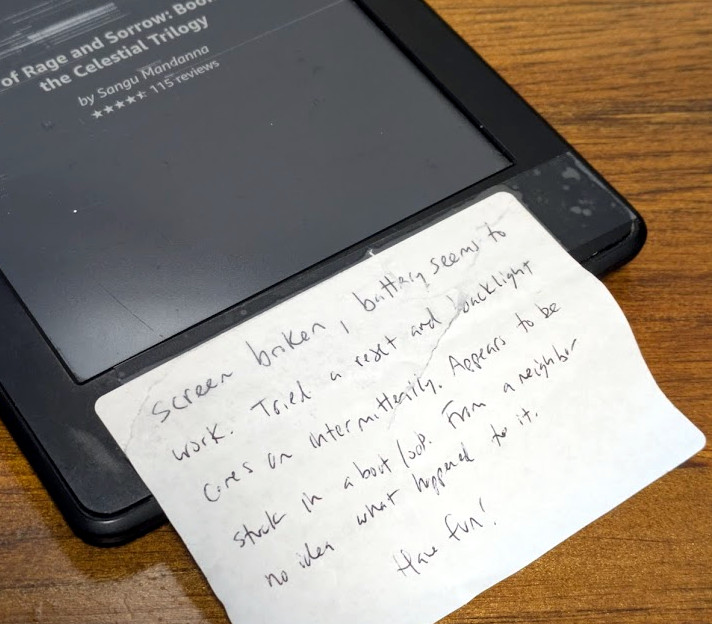
In the closing hours of JawnCon 0x2, I was making a final pass of the “Free Stuff for Nerds” table when I noticed a forlorn Kindle that had a piece of paper taped to it. The hand-written note explained that the device was in shambles — not only was its e-ink display visibly broken, but the reader was stuck in some kind of endless boot loop. I might have left it there if it wasn’t for the closing remark: “Have Fun!”

Truth is, the last thing I needed was another Kindle. My family has already managed to build up a collection of the things. But taking a broken one apart and attempting to figure out what was wrong with it did seem like it would be kind of fun, as I’d never really had the opportunity to dig into one before. So I brought it home and promptly forgot about it as Supercon was only a few weeks away and there was plenty to keep me occupied.

The following isn’t really a story about fixing a Kindle, although it might seem like it on the surface. It’s more about the experience of working on the device, and the incredible hacking potential of these unassuming gadgets. Whether you’ve got a clear goal in mind, or just want to get your hands dirty in the world of hardware hacking, you could do far worse than picking a couple of busted Kindles up for cheap on eBay.

If there’s a singular takeaway, it’s that the world’s most popular e-reader just so happens to double as a cheap and impressively capable embedded Linux development environment for anyone who’s willing to crack open the case.

Continue reading “The Unexpected Joys Of Hacking An Old Kindle”

If IRobot Falls, Hackers Are Ready To Wrangle Roombas

Things are not looking good for iRobot. Although their robotic Roomba vacuums are basically a household name, the company has been faltering financially for some time now. In 2024 there was hope of a buyout by Amazon, who were presumably keen to pull the bots into their Alexa ecosystem, but that has since fallen through. Now, by the company’s own estimates, bankruptcy is a very real possibility by the end of the year.

Hackaday isn’t a financial blog, so we won’t get into how and why iRobot has ended up here,  although we can guess that intense competition in the market probably had something to do with it. We’re far more interested in what happens when those millions of domesticated robots start getting an error message when they try to call home to the mothership.

We’ve seen this scenario play out many times before — a startup goes belly up, and all the sudden you can’t upload new songs to some weirdo kid’s media player, or the gadget in your fridge stops telling you how old your eggs are. (No, seriously.) But the scale here is unprecedented. If iRobot collapses, we may be looking at one of the largest and most impactful smart-gadget screw overs of all time.

Luckily, we aren’t quite there yet. There’s still time to weigh options, and critically, perform the kind of research and reverse engineering necessary to make sure the community can keep the world’s Roombas chugging along even if the worst happens.

Continue reading “If IRobot Falls, Hackers Are Ready To Wrangle Roombas”

Supercon 2025: Streaming Live

While we’d love to have you all join us in Pasadena, the next best thing is to connect up to the festivities through the magic of the Internet. As always, the main stage talks will be streamed live to our YouTube channel, while the talks taking place in the DesignLab will be recorded and posted afterwards.

Though it’s not quite as immersive as being in the alleyway and listening to the dogs bark (if you know, you know), you can also join the #supercon-chat channel in the official Hackaday Discord server if you want to virtually rub shoulders with some of our favorite people in the world.

Continue reading “Supercon 2025: Streaming Live”