About gynocentrism

Gynocentrism (n.) refers to a dominant focus on women’s needs and wants relative to men’s needs and wants. This can happen in the context of cultural conventions, social institutions, political policies, and in gendered relationships.1

See here for more dictionary definitions of gynocentrism

Introduction

Cultural gynocentrism emerged in Medieval Europe during a time of profound cross-cultural exchange and shifting gender customs. From the 11th century onward, European society absorbed influences ranging from Arabic love poetry to aristocratic courtship trends, alongside the rise of the Marian cult. This climate was further shaped by figures such as Eleanor of Aquitaine and her daughter Marie who transformed the ideal of chivalry into a code of male service to women —a tradition now known as courtly love.

Courtly love was popularized through the work of troubadours, minstrels, playwrights, and by commissioned romance writers whose stories laid down a model of romantic fiction that remains the most commercially successful genre of literature to this day. That confluence of factors generated the conventions that continue to drive gynocentric practices to the present.

Gynocentrism as a cultural phenomenon

The primary elements of gynocentric culture, as we experience it today, are derived from practices originating in medieval society such as feudalism, chivalry and courtly love. These traditions continue to shape contemporary society in subtle but enduring ways. In this context, various scholars and writers have described gynocentric patterns as a form of “sexual feudalism.”

For example, in 1600, the Italian writer Lucrezia Marinella observed that women of lower social classes were often treated as superiors, while men served them like knightly retainers and beasts of burden. Similarly, Modesta Pozzo, writing in 1590, remarked:

“Don’t we see that men’s rightful task is to go out to work and wear themselves out trying to accumulate wealth, as though they were our factors or stewards, so that we can remain at home like the lady of the house directing their work and enjoying the profit of their labors? That, if you like, is the reason why men are naturally stronger and more robust than us — they need to be, so they can put up with the hard labor they must endure in our service.”2

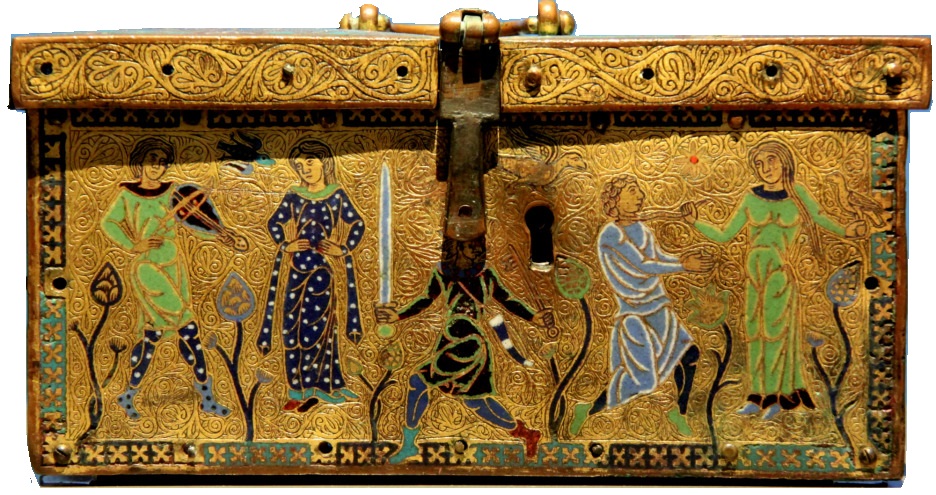
The golden casket at the head of this page depicting scenes of servile behaviour toward women were typical of courtly love culture of the Middle Ages. Such objects were given to women as gifts by men seeking to impress. Note the woman standing with hands on hips in a position of authority, and the man being led around by a neck halter, his hands clasped in a position of subservience.

It’s clear that much of what we today call gynocentrism was invented in this early period, where the feudal template was employed as the basis for a new model for love in which men would play the role of a vassal to women who assumed the role of an idealized Lord.

C.S. Lewis, in the middle of the 20th Century, referred to this historical revolution as “the feudalisation of love,” and stated that it has left no corner of our ethics, our imagination, or our daily life untouched. “Compared with this revolution,” states Lewis, “the Renaissance is a mere ripple on the surface of literature.”3 Lewis further states;

“Everyone has heard of courtly love, and everyone knows it appeared quite suddenly at the end of the eleventh century at Languedoc. The sentiment, of course, is love, but love of a highly specialized sort, whose characteristics may be enumerated as Humility, Courtesy, Adultery and the Religion of Love. The lover is always abject. Obedience to his lady’s lightest wish, however whimsical, and silent acquiescence in her rebukes, however unjust, are the only virtues he dares to claim. Here is a service of love closely modelled on the service which a feudal vassal owes to his lord. The lover is the lady’s ‘man’. He addresses her as midons, which etymologically represents not ‘my lady’ but ‘my lord’. The whole attitude has been rightly described as ‘a feudalisation of love’. This solemn amatory ritual is felt to be part and parcel of the courtly life.” 4

With the advent of (initially courtly) women being elevated to the position of ‘Lord’ in intimate relationships, and with this general sentiment diffusing to the masses and across much of the world today, we are justified in talking of a gynocentric cultural complex that affects, among other things, relationships between men and women. Further, unless evidence of widespread gynocentric culture can be found prior to the Middle Ages, then  gynocentrism is approximately 1000 years old. In order to determine if this thesis is valid we need to look further at what we mean by “gynocentrism”.

The term gynocentrism has been in circulation since the 1800’s, with the general definition being “focused on women; concerned with only women.”5 From this definition we see that gynocentrism could refer to any female-centered practice, or to a single gynocentric act carried out by one individual. There is nothing inherently wrong with a gynocentric act (eg. celebrating Mother’s Day) , or for that matter an androcentric act (celebrating Father’s Day). However when a given act becomes instituted in the culture to the exclusion of other acts we are then dealing with a hegemonic custom — i.e. such is the relationship custom of elevating women to the position of men’s social, moral or spiritual superiors.

Author of Gynocentrism Theory Adam Kostakis has attempted to expand the definition of gynocentrism to refer to “male sacrifice for the benefit of women” and “the deference of men to women,” and he concludes; “Gynocentrism, whether it went by the name honor, nobility, chivalry, or feminism, its essence has gone unchanged. It remains a peculiarly male duty to help the women onto the lifeboats, while the men themselves face a certain and icy death.”6

While we can agree with Kostakis’ descriptions of assumed male duty, the phrase gynocentric culture more accurately carries his intention than gynocentrism alone. Thus when used alone in the context of this website gynocentrism refers to part or all of gynocentric culture, which is defined here as any culture instituting rules for gender relationships that benefit females at the expense of males across a broad range of measures.

At the base of gynocentric culture lies the practice of enforced male sacrifice for the benefit of women. If we accept this definition we must look back and ask whether male sacrifices throughout history were always made for the sake women, or alternatively for the sake of some other primary goal? For instance, when men went to die in vast numbers in wars, was it for women, or was it rather for Man, King, God and Country? If the latter we cannot then claim that this was a result of some intentional gynocentric culture, at least not in the way I have defined it here. If the sacrifice isn’t intended directly for the benefit women, even if women were occasional beneficiaries of male sacrifice, then we are not dealing with gynocentric culture.

Male utility and disposability strictly “for the benefit of women” comes in strongly only after the advent of the 12th century gender revolution in Europe – a revolution that delivered us terms like gallantry, chivalry, chivalric love, courtesy, damsels, romance and so on. From that period onward gynocentric practices grew exponentially, culminating in the demands of today’s feminist movement. In sum, gynocentrism (ie. gynocentric culture) was a patchy phenomenon at best before the middle ages, after which it became ubiquitous.

With this in mind it makes little sense to talk of gynocentric culture starting with the industrial revolution a mere 200 years ago (or 100 or even 30 yrs ago), or of it being two million years old as some would argue. We are not only fighting two million years of genetic programming; our culturally constructed problem of gender inequity is much simpler to pinpoint and to potentially reverse. All we need do is look at the circumstances under which gynocentric culture first began to flourish and attempt to reverse those circumstances. Specifically, that means rejecting the illusions of romantic love (feudalised love), along with the practices of misandry, male shaming and servitude that ultimately support it.

La Querelle des Femmes, and advocacy for women

The Querelle des Femmes translates as the “quarrel about women” and amounts to what we might today call a gender-war. The querelle had its beginning in twelfth century Europe and finds its culmination in the feminist-driven ideology of today (though some authors claim, unconvincingly, that the querelle came to an end in the 1700s).

The basic theme of the centuries-long quarrel revolved, and continues to revolve, around advocacy for the rights, power and status of women, and thus Querelle des Femmes serves as the originating title for gynocentric discourse.

To place the above events into a coherent timeline, chivalric servitude toward women was elaborated and given patronage first under the reign of Eleanor of Aquitaine (1137-1152) and instituted culturally throughout Europe over the subsequent 200 year period. After becoming thus entrenched on European soil there arose the Querelle des Femmes which refers to the advocacy culture that arose for protecting, perpetuating and increasing female power in relation to men that continues, in an unbroken tradition, in the efforts of contemporary feminism.7

Writings from the Middle Ages forward are full of testaments about men attempting to adapt to the feudalisation of love and the serving of women, along with the emotional agony, shame and sometimes physical violence they suffered in the process. Gynocentric chivalry and the associated querelle have not received much elaboration in men’s studies courses to-date, but with the emergence of new manuscripts and quality English translations it may be profitable to begin blazing this trail.8

References

1. Wright, P., What’s in a suffix? taking a closer look at the word gyno–centrism
2. Modesta Pozzo, The Worth of Women: their Nobility and Superiority to Men
3. C.S. Lewis, Friendship, chapter in The Four Loves, HarperCollins, 1960
4. C.S. Lewis, The Allegory of Love, Oxford University Press, 1936
5. Dictionary.com – Gynocentric
6. Adam Kostakis, Gynocentrism Theory – (Published online, 2011). Although Kostakis assumes gynocentrism has been around throughout recorded history, he singles out the Middle Ages for comment: “There is an enormous amount of continuity between the chivalric class code which arose in the Middle Ages and modern feminism… One could say that they are the same entity, which now exists in a more mature form – certainly, we are not dealing with two separate creatures.”
7. Joan Kelly, Early Feminist Theory and the Querelle des Femmes (1982), reprinted in Women, History and Theory, UCP (1984)
8. The New Male Studies Journal has published thoughtful articles touching on the history and influence of chivalry in the lives of males.

International Men’s Day: R.S.V.P (published by Thomas Oaster – 1992)

International Men’s Day: R.S.V.P (1992 book published by Thomas Oaster).

JPG version below:

PDF version below:

Is Evolutionary Psychology a Breeding Ground For “Just-So Stories”?

Is evolutionary psychology telling ‘just-so stories’? The overload of hypotheses appears to vindicate this concern.

The table below compares the approximate number of major speculative hypotheses across several biology-based research fields, including evolutionary psychology, evolutionary biology, genetics, molecular biology, and cell biology. All of these disciplines are grounded in biological science, rather than sociology or cultural theory.

The numbers are comparative estimates derived from analyses using multiple AI systems. In this context, “major speculative hypotheses” refers to distinct, named hypotheses concerning specific traits, behaviors, or biological mechanisms that are actively discussed in the scientific literature. The purpose of the table is to highlight the substantial differences in both the number and specificity of such hypotheses across these biological disciplines.

Discipline

Approximate number of major speculative hypotheses

Evolutionary Psychology
200–500+
Evolutionary Biology
~10–20
Genetics
~10–15
Molecular Biology
~5–10
Cell Biology
~3–5

The dramatically higher number of major speculative hypotheses in evolutionary psychology has fueled one of the field’s most persistent criticisms: that many of its explanations amount to ‘just-so stories.’ Coined by critics like Stephen Jay Gould, the term refers to plausible but potentially untestable or post-hoc adaptive narratives that can be crafted for nearly any human trait or behavior. While evolutionary psychologists argue that these hypotheses generate testable predictions (unlike Kipling’s whimsical tales), the sheer volume invites scrutiny about whether some prioritize storytelling over rigorous falsification.

If a field can generate hundreds of plausible adaptive explanations for observed behaviors, but has limited means of decisively falsifying them, then narrative fit can begin to substitute for empirical constraint. The result is not necessarily false theories, but a research landscape in which speculation accumulates faster than it can be reliably pruned. A high number of competing, trait-specific adaptive hypotheses can indicate that explanations are easier to generate than to rule out, allowing plausible narratives to multiply in the absence of strong constraints. Evolutionary psychology has generated a remarkable number of hypotheses about human behavior, but this proliferation is partly driven by certain reasoning pitfalls, of which two are outlined below.

Affirming the consequent: This is a logical fallacy in which a specific observation is taken as proof of a proposed cause. In evolutionary psychology, this often looks like: “If a trait evolved for a specific purpose, we should see it today. We do see it today. Therefore, it must have evolved for that purpose.” While intuitively appealing, this reasoning is weak because the same observation could arise from many alternative causes. Yet it forms the backbone of many evolutionary “just-so” stories, making it easy to generate new hypotheses without strong empirical constraints.

Presentism:  This compounds the same tendency by interpreting modern human behaviors as direct windows into ancestral adaptations. Because our current environment differs dramatically from that of our hunter-gatherer ancestors, almost any behavior can be framed as an adaptive legacy. This encourages speculative explanations, where contemporary traits—cultural, social, or even maladaptive—are recast as evolutionary imperatives.

Together, these approaches make it easy to craft “just-so” stories, even when alternative explanations exist.

This speculative lens encourages ever more evolutionary explanations, many of which are difficult to falsify. Compared with other biology-based disciplines where mechanisms are directly testable and constrained, human behavior is proven to be complex, context-dependent, and historically distant. In evolutionary psychology, however, the combination of affirming the consequent and presentism has created fertile ground for endless adaptive storytelling, fueling both fascination and debate in the field.

Cross-cultural evidence of contemporary behaviors does not prove evolutionary history. Modern traits can emerge from culture, environment, or chance, yet they are often framed as adaptive legacies. Retain this axiom if you to keep some healthy skepticism intact:

Who First Employed The Term “Hypergamy” to Describe Non-Marital Mating Behavior: Evolutionary Psychology, Or The Manosphere?

The term “hypergamy,” traditionally rooted in marital or caste-based unions, has been extended in evolutionary psychology (EP) and lay discourse to describe women’s preferences for higher-status or higher-value partners in non-marital contexts like dating, short-term mating, serial pairings, or infidelity.

Based on publication timelines and archival searches, the earliest documented uses appear in lay manosphere writings from 2007–2008, predating explicit EP academic adoption by several years. EP’s application emerged around 2008, with growth in the 2010s tied to digital dating data and mate-switching models. Below, I outline the first identified authors, focusing on explicit uses in non-marital frames.

Lay Authors (Manosphere/PUA/Redpill)

Manosphere bloggers and forums adapted “hypergamy” early to explain women’s “branch-swinging” (trading up in casual dating or relationships) and “dual mating strategies” (short-term sex with high-value “alphas” vs. long-term provisioning from “betas”), often drawing loosely on EP but without academic rigor. This popularized the term in online dating culture.

  • Roissy (Heartiste, 2007–2008): The pseudonymous blogger behind Roissy in DC (launched October 2007) is the earliest traceable user. In early posts, he frames hypergamy as women’s instinctual drive to seek superior mates in non-marital scenarios, such as casual dating or affairs, to optimize genetic fitness. For example, a 2008 post discusses “hypergamy in action” during “one-night stands” where women select for dominance and status over emotional bonds. This ties to PUA “game” tactics for countering perceived female opportunism in hookups. Roissy’s work influenced later redpill ideology, with phrases like “hypergamy doesn’t care” emerging in dating contexts.

  • Rollo Tomassi (2011–2012): Building on Roissy, Tomassi’s The Rational Male blog (started 2011) explicitly defines hypergamy as a “subconscious drive” for non-marital upgrading, e.g., in his March 2012 post “The Hypergamy Conspiracy,” where he describes women pursuing higher-status men via “serial dating” or “mate switching” outside marriage. He credits mid-2000s PUA forums but provides the first systematic lay framework, blending it with EP concepts like short-term mating for “good genes.”

These lay uses exploded post-2012 via Reddit’s r/TheRedPill, reframing hypergamy as an “evolved hindbrain” trigger for app-based dating and infidelity, often with misogynistic overtones (e.g., “AF/BB” for casual sex dynamics).

EP Academic Authors

EP adopted the term more cautiously, initially for marital preferences, but shifted to non-marital uses in the late 2000s with studies on dating selectivity and infidelity. Earlier EP works (e.g., Buss 1989) described the pattern without the word.

  • Y. Bokek-Cohen, Y. Peres, & S. Kanazawa (2008): In “Rational Choice and Evolutionary Psychology as Explanations for Mate Selectivity” (Journal of Social, Evolutionary, and Cultural Psychology), they first explicitly apply “hypergamy” to non-marital contexts, modeling it as women’s preference for “superior physical attractiveness” in short-term dating and casual pairings. This contrasts rational choice theory with EP, using surveys to show hypergamous selectivity in initial attraction phases, not just commitment.

  • David M. Buss & Todd K. Shackelford (2008): In “Attractive Women Want It All: Good Genes, Economic Investment, Parenting Proclivities, and Emotional Commitment” (Evolutionary Psychology), they define hypergamy as “marrying up in socio-economic status” but extend it to short-term mating, where women calibrate “mate value” for genetic benefits in non-committal encounters. This marks an early EP pivot to dating and hookups, tested via cross-cultural data.

Subsequent EP works, like the 2015 Mate Switching Hypothesis (Buss et al.), built on this, framing hypergamy as “trading up” in serial dating or affairs. Usage grew with online dating studies (e.g., 2020 Oxford Handbook of Evolutionary Psychology on app-based hypergamy in hookups).

Category
Author(s)
Year
Non-Marital Context
Key Framing
Lay (Manosphere)
Roissy (Heartiste)
2007–2008
Casual dating, one-night stands
Instinctual drive for dominance in hookups to filter alphas.
Lay (Manosphere)
Rollo Tomassi
2011–2012
Serial dating, mate switching
Dual strategy: short-term sex with high-value men outside LTRs.
EP Academic
Bokek-Cohen, Peres, & Kanazawa
2008
Short-term mate selectivity
Preferences for superior traits in initial attraction/dating.
EP Academic
Buss & Shackelford
2008
Short-term mating for genes
Calibrating status in non-committal pairings.

In summary, lay manosphere authors like Roissy pioneered the explicit non-marital extension around 2007, influencing PUA/redpill dating advice, while EP academics formalized it in 2008 research studies. This parallel development shows cultural bleed: manosphere amplified a simplified version, later echoed in casual EP discussions. For verification, see archived blogs (e.g., Heartiste via Wayback Machine) or journals like Evolutionary Psychology.

Note: This analysis by AI; check cited archival material for accuracy.

Historical Outline: How “Hypergamy” Became Misused in Evolutionary Psychology and Pop Culture

1. Original use in anthropology (late 1800s–mid 1900s)

  • The term hypergamy first appears in sociological and anthropological studies of marriage systems.

  • It described marrying up in caste or class, particularly in South Asian kinship structures (e.g., anuloma marriages).

  • The term was strictly confined to marriage, not mating or sexual choice.

2. Mid-20th century sociology

  • Sociologists expanded the term to marital patterns such as:

    • educational hypergamy

    • income hypergamy

  • Still exclusively about marital unions, not dating or sex.

3. Evolutionary psychology (1980s–2000s)

  • EP researchers discussed female preferences for resources, status, or dominance.

  • But they did not originally use the term “hypergamy”—they spoke of mate preference, mate choice, or resource-acquisition preferences.

4. Misappropriation begins (2000s)

  • Online writers and early Manosphere blogs began borrowing “hypergamy” from sociology, often incorrectly assuming it meant any form of women choosing the highest-status male.

  • The nuance that the term is marriage-specific in origin was lost.

5. Pop-EP amplification (2010s–2020s)

  • Popular accounts of EP (e.g., YouTubers, bloggers, “red-pill” forums) adopted “hypergamy” as a catch-all for non-marital female mating behavior.

  • This created a disconnect between:

    • the literal etymology (marriage),

    • the academic use (marriage),

    • and the new pop-EP usage (sexual or romantic preference in any context).

  • The result is a large-scale catachresis: a word misapplied to a domain to which it does not belong.

6. Why the mistake persists

  • “Hypergamy” sounds more scientific than “preference for higher-status partners.”

  • Very few people check etymology.

  • The term gained memetic traction in online male-strategy communities.

7. Consequence

  • A whole generation of EP enthusiasts now uses a marriage-only word to describe non-marital mating behavior, undermining clarity.

Hypergamy vs. Hypergyny: Why Evolutionary Psychology Has Been Using the Wrong Word All Along

How the Misuse Spread: A Brief Historical Outline

Anthropology (late 19th–early 20th century)
  • The term hypergamy originally emerges in anthropological research on marriage systems.

  • It describes marrying upward in caste or class hierarchies, especially in South Asian kinship structures.

  • It applies exclusively to marriage, not sexual behavior, not dating, not mate preference.

Sociology (mid-20th century)
  • The term expands to describe marital unions such as:

    • educational hypergamy

    • income hypergamy

  • Again: strictly marital.

Early Evolutionary Psychology (1980s–2000s)
  • Researchers studied female mate preferences for resources, status, dominance, and protection, but:

  • They did not use the word “hypergamy.”
    Instead, they described mate choice or resource-acquisition preferences.

Online Manosphere and Pop-EP (2000s–2010s)
  • Bloggers and early “red-pill” communities encountered the word hypergamy in sociological texts and misinterpreted it as meaning:

    “Women always prefer the highest-status man.”

  • The marriage-specific nature of the term was lost.

  • The term spread memetically through:

    • blogs

    • forums

    • YouTube commentary

    • popular EP explainers

The Result

A term that had always meant “marrying upward” was suddenly being used to describe non-marital mating and sexual behavior, creating a large-scale conceptual mistake.


Why This Is a Linguistic Error: The Catachresis Problem

This widespread misuse is an example of catachresis—using a word in a way that contradicts its actual meaning or domain.

The root problem is etymological:
  • Hypergamy derives from Greek gamos = marriage.

  • It does not refer to sexual choice.

  • It does not refer to attraction.

  • It does not refer to dating, hookups, or general mate preference.

Using a marriage-specific term to describe general sexual or romantic behavior is a category mistake. It is like trying to describe casual sex with the word “matrimony” ; the semantic field simply does not match.


What Hypergamy Actually Means

Hypergamy = hyper + gamos

  • hyper- = upward

  • gamos = marriage

The literal meaning is:

“Upward marriage.”

Historically, academically, and etymologically, this term belongs to:

  • caste-marriage systems

  • class-based marital mobility

  • formal marital unions

  • sociological studies of marriage patterns

It does not belong to:

  • dating

  • short-term mating

  • hookups

  • sexual attraction

  • romantic preference

  • evolutionary mate choice contexts

The modern evolutionary-psychology usage is therefore incorrect.


What Evolutionary Psychology Actually Describes

Evolutionary psychology does not focus primarily on marriage, but on mating strategies:

  • short-term mating

  • long-term mating

  • sexual preferences

  • romantic attraction

  • mate competition

  • extra-pair mating

  • resource-based selection

These behaviors are much older than marriage, which is a relatively recent cultural institution.

So EP is fundamentally describing mate choice, not marriage choices.

The everyday statement:

“Women prefer the highest-status man available.”

…describes a mating preference, not a marriage rule.

Thus the term “hypergamy” is inappropriate for EP’s purposes.


The Correct Word: Hypergyny

If we need a term to describe female upward mate preferences across all relational contexts—sexual, romantic, or marital—then we need a term built from the correct root.

That term already exists: hypergyny.

Hyper– + gyne (woman)
  • gyne = woman

  • NOT marriage

  • Unlike gamos, it has no marital connotation.

Literal meaning:

“A woman moving upward.”

Hypergyny therefore correctly refers to:

  • any upward-directed female mate preference

  • attraction to higher-status or higher-resource males

  • upward selection in dating, mating, romance, or sex

It describes the very thing EP commentators mean without importing the erroneous assumption of marriage.


Comparison Table

Term Root Literal meaning Proper domain Accurate for EP’s female mating strategy?
Hypergamy:  gamos = marriage “Upward marriage” Marriage systems, caste/class unions No. Using it for general mating is catachresis.
Hypergyny:  gyne = woman “Woman moving upward” Any female upward-oriented choice Yes. Matches EP’s concept of status-oriented mate choice.

Conclusion

The modern discourse on female mating strategies has been built on a linguistic mistake.

  • Hypergamy has always meant upward marriage.

  • Evolutionary psychology is about mate choice, not marriage systems.

  • The popular EP usage of “hypergamy” is therefore a misuse, a category error, and a clear case of catachresis.

The scientifically and linguistically correct term is:

Hypergyny

—female upward mate preference across all sexual and romantic contexts.

Correcting this terminology not only improves clarity but also prevents the confusion that occurs when marriage-specific words are used to describe non-marital mating behavior.

Several human populations show NO EVIDENCE of the classic ~2:1 reproductive skew

Several human populations show little to no evidence of the classic ~2:1 female-to-male reproductive skew (i.e., female Ne = 2× male Ne), and in a few cases, the pattern is reversed (male Ne > female Ne). These exceptions are crucial because they prove the skew is not a universal biological law of human mating (e.g., inevitable female hypergamy or male disposability), but a cultural and historical contingency.


Populations Where the ~2:1 Skew Did Not Occur

Population
Genetic Evidence
Key Finding
Implication
Matrilineal / Matrilocal Societies
High Y-chromosome diversity relative to mtDNA
Male Ne = Female Ne (or even male Ne > female Ne)
Skew is absent or reversed when descent and residence are traced through women
Khasi (Northeast India)
Batini et al. (2019), Zeng et al. (2018)
Y-diversity not reduced; male Ne = female Ne
Matrilineal inheritance prevents lineage pruning
Mosuo (China)
Similar pattern in regional studies
Near parity in effective population sizes
Matrilocal residence disperses male genes
Minangkabau (Indonesia)
High male genetic diversity
Minimal Y-bottleneck
Largest matrilineal society (~5M people)
Nair (South India)
Historical matriliny
Genetic studies show balanced Ne
Tradition of polyandry and female-centered kinship
Some African Forager Groups
Lippold et al. (2014), Karmin et al. (2015)
No Holocene Y-bottleneck in Khoisan, Hadza, Pygmy groups
Hunter-gatherer egalitarianism avoids lineage consolidation

Populations with Reversed Skew (More Men Reproduced Than Women)Yes — male Ne > female Ne in some groups:

Population
Ratio (Male:Female Ne)
Source
Some Papua New Guinea Highland Groups
~1.5:1 to 2:1 (male > female)
Genomic studies of language-specific bottlenecks
Certain Amazonian Tribes (e.g., Yanomami subgroups)
Male Ne slightly higher
Due to female infanticide or bride capture reducing female reproduction
Historical Polynesian Isolates
Occasional male bias
Small founder effects + cultural practices
Key Paper:
Lippold et al. (2014)Human genetic diversity and the nonexistence of biological races; First to document reversed skew in some non-patrilineal populations.

Why the Skew Is Absent in These Groups

Mechanism
In Patrilineal Societies
In Matrilineal/Forager Societies
Lineage Pruning
Elite male clans dominate – most Y-lines die out
No male kin groups – Y-chromosomes stay diverse
Residence Pattern
Patrilocal: sons stay, daughters leave – male gene flow restricted
Matrilocal: men move – Y-chromosomes disperse
Inheritance
Wealth/power to sons – reproductive inequality
Often to daughters or shared – less male monopolization
Violence/Warfare
Organized between patrilines – low-status males killed/excluded
Rare or ritualized – less impact on reproduction
Quote from Batini et al. (2019):

“The strength of the bottleneck correlates with the prevalence of patrilineal kinship systems… Populations with matrilineal or bilateral descent show little or no reduction in Y diversity.”

Takeaway Argument

The 2:1 skew is not human nature — it’s a cultural artifact of patrilineal clan systems that emerged with agriculture ~5,000 years ago.
  • Where those systems never took hold (matrilineal societies, foragers), there is no skew.
  • Where female-centered kinship dominates, the genetic record is balanced or male-biased.
  • Therefore:
    You cannot cite “2 women reproduced for every 1 man” as proof of female hypergamy or male disposability — because in many human societies, that never happened.

This destroys the evosimp/red-pill appeal to “genetic inevitability”. The data shows social structure, not female choice or male competition, is the primary driver.


The Human Reproductive Skew Is Not Evidence of Female Hypergamy

The human reproductive skew is not evidence of female hypergamy. Nevertheless, it’s the favorite myth of red-pill influencers, feMRAs, and pop-evopsych evangelists who distort a genetic statistic to gaslight you into accepting and catering to gynocentrism.

The Claim You Keep Hearing

“Twice as many women as men reproduced in our evolutionary past. That proves women are hypergamous—choosy gold-diggers who only sleep with the top 20% of men.”

Wrong.

The reproductive skew—the fact that ~80% of ancestral females left descendants while only ~40% of males did—is real.
But it is not evidence of female mate choice.
It is not evidence of hypergamy.
It is not even evidence that women had any say in the matter.


What the Skew Actually Is

Genetic Fact
What It Means
Female effective population size = 2× male
Twice as many women as men contributed genes to the next generation.
~80% females reproduced
Almost every woman who reached adulthood had kids.
~40% males reproduced
Most men died genetic dead-ends.

That’s it.
That’s all the DNA tells us.
It says nothing about why.


Two Ways to Get the Same Skew:

Scenario A – Female Choice (the Red-Pill fantasy)

  • Women freely pick the richest, tallest, most dominant men.
  • Top 20% of males get 80% of the sex.
  • Bottom 80% of males get zero.
  • Result: 2:1 female-to-male reproductive ratio.

Scenario B – Male Monopolization (historical reality)

  • Warlords, kings, and chiefs use power, violence, wealth, and law to hoard women.
  • Young girls are sold, captured, or assigned as brides.
  • Low-status men are banished, killed, or priced out.
  • Result: 2:1 female-to-male reproductive ratio.

Same genetic footprint. Totally different cause.


Historical Proof That Monopolization, Not Choice, Drove the Skew

  1. Genghis Khan
    • 1 man: ~16 million male descendants today.
    • Not 16 million women choosing him.
    • Conquest, tribute, rape, and forced concubinage.
  2. Ottoman Harems
    • One sultan, 1,000+ women.
    • Zero female opt-in.
  3. West African Chiefs
    • Polygyny via bridewealth.
    • Poor men couldn’t afford one wife.
    • Women traded like livestock.
  4. Modern Cults
    • FLDS leaders exile teenage boys and assign wives.
    • No female choice. Massive skew.

These are not edge cases.
They are the rule in 85% of documented societies (Murdock’s Ethnographic Atlas).


Why “Female Choice” Is The Weaker Explanation

Argument
Reality Check
“Women evolved to pick high-status men.”
Sure—if they had the power. Most didn’t.
“Modern surveys show women want rich guys.”
Modern women have options. Ancestral women often had none.
“Dating apps prove the 80/20 rule.”
Apps are opt-in, anonymous, urban, post-feminism. Not Paleolithic.

The Genetic Data Is Agnostic

Effective population size (Ne): Female Ne = 2× male Ne.
Translation: Twice as many unique mothers as fathers.

Possible causes:

    • Women selecting alphas (low likelihood)
    • Alphas taking women by force
    • Arranged marriages
    • War killing substantial numbers of men
    • A mixture of the above

The relative influence of each of these factors varies across cultures, time periods, and ecological conditions.


David Buss Doesn’t Claim ‘The Skew’ is Evidence of Hypergamy

Buss’s work is about modern mate preferences, not ancestral monopolization.
He never says the skew “proves” hypergamy — that’s a post-hoc fan fiction by gynocentric ideologues.


The Bottom Line

Reproductive skew is evidence of asymmetric mating outcomes, not asymmetric agency. It shows some men monopolized sex—but reveals nothing indicating that women chose them freely. For this reason, we can stop letting evosimps weaponize a Y-chromosome statistic to guilt men into pandering to modern female narcissism under the false banner of “natural” hypergamy.


Further Reading

  • Zerjal et al. (2003) – The Genetic Legacy of the Mongols
  • Moore et al. (2006) – Niall of the Nine Hostages
  • Saint-Paul (2008) – Genes, Legitimacy and Hypergamy
  • Boberg-Fazli? & Sharp (2024) – Historical Hypergamy? No.

Share this every time someone drops the “2:1 women-to-men reproduced” line…. the skew is not the gotcha they think it is.