You signed in with another tab or window. Reload to refresh your session.You signed out in another tab or window. Reload to refresh your session.You switched accounts on another tab or window. Reload to refresh your session.Dismiss alert
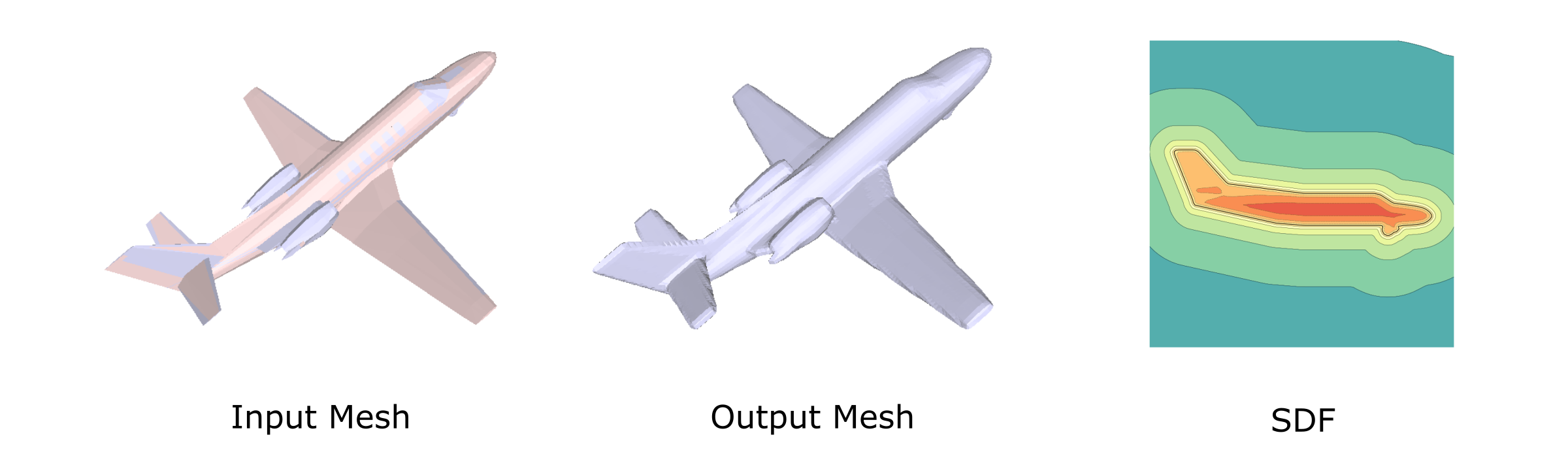
Converts an input mesh to a signed distance field. It can work with arbitrary
meshes, even non-watertight meshes from ShapeNet.
mesh2sdf is used in our paper
Dual Octree Graph Networks (SIGGRAPH 2022)
to generate the training data.
Please cite our paper if you find the code useful for your research.
Installation
mesh2sdf depends on pybind11, and C++
compilers are needed to build the code. Supported compilers are listed
here.
Install via the following command:
pip install mesh2sdf
Alternatively, install from the source code via the following commands.
After installing mesh2sdf, run the following command to process an input mesh
from ShapeNet:
python example/test.py
How does it work?
Given an input mesh, we first compute the unsigned distance field with the
fast sweeping algorithm implemented by
Christopher Batty (SDFGen).
Note that the unsigned distance field can always be reliably and accurately
computed even though the input mesh is non-watertight.
Then we extract the level sets with a small value d with the marching cube
algorithm. The extracted level sets are represented with triangle meshes and
are guaranteed to be manifold.
There exist multiple connected components in the extracted meshes, and we only
keep the mesh with the largest bounding box.
Compute the signed distance field again with the kept triangle mesh as the
final output. In this way, the signed distance field (SDF) is computed for a
non-watertight input mesh.
Citation
@article {Wang-Sig2022,
  title      = {Dual Octree Graph Networks for Learning Adaptive Volumetric
                Shape Representations},
  author     = {Wang, Peng-Shuai and Liu, Yang and Tong, Xin},
  journal    = {ACM Transactions on Graphics (SIGGRAPH)},
  volume     = {41},
  number     = {4},
  year       = {2022},
}
About
Converts an input mesh to a signed distance field (SDF)