You signed in with another tab or window. Reload to refresh your session.You signed out in another tab or window. Reload to refresh your session.You switched accounts on another tab or window. Reload to refresh your session.Dismiss alert
Responder gets you an ASGI app, with a production static files server pre-installed,
Jinja templating, and a production webserver based on uvloop, automatically serving
up requests with gzip compression.
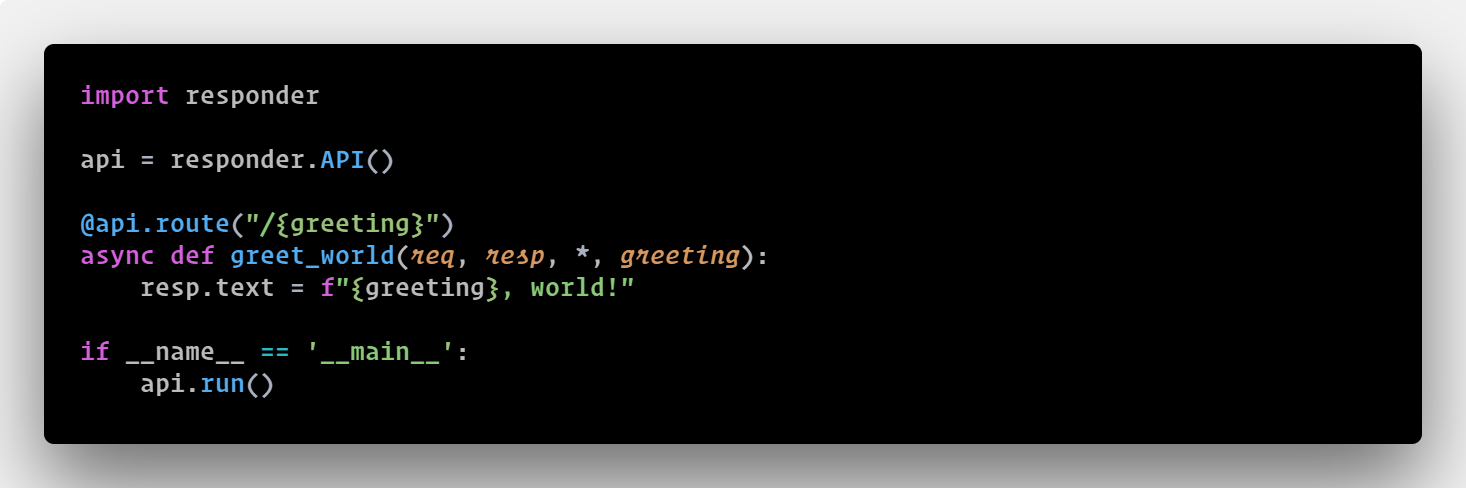
The async declaration within the example program is optional.
Testimonials
"Pleasantly very taken with python-responder.
@kennethreitz at his absolute best." —Rudraksh
M.K.
"ASGI is going to enable all sorts of new high-performance web services. It's awesome
to see Responder starting to take advantage of that." — Tom Christie author of
Django REST Framework
"I love that you are exploring new patterns. Go go go!" — Danny Greenfield, author of
Two Scoops of Django
The primary concept here is to bring the niceties that are brought forth from both Flask
and Falcon and unify them into a single framework, along with some new ideas I have. I
also wanted to take some of the API primitives that are instilled in the Requests
library and put them into a web framework. So, you'll find a lot of parallels here with
Requests.
Setting resp.content sends back bytes.
Setting resp.text sends back unicode, while setting resp.html sends back HTML.
Setting resp.media sends back JSON/YAML (.text/.html/.content override this).
resp.status_code, req.method, req.url, and other familiar friends.
Ideas
Flask-style route expression, with new capabilities -- all while using Python 3.6+'s
new f-string syntax.
I love Falcon's "every request and response is passed into to each view and mutated"
methodology, especially response.media, and have used it here. In addition to
supporting JSON, I have decided to support YAML as well, as Kubernetes is slowly
taking over the world, and it uses YAML for all the things. Content-negotiation and
all that.
A built in testing client that uses the actual Requests you know and love.
The ability to mount other WSGI apps easily.
Automatic gzipped-responses.
In addition to Falcon's on_get, on_post, etc methods, Responder features an
on_request method, which gets called on every type of request, much like Requests.
A production static file server is built-in.
Uvicorn built-in as a production web server. I would have chosen Gunicorn, but it
doesn't run on Windows. Plus, Uvicorn serves well to protect against slowloris
attacks, making nginx unnecessary in production.
GraphQL support, via Graphene. The goal here is to have any GraphQL query exposable at
any route, magically.