


Transcribe input from your microphone and turn it into key presses on a virtual keyboard. This allows you to use speech-to-text on any application or window system in Linux. In fact you can use it on the system console.

VoxInput is meant to be used with LocalAI, but it will function with any OpenAI compatible API that provides the transcription endpoint or realtime API.
- Speech-to-Text Daemon: Runs as a background process to listen for signals to start or stop recording audio.
- Audio Capture: Records audio from the microphone or any other device, including audio you are listening to.
- Transcription: Converts recorded audio into text using a local or remote transcription service.
- Text Automation: Simulates typing the transcribed text into an application using
dotool. - Voice Activity Detection: In realtime mode VoxInput uses VAD to detect speech segments and automatically transcribe them.
- Visual Notification: In realtime mode, a GUI notification informs you when recording (VAD) has started or stopped.
dotool(for simulating keyboard input)OPENAI_API_KEYorVOXINPUT_API_KEY: Your OpenAI API key for Whisper transcription. If you have a local instance with no key, then just leave it unset.OPENAI_BASE_URLorVOXINPUT_BASE_URL: The base URL of the OpenAI compatible API server: defaults tohttps://localhost:8080/v1XDG_RUNTIME_DIR: Required for PID and state files in$XDG_RUNTIME_DIR.VOXINPUT_LANG: Language code for transcription (defaults to empty).VOXINPUT_TRANSCRIPTION_MODEL: Transcription model (default:whisper-1).VOXINPUT_TRANSCRIPTION_TIMEOUT: Timeout duration (default:30s).VOXINPUT_SHOW_STATUS: Show GUI notifications (yes/no, default:yes).VOXINPUT_CAPTURE_DEVICE: Specific audio capture device name (runvoxinput devicesto list).VOXINPUT_OUTPUT_FILE: Path to save the transcribed text to a file instead of typing it with dotool.
Note: VOXINPUT_ vars take precedence over OPENAI_ vars.
Unless you don't mind running VoxInput as root, then you also need to ensure the following is setup for dotool
- Your user is in the
inputuser group - You have the following udev rule
KERNEL=="uinput", GROUP="input", MODE="0620", OPTIONS+="static_node=uinput"
This can be set in your NixOS config as follows
services.udev.extraRules = ''
KERNEL=="uinput", GROUP="input", MODE="0620", OPTIONS+="static_node=uinput"
'';-
Clone the repository:
git clone https://github.com/richiejp/VoxInput.git cd VoxInput -
Build the project:
go build -o voxinput
-
Ensure
dotoolis installed on your system and it can make key presses. -
It makes sense to bind the
recordandwritecommands to keys using your window manager. For instance in my Sway config I have the following
bindsym $mod+Shift+t exec voxinput record
bindsym $mod+t exec voxinput write
Alternatively you can use the Nix flake.
The LANG and VOXINPUT_LANG environment variables are used to tell the transcription service which language to use.
For multi-lingual use set VOXINPUT_LANG to an empty string.
The pop-up window showing when recording has begun can be disabled by setting VOXINPUT_SHOW_STATUS=no or --no-show-status.
-
listen: Start speech to text daemon.--replay: Play the audio just recorded for transcription (non-realtime mode only).--no-realtime: Use the HTTP API instead of the realtime API; disables VAD.--no-show-status: Don't show when recording has started or stopped.--output-file <path>: Save transcript to file instead of typing.
./voxinput listen
-
record: Tell existing listener to start recording audio. In realtime mode it also begins transcription../voxinput record
-
writeorstop: Tell existing listener to stop recording audio and begin transcription if not in realtime mode.stopalias makes more sense in realtime mode../voxinput write
-
toggle: Toggle recording on/off (start recording if idle, stop if recording)../voxinput toggle
-
status: Show whether the server is listening and if it's currently recording../voxinput status
-
devices: List capture devices../voxinput devices
-
help: Show help message../voxinput help -
ver: Print version../voxinput ver
-
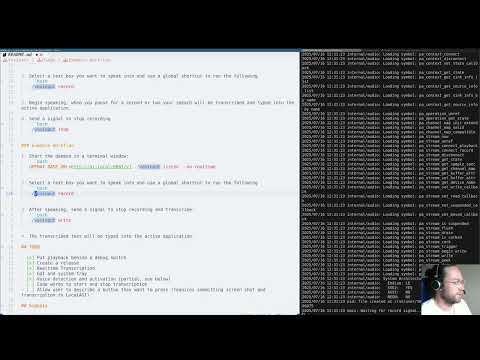
Start the daemon in a terminal window:
OPENAI_BASE_URL=https://ai.local:8081/v1 OPENAI_WS_BASE_URL=ws://ai.local:8081/v1/realtime ./voxinput listen
-
Select a text box you want to speak into and use a global shortcut to run the following
./voxinput record
-
Begin speaking, when you pause for a second or two your speach will be transcribed and typed into the active application.
-
Send a signal to stop recording
./voxinput stop
-
Start the daemon in a terminal window:
OPENAI_BASE_URL=https://ai.local:8081/v1 ./voxinput listen --no-realtime
-
Select a text box you want to speak into and use a global shortcut to run the following
./voxinput record
-
After speaking, send a signal to stop recording and transcribe:
./voxinput write
-
The transcribed text will be typed into the active application.
To create a transcript of an online meeting or video stream by capturing system audio:
-
List available capture devices:
./voxinput devices
Identify the monitor device, e.g., "Monitor of Built-in Audio Analog Stereo".
-
Start the daemon specifying the device and output file:
VOXINPUT_CAPTURE_DEVICE="Monitor of Built-in Audio Analog Stereo" ./voxinput listen --output-file meeting_transcript.txtNote: Add
--no-realtimeif you prefer the HTTP API. -
Start recording:
./voxinput record
-
Play your online meeting or video stream; the system audio will be captured.
-
Stop recording:
./voxinput stop
-
The transcript is now in
meeting_transcript.txt.
- Follow https://localai.io/installation/ to install LocalAI, the simplest way is using Docker:
docker run -p 8080:8080 --name local-ai -ti localai/localai:latest-
Open https://localhost:8080 in your browser to access the LocalAI web interface and install the whisper-1 and silero-vad-ggml models.
-
Test out VoxInput:
VOXINPUT_TRANSCRIPTION_MODEL=whisper-1 VOXINPUT_TRANSCRIPTION_TIMEOUT=30s voxinput listen
voxinput record && sleep 30s && voxinput write
The realtime mode has a UI to display various actions being taken by VoxInput. However you can also read the status from the status file or using the status command, then display it via your desktop manager (e.g. waybar). For an example see the PR which added it.
- Put playback behind a debug switch
- Create a release
- Realtime Transcription
- GUI and system tray
- Voice detection and activation (partial, see below)
- Code words to start and stop transcription
- Allow user to describe a button they want to press (requires submitting screen shot and transcription to LocalAGI)
SIGUSR1: Start recording audio.SIGUSR2: Stop recording and transcribe audio.SIGTERM: Stop the daemon.
This project is licensed under the MIT License. See the LICENSE file for details.
- malgo for audio handling.
- go-openai for OpenAI API integration.
- numen and dotool, I did consider modifying numen to use LocalAI, but decided to go with a new tool for now.
Feel free to contribute or report issues! 😊