You signed in with another tab or window. Reload to refresh your session.You signed out in another tab or window. Reload to refresh your session.You switched accounts on another tab or window. Reload to refresh your session.Dismiss alert
Index your Python objects for fast lookup by their attributes.
Install
pip install ducks
Usage
The main container in ducks is called Dex.
from ducks import Dex
# make some objects
objects = [
    {'x': 3, 'y': 'a'},
    {'x': 6, 'y': 'b'},
    {'x': 9, 'y': 'c'}
]
# Create a Dex containing the objects.
# Index on x and y.
dex = Dex(objects, ['x', 'y'])
# match objects
dex[{
    'x': {'>': 5, '<': 10},  # where 5 < x < 10
    'y': {'in': ['a', 'b']}  # and y is 'a' or 'b'
}]
# result: [{'x': 6, 'y': 'b'}]
This is a Dex of dicts, but the objects can be any type, even primitives like strings.
Dex supports ==, !=, in, not in, <, <=, >, >=.
The indexes can be dict keys, object attributes, or custom functions.
See Quick Start for more examples of all of these.
Is ducks fast?
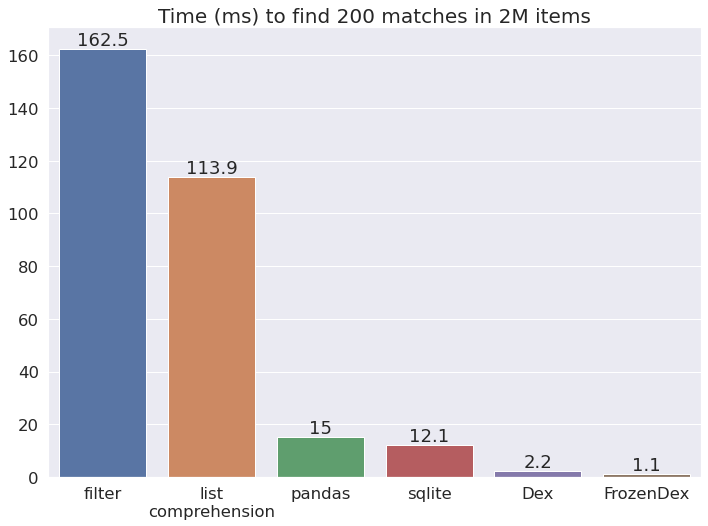
Yes. Here's how the ducks containers compare to other datastores on an example task.
In this benchmark, two million objects are generated. Each datastore is used to find the subset of 200 of them that match
four constraints. The ducks containers Dex and FrozenDex are shown to be very efficient at this, outperforming by 5x and
and 10x respectively.