You signed in with another tab or window. Reload to refresh your session.You signed out in another tab or window. Reload to refresh your session.You switched accounts on another tab or window. Reload to refresh your session.Dismiss alert
textX is a meta-language for building Domain-Specific Languages (DSLs) in
Python. It is inspired by Xtext.
In a nutshell, textX will help you build your textual language in an easy way.
You can invent your own language or build a support for already existing textual
language or file format.
From a single language description (grammar), textX will build a parser and a
meta-model (a.k.a. abstract syntax) for the language. See the docs for the
details.
textX follows the syntax and semantics of Xtext but differs in some
places and is
implemented 100% in Python using Arpeggio PEG parser - no grammar ambiguities,
unlimited lookahead, interpreter style of work.
Quick intro
Here is a complete example that shows the definition of a simple DSL for
drawing. We also show how to define a custom class, interpret models and search
for instances of a particular type.
fromtextximportmetamodel_from_str, get_children_of_typegrammar="""Model: commands*=DrawCommand;DrawCommand: MoveCommand | ShapeCommand;ShapeCommand: LineTo | Circle;MoveCommand: MoveTo | MoveBy;MoveTo: 'move' 'to' position=Point;MoveBy: 'move' 'by' vector=Point;Circle: 'circle' radius=INT;LineTo: 'line' 'to' point=Point;Point: x=INT ',' y=INT;"""# We will provide our class for Point.# Classes for other rules will be dynamically generated.classPoint:
def__init__(self, parent, x, y):
self.parent=parentself.x=xself.y=ydef__str__(self):
return"{},{}".format(self.x, self.y)
def__add__(self, other):
returnPoint(self.parent, self.x+other.x, self.y+other.y)
# Create meta-model from the grammar. Provide `Point` class to be used for# the rule `Point` from the grammar.mm=metamodel_from_str(grammar, classes=[Point])
model_str=""" move to 5, 10 line to 10, 10 line to 20, 20 move by 5, -7 circle 10 line to 10, 10"""# Meta-model knows how to parse and instantiate models.model=mm.model_from_str(model_str)
# At this point model is a plain Python object graph with instances of# dynamically created classes and attributes following the grammar.defcname(o):
returno.__class__.__name__# Let's interpret the modelposition=Point(None, 0, 0)
forcommandinmodel.commands:
ifcname(command) =='MoveTo':
print('Moving to position', command.position)
position=command.positionelifcname(command) =='MoveBy':
position=position+command.vectorprint('Moving by', command.vector, 'to a new position', position)
elifcname(command) =='Circle':
print('Drawing circle at', position, 'with radius', command.radius)
else:
print('Drawing line from', position, 'to', command.point)
position=command.pointprint('End position is', position)
# Output:# Moving to position 5,10# Drawing line from 5,10 to 10,10# Drawing line from 10,10 to 20,20# Moving by 5,-7 to a new position 25,13# Drawing circle at 25,13 with radius 10# Drawing line from 25,13 to 10,10# Collect all points starting from the root of the modelpoints=get_children_of_type("Point", model)
forpointinpoints:
print('Point: {}'.format(point))
# Output:# Point: 5,10# Point: 10,10# Point: 20,20# Point: 5,-7# Point: 10,10
Video tutorials
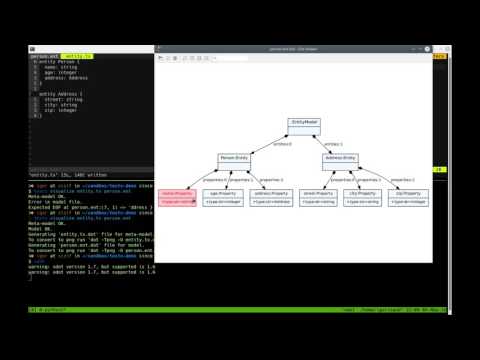
Introduction to textX
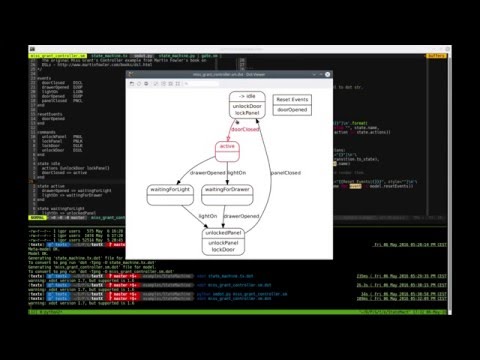
Implementing Martin Fowler's State Machine DSL in textX