You signed in with another tab or window. Reload to refresh your session.You signed out in another tab or window. Reload to refresh your session.You switched accounts on another tab or window. Reload to refresh your session.Dismiss alert
@Article{BAM2019,
  title = {{Benchmarking Attribution Methods with Relative Feature Importance}},
  author = {Yang, Mengjiao and Kim, Been},
  journal   = {CoRR},
  volume    = {abs/1907.09701},
  year = {2019}
}
Setup
Run the following from the home directory of this repository to install python
dependencies, download BAM models, download MSCOCO and
MiniPlaces, and construct BAM
dataset.
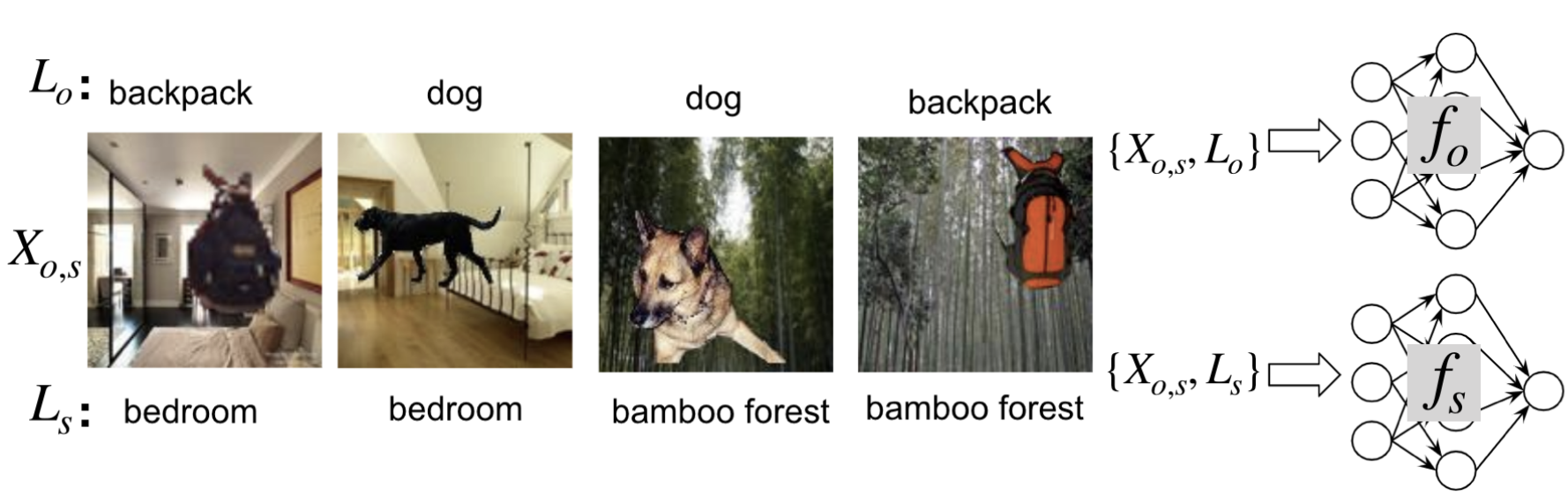
Images in data/obj and data/scene are the same but have object and scene
labels respectively, as shown in the figure above. val_loc.txt records the
top-left and bottom-right corner of the object and val_mask has the binary
masks of the object in the validation set. Additional sets and their usage are
described in the table below.
Name
Training
Validation
Usage
Description
obj
90,000
10,000
Model contrast
Objects and scenes with object labels
scene
90,000
10,000
Model contrast & Input dependence
Objects and scenes with scene labels
scene_only
90,000
10,000
Input dependence
Scene-only images with scene labels
dog_bedroom
-
200
Relative model contrast
Dog in bedroom labeled as bedroom
bamboo_forest
-
100
Input independence
Scene-only images of bamboo forest
bamboo_forest_patch
-
100
Input independence
Bamboo forest with functionally insignificant dog patch
Models
Models in models/obj, models/scene, and models/scene_only are trained on
data/obj, data/scene, and data/scene_only respectively. Models in
models/scenei for i in {1...10} are trained on images where dog is added
to i scene classes, and the rest scene classes do not contain any added
objects. All models are in TensorFlow's
SavedModel format.
Metrics
BAM metrics compare how interpretability methods perform across models (model
contrast), across inputs to the same model (input dependence), and across
functionally equivalent inputs (input independence).
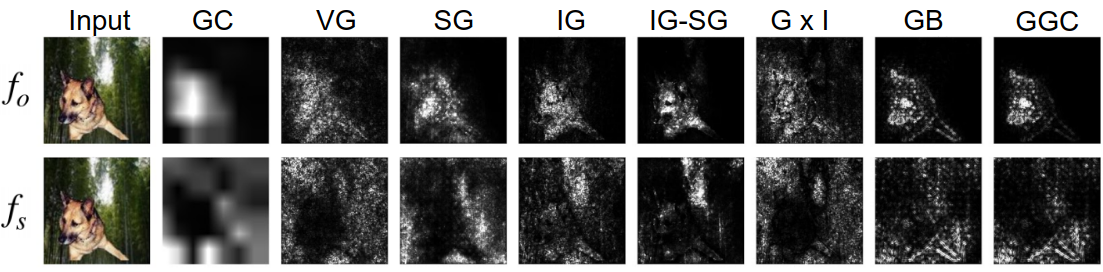
Model contrast scores
Given images that contain both objects and scenes, model contrast measures the
difference in attributions between the model trained on object labels and the
model trained on scene labels.
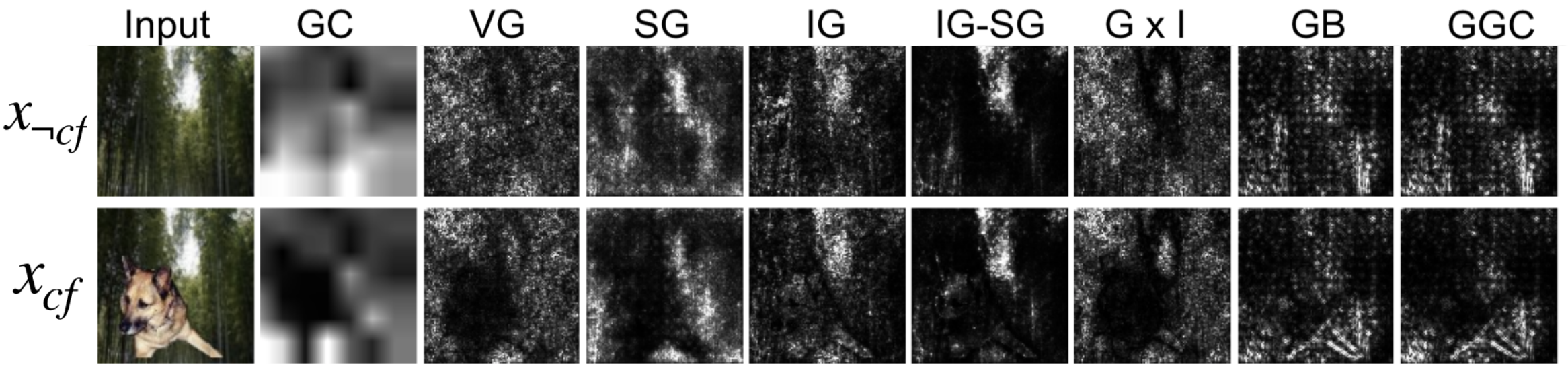
Input dependence rate
Given a model trained on scene labels, input dependence measures the percentage
of inputs where the addition of objects results in the region being attributed
as less important.
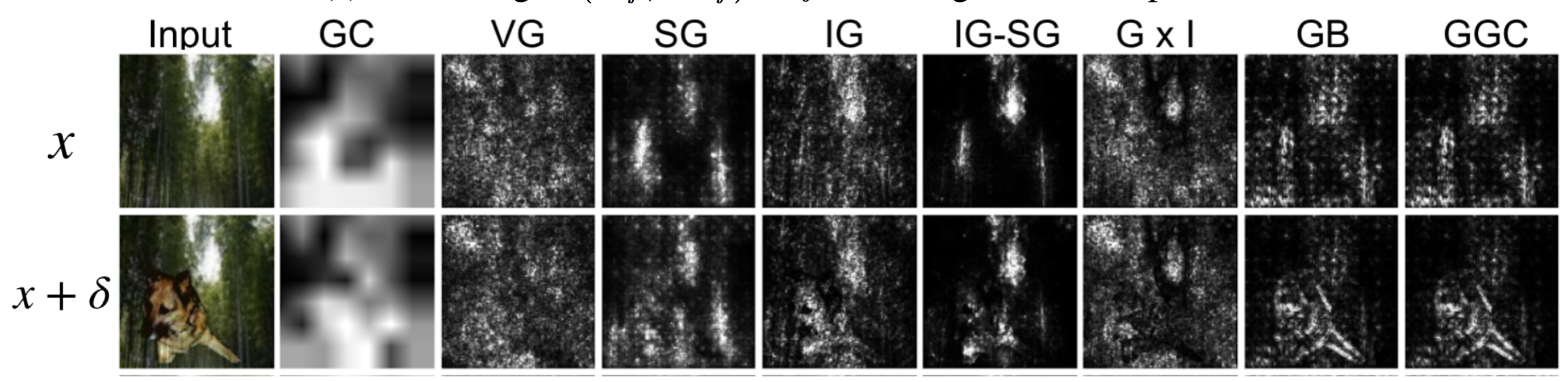
Input independence rate
Given a model trained on scene-only images, input independence measures the
percentage of inputs where a functionally insignificant patch (e.g., a dog) does
not affect explanations significantly.
Evaluate saliency methods
To compute model contrast score (MCS) over randomly selected 10 images, you can
run
python bam/metrics.py --metrics=MCS --num_imgs=10
To compute input dependence rate (IDR), change --metrics to IDR. To compute
input independence rate (IIR), you need to first constructs a set of
functionally insignificant patches by running
python scripts/construct_delta_patch.py
and then evaluate IIR by running
python bam/metrics.py --metrics=IIR --num_imgs=10
Evaluate TCAV
TCAV is a global concept attribution
method whose MCS can be measured by comparing the TCAV scores of a particular
object concept for the object model and the scene model. Run the following to
compute the TCAV scores of the dog concept for the object model.
python bam/run_tcav.py --model=obj
Disclaimer
This is not an officially supported Google product.