

|

|
| CARVIEW |


Oct 23-24th Tacoma
25th-27th- Seattle
28th-29th- Olympia
CONFIRMEDNovember 2nd: Winona- Julia
3rd: Minneapolis- NEED A SPACE
CONFIRMED 4th: Madison- LGBT Outreach Center after party at Plan B
CONFIRMED 5th: Milwaukee- Brewing Grounds For Social Change
CONFIRMED 6th: Chicago- Ryry’s place SHOPPING
7th: Bloomington-
CONFIRMED 8th: Bloomington- Boxcart Books
9th: Bloomington-
CONFIRMED 10th: Columbus- Sporeprint Infoshop
CONFIRMED 11th: Oberlin University- lecture, Intro to kink workshop(heather) and a PLAY PARTY! just for us
Contacted 12th: Detroit- Lance NEED A SPACE
13th: Toledo- NEED A SPACE
14th: Pitt City- ? NEED A SPACE
15th: day off
Confirmed16th: New York-Bluestockings
Confirmed 17th: New York – NYU
Confirmed 18th: Philadelphia-Wooden Shoe Books
19th: Philadelphia-
20th: Baltimore- Porter NEED A SPACE
Confirmed 21st: Frederick- Frederick community center
21st- 4:30pm to 9 Frederick Maryland 4 east church st community room B
22nd: Richmond- ?
Confirmed 23rd: Carrboro- Internationalist Bookstore, 7 pm– maybe also UNC (in progress)
24th: Asheville- In progress
25th: Asheville- day off
26th: Lexington- Don NEED TO TALK WITH DON
27th: Louisville- Ariel ?
28th: St. Louis- Chris and Scott ?
29th: Drive the fuck back to milwaukee and trash talk.
November 2nd: Winona, MN
3rd: Minneapolis, MN – 3pm / Walker Library Meeting Room (upstairs)
4th: Madison, WI – LGBT Outreach Center / after party at Plan B
5th: Milwaukee, WI – Brewing Grounds For Social Change
8th: Bloomington, IN – 6:30pm / Boxcar Books
10th: Columbus, OH – Sporeprint Infoshop
11th: Oberlin University, OH
14th: Pittsburgh, PA – 5pm / The Big Idea
16th: New York, NY – 7pm / Bluestockings Bookstore
17th: New York, NY – NYU
18th: Philadelphia, PA – 7pm / Wooden Shoe Books
20th: Baltimore, MD
21st: Frederick, MD – 4:30pm / 4 East Church St / Community Center / room B
22nd: Washington, D.C. – 6pm / DC Center @ 13th & U
23rd: Carrboro, NC – 7pm / Internationalist Bookstore
24th: Asheville, NC – 7pm / Boba Gallery
26th: Nashville, TN
27th: Louisville, KY
30th: Milwaukee, WI – 6pm / Cream City Collectives 732 E. Clarke St
and let us make us a name,
lest we be scattered abroad
upon the face of the whole earth.
In our most complete work ever, we draw out a critique of the world’s reproductive apparatuses, namely creationism, procreationism (babymaking), and re-creationism (the production of new selves/identities), while dropping some bits of cruel thought about ending the future, abortion, devastating the positive queer project, and necrophilia.
The full text appears in issue 6, which can be found here. What follows is a juicy tidbit:
]]>The common essence of monist, binary, and pluralist ontology is the elevation of the subject to a (singular or multiple) substance—the failure to grasp the nothingness that defines subjectivity. The question of ‘why am I?’ contains its own answer. Without a subject to pose the question, the question could not be posed. No reproductive apparatus is necessary to create or explain subjectivity. The origin and definition of subjectivity is the abyss; all else consists of substance that is constructed around the void and mistaken as the self. When we say that the self consists of a nothingness, this is the same as the assertion that there is no self.
The avant-garde of capitalism has been misconstrued as its enemy. Granted that the destruction of reproduction is the project of queer negation, what has come to be known as ‘radical queerness’ is a largely positive, rather than purely negative, project. In opposition to the world of binary gender, procreationism, the family, politics, modernism, structuralism, dialectics, &c., the ‘queer revolt’ posits pluralist gender, re-creationism, the identity group, identification, postmodernism, post-structuralism, multiplicitous struggle, &c. The latter constitute the reproductive apparatuses of the pluralist existent.
In a crucial point of emergence long ago, woman established herself as existent rather than plunge the monist world of Man into the void from which she came. In another, the proletariat struggled to secure its autonomous liberation from the bourgeoisie rather than destroy the bourgeoisie and itself entirely. On the stage set by the present order, the queer force is making itself busy with the proliferation of identities rather than the utter negation of them.
In the re-creationist order, life is experienced as void and death as the only escape. Such is not far from the truth. For those singularities which are born or incorporated into the reproductive order of identification—which now includes even woman, the proletariat, the queer, the hipster, the anarchist and all the rest—the void is no longer experienced as something outside the castle, but as dwelling within.
Like the negative project of the proletariat, the negative queer project entails the negation of the existent, of the existent’s reproductive apparatuses, and of itself. What’s more, the latter’s self-abolition must take place not only as death, but also the murder of a certain kind of death. This is because even suicide, or self-abolition, has been subsumed under the process of re-creationism. Death is necessary in the process of self-creation because in the act of becoming, one kills the old version of himself. In order to destroy the reproductive process of re-creation, the queer must destroy the latter’s false version of suicide. The queer death-drive is an urge for pure suicide, which is also pure murder.
– Susan Stryker
“My Words to Victor Frankenstein Above the Village of Chamounix: Performing Transgender Rage”
– Bakunin
We have been robbed of our anuses, just so they can turn them into parts for their ignominious machine which produces Capital, exploitation, and the Family. Reduced to its most practical biological functions the anus is becoming fortress—impenetrable, singular, productive. Our very excrement is assigned commercial value—so many nutrients per cubic foot, average moisture content, cost of processing.
To reject the commodity logic of shit, we embrace the anus becoming flower—pleasurable, penetrable, commune. The anus has five muscles; the flower, five petals; the fist, five fingers.† The anus is the common sexual nexus, an enclosure in the commons of pleasure. We refuse the mediation of our anuses under the logic of biopower‡, instead unveiling their insurgence by elaborating a logic of scat. In other words, the anuses of our revolt are scatological rather than biological.
The human strike blossoms at every point of rupture; which is to say, at every point of emergence. Let us speak of the anal rupture, the emergence of fecal matter from our bodies. The human scatological strike will produce nothing in the act of defecation; while leaving nothing behind but an empty rectum. In the space of this void, we become whatever singularities.†† Our feces, freed from the logic of capital, take lines of flight toward police, while our anuses, no longer mere appendages of flesh upon a machine of nitrate circulation, are filled with found objects. Our anuses becoming… cumming glitter, shit, whatever.
SHiT oN eVeRYTHiNG,
_ | _
. / \ the pentagon bumfuck committee

†† Whatever, singularities.
Bibliography
“12 Feces of Insurrecto-fascism.” bashbacknews dot wordpress dot com.
“How is it to be done?” TIQQUN. bloom0101 dot org.
Sims, Michael. Adam’s Navel: A Natural and Cultural History of the Human Form. 2003.
]]>
We must reject all normalization—without illusions. What’s needed is not passivity, and even far less activism, but a putting-into-practice of inoperative rupture, a negation of the logic of normalization in all its forms. In the realization of zones of offensive capacity, we destroy those who would have us give up the singular ecstasy of desiring bodies for the banality of reformism. Every smashed window is a refusal to negotiate, a blow against the structure of the mileu, a recognition of the inoperative teleology inherent in the articulation of becomings.
To those who deride the immanent joy in an act of public sex or a car set aflame, we propose nothing less than to shatter their pathetic impotentiality, without looking back. The compulsive representation proposed to us is like a bad joke, and instead of laughter we respond with riot. This is a call to insurrection, not an insistence on mobilization. Our desire to genderfuck is less the articulation of a concept than the elaboration of a line of flight.
Confronted with those who neglect to recognize themselves in our orgies of destruction, we offer neither dialogue nor sympathy but only social war. It is necessary to commence in secret; not to dream of new ways to organize, but to make manifest the subterranean communes in the heart of each wild orgy.
]]>Hell hath no fury like a drag queen scorned.
– Silvia Rivera
The chronology below requires little introduction; the actions of all these rioters speak for themselves. Suffice to say that this chronology is a small attempt to address a fallacy in popular conceptions of insurrection—that insurrection is ‘macho,’ masculine, or that it reinforces gender norms. It should also address another fallacy in the commonly understood chronology of queer and trans resistance—the one that says “Stonewall was first.”
A note on language. Any terms we apply anachronistically will fail to reflect the ways these individuals and collectives identified. Moreover, we have first-hand accounts from none of these rioters, except some Stonewall and Compton’s participants. Since any language we choose for such a broad span of time, place and culture will be historically inaccurate, we just say genderfuck insurrection. It has the nicest ring to our ears.
Genderfuck is an active term; it speaks of a force that acts upon gender normality. This is more interesting to us than other terms that are passive and speak of identity, which attempt to freeze and quarantine gender transgression into special individuals.
Our tour begins in Greece, the cradle of democracy and the location of the most recent massive insurrection against the false hope of democracy…
390 – Thessalonica, Greece. Butheric, the commander of the militia, arrested a popular circus performer under a new law that punished “male effeminacy.” The people of Thessalonica, who loved the performer, rose up in rebellion and killed Burtheric. In response to the insurrection, authorities rounded up and massacred three thousand people.
1250 – Southern France. A small crowd of cross-dressed males pranced into the home of a wealthy landowner. They sang “We take one and give back a hundred,” and ignored the protestations of the lady of the house as they looted the estate of every possession.
1450-51 – Cade’s Rebellion in Kent & Essex, England. Led by the “servants of the Queen of the Fairies,” the peasants broke into the Duke of Buckingham’s land and took his bucks and does.
1530 – ‘New Spain.’ During his campaign of conquest against communities of resistance in western portions of “New Spain,” Spanish conquistador Nuño de Guzmán wrote of a battle. The very last indigenous warrior taken prisoner after the battle was, in the conquistador’s words, “a man in the habit of a woman” who had “fought most courageously.”
16th century – Europe. Urban carnivals throughout Europe integrated cross-dressing and masks as key elements. The festivals were organized by societies of unmarried ‘men’ with trans personalities. They were called the Abbeys of Misrule, Abbots of Unreason, ‘Mére Folle and her children,’ and others. During festival, they would ‘hold court’ with mock marriages and issue coins to the crowds. They made fun of the government, critiqued the clergy, and protested war and the high cost of bread.
1629 – Essex, England. Grain riot led by ‘Captain’ Alice, who was trans.
1630 – Dijon, France. Mére Folle and her Infanterie went beyond throwing carnivals and mocking elites. They led an uprising against royal tax officers. As a result, a furious royal edict abolished the Abbey of Misrule.
1631 – England. Riots again enclosure led by ‘Lady Skimmington’ drag mob.
1645 – Montpellier, France. Tax revolt led by La Branlaire, who was called by a term for masculine women.
1720 – The Caribbean Sea. Untold numbers of trans pirates sailed across the open seas in the Golden Age of Piracy. It was not altogether uncommon at the time for “women” to “pass as men” while sailing in the navy, on mercantile ships, and as pirates. The two most well-known trans pirates of the era are Read and Bonn. They sailed together with Captain John Rackham, and their stories are known from when they were put on trial for piracy. They were said to be the most fierce and courageous fighters in their crew. Like most pirates, they were faggots.
1725 – Covent Garden Molly House Rebellion, London, England. Since 1707, the Societies for the Reformation of Manners carried out systematic attacks on London’s queer underground. More than 20 “molly houses” were raided by police in London and many “mollies” (mtfs) publicly dragged and hung for cross-dressing. But on one day in 1725, the police attempted a raid of a Covent Garden molly house, and the crowd of mollies, many in drag, fiercely and violently fought back.
1728-1749 – Toll Gate Riots in England. “To cite but four examples, toll gates were demolished by bands of armed men dressed in women’s clothing and wigs in Somerset in 1731 and 1749, in Gloucester in 1728 and in Herefordshire in 1735.”
1736 – Edinburgh, Scotland, “the Porteous Riots, which were sparked by a hated English officer and oppressive custom laws and expressed resistance to the union of Scotland and England, were carried out by men disguised as women and with a leader known as Madge Wildfire.”
1760s – White Boy commons restoration movement in Ireland. The ‘White Boys,’ a peasant guerrilla group who called themselves ‘fairies’ and did mischief at night, were a central feature of the rural class war. They destroyed enclosures, sent threatening letters to elites, reclaimed properties seized by landlords, and freed bound apprentices. They were finally put down by armed force. Their spirit inspired the formation of the ‘Lady Rocks’ and ‘Lady Clares’ in the 1820s and 1830s, and the later Ribbon Societies and Molly Maguires—all were involved in Ireland’s anti-enclosure and anti-colonial struggles and all cross-dressed.
1770s – Beaujolais, France. ‘Male’ peasants dressed as women attacked surveyors assessing their lands for a new landlord.
1812 – ‘General Ludd’s wives’ loom riot, Stockton, England. One of the early Luddite Rebellions against the Industrial Revolution was led by “General Ludd’s wives,” two cross-dressed workers. The mob of hundreds broke windows, stoned the house of Joseph Goodair, a factory owner, and later set fire to his house. They destroyed the products in the steam loom factory, smashed the looms and burned the factory to the ground. The rioting went on for four days until it was stopped by the military at Stockport, and then broke out again at Oldham.
1820s – Ireland. The ‘Lady Rocks’ militant Irish resistance group active; inspired by the White Boys, they wore bonnets and veils.
1829 – The War of the Demoiselles in the Pyrenees. A peasant uprising against restrictive forest code in which the peasants cross-dressed.
1830s – Ireland. The ‘Lady Clares’ militant Irish resistance group active; inspired by the White Boys, their ‘official’ costume was cross-dressing.
1839-1844 – Welsh Toll-gate Riots, carried out by ‘Rebecca and her daughters.’ One well-documented instance was on May 13, 1839. At dusk, a call of horns, drums and gunfire are be heard across the western Welsh countryside. Armed male peasants, dressed as women, thunder up on horseback, waving pitchforks, axes, scythes, and guns. As they storm the toll gate their leader roars: “Hurrah for free laws! Toll gates free to coal pits and lime kilns!” These demands are punctuated by a cacophony of music, shouts, and shotgun blasts. The rebel troops smash the toll barriers and ride away victorious. They call themselves “Rebecca and her daughters.” The Rebeccas are active for four years in Wales, leading thousands of cross-dressed “daughters” in the destruction of turnpike toll barriers. They receive widespread popular support.
1843 – Militant resistance group the ‘Molly Maguires’ active in Ireland. Inspired by the White Boys, the word “Molly” was the vernacular equivalent of what we might call “queen” today.
1959 – Cooper’s Donuts Riot, LA Los Angeles, May 1959. Police attempted a raid on Cooper’s Doughnuts, a late-night hangout for drag queens, butch hustlers, street queens and johns. The cops demanded IDs. The queers fought back. Doughnuts and coffee cups become projectiles. Fighting spilled out onto the street. The cops, taken by storm, called for backup. Rioters were arrested and the street was closed off for a day.
1966 – Compton’s Cafeteria Riot, San Francisco, August 1966. Compton’s Cafeteria, an all-night hangout for drag queens, and hustlers in the Tenderloin neighborhood. The restaurant management called the police on a group of young queens who were being rowdy. A police officer who was used to roughing up Compton’s regulars grabbed a queen. She threw her coffee in his face. A fight broke out. Plates, trays, cups, and furniture were thrown. The plate-glass windows of the restaurant were smashed. Police called for backup as the riot took the street. The windows of a cop car were smashed and a newspaper stand went up in flames.
1969 – Stonewall Riot, New York City, June 28. The police conduct a ‘routine’ raid of the Stonewall Inn in Greenwich Village. They began to round up trans people, drag queens and kings to be arrested for cross-dressing, which was illegal. Hostility grew and grew until an officer shoved a queen, who responded by hitting him on the head with her purse. The crowd became fierce. Cops were pelted, first with coins and then with bottles and stones. When a bull-dyke resisting arrest called to the crowd for support, the situation exploded. The crowd tried to topple the paddy wagon while the police vehicles got their tires slashed. The crowd, already throwing beer bottles, discovered a cache of bricks at a construction site. Cops were forced to barricade themselves inside the Inn. Garbage cans, garbage, bottles, rocks, and bricks were hurled at the building, breaking the windows. Rioters ripped up a parking meter and used it as a battering ram. The mob lit garbage on fire and sent it through the broken windows; squirted lighter fluid inside and lit it. Riot police arrived on the scene, but were unable to regain control of the situation. Drag queens danced a conga line and sang songs amidst the street fighting to mock the inability of the police to re-establish order. The rioting continued until dawn, and for the next four days. Crowds filled the streets and smashed more cop cars, set more fires, and looted stores.
1970 – New York City. Marsha P. Johnson and Sylvia Rivera, veterans of the Stonewall riots, formed the Street Transvestite Action Revolutionaries (STAR). Marsha and Sylvia opened the STAR house for homeless drag queens and runaway queer youth to stay in. The house mothers hustled to pay rent so their kids wouldn’t have to. The youth, in turn, stole food to bring home. STAR linked up with the Young Lords, a revolutionary Puerto Rican group, and with the Black Panther Party.
Hell hath no fury like a drag queen scorned. – Silvia Rivera
The chronology below requires little introduction; the actions of all these rioters speak for themselves. Suffice to say that this chronology is a small attempt to address a fallacy in popular conceptions of insurrection—that insurrection is ‘macho,’ masculine, or that it reinforces gender norms. It should also address another fallacy in the commonly understood chronology of queer and trans resistance—the one that says “Stonewall was first.”
A note on language. Any terms we apply anachronistically will fail to reflect the ways these individuals and collectives identified. Moreover, we have first-hand accounts from none of these rioters, except some Stonewall and Compton’s participants. Since any language we choose for such a broad span of time, place and culture will be historically inaccurate, we just say genderfuck insurrection. It has the nicest ring to our ears.
Genderfuck is an active term; it speaks of a force that acts upon gender normality. This is more interesting to us than other terms that are passive and speak of identity, which attempt to freeze and quarantine gender transgression into special individuals.
Our tour begins in Greece, the cradle of democracy and the location of the most recent massive insurrection against the false hope of democracy…
390 – Thessalonica, Greece. Butheric, the commander of the militia, arrested a popular circus performer under a new law that punished “male effeminacy.” The people of Thessalonica, who loved the performer, rose up in rebellion and killed Burtheric. In response to the insurrection, authorities rounded up and massacred three thousand people.
1250 – Southern France. A small crowd of cross-dressed males pranced into the home of a wealthy landowner. They sang “We take one and give back a hundred,” and ignored the protestations of the lady of the house as they looted the estate of every possession.
1450-51 – Cade’s Rebellion in Kent & Essex, England. Led by the “servants of the Queen of the Fairies,” the peasants broke into the Duke of Buckingham’s land and took his bucks and does.
1530 – ‘New Spain.’ During his campaign of conquest against communities of resistance in western portions of “New Spain,” Spanish conquistador Nuño de Guzmán wrote of a battle. The very last indigenous warrior taken prisoner after the battle was, in the conquistador’s words, “a man in the habit of a woman” who had “fought most courageously.”
Later Middle Ages to 16th century, Europe. Urban carnivals throughout Europe integrated cross-dressing and masks as key elements. The festivals were organized by societies of unmarried ‘men’ with trans personalities. They were called the Abbeys of Misrule, Abbots of Unreason, ‘Mére Folle and her children,’ and others. During festival, they would ‘hold court’ with mock marriages and issue coins to the crowds. They made fun of the government, critiqued the clergy, and protested war and the high cost of bread.
1629 – Essex, England. Grain riot led by ‘Captain’ Alice, who was trans.
1630 – Dijon, France. Mére Folle and her Infanterie went beyond throwing carnivals and mocking elites. They led an uprising against royal tax officers. As a result, a furious royal edict abolished the Abbey of Misrule.
1631 – England. Riots again enclosure led by ‘Lady Skimmington’ drag mob.
1645 – Montpellier, France. Tax revolt led by La Branlaire, who was called by a term for masculine women.
1720 – The Caribbean Sea. Untold numbers of trans pirates sailed across the open seas in the Golden Age of Piracy. It was not altogether uncommon at the time for “women” to “pass as men” while sailing in the navy, on mercantile ships, and as pirates. The two most well-known trans pirates of the era are Read and Bonn. They sailed together with Captain John Rackham, and their stories are known from when they were put on trial for piracy. They were said to be the most fierce and courageous fighters in their crew. Like most pirates, they were faggots.
1725 – Covent Garden Molly House Rebellion, London, England. Since 1707, the Societies for the Reformation of Manners carried out systematic attacks on London’s queer underground. More than 20 “molly houses” were raided by police in London and many “mollies” (mtfs) publicly dragged and hung for cross-dressing. But on one day in 1725, the police attempted a raid of a Covent Garden molly house, and the crowd of mollies, many in drag, fiercely and violently fought back.
1728-1749 – Toll Gate Riots in England. “To cite but four examples, toll gates were demolished by bands of armed men dressed in women’s clothing and wigs in Somerset in 1731 and 1749, in Gloucester in 1728 and in Herefordshire in 1735.”
1736 – Edinburgh, Scotland, “the Porteous Riots, which were sparked by a hated English officer and oppressive custom laws and expressed resistance to the union of Scotland and England, were carried out by men disguised as women and with a leader known as Madge Wildfire.”
1760s – White Boy commons restoration movement in Ireland. The ‘White Boys,’ a peasant guerrilla group who called themselves ‘fairies’ and did mischief at night, were a central feature of the rural class war. They destroyed enclosures, sent threatening letters to elites, reclaimed properties seized by landlords, and freed bound apprentices. They were finally put down by armed force. Their spirit inspired the formation of the ‘Lady Rocks’ and ‘Lady Clares’ in the 1820s and 1830s, and the later Ribbon Societies and Molly Maguires—all were involved in Ireland’s anti-enclosure and anti-colonial struggles and all cross-dressed.
1770s – Beaujolais, France. ‘Male’ peasants dressed as women attacked surveyors assessing their lands for a new landlord.
1812 – ‘General Ludd’s wives’ loom riot, Stockton, England. One of the early Luddite Rebellions against the Industrial Revolution was led by “General Ludd’s wives,” two cross-dressed workers. The mob of hundreds broke windows, stoned the house of Joseph Goodair, a factory owner, and later set fire to his house. They destroyed the products in the steam loom factory, smashed the looms and burned the factory to the ground. The rioting went on for four days until it was stopped by the military at Stockport, and then broke out again at Oldham.
1820s – Ireland. The ‘Lady Rocks’ militant Irish resistance group active; inspired by the White Boys, they wore bonnets and veils.
1829 – The War of the Demoiselles in the Pyrenees. A peasant uprising against restrictive forest code in which the peasants cross-dressed.
1830s – Ireland. The ‘Lady Clares’ militant Irish resistance group active; inspired by the White Boys, their ‘official’ costume was cross-dressing.
1839-1844 – Welsh Toll-gate Riots, carried out by ‘Rebecca and her daughters.’ One well-documented instance was on May 13, 1839. At dusk, a call of horns, drums and gunfire are be heard across the western Welsh countryside. Armed male peasants, dressed as women, thunder up on horseback, waving pitchforks, axes, scythes, and guns. As they storm the toll gate their leader roars: “Hurrah for free laws! Toll gates free to coal pits and lime kilns!” These demands are punctuated by a cacophony of music, shouts, and shotgun blasts. The rebel troops smash the toll barriers and ride away victorious. They call themselves “Rebecca and her daughters.” The Rebeccas are active for four years in Wales, leading thousands of cross-dressed “daughters” in the destruction of turnpike toll barriers. They receive widespread popular support.
1843 – Militant resistance group the ‘Molly Maguires’ active in Ireland. Inspired by the White Boys, the word “Molly” was the vernacular equivalent of what we might call “queen” today.
1959 – Cooper’s Donuts Riot, LA Los Angeles, May 1959. Police attempted a raid on Cooper’s Doughnuts, a late-night hangout for drag queens, butch hustlers, street queens and johns. The cops demanded IDs. The queers fought back. Doughnuts and coffee cups become projectiles. Fighting spilled out onto the street. The cops, taken by storm, called for backup. Rioters were arrested and the street was closed off for a day.
1966 – Compton’s Cafeteria Riot, San Francisco, August 1966. Compton’s Cafeteria, an all-night hangout for drag queens, and hustlers in the Tenderloin neighborhood. The restaurant management called the police on a group of young queens who were being rowdy. A police officer who was used to roughing up Compton’s regulars grabbed a queen. She threw her coffee in his face. A fight broke out. Plates, trays, cups, and furniture were thrown. The plate-glass windows of the restaurant were smashed. Police called for backup as the riot took the street. The windows of a cop car were smashed and a newspaper stand went up in flames.
1969 – Stonewall Riot, New York City, June 28. The police conduct a ‘routine’ raid of the Stonewall Inn in Greenwich Village. They began to round up trans people, drag queens and kings to be arrested for cross-dressing, which was illegal. Hostility grew and grew until an officer shoved a queen, who responded by hitting him on the head with her purse. The crowd became fierce. Cops were pelted, first with coins and then with bottles and stones. When a bull-dyke resisting arrest called to the crowd for support, the situation exploded. The crowd tried to topple the paddy wagon while the police vehicles got their tires slashed. The crowd, already throwing beer bottles, discovered a cache of bricks at a construction site. Cops were forced to barricade themselves inside the Inn. Garbage cans, garbage, bottles, rocks, and bricks were hurled at the building, breaking the windows. Rioters ripped up a parking meter and used it as a battering ram. The mob lit garbage on fire and sent it through the broken windows; squirted lighter fluid inside and lit it. Riot police arrived on the scene, but were unable to regain control of the situation. Drag queens danced a conga line and sang songs amidst the street fighting to mock the inability of the police to re-establish order. The rioting continued until dawn, and for the next four days. Crowds filled the streets and smashed more cop cars, set more fires, and looted stores.
1970 – New York City. Marsha P. Johnson and Sylvia Rivera, veterans of the Stonewall riots, formed the Street Transvestite Action Revolutionaries (STAR). Marsha and Sylvia opened the STAR house for homeless drag queens and runaway queer youth to stay in. The house mothers hustled to pay rent so their kids wouldn’t have to. The youth, in turn, stole food to bring home. STAR linked up with the Young Lords, a revolutionary Puerto Rican group, and with the Black Panther Party.
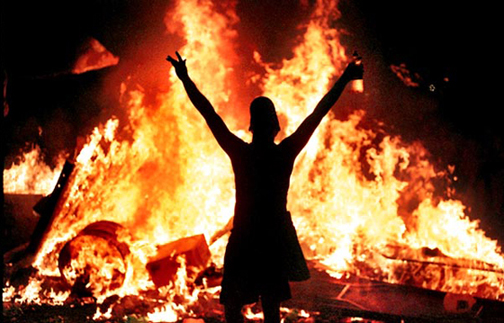
“But trannies can’t be that scary.”
“Are you kidding me, robo-roids? They’re thousands strong…“
Rod Townsend sometimes receives phone calls from The Future, a mysterious entity that knows where things will be in New York after the Starbucks and Whole Foods have blanketed the town and then disappeared.
“Hello?”
“Zhe shi shenme? Is that you, nanonips? I must have hit the wrong avatar on my iPortal! I meant to call the police!”
“The police? Are you okay?”
“I was just having lunch at CNNZone in Times Square when all hell broke loose.”
“Is it a terrorist attack?”
“A what? … No. Far worse. It’s a Tranny Reclamation Riot.”
“What does that even mean?”
“It all started when the Supreme Court overturned the extension of copyright laws. For years, Congress, at the behest of big business had prevented the passage to public domain just about anything. The original intent of the laws, to protect creators, had been perverted to just sustain creative ideas as corporate assets.”
“And how would that affect trannies?”
“I’m getting there, micromuff. At first some of the smaller companies were affected. Characters like Spider-Man going into public domain meant that the assets of places like Marvel Comics were simply wiped out. Some of the larger concerns had some adjustments. TWA for example just shifted some assets around.”
“TWA?”
“Time Warner/American Media? The company Harry Levin runs? Hold on. I have to find a place to hide. I’m going to try this closet. … Damn!”
“What happened?”
“Anderson Cooper’s in there with Rick Sanchez. There’s no more room. I could make try to run across the street to Madame Tussaud-o-Vision.”
“Where?”
“MTV. It’s a portal-vision network that shows programming by wax dummy replicas of humans. Another result of the copyright rollback. Viacom, which had very little creative content, did fine. I wish the same could be said for Walt Disney. If they had survived I wouldn’t be hiding from the tranny rebels out there.”
“How would Walt Disney affect …”
“Duibuqi. Walt Disney was pretty much propped up by their licensed holdings. Mickey Mouse, Donald Duck, Jessica Simpson. All those lunch boxes, t-shirts, toasters and everything else were where their money really was. Following the copyright changes, they quickly went bankrupt. And for Times Square, that meant that about 70 per cent of the theaters and other businesses were suddenly just gone. Completely undisnified. Some locals tried their hand at bringing theater back, but people were wholly uninterested in shows like “Rosie’s Ruff-Riding Rodeo” or “Apprentice, the Musical”.
“So without theater, what happened to Times Square?”
“There was an attempt to continue some of the tourist interests. ESPNZone became where I’m hiding out right now, CNNZone. LOLCaiteteria has very nice interpretations of Franco-American products. And the Jolie-Pitt Adopt-o-rama is quite popular with the gays. But the area is sort of going downhill. Thus the reclamation riots.”
“What exactly are the trannies trying to do?”
“When they were first pushed out of the area back in last century, many of the trannies and the prostitutes and the hustlers all felt that they had been pushed away from their motherland. They had to leave the streets and hole up, resorting to advertising for their services. At some point, local magazines pushed them out as well. Now with so many of the buildings in Times Square just sitting empty, they’re trying to reclaim the land from which they were forced out. Last year they used slingshot garters to take out the Macy’s balloons from the top of the former Conde Nast building. And now, with the riots, I don’t even know if there will be a parade this year.”
“But trannies can’t be that scary.”
“Are you kidding me, robo-roids? They’re thousands strong and … Oh, no. Zhe shi shenme? … It’s a Press-On Pipebomb! I’ll call you soon!”
[stumbled upon at https://gawker.com/322591/the-tranny-reclamation-riots]
]]>