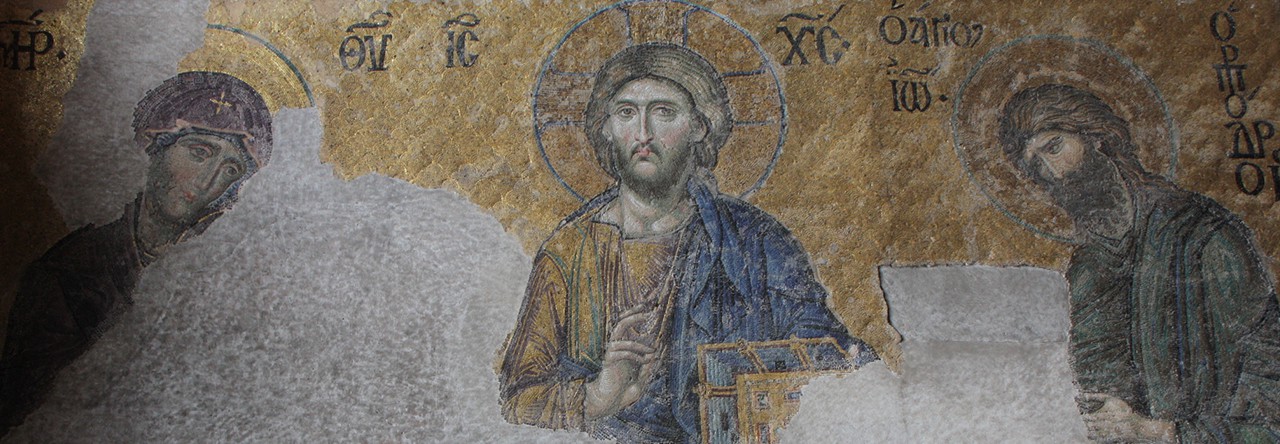
The Blessedness of Being Poor in Spirit 

Blessed are the poor in spirit for theirs is the Kingdom of Heaven. (Matt 5: 3)

Christ in His teaching on the poor in spirit is claiming that true happiness is available even to those poor in spirit; godly blessedness is not dependent on wealth of any kind. The kingdom of God is a matter of the inner attitude of our hearts. The Kingdom is present is in us when we choose to be poor in spirit.

This Beatitude can also be translated as “O the blessedness of the poor in spirit…” as it tells those who are poor in spirit to take heart because God remembers them and loves them, even if the world doesn’t.

Through its long history Christians have interpreted the text to refer both or either to those who lacked financial means or to those who are humble. This Beatitude calls to mind the words the Prophet Isaiah wrote about what the Christ would proclaim:

The Spirit of the Lord GOD is upon me, because the LORD has anointed me to bring good tidings to the afflicted; he has sent me to bind up the brokenhearted, … to comfort all who mourn; to grant to those who mourn in Zion—to give them a garland instead of ashes, the oil of gladness instead of mourning, the mantle of praise instead of a faint spirit; that they may be called oaks of righteousness, the planting of the LORD, that he may be glorified. (Isaiah 61:1-3; emphases added) 

Jesus is claiming that He fulfills this prophecy and He wants the poor, the brokenhearted, the afflicted, the poor in spirit to know that God loves them and cares about them even though they may feel abandoned or can’t see much to give them hope.

St John Chrysostom says poverty of spirit is chosen willfully by people. It is not imposed on them but an attitude they embrace.  The “poor in spirit” aren’t those forced to be humble by their circumstances but rather anyone who chooses humility. This Beatitude says that you can be poor, old, a child, a stranger, a PhD, or unlearned, nothing hinders you from being blessed if you are willing to be poor in spirit.

According to the Fathers, the opposite of being poor in spirit is being angry, critical, condemning, demanding or manipulative.

The Theotokos celebrates poverty of spirit when she sang the Magnificat and claimed this Beatitude for herself. She is a prime example of one who is poor in spirit and yet completely blessed:

My soul magnifies the Lord, and my spirit rejoices in God my Savior, for he has regarded the low estate of his handmaiden. For behold, henceforth all generations will call me blessed; for he who is mighty has done great things for me, and holy is his name. And his mercy is on those who fear him from generation to generation. He has shown strength with his arm, he has scattered the proud in the imagination of their hearts, he has put down the mighty from their thrones, and exalted those of low degree; he has filled the hungry with good things, and the rich he has sent empty away. (Luke 1:46-53; emphases added)

A Heavenly View of Humanity 

When I look at thy heavens, the work of thy fingers, the moon and the stars which thou hast established; what is man that thou art mindful of him, and the son of man that thou dost care for him? Yet thou hast made him little less than God, and dost crown him with glory and honor. (Psalm 8:3-5)

St Basil the Great reflects on how much the science and medicine of his day knew about the human body. He says no one has the time to study it all. Little did he know where science and medicine would go in the future and how much more we know today about the workings of the human body than in his day.

He also comments on how people in his day were more interested in studying the sky than studying the human body, which I’m guessing he is referring to astrology and the ancient interest in reading the signs in the sky to predict and determine human events and history. He thinks it is a far more worthy pursuit to study the human body and try to learn what a human is.  He writes:

Effort has been spent in much diligent study of the human body that belongs to all of us. If you study medicine, you will find how many things it describes to us, how many hidden vessels it has discovered in our internal structure through anatomical dissection, tunnels in the invisible, a single confluence from the body, the channels of breath, the pipelines of blood, the drawing of breath, the dwelling of a hearth of heat by the heart, the continuous movement of breath around the heart. There are thousands of observations concerning these things with which not one of us is acquainted, for nobody has the leisure to take on this field of research, neither does each know himself as he is.

For we are satisfied to know the sky rather than ourselves. Do not despise the wonder that is in you. For you are small in your own reckoning, but the Word will disclose that you are great. Because of this wise David, examining and seeing himself exactly, says, ‘Wonderful is your knowledge from me‘ [Psalm 138:6], I have discovered in wonder knowledge concerning you. (ON THE HUMAN CONDITION, pp 31-32)

Ultimately for St Basil the scientific study of the human body should lead us to a knowledge of our Creator. He doesn’t fear the study of science, medicine, or anatomy for he doesn’t see these studies as opposing truth, but another way to learn the truth about what it is to be human. Through science we can gain some heavenly insight into our world and ourselves.

For it was you who formed my inward parts; you knit me together in my mother’s womb. I praise you, for I am fearfully and wonderfully made. Wonderful are your works; that I know very well. (Psalm 139:13-14)

To Behold the Beauty of the Lord

And he answered, “You shall love the Lord your God with all your heart, and with all your soul, and with all your strength, and with all your mind; and your neighbor as yourself.” And Jesus said to him, “You have answered right; do this, and you will live.” (Luke 10:27) 

How are we to love God with all our being – heart, soul, mind and strength? One way is through the sensory richness of worship as Metropolitan Kallistos Ware describes: 

In our worship, we make use, in the first place, of words, and these words bear a literal meaning, grasped by the reasoning brain. But far more than the literal meaning of words is involved in the act of worship. Beyond and beneath their literal sense, particular syllables and phrases are rich in associations and undertones, and possess a hidden power and poetry of their own. Thus in our prayer, we use words not just literally but beautifully; through poetic imagery – even if the texts are in rhythmic prose rather than rhymed stanzas – we endow the words with a new dimension of meaning.

We worship, moreover, not through words only but in a wide variety of other ways: through music, through the splendor of the priestly vestments, through the color and lines of the holy icons, through the articulation of sacred space in the design of the church building, through symbolic gestures such as the sign of the cross, the offering of incense, or the lighting of the candle, and through the employment of all the great ‘archetypes,’ of all the basic constituents of human life, such as water, wine, bread, fire and oil.

In our literal use of words we reach the reasoning brain; by means of poetry and music, of art, symbol and ritual act, we reach the other layers of the human personality. (THE INNER KINGDOM, p 63) 

We know God not only through Orthodox theology, but also through all of our senses and with all of our bodily organs. To fully experience God in our lives, we engage not only our minds but our hearts, souls and bodies as well. For this is how we experience the beauty of God’s revelation. 

‘Beauty will save the world,’ said Dostoyevsky. It is a primary function of worship to render manifest the saving power of this divine beauty. (THE INNER KINGDOM, p 66) 

One thing have I asked of the LORD, that will I seek after; that I may dwell in the house of the LORD all the days of my life, to behold the beauty of the LORD, and to inquire in his temple. (Psalm 27:4) 

War: Dehumanizing Ourselves and Our Enemies  

What causes wars, and what causes fightings among you? Is it not your passions that are at war in your members? You desire and do not have; so you kill. And you covet and cannot obtain; so you fight and wage war. You do not have, because you do not ask. You ask and do not receive, because you ask wrongly, to spend it on your passions. Unfaithful creatures! Do you not know that friendship with the world is enmity with God? Therefore whoever wishes to be a friend of the world makes himself an enemy of God. (James 4:1-4)

Christopher Browning in his study of average Germans who became mass murderers under the Nazi regime in WWII offers a poignant description of the effects of war on people.

War, a struggle between “our people” and “the enemy,” creates a polarized world in which “the enemy” is easily objectified and removed from the community of human obligation. War is the most conducive environment in which governments can adopt “atrocity by policy” and encounter few difficulties in implementing it. (Ordinary Men, Kindle Location 3095-3098)

War widens any polarization that already exists in a society between “us” and “them.” It often dehumanizes the enemy, justifying our becoming inhuman towards them. In war, the government legitimizes killing, allowing citizens to feel little or no remorse about slaughtering anyone who is labeled an enemy whether they are combatants or not. Too often and too readily, people see war as the only way to deal with enemies, so they accept their own dehumanization because they feel legitimized in slaughtering or mistreating these “subhumans.” It is part of what has been described as truth being the first casualty of war. The government doesn’t want its people to think too much about the morality of it and certainly doesn’t want its citizens turned “warriors” to hesitate in killing the enemy or even in seeing “them” as enemies. It all is how the fallen world operates.

Our hope lies with God who promises to bring an end to war and the need for it. As God tells the Prophet Hosea:

And I will make for you a covenant on that day with the beasts of the field, the birds of the air, and the creeping things of the ground; and I will abolish the bow, the sword, and war from the land; and I will make you lie down in safety. And I will betroth you to me for ever; I will betroth you to me in righteousness and in justice, in steadfast love, and in mercy. I will betroth you to me in faithfulness; and you shall know the LORD. (Hosea 2:18-20)

We pray in all of the liturgies of the Church, and with good reason, for “the peace from above” and “for the peace of the whole world.” We are asking God to bring about His peace for the world and to end the sinful fallenness of our lives which leads us to justify war and the mistreatment of enemies. The end of war might allow us to become more human and humane.

Even when we don’t initiate the war but find ourselves attacked and needing to defend ourselves or others, we have to also pray that God will bring the war to an end quickly and not allow us to lose our humanity. [Which is why I find it totally abhorrent that the Russian Church prosecuted those of its clergy who prayed for peace with Ukraine. The Russian Church was dehumanizing those who prayed for being human and who prayed for humanity.]  The Church and its chaplains should always be reminding its members to be human and not to forget morality.

Is God’s Kingdom Like Anything We Already Know? 

The Kingdom of the heavens has been likened to a man, a king, who arranged wedding celebrations for his son. And he sent out his slaves to summon those who had been invited to the wedding celebrations, and they did not wish to come.  (Matthew 22:2-3)

Christ used parables and metaphors to give us hints as to what the Kingdom of God is like. These teachings are not dogmatic statements, rather they require us to interpret them, which means they may not have a fixed, one-and-only meaning, but might bring different aspects to the minds of different listeners. In the words quoted above, we have to ask: in what way is the kingdom like this man’s wedding feast? What aspects of the Kingdom can be likened to a king inviting his subjects to his son’s wedding? Is it an allegory? Who are the characters to whom it refers?  Are we in the parable? – which characters refer to us? Or does the parable refer to something other than us and we shouldn’t read ourselves into it? There is a sense in which we understand God invites us to His Kingdom and offers the kingdom to come into our lives, yet, like the invitees in the parable, we are more interested in the realities of this world than we are in God’s ethereal (and pie-in-the-sky?) Kingdom. An old wisdom saying says a bird in the hand is worth two in the bush.

Hilarion Alfeyev reminds us that parables are meant to make us reflect on their meanings, which is not obvious but can be ambiguous causing us to be aware of judgment (both our own and God’s).

In the same way, each parable is also a challenge to the listeners. A parable is a ‘realistic fiction,’ an earthly story with heavenly meaning, ‘a genre that is designed to surprise, challenge, shake up, or indict.’ As with many other texts of the Holy Scriptures, parables simultaneously ‘inspire and challenge; they both comfort and accuse. They are a two-edged sword. (SEEKING CHRIST IN THE SCRIPTURES, p 14)

Parables are meant to challenge the listeners. Thus, if we take a parable like the king’s wedding feast (above) and assume it was directed only at the Jews, we are missing the message/challenge to us. The parable challenged them in their day, but is also geared to help us grow in the faith. It is up to us to give the “seed” contained in the parable good growth in our hearts, minds, homes, families and parishes.

Because parables require interpretation, we might miss their lessons for us or focus on a wrong detail or only partially understand the entire parable. One has only to think about the ancient non-biblical parable of the four blind men and the elephant – each blind man touches only one body part of the elephant (the leg, trunk, tail or ear) and then pronounces what the elephant is “like” but because of their limited experience they get it wrong yet fiercely disagree with the other blindmen about what the elephant is “like.” Christ occasionally offered an explanation of His parables, but not always. We are left with the task of discerning what the lessons from the various parables are for us. We can read the various interpretations of past generations of Christians to learn what conclusions they came to about the parables, but we have to realize there may still be a meaning that we have to discover which wasn’t meant for those who came before us but which God wants to reveal to us.

Parables are intended to help us get a new perspective on the Kingdom of God, in fact to help us see the heavenly Kingdom from above! Jesus answered him, “Very truly, I tell you, no one can see the kingdom of God without being born from above” (John 3:3). We cannot see the Kingdom from a worldly point of view. We only see the Kingdom if born from on high – Christ is offering us this heavenly vantage point through His parables.

The Shame of Zacchaeus. 

And when Jesus came to the place, he looked up and said to him, “Zacchaeus, make haste and come down; for I must stay at your house today.” So he made haste and came down, and received him joyfully. (Luke 19:5-6) 

Zacchaeus receives Christ joyfully – not tentatively, or uncertainly or hesitantly. As soon as Christ addresses Himself to Zacchaeus, Zacchaeus is joyful. He doesn’t appear to be afraid of Christ’s judgment, though the fact that he doesn’t approach Christ directly and has to climb a tree because the crowed won’t make room for him, suggests he knows he is not liked by the crowd. Even though he is a tax collector, he doesn’t behave as one having authority or power over others. Archimandrite Zacharias comments about he learns from Zacchaeus: 

I think that both the strength to bear shame and the strength to suffer are gifts from God. When I was a young and inexperienced spiritual father, Father Sophrony told me to encourage the young people to confess precisely the things of which they are ashamed, for if they learn to do so, shame is transformed into strength against the passions, and they will overcome sin.  . . .  And I understood that this is precisely what had occurred in the person of Zacchaeus. He bore shame voluntarily, and the Lord, Who was on his way to Jerusalem in order to suffer on the Cross of shame, saw Zacchaeus bearing shame for His sake and recognized in him a kindred spirit. (REMEMBER THY FIRST LOVE, p 349) 

Though today in Slavic Orthodoxy because the Zacchaeus narrative is read just before the Great Lenten cycle begins, Zacchaeus is now identified as a sinner who repents, Archimandrite Zacharias points out a different idea – Christ sees in Zacchaeus a kindred spirit, one who is willing to overcome shame. Zacchaeus was too short to see over the crowd, however, he was not too ashamed to climb the tree to see Jesus.  Jesus too will climb a tree associated with shame – namely the cross.  Jesus is saying Zacchaeus is behaving prophetically. And Jesus wants all the Jews in Jericho to welcome Zacchaeus into the fellowship of the people of God, for they have misjudged him. Zacchaeus shows his true spirit when he says to Christ, “Behold, Lord, the half of my goods I give to the poor; and if I have defrauded any one of anything, I restore it fourfold.” (Luke 19:8) Note, he is speaking in the present tense, not a future promise. He apparently had been misjudged by his fellow Jews who assumed that as a tax collector he was a greedy, dishonest “sinner”. Instead, he is revealed as an extremely generous man. 

Part of the shame of the Zaccheus story is that the self-righteous condemned him without knowing him and what he was doing with the wealth that he had. Zacchaeus accepted this judgment because he was humble and of the same spirit as the Lord Jesus Christ. Jesus works His ministry of reconciliation, breaking down the walls that divide people, or, as we are known as, sinners. 

Imitating the Saints 

This past summer, I went on a “Band of Brothers” tour of Western Europe following the path of the 101st Airborne Division in WWII. I did a lot of reading in preparation for the tour and then thoroughly enjoyed visiting the actual locations where the events I read about it occurred.  

One stop we made early on in the tour was to the town of Angoville-au-Plain, Normandy, Fance. Located in the town is the small Catholic Church named after SS Cosmas and Damian, two late 3rd Century brothers who were unmercenary healing saints and who were martyred for their faith. 

SS Cosmas and Damian are commemorated on July 1. Dr Daniel Hinshaw offers a little history about them. He notes that the saints lived at a time when Emperor Julian had come to power. Julian (nicknamed in Church history as “the Apostate” ) despised Christianity and attempted to revert the Roman Empire back to paganism and away from Christianity. Hinshaw says that the apostate Emperor… 

 … even complained and raved at his own priests of a Asklepios for not following the Christian example of selflessly caring for anyone regardless of their religious faith, pagan or not. Julian recognized the potential of Christian philanthropia, as incarnated in the care of the sick as a powerful weapon for winning souls, and desperately wished to emulate it in his attempts to restore pagan worship in the Empire. Thus, much of the Christianizing of the Roman Empire after Constantine, at least in the East, occurred in no small part as a result of large scale charitable activities initiated by Christian bishops and other church leaders, both lay and clergy. (SUFFERING AND THE NATURE OF HEALING, p 25) 

Cosmas and Damian were eventually martyred because their charitable work in treating the sick and needy (not charging them any fees for their medical skills) caused a great many pagans to embrace the Christian faith. The two brothers would not cease their charitable work and so were put to death. 

What was special to me in Angoville-au-Plain was the story of what took place in the church during the D-Day invasion in June of 1945. The 101st Airborne had captured the town and their two medics, Robert Wright and Ken Moore, set up a ‘field hospital’ in the church to care for the wounded. The local residents were very impressed with the two medics who treated every person brought into the church, whether American soldier, French civilian or German soldier. The fact that they were so giving of their talents caused the locals to think that they were in fact two modern-day Cosmas and Damians. The locals thought it was no coincidence that the two medics were like their parish’s patron saints. 

A German artillery shell crashed through the roof of the church landing in the center of the church but failing to explode as it was a dud. This made the locals think even more that the two medics were somehow “miraculous” and protected by God. 

The Germans launched a counterattack to recapture the town, forcing the 101st Airborne to abandon it. The two medics decided to remain to care for the wounded soldiers still in the church. They all were captured by the Germans. According to the locals, the two American medics continued to treat whoever was brought into the church including their German “enemies.” The locals were in awe of their Christian attitude. 

The medics used the church pews as hospital beds. At the end of the war the locals decided not to clean the blood stains off of the pews, but to leave them as a memorial for those who suffered and died for the liberation of France. 

After the war, Robert Wright was buried in the church cemetery – the only non-French citizen buried in the small graveyard. He was granted that honor by the grateful residents.  

[Robert Wright was a graduate of the Ohio State University – thus the Ohio State flag marking his grave. The above stained-glass windows are all in the church today including the ones commemorating the 101st Airborne’s arrival in the town.]

Healing vs Visiting the Sick 

I was sick and you visited me (Matthew 25:36)

We can get so focused on cure and healing through modern medicine (or even alternative medicine for that matter), that we forget Christ taught us to visit the sick. We won’t be judged if we didn’t heal the sick, but we will be judged if we didn’t visit them in their time of illness. We have to care for them, have concern and compassion, tending to their needs rather than thinking only about ourselves. We visit the sick because we are to see each of them as Christ and minister to Him. We don’t do it for the salvation of our souls, we do it to love the other.  Dr Daniel Hinshaw in his book,  SUFFERING AND THE NATURE OF HEALING, comments:

The Christian focus in the church’s healing ministry has always been on caring for and attending to Christ in the suffering one. There has been an ambivalence about cure – truly wonderful if and when it happens, but real healing, salvation, is what is to be sought. . . . The meaning and power of ‘I was sick and you visited me,’ has been almost entirely lost. It has no real meaning for many modern physicians. (p 248)

Most of us are not trained medical personnel, but all of us are capable of compassion, mercy, offering hope to others or just listening to them in their agony and praying with and for them.

Healing is distinguished from cure . . .  it refers to the ability of a person to find solace, comfort, connection, meaning, and purpose in the midst of suffering, disarray and pain. The care is rooted in spirituality using compassion, hopefulness, and the recognition that, although a person’s life may be limited or no longer socially productive, it remains full of possibility. (pp 206-207)

Cure relates to disease, whereas healing relates to persons. (p 248)

We perhaps get too caught up in the miraculous but then think if I can’t do miracles, I have nothing to offer the sick. But we can offer them our love, mercy, compassion, our time and talents to meet their needs. The Good Samaritan didn’t heal the man who was assaulted by the thieves, but he did what he was able to do –he was able to be the good neighbor and show the severely wounded stranger compassion.

Blessed be the God and Father of our Lord Jesus Christ, the Father of mercies and God of all comfort, who comforts us in all our affliction, so that we may be able to comfort those who are in any affliction, with the comfort with which we ourselves are comforted by God. For as we share abundantly in Christ’s sufferings, so through Christ we share abundantly in comfort too. (2 Corinthians 1:3-5)

Liturgy Book Back in Print

The Divine Liturgy with Scripture Annotations

Years ago, I edited a scriptural commentary on the Divine Liturgy published by Light and Life Publishing. It was one of their bestsellers. After the death of their founder, Fr Anthony Coniaris, Light and Life ceased publication. Through the years, numerous people have asked me where they might be able to purchase the book. Happily, the book, now expanded, revised and updated by the good folk at St Mary’s OCA Cathedral in Minneapolis, has been republished by Orthodox Journeys. The spiral bound book sells for $19 and can be purchased at https://www.orthodoxjourneys.com/liturgy-and-scripture.

God So Loves the World 

For God so loved the world that he gave his only Son, that whoever believes in him should not perish but have eternal life. For God sent the Son into the world, not to condemn the world, but that the world might be saved through him. (John 3:16-17)

This is the fourth and last post in a series looking at 5th Century Christian hymns as recorded in Stephen Shoemaker’s book, THE FIRST CHRISTIAN HYMNAL. The first post was Jesus in the Old Testament the previous post was Christ Destroys Hell.

While today, many focus on Christ’s Second Coming as judgment day for sinners, the early Church celebrated Christ’s coming again to save the word:

… He will come again to save the world that he created. (p 41; all emphases have been added)

The hymns honor Christ for saving the human race, not just believers. Christ is praised as the Savior of humankind. He came not to fill hell with sinners but rather to empty it and destroy it; He came to save sinners not destroy them.

We sing to you, Christ, who rose from the dead on the third day, and who raised with you the human race. By the power of your resurrection, save us.   . . .   And you raised up with you those who were imprisoned in hell, and having clothed them with light, You presented them to the Father, as promised.  (p 75)

Christ’s effort to bring about salvation, benefits everyone.

You suffered, O Savior of the world, for the sake of us who suffer, and you delivered the world and saved it from the original curse, because you are God and merciful.  (p 203)

You were placed in the tomb for the salvation of the world … (p 257)

Today the joy of the entire world came into being when you arose from the grave, Christ… (p 281)

I also think it worth noting the following verse which speaks particularly to women, who otherwise are sometimes blamed in the Tradition for causing the Fall of humanity. Instead of a male schadenfreude that women deserve to be blamed for the Fall of humanity, this hymn rightfully celebrates their salvation by Jesus Christ which is the far more Christian concept of Christ saving/healing everyone:

You who destroyed the reproach of women… (p 163)

Christ ‘destroyed the reproach of women’, which means the sin of Eve is forgiven and shouldn’t be constantly brought up in Chistian thinking. There is nothing left to reproach women for because Christ has freed them and all men too from the curse of the ancestor’s sin.

Christ frees all of us from all the consequences of sin because He is the Savior of the world.

And we have seen and testify that the Father has sent his Son as the Savior of the world. (1 John 4:14)