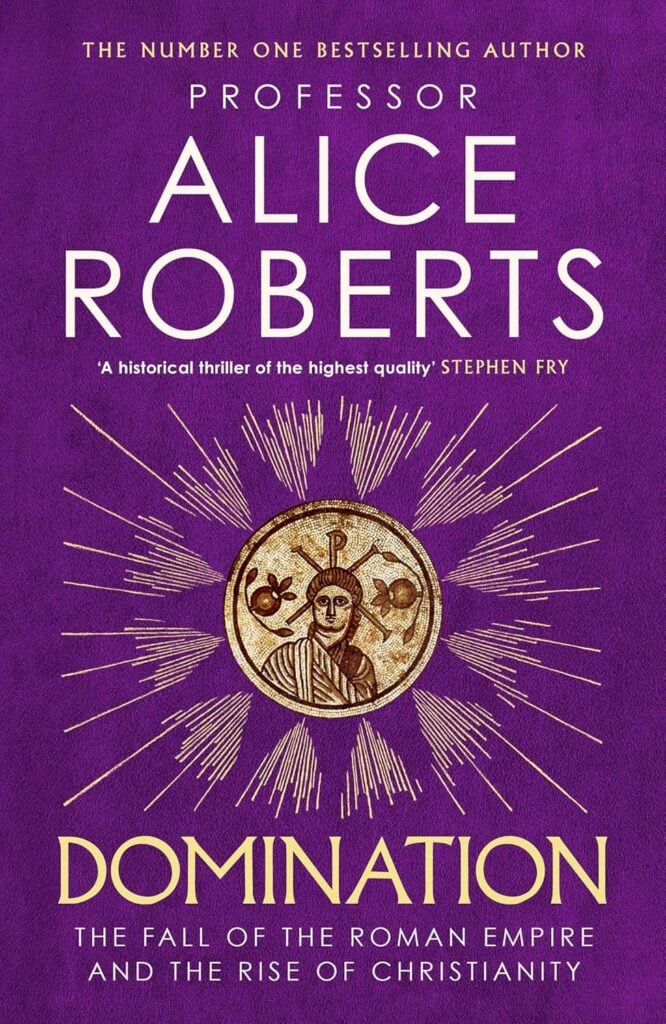
Alice Roberts is a familiar face in British media. A skilled archaeologist, she has for years hosted the television show Digging for Britain, which is a superb piece of scholarly popularization. Throughout, she appears unfailingly lively and colorful (her frequent changes of hair color constitute a kind of trademark), and she must be an outstanding teacher. She is particularly good at taking objects that appear dry and dead and presenting them in their vivid and comprehensible reality. She has taken burials and tombs as her specialty, with a major subfield in plague and pandemic. Some of her books on these themes, such as Ancestors,Buried, and Crypt, are quite brilliant.
Roberts’s strengths are manifest, and all are on display in Domination. There is much to learn here for anyone interested in that epic story of the fall of Rome and the rise of Christianity, and she does a fine job of bringing objects and places to life. After all, so much of the evidence for the spread of the new Christian faith comes from her beloved “burial archaeology”—from tombs, catacombs, and memorial stones. In this area she knows the literature very well indeed.
Where she fails, sadly, is in applying anything like the same skills to the reconstruction of minds, ideas, and beliefs. Roberts is a devout atheist and militant secularist who rejects all religious claims. That in itself certainly would not disqualify her from studying Christian origins or histories of spirituality. But in practice, she views these early eras with a tunnel vision that evinces no awareness at all of spiritual motives. When she describes all the saints and scholars, her architects and illuminators, she has not the slightest appreciation of the beliefs that evidently motivated them, and she clearly doubts whether any sane person could think such ludicrous things.
When Roberts is describing the material remains of the eras she is analyzing, her accounts are informative and evocative. But as she approaches the mainstream histories of Christianity, she becomes all too willing to tell the tale in terms of cynical motives and deception, as a centuries-long grab for power and domination. Her title seems intended to challenge and subvert the arguments of Tom Holland’s successful book Dominion (2019), which showed how Christianity had shaped the moral universe of Western civilization. For Roberts, the story has nothing to do with morality, and precious little with religion, in any recognizable sense. It is a story of power, of oppression, or to borrow Orwell’s horrible image, of a boot stamping on a human face—forever.
You could actually write a very worthwhile history of “The Fall of the Roman Empire and the Rise of Christianity” by looking only at the concepts that Roberts either omits or mentions briefly, almost as an afterthought. One spectacular example is healing, which any worthwhile scholar would rank very high among the reasons early believers accepted the new faith—and in the category of healing, I would include exorcism and demon-fighting. To take just one author: If we have learned anything from the writings of Peter Brown over the past half-century, it is the central importance of healing and “wonderworking,” and of the charismatic holy person as a conduit between Earth and Heaven. Closely related is the idea that God intervenes directly to express his satisfaction or dissatisfaction with how such figures are treated. He might express it through the state of the harvests, or the climate, or such natural phenomena as earthquakes. Or, of course, through the plagues and pandemics that are such essential components of Roberts’s own historical work.
Roberts shows no awareness of this (and astonishingly, given her topic, she makes just one reference to Peter Brown in the whole book). She offers a brief description of the sixth-century Welsh saint Samson of Dol, who engaged in “various miracles, including restoring sight to the blind, healing lepers and exorcising demons.” I quote that because, as far as I can see, this is the book’s only reference to the activities of healing and exorcism.
Although she often mentions shrines, Roberts gives no sense of the healing activities that would have been the main draw for most pilgrims and visitors: She has a few generic references to miracles and visions, most frequently in the British and Celtic context, but staggeringly few, given the book’s theme. Neither “miracle” nor “exorcism” nor “healing” nor “demons” features in the index.
Scarcely less startling is the almost total absence of the Virgin Mary, who appears chiefly in the context of a couple of church dedications. Yes, we finally have a historian who imagines you can examine the appeal of Late Antique Christianity without exploring the cult of the Virgin, which is overwhelmingly powerful at all social levels. There had to be one.
The book’s geographical emphases are also, well, quirky. By any reasonable estimate, in the period Roberts is examining, the Eastern churches were the heartlands of the faith, the most productive in terms of innovative thought, and the setting for most worthwhile debate. Roberts makes some general comments about the East, about Egypt, Syria, or Mesopotamia, but the treatment is very thin, and accounts of the culture in those regions are close to nonexistent. The word “Coptic” occurs once in the book and “Syriac” not at all. Nor does “Armenia.” This is overwhelmingly a Western European study, of Latin Late Antiquity, in an era when such a focus is, at best, eccentric.
As a book, Domination uses a somewhat surprising structure, with almost a reverse chronology. Of the five chapters, the first two focus on the last phases of the Roman empire in the West, a time when Christianity was already well established. The opening chapter, “Land of Saints,” offers an evocative survey of post-Roman Britain, in what we sometimes (controversially) call the Dark Ages, the great era of the Celtic saints. This choice makes excellent sense in terms of Roberts’s own enthusiasms, and the material will be quite familiar to any British person who has watched the many archaeological popularizations that have flourished over the past quarter-century. It may be harder going for American consumers. The next chapter, “End of Empire,” focuses on Gaul, Spain, and the West during the barbarian settlements, and the means by which the old Roman order gave birth to the new Christian worlds of bishops and monasteries.
So far, we might think that we are reading a detailed and specialized account of those late-Roman centuries, and the story is well told. But Roberts’s narrative then takes us further back to the time of the “Heart of Empire,” with a focus on the debates that culminated in the Council of Nicaea in 325, then earlier still to the “Business of Empire,” and then finally to the chapter “Ruler of All,” which discusses Christian origins. Nicaea, in fact, becomes a leitmotif in the book, as an exercise in the imperial co-optation of faith, with Constantine (of course) as the archvillain. We have been here very often before, not least in The Da Vinci Code. Nicaea, incidentally, gets dozens of references in the index, against zero for Chalcedon. That is significant, because the sparse early words of the Nicene definition asserted Christ’s incarnation but left immense room for debating just how those divine and human elements might have coexisted within the one flesh. It was Chalcedon that settled those mind-stretching questions, and explained just how a man walking in Galilee could be regarded as fully divine and yet fully human.
Roberts’s book appears to be structured like a detective novel that begins with a mystery and then progressively unveils the circumstances until finally we arrive at the surprising truth—that Christianity was a centuries-long quest for domination. If that was indeed Roberts’s goal, I apologize for offering the spoiler here. In this instance, the initial mystery, the body in the locked library, is the saint-dominated world of the British Isles, with its monasteries and pilgrimage routes. But Roberts’s solution is so crude as to astonish. It is very much like reading a nineteenth-century rationalist who is still furious at his fundamentalist upbringing and who marshals every piece of polemic he can scrounge together, from whatever discreditable source. The attitude to organized Christian faith is a mix of raw anger and chilly contempt.
Much of Domination is so simplistic and ill-informed as to demand quotation at length, to prove that it really is this bad. In this vision, of course, St. Paul is the villain of the story and the real founder of the Christian faith, but Roberts ignores a huge amount of scholarship when she suggests that he was actually little known in the first few Christian centuries. Paul became prominent, she says, only when his views were taken up around a.d. 400 by Saints John Chrysostom and Augustine of Hippo. “Perhaps they recognized the power of Paul’s relatively simple message. Would the name of Jesus have become so well known had it not been for Paul? Would Paul’s name be so well known if it were not for the golden-mouthed John or the bishop of Hippo? I don’t think we’ll ever know.” Well, yes, I actually do know the answer to those silly questions and so does any competent scholar of early church history. As to Roberts’s first point, about spreading the name of Jesus, she herself rightly notes that “none of the early centers of Christianity—in Jerusalem, Antioch, Alexandria and Rome—were actually established by Paul”; and we could expand that geographical list at some length, to Lyon, Carthage, Edessa, and so on and so forth. Does this fact not answer her question fully?
As to just when Paul’s name became so well known, we need only look at the New Testament itself. Certainly, beginning in the second century, all attempts to construct a canon of Christian Scriptures identified Paul’s letters as a major component of that corpus, even if there was not total agreement on every document. That fact certainly suggests, does it not, that Paul’s name might have aroused at least a glimmer of recognition among believers a couple of centuries before Chrysostom and Augustine?
The crude materialism of Roberts’s arguments is amazing for a scholar of her undoubted intelligence, as is her brusque dismissal of any rival approach. Christianity, she says, exercised no obvious appeal to any likely mass constituency. It conquered an empire solely and entirely because it offered a means by which threatened elites could preserve their power and wealth in a situation of social and political collapse. Here is the core of her argument:
Christianity wasn’t a grassroots movement—or at least, not for long—it was very much led by the middle classes and the elites. We’ve seen, in the west, how the Roman Empire fragmented but its structures, its wealthier citizens and its elite families, its ways of doing things, all stayed in place—under the aegis of Christianity.
With emperors coming and going, barbarians seizing power in the west, and the political landscape of the fourth century looking decidedly unstable, the families who effectively ran the economy—from the middling sort, the merchants, lawyers and doctors, to the social elites—had hit upon an elegant solution. It may have crept up on them, almost inadvertently, but it worked. They’d found a way to protect their interests and to keep everything running, no matter who was, officially, in charge, whether that was a usurping Roman emperor or a new Visigothic king.
That new solution, the Christian empire, the Faith-Imperial Complex, held its supremacy until modern times. “And from then on, it was bishops supporting kings supporting bishops . . . all the way down.”
Although Roberts does not quote Thomas Hobbes explicitly, every chapter echoes his famous remark that “The Papacy is no other than the ghost of the deceased Roman Empire, sitting crowned upon the grave thereof: for so did the Papacy start up on a sudden out of the ruins of that heathen power.” Her theme, however, is the very direct continuity from old pagan and imperial Rome to the whole Christian church, rather than merely to the papacy. In effect, we are to imagine the tenants of a great estate centered on a Roman villa, who one day awake to find that the villa has become a church or monastery, where the old landlord now serves as bishop or abbot, the same man with a different hat. The names have changed, but the domination continues. “Romanitas became Christianitas.” And repeatedly, Roberts portrays the continuity as a deliberate survival strategy by those old elites. If ordinary people accepted the new faith, Roberts tells us, they did so wearily, in order to obey the stern commands of these landlords-turned-clerics.
Not a word of this comports with the abundant evidence we possess from multiple sources of the enormous appeal of charismatic figures, of the wonderworkers and prophets, monks and stylites, who drew the ordinary faithful in countless numbers.
Christianity, Roberts says, was from the beginning a corporate enterprise, which like any modern counterpart was focused centrally on preserving and promoting its brand. “Beyond the ideas contained in Christian scripture, there were some great marketing techniques.” This spiritual Ponzi scheme succeeded thanks to its “businesslike worldliness.” Paul excelled at these techniques. “Paul’s version of Christianity was alluringly simple. Modern politicians know the power of a slimmed-down message, a three-word slogan; and that marketing technique already existed two thousand years ago.” Moreover, “He opened the market up. He’d also sown the seeds of the movement as a financially viable operation—collecting donations on a regular basis and funneling those funds back to the center.” She is undoubtedly correct to note that any rising movement needs to secure a solid financial base, but her corporate analogies go far beyond that, and really are close to obsessive.Christianity, she says, succeeded because of its mastery of brand identity, its manipulation of slogans, jingles and logos.
Roberts scorns anyone who fails to accept her analysis:
I’m sure that apologist historians (including some who claim not to be Christian, but seem to be suffering some kind of Stockholm syndrome) and theologians, and lots of other people who want to believe that organized religion is about something other than money or power, will be queuing up to shoot me down on this.
A reasonable estimate would suggest that the historians who do not agree with that vulgar materialism constitute, what, around 98 percent of the profession? Of course, these people would accept that sound financial foundations are essential for the success of a sect or denomination, and political power can be an inestimable advantage (although it can also be discrediting). But is there nothing more than that? Just test this opinion with reference to any great religious movement in history—the Great Awakenings of the eighteenth century, the Anglo-Catholic and Tractarian upsurges of the nineteenth, the Pentecostal explosion of the early twentieth, the mass Christian expansion through Africa in our own times. All about money and power? Really? Nothing whatever to do with the spiritual worldviews of the constituencies involved, of tensions arising from class, gender, education, race, and demography, as these multiple strains are intensified by perceived heavenly signs and wonders?
I have no wish whatever to shoot Roberts down, but I would very much like to see her confine her writing to areas where she has a vague sense of what the very sizable scholarly consensus actually holds, together with a pinch of self-doubt and an openness to contrary arguments. She could also stick to what she is good at. She should assuredly carry on writing her moving accounts of archaeological sites, as interpreted through the generous sensibilities of a person who is surely far wiser than these rants might suggest.
By all means, read Roberts’s other works, and Ancestors is a fine place to start. Let’s just write off Domination as a horrible mistake.
Consider a gift to America’s most influential publication of religion and public life.
We use cookies on our website to give you the most relevant experience by remembering your preferences and repeat visits. By clicking “Accept All”, you consent to the use of ALL the cookies or visit "Cookie Settings" to provide a controlled consent.
This website uses cookies to improve your experience while you navigate through the website. Out of these cookies, the cookies that are categorized as necessary are stored on your browser as they are essential for the working of basic functionalities of the website. We also use third-party cookies that help us analyze and understand how you use this website. These cookies will be stored in your browser only with your consent. You also have the option to opt-out of these cookies. But opting out of some of these cookies may have an effect on your browsing experience.
Necessary cookies are absolutely essential for the website to function properly. These cookies ensure basic functionalities and security features of the website, anonymously.
Cookie
Duration
Description
__cf_bm
1 hour
This cookie, set by Cloudflare, is used to support Cloudflare Bot Management.
__stripe_mid
1 year
Stripe sets this cookie to set a unique session identifier to recognize users across sessions.
__stripe_sid
1 hour
Stripe sets this cookie to set a unique session identifier for a single session.
_cfuvid
session
Calendly sets this cookie to track users across sessions to optimize user experience by maintaining session consistency and providing personalized services
_shopify_country
1 hour
Shopify sets this cookie to store the preferred country setting chosen by the visitor.
_tracking_consent
1 year
Shopify sets this cookie to store a user's preferences if a merchant has set up privacy rules in the visitor's region.
ak_bmsc
2 hours
This cookie is used by Akamai to optimize site security by distinguishing between humans and bots
AWSALBCORS
7 days
Amazon Web Services set this cookie for load balancing.
cookielawinfo-checkbox-advertisement
1 year
Set by the GDPR Cookie Consent plugin, this cookie records the user consent for the cookies in the "Advertisement" category.
cookielawinfo-checkbox-analytics
11 months
This cookie is set by GDPR Cookie Consent plugin. The cookie is used to store the user consent for the cookies in the category "Analytics".
cookielawinfo-checkbox-functional
11 months
The cookie is set by GDPR cookie consent to record the user consent for the cookies in the category "Functional".
cookielawinfo-checkbox-necessary
11 months
This cookie is set by GDPR Cookie Consent plugin. The cookies is used to store the user consent for the cookies in the category "Necessary".
cookielawinfo-checkbox-others
11 months
This cookie is set by GDPR Cookie Consent plugin. The cookie is used to store the user consent for the cookies in the category "Other.
cookielawinfo-checkbox-performance
11 months
This cookie is set by GDPR Cookie Consent plugin. The cookie is used to store the user consent for the cookies in the category "Performance".
CookieLawInfoConsent
1 year
CookieYes sets this cookie to record the default button state of the corresponding category and the status of CCPA. It works only in coordination with the primary cookie.
cookiesession1
1 year
This cookie is set by the Fortinet firewall. This cookie is used for protecting the website from abuse.
crumb
session
Squarespace sets this cookie to prevent cross-site request forgery (CSRF).
issuem_lp
28 days
The cookie is set by Leaky Paywall plugin to track restricted content based on the subscription levels.
keep_alive
1 hour
The keep_alive cookie is used to maintain a user's session active on a website, preventing automatic logout during periods of inactivity.
lp_us_his
30 days
The cookie is set by Leaky Paywall plugin to track restricted content based on the subscription levels.
m
1 year 1 month 4 days
Stripe sets this cookie for fraud prevention purposes. It identifies the device used to access the website, allowing the website to be formatted accordingly.
ts
1 year
PayPal sets this cookie to mitigate risks and ensure transaction integrity.
ts_c
1 year
PayPal sets this cookie to ensure the security of transactions and verify user authentication.
viewed_cookie_policy
11 months
The cookie is set by the GDPR Cookie Consent plugin and is used to store whether or not user has consented to the use of cookies. It does not store any personal data.
XSRF-TOKEN
session
This cookie enhances visitor browsing security by preventing cross-site request forgery.
Functional cookies help to perform certain functionalities like sharing the content of the website on social media platforms, collect feedbacks, and other third-party features.
Cookie
Duration
Description
pu-cookie-encrypted
session
Popup Maker plugin sets this cookie to enable the website to display a popup on the website. The cookies also serve the purpose of preventing the same popup being shown to the users repetitively.
pum_alm_first_activity
1 day
Popup Maker plugin sets this cookie to enable the website to display a popup on the website. The cookies also serve the purpose of preventing the same popup being shown to the users repetitively.
pum_alm_last_activity
1 day
Popup Maker plugin sets this cookie to enable the website to display a popup on the website. The cookies also serve the purpose of preventing the same popup being shown to the users repetitively.
pum_alm_pages_viewed
3 months
Popup Maker plugin sets this cookie to enable the website to display a popup on the website. The cookies also serve the purpose of preventing the same popup being shown to the users repetitively.
sp_landing
1 day
The sp_landing is set by Spotify to implement audio content from Spotify on the website and also registers information on user interaction related to the audio content.
sp_t
1 year
The sp_t cookie is set by Spotify to implement audio content from Spotify on the website and also registers information on user interaction related to the audio content.
yt-remote-cast-available
session
The yt-remote-cast-available cookie is used to store the user's preferences regarding whether casting is available on their YouTube video player.
yt-remote-cast-installed
session
The yt-remote-cast-installed cookie is used to store the user's video player preferences using embedded YouTube video.
yt-remote-connected-devices
never
YouTube sets this cookie to store the user's video preferences using embedded YouTube videos.
yt-remote-device-id
never
YouTube sets this cookie to store the user's video preferences using embedded YouTube videos.
yt-remote-fast-check-period
session
The yt-remote-fast-check-period cookie is used by YouTube to store the user's video player preferences for embedded YouTube videos.
yt-remote-session-app
session
The yt-remote-session-app cookie is used by YouTube to store user preferences and information about the interface of the embedded YouTube video player.
yt-remote-session-name
session
The yt-remote-session-name cookie is used by YouTube to store the user's video player preferences using embedded YouTube video.
ytidb::LAST_RESULT_ENTRY_KEY
never
The cookie ytidb::LAST_RESULT_ENTRY_KEY is used by YouTube to store the last search result entry that was clicked by the user. This information is used to improve the user experience by providing more relevant search results in the future.
Performance cookies are used to understand and analyze the key performance indexes of the website which helps in delivering a better user experience for the visitors.
Cookie
Duration
Description
AWSALB
7 days
AWSALB is an application load balancer cookie set by Amazon Web Services to map the session to the target.
loglevel
never
Squarespace sets this cookie to maintain settings and outputs when using the Developer Tools Console on the current session.
Analytical cookies are used to understand how visitors interact with the website. These cookies help provide information on metrics the number of visitors, bounce rate, traffic source, etc.
Cookie
Duration
Description
_ga
1 year 1 month 4 days
Google Analytics sets this cookie to calculate visitor, session and campaign data and track site usage for the site's analytics report. The cookie stores information anonymously and assigns a randomly generated number to recognise unique visitors.
_ga_*
1 year 1 month 4 days
Google Analytics sets this cookie to store and count page views.
_landing_page
14 days
Shopify installs this cookie to track landing pages.
_orig_referrer
14 days
Shopify sets this cookie to be used in connection with shopping cart.
_scribd_session
3 years
Scribd sets this cookie to implement audio-files on the website and determines how many and who have listened to these files.
_shopify_s
1 hour
This cookie is associated with Shopify's analytics suite.
_shopify_y
1 year
This cookie is associated with Shopify's analytics suite.
vuid
1 year 1 month 4 days
Vimeo installs this cookie to collect tracking information by setting a unique ID to embed videos on the website.
Advertisement cookies are used to provide visitors with relevant ads and marketing campaigns. These cookies track visitors across websites and collect information to provide customized ads.
Cookie
Duration
Description
NID
6 months
Google sets the cookie for advertising purposes; to limit the number of times the user sees an ad, to unwanted mute ads, and to measure the effectiveness of ads.
scribd_ubtc
1 year 1 month 4 days
Scribd sets this cookie to gather data on user behaviour across several websites and maximise the relevancy of the advertisements on the website.
VISITOR_INFO1_LIVE
6 months
YouTube sets this cookie to measure bandwidth, determining whether the user gets the new or old player interface.
VISITOR_PRIVACY_METADATA
6 months
YouTube sets this cookie to store the user's cookie consent state for the current domain.
YSC
session
Youtube sets this cookie to track the views of embedded videos on Youtube pages.
yt.innertube::nextId
never
YouTube sets this cookie to register a unique ID to store data on what videos from YouTube the user has seen.
yt.innertube::requests
never
YouTube sets this cookie to register a unique ID to store data on what videos from YouTube the user has seen.