

|

|
| CARVIEW |
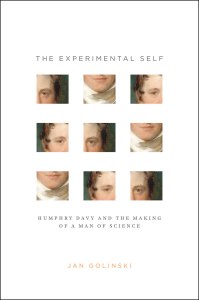 Probably a couple of years ago now, I received in the mail an unsolicited copy of Jan Golinski’s book,
 One of the most wonderful happenings of research is finding one’s subject in unexpected places. The idea of “social mechanics” is to be found in the philosophy of law of Rudolf von Jhering (22 August 1818 – 17 September 1892). In the United States, Jhering most famous work was in its English translation. Published in 1914, Law as a Means to an End (published in translation in 1914) had the following central arguments. The first was that there was no “natural contract.” This was contrary to the jurisprudence of William Blackstone, which posited (like many others) the existence of an original contract as one of the conditions of modern society. Jhering was reacting against a very established natural law tradition. Conversely, Jhering underscored that law was simply the most convenient organization found by man. Morality and personhood were outside of law. It was not that law was amoral. It was that morality was outside of law. Law had no justification outside that it was convenient and that it provided a social function for society.
Thus, Jhering does not also give any ground to organist accounts of the growth and function of law (such as those of Savginy). Law was simply an effect of mankind’s egoism, the inherent and universal tendency of man to maximize his own advantage. This leads Jhering (after page 71 or so) to posit “social levers” responsible for the everyday workings and development of society (as well as its history—the transition from savagism to modern commerce.) Society according to Jhering was nothing but “Thousands of rollers, wheels, knives, as in a mighty machine, move restlessly, some in one direction, some in another….” The machine “must obey must obey the master; the laws of mechanics enable him to compel it. But the force which moves the wheelwork of human society is the human will.” In contrast to nature, the human will is free somewhat free. Social mechanics is the “sum” of “impulses and powers” which humans use in order to move the machine of society. These include include “egoism, self-will, insubordination, inertia,weakness, wickedness, crime” (72). Social mechanics also refer to the forces which the elements of society itself generates to compel the individual. Jhering continued that there is a social mechanics to compel the human will just as there is a physical mechanics to force the machine. This social mechanics is identical with the principle of leverage, by means of which society sets the will in motion for her purposes, or in short, the principle of the the principle of the levers of social motion” (73).
There are four levels of social motion—two of which are egotistical. The first of which (and perhaps the most important) is that of reward, without which there would be no commerce. The other egostical level is coercion, without which there would be no state. Coercion is self-interested in that it is preservation in the face of a superior force (249.) The reward of commerce moves the human being greatly because this motive and commerce generally affirms the dignity of the person (142.)
What is remarkable about this conception of society is not only its reduction to mechanism and mechanical properties and parts, but how, even within a deterministic, mechanistic picture of the world, there is still room for human freedom. If society can be deconstructed like a machine, human beings can influence the machine by affecting one of the parts. But, the machine of society could also compel the individual, it could supply its own force. This digression is also interesting insofar as it outlines an account of social mechanics where it is least to be expected.
*Digression Ends*
Perhaps there was no closer reader of positivism most generally than the early American sociologist than Lester Frank Ward ((June 18, 1841 – April 18, 1913). Ward as I will show was able to take a mechanistic interpretation of natural and social life Ward was a botanist and was the first President of the American Sociological Association. In his Pure Sociology (1903), Ward adopts Comte’s accounts of static and dynamic systems and more or less throws Quetelet “under the bus” by saying the whole conception of “social mechanics” is indeed Comtean (which more or less is Ward’s contribution to a simmering debate among American social theorists as to whether social physics and social mechanics was the contribution of Quetelet or the contribution of Comte.) Ward, denigrating Quetelet and valorizing Comte, undertakes, like Draper somewhat earlier, a huge mechanical reduction of both individuals and civilizations and physical forces in mechanistic terms. The study of society must proceed on two levels: in equilibrium and in flux or motion, or statics and dynamics.
And it is in this account of statics and dynamics that Ward attempts to introduce a reformed vitalistic (my term) principle. His notion of separate specific forces and substances is launched in the context of a renewed discussion of statics and dynamics (164ff.)
Social statics deals with individuals and societies in their integration and equilibrium (158) while social dynamics deals with particles, systems, and civilizations in motion. Social dynamics addresses “disturbances in social equilibrium” (242ff.) Dynamic means both a agent and a “movement.” On the level of the individual body, it describes a change in the motion of a body. On the level of the structure, dynamic means a change in the structures of society itself (221.) Structures like individuals are naturally at a state of equilibrium (indeed, equilibrium is viewed by Ward as a condition for the emergence of the structures of society.) Static systems become dynamic systems since, “construction is only possible through equilibration. Statics does not imply inactivity or quiescence. On the contrary, it represents increased intensity, and this is what constructs. Dynamic movements are confined to structures already formed and, as stated, consist in changes in the type of these structures” (222.) On structure, Ward continues “represents equilibrium” where “order is the necessary basis of progress.” (223.)
As I illustrated in my last post, Draper, just barely was able to account for the properties of a living system as particles in motion. Ward too accounts for living systems as being in dynamic, as changing in configuration as well as changing in state. Everything that is in rest is always in motion. Ward attempts to explain this through reference to kenetics and thermodynamics. Whether he does this successfully is not for my comment.
I note however that in the space of forty years, the bodies of evidence used by sociologists have gone from the physiological (animal heat, caloric, combustion, respiration, etc.) to the thermodynamic. All of matter is under “vibrism” or “chemism” (94.) All of living matter is vitiated by “vital” forces. Man, however, is another element in the social system entirely. And here, I will briefly try to explain how Quetelet’s social mechanics ushers in a new kind of special designation for especially concision actions, forty years later and against Draper’s intentions.
As social physics explains the workings of matter, so to does social psychics account in the same deterministic way for the nature of mind. Social psychics is the “science or substance that deals with the exact and invariable laws of mind” Notice that Ward here says “science or substance.” So, social psychics is the rules and laws governing the particular quality or material quality which is responsible for conscious thought and for the results of conscious thought, human culture and community (150.)
And in such a way as there is physical forces which are reducible to matter and motion, so too are there social energies and social forces which are reducible to their own matters and own motions (165.) This incidentally is where the lauded journal Social Forces gets its name. Social forces are grouped into two classes: essential and non-essential (260ff.)
Essential forces are those of species preservation, growth and reproduction. Non-essential social forces are those higher intellectual and cultural forces which are responsible to human culture itself. These are the forces which are the “chief civilizing agencies” (260) with the highest being “moral, aesthetic and intellectual.” These higher elements are “wants seeking satisfaction through efforts, and thus are social motives or motors inspiring activities which either create structures” through “synergy” “innovation” or “conation.” Human activity and the progress of civilization is distinct from that of brute matter due to the influence of the conative faculty in man. The conative (much in its sense in early modern philosophy, the conatus of Spinoza and others) is synonymous with will or desire. It is the stance of “optimism” which is the natural outlook of all human beings. Optimism guides the will of man and it is these moral, aesthetic and intellectual forces which guide his development and the development of culture. Now, though all of these forces have the appearance of non-material forces, they can in the last instance be reduced to matter and motion (142.)
This reduction of all of society to matter and motion, but to a different kind of matter and motion than brute nature extended to social structures. Social structures were nothing but “the interaction of different social forces.” Social structures are “reservoirs of power” (184.) Human social institutions come into being in order to utilize social energy. Ward here takes as his example the “group sentiment of safety.” Out of this sentiment or social force comes law and religion (185.) Human social institutions, like any product of social forces, can be both material or immaterial, but do not have to be either. If they are the outcome of human striving, of the human will and desire for order, equilibrium and safety, then they are social forces, energies to themselves.
It is with his idea of social forces, at the summit of evolution the actions of the telic agent, which is self-motivating, a physical and spiritual force of its own (464), that Ward attempts to extricate himself from total determinism. In order to account for human social institutions and human will, he posits the existence of social forces, which are both reducible to matter and motion, but unlike brute matter, this type of matter and motion is susceptible to human will and desire, to human striving. Is this a kind of vitalism? Ward here would like to found a new science of psychics, which like thermodynamics and kenetics understood the movement of all base matter. His account of social forces, dependent upon social mechanics, is an attempt to subsume human institutions under laws like those of physics while leaving room for human action. This necessitated the foundation of a new science of forces over atop the old physics.
]]>*Digression Begins Here*
One of my consistent complaints about our understanding of nineteenth century social theory in the United States is that there is little sustained efforts on these topics due to the problem of relevance. My contention was (now some years ago in “The Nineteenth Century Problem“) that our understanding of nineteenth century American intellectual history (as very narrowly defined by the history of ideas, so as to not include the history of social movements or ideologies) was hampered by the issue of relevance. We have a basic problem of knowing so little about nineteenth century social theory that we must resort to boot-strapping mechanisms.
Thus, historians of ideas and historians of science would like to think that they can study anything they’d like. But this is simply not true. I am discussing this since many issues were addressed with my Zilsel friends last week. One was the issue of justification of case studies and of topics for analysis. My respondent (the extremely smart and gracious Volny Fages , who throughout put up with my bad manners) questioned why I justified my attention to the pseudosciences and even my choice of case studies.
Volny countered that it was simply the position of sociologists and historians that they could study what they pleased and that they did not have to justify their choice of topic.) This I think is a wonderful statement. But it is utopian. The entirety of the history and philosophy of science is built on an absurd network of case-study justification. Will has gone into this a great deal more than I, but historians and sociologists of science usually depend on a kind of epistemological imperative. Historians and sociologists can use any case study they want, but it has to address in some way the problem of knowledge or an ism, ideology or -ity (ex. objectivity.) Historians and sociologists or science must also use their techniques to investigate the historical, archival record to uncover that which was unjustly hidden which has been rendered invisible. This is the point of the book on Henry Carey and other early American political economists, The Soul’s Economy. And it is due to the attempt to uncover something hidden, and I contend, to find something not there at all, that Henry Carey’s work is totally misinterpreted.
Historians of the nineteenth century are especially concerned with the invisible or unclear origins of a concept or of an ideology. They delight especially in “debunking” an origin story of an ideology or other commonplace, as this gives them a more status as a “debunker.” This is somewhere between a professional philosopher (which for most is undesirable) and a professional scold (which for most is unattainable, though it may be ultimately desirable. Scolding takes effort and must be sustained.) For the nineteenth century however even this is a burden and not often done. Most often projects in the history of the social sciences are designed to connect rather easily to modern developments (especially in the Cold War) which need not have their relevance justified and are supplemented by ample archives.
All this creates a “Matthew Effect” in scholarship, where scholarly projects become more and more concentrated over time in a given sub-inquiry as graduate students and young professors (who produce the majority of work anyway, with a steep fall in productivity after tenure (see Gordon Tullock’s famous article on discriminating against assistant professors ) seek projects which are low in risk and initial costs and high in rewards. As historiography becomes more established, costs lessen and rewards very often become greater. This assumes that rewards for novel scholarship are relatively low. This is more than often the case because novel work can not by definition establish itself easily (because of lack of prior historiography, thus costs are high) and become superseded quickly. Thus, the reward for any novel work is momentary. And generally as a point of human psychology and human motivation, it is much easier when writing for and with friends. This is increasingly the case with all of the historiography on the Cold War social sciences.
*Digression Ends*
Thus, it was with much pleasure that I agree to discuss at the International Society for Intellectual History’s 2016 meeting, in sunny Crete, the influence of Adolphe Quetelet’s “social mechanics” on early American social theory. I have found the first recorded appropriation of Quetelet’s ideas in the United States, in the work of John William Draper. The first mention of Quetelet’s social mechanics was in the writings of Frederick Denison Maurice in “Politics for the People,” published in 1848.
As Theodore Porter describes, Quetelet’s mécanique sociale (later physique sociale) was meant to be an immediate invocation of Laplace’s mécanique céleste, or the desire to develop laws of social life with the same universality and clarity as those of physics. Such a task was undertaken with a great deal of abandon by Henry Buckle, as many know. Unknown however is the career of social mechanics in the United States. Why has this not been done? The above-mentioned “Matthew Effect” in historiography.
The first utilization and appropriation of Quetelet’s work can be traced to its origins in the work of Henry William Draper (a pioneering chemist and author of many works on the “conflict” between science and religion) Draper described in a massive two volume work, The Intellectual Development of Europe (1864), the social evolution of man. Draper underscored that biological evolution, while important in nature, was less important in modern nations than intellectual advancement. Indeed the distinction between savage and civil was the significance in the later of mental progress and the insignificance of biological evolution. The mechanisms behind intellectual development as well as his advocacy of the supremacy of physical causes, was a key theme throughout his work.
Draper, as I briefly mention below, was committed to the physical unity of mankind. He was convinced that the advancement of civilizations was the result of the development of mental qualities. Contrary to the naturalist Louis Agassi, Draper considered the anatomical and physiological features of man to primarily be fixed. Any variation was not due to the action of speciaton, but to climate. This was a difference of degree rather than kind. Europeans progressed to a more refined state of civilization because there reasoning was “analytic.” Asiatic minds in contrast were “synthetic.” As a consequence (QED), there customs were “invariable.”
Like Buckle, Draper’s works on the Intellectual Development of Europe are suffused with his effort to found laws of human action on the then novel developments in the inquiry of physiology, on the writings of Justus Liebig and others. Physiology was then considered to be the science of matter in motion and to be a branch of “natural philosophy” by Draper and Buckle. Both considered it natural philosophy insofar as physiology through its uncovering of the interplay of material forces and the governance of individuals and especially nations by laws.
One of Draper’s earliest works, the wonderfully titled Human physiology, statical and dynamical, or, The conditions and course of the life of man (1858) cites Quetelet. He has “in an interesting manner extended the methods of statistics to the illustration of the physical and moral career of man.” Quetelet’s reasoning is laudable as he (Draper appears to be glossing a number of his works without actually quoting the source) since it underscores that the “actions which seem to be the result of free will in the individual, assume the guise of the necessity in the community.” Quetelet further underscores that man is born, lives and dies under “immutable laws” much in the same way as communities (Human physiology, pgs. 15 and 16.) This lack of quotation is somewhat unusual in the latter part of the nineteenth century, as in the American speculative writings in the period (such as Samuel Morton’s ethnology and in phrenological works, the citation and the use of an authority, was an instrument of credit.)
What is important to underscore here is the degree to which Quetelet’s work was used by Draper in his text to articulate that it was possible to discuss the social group. Draper then uses ethnology as a middle term to move between the individual and the group. This completes his account of individual gestation, growth and development. This follows many pages on the unity or plurality of the unity or diversity of mankind (c. pg. 600) as well as a detailed discussion of the influence of climate on the races of man, and of the various mental qualities of individuals (cf. pgs 603 especially).
Draper does this to unfurl a huge theory of the progress and advancement of world civilizations under the heading “Social Mechanics.” This is very interesting, for reasons I shall explain. Draper, enmeshed in the language of physiology, wishes to determine the connection between “corporeal development” and “historical career.” He has appropriated Quetelet as ushering in the study of not only the “organization” (pg. 602) and “the community” but uses his “social mechanics” to articulate a vision of how physiology explained the advancement of civilizations. This requires some further explanation.
Draper’s inquiry is divided into two parts: the statical and the dynamical. The statical has as its inquiry the workings of the animal mechanism in equilibrium. Here Draper treats individuals mostly, looking at organic life as a closed system (detailing respiration, excretion, etc.) The origin, growth and development of nations is treated under the heading of dynamical.
Draper throughout very much used the language of the physical sciences: “in this regard the human body may be spoken of as a mere instrument or engine, which acts in accordance with the principles of mechanical and chemical philosophy, the bones being levers, the blood-vessels hydrolic tubes….” (24.) In a like manner, the dynamical accounts for the living system in motion: “Commencing at first as a simple cell, it assumes one form after another in succession, but it is ever ready, like the moving bodies of mechanics to obey the impulses which extraneous bodies may impress upon it.” An organized body though it may be in equilibrium, is never truly at rest. It is always in motion. Bodies, like civilizations, have “past and a future- coming from one state and going into another.” Bodies and civilizations pass from “phase to phase” (457.)
Draper undertook this move in order so that vitalism may be rejected. Vitalism is rejected because it is internally motivated, it is an internal cause which is not subject to the influence of external causes. It is a relic of the “old metaphysical system of philosophizing” (25.)Draper had no issue with reducing all biology to an aggregate of physical causes (hinging on an intriguing understanding of mechanics) where all elements of a living system were either at motion or at rest. Physiology was the inquiry into the motion of the physical particles which drove the organism through its embryonic development, birth, maturity and death.
To return to Quetelet, the reduction of organisimal complexity to the laws of physics is an application of Quetelet’s program. When Draper underscores that “universal history is only a chapter of physiology”, he means that the advancement of civilization can be reduced to the laws of mechanics (here, outside physical forces such as heat or cold, acting on physical bodies, individuals and groups.) It is these forces and nothing else which drive the development of individuals and nations.And civilizations, like all physical systems, have “laws of equilibrium and movement” (605.)
And in the last pages of the work Quetelet’s influence very much shines though. All of mankind can be said to be under the action of physical forces, whose movements and attributes, can be summarized by referencing the “standard man” (611.) Moreover, the laws of physiology, of mankind under the influence of physical forces such as heat, wetness and cold, of their bodies reacting to these physical impulses in determined ways, are only really visible when it is not the individual who is under consideration, but the “multitudes” and the “masses.” Only then is it really visible that the advancement of civilization is not due to the “will” of races or of nations, but to the interaction of physical forces. At the level of the community “the element of free will seems for the most part to disappear” (612.) Civilizations and the advancement of man will progress in the same manner “so long as the influences of external nature are the same, and so long as the construction of the human brain is the same” (ibid.)
Thus, Draper appropriates Quetelet in a major way, applying his ideas of not only the average man, but of the idea of the order and regularity which arises out of the consideration of the mass or aggregate. Draper takes much of Quetelet to heart in his account of the “mechanics” of the advancement, flowering and decay of civilizations, reducing the development of civilizations to the workings of mechanistic systems in equilibrium and in motion.
Quetelet too had a very interesting side-effect here as Draper emphasis on the physiological sameness and unity of mankind melded well with both’s account of the “standard” man. This allowed Draper to inveigh against the argument of the multiple speciation of mankind. Quetelet and Draper’s writings thus served to blunt the virulent racism of polygenesis- or the idea of the existence of multiple species of mankind.
My next post, continuing my talk, will discuss the continuing usages of statistical and dynamical in the conceptualization of social theory. I will focus on the problem of vitalism in such a conception (as well as the invocation of Quetelet) in the major writings of a critical social theorist, Lester F. Ward.
]]>In the course of talking with Joseph on the first day of my questioning of him, I mentioned Gordon Tullock. Tullock and Joseph were good friends. Agassi met him where he was at Stanford and Tullock tried to work with Popper. Undeterred by Popper’s inability to work with Tullock, Tullock then went on to be a post-doc at the University of Virginia (though he only had a J.D) while spending most of his later years at George Mason University. Tullock, throughout his writings acknowledged his fondness for Popper, particularly his suspicion of dogma. By dogma, Tullock meant almost all of economics not written by Gordon Tullock. There are many Tullock anecdotes related to me by Agassi, but one which I shared with him was Tullock’s objection to seat-belts. Seat-belts were instituted in the 1970s to protect drivers from death. No, Gordon responded, the way to make drivers safe is to place a knife in the middle of the steering wheel, so that if drivers speed and shop short, they will be impaled instantly. There is also a page of Tullock insults.
II. The Social Position of Gordon Tullock
Gordon Tullock is lionized by his students, followers and admirers. Mainstream economists ignore him entirely. Tullock was able to publish in over fifty academic journals. But, his influence in the policy profession is minimal and he is not regarded highly outside of the “Virginia School of Political Economy.” His education was not even in economics but in law. As a result he was not taken seriously by most economists. He had so many problems publishing that he founded his own journal, Public Choice
He did however publish widely on the topic of rent-seeking and was co-author with James Buchanan (the Nobel Prize winning economist) of the Calculus of Consent (originally published in 1962.) Buchanan and Tullock’s methodology is more or less that of economic imperialism- choices in voting behavior, the behavior of the individual in politics, is much the same as the behavior of individuals in markets. In the market and in politics, individuals pursue their own interests. As importantly, so do politicians and bureaucrats. That is why Tullock argued especially that there could be no such thing as the public good, as politicians, though they make a great deal of noise about public goods, do nothing but attempt to follow their own interests. Politics is therefore a messy business that is bound to disappoint idealists. The Calculus in many ways made both authors very famous, but it illustrates the perils of the dissenting inquirer, especially for Tullock.
III. At the Root of Every Dissenting Science, An Individual and a Method
In my previous post on Napoleon Chagnon, I wrote that his theory about cultural evolution is more or less a reduction of Yanomami tribesmen into “maximizers.” The Yanomami understand costs and benefits. This is why they are aggressive, because although it may lead to death and dismemberment in the short term, in the long-term aggression can serve as a deterrent. As importantly, being aggressive and being good at fighting leads to higher status and this leads to higher reproductive success. It is as Chagnon and Jim Nell would say “good to be headman.” Bellicosity has an evolutionary advantage (and is therefore encouraged) because fighting is a deterrent and wife-capture good for the demographics of the village (morals play no role in Chagnon’s analysis.) Pursuing self-interest is according to the dictates of evolutionary biology good for one and one’s kin and is therefore encouraged by Yanomami. In the work of both Tullock and Chagnon, their subjects are always “the economic man.”
What is fascinating however is the degree to which Tullock was able to apply this insight to all manner of works. In his rather puckish essay, “The Coal Tit as Careful Shopper” Tullock contended that the coal tit was much like a lady window-shopping. It had a sense of the costs and benefits of its foraging, it knew where it could gain the most benefit for the least cost. Hunter-gatherers act like this as well in optimal foraging theory. Likewise, in his pamphlet on The Economics of Non-Human Societies (1984), Tullock said that all of nature from man to amoeba was rational, so it was quite an insult to call someone irrational: he was worse than an amoeba. Tullock also applied this economic model to the child labor problem. Children were terribly expensive in terms of resources, did they have any use? What Tullock argued was that yes, indeed, children are very good labor sources, especially in agricultural societies. This explained why farm labor intensive regimes had younger populations.
IV. Why We Need a New Taxonomy to Describe Sciences
But here perhaps is the root of Tullock’s position and the key to the wilderness of the dissenting stance. Brilliant though he was, Tullock by applying the economic rationality and the rational choice model without reservation to almost anything (he did however have suspicious about sociobiology, noting that it was unclear if any science could explain both man and “slime mold.”) he perhaps diluted his influence. His “gadfly” “curmudgeon” stance towards modern, especially Keynesian economics and the politics and prospects of government intervention, his inability to take his own personality out of any publication, ensured that his influence only extended to those whom he knew personally. He had few students and many followers, and legions of admirers. But Tullock is an extraordinary example of why we can simply not describe sciences as “sciences” and “pseudo”, for if it is just these categories, how can we describe economists like Tullock who trained as a lawyer and who without any humor at all, compare children to a good martini?
We historians and sociologist must find a way to describe the work of such a man who knew, perhaps early on, that his intellect would not lead to his acceptance, but to the ingestion of a kind of academic hemlock. Tullock by the end of his life was overlooked for the Nobel, and discussed avidly only by those who knew him. After his death retrospectives described the sparkle of his genius, but he founded no real school and did not publish in any of the major academic journals. But we can not describe his work in the same breath as necomancy and astrology. Neither we funny, and neither makes you rethink E.O. Wilson’s work.
]]>
I. The “World’s Most Controversial Anthropologist”
Napoleon Chagnon has been christened the “world’s most controversial anthropologist” by the New York Times. Chagnon enjoys the label, it is on his faculty web site. Why is he the world’s most controversial anthropologist? I give two reasons. 1) in a book published in 2000, “Darkness in El Dorado,” he was accused with James Neel, a well-regarded epidemiologist, of exacerbating a measles outbreak in order to test the fitness of tribes of Yanomami in Northern Brazil and Southern Venezuela. These charges, offered by a journalist, were dismissed by the American Anthropological Association. 2) his linking of social status, with reproductive success or of cultural success with biological success. Chagnon argued, as had his adviser and mentor the geneticist and epidemiologist Jim Neel in the 1970s and 1980 (most explicitly in “On Being Headman” in 1980) that those Yanomami villagers who were good at warfare, good at killing had high social status. Aggression and warlike behavior (through mechanisms not really explained) have become social virtues due to their biological benefits. As a result of their high social status, they enjoyed reproductive success. They had more children than villagers less adept at warfare. Aggression persists, moreover, because it is evolutionarily adaptive and it is the result of human beings acting rationally, in the pursuit of their own self-interest as well as those of their kin.
The linking of status and differential rates of reproduction or “differential fertility” is an old idea, dating back to R.A. Fisher. After Fisher’s death and due to the influence of social biology in Britain and the United States, it became a main tenant of theoretical population genetics and demography after the Second World War, losing (or loosening) its eugenics ties and naturalizing in demography and epidemiology especially. And the idea that social factors influence biological evolution is today a well-established trope in human biology and evolutionary population genetics. It need not be controversial.
Indeed, many of Chagnon’s ideas were in no way original. He just stated them very loudly and applied them to primitive warfare. Chagnon was viewed by much of the anthropological profession, even after the El Dorado controversy died down, as engaging in eugenics. This was because he was taken as saying that there was a “gene” for aggression and warlike behavior. Chagnon did not say this but his reduction of warfare to the principles of biological evolution, his reduction of tribesmen to “utility maximizers” and of yoking cultural evolution to simple biological models, game theory and evolutionary explanations deeply offended a great number in the field who considered culture as one of many social facts. Added to this is Chagnon’s difficult personality and his constant critique of anthropology as rubbish.
His anthropology and the human behavioral ecology he helps promote are the first in my case studies of the dissenting sciences.
But like my others studies in the “dissenting sciences,” Chagnon is both of the field and not a part of the field. He is both central and marginal. He has published in many major scientific journals, like Science. But he is loathed in many parts of the discipline. Chagnon also finds it most comfortable to publish with those who hold his views (particularly today.) Lastly, he considers his anthropology to be “anthropology” and his approach is irreconcilable with that of cultural anthropology. If he is correct, the work of the vast majority of anthropologists is rendered useless. His account of anthropology too relies so much on an alternate conception of the field, where culture, if culture is to be explained at all, it must be explained according to the principles of evolutionary biology and population genetics. Chagnon thus continues to occupy a liminal position in the field a “heretic” and a “misanthrope.” (as he states in his autobiography Noble Savages: My Life Among Two Dangerous Tribes: the Yanomamo and the Anthropologists (2013)
In 2013, when Chagnon was elected to the National Academy of Sciences, Marshall Sahlins, in many ways the premiere anthropologist in the United States, resigned from the Academy in protest.
What makes this position of dissent most interesting is the degree to which he is considered a “heretic.” Terry Turner, a well respected anthropologist in the field, has declared Chagnon and his mentor Jim Neel “eugenicists.” Turner has recently repeated the claim that Chagnon reduces his subjects to nothing more than animals in an oral history of his life and work by anthropologist Alan Macfarlane . On the other hand, Chagnon has inspired a legion of followers who write about the connection between social success and biological success and who consider Chagnon for helping found human behavioral ecology, and are published oftentimes in the premiere anthropological journals. However, if one closely examines the sources and approaches used, it appears than many of these articles on social and biological success appear to be having a conversation amongst other adherents of human behavioral ecology rather than other anthropologists generally. In many ways, every article in human behavioral ecology, even when published in the major journals, is another ballast directed towards the profession. In these articles especially, the approach is given a history and in particular, is constructed as the superior approach because of its synthesis of a number of slow-developing insights.
Briefly, human behavioral ecology uses optimization theory and post-war evolutionary theory (especially the work of W.D. Hamilton) to explain cultural evolution.It further views human beings as engaging in rational behavior (like all of the natural world. This is also the opinion of Gordon Tullock, whose work in public choice political economy was profoundly influenced by his rather idiosyncratic take on sociobiology. This I will detail in the next post) which is evolutionary adaptive. This approach as two institutional centers (University of Michigan at Ann Arbor as well as Rutgers University’s Center for Evolutionary Studies) as well as a number of “aligned” journal such as Ethnology and Sociobiology. An actual social position study of this inquiry will be attempted but not in this post. Human behavioral ecologist publish in a number of mainstream academic journals, but are typically not aligned with major anthropology departments such as Columbia and Chicago. Also, a number of human behavioral ecologists have either studied at University of Michigan or are at Rutgers, so there is social selection in regards to academic positions and pedagogy.
These journals have peer review, but their editorial board and editorial practices are very much predisposed it appears to accepting authors who agree with the approaches of the journal. It also appears that many of the authors who publish in these types of journal only publish in these types of publications. As I become more interested in pursuing this project, I am developing metrics which attempt to describe and measure quantitatively the degree of “inbreededness” of these journals. The questions I seek to answer: to what degree do the same authors publish in journals such as Ethnology and Sociobiology? Are those authors only publishing in those journals such as Ethnology and Sociobiology, where their ideas will be received favorably? Do human behavioral ecologists such as Chagnon, Lee Cronk and Laura Betzig publish at the same rate in journals which are in no way favorable to the dictates of human behavioral ecology?
This question is difficult. For example, Chagnon has published extensively in both Science and in the journal of the American Anthropological Association . His work is also discussed in the pages of this “flagship” journal of the field. Lee Cronk as well has published extensively in this journal. Both are therefore a part of the discipline even if they dissent from its tenants of anthropology as description, of culture as autonomous from biology, and of the task of the anthropologist as a relativistic chronicler.
However, Laura Betzig, also a human behavioral ecologist posses a different case. Unlike Cronk and Chagnon, she only publishes in journals which are favorable to the tenants of human behavioral ecology. The reasons for her lack of mainstream acceptance are obvious, she wishes to turn her understanding of the linkages between social and biological success into a Darwinian theory of history. I shall relate more of this below.
II. The Boar and the Yanomami
In an series of articles and books, Chagnon with others contended that the Yanomami were warlike and this war-like posture was a fundamental state of their society. This was to counter what he considered to be the doctrinaire idea of anthropologists of the “noble savage”, that of the pacific, wise and noble tribe of primitives. Such an idea, Chagnon believed had become solidified in to a “faith” rather than a fact (see his biography “Noble Savages.”) So too was the majority of the anthropology profession based almost entirely on faith rather than on fact. The reliance on faith rather than on fact blinded cultural anthropology to a number of fundamental issues. According to Chagnon, social anthropology suffers from “biophobia.” Cultural anthropologists stridently resist all attempts to explain the behavior of primitives according to any kind of biological imperative. In fact, social anthropology resists any explanation at all. In the 1970s, anthropologists explained any kind of tribal warfare and the dynamics of village demography by framing territorial aggression as the product of competition over scarce resources. Warfare, according to social anthropologists, is the result of dearth. Chagnon found that levels of protein could not be correlated with active warfare. Warfare was then the result of another factor.
Blindness to biology lead anthropologists to not consider the factors behind the evolution of culture. Chagnon used violence as a prism to examine the evolution of culture drawing from political anthropology as well as biological theory. Chagnon in his landmark 1988 article, “Life Histories, Blood Revenge and Warfare in a Tribal Population,” published in Science in 1988, argued that primitive tribesmen can generally be expected to act in ways which promote survival and reproduction, especially the survival and reproduction and survival of themselves and their close kin, or what evolutionary biologists would call “inclusive fitness.” They are rational and engage in behaviors which maximize the survival and reproduction of themselves and their kin. Human beings too through learning and the inculcation of mores and customs, are adept at learning social customs (985-86).
Therefore Chagnon concluded, warfare among the Yanomami is predominantly in retaliation for revenge and resembles a tit-for-tat exchange. Warfare is initiated due to the loss of one’s close genetic relation, leading to a decrease in inclusive fitness. Kin groups which respond quickly forestall violent actions of their neighbors in the future. Aggressive, warlike groups also have a greater facility in abducting women. Aggression leads to greater success in the capture of wives. Tribesmen who act aggressively, kill aggressors and are proficient warriors have higher social status within the community and therefore have higher social and reproductive success.
Thus there are two direct causes for tribal warfare: 1) to forestall aggression, where violence acts as a deterrent and 2) men who kill other men have more wives and therefore more children. Such wives are secured not only through forcible capture, but also through the increased social status granted to men who are good warriors. “Cultural success leads to biological success,” Chagnon concludes, where “in short” military successes lead to reproductive benefits and concessions from others in the community (990). Being successful in warfare, he continues, is one of the many virtues encouraged by Yanomami society. Such a virtue is reinforced because having large numbers of aggressive men leads to a successful village (which does not get raided by outsiders.)
III. The Vineyard
Why did anthropologists take offense at this?
- In part the sociobiology of the late 1970s and 1980s of E.O. Wilson was much to blame. The position of sociobiology viz a viz human behavioral ecology is quite contested. One can think of these two inquiries as overlapping. However, sociobiology has always been more concerned with sociality and adaptation in the natural, animal world than in human communities. E.O. Wilson’s many books discussing human societies have always remained amateurish. The comparison to sociobiology is also not warranted because Chagnon’s notion of cultural evolution has always restricted itself to the development of customs which govern mating and reproduction (although he did a great deal of research on Yanomamo cosmology and religion, he is not remembered for this.) Chagnon discusses “mating systems,” sex, reproduction and war. Little else.
- Chagnon’s account of tribesmen has always been unflattering. He views them as nasty and brutish. He inserted himself into their village politics and there have always been accusations of his exacerbating the conflict. A key, now probably unanswerable question, is whether the tribesmen used machetes as weapons of war due to Chagnon, or whether they had access to those weapons before (Chagnon has been described as an arms dealer in some publications). His outlook on politics, derived from a very select readings of Hobbes and historical works in political anthropology, have portrayed tribal society as a war in the state of nature.
- There is a deep institutional divide between his type of anthropology and the cultural anthropology embraced by the majority of the anthropological profession. Chagnon’s anthropology (and that of Lee Cronk and Robin Fox) is deliberately presenting itself as scientific, falsibable and progressive and the majority of social anthropology as practiced today as not. It is very Popperian.
- Chagnon does not believe there to be any evidence behind the anthropology of Marshall Sahlins and Clifford Geertz. For Chagnon, both men’s anthropology is not evidence based. Moreover, much of Chagnon’s critique of Geertz, Sahlins and social anthropology positions himself as the penultimate and perfect fieldworker. It is Chagnon, having spent decades in the field, who is correct. According to him, many social anthropologists have merely read about primitive tribes and attempt to do as little fieldwork as they can. The debate between Chagnon and Sahlins thus reveals a divide between fieldworkers versus theorists.
- The controversy over Chagnon too is at the core of the problem of the dissenting sciences. Because of his fieldwork expertise, because of his important and voluminous publications, because of his lineage with Jim Neel and his long presence in the field, he can not so easily be dismissed as “pseudoscience.” He is now a member of the National Academy of Sciences as is Robin Fox. Chagnon has a senior academic appointment. His work on differential fertility has granted him many followers and adherents. Human behavioral ecology is now a significant inquiry with its own journals, metaphysical principles and followers. It is an established community. Social anthropologists can not get rid of Chagnon, nor can they rid themselves of his followers.
- Chagnon presents kinship as a social system which reinforces biologically self-interested behavior. This is against a very core tenant of anthropology which views kinship as unconnected to biology in any way.
As I explore in the final section, human behavioral ecology in the work of Laura Betzig has given rise to some fascinating, though troubling speculations. Her example, as opposed to Lee Cronk, provides an interesting test case for examining how the dissenting sciences themselves are heterogeneous and how Betzig has suffered her own kind of marginality by taking many of behavioral ecology’s positions to extremes.
V. “Darwinian History” and the Limits of Dissent
Chagnon’s work has become a significant part of the inquiry called human behavioral ecology. Human behavioral ecology has perhaps one significant center in the United States, Rutgers University. According to Lee Cronk, human behavioral ecology views culture and human behavior as the outcome of reciprocity, cost-benefit analysis, investment and self-interest. Human behavior can be explained in terms of simple models from game theory and population genetics.
All norms and customs, but especially those governing marriage and reproduction, underscore that all human beings seek to maximize their advantage (and that of their kin) while diminishing costs as well as diminishing the benefits of others. All human behaviors are adaptive, increasing the fitness of those who engage in these behaviors in their environment, relative to those who do not. This explains, along a classic social selection model, the origin and persistence of social customs and norms. Another example of behavioral ecology is “optimal foraging theory“. Hunter gatherers tend to forage in a manner which maximizes the utility of the foraging while decreasing the costs. Such behaviors exist because they (if maximizing) improve or increase fitness is passed on through generations, so that over time, customs and practices governing foraging become a part of the culture and norms of the actors.
What is interesting the degree to which, though provocative, such models are only used to explain the behavior of discreet populations (usually primitive tribes). There is some generality though it does not rise to the level of a theory of history. The scenario is quite different with the work of Laura Betzig, who has used her (and Chagnon’s account) of differential reproduction and the connections between status and biological fitness to explain all of human history. Fascinatingly, this was reviewed even poorly in Ethnology and Sociobiology and other aligned journals. Commentators believed there was too little evidence to sustain Betzig’s claim. Betzig is on the margins of the profession. What does she argue? In Despotism and Differential reproduction (1983) she traces the course of human history and the mechanisms of despotism by arguing that hierarchy and despotic regimes arise because of individuals succeeding in maximizing their own reproduction at the expense of others, with great power…comes greater fitness. Power is not pursued for its own sake but for its connections to superior access to reproduction!
Chagnon was Betzig’s dissertation adviser and one can see many of the influences of human behavioral ecology. Everything is reduced to evolutionary adaptation, self-interest and the benefits of kin. What is also fascinating is the resounding criticism carried out in the pages of Ethnology and Sociobiology, which critiqued everything from Betzig’s use of evidence and statistics, to her overall approach. Dissent can only go so far.
]]>My friends at Zilsel have invited me to speak on a topic which I have been working on for quite some time, through my various researches in biosocial anthropology and human behavioral ecology, behavior genetics and public choice economics (in the work of Gordon Tullock especially) the “dissenting sciences.” I keep changing my mind on what to call them, having referred to them as “heterodox” and “pariah” sciences.
I am a bit in a muddle and I have decided to write my way out of this confusion. I have submitted two introductions to introduce my case studies. This is a version of those introductions.

Writing on the Pseudosciences
I do this because our field not only suffers from the privacy of criticism but also the privacy of ideas. As Will has written about many times, historians of science are too concerned with only publishing their very polished thoughts. This means that much of the knowledge of the profession is hidden from public view. This behavior is elitist.
And now everyone reading this hopefully has a better sense of my motivations. My thoughts on pseudoscience are a bit of a muddle, I am using this blog as a way to puzzle out this muddle, as a prelude to puzzling out some of my confusions in a talk on Tuesday. I am deliberately not holding back my unpolished thoughts in the hopes that others will do so.
II. Pseudoscience and Science are Intermixed: The Case of Phrenology
Here are my issues: how to define pseudoscience and how to determine the characteristics of “not pseudoscience” or science, and how to address my case studies which are somehow neither scientific nor pseudoscience. Agassi’s philosophical anthropology in particular underscores that science and pseudoscience are intermixed. But he really does not address the problem further than that. I think for many this is enough.
But I for one would like some clarity on this issue. To begin with there are many, many works on the status of the pseudosciences. A wonderful book edited by Bryan Farha notes that the common characteristics of the pseudosciences are: 1) overuse of adhoc hypothesis to escape refutation 2) absence of self-correction 3) emphasis on confirmation 4) over-reliance on anecdote 5) obscurity. These characteristics to describe pseudosciences quite well according to their own definitions. Accounts of pseudoscience are infused with Popperian methodology, given Popper’s contributions to our understanding of pseudoscience. My case studies pose issues according to these criteria. Gordon Tullock writes very well and very clearly. He has no add hoc hypothesis. Other examples: behavior genetics is in the process of self-correction. A more important point: all modern sciences break the above criteria. But, of course, not all the time. But enough to make problems for this definition.
So, conceptually pseudosciences are a huge mess: what does pseudoscience mean, exactly? Pseudosciences are usually considered to be in some ways anti-scientific or “not science.” But pseudo means having the attributes of science, but not functioning in the same way that science functions. Pseudo sciences are at most “fake” sciences, not “non” sciences. Furthermore, the given examples of pseudoscience are usually quite limited.
In the nineteenth century, phrenology was considered by many to be a pseudoscience. Alchemy too was or is considered a pseudoscience. Phrenology was the early 19th century inquiry into the connections between brain (as matter) and mind (as faculty of cognition). The phrenological work by the Fowlers is in many ways exemplary. We now look at phrenology as nonsense. Rightly so. Phrenology was absolutely wrong. But many of the reactions to its ideas were fruitful. This was also why the debunking of phrenology was so necessary, it lead to some very good ideas. In refutation, there is growth. I know here I am being overly Popperian.
Many contemporaries, particularly in France, ranked phrenology with “necromancy, alchemy and astrology.” But the discipline of anthropology in the United States found the tenets of phrenology very useful to say what it was not. What phrenology is, anthropology is not. Therefore anthropology is better. Phrenology thus provided anthropology with a theodicy, an account of evil. Did phrenology provide inspiration to many who then had careers in psychology and medicine? Of course, this is unprovable, but possibly. As importantly, although it was close to “necromancy” to many, phrenology privileged the unity of the human species. This was not necessarily an argument against hierarchical racism, but the plurality of species was an argument for hierarchical racism in the 19th century. Many critiques of phrenology centered around how it was a poor copy of proper scientific reasoning. This is very important. Phrenology was scientistic, taking on the outward attributes of science but learning none of its lessons. The excesses of phrenology lead in the nineteenth century (especially in neurology, medicine, psychology and anthropology) to useful self-reflections.
Phrenology by providing a theodicy, a bed time story for young scientists, a threat if they did not eat their supper, served a good purpose. Do pseudosciences have a purpose in this regard? absolutely. They tell the developing sciences (like physical anthropology) how they should conduct themselves, aka not like phrenology.
III. In Critiques of Pseudoscience and Among Individuals Whose Work is Called Pseudo-scientific, An Unrealistic Account of Science Emerges
Phrenology, as I mentioned above, served a useful purpose. It impacted the course of social science. But if pseudoscience assists in the development of science, what is the divide between science and pseudoscience? We must also keep in mind another series of related issues. In every pseudoscience, be it phrenology (and according to many minds) astrology or studies of ESP (extra-sensory perception, or the science of “Ghostbusters”), there is an envy of science. There is a among pseudoscientists an unrealistic picture of consensus in science and of how science works, of what science can accomplish and with what evidence. Phrenology constructed a grand system from little evidence.
As importantly, among critics of pseudoscience, there is an unrealistic account of science as well. Science in both accounts is “normal.” Science is a utopia. It is Kuhnian. Along these lines there is an alternate conception of pseudosciences which has emerged recently, that of misbehaving sciences by Aaron Panofsky. Misbehaving sciences, such as behavior genetics, one of my case studies, are “misbehaving” because there is: no consensus among misbehaving sciences of the core tenants of their inquiry; a loose sense of professionalization, of proper pedagogy and institutionalization; a tendency to politicize claims and to make them extravagant; endless public controversies, a constant fight over resources, and anomie.
This account of misbehaving sciences is in many ways wonderful. It is clear and provocative. It is however simply unworkable. In the first instance it underplays to a fantastic degree the role and presence of dissent and disagreement in normal sciences. Panofsky considers a certain level of disagreement good, above a certain level, destructive. Criticism and controversy are then presented as foreign to functioning science. Panofsky does not say this but this an extension of his argument. This is very Kuhnian. One can also make a very good argument that many of the features that Panofsky presents are present in all “behaving” sciences. He very much has an idea that dissent and disagreement in science are pathological or can become so at the shortest notice. This underplays the role of dissent in the growth of scientific knowledge as well. In any case, although Panofsky does interesting work, he too presents an unrealistic account of science which trivializes dissent and presents disagreement as pathological to science.
IV. Some Solutions
Let us not discuss pseudoscience for the moment. If the line between science and pseudo is vague and pseudo can be productive, let us rid ourselves of this term. It is too confusing. But how can we describe properly inquiries, personalities and methodological insights in the social sciences which are, 1) not only are not rejected by the majority of the profession in a field (such as economics, anthropology and psychology) but also are, 2) due to their rejection by the majority, fervently accepted by a minority (who still call themselves economists). I call them dissenting sciences. This gives proper honor to the inquiries I address. It gives them proper space within the sciences they critique (and from the inquiries they sometimes loathe.)
I also put my cards up front. Anthropology is a science. If it was not, the dispute between monogenesis and polygenesis would still be raging. But it is not. Economics is also a science. This is easier to defend.
Dissenting sciences acknowledges that they are very fully formed communities of practitioners, with established social networks and peer review journals, institutional affiliations, etc. Dissenting acknowledges that they are at a social, institutional and intellectual distance from the “center” and the intellectual consensus of the field. All three of my case studies wish to reform the field from within. They express disappointment, even bewilderment, when their work is not adopted by others in their field.. These dissenting sciences are also extraordinarily strident, even vicious in their exchanges within their fields. But viciousness, though painful and unfortunate, is to be an expected part of any modern science. Viciousness is a case a bad manners.
My case studies (behavior genetics, human behavioral ecology, and public choice economics) are somewhat good for their fields (mostly). Public choice, the most; human behavioral ecology, the least. Social anthropology has benefited from its disputes with Chagnon. Behavior genetics is reemerging into respectability. I shall explain further in a subsequent entry. All three, as I shall explain later, do a great deal to keep out virulent racism, among other things. Public choice economics, human behavior ecology and evolutionary psychology, through their own disciplinary and community dynamics keep out more destructive elements, as they police their own borders and lament the state of their respective fields.
By looking at the dissenting sciences, we shall have a clear idea of non-sciences. Non-sciences are truly destructive. Here is an example, the work of Richard Lynn, and another in the work of Arthur Jensen. I shall explain non-sciences too. The work of Lynn and Jensen allows me to make a very clear point. Although I enjoy dissent and think dissenting sciences important, I think it necessary to the proper conduct of science, there must be criteria for refutation, criticism and even debunking. If not, if we just embrace lazy pluralism, Paul Feyerabend is right and we should shut down hospitals and see shamans for broken bones.
V. More on The Dissenting Sciences
Very interestingly, in each of my case sciences, there is a dogmatic insight at the root of departure of the founders in the field from the main tenets of economics, anthropology, and social psychology. This is often explained biographically.
For example, Gordon Tullock and Napoleon Chagnon both have Pauline conversions and have written about it especially. At root of both men’s conversions is a methodological insight. This insight is then used to castigate the rest of the field. It is they who see clearly. It is the rest of their field which do not. Persecution of members in inquiries by the rest of their field is taken to be a test and proof of sincerity. The more criticism was heaped upon Napoleon Chagnon, the more that he was convinced he was correct. Tullock, much to the complaint of many, could never disentangle personal anecdote from intellectual work. Chagnon published a polemic autobiography. Robin Fox (a fellow traveler of Chagnon’s and a fierce critic of social anthropology along similar if distinctive lines which I shall explain) has also published a pugilistic and literary autobiography.
Regardless of these personal dynamics, public choice economics and my other case studies produce works which are extremely interesting, they are sometimes correct. They are provocative, full of good ideas. Nothing is better than a wrong idea. I borrow this sentiment from Joseph Agassi, who says much the same of metaphysics. All three of my case studies are like metaphysical systems. Perhaps they are wrong or strange, but in reading and thinking about them, you are left with more knowledge. You are able to approach any inquiry or field with new ideas.
Thus, in sum, they draw from heroic, self-fashioned personalities who act as “founders,” key methodological insights and very entrenched metaphysical commitments. I enumerate these features for each. For public choice economics they are: 1) the figure of Gordon Tullock 2) the inherent failure of government intervention 3) the idea that man in every decision economizes and that all behavior can be understood in some way through basic economic models (game theory.) For behavior genetics: 1) the figure of Steven Vandenberg 2) the failure of social forces to explain human behavior 3) the causal power of genes and genetics. And for human behavioral ecology they are, 1) the figures of William Irons and Napoleon Chagnon 2) the failure of social anthropology to explain “primitive” human social behavior 3) the insights of theoretical population genetics in the work of W.D. Hamilton.
Last, there is a frequent Popperian tinge to the dissenting sciences today as well as a critique of relativism embedded in all three. Historically, all three come from the post-war developments in biology and economic and statistical methodology.
In my next entry I shall discuss more this idea of the “dissenting” science. I will also take each dissenting science and describe them, their founders and their histories in much finer detail. I will also outline more the traditions, methods, and persons which they dissent: social psychology , Keynesian macroeconomics and social anthropology.
]]>I have argued, not explicitly, that Agassi (and his close friends, students and admirers), the development of his ideas and what that development illustrates about the course of post-war Anglo-American philosophy is worthy of a scholarly treatment, but why? I shall begin to address that in this essay. I have earlier discussed how Agassi’s influence is very hard to measure. He is now very well-cited, but does this mean that his influence is at its peak? How plausible is this when philosophy of science (but not the philosophy of the social sciences, to add complication to a complication) today is very different from when Agassi first developed the core of his philosophical research program.
But Agassi’s importance (not just his influence) very much goes back to what I have described as the “Nineteenth Century Problem”, but is now a very acute problem for recent or contemporary history: how do historians and philosophers define relevance and defend their subjects as relevant, especially when there is no established body of literature, no titans (no Wittgenstein’s, Carnap’s or Popper’s) of ideas, no critical anchoring events (think about a conference on “Ronald Regan and the philosophy of science”). We know so little? What happens when a scholar is outside a well-defined narrative?
Agassi is not Karl Popper or Thomas Kuhn. He is not Feyerabend. He is not Lakatos. He a Popperian, but his engagement with Popper has outlined clear differences. He cannot be said to be responding to any particular school of thought. He is not a Marxist or anti-Marxist. He is against the “inductivists” (This is not a school and needs to be explained by him, as one of his students explained to me. It confuses everyone)
The Cold War influenced him, but he has written for so long (and on so many topics) that describing him as a “post-war” or “Cold War” philosopher of science is without meaning without significant details and qualifications. The Cold War may have transformed the philosophy and history of science, so too did that generation of Wittgenstein and the Vienna Circle a generation earlier. But what came after? What happened in the US? What of the second and third wave of philosophers after Popper and Wittgenstein. How do you describe the development of a discipline like history and philosophy of science without anchoring it in the discussion of personalities every department chair and series editor knows (without dismissing detractors out of hand)? How do you discuss the slow development of the history and philosophy of science in the United States especially?
Are his ideas important, even if (as someone responded with disbelief to my project) no one has “heard of” the majority of Agassi’s interlocutors? Or even Agassi himself? If his ideas can be clearly stated and reduced to a half dozen, does it make them less profound? Is already established fame among the criteria for scholarly merit? Is public controversy? If the controversy is forgotten or dishonest, do we use those controversies as guideposts (see my “Philosophical Controversies Unclear” sub-post)?
These discussions are predicated on professional mentalities which see all efforts at scholarship as a zero-sum game. If I work on Agassi, I do not work on something else. The disbelief in my project is usually followed up by, “well, you should work on Popper then, rather than Agassi.” This is an example of a kind of “Matthew effect” in scholarship (not necessarily just the history of science) where one book, especially if successful, leads to multiple books on a topic, and a gravitational pull towards working on that person, topic, area. Novelty is encouraged in speech, but not in practice. If a number of scholars are working of an area, or a related area, then it is much easier to get an issue together and divide the labor for the purpose of reaping the publication spoils.
This leads to a kind of “hero-worship” dynamic where certain topics, whose importance is easy to justify, receive a great deal of attention, at the expense of lesser-known topics. When monographs and articles underscore their novelty in approaching a well-known topic from a new position, in most cases the argument takes as a given the majesty of the subject, or they depend on what other people have said- which is a kind of hero-worship, or can be. Conversely, historians of science especially have very little vocabulary for dealing with novel topics or with lesser-knowns other than the idea of hiddenness which places the historian of science in a position of moral rightness, who announces that hidden narratives have come to light thanks to their excavation.
This is both circular, as the methodology validates the evidence, and vice versa. This also makes the historian of science the opposite of an objective narrator because of the implicit justice in the stance of uncovering what has been hidden. It is righting a wrong. There is nothing wrong with partisanship but it cannot be stated as objectivity, its opposite. Partisanship must also be understood and announced. Many historians and philosophers of science are partisans in this way and they do not announce themselves as such.
Philosophers of science pose a different problem. Perhaps they are uninterested in their own history. Perhaps they are uninterested in Agassi. Many tell me stories of Agassi. But I immediately say, “OK, was he right?” This is uncomfortable for many people. Perhaps the divisions between the first generation of philosophers after the Second World War, between Popperians and those not of Popper, and even among Popper’s students makes such a history of philosophy impossible, because it is too partisan. I think some contemporary philosophers of science cannot write of the history of their profession simply because it is too painful.
To address another problem, because the relative youth of the philosophy of science, perhaps historians of ideas are mostly uninterested in more contemporary developments, perhaps they do not wish to discuss with contemporary history, especially with some participants mostly living (although this statement in context dependent). Perhaps the history of the philosophy of science in the 1970s and 1980s has too much technical language. Perhaps there is a lack of sureness or awareness of the correct methodology.
Last, books and articles are not supposed to be risky. They are supposed to be natural progressions. The research for your book or article is not supposed to fail. You at the very least are not supposed to announce that this very well may fail and that what you are working on is high risk. You are supposed to work very carefully, quietly and methodically. I do none of this. This is maybe immodest and obscene. But here I take great pleasure in the writing of Alan Macfarlane, who would consul to write on anything that interests you, for a maximum of four years. And always write on something risky. And because of that, all of his writing is excellent. And he is very successful. Fingers crossed.
Because of all of these dynamics, there are no answers for the following questions (I want to bracket the big question of “where is American intellectual history in this? That is another post) which animate my work on Agassi. This means that any work on Agassi will lay part of the groundwork for a social, institutional and posopograhical study of contemporary (c.1970 to 1990) American philosophy: “Why did Boston Studies in the Philosophy of Science publish the volumes it did in the 1970s and 1980s?” or “Who wrote them and why?” or “Did these studies reflect the nature of critical philosophical questions being asked in philosophy during the 1970s and 1980s?” or “How do the plurality of questions addressed in the philosophy of science in the 1970s and 1980s and approaches compare to the philosophy of science today?” or “What was the position of the Boston University philosophy department in the 1970s and 1980s vis a vis other institutions? Does marginality or centrality work here?” or “Where was the best philosophy of science work being done?” The same exact questions could be posed for the Minnesota Studies. And if you collected information on the authors and progression of monographs, as well as the fates of the ideas presented in them, you might have a deeper understanding of the philosophy of science in its slow accreditations in America, particularly in the 1970s and 1980s.
Last question on this score “was philosophy of science weakened by the debates among the Popperians (esp. Feyerabend) so that it could present no unified front against postmodernism and sociological studies of science?”
All of these questions can be combined. And philosophy of science is rarely written about because it is interesting (or novel) or for its own sake but because it proves some point or validates some approach taken by a historian, philosopher or sociologist of science. The history of the philosophy of science has become historiography. This is not good. This means frequently that the errors of philosophy of science are mostly broached in order to underscore the historian’s strengths (of either their evidence or their methodology).
John Zammito has written about the historical development of post-war philosophy of science most broadly.
But the presentations of the ideas themselves are more and more molded by critique by the conclusion: “Philosophy of language ceases to illuminate any of the concrete concerns that drive actual research. Rather than elucidate and concretize decisive concerns of such inquiry…it has pronounced such terms pointless.” The linguistic turn has resulted in a “fundamental deflation of the claims of philosophy” (A Nice Derangement of Epistemes, 271-2). This is very interesting but it mirrors what Agassi said many years ago and continues to say. Agassi understands Wittgenstein as an existential threat to philosophy and post-modernism as a sickness. Zammito references Agassi with brief mentions but does not credit him with ideas (other than “bootstrapping” in a Popperian sense, which is a technical issue) or engage him.
Agassi has been written about, in the context of criticism or support, but no one has written on his ideas and how the development of his ideas reflects the development of the philosophy of science. I have described some plausible reasons for this. People have responded (in many volumes) to Agassi’s ideas, but no one to my knowledge has written about Agassi’s ideas in a “consolidation of gains” sense. This is sad and unfortunate.
My respondents typically lament that he has not written something systematic which outlines his core ideas. His students tell me, he has written on all of these topics but not comprehensively on a single topic. He is a genius and a gadfly. I know he dislikes the latter label immensely, as this suggests a lack of seriousness. So, he has not written a general treatise. This is an immense standard and maybe inaccurate.
With hundreds of publications this cannot be. And I do not think this to be the case. His ideas are very clear and number to a half dozen. Many of them are outlined in his Science in Flux and in his Towards a Rational Philosophical Anthropology. They include: the desirability of criticism and pluralism, the necessity of tolerance, the history of science as a history of authoritarianism (this I disagree with strongly), the freedom of science before the Royal Society, the idea that democracy is painful, but necessary, imperfect yet the best political philosophy we have; last, that it is unwise and cruel to demand that people behave rationally all the time. People are rational some of the time, we should be thankful for that. We should suggest that they behave themselves more (people should not lie, cheat, hurt or fake their experimental results). What Agassi has been trying to do is to wed a theory of rationality to a theory of politics.
This leaves me with three quandaries, suggested by a student of his: 1) is Agassi a public intellectual? This is a very difficult question. Even more interesting: what does that mean today? Can a philosopher be a public intellectual in the United States? Is Agassi a public intellectual in Israel and not in the United States? 2) Is Agassi a political philosopher or a philosopher of science? I need to ask him this. But this goes back to the question of relevance. His political ideas are portable out of a Popperian context. Does his critique of Popper travel well outside of a Popperian context? The two are connected and important for Agassi himself. Is his theory of rationality as important as his theory of democracy? 3) Is Agassi a Popperian philosopher (and important)? Is he part of the generation (along with Larry Laudan, Lakatos, and Feyerabend who are Popperians (even if they reject the label)? Or is he a philosopher in his own right, freed from Popper’s legacy? This is the most important question.
]]>Simon Cook previously described the novel account of the human mind which emerged before the First World War- the Cambridge Mind. He considers the development of this conception of brain and behavior to be a critical moment in the early history of the social sciences in Britain, informing the…]]>
In this post for the Grote Club, I reexamine Herbert Spencer’s discussion of a fundamental dispute in early psychology and intellectual history: the degree of difference between instinct and intelligence.
Simon Cook previously described the novel account of the human mind which emerged before the First World War- the Cambridge Mind. He considers the development of this conception of brain and behavior to be a critical moment in the early history of the social sciences in Britain, informing the views of both Alfred Marshall and W.H.R. Rivers, but to very different effects. From my vantage point of American intellectual history and history of science, I find a number elements of “the Cambridge Mind” interesting.
View original post 1,815 more words