Exporters From Japan
Wholesale exporters from Japan   Company Established 1983
CARVIEW
Select Language
]]> https://equatorialmaths.wordpress.com/2022/02/15/infinite-series-ramifications-pocket-mathematical-library-course-4-fichtenholz/feed/ 0 Dima color diff to pdf https://equatorialmaths.wordpress.com/2015/12/07/color-diff-to-pdf/ https://equatorialmaths.wordpress.com/2015/12/07/color-diff-to-pdf/#respond Sun, 06 Dec 2015 21:52:41 +0000 https://equatorialmaths.wordpress.com/?p=486 Sometimes you want to explain changes you did to a text in (La)TeX, or perhaps to source code, as a coloured diff produced by your favourite VCS, such as git in my case, by attaching it to an email. The net is full of various scripts to do so, with various degree of success; however, all you need is an installation of enscript, something that is standard on most Linux systems, or at least used to be so.

enscript understands a lot of different programming languages, and can highlight them, and not only them, but also various diff files, e.g., something that git normally produces, unified diffs. Now if your diff is saved in a file blah.diff, you can do

enscript -o blah.ps --color -Ediffu blah.diff

to create Postscript file blah.ps with nicely coloured diff. (And you can also produce HTML instead, or convert Postscript to PDF.)

]]>
https://equatorialmaths.wordpress.com/2015/12/07/color-diff-to-pdf/feed/ 0 Dima
Re: Schonhardt polyhedron, IMS-2013/4 program, etc… https://equatorialmaths.wordpress.com/2013/11/28/re-schonhardt-polyhedron-ims-20134-program-etc/ https://equatorialmaths.wordpress.com/2013/11/28/re-schonhardt-polyhedron-ims-20134-program-etc/#respond Thu, 28 Nov 2013 05:49:06 +0000 https://equatorialmaths.wordpress.com/?p=482 The program announced at this post is finally happening, here is
the official schedule etc.

Two of my graduate students at NTU, Svetlana Obraztsova and Nick Gravin, received their PhDs in the past 12 months.

And, on a personal note, there is Jacob Victor, a.k.a. Yasha, born in August 2012 🙂

]]>
https://equatorialmaths.wordpress.com/2013/11/28/re-schonhardt-polyhedron-ims-20134-program-etc/feed/ 0 Dima
Weak Nullstellensatz for C https://equatorialmaths.wordpress.com/2012/08/20/weak-nullstellensatz-for-c/ https://equatorialmaths.wordpress.com/2012/08/20/weak-nullstellensatz-for-c/#respond Mon, 20 Aug 2012 15:29:16 +0000 https://equatorialmaths.wordpress.com/?p=473 Weak Nullstellensatz says, that for an algebraically closed field {\mathbb{K}} each maximal ideal {I} in {R=\mathbb{K}[X_1,\dots,X_n]} has form {I=(X_1-a_1,\dots,X_n-a_n)}, for {a:=(a_1,\dots,a_n)\in \mathbb{K}^n}, i.e. {I=I(\{a\})}, the ideal of an one-element subset of {\mathbb{K}^n}. Its proof in this generality needs quite a bit of commutative algebra. However, if we futher assume that {\mathbb{K}} is uncountable (thus covering a very important case {\mathbb{K}=\mathbb{C}}) we can give a much quicker proof.

Theorem 1 Let {\mathbb{K}} be an uncountable algebraically closed field, e.g.  {\mathbb{K}=\mathbb{C}}, and {I} a proper maximal ideal in {R=\mathbb{K}[X_1,\dots,X_n]}. Then there exists {a:=(a_1,\dots,a_n)\in \mathbb{K}^n} such that {I=I(\{a\})}.

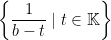
Proof: The first step is to show that {R/I\cong\mathbb{K}}. To see this, we will show that every {b\in R/I} is algebraic, i.e. a root a nonzero polynomial {f\in\mathbb{K}[z]}. Note that the dimension of {R/I} as a vectorspace over {\mathbb{K}} is at most countable, as {R/I} is generated by the images {\phi(X^J)} of the monomials {X^J} under the ring homomorphism {\phi:R\rightarrow R/I}, and the exponents {J} form a countable set. Thus for {b\in R/I\setminus\mathbb{K}} the set

\displaystyle \left\{\frac{1}{b-t}\mid t\in \mathbb{K}\right\}

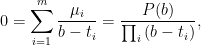
is linearly dependent, i.e. there exist {\mu_1,\dots,\mu_m} such that { \sum_{i=1}^m\frac{\mu_i}{b-t_i}=0. } Thus

\displaystyle 0=\sum_{i=1}^m\frac{\mu_i}{b-t_i}=\frac{P(b)}{\prod_i{(b-t_i)}},

where {P\in\mathbb{K}[z]} and {P(b)=0}. As {\mathbb{K}} is algebraically closed, we have that {P} is linear, i.e. {R/I\cong\mathbb{K}}.

Next, we observe that {\phi} maps {R} to {\mathbb{K}}, and set {a_i:=\phi(X_i)}, for {1\leq i\leq n}. As {\phi(X_i-a_i)=0}, we see that {X_i-a_i\in I}, for {1\leq i\leq n}. By maximality of {I}, we obtain {I=(X_1-a_1,\dots,X_n-a_n)}, as claimed. \Box

Here one can find reduction of the general case (not assuming non-countability of \mathbb{K}) to this one.

]]>
https://equatorialmaths.wordpress.com/2012/08/20/weak-nullstellensatz-for-c/feed/ 0 Dima
Schonhardt polyhedron and IMS-2013/4 program https://equatorialmaths.wordpress.com/2012/05/28/schonhardt-polyhedron-and-ims-20134-program/ https://equatorialmaths.wordpress.com/2012/05/28/schonhardt-polyhedron-and-ims-20134-program/#comments Sun, 27 May 2012 18:45:38 +0000 https://equatorialmaths.wordpress.com/?p=457 One cannot always triangulate a non-convex polyhedron using only its vertices, sometimes one need to add more of them. A simple example of this phenomenon is Schonhardt polyhedron. Here is a picture illustrating how one builds it that I drew for a forthcoming paper, using Tikz LaTeX package, which is awesome, but totally overwhelming.

Image

It fact, it’s easy to see that the 6 vertices and 12 edges it has are not enough. Indeed, each pair of non-intersecting edges determines a simplex, but it’s easy to observe that any such selection will include one the forbidden pairs of vertices AC, A’B, or B’C’. (The LaTeX source of the picture is here).

The paper I mention is related to a topic of the program on inverse moment problems at IMS (NUS/Singapore) in late 2013-early 2014 which I co-organize.

]]>
https://equatorialmaths.wordpress.com/2012/05/28/schonhardt-polyhedron-and-ims-20134-program/feed/ 1 Dima Image
Sage (sagemath.org) at GSoC 2012 https://equatorialmaths.wordpress.com/2012/03/19/sage-sagemath-org-at-gsoc-2012-3/ https://equatorialmaths.wordpress.com/2012/03/19/sage-sagemath-org-at-gsoc-2012-3/#respond Mon, 19 Mar 2012 04:33:26 +0000 https://equatorialmaths.wordpress.com/?p=450 Sage (not the accounting software, but sagemath.org) is accepted to Google Summer of Code 2012, and I will be one of many mentors. 

]]>
https://equatorialmaths.wordpress.com/2012/03/19/sage-sagemath-org-at-gsoc-2012-3/feed/ 0 Dima
https://equatorialmaths.wordpress.com/2012/02/21/445/ https://equatorialmaths.wordpress.com/2012/02/21/445/#respond Tue, 21 Feb 2012 07:23:20 +0000 https://equatorialmaths.wordpress.com/2012/02/21/445/ Azimuth:
The battle is heating up! Now Elsevier, Springer and a smaller third publisher are suing a major university in Switzerland, the Eidgenössische Technische Hochschule Zürich, or ETH Zürich for short. Why? Because this university’s library is distributing copies of their journal articles at a lower cost than the publishers themselves. Aren’t…]]>

This is just SO wrong, that I find it hard to believe. I cannot boycott Springer, at least not yet, given that I have a number of papers under submission in Springer journals, but OK, I’m going to boycott Elsevier.

Azimuth

The battle is heating up! Now Elsevier, Springer and a smaller third publisher are suing a major university in Switzerland, the Eidgenössische Technische Hochschule Zürich, or ETH Zürich for short. Why? Because this university’s library is distributing copies of their journal articles at a lower cost than the publishers themselves.

Aren’t university libraries supposed to make journal articles available? Over on Google+, Willie Wong explains:

My guess is that they are complaining about how the ETH Library (as well as many other libraries in the NEBIS system) offers Electronic Document Delivery.

It is free for staff and researchers, and private individuals who purchase a library membership can ask for articles for a fee. It is a nice service: otherwise most of us would just go to the library, borrow the printed journal, and scan it ourselves (when the electronic copy is not part of the library’s subscription). This…

View original post 227 more words

]]> https://equatorialmaths.wordpress.com/2012/02/21/445/feed/ 0 Dima Experimental Sage-based Mathematics course https://equatorialmaths.wordpress.com/2011/08/07/experimental-sage-based-mathematics-course/ https://equatorialmaths.wordpress.com/2011/08/07/experimental-sage-based-mathematics-course/#respond Sun, 07 Aug 2011 08:28:56 +0000 https://equatorialmaths.wordpress.com/?p=434 We are to embark upon teaching a 2nd year undergraduate course Experimental Mathematics, which will cover computer algebra basics, and refresh concepts from 1st year linear algebra, calculus, and combinatoris, with few more advanced things thrown in. The course will be based on Sage, with the actual software running on dedicated servers, and accessible via Sage web notebook interface (i.e. basically nothing but a web browser running on the student’s computer/laptop/ipad, etc).

Given the enrollment of about 120, this will be interesting…

PS. Most students did not appreciate the freedom given, and complained, complained, complained…

]]>
https://equatorialmaths.wordpress.com/2011/08/07/experimental-sage-based-mathematics-course/feed/ 0 Dima
An email from Sendai (Tohoku University) https://equatorialmaths.wordpress.com/2011/03/13/an-email-from-sendai-tohoku-university/ https://equatorialmaths.wordpress.com/2011/03/13/an-email-from-sendai-tohoku-university/#comments Sun, 13 Mar 2011 15:30:08 +0000 https://equatorialmaths.wordpress.com/?p=427 I was very glad today to receive an email from Akihiro Munemasa (from Tohoku university at Sendai), my long-term collaborator and friend. He says he’s OK, but has no electricity/water/gas…

And, as we see, they have internet, at least some kind of service (email went via me.com, a web-mail service run by Apple).

Well, I can only wish a lot of strength to Akihiro, and all the people affected by this disaster!

PS: today (14th March) he also sent me photos of his office:
photo of the office

]]>
https://equatorialmaths.wordpress.com/2011/03/13/an-email-from-sendai-tohoku-university/feed/ 1 Dima photo of the office
2010 in review – Happy New Year! https://equatorialmaths.wordpress.com/2011/01/02/2010-in-review-happy-new-year/ https://equatorialmaths.wordpress.com/2011/01/02/2010-in-review-happy-new-year/#respond Sun, 02 Jan 2011 14:01:27 +0000 https://equatorialmaths.wordpress.com/?p=414 While it might be snowing on this page, Edith picked up a mango fallen from a tree outside our block of flats this afternoon…

The stats helper monkeys at WordPress.com mulled over how this blog did in 2010, and here’s a high level summary of its overall blog health:

Healthy blog!

The Blog-Health-o-Meter™ reads Fresher than ever.

Crunchy numbers

Featured image

A helper monkey made this abstract painting, inspired by your stats.

A Boeing 747-400 passenger jet can hold 416 passengers. This blog was viewed about 5,700 times in 2010. That’s about 14 full 747s.

In 2010, there were 6 new posts, growing the total archive of this blog to 33 posts. There were 5 pictures uploaded, taking up a total of 28kb.

The busiest day of the year was May 11th with 79 views. The most popular post that day was Is C++ the worst 1st programming language for maths majors?.

Where did they come from?

The top referring sites in 2010 were terrytao.wordpress.com, cameroncounts.wordpress.com, debian-news.net, edventure.ntu.edu.sg, and symomega.wordpress.com.

Some visitors came searching, mostly for funny pictures, funny, confused cat, total unimodularity, and funny pics.

Attractions in 2010

These are the posts and pages that got the most views in 2010.

1

Is C++ the worst 1st programming language for maths majors? May 2010
4 comments

2

Total unimodularity and networks October 2009
1 comment

3

Cosets and normal subgroups March 2009

4

Bipartite matchings via linear programming September 2009
1 comment

5

Bellman-Ford algorithm for shortest paths and potentials September 2009

]]>
https://equatorialmaths.wordpress.com/2011/01/02/2010-in-review-happy-new-year/feed/ 0 Dima Healthy blog! Featured image