


| CARVIEW |


Compactness theorem
| Field | Mathematical logic |
|---|---|
| Statement | A set of first-order sentences has a model if and only if every finite subset of it has a model. |
| Generalizations | Gödel's completeness theorem |
In mathematical logic, the compactness theorem states that a set of first-order sentences has a model if and only if every finite subset of it has a model. This theorem is an important tool in model theory, as it provides a useful (but generally not effective) method for constructing models of any set of sentences that is finitely consistent.
The compactness theorem for the propositional calculus is a consequence of Tychonoff's theorem (which says that the product of compact spaces is compact) applied to compact Stone spaces,[1] hence the theorem's name. Likewise, it is analogous to the finite intersection property characterization of compactness in topological spaces: a collection of closed sets in a compact space has a non-empty intersection if every finite subcollection has a non-empty intersection.
The compactness theorem is one of the two key properties, along with the downward Löwenheim–Skolem theorem, that is used in Lindström's theorem to characterize first-order logic. Although there are some generalizations of the compactness theorem to non-first-order logics, the compactness theorem itself does not hold in them, except for a very limited number of examples.[2]
History
[edit]Kurt Gödel proved the countable compactness theorem in 1930. Anatoly Maltsev proved the uncountable case in 1936.[3][4]
Applications
[edit]The compactness theorem has many applications in model theory; a few typical results are sketched here.
Robinson's principle
[edit]The compactness theorem implies the following result, stated by Abraham Robinson in his 1949 dissertation.
Robinson's principle:[5][6] If a first-order sentence holds in every field of characteristic zero, then there exists a constant 








The Lefschetz principle, one of the first examples of a transfer principle, extends this result. A first-order sentence 


Upward Löwenheim–Skolem theorem
[edit]A second application of the compactness theorem shows that any theory that has arbitrarily large finite models, or a single infinite model, has models of arbitrary large cardinality (this is the Upward Löwenheim–Skolem theorem). So for instance, there are nonstandard models of Peano arithmetic with uncountably many 'natural numbers'. To achieve this, let 


Non-standard analysis
[edit]A third application of the compactness theorem is the construction of nonstandard models of the real numbers, that is, consistent extensions of the theory of the real numbers that contain "infinitesimal" numbers. To see this, let 


A similar argument, this time adjoining the axioms 
It can be shown that the hyperreal numbers 
Proofs
[edit]One can prove the compactness theorem using Gödel's completeness theorem, which establishes that a set of sentences is satisfiable if and only if no contradiction can be proven from it. Since proofs are always finite and therefore involve only finitely many of the given sentences, the compactness theorem follows. In fact, the compactness theorem is equivalent to Gödel's completeness theorem, and both are equivalent to the Boolean prime ideal theorem, a weak form of the axiom of choice.[10]
Gödel originally proved the compactness theorem in just this way, but later some "purely semantic" proofs of the compactness theorem were found; that is, proofs that refer to truth instead of provability. One of those proofs relies on ultraproducts hinging on the axiom of choice as follows:
Proof:
Fix a first-order language 





Now for any sentence 
- the set
is in
- whenever
then
hence
- the set of all
with the property that
is a superset of
hence also in
Łoś's theorem now implies that 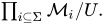
See also
[edit]- Barwise compactness theorem
- Herbrand's theorem
- List of Boolean algebra topics
- Löwenheim–Skolem theorem – Existence and cardinality of models of logical theories
Notes
[edit]- ^ Truss 1997.
- ^ J. Barwise, S. Feferman, eds., Model-Theoretic Logics (New York: Springer-Verlag, 1985) [1], in particular, Makowsky, J. A. Chapter XVIII: Compactness, Embeddings and Definability. 645--716, see Theorems 4.5.9, 4.6.12 and Proposition 4.6.9. For compact logics for an extended notion of model see Ziegler, M. Chapter XV: Topological Model Theory. 557--577. For logics without the relativization property it is possible to have simultaneously compactness and interpolation, while the problem is still open for logics with relativization. See Xavier Caicedo, A Simple Solution to Friedman's Fourth Problem, J. Symbolic Logic, Volume 51, Issue 3 (1986), 778-784.doi:10.2307/2274031 JSTOR 2274031
- ^ Vaught, Robert L.: "Alfred Tarski's work in model theory". Journal of Symbolic Logic 51 (1986), no. 4, 869–882
- ^ Robinson, A.: Non-standard analysis. North-Holland Publishing Co., Amsterdam 1966. page 48.
- ^ a b c Marker 2002, pp. 40–43.
- ^ Gowers, Barrow-Green & Leader 2008, pp. 639–643.
- ^ a b Terence, Tao (7 March 2009). "Infinite fields, finite fields, and the Ax-Grothendieck theorem".
- ^ Goldblatt 1998, pp. 10–11.
- ^ Goldblatt 1998, p. 11.
- ^ See Hodges (1993).
References
[edit]- Boolos, George; Jeffrey, Richard; Burgess, John (2004). Computability and Logic (fourth ed.). Cambridge University Press.
- Chang, C.C.; Keisler, H. Jerome (1989). Model Theory (third ed.). Elsevier. ISBN 0-7204-0692-7.
- Dawson, John W. junior (1993). "The compactness of first-order logic: From Gödel to Lindström". History and Philosophy of Logic. 14: 15–37. doi:10.1080/01445349308837208.
- Hodges, Wilfrid (1993). Model theory. Cambridge University Press. ISBN 0-521-30442-3.
- Goldblatt, Robert (1998). Lectures on the Hyperreals. New York: Springer Verlag. ISBN 0-387-98464-X.
- Gowers, Timothy; Barrow-Green, June; Leader, Imre (2008). The Princeton Companion to Mathematics. Princeton: Princeton University Press. pp. 635–646. ISBN 978-1-4008-3039-8. OCLC 659590835.
- Marker, David (2002). Model Theory: An Introduction. Graduate Texts in Mathematics. Vol. 217. Springer. ISBN 978-0-387-98760-6. OCLC 49326991.
- Robinson, J. A. (1965). "A Machine-Oriented Logic Based on the Resolution Principle". Journal of the ACM. 12 (1). Association for Computing Machinery (ACM): 23–41. doi:10.1145/321250.321253. ISSN 0004-5411. S2CID 14389185.
- Truss, John K. (1997). Foundations of Mathematical Analysis. Oxford University Press. ISBN 0-19-853375-6.
External links
[edit]| General | |||||||||
|---|---|---|---|---|---|---|---|---|---|
| Theorems (list) and paradoxes | |||||||||
| Logics |
| ||||||||
| Set theory |
| ||||||||
| Formal systems (list), language and syntax |
| ||||||||
| Proof theory | |||||||||
| Model theory | |||||||||
| Computability theory | |||||||||
| Related | |||||||||
