


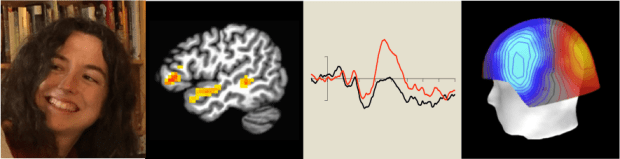
I’m an associate professor in the Department of Linguistics and the Neuroscience and Cognitive Science Program at the University of Maryland. I serve as the Co-Director of the KIT-Maryland MEG Lab and collaborate with the Maryland Language Science Center.
Since I was 21, I’ve been pursuing this question: what about the brain resulted in human language being the way it is? Back then I thought this would just involve learning how to use neuroimaging measures to see what happens when you give people sentences of particular types. I couldn’t see then that a serious attack on that question would require a theory of what it means to represent stuff, a position on what computation and memory are, knowledge from evolutionary neuroscience about the particular contingent history of vertebrate brain evolution, a coherent account of how neurons store and transmit information, etc. I did know early on, from my many great teachers, that to ask the question at all requires a deep understanding to begin with of how human languages are actually structured.
Today I continue to use traditional neuro measures in my work (primarily EEG and MEG), but I also spend plenty of time reading, studying, and contributing to the sub-theories that we need in order to answer this question.
PhD students interested in working with me can apply through the Linguistics PhD program or the Neuroscience and Cognitive Science (NACS) PhD program.
 Ellen Lau