

|

|
| CARVIEW |


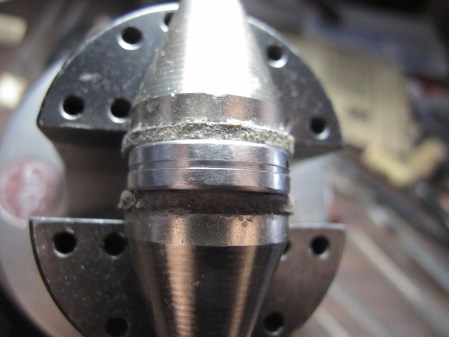

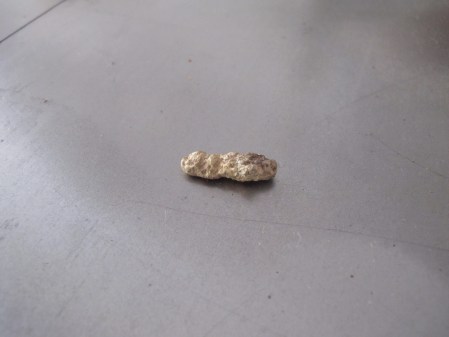


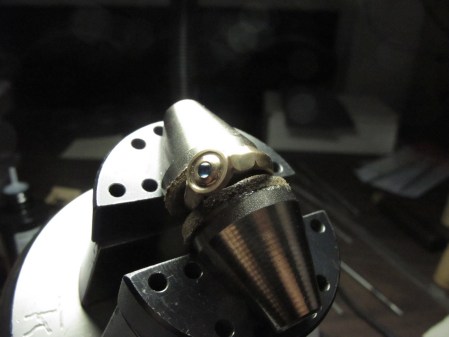
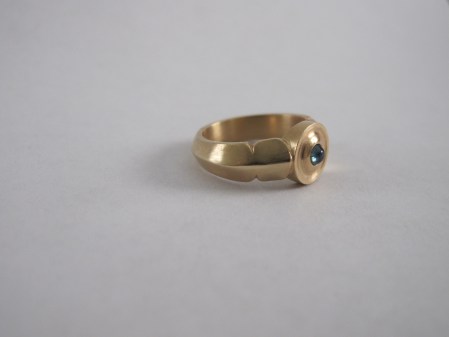
 My tools for shaping metal are a mixture of purchased and homemade. I carved the gold, chased the gold, and filed the gold, all in whatever order and to whatever degree struck me as the best method at a given moment. I call it my “look and do” method, pretty much the same as sharpening saw teeth, simply seeing what needs done then doing it. And not getting hung up on any preconceived idea about how it ought to be done.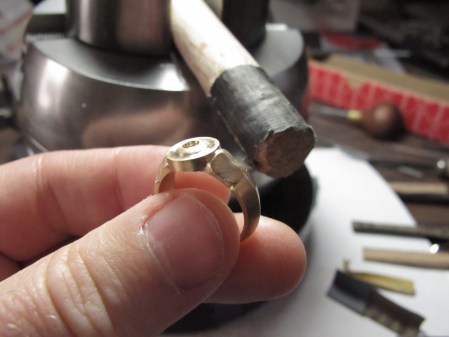










Then every once in a great while you get lucky and one takes up residence under your porch.
Unexpected. Unheralded. Down on his luck. Exactly how you go from being a hobo to being a highly prized shop cat is something I’m still trying to figure out. Charlie figured it out, though. My shop cat Charlie, that is. He made the transition seamlessly. You’d have never known he hadn’t swung a hammer before or ever used a saw. He was a natural.
Not all animals are cut out for the rigors of shop life. The work is hard. The hours are long. The pay is meager. Charlie wasn’t in it for the money. While most cats are content to lie around all day in patches of sunlight, a good day for Charlie began with a stiff cup of coffee and ended with a beer and a dirty joke. It wasn’t uncommon to find him in the shop late at night working on his own side projects. Although I suspect that at times he was secretly fixing my mistakes.

A Little Well-Deserved R&R
Charlie broke the rules. He didn’t care that every bucolic image of shop life depicts a dog. He didn’t even groom much. He didn’t let the absence of opposable thumbs slow him down. All of the follies, failures, and small victories that characterize the life of a small shop, he was there for it all. He became proficient in human profanity.
He will be missed.
Join me in raising a glass to the animals that grace our lives. They give us something that can’t be bought. They come into our shops and give us something that can’t be made. They hold back nothing. They give away everything. They adopt us at least as much as we adopt them. We are lucky for getting to be a part of their brief sojourn. So, Clink! Clink! Hear! Hear! As Charlie always used to say, “It’s five o’clock somewhere.”
]]>I’m profoundly grateful for everyone who has supported me. I’ve been very lucky to have had the support of so many kind people. It goes to show that there is a place for the smallest tool makers and that there is a desire for handmade saws. But more than that, it shows there are some very good people out there.
I’ll still be around. I’ll just be making different things. What exactly? Lots of things—a wide variety, and probably not many of the same thing twice. Creativity and variety are what really keep me going. I’ll revamp the website at some point here and will keep the Toolworks writing in an archive of some kind.
So this is goodbye in a sense but in another sense not. It’s kind of like a cage fight—sometimes just when you think it’s over, that’s when it really gets good.
]]>
My left brain and right brain each accept the presence and ultimate necessity of the other, sort of like Sam the sheepdog and Ralph the wolf in the Looney Tunes cartoons I grew up with. My left brain tries any number of ploys to get over on my right brain—obvious gambits, like carefully reasoned arguments, and then subtler maneuvers, like trying to shame me into being more organized. But it got downright dirty when a very attractive and silky smooth micrometer was inserted into the the picture. My left brain slipped the micrometer into a pocket of my shop apron, and my right brain let it stay there for a little while, no doubt due to its nice weight and perfectly smooth mechanism. But that’s all the farther it ever went.
The fact of the matter is, when I make saws I rely on as few measurements as possible. I start with a handful of them, but by the end there are no numbers left that I care about. And the numbers I do use are not built into templates and things like that. I apply the measurements themselves each time from scratch. No doubt this is very inefficient and conducive to tiny errors.
So how can I work this way and ensure that all of my saws are the same?
Well, they aren’t. No two are exactly alike. Not exactly. The differences aren’t so great that one dovetail saw, say, is completely unlike another one, but they aren’t either carbon copies of one another. Far from it. I mean, what’s the point of working by hand and trying to emulate automation? That negates perhaps the biggest advantage that working by hand affords you.
What maintains consistency between them is the amount of care and attention given to each one, so that any uniqueness becomes a strength, not a deviation from a standard or ideal pattern. They all start from about the same spot and then are allowed to develop a bit of their own character. What is exactly the same in each case is the degree of internal consistency—everything gels. This way a saw can be unique and still be spot on. Otherwise, if a measured pattern is your standard, and you have any deviation from it, and that pattern remains your standard, you now have an error. The idea of tuning a tool for performance isn’t uncommon—I just start that whole process from back when the tool is built.
No it isn’t the most efficient way to make a saw—but it isn’t supposed to be. And yeah, a lot of the differences are soft and are difficult or maybe even impossible to quantify. That’s kind of the point. Measurements aren’t necessarily the most complete expression of detail. The left brain doesn’t always have a comparable way to express everything that the right brain does.
My left brain baits my right brain as if asking for Grey Poupon. “Pardon me, may I borrow your micrometer?”
My right brain yawns. “Sorry. It’s in my other pair of pants.”
]]>
All of the tools depicted on the chest are interesting, but one particularly caught my eye. Even if you didn’t already know, you could probably guess which one—that bow saw with the nice lines and the scrolls at the tops of the arms. Some time back, a year or more I’d guess, my neurons were mounting a titanic mutiny and I decided I needed a side project—so I decided to make this saw. I normally don’t copy or reproduce tools, but that’s pretty much what I did here, with the exception of a few liberties that I’ll explain momentarily.

Different people mean different things when they use the word “reproduce”—all biological senses of the word notwithstanding. With this saw my goal was to make a “reasonable” copy but not to agonize over reproducing the saw down to its last molecule. I wouldn’t imagine that was the spirit in which the original was made anyway.
So making the saw involved one actual measurement—the blade is about 22″ long. I chose that length because I thought it would be useful, and because the saw on the chest clearly is not a small turning saw. Everything else was sized according to information gleaned from the image on the chest, or in the case of the stretcher, the length was dictated by the length of the blade. I sketched an arm of the saw onto some poster board to make a pattern for the arms.

The toggle that tightens the cord is one of the places I took some liberties. The one on the actual saw is plain and I chose to put some low relief carving on mine. I also made the brackets that hold the blade decorative. The one liberty I took that I soon regretted was to make one of the saw’s handles longer and more vase-like. With the way the arms of the saw are shaped, it tilts your wrist right down into that handle. That could be easily fixed by simply replacing that handle with one that matches the handle on the far end, but in fact, making this saw once showed me several things I would do differently were I to make it again, so I didn’t bother changing anything.

For instance, I didn’t entirely care for the curvature of the lower part of the arm for other reasons—the way it forces your wrist to tilt really saps your leverage and feels awkward. Were I to make this saw again I’d play around with that lower part of the arm to find something a bit more user friendly while retaining the character of the saw. Also, there is more wood in this saw than in most bow saws—while it was not ungainly or unwieldy, were I to make a second one I would play around more with the design to make it a bit lighter. Why not?

So why not just replace the large handle on this saw and tweak the arms a bit more? Well, I think I’d rather just leave this saw as it is and keep it as a frame of reference for subsequent forays. Sometimes it is best to let a first piece be a first piece, rather than try to impose on it from the outside a degree of refinement it didn’t possess from its inception. I just haven’t gotten around to making the second saw yet. Maybe some of you would like to make it too.
But first thing’s first—let’s get out of the 17th century before something happens and we’re stuck for the rest of our lives with no indoor plumbing. Or worse, 17th century beer!
]]>Stephen King novels and Edgar Allan Poe stories formed the backbone of these macabre after hours sessions. To this day I have a dream involving a pitfall trap baited with a miniature Snickers bar, and I blame it entirely on Edgar Allan Poe. I think his story The Pit and the Pendulum caused my belly button to go from being an outtie to an innie—no kidding. I still own the book I used to read from, a gigantic volume of his stories and poems given to me by my grandmother. No my grandmother wasn’t sick and twisted for giving me that book—I actually requested it. So leave my grandma alone.
And besides, the older I get, the more I think that maybe Edgar was just misunderstood. Maybe he just needed an outlet to transform his morose energies into something positive. Like what if he had discovered pen turning? He was obviously drawn to the pen. He might have spent his time at the lathe joyously turning pens for friends and family. Or what if he had learned how to tune a hand plane or sharpen a saw? I bet he could have designed one heck of a coffin.
But then what would our American literature be without melancholy Edgar lurking in the shadows? Especially at this time of year when the somber and the dreary are the order of the day? How could there be no Raven? No Telltale Heart? No Fall of the House of Usher? Should you ever be glad that someone didn’t discover a craft as interesting as woodworking? Even if what results are stories and poems as memorable as those written by Edgar Allan Poe? It’s hard to say. The only thing I do know is that I won’t be staying up late tonight to read his stories. I will, however, dip into the candy bowl by the door and treat myself to a miniature Snickers.
]]>