


Tipping is a hot issue these days. How much should you tip staff in a restaurant or hotel, or even other types of situation? Should you even tip at all? For service staff tips are a vital source of income, supplementing what might be a very low standard wage. Tips are welcomed as a sign of having done a good job, and it’s nice to show your appreciation.

But tipping is fraught with micro-politics! For some people, it is only viewed as necessary if the provider of the service has gone above and beyond what might be seen as their usual duties. To them it’s a discretionary ‘thank you’ – something that tells the server they’ve done an extra good job.
For others though it’s a necessity. In America, tipping is pretty much obligatory, and it can come as a shock to the uninitiated to have 20% automatically added to the bill, whether service or food have been good or bad. Putting service charges on a bill is rapidly becoming the rule rather than the exception. Debating or, even worse, withdrawing the tip opens up a whole raft of potential awkwardness.
And what about other ‘extras’ that are added to a bill without our knowledge or consent? Go to a café in Italy, for example, and you might think the basket of breads and dish of oil placed in front of you when you sit down is a nice treat from the owners, a free welcome gift to get you settled…until you see the ‘coperto’ or ‘cover charge’ on your bill!
All this might seem like a modern problem, but the unwarranted service charge actually goes back a long way. Travellers regularly complained about the variety of levies that were imposed on them for things they neither needed nor asked for.

In 1849, a disgruntled traveller called William Freckleton (possibly not his real name!) wrote to the Weekly Vindicator, complaining about just this situation. For Freckleton, the cause of all evils in travel was nothing to do with health or the journey but instead having to pay tips to a veritable army of chancers! His solution, and the purpose of his letter was simple: travellers should be advised to pay nothing but the fare for the journey and the cost of the room!
What had elicited his wrath? Freckleton arrived after a long journey to a posh hotel “denominated either Royal or Imperial of course”. He had tea and went to bed, carrying in his hands his own dirty boots in which he had walked all the day. On receiving his bill from the maid the next morning he was dismayed to see two entries that he did not recognise: sixpence for ‘maid’ and ninepence for ‘boots and waiter’.
Incensed, Freckleton pointed out that his boots had not been cleaned, and had not left his sight. “As to a waiter, I saw none”. A stand-off ensued, and the maid threatened to call the police, at which he retorted that he would save her the trouble and fetch a constable to arrest her and the hotel owner for trying to obtain money under false pretences. He left the hotel in high dudgeon, carrying his boots and trunk, and with the words “stingy rascal” ringing in his ears from the offended maid.
He did, however, have some sympathy for the need for individuals to try and supplement their meagre income. Noting an apparently common practice of making hotel servants buy their jobs (in one case he cited a head chambermaid in a large hotel who had paid £200 for the privilege of the post – a substantial sum) to deter them from their ‘fleecing avocations’…in other words to stop them from trying to make a living from spurious tips!

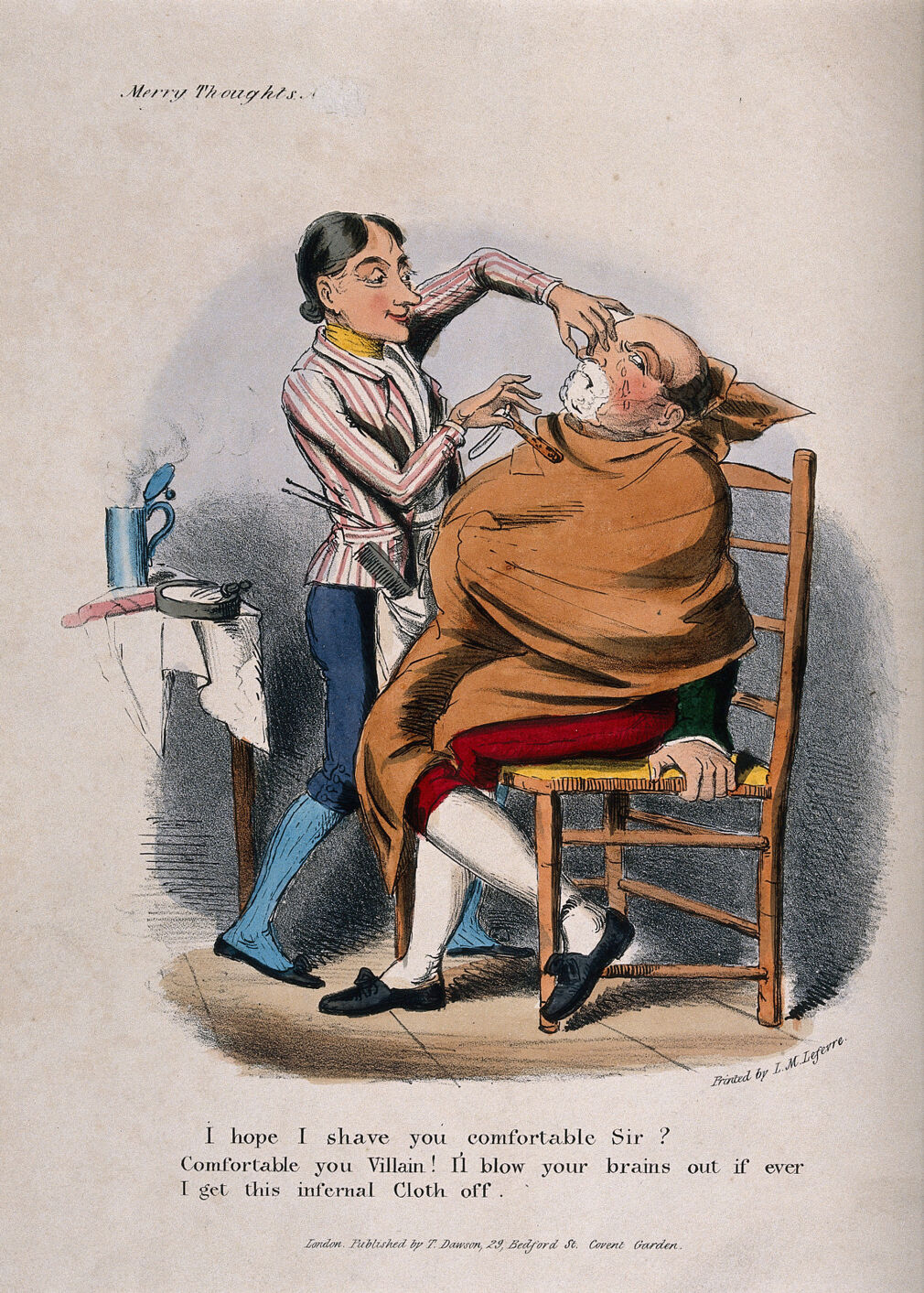
(Wellcome Images)
But Freckleton’s experience wasn’t unusual. Even from the eighteenth century travellers regularly complained about “idle hordes” who congregated around inns and coaches, looking to make a quick sixpence by claiming to provide some or other spurious services. The arrival of railways created a whole raft of new opportunities for dubious luggage-carriers and carters, hostlers, shoe-shiners and guides. Amongst the things that stagecoach travellers were expected to cough up extra for were porters, waiters, provision of candles and sometimes even local levies to help the poor. As a great post on the ‘Wicked William’ blog points out, inns and hotels were akin to motorway service stations, charging overblown prices for low quality food. There were also taxes and toll roads to pay for which again added to the basic costs.

So tipping – and service charges – are nothing new. The history of added extras is a long one, and travellers and strangers have always been seen as easy pickings!






 Dr Alun Withey