


| CARVIEW |
– Neil Gaiman
 Rayuela (Hopscotch) Julio Cortázar. Cover of the first edition, Editorial Sudamericana 1963
When the ‘counter novel’ Hopscotch by Julio Cortázar was published in 1963 it was celebrated as one of the most innovative experiments in 20th-century literature [1]. The book was written to allow and encourage many different and complementary readings. As the author’s note at the beginning of the novel suggests, it can be read either progressively in the first 56 chapters or by ‘hopscotching’ through the entire set of 155 chapters according to a ‘Table of Instructions’. Cortázar also allows the reader the option of choosing their own unique path through the book. It’s no coincidence that the narrative – from the title of the book to the several overlapping stories that are contained in it – is based on a game often played in small groups in public spaces and playgrounds, in which the player has to hop or jump to retrieve a small object tossed into numbered patterns drawn on the ground. The book’s main structure has strong allusions to the notions of ‘space’ and the way we navigate through it, with its three main sections entitled ‘From the Other Side’, ‘From this Side’, and ‘From Diverse Sides.’
 Book Bloc: A Collective Development. Shield Illustrations by Marwan Kaabour at Barnbrook.
Similarly, but from a different perspective, one of the first things the reader notes when flipping through Fantasies of the Library edited by Anne Sophie Springer and Etienne Turpin and published in 2016 by MIT Press, is that the book itself can be understood as a kind of public space.[2] In effect, it presents a brilliant dérive through books, book collections and the physical spaces of libraries from a curatorial perspective, going from private collections and the way their shelves are organized, to more ad hoc and temporary infrastructures, such as the People’s Library at Occupy Wall Street in New York, or the Biblioburro, a travelling library in Colombia that distributes books from the backs of two donkeys, Alfa and Beto. Various configurations and layouts have been designed in response to these narratives. They include essays, photos, and interviews, setting up different kinds of encounters between authors, editors, readers, photographers, and illustrators. Once you have the book in your hands, you gradually start to apprehend that the four conversations are printed only on left-hand pages, interspersed with other essays on righthand ones. So it is only when you start reading voraciously and are interrupted by the ‘nonsense’ of these jumps, when the understanding of the dynamics imposed by the layout manifests itself, that you become aware you are already ‘hopscotching’ from page to page. The chapter ‘Reading Rooms Reading Machines’ is not only a visual essay about the power of books to create spaces around them and gather a community, it is also a curated, annotated and provocative history of these spaces as a conceptual continuation between the book and the city, ‘two environments in conjunction’, as Springer writes.[3]
In some ways, it resembles the encounters you have in the streets of your neighborhood. Some people you only glance at, others you smile at, there are a few with whom you talk and if you’re lucky, you might meet a friend. Within the texts, you can hop back and forth, approving, underlining, or absorbing in more detail. From individual object to the container known as the library, the idea of the book as a territory is explored in depth. Different kinds and sizes of spaces and the interactions that happen in and between them emerge. Springer describes the library as ‘a hybrid site for performing the book’ – a place where the book is not a static object but a space in which the reader is an active agent, coming and going from the outside; outside the pages and outside the library. It recalls Ray Bradbury’s assertion that: ‘Books are in themselves already more than mere containers of information; they are also modes of connectivity and interrelation, making the library a meta-book containing illimitable intertextual elements.’
 Interference archive book blocs workshop. Source: Interference Archive.
In moving from the ‘hopscotching’ suggested by Cortázar to the idea of the ‘library as map’ as discussed by Springer and Turpin, it is clear that the inextricable relationship between books and space forms the basis of our understanding of books as spaces of encounter, and the importance of heterogeneous books – whether fiction, poetry or critical theory – as spaces of encounter for architectural discourse. In that sense, books can be perceived as new kinds of spaces, where empathy, alterity, and otherness are stronger than ideologies. Catalyzing dissent and open dialogue, they can be one of the most effective tools of resistance in times of censorship, fake news, and post-truth. Social anthropologist Athena Athanasiou explains how books have been used in public space as part of political struggles. ‘People have taken to the streets to fight for critical thinking and public education, turning books into banners and shields against educational cuts and neoliberal regimes of university governance’, she writes.[4] This activism emphasizes the strong symbolic power of the relationship between books and architectural spaces, ‘where the books were not only at the barricades, they were the barricades’. Such an agency can transgress almost any kind of limit or boundary and can happen in any sort of space – from your mobile device to the library or the street. But it is in the public sphere where the book’s agency can have the ‘power to affect’, becoming ‘a hybrid site for performing the book’ beyond the confines of the library.[5]
Books can be ‘performed’ in many ways, especially when critical writing and the act of reading create spaces of encounter in the city. In June 2013, after plans were unveiled to develop Istanbul’s Gezi Park, artist Erdem Gunduz initiated his Standing Man protest while he stood motionless in Taksim Square for eight hours. This thoughtful form of resistance inspired a group of ‘silent readers’ who successfully transformed a space of fighting and friction into a meaningful space of encounter by simply standing still and reading books. It became known as the Taksim Square Book Club, paradoxically one of the most dynamic demonstrations in recent years. The strength and energy contained in the bodies of each reader, but also in every book and the endless stories and narratives between covers, transformed Taksim Square into a highly politicised space. Instead of being compromised by conflict between government and citizens, it became a space of encounter that gave agency to each silent reader and to the wider collectivity they brought into being.
 Readers in Istanbul’s Taksim Square transform the space through peaceful activism. In Pictures: The Taksim Square Book Club. George Henton Aljazeera
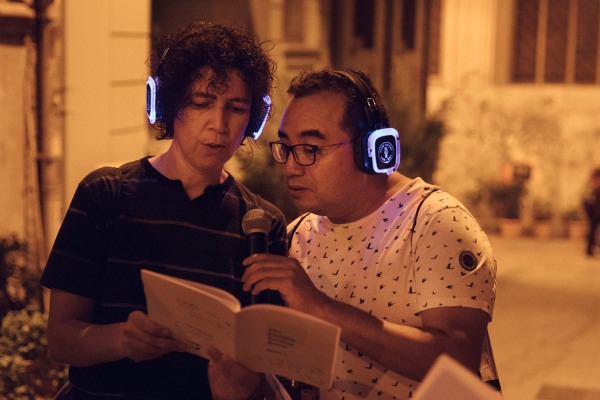
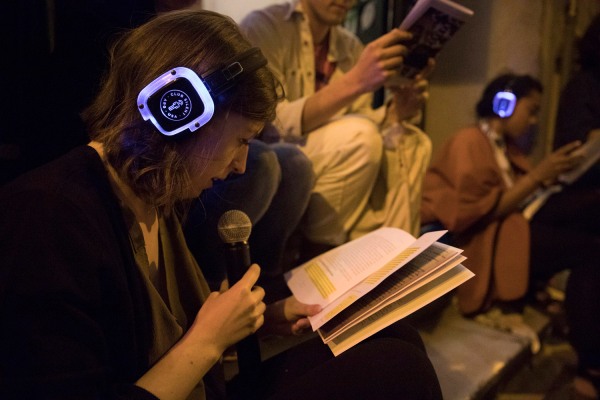
The moment when writing, often carried out in solitude, is published, circulated and made accessible to everyone is the moment of generating public space, argues the French philosopher and art historian Georges DidiHuberman. This was demonstrated in the ‘Parasitic Reading Room’, a nomadic, spontaneous and parasitic set of reading spaces staged during the opening days of the 4th Istanbul Design Biennial.[6] Initially consisting of a series of out loud readings of texts at selected venues, it then expanded to become an urban dérive across the streets of the city in the company of a mobile radio broadcasting the live readings. At that moment, the ‘walking reading room’ became a space of exchange, knowledge, and collaboration. Different points of view coexisted, enriching each other, forming knowledge assemblages. It reminds us that reading together, whether silently or aloud, forces us to interact, to respect the times and rhythms of others, to learn new words and their sounds and to think new thoughts. In doing so, we rediscover new territories of empathy that become visible when visiting these spaces of encounter, where we learn that we can host otherness as part of the self. Where comradeship is a means instead of an end. Books create the spaces in which to play hopscotch together again.
—–
This piece is featured in the Architectural Review December 2018/January 2019 Library + Books issue
—–
[1] First published in Spanish, in Argentina in 1963. Published in English for the first time by Pantheon (US) in 1966 translated by Gregory Rabassa.
[2] Anna-Sophie Springer, Etienne Turpin; Fantasies of the Library. K. Verlag and the Haus der Kulturen der Welt, 2015.
[3] Borrowing from Sanford Kwinter, “Inside the Urban Azimuth (at the End of the Age of the Book),” Harvard Design Magazine 38, Summer 2014.
[4] The book bloc was invented at La Sapienza University of Rome in November 2010, as a practice of public demonstration against Silvio Berlusconi’s education reforms; followed by demonstrations on the streets of Genoa, Milan, Madrid, London, Manchester, Berkeley and Oakland (USA), and other cities during the following months. Athena Athanasiou, ‘When the Arrivant Presents Itself,’ L’Internationale, 2014.
[5] In Baruch Spinoza’s Ethics, the term “affect” is the modification or variation produced in a body (including the mind) by an interaction with another body which increases or diminishes the body’s power of activity.
[6] The Parasitic Reading Room, a project by dpr-barcelona and the Open Raumlabor University for the 4th Istanbul Design Biennial, A School of Schools.
]]>
“[Books] can show you a different world. It can take you somewhere you’ve never been. Once you’ve visited other worlds, like those who ate fairy fruit, you can never be entirely content with the world that you grew up in. Discontent is a good thing: discontented people can modify and improve their worlds, leave them better, leave them different.”
—Neil Gaiman
‘Why our future depends on libraries, reading and daydreaming.’ The Guardian, 2013
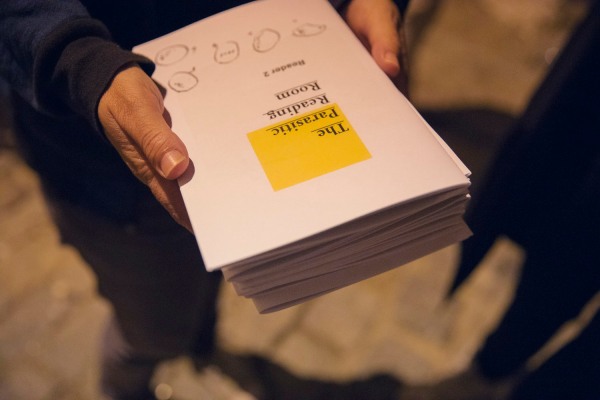
Aristide Antonas and Thanos Zartaloudis define ‘The Parasitic Council’ as that place “where a public space can be the plateau for the occupancy of a commonhold in order that it performs multiple parasitic functions of common use without claims to property.” Following this protocol of action and occupancy of the city, and connecting them with the 4th Istanbul Design Biennial ‘A School of Schools,’ dpr-barcelona and the open raumlabor university joined forces to set up a Parasitic Reading Room for the opening days of the IDB, in September 2018, a nomad, spontaneous and parasitic set of reading spaces that took place along the biennale venues and other spots in the city, with the intention to ‘parasite’ the event participants, visitors, ideas, contents and places, and to provoke a contagion of knowledge. The Parasitic Reading Room is a spontaneous school, made by reading aloud a selection of texts that are related with the biennale’s scope.
On his book Deschooling Society, Ivan Illich states that most learning happens casually, and training of young people never happens in the school but elsewhere, in moments and places beyond the control of the school. When claiming for the revolutionary potential of deschooling, Illich makes a call to liberating oneself from school and to reckon that “each of us is personally responsible for his or her own deschooling, and only we have the power to do it.” This is why the wide domain of academia needs to be challenged in radical and unexpected ways and we need to envision other spaces of encounter and knowledge exchange out of its walls. Similarly, Michael Paraskos rightly pointed on his essay The Table Top Schools of Art, that “we might well say that if four individuals gather together under a tree that is a school. Similarly four individuals around a kitchen table. Or four individuals in the café or bar. By redefining the school in this way we also redefine what it means to be a student in a school or a teacher.”
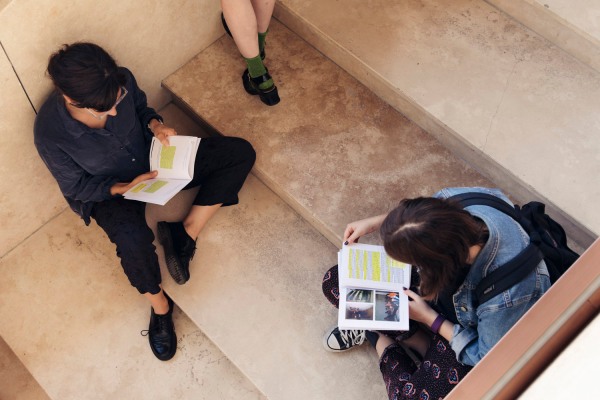
Perhaps the essential question at this point is what kind of readings should form this alternative bibliography on different pedagogical models, about other sources of knowledge, that come not only [but also] from the pages of our favourite books? This question can have multiple answers which all of them are to be intertwined, multi-connected, overlapped. Poems, films, instagram photos—and its captions—, songs, e-mail exchanges, objects, conversations with friends over a glass of wine or a coffee, dreams; we learn from all of them albeit [or often because] the hectic diversity of formats, and sometimes its lack of seriousness.
By reading aloud we share a space of intimacy, a time and place of learning not only from the contents, but from the nuances, the accents, the cadence of the reading. Abigail Williams called this ‘the social life of books,’ “How books are read is as important as what’s in them,” she pointed—we call it ‘the book as a space of encounters.’ This means spaces where different books coexist and enrich each other; books as the necessary space where the author can have a dialogue with the reader, where different readers can read between the lines and find a place of exchange, where to debate, and discuss ideas. Books and encounters as an open school.
If everywhere is a learning environment, as we deeply believe, and the Istanbul Design Biennial intended to prove by transforming the city of Istanbul into a school of schools, we vindicate the importance of books—be them fiction, poetry or critical theory—as learning environments; those spaces where empathy and otherness are stronger than ideologies, where we can find space to ‘parasite’ each other’s knowledge and experience and create an open school by the simple but strong gesture of reading aloud together.
Because, what is a school if not a promise?
***

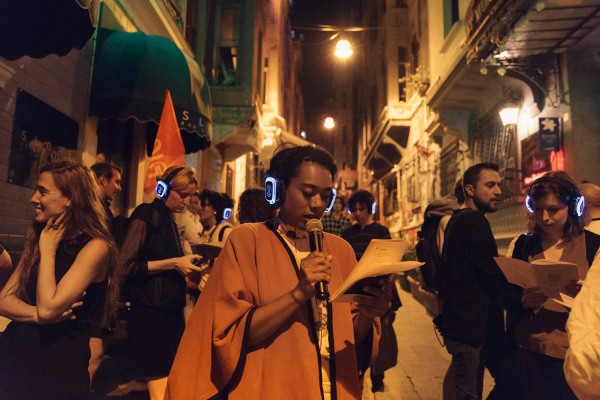
The Parasitic Reading Room expanded its reach with one of its most dynamics installment, an urban dérive across the irregular streets of the city in companion of a mobile radio (radioee.net), through a live broadcast of the public readings. In that moment, the “walking reading room” became a space of knowledge exchange, of joint efforts to keep the radio moving, of empathy and joyful, of different languages discussing together relevant topics, a space where to sing and to learn, a borderless open school.
Please join us on this wonderful adventure of reading aloud, by listening to the broadcast, here:
*****
All photos by Lena Giovanazzi for Making Futures.
You can read the Parasitic Readers on line: The Parasitic Reader 01 and the Parasitic Reader 02.
— This is an on-going projects with more instalments following the Istanbul Design Biennal kick off. Other instalments includes The Parasitic Reading Room: Repair Acts readings led by Rosario Talevi, as part of RepairActs, International Network Meeting & Conversation, Bristol [February 2019]; and the forthcoming Friend/ships: l’amitié comme moyen de transmission, with Rebekka Kiesewetter, Continent, and dpr-barcelona, Centre culturel suisse, Paris [March 2019]; and more to follow.
]]>
“To make myself understood and to diminish the distance between us, I called out: “I am an evening cloud too.” They stopped still, evidently taking a good look at me. Then they stretched towards me their fine, transparent, rosy wings. That is how evening clouds greet each other. They had recognized me.”
― Rainer Maria Rilke [1899]—translating into words a cloudy day.
The first thing you read when opening the pages of the book Essay on the modifications of clouds, is a poem written by Johann Wolfgang von Goethe where he describes different classifications of clouds—from Cumulus to Nimbus, through Cirrus, and Stratus—as an homage to the author of the book, Luke Howard. This seemingly simple gesture of mixing up poetry and science becomes stronger as you flip the pages and start getting in deep into his research about “the principles of their production, suspension and destruction.” Howard’s intention to create a classification system for this meteorological phenomena is more than a scientific essay; it is a wonderful cabinet de curiosités where science flirts with poetry, and takes the reader through a travel that goes from popular knowledge including facts about how the shape and density of clouds can affect the state of a person’s mind and body; to a detailed description of what ‘The Rain Cloud’ is, or even gives detailed data about the life span of the different kind of clouds.
The nomenclature that Luke Howard suggested in the early 19th Century has been universally adopted and the one still used in the current times, simply updated by scientific research guided by curiosity and a careful observation of nature; the same care described by Goethe about Howard’s observations,
“To find yourself in the infinite,
You must distinguish and then combine;
Therefore my winged song thanks
The man who distinguished cloud from cloud.”

Watercolour from ‘On the modifications of clouds’ by Luke Howard.
Maybe because clouds draw unfathomable dreamscapes around us, or just because they are somehow ephemeral and untouchable, we just felt the impulse to make this brief post with a few projects inspired by them, while following the same narrative as in Howard’s book: a poem first; engravings, researches, and photographic projects following:
“Continuous as the stars that shine
And twinkle on the milky way,
They stretched in never-ending line
Along the margin of a bay:
Ten thousand saw I at a glance,
Tossing their heads in sprightly dance.”
—from William Wordsworth’s ‘I Wandered Lonely as a Cloud.’
+++++

‘The Movement of Clouds around Mount Fuji’ by Masanao Abe.
In the book The Movement of Clouds around Mount Fuji, it is explained that in the late 1920s, the Japanese physicist Masanao Abe built an observatory with a view of Mount Fuji. From it, over the course of fifteen years, he recorded the clouds that surrounded the mountain. He was interested in the scientific question of how the air currents around Fuji could be visualized by means of film and photography. A century later after Luke Howard’s book, technology in the early 20th Century allowed Abe to do a cinematic research of cloud’s movements which was a step further from the beautiful watercolours that accompany Howard’s research, albeit they both share the same enigmatic and melancholic aesthetic result.
Here, the relationship between Mount Fuji and the clouds speaks by itself and can be inspiration from many other practices beyond physics and science. The way the clouds surround it, it’s like a dance; projecting shadows of undefined shapes, darkening the snowy landscape, or just flying above the mount in the most joyful way, as it can be seen in the almost cartographic drawings accompanying each photo in this book.

Cloud Cage by Chema Madoz.
Have you ever lay down in the grass looking up the sky, trying to find forms in the clouds? Have you ever feel the impulse of raise your hand and try to touch a cloud? Or even more, tried to catch it? Photographer Chema Madoz transforms this vivid and almost childish illusion into a unique moment, when he attempt to portrait the unachievable, the inscrutable, with his piece ‘Cloud Cage,’ which perhaps not by coincidence, recall fragments of another poem:
“As a bird —an immense bird and sound—
Holly Name flew out of my chest.
And ahead the mist mysterious crowds,
And the empty cage behind me rests.”
—from Osip Mandelstam’s ‘I Could Not Among The Misty Clouds.’

‘Nimbus,’ by Berndnaut Smilde.
In the same way as Madoz, photographer Berndnaut Smilde has taken inspiration from clouds to create his photographic work Nimbus, where the ephemerality and lightness of clouds is confronted with the roughness of the built environment. He defines this work as “a transitory moment of presence” when the cloud occupies the space only for a few seconds before they fall apart again.
Howard describes the transformations of clouds as based [some times] in curious and capricious divisions and subdivisions and, in Nimbus, this provocative encounter with architecture—a practice which as opossed to the formation of clouds, is identified as solid, planned and projected—just opens many questions about the many significances of concepts like time, endurance, and permanence.

Centre des 7 ports jumelés, Osaka. Lacaton & Vassal.
From Smilde’s clouds inhabiting architecture to architecture created by clouds, we want to finish with this project that our friend Tiago Borges shared with us. It’s the Centre des 7 ports jumelés, an unbuilt project proposed by Lacaton & Vassal for Osaka, in which they use propose to ‘build’ an artificial cloud at the height of the surrounding tower blocks, symbolizing the exchanges between countries.
That clouds has the marvellously capacity to be transformed, it’s a fact. They can become rain, dew, an aqueous atmosphere, a piece of shade, an enigmatic photography, an architecture project, or a melancholic poem. As they float in the skies above, they speak about otherworldly realities. So this is just a small homage to all this poets, scientists, artist, architects who have taken part on transforming those cloudy dreams into something comprehensible to all of us.

‘The Cloud,’ Percy Bysshe Shelley, 1820.

Described as a spatial essay, the recently finished exhibition “After the End of the World” at CCCB in Barcelona, presented a tour into “the Anthropocene planet” through a selection of speculative design, architecture, scenic arts, photography, science, and philosophy works.
The exhibition space was solved with a series of screens, like thresholds, transporting us to different present and future scenarios of climate change at global scale. The territories, the urban and domestic landscapes recreated by the different installations of the exhibition reflexively depicted the logical result of years of neoliberal extraction and dispossession; a result that we have swallowed without question under the mantra of progress, skillfully sweetened with several years of marketing.

Sea State 9: Proclamation. Charles Lim Yi Yong
The beautiful and disturbing satellite images curated by Benjamin Grant and the terraforming systems in Singapore shown by Charles Lim put us face to face with this extractive and testosteronic logic of domination, with which we have learned to perceive the environment: as an object to be exploited and which purpose is basically to satisfy our needs. Somehow, these installations seem much like those head news announcing major catastrophes to which we are practically anesthetized, because let’s be absolutely sincere: in reality we have not achieved much with good intentions, moral appeals or discouraging forecasts, while we continue without questioning the Western-welfare model, the production system, the continuous growth and the consumption level that allows them.
The installation of Kate Davis and Liam Young – Unknown Fields points to the production and consumption problem stated above, highlighting the landscapes and human stories behind one of the most globalized industries on the planet: the textiles. This installation brought to our mind that in 2016 H&M featuring M.I.A. already tried to touch our sensibility with a global call to recycling labeled #WorldRecycleWeek. However, the 2017 collection and the subsequent ones, kept arriving on time to their stores.
Superflux displayed an urban domestic space of emergency and self-production. The installation had an atmosphere of certain oppression and isolation that is disturbingly familiar. This installation didactically speculates on the chains of production, consumption and food sufficiency that will allow some form of subsistence in the metropolis to come. In our opinion, it was the best installation of the exhibition.
Natalie Jeremijenko re-edited the Environmental Health Clinic, a proposal to take science to the citizens at the street level, it was coupled with a program that jumped outside the limits of the museum and gave a unique and interesting didactic dimension to the whole exhibition.

Mitigation of shock. Superflux.
With all the above, it was a bit problematic to digest the poetic-philosophical-narrative thread of the exhibition, entrusted to Timothy Morton incarnated as “Minister of the Future” [sic]. It is not that ideas like hyperobjects (e.g. climate change) or ecology without nature are not consistent. In fact, they would have given solid arguments for a narrative that challenges the natural-artificial binomial and our perception as beings embedded in nature.
Because there is nothing more authentically human than the bureaucracy and its institutions (including Ministers and their Ministries). So, unless the intention was to revisit the masterly irony of Orwell’s farm (without a hint of rebellion), the scenarios, arguments, and promises developed by Morton still drag a lot of “anthropo-” and little of “non-human” [1]. It seems that WOOO (Western Object-Oriented Ontology) has just discovered something that so-called animists cultures have been cultivating for some time ago with exquisite sophistication [2]. Under this current of thought, it seems that after the collapse of the industrial society, we were just waiting for the arrival of white shamans to explain us the agency of our environment.

Toxic waste from an aluminum plant in Darrow, Louisiana. Daily Overview.
It is precisely this Western, white, human and still testosteronic view that in our opinion dismantles the main narrative of the exhibition. It has missed in making visible the interconnections, in making evident the mesh that shows the interdependence between humans and non-humans (if we still want to involve Morton); the latent power of the networks of affection around us, the conviviality and the conflict, or the myriad of life thresholds beyond human biological tolerance.
We left the installations with the certainty that there are still many worlds, and they will be here long after the end of this exhibition.
*****
[1] Timothy Morton as Minister of the Future in the exhibition “After The End of the World”. Plus: Morton’s Opening speech and ministerial programme.
[2] Dylan Rainforth – How Aborigines Invented the Idea of Object-Oriented Ontology.
un Magazine 10.1 36/39.
]]>

A promise of leisure can be read in a number of avant-garde architecture projects from the 1960s. Here, the bed, or at least the mattress, played an important role. People lounged around in covers, cuddling in soft-porn-like manner in whirling bubbles, letting themselves be synced into rhythm by the machine for the coming society. Or they organised free time in horizontal structures following grassroots principles in now flexible and airy forms above the stone city, where day and night have already been abolished. These were projects that affirmed the popular promise of the European welfare state and fantasised about a future without labour that had, as popularly believed, already begun.
This architecture of immaterial labour not only mirrors how diffuse the concept of labour has already become, and how this seems to permeate all aspects of human activity, but it also points to an emancipatory aspect at the moment of its emergence. The development of this architecture could be discussed on the basis of many examples: the invention of the office landscape by the German management consultants Eberhard and Wolfgang Schnelle (1956), Joan Littlewood and Cedric Price’s Fun Palace (1962–66), Herman Hertzberger’s Centraal Beheer (1967–72), also Hans Hollein’s Mobile Office (1969), Haus-Rucker-Co’s Yellow Heart (1967/68), and not least John Lennon and Yoko Ono’s use of space in their two Bed-Ins in Amsterdam and Montreal (March and May, 1969). These are all examples of working spaces, most of which were created parallel to and in conjunction with the emancipation movements of the 1960s. Taken as models, they illustrate how new immaterial labour can be portrayed and which possibilities architects, artists, and their teams come up with to deal with the new work paradigm using architectural means. In the movement toward immaterial labour, spaces of production undergo a number of convergences: human and machine, house and city, living and working, architecture and mechanical emotion machines, art and commercial, outside and inside.
Working in a luxury hotel
Especially Yoko Ono and John Lennon’s appropriation of the hotel room — during their two one-week Bed-Ins, first in the Hilton in Amsterdam, then in Montreal — can be seen as a template for the contemporary form of ‘working glamour’. The Bed-In is a foil for a life in which working in bed and from a hotel as the most extreme workers’ fantasy — as the most extreme fantasy of freedom — increasingly becomes reality. As working, leisure, and life are more and more intertwined, the tipping points into a seemingly glamorous way of working become visible, presenting themselves between an unbounded claim to space and its limited realisation. The Bed-In performance is thus less interesting as a protest performance. However, it is significant for understanding a proletarianised form of working in bed that is no longer the privilege of the bourgeoisie and their children. In their Bed-In performance, Lennon and Ono appropriate the generic node of a worldwide trade network by reorganising the space.

John Lennon & Yoko Ono in the Amsterdam Hilton Hotel, room 902. Photo by Nico Koster
They operate in an entrepreneurial way for their own agenda. Their work consists of communication, and it is only made possible by being connected and distributing it via the media. At the same time, the Bed-In performance should be divided into three sections to illustrate the paradox of entrepreneurial and/or alternative action in the contemporary economy. In the first section in Amsterdam, the total exhaustion and depressive state of the protagonist and her partner become visible. Then, there is an emancipatory turn achieved through idleness and the subsequent reorganisation of the hotel room. In the third section, the performance in Montreal, the emancipatory moment of the performance is returned to conventional stereotypes. In this last moment of the performance, Lennon and Ono’s production of added value is exploited by third parties.
Living space and working space converge in the staging of the Bed-In. It is not arranged on the stage of a theatre or in a stadium, nor in a museum or an art gallery. Instead, the performance takes place in rooms where Lennon and Ono live. The spatial framing differs fundamentally from the sites of Ono’s art, the music studios where they both worked, or the concert arenas where Lennon performed. While the art space, the studio, or the stage space are traditionally separate from living spaces, the couple’s everyday living space becomes a temporary working space during the Bed-In, and their working space conversely becomes their living space: they live in the space of their performance and work in their living space. Apart from the press conferences and the visits, apart from the telephone interviews, Ono and Lennon reside in these rooms, eat and sleep there.

Yoko Ono and John Lennon Bed-In at a Montreal hotel in 1969. Photo: Gerry Deiter, source MoMA.
The entrepreneurial self in bed
Often-forgotten pictures of the Bed-In show Yoko Ono and John Lennon lying peacefully and lost in the oversized bed of the Amsterdam Hilton. The pictures reveal an aspect of entrepreneurial action that the French sociologist Alain Ehrenberg calls ‘the exhausted self’. It is a latent exhaustion that can become depression which Ehrenberg associates with the disappearance of the boundaries between what is allowed and what is prohibited, between the possible and the impossible, and which alters and irritates the mental order of every individual. With the blanket pulled up to their chins in a room that seems darkened by the Hilton decoration, Ono and Lennon appear completely exhausted, as the “Ballad of John and Yoko” — which Lennon recorded with Paul McCartney in London shortly after the Amsterdam Bed-In — also recounts:
“Drove from Paris to the Amsterdam Hilton
Talking in our beds for a week
The newspeople said
‘Say, what’re you doing in bed?’
I said, ‘we’re only trying to
get us some peace’.”
The last line of the song — “to get us some peace” — can be interpreted in two ways: on the one hand, I can read it, in keeping with the intention of peace activism, as the desire to gain peace for the world. On the other hand however, the line can also mean that Lennon yearns for peace for himself and his wife. The one undisputed interpretation follows the conventional narrative about effective media work for peace through refusal. The other interpretation emphasises the reverse side of the activist acting from within himself: exhaustion, the desire for non-confrontation, harmony, and personal peace.

John Lennon and Yoko Ono Bed-In at a Montreal hotel in 1969. Photo he released to CBC News, Source CBC.
John Lennon is less of a working class hero in the traditional sense, who rebels against the system, than he is portrayed in countless biographies. In the Bed-In he reveals more contours of a new type of worker that must be called, following Ulrich Bröckling, the entrepreneurial self. Lennon works creatively and entrepreneurially, as an active and independent subject; he is innovative and uses imagined opportunities for gain, bearing the risks of these endeavours and closely cooperating as a team with his wife. Lennon calls the Bed-In an advertising campaign for peace. It is an event that makes use of media attention on their wedding to play with public expectations: what could top the scandalous record cover of Two Virgins (1968), where Ono and Lennon are depicted naked?
With the Bed-Ins, Ono and Lennon disappoint the expectations of the journalists and initially do nothing, or simply conduct absurd conversations with those present. In keeping with Ono’s art practice, they frame a setting of astonishment, in which expectation are disappointed. Initially in Amsterdam, the Bed-In is also an artistic performance outside an art space that borrows from Ono’s artistic practice. Without realising it, all the journalists wanting to report on the event became viewers of an art form taken from the avant-gardes of the time, causing first pure confusion and misunderstanding. It is only after this that the initially depressive atmosphere, the passivity, and the absurdity generated by Lennon and Ono through their performance, is exchanged through the reorganisation of the space for an active and seriously-meant work towards the essentially unachievable concern of ‘world peace’. The use of the hotel room thus changes from passive insertion into the existing structure to actively arranging and taking action. The couple set themselves up in the hotel room: the bed is moved in front of the window, only white sheets are used, and many flowers are set up around the bed. In addition, instructions for attaining world peace are written in block letters on paper and attached to the window and the walls for everyone to see: “Hair Peace”, “Bed Peace.” Lettering is even scribbled directly on the window of the hotel room.
>>> These are excerpts from the essay ‘Working Glamour,’ by Andreas Rumpfhuber. Published in the book Into the Great Wide Open [dpr-barcelona, 2017].
To read the complete essay, download it in PDF format, here.
*****
Related to this topic, you can read at the Het Nieuwe Instituut’s web-site the essay The 24/7 Bed, Beatriz Colomina’s take on the bed as a unique horizontal architecture in the age of social media, where she writes about a variety of spaces and times, from bed to bed, as a contemporary workspace transforming labor. Her essay ‘The 24/7 Bed,’ has been published in the book Work, Body, Leisure, published in conjunction with the Dutch Pavilion at the Biennale Architettura 2018.
Work, Body, Leisure. Edited by Marina Otero Verzier, Nick Axel. Het Nieuwe Instituut and Hatje Cantz Verlag GmbH, 2018. [Hatje Cantz Verlag]
Plus:
In 2009 the magazine mu·dot published their issue #2, ‘The Glamour Issue,’ including Andreas Rumpfhuber’s essay “The Working Glamour. John Lennon, Yoko Ono: Bed-In Amsterdam and Montreal, 1969.”(download the PDF here).
]]>
A woman lives in a small town called Słubice. It is a border town in western Poland, closely linked to its German sister city Frankfurt (Oder), of which it was a part of until 1945. In this small town, as in the rest of the country, abortion is banned except in a few circumstances—sixty-nine percent of Poles view abortion as immoral and unacceptable. In this socio-cultural and political context, suddenly, a shadow overflies the sky. The woman looks up and has the feeling that something important is about to happen. The shadow starts getting darker as it comes closer, like an announcement of hope, and the sound gets louder from one second to the next. The shadow brings rain into a dry territory.
The woman is pregnant and wants to wield her abortion rights. But she can’t, or rather could not. The shadow is a small drone that is bringing abortion pills from a country where abortion is legal, and delivering it to this border town where abortion is severely restricted.
Before it was only a shadow, then it was a drone. Now, it is an angel.
*****
The image of the drone has been absorbed by our collective imaginary in so many ways, provoking everything from deep feelings of dread to the highest hopes of freedom. Important debates are currently taking place about military policies, political implications, and economies of the drone industry; nevertheless, and similarly important, are considerations about the social, psychological and emotional impact of living surrounded by the immanent presence of drones.
In Western countries—particularly those that have declared “war on terror”—and from the other side of the screen, it is difficult to know if a drone is documenting an event, filming a music video, monitoring weather, taking panoramic photos or bringing abortion pills into conservative countries. The myriad ways in which they can be used, from militarized killing machines to beneficial devices observing disaster situations, opens a debate that stretches wider than politics and economics to tackle humanitarian, social and ethical concerns. These, usually dismissed by politicians and policy-makers, are important because they deal with the intangible—traditions and context-based cultural interpretations.
The drone theme can be easily paired with science fiction and other new narratives, where a vehicle capable of flying without a pilot captures our imagination by the random beauty of the possibilities behind this idea. Sadly, we’re talking about the beauty of fear. Immanence—the divine presence—can be the word that better describes the feeling and thoughts that materialize when one hears the word “drone.” From the constant shadow over countries with targeted individuals, to the unstoppable Twitter feed that emerges when you search the hashtag #drone, the murmur of the drone’s presence in the sky resonates from miles away. Inner fear deriving from its presence can be defined as a transcendent experience—an experience beyond the normal or physical level—provoked by an element that is always there, even if you’re not able to see it. Is not a coincidence that the laser-targeting marker used to direct hellfire from a drone is called “the light of God” by marines and the military, according to video artist Omer Fast in his film Five Thousand Feet is the Best. Fast explains:
“… the Marines like to call it the Light of God. It’s a laser-targeting marker. We just send out a beam of laser and when the troops put on their night vision goggles they’ll just see this light that looks like it’s coming from heaven. Right on the spot, coming out of nowhere, from the sky. It’s quite beautiful.”

Illustration of the book ‘Atlas Marianus’ by Wilhelm Gumppenberg (Jaecklin, 1659)
The delusion of the omniscience of the drone subsequently causes the delusion of omnipotence, the fiction that a drone possesses unlimited power. In fact, all these feelings provoked by the constant shadow of the drone can be linked with otherworldly—even religious—traditions; feelings that are intertwined with concepts such as immanence, omniscience, transcendence and omnipotence. In this scenario, “you can run but you can’t hide” is a popular motto commonly used when referring to drone strikes, which entails a strong truth about the impossibility of hiding away not only in physical terms, but also in spiritual, emotional and psychological ones. This impossibility of hiding can be related to the Christian feeling of fear after committing a sin: you can hide from everybody but not from the eyes of god; as a Predator drone operator wrote in his memoirs: “…sometimes I felt like God hurling thunderbolts from afar.” But references stream not only from Christianity; mythological allusions can also be found in this context. One of the latest improvements in drone technologies is called Autonomous Real-Time Ground Ubiquitous Surveillance Imaging System (argus-is), alluding in its acronym to the Greek mythological figure of Argos Panoptes—a giant with one hundred eyes—since it fuses together data from three hundred and sixty-eight cellphone cameras to create a composite image of 1.8 billion pixels. Drones are the creation of power structures, and what power structure is stronger than our own beliefs?

Illustration of how ARGUS IS array links together images streamed from hundreds of digital camera sensors. Source: Daily Mail
The drone phenomena should be understood as part of a wider ecosystem, which has two main bodies, one physical and the other intangible. The physical body is formed by species of devices: the drones themselves; the network that makes possible the connections between the drone and the pilot, even if they are thousand of miles away; the network’s vast infrastructure, in the form of data centers, internet connections and so on; and the physical places where the pilots spend their time controlling the distant targets. On the other side of the spectrum, the drone inhabits an intangible, seamless ecosystem formed by a set of emotional and psychological layers such as solitude, fear, loneliness, disbelief and ethical concerns. We can say, then, that we are all species belonging to this large infrastructure if we define it as “bare life,” referring to Giorgio Agamben’s notion of life reduced to its natural, biological dimension and excluded from the political community.
As such, all our ideas about drones are basically illusory. We’ll never know if author Richard Brautigan was predicting unmanned aerial vehicles when he wrote All Watched Over by Machines of Loving Grace; but it seems possible, since if we listen to conversations about drones, people tend to endow them with a soul. References to drone activities, military or not, abundantly use expressions such as “the drone can see enemies, target them…” This obscure humanization of the drone gives an ontological dimension to the debate. In that sense, the relationship between humans and machines goes far beyond the traditional; we need to reconsider our understanding of the human, and his role as a drone pilot, insofar as drones operate on a threshold in which life is both inside and outside the “killing machine.”
All these considerations reveal that we are somehow living in a post-utopian world, particularly when reflecting on the architectural and spatial manifestations of utopias, which have been commonly envisioned to overcome the aerial space, a formerly wide and open field for design experimentation. Today, it seems that the space for utopias has been conquered to become a battlefield; fantasy and fear vis-à-vis. “The sky here is not merely a space for flight. It is a space for the transmission and reception of command, control, communications, computation, and intelligence,” as Honor Harger wrote. Our fantasies are made of dreams, but what happens when there’s no more space for dreams? Constant dreamed of a New Babylon occupying the space above the ground with a pattern that can grow progressively, an open framework ready to cover all the surface of Earth; and by doing so, he transformed our notions of the politics of the atmosphere. Following similar formal principles, Yona Friedman developed his concept of Ville spatiale–the Spatial City–in the early 1960s. As in the New Babylon, La Ville Spatiale is raised on slender supports up above the earth; independent structures suspended over the old cities and the landscape. Moving upwards, above the first layer over ground, there is a whole set of avant garde projects intended to be built in the sky.

Urbland 2000 by François Dallegret, 1966.
Already in 1726 in Gulliver’s Travels Jonathan Swift described Laputa, an island city floating in the sky with an area of ten thousand acres. In the twentieth century, highly influenced by science fiction, several floating city projects materialized as speculative proposals. In the 1920s, Hugo Gernsback suggested that ten thousand years hence “a city the size of New York will float several miles above the surface of the earth, where the air is cleaner and purer and free from disease carrying bacteria.” In 1929, Georgii Krutikov designed his famous Flying City. More recently, and among many others, we have the 1966 Urbland 2000 by François Dallegret. In these kinds of projects, the atmosphere suddenly becomes the basis for political action, as Mark Wigley has stated, because it becomes a space for negotiation. As it is now.

Illustration of Gernsback’s speculative article on what cities will be like in the future. Source: Wikimedia
How to understand and move through the dilemma of drones occupying a space for negotiation that is supposed to be a common space? We’re not talking only about the negotiations on the use of the air space, but of a set of rules that navigate in the vast waters of the unspoken. Regulations on aerial space are becoming stricter on a daily basis, and all the hidden layers of policies dealing with this topic are not as transparent as they should, affecting the way we adapt to them. Can we ask ourselves if being visible from the sky is legally considered being in public? What happens on the other side of the screen—that can be thousand miles away from the visible drone— in a space and time that is not visible at all? One of the biggest ironies of remote piloting is that aircrews have been removed from the dangers and humanity of their impact on the battlefield, while simultaneously attacks are increasing both in intensity and in territorial terms. The fear of the unknown becomes a way to govern and control.
However, this context can also be a perfect landscape to recover an utopian approach to airspace, transforming the battlefield in a space for dreams once again. Today, almost everyone can buy or build a drone, and all kind of uses have been envisioned for what was initially created as a weapon, from journalism to pizza-delivery drones. This is a natural reaction when a new technology is adopted for civic use, but after the hype and trendiness of “using-drones-for-everything,” we must admit that are several fields of action where drones can be—and are indeed helpful. In the past few months, researchers started using drones to look for corpses in hard-to-access locations, or to monitorize the size of seabird colonies seeking to understand how climate change affects the Australian coastline. In both cases, scientists rave about how effective the use of drones has turned out to be.
“The modern civilian is, in a sense, as close to warfare as we have ever been,” Henry Barnes recently wrote, pointing out how “through whistleblowers such as WikiLeaks, we have never been more aware of how our wars are being fought, even if the gaps in our knowledge are still huge.” We can add that this awareness allows us to understand and therefore to find the gap in the policies that sustain the uses of drones. There is an urgent need for a proper debate on the politics of the atmosphere again, and instead of accepting the weaponizing of airspace in praise of security, we should ask ourselves if we can reverse this approach and transform the silence and invisibility, from the other side of the screen, into a new political infrastructure based on an afterlife for the drone.
Beyond naiveté, this is not a conclusion, but an invitation to explore further the limits of what we know about drones, and turn this knowledge based on fantasy and fear into a new relationship between space and data. A drone transformed into a shadow, a shadow converted into a ghost, a ghost becoming real to inhabit the unknown. The unknown turned utopia.
***
This text by Ethel Baraona Pohl was published as the closing essay of the book Drone. Unmanned, Architecture Series. Edited by Ethel Baraona Pohl, Marina Otero Verzier, and Malkit Shoshan. Published by dpr-barcelona, as an e-Book in 2016, and as a paperback in 2018.
Drone is the the first volume of Unmanned. Architecture and Security Series, a research and publishing project which examines architecture’s role in the construction of the contemporary security regimes. The series discusses the consequences of the civilian appropriation of military technologies, and sets an agenda for design professionals to engage on a technological, cultural, and political level by putting forward forms of resistance.
This publication was made possible through the generous support of the Graham Foundation for Advanced Studies in the Fine Arts, the Het Nieuwe Instituut, and the Creative Industries Fund NL.
Header image: An ‘Abortion drone’ that took off from Frankfurt Oder in Germany, transports packets of Abortifacients abortion pills, for delivery in Slubice, Poland, 27 June 2015. Source: Exministries TV
]]>
Spatial practice and urban studies have seen a diversification and politicisation over recent decades. Although professional and institutional forces still dominate, approaches grounded in relational thinking, activism, art practice, socially engaged initiatives and counter-economic strategies have a powerful lineage. Entwined within these histories of spatial practice is a narrative concerned with crucial questions of how we might learn about such spatial praxis; about the historical and contemporary urban condition and the relation of the subject within it; about future imaginaries of what it might mean to be, or to become, an architect, urban designer, or spatial practitioner; and about learning how to learn.
Global crises around capitalism and climate change, including extreme inequality, mass displacement of people and devastation of biodiversity, make urgent the need to take responsibility and understand the potential agencies of a spatial practitioner. At the same time, the increasing bureaucratisation and the limited imagination of the neoliberal institution about what society might be are reducing the scope of educational programmes. This limitation extends to the understanding of the roles and competencies such practitioners may require, and where and how they might intervene.
How might we make better accounts and take responsibility in the way we learn, practice and research? Such complex concerns are not limited to one domain and, as per Guattari, require operating transversally. This means working across disciplines and practices, uniting practice and theory and bringing together the social, political and pedagogical:
“Learning to think differently is both a political and a pedagogical project since both pedagogy and politics involve processes of change and transformation. Indeed, change and transformation are critical in the area of environmental education and environmental politics, both of which […] presume and reinstate a separation between what constitutes ‘us’ and the ‘environment’.”

Applications of a mobile classroom. Photo by Abelson.
The Spaces of Learning traversed and established by Urban School Ruhr in response to these conditions reflect a historical lineage of critical activity that transposes pedagogical experiments within and across the urban realm. It is the specificity of this relationship that we would like to pursue in particular as a line of flight through this complex entanglement of the spatialities of alternate pedagogies. If pedagogy is, as Paulo Freire suggests, about challenging relations and subject positions, spatiality and the urban are crucial, since, as Margaret Kohn states: “[s]pace is one of the key ways in which the body perceives power relations. The physical environment is political mythology realised, embodied, materialised.”
Such an approach and finding out is necessarily a collective endeavour, which involves experiential, critical and projective actions. One less known, but important example is the pedagogical work of Célestin Freinet. In rural France in the 1920s and 30s, Freinet brought a printing press into the primary school classroom that he taught in. This press was to be used by the children to collectively print their own stories and information based on their explorations out in their local spaces and which they had gathered together on “learning walks”. Thus, the children carried out collective processes of exploration, gathering, reflecting, editing and writing before printing newspapers and journals of their work. These documents were then sent in the mail to other local and regional schools to share their findings and ideas with other children; sharing their efforts and supporting the learning of others.
We see Freinet’s work as a crucial precursor to the notion of spaces of learning at USR, as it embodies the complex, anarchistic and anti-essentialist view of both pedagogy and of spatial practice that underlies these endeavours. “New assemblages began to be created […] replacing traditional, institutionally designed directives and government mandated forms of teaching and learning […] The end result was a release of new desire that escaped the impasse of the State.”[1] Freinet’s work was influential in the development of what became the field of Institutional Pedagogy (as conceived by the brothers Jean and Fernand Oury) and also inspired Felix Guattari’s work on transversality and the production of subjectivity outside institutional mechanisms (specifically his experiments to allow roles to be changed at the La Borde clinic where he worked, including between patient and analyst).
The process that Freinet coordinated based around the printing press was radical and is relevant here because it encourages and permits assemblages of collective activity without prescribing outcome or content; it was “utilised in such a way that the act of learning became entwined with a process of collective social organisation […] transforming the space of [the] school and [the] students’ work into a source of micropolitical activity.”

Official book launch of Aristide Antonas ‘Archipelago of Protocols’ on a public reading on the stairs of Philopappou Hill – under the Greek Acropolis. Photo by Gary Hurst
Better known than Freinet for his ideas about education and the city was the anarchist educator and architect Colin Ward, whose books Streetwork: The Exploding School [2] and The Child in the City (Pantheon, 1979) emerged from a pedagogical tradition that brought anarchist ideas to education, allowing children to have a different relationship to their learning and understanding that was fundamentally tied to the city: “[the] city is in itself an environmental education and can be used to provide one, whether we are thinking of learning through the city, learning about the city, learning to use the city, or to control or change the city.” [4]
Ward’s work “created an entirely new discourse and practice” about (in this case, but relevant far beyond) primary school education by showing how learning in, from, with and for the city, in the spaces and with the various actors of the city, could offer a radically different experience of learning. Not least, Ward’s work encourages us to con- sider the potential of the city space, as he imagined multiple uses for streets (in response to the dominance of the motor car). This raises crucial ideas about the social pedagogical potential of the street – what can we do there and what kind of learning does the street/city make possible or encourage? Ward’s contribution did not only offer alternate pedagogy, but also started to critique the professional and political authority of the production and use of urban space. The subtitle of Ward and Fyson’s book was informed by a report called Environmental Education that was published in 1970 and which suggested schools “exploding into the environment”. For Ward, “there was never a more apposite moment for such an explosion. For theirs is not only a crisis of confidence in the school system; there is also a crisis of confidence in the wisdom of the decision-makers who shape our urban environment.” This highlights how initiatives such as USR are politically challenging the way that urban/spatial professionals, as well as other actors, are constructed, how they understand both themselves and their object/subject of study, and the epistemology of the city – how do we know? Who knows?
These questions, following the work of Ward and Freire among others, inspired a range of alternative approaches to architectural education, which, as argued by Beatriz Colomina following her Radical Pedagogy research project, significantly informed the wider architectural discourse in the late twentieth century. Colomina suggests that these experiments in education constitute forms of architectural practice in their own right. “Pedagogy operated as an active agent in the processes with which it was concerned, rather than through modes of detached or complacent reflection.” Cedric Price’s influential tenure at the Architectural Association in London in the 1970s saw studio projects conceived as manifestos or educational tools and learning as holistic process that did not just occur within the academy. Architecture was understood as process not product and a building was not always the answer.[5]
Rooted in this historical lineage, such pedagogical experiments as those at USR seek to mobilise and enact spaces of learning which are socially and relationally active. This requires taking a position that acknowledges fluid relations between subjects and the city, characterising those who take part as active citizens rather than fixed in the roles of “teachers” and “students” orientated toward the city as fixed subject. Feminist philosopher Rosi Braidotti speaks of the importance of minor voices and taking minor positions in the process of developing knowledges. In doing so, she valorises the notion of connecting with characteristics ascribed to the Other as a way to understand difference as site of discursive problematisation. Such work seeks to redraw new and possible power relations between multiple (always becoming) subjects and break down artificial dichotomies (teacher/student; school/city; child/adult; public/private; human/nature).

The class immersed on an intense discussion about Autonomy and its implications during the Autonoma Conference at the Onassis Cultural Centre in Athens. Photo by Gary Hurst
Meaningful and productive encounters with others in spatial practices require the development of tools for embodied vision and for encounter. The use of fiction in such contexts allows for radical speculations about how the future might be constituted. The convening or staging of speculative and playful conversations between subjects who would not usually speak together can be understood as potentially transforming subjectivities and understandings of power and agency.[6] To convene stories as a spatial practitioner is to be aware of the embodied nature of vision,[7] making tools for intervention that allow for the prototyping of new ways of acting in “public” – with the “other”. Practices such as muf, public works, and raumlabor have employed interventions (at the scale of a body, interpersonal or urban) to mediate relations and perform space differently.[8] Fiction in urban and spatial practice is a game, with props, taken seriously as performative knowledge making.
Spaces of learning are therefore performatively enacted rather than predetermined, meaning that, following Judith Butler, the spaces are brought into being as they are “performed” by the complex range of actions, events, movements, negotiations and so on that they both enable and are constituted by. The processes of learning that USR set in motion might be said therefore to be productive of certain kinds of experimental space, since, as John-David Dewsbury remarks, “[t]he performative is the ushering in of the worlds that it affects: it is an actualisation, a series of practices … [that] does not provide blueprints, models, ideals, or goals. Rather, it experiments; it makes; it is fundamentally aleatory; it is bricolage.”[9] The activities of USR can be thus be read as alternative processes of the design as well as the production of different kinds of knowledge. By nomadically traversing the urban space, by connecting with local actors, by sharing stories and experiences, a multiple, sometimes contradictory, continually in-the-making version of the urban space is collectively produced. Far beyond simply learning “in” space, spaces of learning might establish conditions that help us to search for and produce new kinds of social relations, spaces and situations to attend to the urgent political, cultural and environmental pressures of this moment. As Dewsbury suggests:
“Performativity is the sense of experimentation that greets us everyday; it is our ongoing tentative endeavour to enact local utopias that seek to create situations for joyful encounters, to enact performances that work in such a way that they do not question the superiority of one body over another, but rather compose a rhythm that sustains and eases.”
The work to test and build capacities and relationships, and collectively rethink and remake both what is possible and anticipated could be understood as a “prefigurative” practice, which seeks to “enact commitments for the future within creative processes”.[10] This is to recognise that as well as dominating discourses, there are critical and subjective capacities within us all that allow us to see beyond the everyday, normative approaches. The bringing together of the social, spatial and the political is a pedagogical strategy to mobilise resources, shift meanings and values, and to actively change spaces, relations and desires.
—Julia Udall & Sam Vardy, ‘How do we know? Who knows? A history of enacting spaces of learning.’ Explorations in Urban Practice. The Urban School Ruhr series [dpr-barcelona, 2017]
—–
[1] Matthew Carlin, “Deleuze and Guattari: Politics and Education”. Encyclopedia of Educational Philosophy and Theory (Springer, 2016), pp.1–5.
[2] Together with Anthony Fyson (London: Routledge & Kegan Paul Books, 1973)
[3] London: Woburn Press, 1978 / New York: Pantheon, 1979
[4] Colin Ward, The Child in the City (London: Woburn Press, 1978), p.176.
[5] Royston Landau, “A Philosophy of Enabling: The Work of Cedric Price”. AA Files (8)(1985), pp.3–7.
[6] Felix Guattari, “Transdisciplinarity Must Become Transversality Theory”. Culture & Society, Vol. 32 (5–6) (2015), pp.131–137.
[7] Donna Haraway, “Situated Knowledges: The Science Question in Feminism and the Privilege of Partial Perspective”. Feminist Studies 14, no. 3 (1988), pp.575–99.
[8] Katherine Shonfield, Adrian Dannatt, and Rosa Ainley, This is what we do: a Muf manual (Ellipsis London Pr Ltd., 2001); Kathrin Böhm, If you can’t find it, give us a ring – public works (ARTicle Press Publishers & ixia PA Ltd 2006); Berggren, K. and Altés Arlandis, A., “From Berlin to the polar circle: a conversation with Francesco Apuzzo and Axel Timm from Raumlabor” in Intravention, durations, effects: notes of expansive sites and relational architectures (Baunachy: Spurbuchverlag, 2013).
[9] John-David Dewsbury, “Performativity and the event: enacting a philosophy of difference”. Environment and Planning D: Society and Space, 18(4) (2001), p.195–196.
[10] Valeria Graziano, “Fake it until you make it: prefigurative practices and the extrospection of precarity”. Mapping Precariousness, Labour Insecurity and Uncertain Livelihoods: Subjectivivties v and Resistance (Taylor & Francis Group, UK, 2017).
boundless, directionless, horizonless,
in the dark of the mind, in the world of emotion,
by primordial intuition, terror.
Speech is a social chart of this bog.”
– Marshall McLuhan.
The Medium is the Massage, 1967

The photo above was taken by Frederic Ballell in a book market in our neighbourhood Sant Antoni, in Barcelona, in 1915. We want to use it as a leitmotif to post in our blog today, because apart from the worldwide celebrations on World Book Day on April 23rd, we found out that today is also the 21st year that there’s been a World Book Day celebrated on 1st March and as book lovers, why not to celebrate twice a year, at least?
We want to make a brief homage to all those researchers, designers and thinkers who are working to blurry the boundaries between formats of this precious object that we call ‘a book,’ and who are taking us from the printed pages to the acoustic space, and the other way around.
We’re back in the acoustic space, so let’s start!

In 1900 was published the book A Book for All Readers, written by Ainsworth Rand Spofford, and published by G. P. Putnam’s sons. It was conceived as a guide to the formation of libraries and the collection, use, and preservation of books. The poem above appears in the chapter ‘humors of the library,’ on page 442.
In 2016, graphic designer Astrid Seme in collaboration with Sizwe Mthethwa and Thapelo Kotlai transformed the aforementioned poem into a rap song. They explain the project, saying that “Rap, a style inherited from poetry, shifts the printed words to A Song for All Readers. Rhyming the oration of the sacred librarian line by line is reminiscent of common practices in protest movements and keeps on demanding #FreeEducationForAll and an open access to knowledge for future readers.”
Play it out loud, here and please, always support free education for all!

In 1967 Marshal McLuhan and Quentin Fiore published the seminal and influential book The Medium is the Massage, stating that “modern media are extensions of human senses; they ground us in physicality, but expand our ability to perceive our world to an extent that would be impossible without the media.”
One year later, as a consequential experiment with different kind of media, McLuhan had the idea of creating an audio version of the book, as a reading performance to give voice to the book contents. It was published by Columbia Records in the format of a vinyl LP.

In 2012, following McLuhan ideas, Jeffrey T. Schnapp and Adam Michaels published the book The Electric Information Age as a collaboration between Inventory Press and Princeton Architectural Press. It has been published in the form of a small, inexpensive paperback with the aim to explore a time span in mass-market publishing in the sixties and seventies.
Like these all paperback editions of the 1960s, Michaels also vindicate the role of the paperback format nowadays in a conversation with Alan Rapp for Domus, “While the publishing industry tends to treat the mass-market paperback as obsolete, I hold the apparently anachronistic view that it remains the ideal format for serious reading.

Created as an audio extension to The Electric Information Age book, a vinyl LP was made in the spirit of the experimental 1967 The Medium is the Massage LP. Produced by Schnapp, Michaels, and Daniel Perlin —The Masses— it is described by them as the “first spoken arts record you can dance to” based on media theorist Marshall McLuhan’s groundbreaking book of the same name.
Play it out loud, here.
And last but not least, on this World Book Day and coming from the deep world of emotions —all those possible emotions that a book can contain among its pages, including desire, curiosity, terror, fear, passion, sadness, pleasure, confidence, loneliness, wonder, friendship— this is also our personal homage to McLuhan, The Masses, Guy Montag, Alain Resnais and all of you who are working to feed these paper-crunching pseudo-insects; to feed us with your books. And these books can be printed, tweeted, recorded, performed.
The only important thing here is to keep making books.
Play it out loud and make, make, make books.
Enter the museum.
Look around.
How many people there do you know?
Look around again.
How many of these people are part of your social graph?
Do you have your smartphone with you?
Do you have Google Maps, Tinder or Facebook geolocation services turned on?
Look around once again.
Do they know that you’re there?
One of the biggest challenges in the era of hyperconnectivity is that of anonymity. There was a time when anonymity was traditionally accepted as something natural: when you went to vote, when you browsed the Internet, even when you went to protest in the street. But those times seem to not exist anymore. Data trading has become one of the main businesses around the globe; and the depoliticization of human rights related with IMSI (International Mobile Subscriber Identity) catchers, intrusion software, Internet monitoring solutions, etc., make “anonymity” and “privacy” seem like words belonging to and old lexicon. Often, we don’t even notice that every time we open our Internet browsers we become “captives of the Cloud”, as Metahaven poses it.
This tale of two words—at the same time, a tale of two worlds—is commonly expressed in the incontestable language of binaries, of this against that. But can anonymity be reconciled with hyperconnectivity Interspersed between the public and the private, there exists a whole world of complex dynamics, a form of lawlessness that empowers and weakens the user at the same time, where the surveillant and the surveilled become intertwined. Accordingly the Internet seems to be a stateless state—or a series of infinite and fluid stateless states—where possibilities are endless and the gaps in current legislations create spaces where the legal and the legitimate are confronted; by some means recalling Giorgio Agamben when he states “that the state of exception appears as the legal form of what cannot have legal form.”

Trevor Paglen and Jacob Appelbaum, Autonomy Cube, 2015. Photo: Trevor Paglen.
Already in 2002 the alpha version of a free software which enabled anonymous communications —Tor— was launched, intending to conceal the user’s location and usage from anyone conducting network surveillance, and thus enabling its users to surf the Internet, chat and send instant messages anonymously. The flagship project of Tor is the Tor browser, which upon termination of a session deletes privacy-sensitive data and the browsing history. The Tor browser is at the heart of a unique experiment called the Autonomy Cube, which intends to reconcile these two opposite wor(l)ds by the use of a minimalist block—almost translucent, nearly ethereal—that houses a custom-made Wi-Fi router. Tor encrypts the data, and the Anonymous Cube makes a strong, visible statement out of it, where the translucent and the ethereal become something tangible, somehow creating a space of exception wherever it is exhibited.

‘Scenographies of Power: From the state of exception to the space of exception.’ Photo© Maria E. Serrano

‘Scenographies of Power: From the state of exception to the space of exception.’ Photo© Maria E. Serrano
The Autonomy Cube has been described as a project “to be exhibited and used”, but we can add that it is a project “to be exhibited, used, appropriated and expanded”. If any cultural institution, be it a private gallery or a public museum, installs the piece, then the Autonomy Cube—and also Tor—become part of the institution. The political gesture is served.
Imagine that you are visiting a gallery or a museum and you connect your phone to that router. Immediately it redirects its data over the Tor network, but it also simultaneously serves as a Tor relay—suddenly your device is one of the thousands of volunteer computers that bounce the traffic of Tor users, increasing the software’s anonymizing properties. Unexpectedly, you become part of the exhibited piece, the unseen becomes visible and anonymity and hyperconnectivity start working together.
Two wor(l)ds forming one single universe.
***
This text was written for the publication Scenographies of power: from the state of exception to the spaces of exception, catalogue of the exhibition with the same name curated by Maite Borjabad López-Pastor for Inéditos 2017, at La Casa Encendida.
With artworks by: !Mediengruppe Bitnik, Gulnara Kasmalieva and Muratbek Djumaliev, Trevor Paglen, Susan Schuppli, Taryn Simon, Arkadi Zaides.
The Autonomy Cube is a project by Trevor Paglen and Jacob Appelbaum, 2014.
]]>
When, where and how was it decided that women would, by default, take care of housework? Even more, how is it possible that in our advanced capitalist society, where wage marks the symbolic line between production and dependence, housework is accepted as a natural condition, an attribute distinctive mainly to women and destined to be unwaged.
In her seminal book Caliban and the Witch, Silvia Federici points to the profound transformations introduced by capitalism to the reproduction of labor-power and the social position of women. At first, it required the transformation of the body into a work machine, and then the position of women as the means of biological production of workforce. Capitalism is grounded on division amongst the working class, establishing hierarchies built upon gender and race. As a system, it institutionalized patriarchal society based on productivist premises on which most of us have been trained.
With the advance of capitalism during the Twentieth Century, the division of labor and class accentuated also a division of gender. If the Second World War created the conditions for the development and the spread of international architecture throughout the western world, the techniques and materials developed by war industry also catalyzed the development of appliances marketed for women, to efficiently manage housework. In this way, the idea of domestic happiness was born.1 But these developments didn’t called into question the seclusion of women to the domestic sphere and the denial of interaction in circles beyond those related to child and housework.

Oihane Iragüen. Semioticsofthekitchen.com (2016)
In the early 70s, the movement ‘Wages for Housework’ promoted by The International Feminist Collective and fed by ideas of Italian Operaismo, pointed to the fact that childcare and housework are essential for industrial work since together they are the basis in which its workforce is reproduced. The movement was revolutionary because it confronted capitalism with a reality already common to most women – and pointed to the relevance of unwaged reproductive labor within the capitalist growth model. As pointed out by Silvia Federici, “The WfH movement had identified the house-worker as the crucial social subject on the premise that the exploitation of her unwaged labor and the unequal power relations built upon her wageless condition were the pillars of the capitalist organization of production.”2 Mariarosa dalla Costa and Selma James, both co-founders of WfH eloquently assert that ‘If you are not paid by the hour, within certain limits, nobody cares how long it takes you to do your work.’3
Some feminists objected ‘Wages for Housework’ considering that the movement institutionalizes housework as a task for women. Nevertheless, in the core of the movement was a clear attempt to emancipate housework from its traditional gender bias, challenging the myth that it is “women’s labor”. The critique was never intended as a dichotomy of gender – a confrontation between women and men, but its demands were posed to the state as representative of collective capital – “the real Man profiting from this work”.

Martha Rosler. Semiotics of the Kitchen (1975).
Throughout the second half of the last Century, with the normalization of neoliberalism on a global scale, and the expansion of the world labor market under the hollow promises of trickle-down economics, accumulation by dispossession and class division accelerated. Under neoliberal agenda, feminist politics has focused on achieving equal workspace and pay for women and men4, and has neglected perhaps the most important lesson from the ‘WfH’ movement: the identification of unwaged housework as a pillar of capitalist growth. We are yet to identify a state where housework is recognized and paid in a similar way to waged labor. A recent OECD survey points to Nordic countries as having the most equal distribution of paid and unpaid work. The survey indicates that gender equality is not only about women reaching full-time employment but also about men reducing their long hours in paid work. Although it offers some advance towards gender equality, the OECD position fails to challenge the symbolic line between paid and unpaid labor, nor make the case for housework as a fundamental driver of capitalist modes of production.
The OECD survey suggests that Japan is the least equal when it comes to the balance of paid and unpaid work. According to Japan’s Ministry of Health, Labor and Welfare; by 2010 the percentage of women that continued to work after childbirth was around 46% of all working mothers. The same report states that, of all working mothers, 86.6% took childcare leave compared to just 2.3% of male workers who did. Data suggest that Japanese women juggle to combine the paid job with housework; and also reveal that, until housework and childcare are recognized as the basis of economic production, the liberating gift of work will remain a poisoned chalice for most women.
 Kaho Minami in Household X by Kōki Yoshida (2010).
Is there a way to correct this inconsistency? What if a rebellion emerges from within the home itself, growing into a network which challenges the very foundations of patriarchal capitalism?
Starting in the late 90s and boosted during the first years of this century, a group of Japanese women gave unexpected meaning to their condition as housewives, redefining the very concept of domestic housework in the form of online currency trading. Something that started as a micro-economy of online trading became a destabilizing force in foreign currency exchange markets.
The financial success of the FX Beauties relies on their ability to take care of the most minute details in household saving; an ability developed through several years of post-war frugality. These tansu (named after the traditional wooden cupboards in which savings are stored) constituted one of the world’s largest pool of savings.5 Investing those savings in volatile trading markets worked as long as the yen did not increase in value against the currency of investment. Their strategy is mimicked by professional traders, banks and hedge funds today, who all borrow in yen at low-interest rates, converting it into foreign currencies before investing the return at higher rates (yen carry trade strategy). By 2007 the yen began to rise, and returns on investments fell dramatically, provoking the loss of several family savings. Several trade experts relate the global liquidity before the 2008 financial crisis to this carry trade in yen.
The success of the FX Beauties attests to the power of decentralized action to destabilize the very system that enables that action to take place. The adventure of these enterprising Japanese women could also be taken as an exemplary narrative of emancipated housewives, undermining the patriarchy imposed by capitalism, and questioning the distinction between categories of paid and unpaid labor. Read as a collective action they are digging up the unwaged foundations that sustain capitalism and translating housework into a quantifiable financial force.

Carrie Mae Weems. The Kitchen Table Series (1990).
Nonetheless, their activity is also a manifestation of the pervading power of money in contemporary society and the successes and failures generated by greed in stock markets. The FX Beauties celebrate the imagination, obscurity, and unpredictability of human relations. Their collective action is an exploration of a subjective and gender-neutral realm, made up of our desires and intuitions.

Carrie Mae Weems. The Kitchen Table Series (1990).
***
This text was written for the publication project (On the Floating World of) the FX Beauties edited by Christine Bjerke exploring the gendered environments of Japanese female Forex trading collective, the FX Beauties.
[1] Beatriz Colomina. Domesticity at War. MIT Press 2007.
[2] Silvia Federici. Revolution at Point Zero. Housework, Reproduction, and Feminist Struggle. Autonomedia 2012.
[3] Dalla Costa and James The Power of Women and the Subversion of the Community. Falling Wall Press 1972.
[4] Equal Pay Day and other similar initiatives investigate why women are still paid less than men and carry actions toward an equal wage for labor developed both by women and men.
[5] Satyajit Das. Extreme Money: The Masters of the Universe and the Cult of Risk. John Wiley and Sons, 2011.
Main pic. Being a Stay-at-Home Mom. Source Japan Info
]]>