


| CARVIEW |
In terms of whether my PLN can grow my professional development post-course, I think that it can if I put time and effort into growing it as I grow myself both personally and professionally. The beauty of PLNs is that you have a lot of control over the people you engage with, the content you see and the subject matter you focus on. Previously in this course, there has been discussion on how including people and content adjacent to your field can be extremely beneficial. Diversity can be injected in many ways and that is one of them, and it is ultimately beneficial for all to use the internet and PLNs to “overcome the different cultural, but also social, economic, and political barriers.” (Giudice et al., 74) I was to change directions I think it would be more about building up into that new field rather than purging it of all those previous connections. PLNs are what you make of them, and the time and care you put into them will reflect in the connections and professional opportunities that are open to you.
Works Cited
“EDCI PODCAST – 2021–10-24 Mo Amir.” YouTube, uploaded by Jesse Miller, 24 Oct. 2021, www.youtube.com/watch?v=LgoDet6pwaI.
Giudice, Del Manlio, et al. “From Information Society to Network Society: The Challenge.” Social Media and Emerging Economies: Technological, Cultural and Economic Implications (SpringerBriefs in Business), 2014th ed., Springer, 2013, pp. 71–88, doi:10.1007/978-3-319-02490-5.
]]>Unfortunately, media literacy is often written off. This is partly due to the idea that we as individuals are smart enough to figure out what is true for ourselves rather than being taught this, but also because the internet and media are a comparatively new aspect of our world and evolving constantly. It is easy with social media to fall into the trap of forgetting to consider employing media literacy. Much like the news cycles, social networks want us to engage and stay on their site and the best way for them to do that is to show us what we like and want to see. Unfortunately, this has created these enormous echo chambers, which are incredibly polarizing and divisive. A wide variety of varied perspectives in a PLN can help prevent this “echo chamber”, keep those media literacy skills sharp and foster discourse rather than division.
Works cited
“EDCI 338 – MEDIA LITERACY with JULIE SMITH.” YouTube, uploaded by Jesse Miller, 6 June 2021, www.youtube.com/watch?v=57r3-aEnci0.
]]>The internet and PLNS present an opportunity for individuals to look beyond their own experience, an act that seems simple but has the possibility of breaking down long held class and education barriers and open our world up for more of the population. PLNs are also adept at adjusting their delivery depending on their audience. Different individuals learn in different ways, or may be drawn to different forms of media. Digital PLNs have the unique ability to be multimedia and reach all these individuals in the way that best suits them and their learning needs.
In a PLN, diverse voices are incredibly important for getting a broader more global perspective but those advantages do not just exist on that scale but are relevant on a more local stage as well. In a community scale we can have incredible diversity, and establishing a PLN that discusses issues that are relevant to all and brings forth different perspectives and experiences can create enormous unity and understanding in a world that can feel very polarized. Markiel Simpson and his background was the perfect network in order to launch a campaign. His experience in BC housing is very relevant, and his unique voice as a young black Canadian only add further credit to his experiences and thoughts. For Simpson, twitter has been a huge advantage towards building his PLN and a platform in which to share his voice and experience. Clark and Aufderheide commented that “People come in as participants and leave recognizing themselves as members of a public— a group of people commonly affected by an issue, whatever their differences about how to resolve it.” (59). The power the public has as a unit is much more significant than the power we have as individuals, and harnessing PLNs as a way in which to bring together those from different perspectives and walks of life together into that more powerful unit.
Works cited
Jansen, S., et al. “A New Vision For Public Media.” Media and Social Justice, edited by Jessica Clark and Patricia Aufderheide, 1st ed., London, United Kingdom, Palgrave Macmillan, 2011, pp. 55–67.
]]>Employers will occasionally create PLNs for their employees which can be very helpful but do also have some disadvantages. First and foremost, the advantage is a PLN created by your place of work integrates all of your coworkers so you get some online and in-person integration which can be hugely beneficial. Additionally, you presumably already have a relationship and understanding with coworkers and communication and learning can be much smoother. However, there are also some negatives. Primarily, that you’re somewhat limited in both sources and expression. Depending on the diversity of your place of work there may not be much exposure to varied perspectives and experiences. In terms of limitation of expression, there are certain perspectives you yourself will not be able to share due to your PLNs integration with your workplace.
If you do choose to build a PLN on your own, it is important you’re careful to verify and explore the individuals you follow as well as choose those who share openly their mistakes and their sources. Most who have been creating content for their own PLN for a long time are transparent about their research process to avoid spreading misinformation, and it can also be useful to wait and think before posting to avoid snap decisions without proper consideration for truth. Experts are also a great source for information, but it is still wise to consider being wary of taking anything at face value until you know the source is an accurate one.
For example, if I was to create a social media campaign around feminism and women in STEM fields, my first instinct would be to reach out to women in my life that have pursued careers in those fields and add them to my PLN. After that I would begin searching for other individuals who speak about this subject or live it, beginning with larger public figures and organizations involved like The American Association of University Women or Jessica Malaty Rivera an epidemiologist. Other Instagram accounts also focus on women in STEM and would be fantastic additions. Finally, it would be important to approach the individuals and resources I integrated to make sure there was a wide range of voices. As with any field, women in stem are not homogenous and it is incredibly important to make sure I’m getting input and experience from women of all colours, nationalities, backgrounds and sexualities as well as non-able-bodied women and those who fall on the lgbtqa+ spectrum and may identify better with non-binary or other gender identities. Presumably, this campaign is to make a difference for the better, and that can only really be achieved by having a broad inclusive idea of the challenge.
]]>First and foremost, I often think about how I was pulled out of class regularly for more personalized help making me miss a lot of instruction time and singling me out in my class. I have only a vague memory from this period, as I was very young but I wonder now how much extra help this actually provided when I was missing class content from my own grade and additional time exposed to French the language I was supposed to be learning. As many educators have now realized, separating students from their class is not true inclusion (“The Evolution of Inclusion: The past and future of education” )
Another aspect that concerns me today is that I was expected to be my own advocate within the system. As soon as I grew up and reached middle school, it was up to me to make sure my teachers knew about my IEP and again, any help I received was outside my classroom. At the time, as a child, I didn’t mind, but now I wonder how beneficial it was. I got extra help, for the most part, which I certainly needed and if the system was trying to help me with my challenges, isn’t that enough? It is certainly important that children with different learning needs receive extra help, but surely there is a way to create an educational environment that allows all types of learners to express themselves and provides opportunities to meet those different needs. As a child, I did not feel that the education system was there for me, but rather that I was separate from my class and ‘different, which is exactly the opposite of what an inclusive educational environment should do.
My current PLN is somewhat diverse, but could certainly be improved. I would say I am most certainly more of a listener and than a talker because I tend to listen only and engage very little. As for being in “a silo”, I tend to lean much towards content related to education, working with children and similar subject matter and while I think there is less division there than in other areas I could likely use more varied thoughts and opinions in that content. PLNs are an excellent way to integrate diversity into your understanding of the world and topics you find interesting. Personally, I could benefit from voices from the broader world, as I seem to follow primarily western individuals.
PLNs have the ability to broaden your idea of inclusion and diversity because they can expose you to a wider range of diversity than you might see in everyday life. Diversity exists on all scales, and that includes globally which is hard to conceptualize for many. In terms of my professional setting, I think inclusion is an ongoing practice and probably always will be. I currently work with young children, and learning to provide as much support and openness to diverse children and their needs is a process. I do think that the fields of childcare and education are some that are having to be the most proactive about inclusion and diversity but still have their challenges. For example, it is a heavily female-dominated field a fact that we should definitely be exploring how to change.
References
“EDCI 338 – 20 Minutes Moore.” YouTube, uploaded by Jesse Miller, 30 May 2021, www.youtube.com/watch?v=KeSV0rUl1bA.
Moore, Shelley. One Without the Other: Stories of Unity Through Diversity and Inclusion (Reimagining Inclusion: The ONE Series (1)) (Volume 1). HighWater Press, 2016.
“The Evolution of Inclusion: The past and future of education.” YouTube, uploaded by Five Moore Minutes, 1 Oct. 2018, www.youtube.com/watch?v=PQgXBhPh5Zo&feature=youtu.be.
]]>The internet is the only place in the world where a 16-year-old can have as much influence as a rich 75-year-old man and in many ways is “reshaping the ways that humans create, store, and distribute knowledge” (Couros,114) This is an incredible asset for young people especially, who can often struggle to have their voice effectively heard before they can vote or participate in most elections and democratic processes. As a large component of the population, the internet and social media allow them to share their experiences and their concerns and teach while they are being silenced as our leadership has deemed them too young. I don’t think people my age and younger appreciate this enough, our voice, alone and collectively is louder than it maybe ever has been
However beautiful this is as a concept of an equal playing field for learning and collaboration; it is unfortunately not untarnished by the inequality of the outside world. Social media websites like TikTok have faced backlash recently when its algorithm was obviously shown to be favouring European features, and those who come from upper-class families have an easier time gaining a wider audience more quickly. It is unfortunate, but though the platform is equal at its very base the chance to be successful or share your ideas is not. There is also the aspect that many marginalized or even young people cannot truly use social media as an authentic voice due to repercussions in their work. I have personally worked with organizations that have strict social media policies while I am employed, and people of colour have to be particularly cognizant of their social media activity as they regularly face racism that deems black culture “unprofessional.”
Works cited
Veletsianos, George. Couros, Alec. “Developing Personal Learning Networks for Open and Social Learning.” Emerging Technologies in Distance Education (Issues in Distance Education), Edmonton, Athabasca University Press, 2010, pp. 109–28.
]]>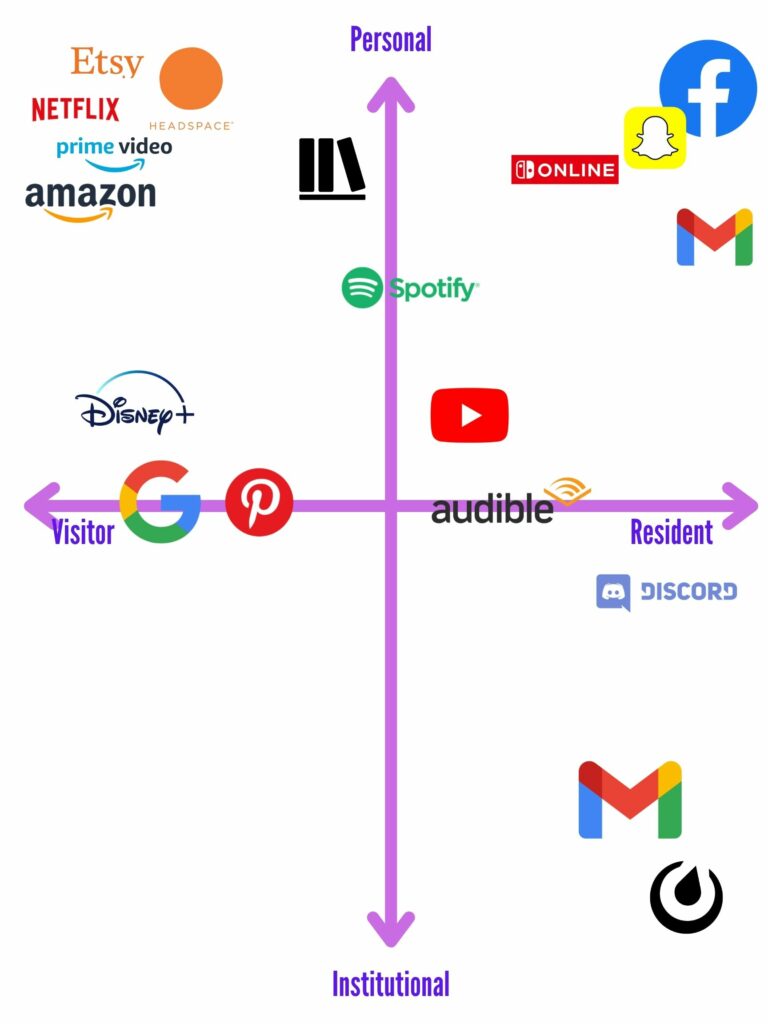
In the event that an employer was to examine my V+R map, I don’t think I would be too concerned with what they saw. There are certainly some areas of my online presence that I wouldn’t necessarily want to show to potential employers but my easily accessible online presence is both pretty “locked down” so to speak, and also relatively appropriate for work. My social media pages are private, and even after gaining access to them, all the content is innocuous. This is partly because of the work I’ve done throughout my life, which often blurs the lines between coworkers and friends pretty heavily. Partly due to this, and partly due to my tendency to delete or private old content that I posted when I was younger my social media and general online presence is very appropriate for work. An employer would certainly be able to tell some things about me from my V+R map, my age for one. I’m old enough that people seem to disagree whether I am a millennial or a generation z, and I think my social media use is somewhat of a clue for that. Although irregularly, I still use Facebook which something younger than I am more or less don’t do. I don’t use TikTok, though I know a wide variety of people do including those both older and younger than me. Also interesting is that there are several services I use that are meant for more social aspects that I don’t use for that, but instead for more personal use.
]]>Despite all the positives surrounding the communication aspects, we still know very little of what drives an individual to so actively participate in social networking the way we see today. It is common for the motivation to be professional, as networking is both convenient and wide-reaching on the internet. However, aside from professional uses, there is a great deal of discussion coming forward about the addictive aspects of many social networking sites. Many social networking sites are designed specifically to keep the user coming back and staying, whether it is good for their health or not. There is also the matter of individuals frequently having both a professional and personal online presence. While professional presences are often very curated, personal ones are usually more “free form”. This is fine until the two identities converge or intersect, and depending on the content in the personal sphere it may cause issues in one’s professional life.
With any public activity, one could argue there is a degree of risk, however, the risks associated with maintaining an online presence are frequently undervalued. This is primarily due to the permanence of the internet. While you may make some poor choices in “real life”, it is much less likely for those choices to resurface in 10 years than it is for them to resurface on the internet.
There is also the matter of an online presence being much further reaching than a physical one. This can be really beneficial, as discussed earlier with finding those who share your interests or even being more informed on global matters. However, one also has to consider privacy. That online presence that can easily make you knew friends, can also put your personal information into the hands of those who will use it for ill. An easy comparative frame of reference for a regular person having an internet presence and a “physical” social presence is the difference between introducing yourself at a small house party and standing up on a stage at a huge concert. They may be doing and saying the same information, you have much less of an idea of who hears it and what they may do with that information. While I personally have very little, if any, professional presence in the social networks I use I can still draw the comparison between more “free form” personal use and that which is a bit more curated. I first began using Facebook when I was 13, only four years after it became available for public use. As a result, a lot of the older content that I posted is, well, that which one would expect a 13-year-old to post. This isn’t necessarily bad, but it certainly is not what I would post now. A more current social network I use is Instagram, which I got in 2015. I have always been very particular about what I post there, mostly due to the visual aesthetic and as a result, it is very curated.
References
- Boyd, Danah. “Networked Privacy”. Surveillance & Society, vol 10, no. 3/4, 2012, pp. 348-350. Queen’s University Library, doi:10.24908/ss.v10i3/4.4529.
- “Eric Stoller – What Is Digital Identity?”. Youtube.Com, 2021, https://www.youtube.com/watch?v=u0RryRbJza0.
- Rajagopal, Kamakshi et al. “Understanding Personal Learning Networks: Their Structure, Content And The Networking Skills Needed To Optimally Use Them”. First Monday, vol 17, no. 1, 2012. University Of Illinois Libraries, doi:10.5210/fm.v17i1.3559.
- “What Is A Personal Learning Network (PLN)?”. Futurelearn, 2021, https://www.futurelearn.com/info/courses/learning-network-age/0/steps/24644.
My first thought after looking at Pod 8’s Interactive learning resource is how wonderful and professional it appeared! Everything is very well presented, cohesive and aesthetically pleasing without the graphics or visuals overwhelming the viewer too much. The table of contents is a nice touch many often forget, and is incredibly useful especially when working with as many slides as in this particular resource. I cannot begin to imagine the care and consideration that went into just this aspect alone, it is clear Pod 8 put significant thought into all aspects of their learning resource.
I am normally against having a significant amount of text on a slide show like this resource displays, primarily because there are several studies that suggest that the human brain doesn’t do a very good job of absorbing information in that way. However, this is greatly mitigated by their decision to include audio recordings of all the text. This choice was made in order to aid ELL and dyslexic students to fully participate in the course. The touch was nice, as well as the other considerations such as speaker notes underneath each slide.
There was an element of this that confused me a bit, the audio recordings on each slide in addition to some other aspects made it difficult for me to discern which parts of the resource were meant for the educator and which for the student. I understand this is partly because of the requirements for this particular assignment, as there is some information you might not normally include in a resource such as this outside of the course. None the less it seemed to me to switch very quickly from one to the other leaving me occasionally feeling a bit lost about the actual target audience. It could perhaps be made a bit clearer with colours differentiating for teacher vs for student, or possibly slightly different organization?
Overall, however, the ideas on mindfulness and brain breaks are well organized and presented. I can see this being an incredible resource not only for teachers but also anyone who finds themselves working with groups of children. The additional outside resources such as videos and colouring sheets were a nice addition, and make this a very comprehensive tool for anyone who might have had the good fortune of coming across it. Great job Pod 8!!
Resource: https://docs.google.com/presentation/d/12DPkkY5v8EpEdW8iixby0AH5whE48rVKBIewVZyTVQA/edit#slide=id.gbb3ccd7b2a_0_0
]]>This video is one in which the students follow along as the video demonstrates by music and visuals how to do this specific dance. In this case, the dance is the cha-cha slide accompanied as it always is by the song cha-cha slide. However, the video itself doesn’t prompt this interaction directly except perhaps a few subtle visual cues that may indicate that the purpose is to follow around. However, I think unless it was presented as something to follow along too many children would not pick on a cue such as pointing to his feet when he stomps as an instructional demonstration of sorts.
I think the ways students might respond is extremely dependant on the situation and location they find themselves in, even unprompted in a gym class or open space where they are standing some may dance along. However, in a seated classroom it seems more likely that many students would likely simply watch the video and make no move to copy what they are observing. In order to truly get all the students involved, I believe some introduction or prefacing would be necessary.
If used in a learning environment, I would encourage the students to follow along. Depending on the age group and their skill level, possibly do it several times to allow everyone to begin to feel more comfortable. Besides a video screen, everyone would only need themselves and some physical space to effectively participate. It could be an excellent transition activity, allowing students to warm up and gain a greater sense of physical literacy before breaking into groups to create their own dance.
If I was to recommend some changes to the video itself, I believe some more direct prompting to follow along would be a positive addition. Perhaps a visual or audio prompt at the beginning to “get up and try it for yourself” could be a good addition. While many of the visual effects make the video more fun and engaging and even more accessible, they at times go a bit overboard and distract from the actual dancing. Some simplification or removal of some of these effects would be helpful, and still maintain the enjoyable and dynamic style of the video!
]]>Our interactive learning resource explores a bit of this topic, discussing how a dance unit may be designed and adapted to accommodate ELL students. Dance instruction doesn’t necessarily require spoken words, making it an excellent choice for students still in the process of grasping a new language. Additionally, our first lesson contains an option for students to share their favourite music which could allow ELL students to share music in their native language and share it with their peers. Similarly, this unit could be adapted to suite hearing impaired students by adapting some of our lessons to rely on visual cues as opposed to verbal. If possible, music with enough base can provide deaf students with a similar connection to music as their hearing counterparts.
Students with physical disabilities can be adapted for as well, whether that is teaching dances using more isolated areas of movements (such as many popular TikTok dances that use primarily arm movements) or adjusting further to allow for more rhythm-based participation. A great deal of our interactive learning resource is dependent on what the students choose to do with themselves, such as creating their own dances. This allows all students to adjust to their comfort and abilities while still having a fun and impactful learning experience, no matter their knowledge, ability or experience.
]]>A fundamental aspect of Cooperative learning is the goal of creating “structured positive independence” (Gillies, p. 41). An ideal cooperative learning environment gives students the opportunity to learn as a group, as well as the knowledge and constraints that this learning is only possible using their whole group. When utilized properly, it has been shown to be hugely beneficial “cooperation was more effective than interpersonal competition and individualistic efforts; cooperation with intergroup competition was also superior to interpersonal competition and individualistic efforts” (Gillies, p. 39) Additional to these academic benefits, there is frequently a social benefit especially with younger students for whom socialization and peer interaction is arguably just as important a lesson as the classroom content itself. While groups are the base of cooperative learning, many approaches exist that work off this base.
A popular approach to cooperative learning is the “think, pair and share”, in which students consider a question or problem on their own and then when prompted turn to another and work on it with each other, finally, pairs share their conclusions with the larger group. Another common system is the Jigsaw approach, which has several different subsets but relies on groups being deemed “experts” in one area or subject. Students move to other groups to learn about something their group is not the “expert” on before returning to their original group, or sometimes the class, to share their new knowledge.
At its very core, cooperative learning is essential to dance. There is virtually no dance that does not require at least some aspect of group work, whether that be with a partner or simply being aware of those around you during line dancing for example. In some ways, the more common methods of executing cooperative learning do not work as well in the context of dance physical education as others. “Think, pair and share” and “jigsaw” are excellent in some cases, but may be more difficult to execute in this setting. However, cooperative learning should still be worked in a physical education setting. In a dance unit, for example, groups can choreograph their own dances and present them. Alternatively, they could create or learn new dance steps/moves and similar to a Jigsaw approach share them with other groups or the class. Zach & Cohen suggest another method, working more off a “micro-teaching” approach but doing so in smaller groups in order to encourage learning of core skills as well as social interaction on that smaller scale (Zach & Cohen, p.95)
Bibliography
Gillies, Robyn M. “Cooperative Learning: Review of Research and Practice .” Australian Journal of Teacher Education, vol. 41, no. 3, 2016.
Johnson, David W., and Roger T. Johnson. “An Educational Psychology Success Story: Social Interdependence Theory and Cooperative Learning.” Educational Researcher, vol. 38, no. 5, 2009, pp. 365–379. JSTOR, www.jstor.org/stable/20532563. Accessed 4 June 2021
Zach, Sima, and Rona Cohen. “Using the Cooperative Learning Model in Physical Education Teacher Education: From Theory to Practice.” Cooperative Learning in Physical Education, 2012, pp. 88–99.
]]>There are many reasons why this course was such a positive experience, beginning with its location. Having the course take place where we worked was ideal, though it may not have been had my workplace been different. As a residential summer camp, all the staff who were taking the course ate and slept on property during the two days in which it took place. This allowed for a lot more flexibility in scheduling, as travel time wasn’t really a concern at any point there was more time for hands on practice. Additionally, in this situation we had a huge amount of outdoor space so the instructor was able to vary our learning environments to better represent real world scenarios.
These scenarios were integral to my learning experience. First Aid is a hands-on skill, and the number of opportunities I had to practice it were so essential to my comfort in my abilities. It was also in part the people that I took this course with that made it a positive experience. Fist aid frequently requires you to get very close to the people you are doing it with. Many of my coworkers were people I knew well, I found that I was better able to focus on my skills as opposed to any awkwardness of getting into a stranger’s personal space. The instructor worked with our experiences and practices as a staff, and adjusted the course to best fit the environment in which we would be using our skills.
Similar to a constructivist method, she approached our learning in a way that acknowledged what we already did and knew as well as creating situations and learning experiences that pushed us to practice what we’ve learned. While she adjusted her expectations to include that a first aid emergency in the camp environment would be responded to by calling our medic, and the fire department would arrive within 5 minutes she worked to create (sometimes ridiculous) scenarios in which those supports wouldn’t be immediately available. Finally, it was fun. Sling tying relay races, ridiculously unfeasible emergencies and a generally positive supportive learning environment. I hope I can have another experience as memorable and impactful as this once in the future!
]]>My name is Lia, and this will be my second to last semester of my undergraduate degree. I’m a French major, and will hopefully be returning to UVic in the fall of 2022 for the post-degree practicum program offered by the education department. I’d like to pursue a career as an immersion teacher, preferably with elementary-aged children as I already work with them daily.
I like hiking, yoga and participating in community theatre (when they’re open again!) Looking forward to a busy semester with you all!
]]>