A great Masters of Privacy interview of Alan Chapell by Sergio Maldonado. While the focus is on universal opt-out of tracking (e.g. with Global Privacy Control), the dialog provides a great overview of developments in regulation, business, and practice. MyTerms also gets some flowers from Sergio.
Because depending on Big AI for privacy won't work
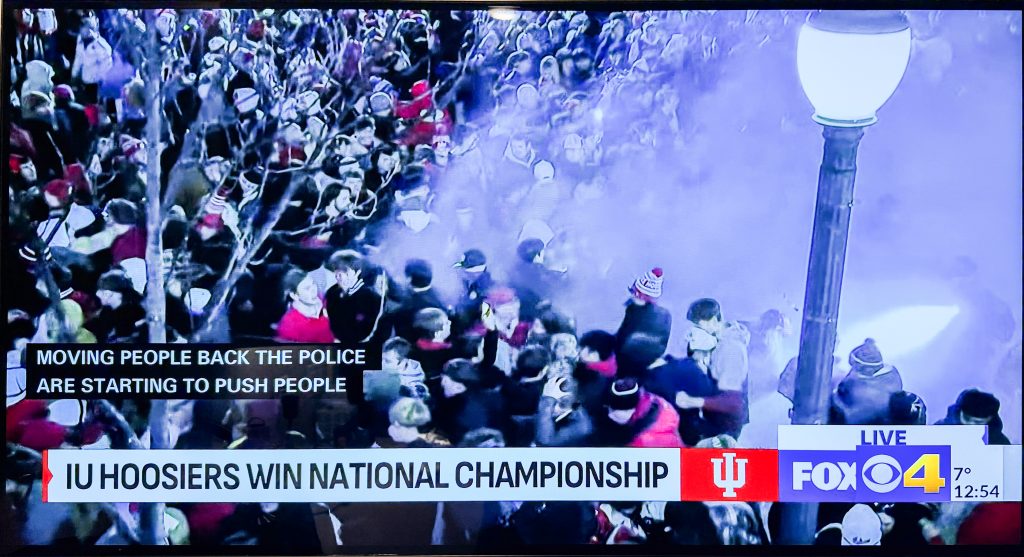
You can read about it everywhere. Probably hard to escape, because it’s the best story in sports right now: how the team that had lost a record number of games went undefeated this season, going 16-0, a feat not achieved since Yale did it sometime in the 19th century.
I’m new to the possessive first-person pronouns here, having arrived only five years ago. I’ve been hanging out with people who have been Hoosier natives and fans for generations. To call this victory gratifying and uplifting for them is the height of understatement. This is a deeply personal moment. I’m less invested and just glad the Hoosiers won.
However, while correlation is not causation, I would like to point out that success seems to follow me. During my two decades in North Carolina, NC State and UNC became big basketball winners. Duke came later, after I became a devoted fan living in California. Before that, Duke was squat.
When I came to the Bay Area in the mid-’80s, the 49ers became something of a dynasty. The Giants and the Athletics were such hot shit that they played each other in the ’87 World Series, causing the Loma Prieta earthquake.
After we moved to Boston in ’07, the Patriots went undefeated*, the Red Sox won the World Series, and the Celtics won the NBA championship. And the winnings persisted.
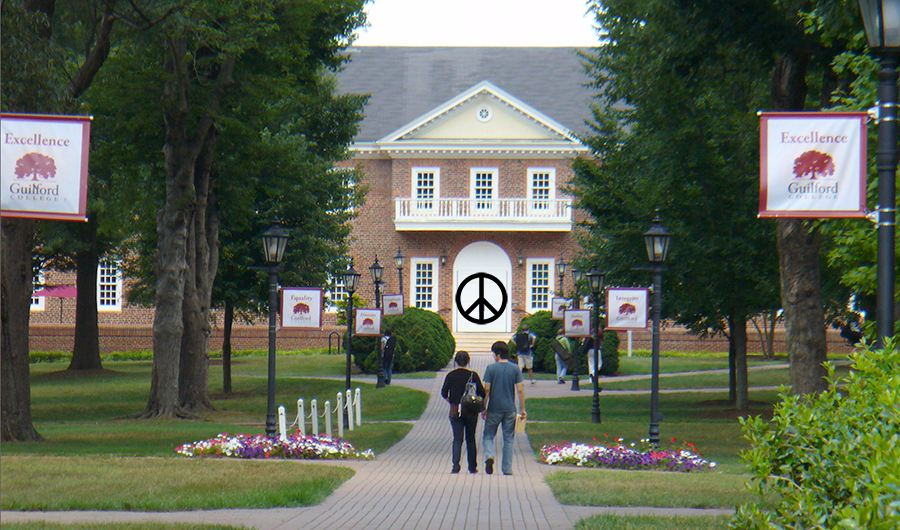
My alma mater. I remember civil rights demonstrations on that walkway in front of Founders Hall.
And here we are.
I was completing my junior year at Guilford College in Greensboro, North Carolina, when Martin Luther King Jr. was assassinated. At that time, Greensboro was one of the main targets of the civil rights cause, and the site of much unrest. I was among those who marched and demonstrated. The antiwar movement was at high ebb at that time as well, because the Vietnam War was massively failing, and dozens of thousands of young male boomers were being drafted to die in it. Me included.
I remember saying, when we heard MLK was gone, that this would end the civil rights movement and delay its fulfillment for fifty years. I was right about the former (see that last link) and wrong about the latter. Fifty-eight years have passed, and the long road istill stretches ahead of us.
Back then I also had hope that nonviolence would at least persist as a value and a strategy for fighting war and injustice. I was wrong about that, too. Nonviolence didn’t die with Doctor King, but it lost its exemplar. None of his stature and weight have shown up since.
Joan Westenberg:The Discourse is a Distributed Denial-of-Service Attack. Just one worthy pullquote: “The problem is structural. The total volume of things-you-should-have-an-opinion-about has exceeded our cognitive bandwidth so thoroughly that having careful opinions about anything has become damned-near impossible. Your attention is a finite resource being strip-mined by an infinite army of takes.”
Hope Spring trains eternal
Bummed to see the Mets tradeJeff McNeil to the A’s. At least he’s back home in California. But this move by the Mets looks like a good one.
Unrelated, sort of: After watching Brett Butler play for the Durham Bulls, I followed his major league career for all nineteen (!!) of his seasons as a leadoff hitter. Fun guy to watch.
Two pieces of interesting info from this clip on Reddit: 1) Don’t have any plane, much less another gigantic A380, take off into the wake another one like it. 2) LA Flights is an online YouTube channel doing live reporting of aircraft landing and taking off at LAX.
I’ve been young a long time. My chronometer says 78.4685 years, which is long for a human but short for a rock. I know a lot of rocks. It helps to have perspective.
I still work. A lot. I’ve outgrown getting paid, though my work is still valuable. (Or so I believe.)
But it’s hard to open jars now. Also to climb trees, but that’s an expired skill. Opening jars is not.
Oddly for an ordinary dude, I took pride for most of my life in my skill at opening jars. All one needs, I taught myself, is enough grip in each hand to lock onto the jar and lid, then using one’s fixed wrists and forearms like long-handled wrenches. Does the job.
I once mistook the old-fashioned crown cap of a beer bottle for a more modern twist-off one, and got the cap to turn in circles while perforating the web of my hand next to my thumb. Now, even for twist-off caps, I need a channel-lock pliers (recommended). My hands won’t do it.
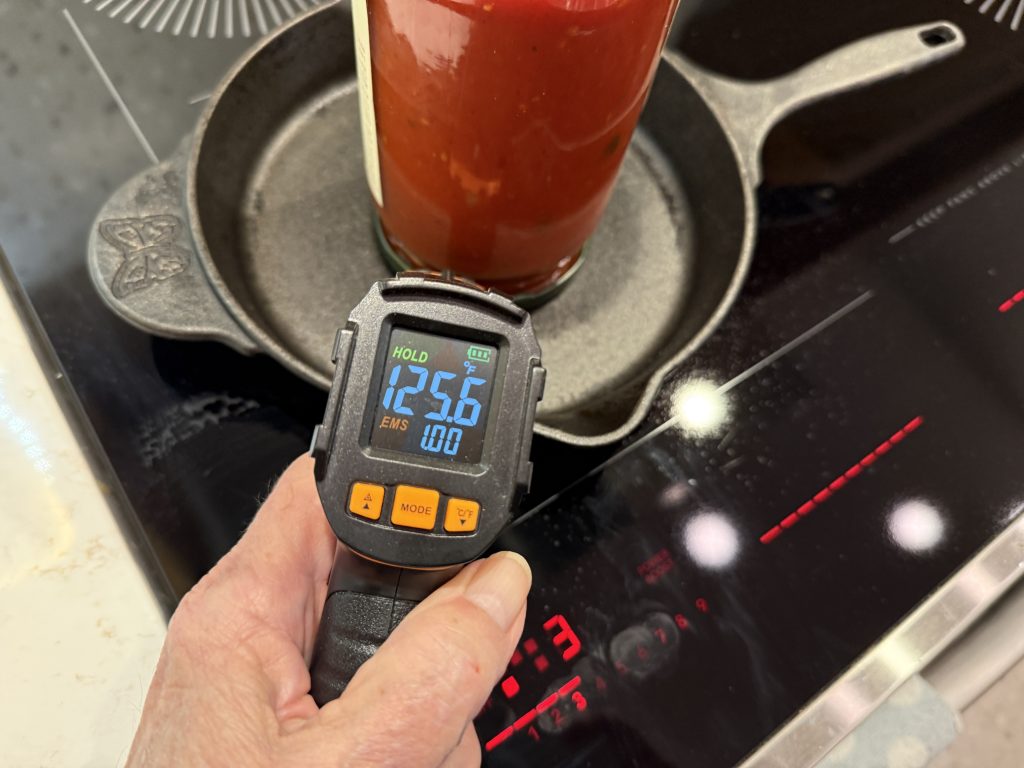
So here’s how I loosen the metal lid of pasta sauce jar, especially when the running-hot-water-over-the-lid method fails:
Put a small metal pan on low heat.
Wait until the surface gets to about 130°, then turn it to simmer, or the lowest possible value, so it holds that temperature. To check, use an infrared thermometer laser gun-like gizmo. They’re cheap online: less than $20, tariffs withstanding.
Stand the jar, lid down, on the pan, while watching the temperature adjacent to it. Don’t let it get above 150° or so.
Allow enough time for the lid to heat up a bit.
Take it off, and use your thermo gun to make sure it’s cool enough to grab.
Now you can twist off the lid.
Works every time for me, and I am now certifiably weak. (But not too weak to type this.)
Bought a used Kodak 4200 Carousel projector for pocket change at a garage sale a few months back, so I could go through my large cache of slide photos shot between 1950 and 1972. Turns out the bulb was dead, so I bought a new one for $19.73 on (of course) Amazon. I could have bought a comparable one from Walmart for a lot less, but I would have had to pay for shipping too, which made the cost difference small. I pay for shipping with Amazon as well, of course, because $$$Prime. Every now and then I want to go through the math to see whether paying for Prime is worth it. But my time has value too, so I don’t. And I’m used to Amazon. Color me normal.
Mark Hurst in The upside of child sacrifice: “It appears, increasingly, that a primary goal of our interconnected digital system is to sacrifice as many children as possible, as fast as possible, with as little friction as possible.”
Ethical Marketing News says the number is $1.19 trillion, 71.6% of which is “algorithm-driven.” Of that $1.19 trillion, “Alphabet, Amazon and Meta take a combined market share of 56.1% excluding China this year – equivalent to $556.6bn – rising to 58.0% in 2026.”
Of course, we know when we are on any of those three companies’ platforms, or use any of their products, we are being spied on. But we may not know that nearly every website with a cookie notice is in the same business, and personal data about you is harvested there as well, regardless of what you click on in the subset of cookie notices that give you a way to opt out of tracking. See here and here.
As it says, “Advertising corrupts, and digital advertising corrupts absolutely.”
The big dog is eating the new dog’s lunch
The two AI chat systems I use most are ChatGPT and Gemini. The results from both are about even. Both are good and getting better. Both keep a history, which is essential for me, because I often need to revisit and search old Q’s and A’s.
The main differences are rates of improvement in speed, quality, and service offerings. Gemini is much faster in getting me answers (it seems ChatGPT is purposely slow). Gemini’s rate of answer improvement is increasing faster. And ChatGPT’s desktop and mobile apps remember all my history. Not the case (far as I can tell) with Gemini. Not yet.
Alphabet was clearly on the path to providing useful AI services for everybody when ChatGPT suddenly jumped in front of it, and a pack of other AI dogs, in 2022. And in some ways, ChatGPT still has the edge. That’s why I pay for ChatGPT and not the others. But there are trends to weigh here, and resources to consider. Some numbers from Gemini:
“Microsoft’s CEO admitted GPUs are sitting in warehouses unplugged.
Not demand. Not defects. Power.
Transformer lead times: 4 years
Grid interconnection queues: 8 years
NVIDIA backlog assumes: 18 months…
$4.5 trillion valuation depends on infrastructure that does not exist.
The chips are ready. The grid is not.”
Logisms
I like “everwhat” and “everwhen.” Just wanted to say that.
Still trying
“Life is a casino with no house, so go ahead and influence your own bets. The future is a black swan hatchery that will produce colors other than black and white. Every species is a mistake that works. Best to make new ones.” —The Intention Economy
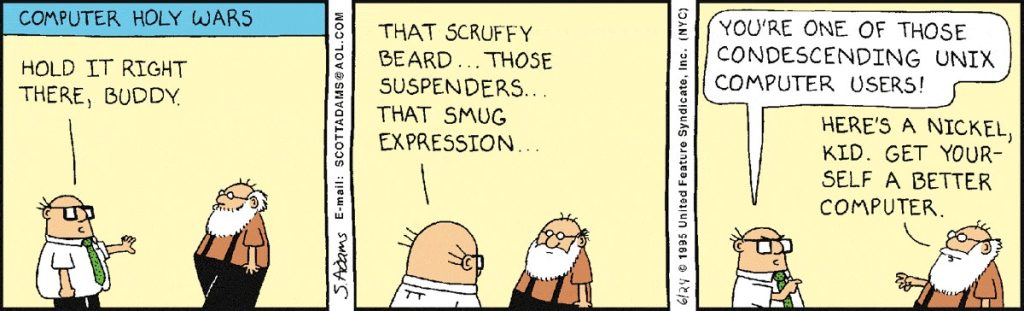
Scott Adams’ brilliant take on old skool Unix geeks. For a long time I thought the bearded dude was my old boss Phil Hughes (who gave us Linux Journal), but am convinced now it was Jon Maddog Hall.
Remembering Scott Adams
Scott Adams understood business, and especially its innate absurdities, better than anyone else in the world. That’s why his Dilbert comic strips were so right-on and popular. He also correctly predicted the results of the 2016 election (as did I), but I think he was off-base on why. I think he was also wrong about a lot of other stuff, which was why I stopped paying attention to him (although I did read and enjoy his book Win Bigly, even though I disagreed with some of that too). From what I’m now reading about his health, the last year or more of his life was almost pure misery. His passing today, while in some ways a blessing (he had earlier talked of taking suicide drugs), is a huge loss. He was a one-of-one, and there will never be another.
Divide and —?
Axios: “The nation is splitting into three distinct economic realities: the Have-Nots (stalling) … the Haves (coasting) … and the Have-Lots (rocketing to greater wealth)…This shift, if it holds, will rattle economics, politics and AI throughout 2026 and beyond. We’re already seeing it in rising inequality, pessimism about the future and AI opposition.”
So mark me down as doubtful.
Facebook invites me “to start making money with our new content monetization program.” Guess that means their AI hadn’t been trained on the large corpus of things I’ve written about creepy adtech and why it needs to die.
Mortal words
Thousands of years ago, in the late ’80s, President George H. W. Bush was a guest on Rush Limbaugh’s talk show. After a caller criticized Bush and his policies at great length, Bush didn’t defend anything. He just said, “Guess I’ll mark you down as doubtful, fella,” and moved on to the next call. Hence the subhead for the item above.
We’ve had privacy tech in the natural world for millennia. Can we bring it to our new digital world?
In What destroyed ‘the right to be let alone’, Tiffany Jenkins in the Washington Post argues that demolition of personal privacy began in the postwar years and became normative in 1973. That was when PBS ran An American Family: a cinéma verité exposure of the Loud family in Santa Barbara, and the inaugural example of what came later to be called Reality TV.
And now we live in a digital world where, as she says,
Intimacy floods the public realm while light shines on the private. Instead, we have embraced a narrow, impoverished conception of privacy, always a protean concept, not as protection from authority and public scrutiny, and as a sanctuary for the inner self and a shelter for intimacy — but merely as data protection.
Through it all, we blame the convenient scapegoat of the moment: the internet. But this gets the timeline wrong. By the time social media arrived, we were already living in a post-private world. The digital revolution simply gave us more efficient tools to do what we were already doing: performing our identities, seeking validation through revelation, and treating intimacy as a public commodity.
She concludes,
All the digital detoxing and platform regulation in the world won’t restore what was lost long before the internet was ever invented. Far better, then, to face up to how we voluntarily dismantled the very idea that some things should remain hidden, that mystery and restraint might be virtues, and that not everything must be shared.
The business models of technology giants like Google and Facebook clearly violate people’s privacy, as does state surveillance. But we would be kidding ourselves if we thought that technology alone has undermined the moral status of privacy and private life. The cameras that Lance Loud invited into his hospice room were not smartphones or CCTV cameras. They were the logical expression of a cultural revolution that began decades earlier. We invited them in.
Can we reverse that history, now that we live in a digital world as well as the natural one?
One might think not. After all, in this new world we have mass surveillance by governments and the adetch fecosystem, in addition to the strange new fact that everyone with a phone can record anything anywhere and share it with everyone else.
But the digital world is still new—decades old at most—while the natural world has been with us for as long as we’ve been a species. We have also had the privacy tech called clothing and shelter since not long after we started walking upright. For just as long we’ve had ways—both obvious and subtle—to signal our privacy preferences to each other. We don’t have any of that yet in the digital world.
No reason not to start, despite the enormities of Google, Meta, the adtech fecosystem, and the inadequacies of privacy regulations that are at constant odds with the sad fact that spying on people pays well. It’s still early, folks!
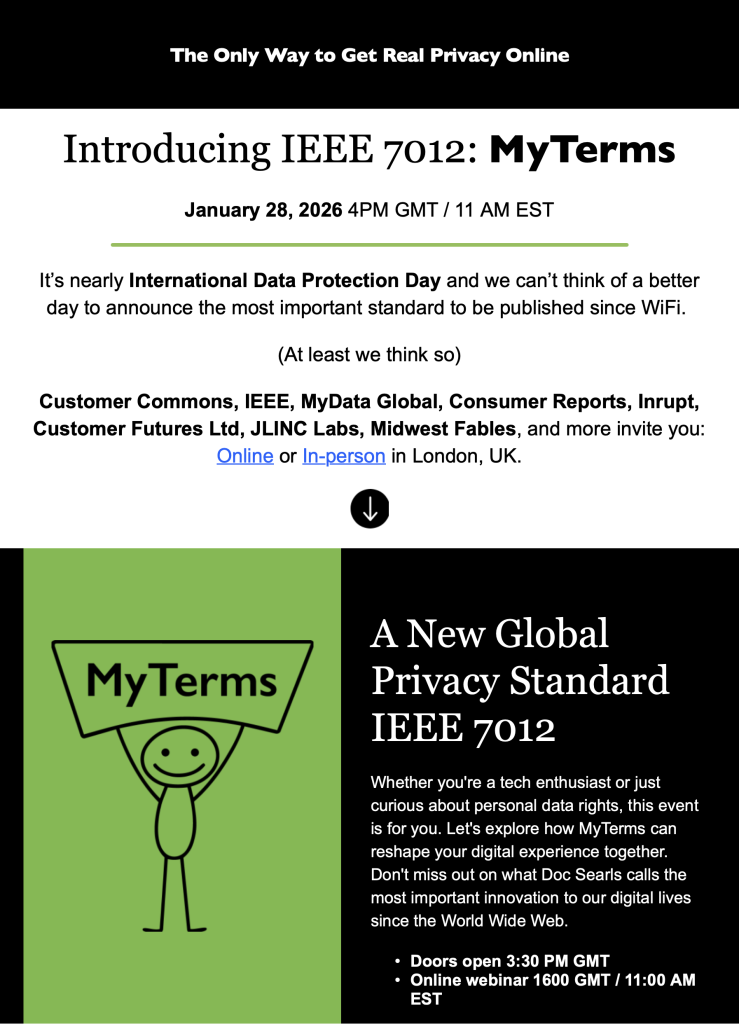
To get us started, a bunch of us, with help from the IEEE, have come up with a new standard for signaling and securing our privacy online, and framing up business models and incentives that pay better than spying on people. It’s called IEEE P7012, nicknamed MyTerms.
MyTerms makes “the right to be let alone” a contract and not just a promise. It obsolesces consent by cookie notice and replaces it with a choice of privacy agreements that you proffer as the first party, and the website or service agrees to as the second party. This sets the stage for both parties to trust each other and develop mutually respectful relationships if they wish. Optionality is maximized, from “let alone” at one end to “trusting relationship” at the other.
MyTerms is due to be published later this month. I believe it is the most important and far-reaching standard of this millennium, and that it will deliver on the promise of full personal agency that the Net and the Web both promised us in the first place.
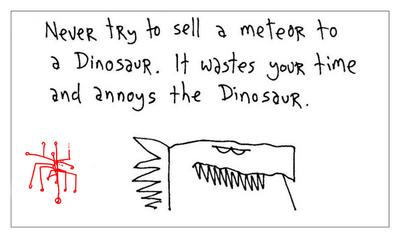
We don’t have to start by attacking the big and the bad. As Hugh McLeod put it long ago,
The rich target instead is the hundreds of millions of websites and services that don’t participate in the adtech fecosystem and would be glad to be among the first pioneers to civilize the Net and the Web—and to wear their choice to agree with people’s privacy requirements as a badge of honor:
Whole markets will follow as soon as they see MyTerms are good for business. Which will happen, simply because far more business can be built on trusting relationships in free and open markets than on trustless surveillance in captive and closed ones.
Now that we have the standard, all we need is the tech (some of which is in the works) and to spread the word. I’m doing that now, and so can you. Thanks!
Trying to watch the Patriots-Chargers game on NBC here. Logged in (we have NBC on Dish in our home system), but I just get the spinning spokes. Tried a different browser and that one is stuck in “Coverage will resume shortly.” Trying another browser… That one worked.
Fun epitaphs
I WAS ALMOST FINISHED
STEP TO THE LEFT PLEASE. THANK YOU.
THAT’S OKAY. I HAVE ANOTHER PLAN.
I NEVER DUG THIS
SORRY I’M ON MUTE
SHOULDN’T YOU BE SOMEWHERE?
THIS IS EARTH? NOT MARS?
WAIT FOR IT!
Bob Weir is gone. He and Jerry Garcia were (at least to me) the sonic and vocal backbone of the Grateful Dead. He was less than two months younger than me. Jerry was older, but dead at 53. Phil Lesh made it to 84, dying in October 2024. Bill Kreutzmann is still with us at 79. Ron “Pigpen” McKernan croaked at 27. Mickey Hart’s still cookin’ at 82.
I didn’t see much of The Sopranos, but I remember hearing The Doors’ “When the Music’s Over” during one of the late episodes. The line in the lyrics following the title one is “Turn out the lights,” foreshadowing the ending of the whole show. It’s my favorite track on my favorite Doors album. Two of the band members, John Densmore and Robby Krieger, are still with us at 81 and 80, the milestone our President (who shall remain nameless, because algorithms) will hit in June, and I’ll hit two Julys later, if I’m still here.
Which brings me to a fact that might seem a theory: that death is not a state. One does not exist when dead, though to say one is dead suggests that it’s a state. When we die, we are gone. Existence for us has ceased, except in the hearts and minds of others, and in whatever works we have left among the living.
If death is a state, then life is the exception to it. But if life is a state, death is its absence, and no more.
To say one is no more is also to say life is nothing but more.
More breathing, more heartbeats, more thoughts, more of what Whitman celebrated.
Most of Whitman’s body was interred in Camden, New Jersey, in a house-like vault. His brain was removed for study and then either spoiled, went splat, or both. Hard to know.
If you want me again look for me under your boot soles.
You will hardly know who I am or what I mean.
But I shall be good health to you nevertheless.
And filtre and fiber your blood.
Failing to fetch me at first keep encouraged.
Missing me one place search another
I stop some where waiting for you.
He isn’t dead, because nobody is. He is just inaccessible in living form.
But here he is. Same as Bob and Jerry and Jim and Ray.
The last thing David Hodskins emailed to me was “Don’t become a Hoosiers fan.”
It was David who made me a Duke Blue Devils Basketball fan. David was an Iron Duke—an alumnus who contributed to the program and bought season tickets. He made me a fan by bringing me often to fill the other of his two seats in Cameron Indoor Stadium. This was between 1977 and 1984. At the beginning of that stretch, Duke had been in a long slump following the Vic Bubas era and only got good near the end of the Bill Foster years, peaking in ’77-’78, when they had what the late great John Feinstein called Forever’s Team. While that team may have been the best in the country, it lost in the championship game to Kentucky when Goose Givens went nuts and scored a zillion points.
But the Duke Dynasty started much later. Mike Krzyzewski replaced Bill Foster in 1980, when Duke was good but not great. The greats of that time were, among others, Louisville, NC State, North Carolina, Georgetown, and—most hated of all—Indiana under Bob (then still Bobby) Knight. It’s easy to forget that Coach K’s early years were kinda blah. His teams didn’t make the final four until ’86, and his first (of five) championships didn’t come until ’91.
My point here is that I got into Duke basketball when they were far from the much-hated overdog they’ve been for close to four decades. That’s my excuse. Anyway, David Hodskins didn’t want me to become a Hoosiers fan.
But I’m a Hoosier. Indiana is where I work (as a visiting scholar at IU), and Bloomington is where I live. (Yes, I also live in Santa Barbara, but that only complicates things other than sports.) Bloomington is also where The Greatest Story in College Sports is happening right now, with Indiana Football.
One thing making this story the Greatest Ever (yes, perhaps, and we’ll see) is that it’s hard to overstate how lame Indiana Football has been. Not for years, or decades. For generations. For example, until this year (when Northwestern exceeded it), Indiana University held the record for the total number of losses in college football: 715.
It was at that number at the start of this season. And there it remains, because this year’s team is undefeated, #1 in the country, and about to play for the championship, against the Miami Hurricanes.
I won’t cite other stats, but will instead repeat what Hoosier lifers told me last night after a bunch of us watched our team drown the Oregon Ducks. (This was after doing the same a week before in the Rose Bowl to the Alabama Crimson Tide. The Hoosiers will probably do the same to Miami in the championship game a week from Monday.)
“We were the doormat of the Big 10,” they said.
Whether IU wins the championship or not, it’s hard not to be invested in the story. Because it’s happening now, and there has never been another story like it. The movie is being performed right now by real characters.
Consider this for a cast: the largest population of alumni in the country: 805,000. No wonder they filled the Rose and Fiesta bowls. Betcha most of the spectators in the stands at the championship game will also be Hoosiers, even though it will be played at the Miami Hurricanes’ home field: Hard Rock Stadium. Indiana’s (yes) perfect quarterback, Fernando Mendoza (who has had more touchdown passes than incompletions in recent games), grew up in the same Miami neighborhood, making the game local all around.
The inevitable movie about the Hoosiers’ football turnaround won’t be brilliant fiction, like Hoosiers (a truly great sports movie, written by Bloomington native Angelo Pizzo and directed by fellow Hoosier David Anspaugh). It will be a documentary. And I already have a title.
Just got a pile of these t-shirts for $16.99 each at Sam’s Club.
Team!
Teams change. They have to. Players get injured, age out, or stop fitting. Other players come and go for various reasons. The big one lately is salary caps. Oddly, a “good salary” underpays a valuable player. And the draft brings in rookies every year. Some work out, some don’t. Some only work out when they get replanted with another team.
But there are times when teams are teams, and just work. I think that’s the Knicks right now, even though they’ve lost five of their last six games. One does learn by losing as well as winning. I’m sure that’s happening now.
What I’m saying there is Don’t make any trades. Keep the team together. If you do, and everyone stays healthy, they’ll win the East, and maybe the championship as well.
Sports polygamies
I grew up in a town in New Jersey that is closer to Manhattan than much of Brooklyn and Queens. The city skyline combed the horizon east of my bedroom window. As a kid in the ’50s, my main teams were the Brooklyn Dodgers and the New York Knicks. When the Dodgers divorced Brooklyn and married Los Angeles—and the Giants did the same when they ran off with San Francisco—I was lost along with millions of other local National League (aka Anyone But the Yankees) fans until we were all adopted by the New York Mets. That happened in ’62, when I was 15. I loved those Mets immediately and still do.
But I also move around. In 1965, at age 18, I went to college in North Carolina, where I fell in love with college basketball. (My school, Guilford College, was at the top of the NAIA, and won the championship in ’74. Bob Kauffman was the big star during my first three years there.) I also started playing pickup and intramural basketball then, and fell in love with that too. (All I was good at was shooting if nobody defended me. I had no other skills and had the leaping ability of a parking lot. But shooting got me chosen other than last for pick-up games, and if I got the first shot in a game of HORSE, there was a fair chance that I’d win. Now old and arthritic, I shoot about 3% from out there. Or anywhere. (Caution: the best line ever uttered by New Jersey senator Cory Booker was in response to a question about his skills as a high school football player: “The older I get, the better I was.” Same goes for me and pickup basketball.)
When I went back to New Jersey for a stretch between 1969 and 1974, I fell in love with the New York Knicks. I had liked them before I went to North Carolina, but not the way I liked the Mets. But between the Mets’ World Series win in 1969, the National League Pennant in ’73, and the Knicks’ NBA championships in ’70 and ’73, I was in sports heaven.
But then I moved back to North Carolina, where I became fully invested in college basketball, which is almost a religion there. The family fave (I have many kin in NC) was, and remains, the Wake Forest Demon Deacons. But I couldn’t help digging all of ACC basketball, especially the North Carolina Tar Heels, because I lived mostly in and around Chapel Hill. Starting in the Fall of ’77, I started going to all the Duke games I talk about in my Whoosiers post, which made me a Duke fan.
Then, in 1985, I joined David Hodskins in Palo Alto, to set up our business there. College basketball in the Bay Area was small stuff at the time (still is, mostly), so we got season tickets to the Golden State Warriors, to which I stayed a loyal fan until I moved to Santa Barbara in 2001. During that time, I also enjoyed following the San Francisco Giants and 49ers, and the Oakland A’s (though not the Raiders). I never stopped loving the Nets and the Knicks, though I didn’t follow them closely.
Though the Southern California teams—Dodgers, Lakers, Angels, Clippers, Chargers—enjoyed some loyalty among locals in Santa Barbara, I had rooted against all of them too much over the years to develop any new loyalties. Though now I’m ready to dig the A’s, because my favorite Met, Jeff McNeil, was just traded there. Though I’ve never met Jeff, his mom is our bookkeeper in Santa Barbara, and I’ve followed his career a bit through her.
Anyway, in 2007, we moved to Boston, just in time for the Celtics, Red Sox, and Patriots all to have great seasons (the first two won championships in ’08, while the Pats were undefeated in the regular season, but lost in the Super Bowl, inviting the third-best second-best Onion headline of all time*). Our son was 10 years old when we arrived, and he and I got totally involved in the local sports scene. If you told me when I was growing up that I would become a fan of any Boston sports team, I’d have thought you nuts, but that’s what happened: I had an affair with all three teams. Still do, though I continue to love the Mets and the Knicks. (I was never crazy about the New York football Giants and Jets, though I did like them.)
I think my loyalties are kind of like those of a coach. You love the one you’re with. And when you’re away from all your sports loves (as I am now from New York, North Carolina, California, and New England), you kind of root for all of them in some ways.
But the blood runs deepest. I’m a son of New York, and will be until I’m gone.
Also, Gemini failed. I still don’t know who she was.
I think we could have powered two cities with the work Gemini just did, thinking slowly to help me identify the actress that my old pal Drew Youngs sings about in his video (and musical composition) Betty the Bloop. In an unrelated matter, somewhere I have still photos (remember those?) of the work Drew’s dad’s body shop did fixing the crushed rear end of my new 1985 Toyota Camry after it was crunched by a drunk driver on Alma at Chruchill that same year in Palo Alto. Best car I ever had, by the way.
Be in charge
Phil Windleywaxes wise on authorization. Here’s why this topic matters: In the future, the companies and organizations you deal with won’t do anything without your permission and guidance. (Thank MyTerms for getting that ball rolling.) You will need tools of your own rather than those entities’ internal systems, all of which (at least the way business works today) are captivity traps.
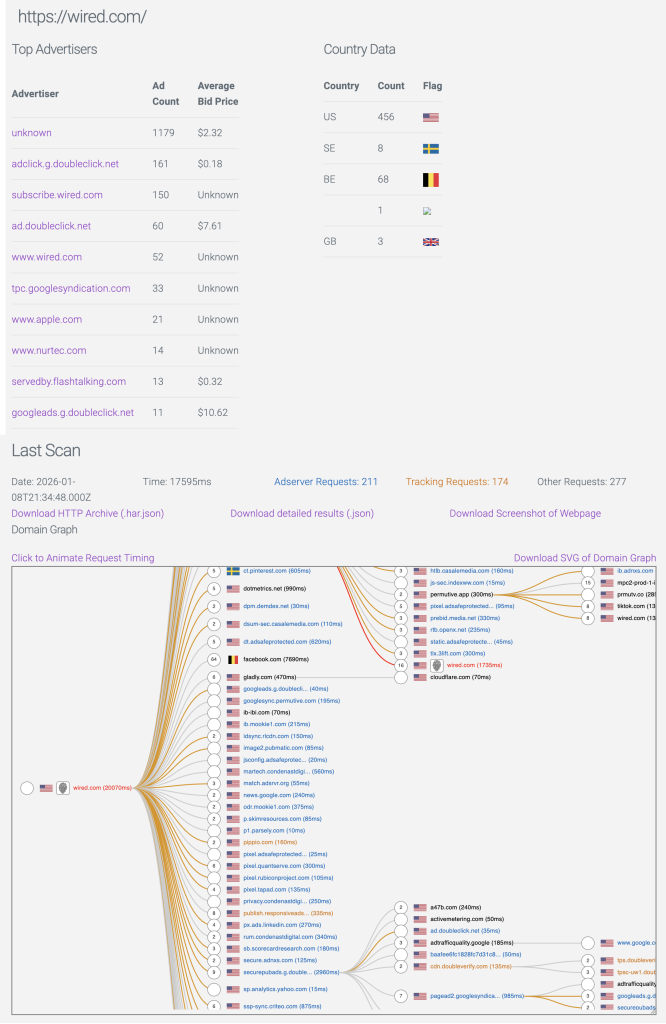
Well, not really. I just want to give you a good idea of what PageXray does, which is far more than show you that a typical website stuffs your browser with cookies.
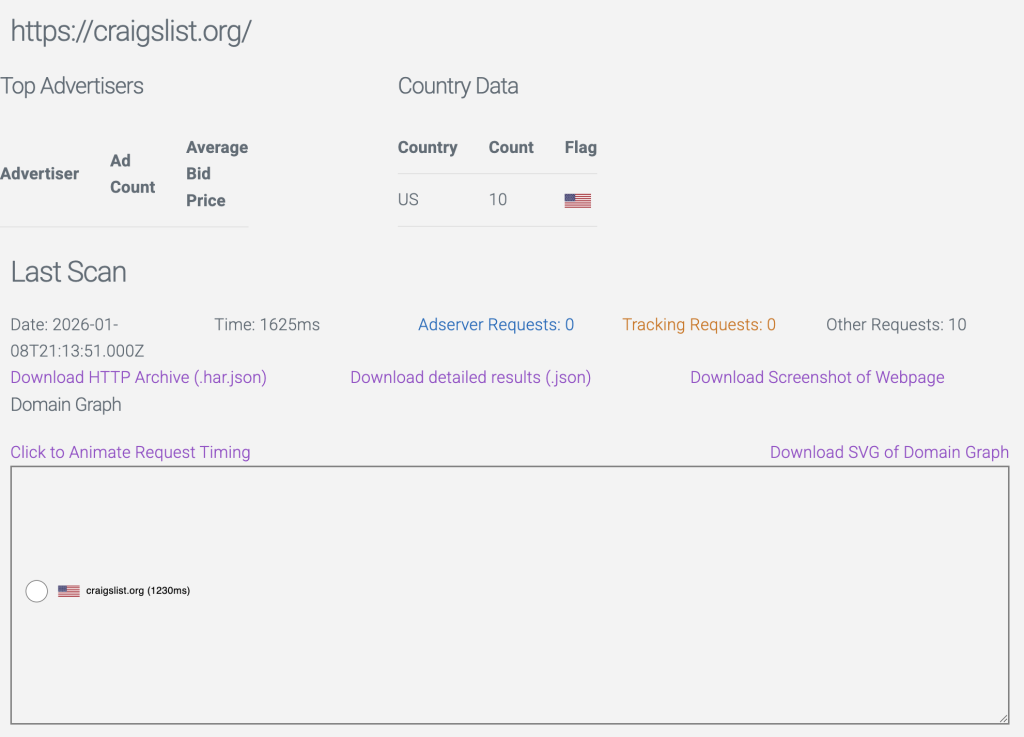
For example, a PageXray shows all the unseen places to which information about you flows, thanks to the surveillance those cookies enable:
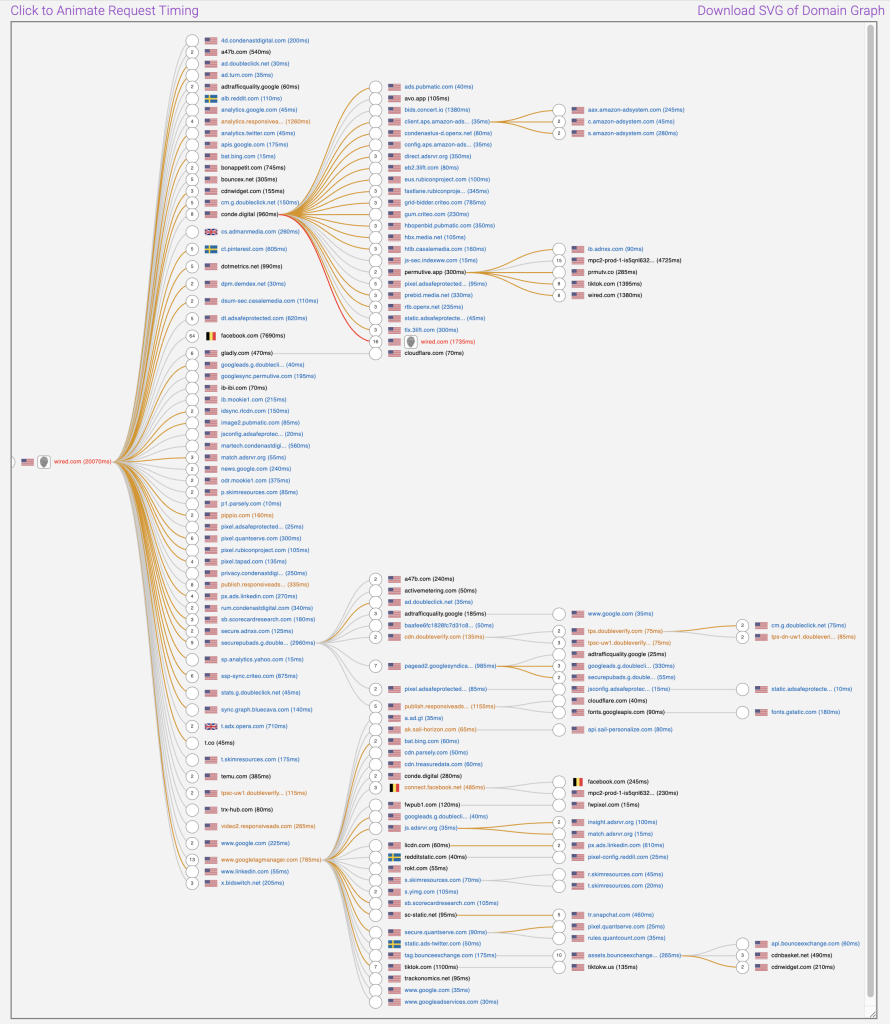
If you zoom out all the way on that graphic, you’ll get this:
What you see there is the explosion of paths down which data about you oozes out to almost countless places known and unknown.
Craigslist also doesn’t interrupt your experience with a cookie notice, because it doesn’t play the cookie game. And it’s been that way since Craig Newmark founded the service 31 years ago, on March 1, 1995, at the very dawn of the commercial Web.
But I’m not here to knock Wired, or Conde Nast, which runs the advertising show for all its publications. What they do is pro forma in what we might call Web 2.99.
But rather than jump to Web 3.0, how about a reset to version 1? For a sense of that, here’s an excerpt from the Wired piece:
The site is what Jessa Lingel, an associate professor of communication at the University of Pennsylvania, has called the “ungentrified” internet…
“It’s not a perfect platform by any means, but it does show that you can make a lot of money through an online endeavor that just treats users like they have some autonomy and grants everybody a degree of privacy,” says Lingel. A longtime Craigslist user, she began researching the site after wondering, “Why do all these web 2.0 companies insist that the only way for them to succeed and make money is off the back of user data? There must be other examples out there.”
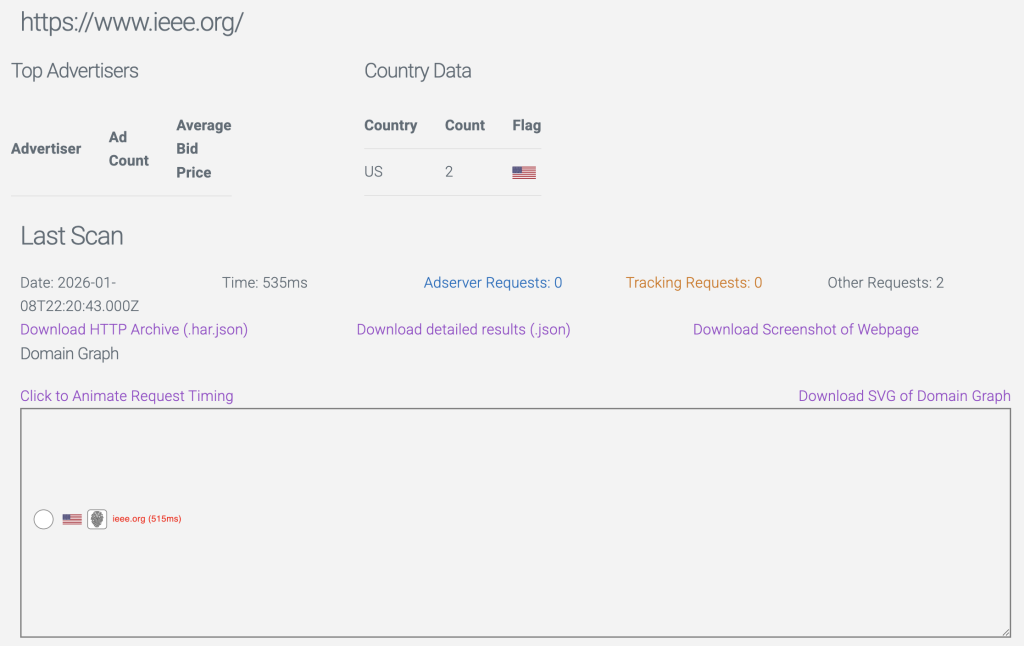
Examples, that is, of retro enterprises that don’t participate in the adtech fecosystem. Take the IEEE, which was born in 1963, long before Web Zero. Here’s the IEEE’sPageXray:
That’s especially cool, since the IEEE hosts the working group for P7012 – IEEE Draft Standard for Machine Readable Personal Privacy Terms, which I chair. That standard is now done, and will be published later this month. Its nickname is MyTerms (much as the nickname for IEEE 802.11 is WiFi).
MyTerms’ purpose is to deliver on the promise of full personal agency that we got from TCP/IP (the Internet) and HTTP (the Web), way back in 1.0 days, and lost in Web 2.0, when surveillance mania spread to the far reaches of human tolerance.
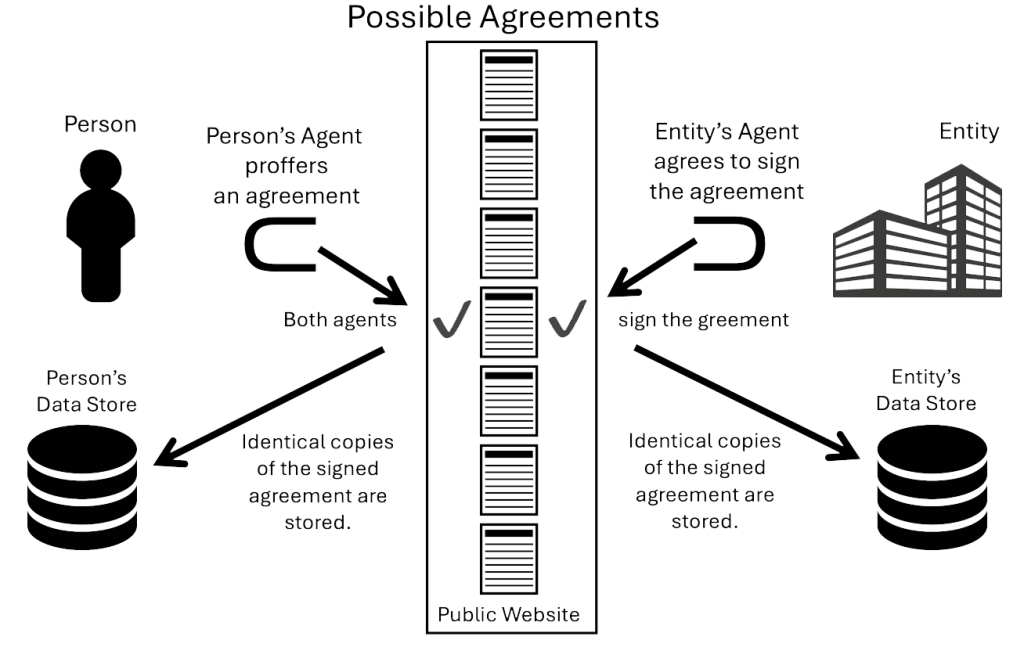
With MyTerms, privacy is a contract between you and the sites and services of the world. You’re the first party, and they’re the second party. You proffer one of a short roster of possible agreements listed publicly by a disinterested nonprofit. Both sides keep identical records of agreement. Here’s a diagram that unpacks it:
The purpose of this post is to challenge Craigslist, the IEEE, and other website and service operators whose hearts never left Web 1.0 to help us put MyTerms to work. (I just checked and see that DuckDuckGo and Mozilla also pass the PageXray test. So this is a challenge to them too.)
We don’t need much to get started: a browser plugin, a web server plugin, methods for recording identical agreement records on both sides, and other items listed in the last link.
For sites online where the terms people choose to proffer will be listed, we already have Customer Commons in the U.S. and MyTerms.info in Europe. The model for both is Creative Commons. Put simply, MyTerms will do for personal privacy what Creative Commons does for artistic licenses. We thank them for paving the way.
Fourteen years ago, agency had lost its original meaning, and was mostly applied to forms of business (real estate, advertising) and government bureaus (farm service, emergency management). That's why I devoted a chapter of The Intention Economy to what agency meant in the first place. Wrote about it again last year in Real Agency. Now the word is even hotter shit than it was then. The latest: Humanizing AI. Look at how many of its pieces here are about the first and best forms of real agency.
Overheard
"When somebody you're talking to about something important interrupts the flow by saying 'I just bronzed my dogs,' what can you say to get things back on track?"
A model for the future
What I first posted here is now a longer standalone post here.
When we first thought about this at ProjectVRM in the late ’00s, we saw a browser header that looked like this:
The ⊂ and the ⊃ are for the personal and website sides of potential or actual MyTerms agreements. Popdown menus next to both could detail choices or states. The upper example might show that no agreement yet exists between the person and KQED. The lower one shows that there is agreement, and might further show (in drop-down menus next to both symbols) if there is an additional state of relationship. So these two symbols and the menus under them might constitute or point to VRM + CRM dashboard.
Browser and web server plugins are easy to imagine and develop. Today there are:
~112,000 extensions for Chrome (see here and here)
Doubtless thousands for Safari (all come through the Apple Store, which is not a useful source for that one)
~60,000 WordPress and 5400 Code Canyon plugins (see here, here, and here)
~50,000 Drupal modules, including ~8,000–10,000 Drupal 10/11 compatible modules
Data storage and retrieval are harder. Here is what I have thus far. Please help me (or anyone) improve on it or replace it.
First, adtech “consent strings” described in IAB Europe’s Transparency & Consent Framework (TCF). These seem optimized to capture preferences, store them locally and broadcast them to vendors. They create a “TC String” and record storage/access details, but they are not designed as a mutually signed/identical contract record between the individual and the site, which MyTerms requires. They do, however, provide compact and interoperable encoding and widespread use of tooling. So they at least point in the right direction.
Second, consent receipt / consent record standards:
Kantara Consent Receipt frames a “receipt” as a record given to the individual, in standard JSON.
ISO/IEC TS 27560:2023 describes an interoperable information structure for consent records/receipts. This includes support for exchange between systems and giving the individual a record.
W3C DPV (Data Privacy Vocabulary) is cited in MyTerms (IEEE P7012) and is good for indicating privacy preferences and maintaining records. It also has guidance for implementing ISO 27560 using the DPV.
What we have in the world so far, however, is framed around consent to processing, not reciprocal agreement to contractual terms. We still need bitwise-identical records on both sides. That’s what MyTerms requires.
Third, we might want to create a model that looks like receipt + contersigned agreement artifact + lightweight state token.
For that combination, we might define a canonical MyTerms Agreement Record, or MAR. Note that this is something I just made up. So, rather than taking it with a grain (or a larger measure) of salt, help us by replacing or improving that label, and anything I’m saying here.
Some possible fields:
Agreement ID (UUID, for Universal Unique IDentifier)
Parties (site identity + individual agent identity/pseudonymous key) Important: MyTerms should not be dependent on a universal identity system. All that matters is that both parties have a record of agreement with each other. That means all they need to know is how to remember each other. That’s it.
Terms pointer(s): roster ID + exact version/hash (so “same terms” is provable)
Context: site origin, date/time, version of a given term agreed to
Decision: accept / refuse / counter-offer choice (Note that the MyTerms standard is not about negotiation. It’s about choice, and that one is provided by the individual as the first party. At the person’s discretion, they can provide the second party—a site or service—with a first and second choice of agreement, but no more than that.
Signatures: individual agent and site/agent countersigned signatures.
I think the MAR (or whatever we call it) might be canonicalJSON (or CBOR) so both sides can compute the same bytes, then sign the same digest, which I think will make identical records concrete. But I am sure there are other ways.
We can borrow structuring ideas from ISO 27560 / Kantara receipts (timestamps, identifiers, machine readability) while changing semantics from “consent to processing” to “contractual privacy terms” (which still address processing, which is what the GDPR cares most about).
Then, rather than store the MAR in a cookie, store a state token for performance/processing and UX. These can be “myterms_agreement_id,” or “myterms_agreement_hash,” or maybe a status flag, so the browser and the site server can quickly recall state, leaving an authoritative record in each side’s database and turning the likes of ⊂ and ⊃ into meaningful UI elements.
The MAR also needs to record refusals. These might be something like “decision=refuse” or “counter-offer-rejected.” (Note that ignoring a MyTerms signal is a refusal.)
We should also have additional annotations (e.g. reasons for refusal, if the counterparty gives any), and perhaps some kind of signature from the site certifying the refusal.
On the WordPress side, plugins can store MARs in a custom table with records indexed by “agreement_id,” origin, the other party’s pseudonymous key, “terms_hash,” timestamps”… plus “active agreements,” “export/audit trail,” refusals, and other variables, including endpoints for choosing and retrieving the agreement by ID for audits and disputes.
As for where records live, at least on the individual’s side, digital wallets make sense. There are many approaches to wallets today, including the Solid Project‘s pods. (More here.)
As for who productizes any of this, we have—
Browsers (either as a built-in feature or with a plugin)
Password managers (which already store structured secrets + metadata, and use both browser extensions and standalone apps)
“Identity / verifiable credential wallet” vendors (with which “countersigned agreement receipts,” which are forms of credentials)
Personal data store projects (e.g. Solid pods)
Browser, Web/CMP server, and plugin/extension/module makers
A thought: If we want compliance auditing to have teeth without a regulator in the loop, how about an “append-only transparency log” that is conceptually similar to certificate transparency. So “I agreed / you agreed disputes become easy, and refusal logs can be corroborated without revealing private details, how about—
Both sides submit the agreement hash (not the full agreement) to a public/neutral log. (Possibly a blockchain. I add that to attract developers who are fond of those.)
The log returns a proof.
I am sure experts in ODR (online dispute resolution), a well-developed field, will want to weigh in here.
That’s all I have for now. I’ll add more (and perhaps subtract some as well) as folks respond to what I have so far. Thanks.