


| CARVIEW |
The post <strong>2026, the year we shine</strong> appeared first on Deep Learning Indaba.
]]>This year marked a shift across the continent. We experienced a deepening sense of self-actualisation in African AI, ML, and Data Science. We are no longer waiting for inclusion. We are claiming space, setting agendas, and building tools that reflect our realities. Across the ecosystem, we saw new African models, datasets, strategic gatherings, and startups that signal a continent increasingly confident in its own direction. These milestones were not only technical, they were cultural.
Our communities insisted on shaping narratives, as seen in the representation at and around the Global AI Summit on Africa in April 2025. Our researchers stepped onto global stages with authority, and our young scholars worked with the assurance that African excellence in AI is not emerging, it has always been here. Data Science Africa marked its 10-year anniversary, the Deep Learning Indaba convened in Kigali, collaborating with policy makers, and countless initiatives across the continent continued to deepen capacity and imagination.
For the Deep Learning Indaba, this year offered its own moments of reflection and pride. The IndabaX chapters reached even more countries,nurturing a new generation of organisers. Our alumni continued to lead labs, fellowships, and startups at home and abroad. And, in a symbolic marker of our collective journey, the Indaba finally gained a full Wikipedia page. Yet we recognise, always, that the Indaba is just one thread in a much larger tapestry. The progress of African AI this year was driven by hundreds of organisations, university labs, open-source communities, civil society groups, research collectives, and volunteers. The ecosystem is thriving because so many people chose to push forward together, often quietly and without spotlight.
Across the continent, we saw AI woven into the everyday work of social impact practitioners, academic labs, policy thinkers, entrepreneurs, and educators. Grassroots communities expanded capacity; built bridges between research and public good; and carried forward the essential work of documenting languages, digitising cultural heritage, understanding climate impact, improving health systems through AI, and much more. Our growing presence in global conversations this year was not accidental, it was the result of patient community work, advocacy, and persistence over many years. Africa entered 2025 with greater clarity about what we want from AI, and how we intend to build it.
As we move into 2026 and beyond, the call before us is to pair our ambition with generosity and care. Generosity in how we share knowledge, mentorship, datasets, compute, and opportunities. Care in how we build technologies that centre dignity, fairness, and the well-being of our communities. We will make missteps; we will encounter failures and learning moments. Our responsibility is to learn, support one another, and continue to build. The road ahead will demand collaboration, patience, and a commitment to lifting others as we rise. If this year taught us anything, it is that African AI advances when we lead with purpose. and when we lead for one another. We will need to expand the resources available to researchers and developers locally, especially expanding investments from African funders. Let us enter the new year with gratitude for how far the ecosystem has come, and with a renewed resolve to keep expanding what is possible, together.
The post <strong>2026, the year we shine</strong> appeared first on Deep Learning Indaba.
]]>The post Building Africa’s AI Future Together appeared first on Deep Learning Indaba.
]]>What an incredible week we had in Kigali, Rwanda for the 7th annual Deep Learning Indaba that brought together 1000 of us from 43 African countries. I am still feeling inspired and amazed by the incredible energy of our community, and I’m so grateful to have had the chance to serve as one of this year’s General Chairs.
When I think back to what first drew me to AI, it was simple curiosity, a desire to understand how machines could “think” and help with everyday tasks, from a robot vacuum navigating an apartment to a rover exploring Mars. But what keeps me in this field goes far beyond curiosity: it’s the transformative potential of AI for Africa. Traveling across the continent, I’ve seen how similar our challenges are. We all seek the same fundamentals: better infrastructure, accountability, quality education, stable electricity and internet, stronger support for farmers, and more climate-resilient communities.
AI can help. Not as a magic fix–it won’t end corruption or repair broken systems–but as an important tool for greater transparency, better decision-making, and smarter planning. We generate vast amounts of data every day; with it, we can build chatbots and virtual assistants that answer questions about voting locations, eligibility, or procedures in local languages, empowering citizens to make informed choices and elect the right leaders. We can also build forecasting models to strengthen agriculture, healthcare, and climate resilience.
We’re already seeing this impact take shape across Africa through the Deep Learning Indaba (DLI). The DLI has made significant contributions to the African AI ecosystem. Through Ideathon, teams are turning local challenges into tangible AI-driven solutions–from Amathambo AI’s automated medical roster system that helps hospitals improve efficiency and staff satisfaction, to FarmA’s proposed idea to support rural farmers with agricultural knowledge. The Ideathon shows how innovation can emerge from collaboration.
Beyond that, the DLI’s research and publication tracks help early-career researchers refine their work through the DLI Mentorship Programme, published alongside peers, and gain visibility in global forums. This year’s DLI Community Hackathon invited AI communities across Africa to prototype ideas that address African realities such as AI for indigenous language inclusion. Across the IndabaX network, local organisers are amplifying this momentum, growing new communities, nurturing talent, and bringing the vision of a connected African AI ecosystem to life. The DLI Tutorials and Practicals team is developing foundational AI content to strengthen AI education across the continent, introducing cutting-edge tools and empowering African AI communities with the knowledge they need to tackle local challenges. The DLI Workshops bring together the local and international community to explore focused topics such as AI for businesses in Africa, quantum machine learning, and the computing resources required to build these models. It also creates space for vital socio-technical discussions on trust in AI, as well as the challenges and opportunities of developing and owning the data and technologies built by Africans.
Each of the DLI’s initiatives is fully led by Africans rooted within their community, whose dedication reminds us that lasting impact often begins with small, shared experiments driven by passionate people. This movement is powered by you, and we thank you for your continued effort.
The world is changing fast, and Africa’s landscape will change with it. To become the shapers and owners of the coming AI revolution, we must learn to work hand-in-hand (Urunana), to live in the spirit of Ubuntu (I am because we are), to build together (Masakane), to seek knowledge and share it (Xam Xamlé) and to keep showing up for one another, amplifying our voices (Sauti Yetu).
Together, hand-in-hand (Urunana), we can (Yɛbɛtumi) and we will build Africa’s AI future.
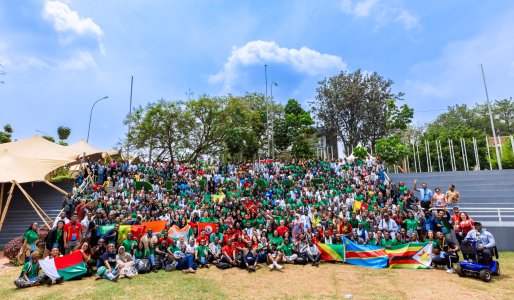
The post Building Africa’s AI Future Together appeared first on Deep Learning Indaba.
]]>The post When Community Leads: Rwanda to Host the 2025 Annual Deep Learning Indaba appeared first on Deep Learning Indaba.
]]>Pierrette Mahoro Mastel currently works at GIZ as a Digital Health Advisor, prior to that she was at CMU-Africa where she did her Masters in IT with a major in Machine Learning. Mastel is the IndabaX Rwanda lead and one of the 2025 General Chairs for the Indaba to be held in Kigali 17-22 August 2025.
I first attended the Annual Deep Learning Indaba in 2022 with two of my other CMU Africa colleagues. I still remember several people’s surprised faces when I would say that I’m from Rwanda. I kept asking why and they all said the same thing; it was their first time meeting a Rwandan at the Indaba. There was one other Rwandan from University of Oxford that year, and those who knew him made sure to introduce us. Honestly, it was a little embarrassing. Here I was at the largest gathering of AI practitioners on the continent—and yet Rwandan representation was virtually nonexistent. I felt inspired to change that.
Rwanda’s AI/ML community began taking shape around 2018-2019 when African Institute of Mathematical Sciences Rwanda (AIMS) students organised the first IndabaX Rwanda in 2019. Around the same time, CMU-Africa alum launched AI Saturdays Kigali. However, these early efforts lost momentum when the AI Saturdays founder left the country, and the COVID-19 pandemic brought IndabaX Rwanda to a halt. The community started gaining traction again with the creation of MBAZA NLP in 2021.
Towards the end of the 2022 Indaba, I was then asked by one of the Indaba organisers to reinitiate IndabaX Rwanda. We held our first IndabaX the following year, which was co-located with ICLR and we had over 100 attendees. Most were international participants already in Kigali for ICLR, rather than members of our local community—but it was a start.
With the presence of CMU-Africa, AI Saturdays Kigali, the growth of Mbaza NLP, and eventually the establishment of IndabaX Rwanda, the machine learning and AI community in Rwanda steadily began to grow. That growth was clearly visible in 2023—from just me attending the Indaba in 2022, to six Rwandans and more than ten others from our local community participating the following year.
In 2024, we hosted a two-day IndabaX Rwanda that drew over 150 attendees. What excited me most wasn’t just the increase in numbers, but the quality of the research, the projects, the conversations being showcased. The maturity was quite apparent. Fast forward to 2025, Rwanda is hosting the Annual Deep Learning Indaba. And while grassroots communities alone didn’t get us here, they laid much of the foundation. Rwanda’s progressive visa policies and its strong Meetings,Incentives, Conferences and Exhibitions (MICE) sector also played a critical role in making this possible.

Day one of the 2024 IndabaX Rwanda at Norrsken House Kigali
It’s no surprise that grassroots organisations such as Mbaza NLP, the Deep Learning Indaba, Masakhane, and Data Science Africa have played and continue to play a major role in shaping Africa’s local AI/ML ecosystems. For over a decade, these communities have been at the forefront of ensuring that Africans are not just bystanders or consumers in the global AI movement, but active contributors, researchers, and builders. While many governments are only now beginning to draft their National AI Strategies, these communities have already laid the groundwork. And while it’s encouraging to see countries across Africa taking serious steps towards advancing AI—drafting national strategies, setting policies, and organising high-level events such as the Global AI Summit on Africa to fund AI efforts on the continent — my hope is that we don’t take as long to recognise who is best positioned to implement these strategies. Grassroots organisations should be at the forefront for funding and support. They have a proven track record: building talent pipelines, driving community-led research, and creating inclusive platforms for African voices in AI. If we want these national strategies to translate into real, sustainable impact, then the implementers must be those who have already shown they can do the work—and have been doing it long before it was on anyone’s policy agenda.
The post When Community Leads: Rwanda to Host the 2025 Annual Deep Learning Indaba appeared first on Deep Learning Indaba.
]]>The post Press Release DLI 2025 appeared first on Deep Learning Indaba.
]]>
KIGALI, RWANDA –July 14th, 2025– The Deep Learning Indaba (DLI), Africa’s premier machine learning and artificial intelligence (AI) event, proudly announces its 7th edition, set to take place in Kigali, Rwanda, under the powerful theme “Urunana – Hand in Hand for AI in Africa”. This edition will build on the success of the previous editions in South Africa, Kenya, Tunisia, Ghana, and Sénégal.
The University of Rwanda’s Kigali Campus will host over 1,000 participants, including researchers, students, industry professionals, startups, and policymakers from Africa and beyond from August 17th to 22nd. This event aims to create a collaborative and inspiring environment for the continent’s dynamic AI community.
The Deep Learning Indaba is more than just an annual event; it’s a grassroots movement dedicated to empowering Africans to become active contributors and leaders in the advancement of AI, rather than just consumers.
The edition remains committed to inclusivity and diversity, actively ensuring representation from across the African continent and beyond through travel and accommodation sponsorships, mentorship programs, and community engagement initiatives.
“By prioritising education, collaboration, and inclusivity, the Deep Learning Indaba has become a beacon of hope for Africa’s technological renaissance,” stated Bruno Ssekiwere, Tejumade Afonja, and Pierrette Mahoro Mastel, the 2025 Indaba General Chairs. “Hosting the Deep Learning Indaba 2025 in Kigali perfectly aligns with Rwanda’s vision to become Africa’s hub for inclusive, responsible, and homegrown AI innovation. As our community grows and evolves, we will continue to work together, to unlock new opportunities, inspire innovation, and solidify Africa’s place in the global AI landscape”.
Professor Kayihura Muganga Didas, Vice Chancellor, University of Rwanda expressed his enthusiasm: “Hosting the 2025 Deep Learning Indaba is both an honor and a testament to the University of Rwanda’s commitment to championing research, innovation, and collaboration across the continent. We are proud to welcome Africa’s AI community to our campus, and we look forward to working alongside the Deep Learning Indaba to inspire the next generation of scientists, technologists, and changemakers who will shape Africa’s digital future”.
Highlights of the 2025 Deep Learning Indaba will include:
- Distinguished Keynote Speakers: The event will feature leading voices in AI, including Verena Rieser (Senior Staff Research Scientist at Google DeepMind), Max Welling (Research Chair in Machine Learning at the University of Amsterdam and Distinguished Scientist at MSR), Dina Machuve (Co-Founder and CTO of DevData Analytics), and Sanmi Koyejo (Assistant Professor at Stanford University and co-founder of Virtue AI).
- Verena Rieser shared her anticipation: “The promise of AI’s transformative power demands a collective vision. For AI to truly serve all of humanity, its alignment must be forged not just by a few, but by the rich tapestry of human experience and wisdom. I’m thrilled to be at the Deep Learning Indaba in Rwanda, where we have the unparalleled opportunity to collaborate and ensure AI’s benefits reach everyone, everywhere. I look forward to connecting with the community”.
- Sanmi Koyejo added: “I’m excited to join the Deep Learning Indaba community to discuss how we can transform AI evaluation from ad-hoc benchmarking into a rigorous measurement science. I look forward to exploring with fellow researchers how real-world applications and modern computational techniques can help us build the evaluation frameworks that the field truly needs”.
- A Flagship “AI Policy in Africa” Panel: Featuring experts like Jane Munga (Carnegie Endowment for International Peace), Vukosi Marivate (University of Pretoria), Rayid Ghani (Carnegie Mellon University), and Virginia Dignum (Umea University).
- Engaging conversations: Panel discussions will revolve around critical areas such as Ethical AI, AI in Healthcare, Climate-Resilient AI Solutions, AI for Business and Finance in Africa, and Centring Data in African AI.
- Engaging Workshops: In-depth sessions for collaboration and community building across a wide range of topics, including Trustworthy AI, Responsible AI, Robotics, Quantum ML, Data for African AI, Neuroscience, Natural Language Processing, and Compute.
- A Comprehensive Program: The event will also include tutorials, a two-day African Research Symposium, mentorship sessions, paper presentations and more. You can find the full program here.
Building on the remarkable success of the Indaba 2024 in Dakar, Senegal, this year’s edition in Kigali is set to be even more impactful. The 2024 event brought together over 700 participants, showcasing 150+ posters and 62 papers, and featured 90+ startups. It hosted 40+ speakers and guests, including Samy Bengio from Apple, and was supported by 30+ sponsors such such as Google DeepMind, InstaDeep, JPMorgan Chase & Co, Meta, Microsoft AI for Good Lab, and OpenAI.
For a deeper understanding of past achievements, the full Deep Learning Indaba 2024 Impact Report is available here.
As a registered charity with over 100 dedicated organisers, DLI has been building a sustainable pan-African community of AI expertise since its inception in 2017. Through its annual event, the distributed IndabaX local chapters in 47 African countries, and its Excellence in Research and Community Awards, DLI aims to strengthen Africa’s AI ecosystem, foster learning, collaboration, and innovation, and recognise local leadership.
About the Deep Learning Indaba:
The Deep Learning Indaba is a grassroots movement, a culmination of the collective efforts of people across the continent working towards a common goal: to strengthen and empower the African AI community, ensuring Africans are contributors, shapers, and owners of the coming advances in machine learning. Founded in 2017 by a group of friends and collaborators, it has grown into a registered charity powered by volunteers who organise events, coordinate activities, and foster a community of passionate researchers and practitioners. DLI works in collaboration with other pan-African communities and is strengthened through international partnerships, continually fostering new research collaborations, incubating innovation projects, and opening career opportunities.
###
Press Contact: comms@deeplearningindaba.com
The post Press Release DLI 2025 appeared first on Deep Learning Indaba.
]]>The post Under the Jasmine Tree appeared first on Deep Learning Indaba.
]]>This month’s newsletter was written by two community members. Amal Nammouchi, originally from Tunisia 🇹🇳, is a co-founder of AfriClimate AI, a Pan-African non-profit using AI to tackle climate challenges across Africa. She is a PhD candidate affiliated with SOLVE and Karlstad University, Sweden, and is a long time organiser for the Deep Learning Indaba, including her role as the Chair of the Applications and Selection Committee for the 2024 Deep Learning Indaba. From Algeria 🇩🇿, Sabrina Amrouche relocated to Switzerland to pursue a PhD in physics and AI CERN. She has moved to industry after her PhD and is now leading the data science department at ZYTLYN. She is a co-founder of AfriClimate AI and leads the AfriNet project.
🇹🇳 Growing up in Tunisia, the northernmost African city, I spent countless hours beneath Jasmine trees, enjoying the cold breeze of “El 9ayla”, the Tunisian term for midday hot hours, and the soft echoes of “Ta7t el Yassmina – Under the Jasmine Tree” song filled my soul. I grew up in El Alia, a quiet farming town, where summer days meant joining neighbors to pick tout and hendi fruits, playing under the wide open sky, climbing trees with sticky fingers, and resting under fig branches while the land was filled with life. Those rhythms once felt eternal. But with each passing year, they began to shift. What we once called seasons started losing their meaning: extreme heat waves hitting more often, more harshly reaching 50°C temperature in my little coastal town, carrying a different weight, one of risk, even death for some, rain arriving too late or not at all, fruit ripening too early, the soil too dry.
🇩🇿 It’s been ten years since I left Algeria. Before that, the idea of water consistently coming out of a tap was foreign. The very first time I immersed myself in a bath tub was when I was 27. The notion would be completely outrageous back home. People get regularly shamed for washing their cars… Water means food, peace, or chaos. More than 85% of my country’s agricultural land depends on rain. Rain makes and breaks farmers and millions of livelihoods. On dry spring days, there would be massive prayers (“Salat el istiskaa” in Arabic) organised to humbly plead for rain. It is the last resort for people when they, helplessly, see their crops die. Most farmers in my country sold their land and moved to the city. My parents came from a family of farmers. When their land completely dried, a decade ago, I remember my mother, shovel in hand, filling up large bags of the old tired soil that once fed her. That soil travelled hundreds kilometres and now sits in a balcony nourishing colourful roses. And so, there was once a Jasmine tree that scented my early childhood memories. I get to see what remains of it on my mother’s balcony every time I visit.
🇹🇳 🇩🇿 Climate change has never been a scientific, abstract concept. For many of us, it arrived slowly, quietly—like a neighbour who overstayed their welcome, reshaping the contours of daily life without asking. It revealed itself in the wells running dry, in the timing of harvests going unpredictable, in the exhaustion on the faces of farmers who can no longer rely on the sky. And yet, despite the heaviness, we have found something else: connection. Through communities such as the Deep Learning Indaba and AfriClimate AI, we’ve learned that while the signs of crisis may differ across our landscapes, our stories echo each other. From Cape Town to Cape Angela, From El Alia to Milliana, we are united by the urgency to protect what we love, to unite in pushing the frontiers of climate research, adapt and mitigate together.
AfriClimate AI was born from this shared vision. A grassroots community of AI and Climate researchers, professionals, policy makers and changemakers, dedicated to harnessing the power of AI for a sustainable and climate-resilient Africa. Our work is deeply rooted in Wangari Maathai’s powerful assertion: “You cannot protect the environment unless you empower people, you inform them, and you help them understand that these resources are their own, that they must protect them.” Guided by this vision, we have set ambitious goals to tackle the pressing challenges at the intersection of climate science and AI across the continent. From capacity building through our workshops and seminars, to knowledge sharing through AfriWiki, to concrete on-the-ground impact with AfriNet—where we deploy community weather stations—and research initiatives such as our weather benchmarking project, we strive to bridge gaps and cultivate resilience.
Whatever your vision, there is a place for you to plant a seed, to empower, to volunteer, and to grow alongside us. We invite you to join in reimagining and rebuilding a future where communities thrive in harmony with their environment.
The post Under the Jasmine Tree appeared first on Deep Learning Indaba.
]]>The post Letter to the Community: Prof. AZA Allsop appeared first on Deep Learning Indaba.
]]>I am honored to have this platform to communicate with the Deep Learning Indaba community. I must admit that it has been challenging to write to you at this time where there is so much going on and so much to say. I am unsure of what is most salient. I do think we are at a critical time in human history. Our technology is rapidly expanding and our machines are becoming more and more “intelligent” as we simultaneously enhance our ability and capacity for self-destruction. We have inherited and been trained in a model of society and science that is not sustainable. Can we adapt in time to meet these challenges? I mostly position myself as an optimist and even still it can seem overwhelming to think about the solutions and where they will come from.
However, the more I think about it, the more certain I am that the solutions for our crises will come from people like you. Those who have been historically marginalized from the global STEM stage yet have such abundance of natural, mental, cultural and spiritual resources that our brilliance can’t be denied. I also think that Artificial Intelligence, with its capacity to integrate, synthesize, and find patterns in large, complex data, will be an important part of our ability to solve our greatest problems.There is an opportunity for Africa and the diaspora to be leaders in a social evolution that utilizes AI to facilitate our ability to survive the times that are coming.
Indeed we are in a time where impactful change is needed. There are 3 major interrelated crises that threaten our species and require our deep and urgent attention: mental health, social, and climate crises. Mental health symptoms continue to worsen globally with severe implications for societal well being. Increases in loneliness in society and the growing impact of wars and social upheaval are witnessed across the globe while expenditures on peacebuilding and peacekeeping represent less than 0.6% of military spending. The 10 most recent years are the warmest on record and weather-related events have already displaced an estimated 23.1 million people on average each year over the last decade. These are sobering realities to contend with, yet we have to contend with them for our lives and the lives of our families.
As scientists, engineers, academics, and entrepreneurs in the community we have tools that we can leverage to solve problems. We know how to tackle challenges and persist until something breaks through into Light. There are so many ways that we can use our gifts and the opportunities and privileges we have had to learn science and help shape the future. I urge us to always rely on the ethos of community as the word Indaba implies. Let the Indaba not just be a gathering to share data, but a nexus point that can galvanize a movement. We have to come together across the Diaspora to solve the problems that we now face. We can’t look to others for the answers but must take it upon ourselves as a community to be bold in crafting new ways of thinking, solving, and being.
I remain an optimist because wherever we see dark, there is space for light to shine. I am a person of African descent who started my science career as a college student at North Carolina Central University, an HBCU, and then completed medical and graduate training at Harvard, MIT, and Yale. I understand that the resources, access, and network are not equally available to everyone. Yet in the most dire circumstances, where resources are most limited, there is a tremendous potential for rapid and ingenious innovations. I encourage you all to remain bold in the face of adversity and to continue to make a path forward in which we can truly use advances in AI to achieve humanity’s balanced co-existence with nature. I pray for peace, love, and joy for us here and now as we pursue this quest.
Best,
AZA Allsop, MD, PhD
The post Letter to the Community: Prof. AZA Allsop appeared first on Deep Learning Indaba.
]]>The post Throwing bones appeared first on Deep Learning Indaba.
]]>Rarely, with the benefit of hindsight, there is a moment that stands out as wildly impactful. For me, attending the Deep Learning Indaba (DLI) in 2022 was one of those milestones. A year into a tough PhD programme overseas with a heavy theoretical machine learning course load, I was struggling with self-doubt and imposter syndrome. The Indaba in Tunisia was my first after five years, yet it felt like I belonged. The DLI re-rooted my commitment to Africa and my goal of giving back to our community.
I like to think of my Indaba re-rooting using the analogy of “throwing bones”, which has three meanings for me: the bones that form the core knowledge skeleton; the bones of prediction; and the bones we use to help others. First, as a medical doctor, the skeleton is what holds the body together: the fundamentals. Second, as a theoretical neuroscience and machine learning researcher, the throwing of the bones (or amathambo) for divination by Zulu and Xhosa traditional healers (sangomas), speaks strongly to the problem of prediction. And third, the act of throwing someone a bone – offering a small piece of help – is a meaning of amathambo that has become clear to me in reflection.
The company I co-created out of the 2022 Indaba’s Ideathon, Amathambo AI, has put all three of these concepts together in our quest to predict patient load and manage staff rostering in healthcare. The beautiful name was suggested by my fellow conspirators and founders, two long-time Indaba stalwarts and friends, Simphiwe Zitha and Sicelukwanda Zwane. Our journey embodies the three amathambo principles:
- They have thrown me many bones! Being able to trust and lean on one’s team is essential.
- We have been cautious to stick to the skeleton in the product we are building – we have kept the tech simple, because we know that we are solving an important problem.
- We have been mindful to not get too caught up in our researcher-brains: to take time to predict not just patient load data, but also our future and our business’s future.
While these sound straightforward, I am reminded that there would be no Amathambo AI without the Indaba community, who have thrown me so, so many bones. From organisers and keynotes giving up time, to sharing a lift, to eating together, to exchanging both cultural and scientific ideas, to enabling internship opportunities, to being able to access sustained mentorship and advice – these small puzzle pieces have played a huge role in growing me as a researcher and participant in the African machine learning community. Importantly, I think I owe a large part of my journey to simply being at the Indaba in 2022.
“The family is like the forest: if you are outside it is dense; if you are inside you see that each tree has its own position.”
– Akan Proverb, shared by Yaa Gyasi in Homegoing, an excellent book contrasting the author’s birthplace in Ghana to modern USA across generations of slavery.
There’s something special about the rootedness and connection of going home, and it’s how I felt when I left Tunisia. “Homegoing” to the Indaba gets better with every mindful interaction. Choosing to be involved, to put the community’s interests above one’s own, to be present: these are how we continue to grow our space, and throw bones of knowledge and support to one another.
I encourage everyone to get involved in the Indaba. This does not need to look like leaping to join the main organising committee from the get-go. For me, it means reflecting on your path and finding the next meaningful step (see James Allingham’s suggestions in last month’s edition), including those that also help another member of the community. I started by simply attending – joining an Ideathon team sharing my interests – then slowly realised where I could make more and more impact.
So, throw someone a bone, be sure to build and nourish your own knowledge skeleton, and may the bones continue to point towards an AI future with strong, interconnected roots across the continent.
– Kira Düsterwald. 2025 Programme Chair (Keynotes), 2024 Programme Chair (Practicals), multi-year practicals developer and tutor, and long-time attendee. April 2025.
The post Throwing bones appeared first on Deep Learning Indaba.
]]>The post Xam Xamlé: Our Latest Indaba Impact Report appeared first on Deep Learning Indaba.
]]>Our mission to Strengthen African AI remains necessary and valued, and this impact report shows all the ways in which we execute that mission. As always we are grateful to all our funders and volunteers who make these impacts possible. We thank you for your ongoing support for the Deep Learning Indaba, financially and in other ways; please reach out to us with any questions.
This year, we summarise our work over 2024 in the form of an impact report as most charities now do. The programmes of the Indaba, its operational efficiencies and organising approach remains the same, but we are choosing to frame our work throughout a year in terms of its impacts and the changes it is enabling in the ecosystem, and the importance to our beneficiaries, so that the value and ongoing significance of our work can be better understood.
Seven Impact Areas
Our impacts are broad, and we consider our impacts across seven areas: six areas of continental transformation, and one organisationally-focussed on our internal growth and maturity. Our impact aims support our educational and charitable mission.
Over 2024, we strengthened African AI:
Talent. Our commitment to advancing talent, skills and Competencies allowed us to: advanced the national agenda in Senegal, where the annual Deep Learning Indaba was hosted; showcased a continent-wide network of AI expertise; advanced technical skills in LLMs for African languages, AI for Biology, and fundamental ML research; and drove focused skills development through active mentorship.
Research. We supported the advancement of novel research and dissemination through publications, where we established higher quality on a focused set of 50 papers; the Africa Research showcase created visibility and opportunity for teams behind almost 250 research projects; and we distributed the Lacuna fund grant of approximately $500K to 5 projects in African language technologies.
Innovation. We strengthened the pipeline of ideas to deployment by showcasing innovation and commercialisation from 69 startups across the continent, hosting startup showcases and pitch sessions, and embedding the role of company building in Africa’s AI ecosystem; the Ideathon helped accelerate new cross-continental collaborations that are the seed for future startups and innovations.
Ownership and Capacity. New technical communities have been identified or established in 47 countries across the continent, achieving the goal of setting the foundations for AI readiness, ownership and capacity at a continental-scale.
Leadership. The Indaba awards, which honour African scientific and intellectual luminaries, celebrated and elevated the pioneering work of researchers innovators in 5 categories, and showcased the breadth of leadership and excellence that already exists.
Communities. We’ve established the platform that brings together Africa’s leading innovation groups across fields particularly in Languages, Vision, Health, and Climate; hosted sessions to connect leaders of community groups supporting leadership development; and invested in the visibility of community groups to help advance their own missions and impacts.
The Indaba Organisation. We continue to make progress in building an extraordinary organization to support the impacts and future ambition: by professionalising our internal processes, actively managing risks, and having a strategy for more ambitious and transformative approaches to Strengthen African AI.
What’s next
As we close the chapter on our last edition, we’re filled with gratitude for the community that made it all possible—and even more excitement for what lies ahead. We are gearing up for the next edition of the Deep Learning Indaba annual event, set to take place in Kigali, Rwanda this August. Whether you’re looking to support, or simply stay connected, we welcome your ideas, questions, and contributions. Reach out to us anytime at ideas@deeplearningindaba.com.
For more information about the Indaba and our updates, sign-up to our newsletter.
We are currently Fundraising – see our sponsorship booklet and get in touch with us at sponsorship@deeplearningindaba.com for more details.
The post Xam Xamlé: Our Latest Indaba Impact Report appeared first on Deep Learning Indaba.
]]>The post Lessons From My Indaba Journey appeared first on Deep Learning Indaba.
]]>As I reflect on my journey, from a fresh engineering graduate with a new interest in machine learning, to my first exposure to research during my MPhil in Cambridge, and now as a Google DeepMind researcher with a PhD in machine learning, I’m struck by the large role that the Indaba has played.
I truly believe that one of the biggest influences on my trajectory was engaging meaningfully with the Indaba and seizing the opportunities it presented. However, before I go any further I’d like to acknowledge the role that luck and privilege played. Through my undergraduate studies, I was fortunate to meet Benjamin Rosman (co-founder of the Deep Learning Indaba), who introduced me to the Indaba in the first place. And, on top of all my hard work, I was incredibly lucky to be accepted at Cambridge for my MPhil.
My first Indaba in 2017 was a turning point. Initially, I was ‘only’ going to be an attendee, but I found out that tutors were needed to beta-test and help run the practicals, and I volunteered. I spent hours meticulously going through the exercises, finding bugs, and suggesting improvements. During coffee breaks, conversations with the Indaba organisers were eye-opening. They pointed me towards Zoubin Ghahramani at Cambridge. Following their advice, I reached out to Zoubin and ended up working with him, which profoundly shaped my understanding of machine learning. As a result of my work with Zoubin, I was able to secure a fully-funded PhD position at Cambridge.
In 2018 and 2019, I continued to engage. In 2018, my hard work on the practicals in 2017 was recognised, and I was asked to be a “head tutor”. In 2019, I was asked to co-develop all of the new practicals for that year.
Avital Oliver from Depth First Learning (DFL) was also at the 2019 DLI. He was looking for folks to contribute to the website. I jumped at the chance to contribute. I volunteered to create a study guide on Wasserstein GANs, despite knowing very little about them. I spent countless hours researching, learning, and ultimately producing a resource that Avital and the DFL team were proud of. Avital’s recommendation for my first Google Brain internship was without a doubt the reason I was selected. And the success of that led to a second internship, which ultimately led to my job at Google DeepMind.
I am acutely aware that my story isn’t universally replicable. Luck played a significant role. And, as mentioned, my starting point was one of privilege. But I hope that my story also shows how communities like the Indaba can give us the chance to grow and succeed.
So how can you make the most out of your next DLI? Here are my suggestions:
- Connect Authentically: Don’t network for the sake of networking. Try to make a friend rather than a “connection”.
- Contribute Actively: Take initiative. Volunteer to be a tutor and/or develop an Indaba practical. Pitch an idea at the next Ideathon or sign up to support a team’s vision. Help organise your local IndabaX to spread the Indaba mission. The more you give, the more you’ll receive.
- Dive Deep: If a topic interests you, explore it thoroughly. Ask follow-up questions. Collaborate with others to understand complex concepts.
- Seek Mentorship: Identify individuals whose work you admire and ask for specific guidance. Sending a polite email doesn’t cost you anything; the worst that can happen is you don’t get a reply. The Indaba mentorship programme is a great place to start and matches mentees to mentors based on specific goals and overlapping interests!
- Create Something: Write a short blog post, or develop tutorials based on what you learn at the Indaba. Sharing your knowledge is one of the best ways to understand something deeply. Kale-ab Tessera shared some great advice for getting started as a creator, in the newsletter last year. Grassroots machine learning initiatives like Masakhane, Sisonke Biotik, AfriClimate AI, and Ro’ya-CV4Africa are also a great place to start.
- Most importantly: have fun! The Indaba can be intense, so take breaks when you need to, explore the host city, and make new friends.
The Indaba is more than a conference, a summer school, or a community; it’s a platform for positive change. By engaging actively and meaningfully, you can unlock opportunities you never thought possible.
– James Allingham. 2025 Programme Chair (Workshops), 2024 Programme Chair (Practicals), 2018 Indaba𝕏SA Organiser, and long time practicals contributor. March 2025.
The post Lessons From My Indaba Journey appeared first on Deep Learning Indaba.
]]>The post Deep Learning Indaba: Bridging the Gap in Africa’s AI Landscape appeared first on Deep Learning Indaba.
]]>The primary goal of the Deep Learning Indaba is to address the underrepresentation of African voices in the global AI landscape. By providing opportunities for education, networking, and skill development, we seek to empower African researchers and practitioners to contribute meaningfully to the global AI community. The Research in Africa Showcase at the annual Indaba and the IndabaX Programme of the Deep Learning Indaba are key demonstrations that this goal is being achieved.
The Research in Africa Showcase is one of the most anticipated highlights of the Indaba. It is a platform designed to celebrate and spotlight the groundbreaking work being done by researchers across the continent in the fields of AI and machine learning (ML). This special day not only provides visibility to research from across the African continent, but also fosters collaboration, mentorship, and inspiration among participants through IndabaX Spotlight talks, Poster Presentations, African Datasets Session, African Startups Session and the Publications Track.
The impact of the Deep Learning Indaba has inspired the establishment of numerous IndabaX Communities (local AI communities and events) across Africa. The IndabaX programme acts as a force multiplier, by creating a ripple effect, fostering AI literacy and enabling the development of AI solutions tailored to address Africa’s unique challenges, including healthcare, agriculture, and education. In 2024 we had IndabaX events in over 47 countries. We anticipate 50 African countries will be represented in 2025. We encourage everyone to get involved in the IndabaX events that will soon take place in your respective countries. Follow the website for up to date information: https://deeplearningindaba.com/2025/indabax/.
The Deep Learning Indaba is more than just a gathering; it is a movement that empowers Africans to harness the transformative potential of AI. By prioritising education, collaboration, and inclusivity, the Deep Learning Indaba has become a beacon of hope for Africa’s technological renaissance. As we continue to grow and evolve as a community, we promise to unlock new opportunities, inspire innovation, and solidify Africa’s place in the global AI landscape.
– Bruno Ssekiwere. 2025 General Chair for the Deep Learning Indaba. January 2025.
The post Deep Learning Indaba: Bridging the Gap in Africa’s AI Landscape appeared first on Deep Learning Indaba.
]]>