


“David George Haskell’s great strength as a writer is that he is open to surprise. He regards the planet as a strange and beautiful place. How Flowers Made Our World is at once closely observed, richly reported, and mind-blowing.” Elizabeth Kolbert, Pulitzer Prize-winning science writer and journalist
“‘Who runs the world? Girls!’ sang Beyoncé a while back, but really it’s flowers and flowering plants that run this world and have for more than a hundred million years. In this vividly written book, David George Haskell shows how they do that, how flowering plants made the modern world from prairies and rainforests to bees and butterflies, how the most trivialized part of the natural world is among its most powerful and essential.” Rebecca Solnit, Writer, historian, and activist, author of Orwell’s Roses
“A tender portrait of flowering plants as powerful agents of change. Flowers wield beauty as a world-making force, actively shaping the planet—and, by extension, us. This book is a joyful exhortation to floral reverence, and brims with curiosity, humor, and crystal-clear scientific delights. We are all more in sway of flowers than we think. Richly precise, How Flowers Made Our World is a celebration of the inventiveness of floral life.” Zoë Schlanger, author of The Light Eaters, staff writer, The Atlantic
“In this dazzling book, scintillating with wonder and scholarship, Haskell shows us how flowers – so often belittled and misunderstood, have shaped ecology, and so shaped us. Flowers are tectonic, and here is a book worthy of them.” Charles Foster, author of The Edges of the World
“Flowering plants as you’ve never seen them before: these flowers are the sneaky, sexy, volatile, opportunistic rebels of the vegetal world. They turned the planet on its head and, as David George Haskell demonstrates so masterfully, they have so much still to teach us. Science writing with sensuality, sensitivity and soul.” Cal Flyn, author of Islands of Abandonment
Kirkus Starred Review: “An edifying celebration.”
Pre-orders are now open: US preorders, UK preorders. Published March 2026
When flowers appeared on planet Earth, nothing was ever again the same. In this book, I celebrate the many ways that flowers build, sustain, and animate the living world, human life included. They are the world’s great collaborators and creators. Writing this book transformed how I see life’s history and future, and I’m thrilled to share these stories with you. And, yes, I really mean it when I say revolutionaries. They remade the world, using cooperation, beauty, and illusion as creative forces.

I post updates and share stories on Instagram, Facebook, and Bluesky — please join me there. Sign up here for my free newsletter. I send no more than four a year, focused on my new books, upcoming live events, and news about collaborations. I also share reading recommendations.
My previous books:
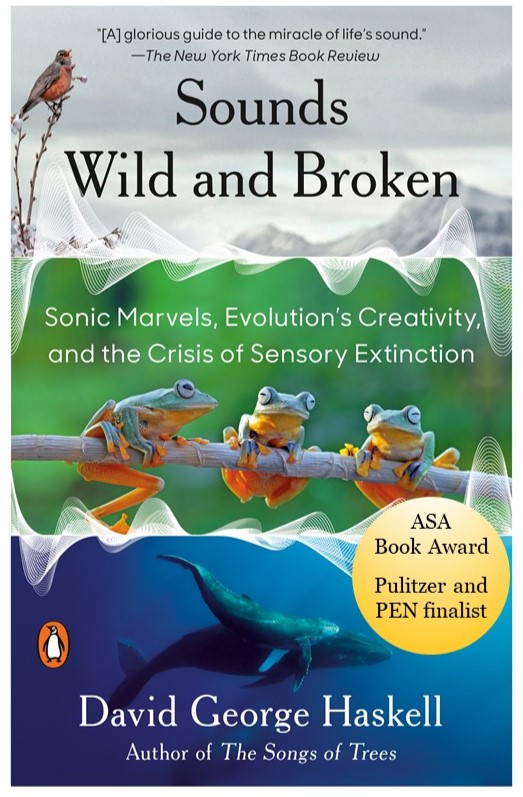
Sounds Wild and Broken: Sonic Marvels, Evolution’s Creativity, and The Crisis Of Sensory Extinction.
Finalist, 2023 Pulitzer Prize, General Nonfiction
Finalist, 2023 PEN/E. O. Wilson Literary Science Writing Award
Winner, Acoustical Society of America’s 2023 Science Communication Award (Long-form Print category)
Editor’s Choice, The New York Times Book Review
Book of the Day, The Guardian
Now out in paperback at your favorite indie bookstore or online: United States, United Kingdom, Australia; translations in Chinese (complex characters), French, Italian, Japanese, and Korean.
“‘Sounds Wild and Broken’ affirms Haskell as a laureate for the earth … a glorious guide to the miracle of life’s sound” Cynthia Barnett reviewing in The New York Times Book Review.
Reviews, sound samples, and more here.

Thirteen Ways to Smell a Tree. October 2021. Now out in paperback. Published in UK; Blackwell’s ships free to US.
Best Books of 2021, Radio Times. “…enchanting, magical insight into the wonder of trees” Kate Humble
“contagious enthusiasm … Haskell’s sustained sniffing is an example of how we can acknowledge, and perhaps begin to appreciate, all that exists outside human agendas and forms of communication.” Kate Simpson in Times Literary Supplement.
“This is a book for literary connoisseurs, fact-lovers and environmentalists. In short, it is a book about trees and people, for everyone.” BBC Countryfile
“Eclectic, brilliant and beautifully written, David Haskell reboots our aromatic memory reminding us of how our lives are intertwined with the wonder of trees. A treat not to be sneezed at.” Sir Peter Crane, FRS.
“Thirteen Ways to Smell a Tree is a transportive olfactory journey through the forest that sets the sense tingling. Every chapter summons a new aroma: leaf litter and woodsmoke, pine resin and tannin, quinine and bay leaf—life in all its glorious complexity. David George Haskell is a knowledgeable, witty and erudite companion, who takes us by the hand and leads us through the world, reminding us to breathe it all in. This book is a breath of fresh air.” Cal Flyn, author of Islands of Abandonment.
 The Songs of Trees:
Winner of the 2020 Iris Book Award
Winner of the 2018 John Burroughs Medal
Best Science Books of 2017, NPR Science Friday
Favorite Science Books of 2017, Brain Pickings
The 10 Best Environment, Climate Science and Conservation Books of 2017, Forbes.com
“A work of scientific depth and lyricism” The Guardian
“has the diverse busyness of a thriving woodland. It is hard to think of a recent scientifically-inflected book on nature that is as fluent, compelling, and intoxicatingly rich.” The Times Literary Supplement.
“Haskell proves himself to be the rare kind of scientist Rachel Carson was when long ago she pioneered a new cultural aesthetic of poetic prose about science…a resplendent read in its entirety” Maria Popova in Brain Pickings
Interviews in Outside Magazine and Yale Environment 360.
Listen to a compilation of sounds from the trees or visit with them through photos and sound.
More…
 The Forest Unseen:
Winner of 2013 Best Book Award from the National Academies
Finalist for 2013 Pulitzer Prize in General Nonfiction
Runner-up for 2013 PEN/E.O. Wilson Literary Science Writing Award
Winner of the 2013 Reed Environmental Writing Award
Winner of the 2012 National Outdoor Book Award for Natural History Literature
Dapeng Nature Writing Award (in translation). Shenzhen, China. 2016.
“He thinks like a biologist, writes like a poet, and gives the natural world the kind of open-minded attention one expects from a Zen monk rather than a hypothesis-driven scientist.” James Gorman, The New York Times
“…a new genre of nature writing, located between science and poetry.” Edward O. Wilson, Harvard University
More…
 David George Haskell