Market – what market? The catch 22 at the heart of innovation in government

The first of what may be quite a few articles I reproduce here which I wrote for The Mandarin from around 2016 to 2020 or thereabouts (The Mandarin has put the articles I wrote for them behind its paywall so when people need them online, I reproduce them here).

Picture: Getty Images

There is a huge catch 22 driving impact measurement in human services. A lot of the evaluation is done because governments seek it, but then it goes nowhere – and for good reason. NGOs and others hoping to ‘scale-up’ innovation can’t escape this without something like an Evaluator-General, writes Nicholas Gruen.

There’s a spectre haunting service provision. For decades now, we’ve presumed that new and innovative service provision will emerge from innovation out in the field, with successful pilots and innovative programs initiated by NGOs being grown to their appropriate size and unsuccessful ones being improved or closed down. But it almost never happens.

As Peter Shergold put it in 2013, things don’t actually work out this way:

Too much innovation remains at the margin of public administration. Opportunities are only half-seized; new modes of service delivery begin and end their working lives as ‘demonstration projects’ or ‘pilots’; and creative solutions become progressively undermined by risk aversion and a plethora of bureaucratic guidelines.1

As I’ve pondered this paradox over the past decade, it’s slowly dawned on me that, however well-intentioned we’ve been, it’s all built on a lie – a lie we’re not even admitting to ourselves.

There’s a catch 22 at the heart of the system. Continue reading

Posted in Cultural Critique, Information, Social Policy | 2 Comments

Some thoughts about Bondi

Why did it happen?

I think that the combination of four factors (listed below) was close to a sufficient cause. Sufficient at least to make a terrorist attack highly likely. And they are also arguably necessary. I think if you remove any one the first three then Bondi does not happen, though I am not 100% sure of the last one and it might only be a contributing factor.

Continue reading

Posted in Ethics, Immigration and refugees, Law, Politics - national, Religion | 75 Comments

Some musings on reality motivated by the age of AI

Is there anyone at home?

Is the chess program on your phone conscious? Is ChatGPT5 a conscious agent? Will ChatGPT9 be conscious?

Most people would answer “no” to the first question, “don’t think so” to the second and “don’t know” to the last.

I think it is more likely that the chess program is conscious but would bet serious money that it isn’t. And there is zero chance ChatGPT5 is conscious. Not close to zero, but the same absolute zero you would assign to a rock. Zero as a number exists to describe the chance that a rock is conscious.

Continue reading

Posted in Uncategorized | 22 Comments

Australian male violence against female partners: the 2024-25 drop

The latest figures on intimate partner femicide show much of a recent rise in men killing women has now been reversed, at least temporarily.


Prologue: Violence against women is a bad thing, and it’s still bad even when, as the article below points out, it used to be far worse. We should be trying hard to lower rates of violence, by finding good solutions and implementing them with urgency. As part of this, we should understand just what we’re dealing with – which is what this series of posts tries to do.

This is my second post on Australian male violence against women. Back in early 2024, I posted here on Troppo about what some community groups argued was an epidemic of male violence. 2022-23 had seen a rise in the number of women killed in intimate partner violence, and 2023-24 was already shaping up to be worse. As community groups voiced their concern, news media focused on the issue for several weeks. South Australia called a Royal Commission.

Some 18 months on, it’s worth checking what has happened to those statistics.

The 2024-25 drop is not historic

The news seems good. After two years of rises, 2024-25 brought a huge 35% drop in the rate of intimate partner homicide against women. This fall is shown at the right-hand bottom corner of the graph atop this page. See an interactive version here.

In percentage terms, the 2024-25 drop is the biggest recorded single-year fall in intimate partner homicide against women in Australian history (the records go back to 1989-90). We’re now back down near the all-time lows of 2020-2022 – a period when COVID lockdowns may have been making the figures look misleadingly good (though we’ll probably never know for sure).

Did Australia celebrate that “historic fall”? Did community groups put out press releases congratulating Australia on slashing this most reliable and most awful of all domestic violence metrics? Did the media announce this biggest fall in the history of our figures?

No, we saw no celebration, no press releases – indeed, not even a media story that I could find.

And here’s the thing: I would argue that this non-response was entirely appropriate – for two reasons.

Continue reading

Posted in Criminal law, Methodology, Politics - national | Tagged crime, epistemology, femicide, public policy, women | 4 Comments

The Evaluator General redux

Why does this graph capture the idea of the Evaluator General? All is revealed in this post.


Luke Slawomirski, a health economist I met at the OECD over a decade ago when I proposed Gruen Tenders among other things to the health policy folks there. Anyway, in August Luke, who was previously a clinician and now lectures and is finishing a PhD at the Menzies Institute for Medical Research, asked if I’d like to join him as a co-author of the piece you see below.


Since 2018, about 33,000 fewer Australian patients have suffered avoidable complications like infections, pressure sores, and surgical mishaps in our public hospitals each year, according to a recent study. That’s freed up an estimated 55,000 hospital beds, worth nearly $400 million based on current prices.

How was it done? By spending more? No — by paying less when hospitals failed to prevent harm. This can be seen as a win for pay-for-performance (p4p), the idea that tying dollars to outcomes can sharpen incentives and drive improvement.

But the real lesson isn’t about hospitals, or even penalties as a lever for improvement. The message is that policy works best when it is treated as a cycle of implementation, evaluation, and adaptation.

That’s where Australia still falls short. Continue reading

Posted in Economics and public policy, Health, Innovation | Leave a comment

Fixing the world, one video at a time

Share this video! Please!

Well, the time has come folks. On Thursday I’ll be launching a video series that’s been over two years in the making. I could have written a book, but I made 20 short videos instead. Conner Bethune, pictured above, watched the series through and rang me to rave about it. He said the videos addressed the ‘moral injury’ his generation has suffered watching on as those they’re supposed to look up to behave in increasingly amoral ways. He said the videos gave him hope that some people could diagnose our problem and suggest a way back. Well, this was all music to my ears as you can imagine. So I invited him to put his ideas in the medium of choice. A video. This is the result – a fantastic teaser for the series.

Please share it with everyone you know to get the word out. Restack this post, tweet it, bluesky it etc etc. Remember: your grandchildren will ask – where were you when people were sharing and retweeting the series?

Posted in Democracy | 10 Comments

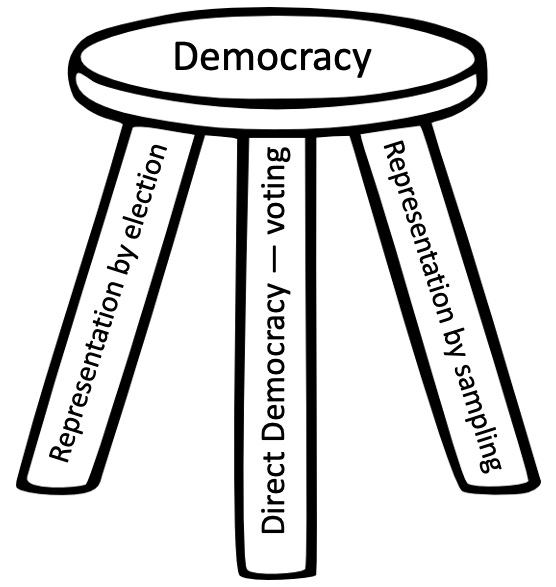
Democracy as a three legged stool: our two centuries long Magna Carta moment.

This piece began as a lengthy comment responding to Ken Parish’s post on my proposal for a third ‘people’s chamber’ chosen by lottery. I posted it on Substack a few weeks ago, but thought it might be a worthwhile post here.

I don’t support citizens’ juries as some kind of ‘hack’ to the existing system, which I see as in an advanced state of decay. That’s because, in the West in the last 800 odd years, there have been two different ‘logics’ applied to the democratisation of monarchy. The first was Magna Carta and the idea of entangling the judgement of one’s peers into the processes of government. And the second was the idea of applying ‘checks and balances’ to government from the 17th century on.

In the former case, an institution was (eventually) developed that husbanded the life world of the people within the machinery of government. In the latter case, the idea of checks and balances was a fine one. But the entire system was administered by the same elite class that it was supposed to hold to account. And that’s turning into an unaccountability machine (see Robodebt, the NACC and the rising tide of careerism in public life to say nothing of the unaccountability machine in the wider governmental structures in business).

In government these checks and balances are mostly, comically easy to subvert – you just win government and appoint your cronies. We’re seeing this in the US and they have more checks and balances than us – like Senate confirmation hearings. Once the partisanship reaches a certain level, things can move very fast.

We might have democratised monarchies by doing something similar to Magna Carta in the legislative and executive branches. But it’s a simple fact of history that we didn’t. But we can get glimpses of what that might look like by looking around. Belgium now has parliamentary committees with 15 elected legislators and 45 randomly selected citizens. There are standing citizen councils in East Belgium, Paris and a few other places.

Michigan has the Independent Citizens’ Redistricting Commission, which draws electoral boundaries. And it does it in a way that is much less corruptible than almost all the systems used elsewhere, including here. These are the kinds of institutions we should be developing. Elsewhere in the Western world, these kinds of things are easily subverted by doing what Scott Morrison did with the AAT. Appointing your cronies to ‘independent’ positions.

If that’s the ‘bulwark against tyranny’ argument, there’s also the ‘can we please have a sensible conversation’ argument. Even where there’s a strong cross-bench, MPs can’t remain MPs without a good deal of double talk. I was discussing budget repair with an independent member of the Tasmanian parliament the other day and they’re almost as hamstrung as party politicians. Because if you want to get elected, your ‘messaging’ though our marvellously dystopian mass and social media has to be pretty reductive. You have to spin your question begging nonsense for media management reasons. Taxes are bad and spending is good! And we wonder why fiscal responsibility is a growing problem!

You might ask why don’t I want to abolish the existing system and just back sortition based citizen assemblies.

Two reasons Continue reading

Posted in Democracy, Sortition and citizens’ juries | Leave a comment