HTTP/2 301
server: nginx/1.27.4
date: Sat, 31 Jan 2026 11:38:21 GMT
content-type: application/rss+xml; charset=UTF-8
location: https://caprim.opened.ca/feed/
last-modified: Fri, 20 Nov 2020 02:15:12 GMT
etag: "bb4c525c4e03dd88874d2266b6e35f82"
x-redirect-by: WordPress
fastcgi-cache: MISS
strict-transport-security: max-age=31536000; includeSubdomains;
HTTP/2 200
server: nginx/1.27.4
date: Sat, 31 Jan 2026 11:38:21 GMT
content-type: application/rss+xml; charset=UTF-8
vary: Accept-Encoding
last-modified: Fri, 20 Nov 2020 02:15:12 GMT
etag: W/"bb4c525c4e03dd88874d2266b6e35f82"
link: ; rel="https://api.w.org/"
fastcgi-cache: BYPASS
strict-transport-security: max-age=31536000; includeSubdomains;
content-encoding: gzip
capri’s site
https://caprim.opened.ca
Fri, 20 Nov 2020 02:15:12 +0000en-CA
hourly
1 Peer Review: Technology Addiction
https://caprim.opened.ca/peer-review-technology-addiction/
https://caprim.opened.ca/peer-review-technology-addiction/#respondFri, 20 Nov 2020 02:15:12 +0000https://caprim.opened.ca/?p=122I was given the assignment of doing a peer review for “Teaching Technology Addiction in a Highschool Classroom” by Sinead Swan, Colton Van Camp, and Harleen Parmar. First off, I really appreciated the choice of subject for this interactive resource. Technology addiction is a very relevant and topical choice for crafting a lesson around in this current time. From a designer perspective, this interactive resource plan is organized and incredibly clear in its delivery. I appreciated that every part was labeled and easy to access as I was scrolling through.
From my understanding, there was to be a part in the learning resource about technology rationale, where the authors would explain the technologies they would use and rationalize those decisions, and I could not find that in this resource. Although technology was something that was discussed within the resource, so perhaps it was just not explicitly labeled. Either way, I would make that portion more clear as I do believe it was in the given criteria.
I found it interesting that one of the activities involved going in and looking at things like app usage and screentime, if only because I worry some students would be self-conscious about their own equipment. It’s easy to find screen time statistics for someone with the newest few iPhones, but for those with older or more obscure phone brands I feel as though that could unintentionally cause some discomfort or feelings of inferiority amongst students as comparison is bound to happen – especially amongst high school-aged teenagers. Socioeconomic disparities are something that do unfortunately occur in classroom settings. So perhaps making that particular activity optional, or just having an open dialogue that students do not necessarily have to evaluate their own screentime to understand the point so that certain students do not feel pressured to share or be embarrassed by comparing their phones to others would be of value there.
It makes a lot of sense given the content that is being teached to be grading mostly on solid reflection, understanding of materials, and completion. One thing I was a little confused about is the part that said 10 marks would be given to creativity. At first, I assumed that it referred to a neat and orderly journal but then in the following explanation I saw that that was a separate section. Speaking from my own personal experience, I am not an inherently visually creative person, so it can be frustrating when parts of my grade is dependent on something that comes easily to others but I am just inherently not good at. I would suggest clarifying more in the explanation exactly what you mean by creativity and making it unique to who they are and their lifestyle in terms of how that’d actually be expressed in this journal format; because I just found myself wondering what the grader was actually expecting from that section, so if I was wondering and having these questions then I’m sure hypothetical students might be as well.
All things considered, I definitely think this was a really interesting topic and it was very well expressed. I can tell that a lot of thought and effort went into this, and I’m very glad I got to read! Hopefully these comments can be of some help as you all move forward!
]]>https://caprim.opened.ca/peer-review-technology-addiction/feed/0Comments for Interactive Learning
https://caprim.opened.ca/comments-for-interactive-learning/
https://caprim.opened.ca/comments-for-interactive-learning/#respondWed, 28 Oct 2020 19:55:12 +0000https://caprim.opened.ca/?p=117In Soals’ blogpost this week titled Interaction with Art, she described a video that focused on teaching others how to paint with acrylics and explained how she would go about showing that video in a classroom setting. I thought that having students follow along was definitely the way to go, as I myself would struggle if I watched the video and then was told to try and replicate it and I’m much older than the target age group; using well-timed pauses as students paint as they go seems like a much better approach. Since this assignment is not necessarily about getting it “right” and more about participating and trying the new concept it makes sense that the grading would be focused on completion and gaps in skill level would have no relevance. It is also nice that this assignment would result in minimal workload for the teacher, as most of the actual “work” would be done by the students as they try painting along. Overall, this video seems like a great tool to help students interact with art in a way that they might not have ever done before, and the assignment that Soals came up with seems like a good way to supplement that.
In Zihan’s post titled Interaction Prompt, the video that she selected focused on art composition and the basics of drawing. This is another important concept for students to learn so that they can understand more about how art itself is constructed. Zihan also stresses the importance of taking notes, which can greatly aid the learning process as students remember things better after having written it down by hand. This is a necessary insight as so much of learning now is online – having a reminder for students that writing things down by hand may be more beneficial is a great way to keep them engaged in the content and have them demonstrate their learning.
]]>https://caprim.opened.ca/comments-for-interactive-learning/feed/0Interaction and Teaching in a Digital Age
https://caprim.opened.ca/interaction-and-teaching-in-a-digital-age/
https://caprim.opened.ca/interaction-and-teaching-in-a-digital-age/#commentsSun, 25 Oct 2020 19:46:39 +0000https://caprim.opened.ca/?p=115The video I found is a TedTalk from students of the Al Yasmina Academy that talks about how every person is an artist just by the merit of being themselves and discusses the importance of self-expression. Although there is not necessarily an inherent need to respond – this video absolutely could be a starting point in creating a discussion and activity for students. Because this video is done by other young people and is also only about ten minutes it makes it more ideal to show to the age group that we had decided on of children grades 6-8 and in general makes it more accessible. Young people seeing someone only a few years older than them talking about this topic creates a feeling of “Wait, I can do that too.” that makes the video much more approachable. Some students may make notes, but I think this video is best suited to a discussion and subsequent activity.
The activity should focus on disconnecting the concept for students that art is something that only people in museums are good at, and then reaffirming that anyone can be an artist as long as they are creating. The students will all take a piece of 8×11 white paper, then close their eyes and try and draw a given topic. After all the students have their creations, the class will have a discussion of what they were trying to do. Likely, students will say they were trying to make the subject as realistic as possible, or as close to the topic as possible. We will then do the activity again, this time with no given topic and the students being free to draw whatever does or does not come to mind. After this activity, we will discuss what felt different about having a subject to draw and perimeters to follow versus just being free to follow whatever your mind wanted. Through this activity, we are reinforcing the concepts of the video that art is not meant to be in rigid forms, and that there is no pressure for perfection or accuracy in self-expression. This activity also requires very little work on the side of the educator, with all they need to do being providing paper and crayons for students to draw on, managing timing and when to close the eyes, and helping facilitate the discussion afterwards. Overall, this activity can be a fun, on-hand, and attainable way to help students reconstruct their misconceptions about creating art and being artists.
]]>https://caprim.opened.ca/interaction-and-teaching-in-a-digital-age/feed/7Comments for Inclusive Learning
https://caprim.opened.ca/comments-for-inclusive-learning/
https://caprim.opened.ca/comments-for-inclusive-learning/#respondSat, 17 Oct 2020 20:16:03 +0000https://caprim.opened.ca/?p=111In Yirun’s blogpost entitled (Prompt) Inclusive Design they brought up many good points about ways to make learning more interactive and thus make it more inclusive. Approaching the subject with five clear ways made the blog itself easy to follow and understandable. Out of the five ways the one that stood out to me the most was the concept of feedback. As an educator, one cannot assume that everything they do is perfect or correct. It’s of much more value to open up the value and directly hear from the people that someone is working with. This makes it so that educators can hear relevant and specific points on where they can improve and where they’re doing well so that proper consideration of how to be better can occur. In addition, having this open form of communication between students and teachers makes an environment more comfortable. It gives students a level of agency and control in how they are being taught, and helps them better explain what they need to succeed.
And then in Zihan’s blogpost also about Inclusive Design, they brought up great ideas on how to make lectures more engaging. Because we are currently in a time of online lectures, and only communicating through Zoom – it can be very hard to keep people engaged. When everything feels so distanced, how can we still make it still feel personal and fun? Zihan brought up using things such as flashcards and games to increase engagement, which I think makes a lot of sense because when students are just hearing something through their computer speakers it often goes in one ear and out the other. Using tools that test the learners and also help them enjoy class during this very abnormal time is a way to create connections even at a distance. And those connections are not only between learner and educator, but also among the different students. The loss of social connection for students is one of the most unfortunate byproducts of the pandemic, so finding ways to have young people talking and learning together is more relevant now than ever.
]]>https://caprim.opened.ca/comments-for-inclusive-learning/feed/0Inclusive Learning
https://caprim.opened.ca/inclusive-learning/
https://caprim.opened.ca/inclusive-learning/#respondSat, 17 Oct 2020 20:00:08 +0000https://caprim.opened.ca/?p=107
Creator: smartboy10 Credit: Getty Images
Integrating inclusivity into education and subsequently into our own learning design is of the utmost importance. In a time where there are people of all different kinds of ethnicities, backgrounds, sexualities, and even more all converging together – especially in an educational context where they are still young – it is immensely significant to make sure all learners feel comfortable and safe in the space that we are sharing. As it was said in this week’s reading, “An inclusive design begins with the understanding that every person is a learner, and every learner has the right to pursue excellence and achievement.” Because every single learner has the right to pursue achievement, that means it is the responsibility of the educator to do everything they can to help all these different learners have the best set-up to be successful in whatever context that is. For the learning activities in our own blueprint, mainly the concept of creating a group mural, in a collaborative activity it is of value to identify and then reduce potential barriers. For instance, asking students to collaborate on a mural when they likely come from very different socio-economic or cultural backgrounds – there needs to be emphasis that there is no “right way” to do something, and students can express their pasts and know that they will be met with empathy and not disinterest. This is a responsibility heavily on the educator, as they need to be the ones setting clear boundaries and reinforcing positive and open communication. In addition, art is an expensive medium to explore, and as stated before there is likely children of all different kinds of socio-economic backgrounds. To reduce potential barriers here, if any materials are not provided then required materials should be under a certain dollar amount to increase accessibility, and there should be discrete funds in place to help students who cannot afford to buy their own so that no student is without materials and feels out of place.
Another aspect of ensuring student success is being flexible in the face of unforeseen circumstances. For example, we are currently in the throes of the COVID-19 pandemic so there needs to be some adjustments to accommodate that. Setting up a plan that includes required masks for both students and learners, reduced groups numbers, distancing of small groups, and no sharing of art materials are all ways to help students continue their creative journey while also putting relevant safety measures in place. Overall, inclusivity is about approaching situations with empathy, being flexible and creative in various approach for various types of learners, and always wanting to learn more to better help both those around you and also yourself.
]]>
https://caprim.opened.ca/inclusive-learning/feed/0Comment for Learning Theory Blogs
https://caprim.opened.ca/comment-for-learning-theory-blogs/
https://caprim.opened.ca/comment-for-learning-theory-blogs/#respondSat, 17 Oct 2020 19:55:54 +0000https://caprim.opened.ca/?p=104In reading Jane’s post about cooperative learning – I really got to hear about a vastly different approach to the course material than my own groups. As my group’s own learning resource is centered around creativity and art projects; it was very interesting to read a post that discussed economics and public goods. In particular, I found Jane’s point about expert groups to be of immense value when they say, “ the students who take the same role in the group can break the boundaries of the group and further form an expert group.” The concept of students doing the same subject all altogether to then further their learning to the point of mastery that then benefits the group as a whole is something I found to be very relevant. It made me think of how within our learning pods we all choose a different learning theory to research, but each group had someone study that particular learning theory. Meaning that if all the people who researched a specific type of learning were to converge and share knowledge – within the group setting of our class we would have multiple expert groups that are about each separate learning theory. That just reflects how we can see the theories we are learning about be applied in real-time as we go further into the semester.
]]>https://caprim.opened.ca/comment-for-learning-theory-blogs/feed/0Experiential Learning & Visual Arts
https://caprim.opened.ca/experiential-learning-visual-arts/
https://caprim.opened.ca/experiential-learning-visual-arts/#commentsSat, 03 Oct 2020 19:07:26 +0000https://caprim.opened.ca/?p=94What is Experiential Learning?
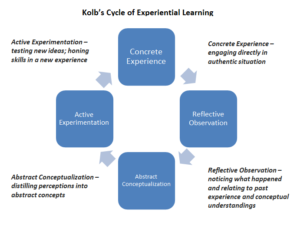
The easiest way to describe experiential learning is with the simple phrase, “learn by doing.” Experiential learning follows the principle that people learn best by actual practical experiences, so there is an emphasis on things such as hands-on activities, practicums, and field experiences. This theory was first proposed in the 1980’s by psychologist David Kolb, and it uses the basis that experience’s that people connect to through emotion, cognition, and the environment they were in at the time influences the learning process. Kolb (1984) created a cycle (pictured below) to better explain the thought process behind experiential learning; where concrete experience feeds into reflective observation which feeds into abstract conceptualization which feeds into active experimentation which then feeds back into finding more concrete experience to test one’s new ideas from active experimentation. The important thing to remember is that this theory is a cycle and not simply a static concept – it is a process as each component pushes forward into the next.
Experiential Learning. Boston University, n.d.
How is Experiential Learning Connected to Visual Arts?
I believe a very strong case can be made that there are many connections between visual arts and experiential learning. When the theory in question is focused on hands-on activity, and so much of art is the process of creation; the two concepts seem to go hand in hand. In early grade school, students are often given time to draw and create their own works of art, and then explain it to the class. This process is actually perfectly aligned with experiential learning, as children doing and then explaining follows Kolb’s cycle of concrete experience followed by reflective observation, and then through the comments or questions of their classmates that will lead them to more abstract conceptualization and then having new ideas to continue honing experience and so on and so forth. Creation is so closely connected to actions and doing, and art is something that does not lend itself to be taught strictly in a classroom with no opportunity to try it hands-on. Although the theory does have an emphasis on experience and the process of “doing” – reflection has equal importance in the theory, with this quote from the Association of Experiential Learning explaining, “Reflection on learning during and after one’s experiences is an integral component of the learning process. This reflection leads to analysis, critical thinking, and synthesis.” Visuals arts also places importance on reflection; as an artist must look at their work to see what they were trying to convey, how they did with making that message come across, and how they used whatever color/technique/medium to send whatever message they were trying to send. Because of this, there is a definitive link between visual arts and the way that experiential learning can and has been used to teach it.
How is Experiential Learning Connected to our Learning Resource?
My group’s learning resource is about children partaking in a collaborative mural assignment where they would use paint to create and then display their work. This concept is very much in line with what we have already established about experiential learning. The hypothetical children in this scenario are engaging in a hands-on activity of using paints to express themselves, and they must reflect and have conversations with each other as well as instructors to communicate their thoughts. They are indeed following the principle of “learn by doing” as they are in control of physically putting the paint onto the walls and explaining their process. The students would need to have an idea, plan it, and then apply it in a real-world setting and reflect on it; while instructors provide suitable support, bring up and facilitate questions, and provide resources. In the context of our learning resource, the experiential theory can be used to shape and help facilitate proper discussion in it’s connection to creation, so in that way I think it’s of immense value to incorporate elements of this learning approach into our blueprint.
]]>https://caprim.opened.ca/experiential-learning-visual-arts/feed/2Comments 1
https://caprim.opened.ca/comments-1/
https://caprim.opened.ca/comments-1/#respondMon, 21 Sep 2020 17:41:18 +0000https://caprim.opened.ca/?p=91I was really struck by Soals’ post about overcoming the good art complex because this is something that has had a certain impact on my life as well. From my own experiences, I can definitely empathize with the pressure that the only valid art is “good” art, and the idea of art only being possible with mastery and that mastery being represented as realism. By putting very rigid notions of what it means to be “art” we end up limiting who is “allowed” to create, when in actuality art doesn’t need to achieve these mind-boggling feats that we expect it to in order for it to be of worth. When I show someone something I’ve drawn or created, I feel the need to do an immediate disclaimer as they look at it by saying “I’m not an artist but here it is” so that way if it is considered “bad” I don’t have as much personal stake in the matter. This is a very limiting and unfortunate byproduct of our Western notion of art, and it results in feelings of shame or inaccessibility over something that is inherently accessible. Instead of learning or growing for the enjoyment of a craft, people are instead learning for the sake of getting to put an arbitrary label of outward approval, and it takes the joy out of discovery. I absolutely agree with Soals’ statement that it’s important to push past these biases and rediscover yourself.
Reading Latenight11’s blog post about learning the ukulele reminded me of my own story of maintaining motivation and not giving up. Just like I had a support system that helped me when I doubted myself; they too had a support system in the form of their roommate. What made Latenight’s experience even better is that their roommate ended up joining them and they learned ukulele together, so this shared experience became even more fruitful when they had each other to keep the other accountable. You really get the sense reading all these posts that having someone who encourages you and gives you positive reinforcement makes all the difference when it comes to learning, and this is an approach that sees practical results.
Both of these posts helped me think more about the prompt and my own experiences, so thank you for writing Soals and Latenight11!
]]>https://caprim.opened.ca/comments-1/feed/0Blog Post 1: Learning, Motivation, and Theory
https://caprim.opened.ca/blog-post-1-learning-motivation-and-theory/
https://caprim.opened.ca/blog-post-1-learning-motivation-and-theory/#commentsFri, 18 Sep 2020 22:30:37 +0000https://caprim.opened.ca/?p=88Share a story about your best learning experience. Why did you enjoy it?
For me, my best learning experience was ironically, in a case where I was learning how to teach. For three years I was a teacher’s assistant in a second-grade classroom, where I was learning every day how to interact, teach, and engage with young children. This was a steep learning curve for me, because even though I loved kids; I had never been around them for an extended period of time, and especially in a context where I was supposed to be more of an authority figure. This combination could have easily been disastrous if I had had a subpar mentor. Luckily though, this was not the case for me. What made this experience such a positive one was that I had the pleasure of working with a teacher who was able to learn and adjust her approach after she got to know me and my own learning style more.
Like it is mentioned in Motivation and Learning, knowing your target learners will increase the likelihood of increased motivation. There were many times during those years that I felt frustrated or discouraged at how things were going, but because my mentor understood who I was and how I worked best; she was able to help me work through these difficult times and mental walls. I already had an interest in teaching, as I mentioned earlier in this post I had always loved kids, but if that interest wasn’t fed into positively then it very well could’ve died out. When considering the question, “Why were you so invested in seeing it through?” It’s because I had that very firm and consistent support system that was able to help me navigate through uncertainty and lapses in motivation. I enjoyed this experience so much because it was about more than learning, but also about building bonds not only with my mentor but with the kids I was working with. Because I was so well supported, I was then in a better state to support the children too and so on and so forth. Those positives mindsets could then see into other intrapersonal relationships, and every person in that environment was then better off for it. This example of my own best learning experience is one that I hold very highly because it was able to show me the tangible positive effects of fitting a teaching approach to specific learners.
]]>https://caprim.opened.ca/blog-post-1-learning-motivation-and-theory/feed/3Introduction to Me!
https://caprim.opened.ca/introduction-to-me/
https://caprim.opened.ca/introduction-to-me/#commentsTue, 15 Sep 2020 01:51:34 +0000https://caprim.opened.ca/?p=80Hello everyone! My name is Capri and I am a third-year anthropology student who is very excited to be welcoming you all to my blog! I’m majoring in anthropology and minoring in education, with the hope of honing in on the connection between youth and culture as a bridge between the two subjects. I desperately wish I could be in Victoria, but I’m actually back in my home state of Washington right now with my parents. I’m an international student who came to Canada to study, but unfortunately, I’m stuck in the U.S for the time being! Regardless, I’m really glad that I’ll still have this opportunity to learn and connect with other students this semester as we all go through navigating online learning, and to be able to write out some of these thoughts using this blog!
In my free time, I just like to play the Nintendo Switch, read, watch movies, and other pretty normal things that I’m sure we’ve all spent a lot of time doing over the past couple of months. I’m a huge fan of attending concerts and live music as well, but those have understandably not been very common as of late. At the end of this first post, I’ve also attached a photo of my dog Muffin who keeps me company. She is absolutely the light of my life and if anyone would like more pictures of her I am happy to provide. Hopefully, that’s a good amount of info to get to know me a little better! Please anticipate more of my blog posts sometime in the near future!
]]>https://caprim.opened.ca/introduction-to-me/feed/1Test Learning Design Post
https://caprim.opened.ca/test-learning-design-post/
https://caprim.opened.ca/test-learning-design-post/#respondSat, 02 May 2020 21:43:45 +0000https://caprim.opened.ca/?p=43This post will appear in a few places:
in the blog feed on the front of your website
in the Learning Design menu on your website. This is because we have applied the “edci335” category to this post and the menu item “Learning Design” has been created from the category “edci335.” For every post you make for this course, please assign the “edci335” category to it. You are welcome to use this blog for your personal hobbies or for other courses, in which case, you could create additional menu items and categories for them.
if you give permission, your posts categorized “edci335” will be aggregated onto the Blog Feed on the EDCI 335 Course Website.
Feel free to delete this post once you understand this. If you have any questions, please reach out to your instructor.