


S3 E6: With... Elysia Brown
-
Mia and Sam are joined by their Museum colleague Elysia Brown! Elysia is
part of the Visitor Experience team at the Parsonage, volunteers for the
Publish...
1 day ago
| CARVIEW |

The influence of British colonialism on the Brontës and their work is examined in a new exhibition.The Colonial Brontës focuses on the period of exploration, conquest and intercultural encounters of the late 18th and early 19th centuries.And it illustrates the extent to which the literary siblings were fascinated by colonial military campaigns and British missionary activity.The exhibition – at the Brontë Parsonage Museum, Haworth – opens on Wednesday, February 4, and continues until January 1, 2027.Professor Corinne Fowler, honorary professor of colonialism and heritage at the University of Leicester, is a co-curator of the event.She says: "The Brontë children were avid readers and their literary imaginations were fired up by what they learned about British colonial activity in Africa and India."This exhibition reveals that the young Brontës fictionalised real-life colonial battles, British explorers, missionaries and Asante warriors. It identifies their source material and traces the influence of empire writing into their mature works, particularly Jane Eyre and Wuthering Heights."In 1826, Charlotte – then aged 10 – nine-year-old Branwell , Emily, eight, and Anne, six, invented their own colonies, collectively called the Glass Town Federation.They used the imaginary world as a setting for stories, poems and plays.Their 'kingdom' was inspired by the real-life Asante Empire in West Africa, an area regularly in the news of the day.Ann Dinsdale, principal curator at the Brontë Parsonage Museum, says: "This exhibition shows how these young Yorkshire children interpreted world news, incorporating it into their play and later their adult writings. That they were able to look critically at global events gave them a world view that was ahead of its time."And Rebecca Yorke, museum director, says: "We are delighted that Professor Fowler accepted our invitation to co-curate this exhibition with us. Academics and readers alike have long discussed the influence of colonial Britain on the Brontës’ lives and works, particularly in relation to the story of Heathcliff, and with a new film adaptation of Wuthering Heights about to be released it is a fitting time to explore the connections between what the Brontës read and wrote."Exhibits include manuscripts created by the Brontës as children, items relating to race and Heathcliff’s ethnicity, reading materials – with handwritten notes and doodles – and matchbox-sized miniature books. (Alistair Shand)
A stunning nature reserve, whose landscape famously inspired the Brontë sisters, is being touted as a must-see for nature enthusiasts and wildlife lovers.This pioneering nature reserve in West Yorkshire has been making waves after recently being named one of the wonders of the world to visit in 2026 by esteemed international travel magazine, Condé Nast Traveller.The picturesque reserve was established in May 2025 as part of King Charles' initiative of 25 National Nature Reserves (NNRs), designed to conserve wildlife and celebrate UK landscapes by providing enhanced protection to the unique topography within these designated areas.Covering 3,148 acres (1,274 hectares) - roughly double the size of Ilkley Moor - the reserve connects eight natural sites within the Bradford and South Pennines area, including the famous Penistone Country Park in Haworth, once home to the Brontë sisters, Charlotte, Emily and Anne. (Parul Sharma)
I came to Brontë country fully signed up for the unfiltered Wuthering Heights experience: the tumult of windswept moors, storm-beaten farmhouses, haunting heroines, nature wild and untamed. I didn’t think it would turn its full fury against me.I’ve been halted on a riverside track that leads to the stone farmhouse where I’m staying, set on a hillside in the Yorkshire Dales. [...]I’m not sure how long it takes me to reach the house; all I remember is more barely passable breaches, clinging on to a mossy stone wall here, a rotten plank there, while the river gnashed at my legs. I couldn’t help but compare my state to Cathy’s after one of her outdoor misadventures — “as dismal as a drowned whelp” — but this wasn’t the immersive Wuthering Heights experience I had in mind.To the south, a stretch of the Pennines in Lancashire and West Yorkshire has been a magnet for Brontë tourists since the 19th century. The sisters’ eternally alluring novels, their rootedness in this landscape, and the mythology surrounding Emily, Charlotte and Anne’s genius — Emily being the most enigmatic of all — have birthed what can feel like an open-air literary theme park.Any connection to the family or their work, true or tenuous, will appear on a bus route, walking map or TikTok video. And each film adaptation attracts a new wave of Brontë pilgrims. The latest version of Wuthering Heights, directed by Emerald Fennell, lands on February 13 and Brontë country is bracing itself for the Insta-crowd, along with the notion of Cathy (Margot Robbie) in red latex and Charli XCX picking up Kate Bush’s hooded mantle on the soundtrack.I started my tour at the latest attraction to open to the public, the Brontë Birthplace, part museum, part magical guesthouse. Nothing tenuous about this link: the three authors and their brother Branwell were born in the house in the village of Thornton, a few miles west of Bradford. Emily was barely a toddler when the family left in 1820 for the famous parsonage at Haworth, but it’s an ideal scene-setter for my pilgrimage.Anna Gibson, the Brontë Birthplace general manager, tells me that when the eponymous non-profit society bought the terraced house in 2023, it had been “split into flats, shops, restaurants, all sorts” over the previous two centuries. For many years, a butcher’s shop had its sausage-making machine in front of the very hearth where the novelists are said to have been born.Restored and opened last year, there are three bedrooms. I’m the lone guest on this January midweek night, so choose the largest, where Emily slept alongside her siblings — there were six children under the age of six in the house (not a typo, and none were twins). At a window, a small mahogany mirror marks the spot where their father Patrick is said to have shaved, looking onto Market Street below.The fireplace, like most in the Birthplace, is original, but not the furnishings; most available Brontë furniture has been snapped up over the past century or so by the Brontë Society for the Haworth parsonage, now a museum. Instead, the dark wood pieces here are sourced locally, says Gibson, dated “1820 or a bit earlier, because they weren’t wealthy people and some of it would have been second-hand”. An exception to the faithful staging is my bed, a four-poster that’s closer to the luxury Charlotte might have afforded later in life, as the only sibling who survived long enough to enjoy her income.Left alone, I can’t resist creeping around the house in the middle of the night, imagining the torch on my phone to be a chamberstick candle. The room I’d love to revisit in the dark is the maids’ quarters in the attic above the kitchen, with its low ceiling, narrow stone staircase, rocking chair and creepy nursery furniture. When Gibson showed me the attic room earlier, she told me a visiting YouTuber had opened a cupboard, only to feel like she was poked in the eye by an invisible hand.But, alas, the room is only accessible in the daytime. I realise I’m being ridiculous: I only stepped off the train in Leeds a few hours ago and I’m already yearning to be haunted by my favourite Victorian novelist girl-crush.Day breaks, and I have been ignored by any tiny Brontë ghosts. The Birthplace has a new café but doesn’t yet offer breakfast. Instead I walk a couple of minutes to Plenty at the Square, a wholesome vegetarian spot linked to a community arts hub where, in view of the incoming storm, a fellow diner and a waitress insist on giving me cardboard boxes to wedge under my tyres in case I get stuck (I will).Past some of Thornton’s well-preserved narrow alleys, as well as 20th-century housing and a bypass, is a graveyard where the ruin of the Old Bell Chapel lies. This, along with an ivy-covered octagonal bell tower, is all that remains of the church where Patrick Brontë served as curate. It’s deliciously gloomy in the pale grey mist.I’m in the mood for the stuff of the novel. The moors are calling.It’s early January and daylight is limited, but there’s time for one of the shorter walks to Top Withins, a ruined farmhouse on the moors west of Haworth — a place long associated with the Earnshaw homestead that gives Emily’s only novel its title. From the village of Stanbury, it’s only a couple of kilometres, partly on a path that today would be better suited to crampons than to my trusty Merrell’s. After passing some empty stone houses, I reach Top Withins and look out at a panorama of desolation, frozen and starkly beautiful.The craggy ruin is marked by a plaque that bears the tone of a purse-lipped postwar Brontë Society volunteer: yes, its “situation may have been in her mind” when Emily wrote Wuthering Heights but no, the building “bore no resemblance to the house she described”. Today, it’s a perfect match for the account Lockwood, the visiting southerner, recounts of his first approach to the house: “On that bleak hill-top the earth was hard with a black frost, and the air made me shiver through every limb”. There’s even a closet-sized room with two small holes for casement windows — impossible not to imagine Cathy’s “ice-cold hand”.Over the afternoon I spot just a few walkers — all, unlike me, prepared with trekking poles — and hear only a “sleet-laden wind” and the call of grouse. On the way back, pheasants’ footprints have joined mine in the snow. Suddenly a dark slab of concrete sky is descending and urges me onwards to the house that for the rest of my stay will be my real-life “perfect misanthropist’s heaven” (as a naive Lockwood idealises the neighbourhood he’ll share with Heathcliff).Like the location scouts for Fennell’s film, I’ve decided that to capture the isolation of Emily’s fictional farmhouse, today’s Brontë trail won’t do. I head north to Cowside, a late-17th-century stone farmhouse in the Langstrothdale valley, a little over an hour’s drive from Haworth. The surrounding land is still used for grazing, punctuated by field barns and drystone walls; Cowside still has its old piggery and henhouse.The Landmark Trust, which restores historic buildings and opens them to guests, has returned the house to its form circa 1800. Inside, there are flagstone floors, mullioned windows, moulded ceiling beams — but also underfloor heating, soft linens and wood burners in the inglenook and stone fireplaces. Most transportive is a quote from Corinthians, uncovered during the restoration, painted in gothic script on the walls of the parlour: “Whether ye eat, or drink or whatsoever ye do, do all to the glory of God.”Even without a flash flood, reaching Cowside isn’t the easiest for a city-dwelling bookworm. After the riverside track — SUV recommended — there’s a climb of about 300 metres with all your wood and food for your stay (a wheelbarrow is provided).But I am smitten, tending my fires, reading my books during wintry nights of true darkness and silence broken only by a nearby owl or creaking branches. This is the place to find yourself inside the spaces of Emily’s novel; to experience a “life of such complete exile from the world”, as the residents of Wuthering Heights do.If Brontë country is a literary theme park, Haworth’s Brontë Parsonage Museum is its Magic Kingdom. This is where Emily lived from 1820 until her death in 1848; it’s where all the Brontës wrote their novels.I tour the parsonage with Sam Harrison, its programme officer. The carefully preserved rooms are quiet, and other visitors — a tall couple dressed in formal black, a mother and daughter with an endearing shared enthusiasm — talk in hushed tones or not at all. The most important space is the dining room, housing the table where Emily, Anne, Branwell and Charlotte wrote, and around which they would promenade while sharing their work. The letter “E” is roughly engraved on its top, though no one can prove Emily is the culprit.The most evocative piece of furniture is also here: the couch where Emily died, aged 30, three months after Branwell and six months before Anne. Some fans burst into tears upon seeing it, Harrison tells me. Opposite, the windows look directly onto the graveyard, through which each Brontë (except Anne, buried in Scarborough) was carried to the family vault under the church; their mother Maria had been first, when Emily was three, followed by the eldest siblings Maria and Elizabeth, 11 and 10. It would have been an even starker sight then, with no trees to soften the view, nor curtains. Patrick refused to install them, having held too many funerals of children who had died in house fires. Little wonder that Emily has young Catherine say, “I feel and see only death!”In spite of the numerous biographies, we know little about Emily as a person, adding weight to the clues offered by each of her possessions. Almost all are the tools or product of creative discipline. She played the cabinet piano in Patrick’s study; there’s her portable rosewood writing desk with pens, nibs and blobs of sealing wax; her mahogany paintbox and geometry set; and minutely detailed sketches and paintings by all the siblings.Their father was a published author of poetry, fiction and political prose, and kept a good stock of books. It all belies the myth, started by Charlotte, that Emily, having “no worldly wisdom”, wrote “from the impulses of nature”. The residents of this house were serious about art and literature.And yet, all that mythmaking succeeded in bringing us here. Since it opened in 1928 people have visited from all over the world; at the entrance I count printed guides in a dozen languages. What would the Brontës make of all this? “They’d probably think we’re mad — ‘What are you doing putting our stockings on display?’ — but I like to think they’d be amused by it all,” says Harrison.After paying respects at the Brontë chapel and vault inside the church, it’s a few steps to the open country. The parsonage really is right on the edge of the moor. Death on one side, untamed wilderness on the other. For Branwell, there was a third way: the Black Bull Inn, where, along with the apothecary where he procured his laudanum, the struggling Brontë brother fed his addictions. In the pub’s lunchtime din I find the mason’s chair said to be his, under a stained-glass window. Legend has it that when his family came looking for him, he’d escape through the kitchen.A signposted route from the graveyard through Penistone Hill Country Park and across Haworth Moor leads to the Brontë Waterfall, which makes a sweet site together with the “Brontë chair” (a seat-shaped rock) and a rebuild of the diminutive Brontë Bridge (the original was swept away by a flash flood in 1989). On dry days, the falls can be underwhelming. On my second visit, after the snowmelt, it’s gushing. This circular route continues to Top Withins and Ponden Hall, a house associated with the fictional Thrushcross Grange (and now partly an Airbnb).It must be said that the Brontë associations claimed for some sites are about as authentic as the pun-riddled merch on Haworth’s Main Street, from mugs to haunted dolls to droll “Never Mind the Brontës” pastiches (mimicking the cover of the Sex Pistols’ single “God Save the Queen”).Yet fan fantasy is endemic to the Brontë business. Like Shakespeare, their universal themes are ripe for modern retelling, Emily’s scant biography bound to draw speculation, clashing claims, even tedious controversy. We might see Wuthering Heights’ adaptability tested to the limit next month. But everyone I meet, from Anna Gibson at the Brontë Birthplace to the cashier at the Parsonage Museum gift shop, shares a superfan’s excitement about the new film. (Maria Crawford)
In a recent Fandango interview, the filmmaker and her star, Margot Robbie, suggested their aim is for a visceral reaction to the film. Robbie recalled how Fennell spoke about the goal she hoped to achieve with the audience. “One of the first things Emerald said to me was, ‘I want people to cry so hard they vomit.’ I was like, ‘This sounds very appropriate, actually,’” she laughed.I don’t think I’ve ever had such a reaction to a movie. Hell, has anyone? If this did happen to you, I hope you sought medical attention.Fennell recently stated that she aimed for “Wuthering Heights” to “become this generation’s Titanic.” She’s described shooting the film as this self‑inflicted emotional challenge — “a kind of masochistic exercise.” This project, in her words, is the film she’s been waiting to make her entire life. Meanwhile, Robbie claims her co-star, Jacob Elordi, is so good in the film that she’s convinced he’s “this generation’s Daniel Day-Lewis.”On a side note, pre-sales for “Wuthering Heights” are currently strong, hinting at a $30M-$35M domestic opening weekend. This would easily be the biggest box office opener of Jacob Elordi’s career, and Margot Robbie first hit since “Barbie.”Furthermore, the film recently got stamped with an “R” rating: for “sexual content.” Test screenings had mentioned the notable amount of hyper-sexualized imagery — far more explicit than any previous adaptation of this material. The runtime listed on AMC’s website is 135 minutes.“Wuthering Heights” has a production/distribution budget reported at around $80M. That figure largely reflects the deal Warner Bros. struck to acquire and back the film after a competitive bidding war — including a higher reported offer of around $150M from Netflix that Fennell and her producers ultimately declined in favor of a theatrical rollout. (Jordan Ruimy)
When we meet in the run up to Christmas, the 28-year-old is making the most of her time off before embarking on a global press tour for Wuthering Heights, Emerald Fennell's sensationally anticipated interpretation of Emily Brontë's classic gothic novel about the destructive love affair between Catherine 'Cathy' Earnshaw (played by Margot Robbie) and Heathcliff (Jacob Elordi).Oliver plays Isabella Linton, the spoiled sister of Edgar Linton, whom Cathy marries. 'She’s a very repressed character who is desperate for love,' says Oliver, explaining Fennell's version of Isabella. 'Emerald’s interpretation of Isabella’s story is the reverse of Cathy's; there's an uncorseting of her. Like she becomes undone. There’s something so powerful about being underestimated.'The role was given to Oliver early on via a text from Fennell, who she had previously worked with on Saltburn, in which Oliver played the blonde, chain-smoking Venetia Catton. 'She said, if you want Isabella, she's yours.' Fennell had Oliver in mind from the beginning. 'She is the most remarkable actor,' says the director over Zoom. 'We saw so many people for Saltburn, and Alison came in and was just so unbelievably real. Even the way she breathes is different.' A similar crew worked on the two films, which were both written and directed by Fennell.'And yet a lot of people didn't recognise Alison,' Fennell laughs. 'She's so good that she disappears.'Much like Saltburn, Wuthering Heights has been setting the internet alight, with claims of oversexualisation, historical inaccuracies and whitewashing (Heathcliff is described as 'dark skinned' in the book), all before its release. Fennell brings in her own idiosyncratic reimagining with music by Charli XCX and provocative scenes – the film reportedly opens with a public hanging in which a man ejaculates mid-execution.'It’s how Emerald experienced the book when she read it as a teenager,' says Oliver. 'So it's not what's on the page, and I don't think that's what it's trying to be.' Does she think the film will make a Saltburn-style splash? 'You’ll never be bored by an Emerald Fennell film,' the actor replies, carefully. 'I think it will make noise, but you never know how things are going to be taken. I’ve learnt that it's not really my business to worry about that.' (Olivia Petter)
.png)
Saturday 24th January–March 2026Brontë Birthplace, ThorntonWe are delighted to announce Garett Wilde as our next Artist in Residence at the Brontë Birthplace.American-born photographer and Social Media Marketing Manager, Garett Wilde now lives locally in Haworth and draws deep inspiration from the landscapes, architecture, and atmosphere of the Brontë Country. His work captures the intimate details of the moorlands and historic built environment, shaped by a profound admiration for the Brontë Sisters and the folklore, and history of the region.Garett’s photography is immersive and evocative, focusing on natural light across the four seasons to reveal the raw, magical qualities of the landscape he walks daily. His work invites viewers to slow down, observe closely, and experience Brontë Country through a contemplative lens — while also reflecting his passion for travel and exploration beyond the moors.Brontë Country and Beyond forms part of our ongoing Artist in Residence programme, celebrating contemporary creatives whose work resonates with the spirit, landscape, and legacy of the Brontës.
Shepherding is also just something you can do in England’s more inhospitable environments, where other forms of working the land aren’t going to turn much of a profit. That means you’ll see a lot of sheep in adaptations of books by the Brontë sisters, which are set in such cold and dreary and wet places. In the trailer for 2011’s Jane Eyre, you’ll notice Mia Wasikowska on her quest for freedom and self-determination. (There, sheep stand for all of the metaphors above as well as a symbol of civilization and stability in a world of Hobbesian cruelty.)And if you go all the way back to the 1939 adaptation of Wuthering Heights with Merle Oberon and Laurence Olivier? They’re riding on horseback past a big flock of sheep in the midst of their tempestuous passion. The imagery is maybe a little different here. Catherine and Heathcliff are wolves! They’re dangerous! They’ll tear the sheep around them apart.But this brings us all the way around to a point at the end of this blog post. So far, Warner Bros. has released two trailers for Emerald Fennell’s smoldering and sensual adaptation of Wuthering Heights with Margot Robbie and Jacob Elordi (a guy, we have already established, who is familiar with sheep-related drama). Neither trailer includes any sheep. There’s Heathcliff, shirtless in a barn, lifting hay that might eventually be fed to sheep. And Heathcliff looking out over the moors, where he should probably be tending to a few sheep. (In case you haven’t read the book, he is made to be a servant on the estate before he goes off and gets mysteriously rich. He should know about sheep.)Emerald Fennell, are you going to deny period-drama fans the pleasure of a few shots of herds of sheep? Is the movie, which includes a soundtrack by Charli XCX, going to be so bah-ratty that it doesn’t give us some livestock? Can you promise that there will be at least one sequence where we see either Robbie, Elordi, or even Hong Chau in frame alongside a sheep and that it will be metaphorically important? I know you’re not someone to turn down an on-the-nose image! Emerald, promise me sheep, and only then will I buy a ticket. (Jackson McHenry)
Wednesday, January 28, 20265:30 PM 10:00 PMDeets: The anticipated premiere of Wuthering Heights is rolling out the red carpet in LA.A bold and original imagining of one of the greatest love stories of all time, Emerald Fennell’s “WUTHERING HEIGHTS” stars Margot Robbie as Cathy and Jacob Elordi as Heathcliff, whose forbidden passion for one another turns from romantic to intoxicating in an epic tale of lust, love and madness.Who You May Spot: Jacob Elordi, Margot Robbie, Charlie XCX, and moreHint for the Average Socialite: This event is invite only.
Wuthering Heights will premiere in London on February 5. Like most premieres in the capital, the movie’s stars are expected to walk the carpet from around 5.45pm. [...]Wuthering Heights will have its London premiere in the heart of the capital’s cinema district, Leicester Square at the spot’s Odeon Luxe. [...]The film’s stars including Margot Robbie and Jacob Elordi as well as Alison Oliver, Hong Chau, Shazad Latif, Martin Clunes, Ewan Mitchell, Charlotte Mellington are just some of the stars expected to walk the red carpet.Director Emerald Fennell and pop icon Charli XCX who has worked on the film’s soundtrack is also set to attend. (Amber Peake)
Following Emerald's last sizzling film Saltburn, fans of the writer and director are awaiting a steamy take on Wuthering Heights, with Margot Robbie and Jacob Elordi leading the cast as star-crossed lovers Catherine and Heathcliff in the movie.Alison shared insight into her role as Isabella Linton in the film, adding: 'She's a very repressed character who is desperate for love.'Emerald's interpretation of Isabella's story is the reverse of Cathy's; there's an uncorseting of her. Like she becomes undone. There's something so powerful about being underestimated.'Alison added that she learned she'd got the role after Emerald sent her a text message, after she previously worked with The Crown star on Saltburn.'She said, if you want Isabella, she's yours,' the star revealed.In the wake of speculation that this version of Wuthering Heights will be racier than others, Alison said it will reflect Emerald's experience of reading the gothic book.She revealed: 'It's how Emerald [Fennell] experienced the book when she read it as a teenager. So it's not what's on the page, and I don't think that's what it's trying to be.'You'll never be bored by an Emerald Fennell film. I think it will make noise, but you never know how things are going to be taken. I've learned that it's not really my business to worry about that.' (Laura Fox)
Following this thinking, there obviously are other books that kind of fall into similar narration/plot styles like Northanger Abbey and Jane Eyre (cause Jane Eyre is just a Northanger Abbey 2.0). (The Austen Shelf)
%20(1).jpg)
CICO BooksISBN: 978-1800655751January 2026Step into the atmospheric worlds of the Brontë sisters’ novels with these INSPIRATIONAL and EMPOWERING quotations.From Emily’s Wuthering Heights to Charlotte’s The Professor and Jane Eyre and Anne’s The Tenant of Wildfell Hall, here you’ll find the most iconic lines from all of their much-loved works.Thanks to their power and originality, the Brontës’ novels and poetry hold enduring appeal and provide endless inspiration, even 200 years after the sisters were born.Covering themes including independence, resilience and gender roles, here you’ll find empowering quotes from these pioneering sisters who rebelled against the limitations of their time.Relive the emotional power and passion of their novels through lines on romantic love, and discover haunting quotations on the supernatural and the beauty of nature.Designed with stunning typography and illustrations, this beautiful book is perfect for keeping to hand, whether you want to find guidance, solace or use the quotes as a stepping-off point for exploring more of the Brontës’ works.
In a recent cast interview with Fandango, the Barbie actor opened up about what it was like to work alongside Elordi. “I'm so codependent with people I work with, and I love everyone so much, and I'm always that person who's so devastated when a job's over and I never want it to end,” she said. “I think I developed that quite quickly with Jacob, too.”Robbie then recalled the Saltburn actor’s behavior on set, noting how he was always around whether he needed to be or not.“I don't know if Emerald told you to do this or you did this,” she told Elordi while referencing the film’s director, Emerald Fennell. “But I remember the first couple days on set, he would just be always in the vicinity where I was, but like in a corner, watching Cathy.”“I didn't tell him to do that,” Fennell chimed in. “I actually had to ask him to leave.”The Suicide Squad actor continued, explaining that she had gotten so used to Elordi being around, she began to look for him and was “unnerved” when she discovered he was not watching her.“I felt quite lost, like a kid without their blanket or something,” she added.Elordi agreed that he felt the same way about his co-star, calling it a “mutual obsession.”“If you have the opportunity to share a film set with Margot Robbie, you're going to make sure you're within 5 to 10 meters at all times, watching how she drinks tea, how she eats her food ... She's just like an elite actor,” he said. (Brittany Miller)
Three tracks from Charli XCX have been released so far in anticipation of her upcoming album Wuthering Heights. This piece will focus on Wall of Sound, her latest release. Taken together, the three tracks feel like a kind of loading screen for the album. The first two tracks, House featuring John Cale and Wall of Sound, have a distinctly cinematic quality, as if they exist mainly to build atmosphere and tension. That said, they still sound great. Chains of Love feels like the most fully realized song of the three.As a die-hard Charli fan, these tracks give me no clear sense of where the album is headed. Wall of Sound in particular feels more epic and cinematic than anything I have heard from her before. The track unfolds like one long breakdown, stretching and hovering rather than resolving. Somehow, Charli has already sold me on the album before it is even out. Maybe she is a master at this, or maybe I am just easily persuaded.With Brat being such a massive success, it is hard to predict where Charli will go next. She may have been working on something entirely different alongside Brat, or perhaps its overwhelming popularity pushed her instincts in a new direction. Brat was undeniably influential. Like ripples spreading across water after an impact, its sound quickly echoed outward, with other artists drawing directly from Charli’s ideas. Watching this happen in real time has been fascinating. I have rarely seen other major artists so openly mirror one person’s work. I will not name names, but the point stands. It only underscores how influential Charli really is.In the end, Wall of Sound tells me almost nothing concrete about Wuthering Heights. It is soft, swaying, and leaves the album feeling wide open with possibility. In the next few weeks, Wuthering Heights will be released, and we will finally get some answers. (Peter Källman)
Want to see it first, before the masses? We’re giving away two tickets to the exclusive, highly anticipated red carpet Irish premiere in Dublin on Tuesday, February 10. With a special post-screening after party, we can’t think of a better way to celebrate the upcoming Valentine’s Day weekend.
Sister Charlotte is only the second most noteworthy Charlotte linked to the house — and by coincidence, she was born in the same year that her more illustrious namesake visited Norton Conyers. Charlotte Brontë came to the house in 1839, and was — according to her friend Ellen Nussey — much impressed by the house in general, and in particular a dark tale that was part of the Graham family history.'Like any good novelist, Brontë used her impressions of several houses to build up a picture of Thornfield, Mr Rochester's country seat in Jane Eyre,' Gervase Jackson-Stops wrote in Country Life in 1986, shortly after Sir James took over the the stewardship of the house. 'Yet Norton Conyers, which she visited in the summer of 1839, as governess to the then-tenants' grandchildren, contributed one of the most important ingredients in the book — the Graham family legend of a madwoman confined in the attics.'The woman in question was referred to as 'Mad Mary', as Lady Graham herself explained in a 2003 article in Country Life. 'Who she was, whether servant or family, is not known,' Lady Graham wrote. 'Perhaps she was a servant who had children by "master" and who suffered from epilepsy or post-natal depression rather than madness.'Although Brontë's connection to Norton Conyers was well known for many years, confirmation of the existence of the attic didn't come until part of the long refurbishment work undertaken by Sir James and Lady Graham removed some panelling to reveal a previously hidden staircase. Sir James — whose family have owned the house since the mid 17th century — asked for a hollow-sounding panel to be investigated, and his hunch proved correct: stairs up from the 'Peacock Room' to an attic room were uncovered.There seems little doubt then Brontë based her timeless tale in large part on Norton Conyers. ‘We believe that the house inspired Thornfield Hall and the mad Mrs Rochester in Jane Eyre,’ observes Lady Graham. (John Goodall)

Edited by Pascale DenanceL'HarmattanISBN: 9782336479477January 2026Emily Dickinson et Charlotte Perkins Gilman écrivaient dans un contexte difficile. Bien des obstacles auxquels ces autrices étaient confrontées apparaissent en mise en abyme dans leurs textes. Sans cesse présentifiés par nos lectures successives, ces derniers annoncent un futur qu'ils contribuent à créer : filtre précurseur des textes théoriques et de la réalité à venir, ils transcendent toute appréhension figée de l'être et du temps.
Figures archétypales de rebelle dans trois romans du XIXe siècle : Pride and Prejudice, Jane Eyre et MiddlemarchComme beaucoup de romans majeurs du XIXe siècle, Pride and Prejudice de Jane Austen, Jane Eyre de Charlotte Brontë et Middlemarch de George Eliot privilégient l’exploration d’une conscience de femme et l’expression d’une protestation politique et sociale en posant un regard sur le monde d’un point de vue différent. La lecture proposée ici se fait à partir de l’étude de la réécriture de trois figures archétypales de rebelle : Lilith, Antigone et la femme de Barbe Bleue. Ces archétypes fournissent des modèles identitaires à des formes différentes d’engagement politique : la révolte radicale et sans concession, la fuite, et enfin une lutte pragmatique contre l’injustice. On peut mettre au jour la présence d’une combinatoire de ces divers paramètres dans chacun des trois romans considérés et montrer ainsi la force, mais aussi les limites de ces archétypes en tant que modèles identitaires.
Jane Eyre by Charlotte BrontëJane Eyre is one of my favorite novels; it is a beautiful, complex story with innumerable plot twists and layers of meaning. The novel is written from the perspective of the titular character, a lonely, reserved orphan girl, who desperately longs to find a family and a sense of identity. This novel is another 10/10 for me; I highly recommend it. Read my article on Jane Eyre to find out more about the novel. (Katherine Stevenson)
Thu 22 Jan, 2:30pmBrontë Event Space at the Old School RoomJoin us at the Brontë Parsonage Museum for a screening of Hollywood’s 1943 Jane Eyre. Starring Orson Welles and Joan Fontaine, it’s classic Hollywood: dark and moody, despite the entirely Hollywood-shot locations! Whilst not entirely faithful to the novel, it’s difficult not to be captivated by the performances and to enjoy the gothic romance elements. It’s a must-watch for fans of classic Hollywood!Refreshments will be provided.
Jacob Elordi has admitted to having an 'obsession' with Margot Robbie during the making of Wuthering Heights.In a new interview, the 28-year-old Frankenstein actor said the feeling was 'mutual' between the two Aussie stars.The Brisbane-born star gushed that he made sure he was no less than 10 metres away from the Barbie actress 'at all times'.'We have a mutual obsession,' he told US entertainment platform Fandango, as the 35-year-old blonde beauty sat nearby.'I think the thing is, regardless of plot or screenplay, if you have the opportunity to share a film set with Margot Robbie, you're going to make sure you're within 5 to 10 metres at all times.'Watching how she drinks tea, how she eats her food, how she does it. When is it going to slip? When is the thing going to come undone? And, it never comes undone,' he added.Elsewhere, the Saltburn star, who plays Heathcliff opposite Margot's Catherine, shared more behind the scenes secrets.'There'd be a moment where we'd be running hand-in-hand through the moors – maybe not even in the scene, just setting it up – where I'd look across at her and she'd be looking at me... and in that moment, we really were a part of their love, for real.' (Anthony James)
Charlotte, Emily, and Ann Brontë didn't just pick random male pen names out of a hat; they chose matching ones. As Currer, Ellis, and Acton Bell, the sisters published their poetry and prose without giving away their gender. Their reasoning? They suspected women writers were judged unfairly, and they weren't wrong.Under those names came Jane Eyre, Wuthering Heights, and Agnes Grey, leaving an indelible mark on literature. When the reality of their identity became public, it was clear that their experiment had paid off, as their novels were already widely recognized and respected. (Logan DeLoye)
Averse to personal publicity, we veiled our own names under those of Currer, Ellis, and Acton Bell; the ambiguous choice being dictated by a sort of conscientious scruple at assuming Christian names positively masculine, while we did not like to declare ourselves women. . .
%20(1).jpg)
Edición anotadaBrontë, Emily JaneEdited by Janet GezariTranslated by Lucía Márquez De La PlataEdiciones AkalISBN: 978-84-460-5748-2November 2025
Cumbres borrascosas (1847), de Emily Brontë, ha sido calificada como la historia de amor más hermosa y profundamente violenta de todos los tiempos. En su centro están Catherine y Heathcliff, sus protagonistas, que habitan en los brumosos, ventosos y sombríos páramos de Yorkshire, el singular escenario donde se desarrolla con fuerza arrebatadora esta historia de venganza y odio, de pasiones desatadas y amores desesperados que van más allá de la muerte y que hacen de ella una de las obras más singulares y atractivas de todos los tiempos.Era una novela controvertida ‒acogida con tibieza por la crítica‒, porque desafió los puntos de vista victorianos sobre moralidad, religión, clase, desigualdad de género y feminismo, también proporcionó una descripción inusualmente contundente de la crueldad física y mental. Fue escrita en un momento en que a la mayoría de las mujeres no se les permitía tener una educación ni expresar sus opiniones, pero Emily Brontë desafió las convenciones al convertirse en una mujer independiente. Nació y vivió en una casa parroquial situada a las afueras de Haworth (West Yorkshire, Inglaterra), junto a su padre, pastor protestante, y sus hermanas Charlotte, Anne y Bradwell (sic). La pérdida de su madre y dos hermanas mayores, fallecidas a consecuencia de la tuberculosis, marcaron la infancia de los hermanos que crearon un microcosmos, un lugar seguro en el que refugiarse de la tragedia familiar, así como un poderoso vínculo entre ellos cimentado en la pasión por los libros y la escritura, que su padre les alentó a cultivar.¿Cómo es posible que Emily, que pasó gran parte de su corta vida aislada en la intimidad de su casa, escribiese sobre pasiones irrefrenables como hizo Cumbres borrascosas? La Brontë se manchó las manos de tinta para dar rienda suelta a aquello que la fría y protocolaria sociedad victoriana le obligaba a reprimir, pero que, igualmente, sentía y pensaba. Que algo no se muestre no significa que no exista, y Emily reivindicó precisamente eso, la existencia de la profunda complejidad psicológica y sentimental que atesoraba tanto ella como sus heroínas.Cumbres borrascosas. Edición anotada ofrece a quienes se encuentran con la novela por primera vez ‒así como a quienes vuelven a ella‒ una amplia gama de contextos en los que leer la poderosa obra maestra de Brontë. La editora del volumen, Janet Gezari, explora los contextos filosóficos, históricos, económicos, políticos y religiosos de la novela y sus conexiones con otros escritos de Brontë, en particular sus poemas. Las anotaciones explican las alusiones de Brontë a la Biblia, a Shakespeare y a sus otras lecturas; aclaran sus referencias a temas como el folclore, la teoría educativa y la esclavitud; traducen el grueso dialecto de Yorkshire de Joseph, el hosco criado de Cumbres borrascosas, la granja que da nombre a la novela.Cumbres borrascosas editada por Janet Gezari encuentra innumerables maneras de ayudarnos a ver de nuevo la obra maestra de Emily Brontë; a la que el lector querrá volver durante muchos viajes.
Part of the introduction to the edition can be read here.
Feather Theatre’s rendition of Jane Eyre was a production with some definite highs. The immortal words of Charlotte Brontë carried throughout, brought to life by the obviously talented cast. Many technical aspects were also pleasing to the eye, with the lighting being notably successful. Lighting colour shifted subtly between scenes, reflecting the emotions of the characters without being garish or glaring, truly utilising to the maximum the lighting facilities of the Assembly Rooms; the proposal scene did this particularly well with a beautiful pink flush.As the titular lead, Estelle Pollard-Cox definitively stood out as Jane Eyre. Her accent was almost flawless, and for a character that is introspective like Jane Eyre, it can be difficult to adapt their inner thoughts for a performance, yet everything from Pollard-Cox’s gestures to facial expressions perfectly encapsulated this. Mr Rochester was played by Ross Killian, and he did not shy away from the more unlikeable aspects of the character, making him a truly intimidating figure, with Rochester’s domineering nature coming out from his first scene.On the whole, the ensemble did what every good ensemble does, and truly brought their best, with many actors juggling multiple characters successfully; this was particularly seen with changes in accent and manner. Considering the small size of the cast, they really made the most of it, with quick changes happening with ease and fluidity. Lauren Williams did a notable turn as three characters: Bertha, Blanche, and Leah, differentiating each character with panache.Co-direction by Nat Pryke and Nell Hickson was well-suited to the almost simplistic nature of the story. A minimal set and mostly constrained movements allowed for Charlotte Brontë’s prose to immerse the audience seamlessly. The different levels on stage were utilised to their full potential, allowing for the manor of Thornfield to be depicted dynamically within the constraints of a small stage. While the direction of the actors was energetic, this worked better in some scenes than others. It may have been more effectual for there to be a gradual build in energy towards the intermission, though this did help retain interest.What limited this performance the most was the script. While I am no Jane Eyre sycophant, I have read the book, and it was clear the parts that deviated from it were the weaker portions. This was partially due to the dialogue becoming either overly expository or trying to force in humour where it was neither needed nor actually funny, despite the actors’ best efforts. The main virtue of the script was how it ruthlessly cut parts of the book that dragged, such as Jane’s childhood. The only time when this was perhaps confusing was when Jane’s time after Thornfield was not present, so she seemingly reappears with little context, missing out parts (while seemingly not key to the plot) are essential to her character development. To someone unfamiliar with the source material, this would likely be jarring.Overall, Feather Theatre’s Jane Eyre was engaging and definitely brought up by the skill of its actors and technical team. While there were undeniably weaker parts, it was nevertheless rather enjoyable. All of these actors have immense amounts of talent and skill, and the pacing was snappy enough so that there was never a dull moment. (Emily Hatwell)
Nearly 200 years since Charlotte Brontë published Jane Eyre, her unconventional orphan Jane – with her intense emotions and sense of injustice – continues to captivate and intrigue readers. [...]As an autistic woman, I have long felt a particular affinity to the character of Jane Eyre. Like Jane, I have been perceived as unconventional and abnormal. I, too, experienced a childhood of unintentional error, in which “I dared commit no fault: I strove to fulfil every duty”.But despite my efforts, I frequently found myself getting into trouble. I would speak directly and honestly, causing offence without intention. I would ask clarifying questions which were perceived as personal attacks. I, too, was perceived as “naughty and tiresome”. I often felt I was “not like other girls”.As an adult, writing my master’s thesis on Jane Eyre, I was haunted by my undiagnosed autism. It threatened to escape at any moment – much like Bertha, Rochester’s mad wife imprisoned in the attic. A family secret. Through a lifetime of learning to mask – to conceal my “externally noticeable” autistic traits – I built a kind of attic within myself. Inside it, my autism, like Bertha, fought against its incarceration, threatening to reveal itself.After I received my diagnoses of autism and ADHD in 2022, I began to see Brontë’s novel in a different light. Then, I discovered that reading Jane Eyre as autistic is not new.In 2008, literary studies scholar Julia Miele Rodas first showed how Jane Eyre can be interpreted as autistic. Specialising in disability studies and Victorian fiction, Rodas later wrote that Charlotte Brontë’s narrative voice “resonates with autism”.Charlotte Brontë’s biographer Claire Harman has suggested various members of the Brontë family, including Charlotte’s sister Emily (author of Wuthering Heights) and their father Patrick, might have been autistic.In addition to autism, other forms of “neurodivergence” have been explored in the novel, from ADHD to complex trauma, mental illness and disability. (Although “neurodivergence” is commonly associated with autism and ADHD, the term’s true meaning is much broader.) Feminist disability studies scholar Elizabeth Donaldson pioneered interpreting Bertha’s madness as a form of mental illness and disability. Drawing from Rodas, disability and literary studies scholar Jill Marie Treftz interprets Jane’s childhood friend Helen Burns as having ADHD.Opening up new ways of reading the text, the autistic Jane Eyre also transforms older interpretations, particularly of madness and gender. Most famously, Sandra M. Gilbert and Susan Gubar’s essay A Dialogue of Self and Soul: Plain Jane’s Progress (published in their collection of feminist literary criticism, The Madwoman in the Attic).Gilbert and Gubar interpret Jane Eyre as the story of a woman who learns “to govern her anger” to survive Victorian patriarchal standards of femininity. In the process, Jane is “haunted” by her own repressed “hunger, rebellion, and rage”, represented through the literal haunting of Bertha, the “madwoman in the attic”.This reading is transformed when Jane herself is interpreted as another kind of neurodivergent: autistic. Read this way, her story becomes more than that of a woman who learns to “govern” and eventually “kill” her unfeminine anger. It becomes the story of an autistic woman, learning to mask and stifle her autism to survive patriarchy’s ableist standards of womanhood. These standards are at odds with autism’s very nature. (Chloe Riley) (Read more)


%20(1).jpg)
Hay novelas que envejecen con dignidad y otras que no envejecen en absoluto: permanecen en un estado de intemperie perpetua, como si el tiempo no lograra domesticarlas. Cumbres borrascosas pertenece a esa segunda estirpe. Desde su publicación en 1847 —firmada por Ellis Bell, el seudónimo masculino de Emily Brontë—, el libro ha sido leído como romance, tragedia, alegoría gótica, relato de venganza y hasta como una herejía sentimental contra la moral victoriana. Su grandeza, sin embargo, no reside en la etiqueta que se le cuelgue, sino en el hecho de que ninguna le queda del todo bien. La novela se resiste a ser una sola cosa, y esa resistencia es parte de su poder.En el capítulo 11 de La Ciudad de las Damas, el podcast literario de Artículo 14, Espido Freire subraya precisamente esa condición incómoda: *Cumbres borrascosas* no es una historia de amor para consolar, sino una experiencia emocional extrema que obliga a mirar de frente la oscuridad del deseo. Lo que Emily Brontë escribe no busca idealizar la pasión, sino examinarla en su forma más obsesiva, destructiva y, a la vez, irresistiblemente humana. Pocas novelas han retratado con tal lucidez la frontera borrosa entre el amor y la posesión, entre el vínculo y el daño. (...)Quizá esa sea su grandeza: Cumbres borrascosas narra un amor que, precisamente por ser posible, asusta. Un amor sin pedagogía, sin final reparador, sin moral tranquilizadora. Una novela escrita con el lenguaje desbocado de la poesía y con el pulso implacable de quien comprende que hay afectos que no curan, solo persisten. En ese gesto —en esa negativa a endulzar— Emily Brontë inventó un clásico que no se deja domesticar. Y las Damas lo analizamos en el capítulo 11 junto a Espido Freire. (María Serrano) (Translation)
Camille Paglia, en su monumental ensayo Sexual Personae, contrapone la naturaleza apolínea de Jane Eyre a la oscuramente dionisíaca de Cumbres borrascosas, contrastando a sus autoras y heroínas: la primera, una modélica dama victoriana que aprenderá a conquistar su posición en la sociedad y el corazón de su amado, desentrañando junto al lector el elemento misterioso e irracional del libro: la “loca en el ático”. La segunda, una virago cuyo género Paglia interpreta prácticamente como andrógino y cuya pasión aparentemente asexual por Heathcliff tiene algo de desdoblamiento íntimo de la propia Emily, quien parece proyectarse en su protagonista masculino, byroniano y diabólico, antes que en su heroína, Catherine. En cualquier caso, se trata de una inmersión sadiana “… llena de estallidos de violencia y de vívidas fantasías de muerte y de tortura. Presenciamos o escuchamos cómo se pega, se abofetea, se azota, se pellizca, se araña, se tira de los pelos, se da patadas, se pisotea…”. (Translation)
“Shahrazad’s tales, stuffed with detail, unravelling, tumbling over each other, growing taller in the telling like the jinn who so often appear, are not minimalist,” Winterson observes. “Stories piled on stories. A bazaar of excess. Wealth beyond the reach of avarice. … More diamonds than stars. It’s an inventory of bling.” Just when she locks on a platitude, she spooks us with a reversal, a balletic leap, connecting “Nights” to “Jane Eyre,” say, or inserting an aside on the etymology of “escape,” digressions true to the spirit of “Nights.” (Hamilton Cain)
She traces her interest in the dark side of women’s lives back to two of her biggest influences: Daphne du Maurier and Charlotte Brontë. “Rebecca was one of my earliest inspirations, which I’ve referenced in multiple books of mine,” she says. “Rebecca and Jane Eyre were the original domestic thrillers, before they were even a thing.” Whether any of McFadden’s books will achieve similar classic status is a question for future readers. (Sarah Ditum)
Many websites repeat or republish previously reported information about Wuthering Heights 2026 or Charli XCX's new Wuthering Heights songs: Los 40, Just Jared, El Ukelele, Vogue Singapore, Far Out Magazine, NME, Mindies, El Confidencial, eCartelera, El Pueblo, Libreriamo, Comingsoon, Grazia, Moviemag, Woman's World...
%20(1).jpg)
19/01/20266:30 PM - 8:00 PMHyperemesis Gravidarum is medical terminology for the excessive vomiting of early pregnancy. There is a commonly held belief that Charlotte Nicholls (née Brontë) suffered from hyperemesis gravidarum; however, is this merely a myth, a story, a false idea or is it true, a reality, and an accurate description of her tragic, final illness and untimely death?Charlotte’s official death certificate of 1855 showed that the disease Phthisis, also known as consumption or tuberculosis, was the cause of her death. Yet modern Brontë commentators claim that Charlotte died from excessive vomiting of pregnancy / hyperemesis gravidarum.Charlotte wrote in Jane Eyre (1847),“I cannot proceed without some investigation into what has been asserted, and evidence of its truth or falsehood.”And so, on 19 January, 2026, the very same day a hundred and seventy-one years ago in 1855, when Charlotte wrote to Ellen Nussey explaining that,“… indigestion and continual faint sickness have been my portion …”Join us via Zoom from the Brontë Birthplace, Thornton to hear esteemed retired Consultant Obstetrician & Gynaecologist Dr Michael O’Dowd present evidence both for and against the concept that Charlotte was affected by hyperemesis gravidarum.
Charli XCX has offered “Wall of Sound,” the latest song from her upcoming album Wuthering Heights.
While its title suggests a massive onslaught of noise, “Wall of Sound” takes a more restrained and evocative route; backed almost entirely by strings, Charli pinpoints a fraught, heavy feeling brought on by desire. “Unbelievable tension/ Wall of sound/ Monolithic/ So I’m gonna stay still,” she narrates, later describing a war between “love and hatred,” between acting on her feelings and retreating. Meanwhile, the strings beneath her escalate and build with tension. Listen to the new track below.
“Wall of Sound” follows prior singles “Chains of Love” and “House” (feat. John Cale), the latter of which actually features something much closer to a “wall of sound” compared to the new track. All three songs will appear on Wuthering Heights, Charli’s new companion album to Emerald Fennell’s upcoming film adaptation. Both the album and film will arrive on February 13th. We also named Wuthering Heights one of the Most Anticipated Pop Albums of 2026. (Paolo Ragusa)
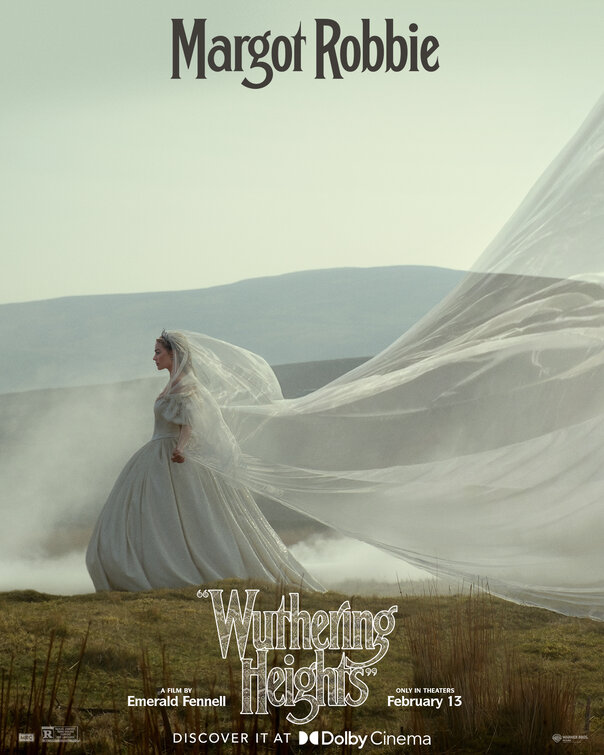
After some rather underwhelming key art for Emerald (Saltburn) Fennell's upcoming adaptation of Bronte's cult-lit classic, Wuthering Heights, the character posters come through with a cold and tactile pair of character posters. I have highlighted Margot Robbie's Catherine Earnshaw here for the layers of gauze and fog and sky.
As she walks along the Yorkshire Moors in an elaborate wedding dress, she surrounded by the hazy mists; her train uplifted by the languid morning air. You can see the hills in different shades in the background, further framing her form. It is grim and cold. Against the angst and the passion of a potential coupling, this is about as a succinct an image as one might get for the story. Robbie, of course, has just the right poise here.
The title card is framed by the director's credit and release date. (I suppose you could classify this as a teaser poster, given the lack of main credit block, even as the film is releasing in a couple of weeks, and several other posters and key art have been released).
Given it's UK setting, one wonders why there is not a QUAD style poster released (point me to it if you know of one) given the horizontal framing and lines here. (Kurt Halfyard)
Wuthering Heights tells us that love should hurt. Actually, it should burn. Lacerating your heart and excavating your soul, it will, in the words of Emily Brontë herself, drive you mad. Fans of the 19th-century classic were reminded of this when the first full-length trailer for Emerald Fennell’s highly contentious but much-anticipated adaptation, which stars Margot Robbie and Jacob Elordi, came out in the fall.
The trailer depicts Cathy (Robbie) and Heathcliff (Elordi) meeting as children before becoming embroiled in what it describes as “the greatest love story of all time.” While it’s not clear how far Fennell has strayed from the 1847 novel—the film has raised eyebrows among literary types who’ve pointed out that Heathcliff is described as “dark-skinned” in the book, while Cathy wears a shiny red dress, among other things in the film—it’s set to be a major cinematic event, with original songs by Charli XCX and a Valentine’s Day release date.Make no mistake: Wuthering Heights—which focuses on the intense bond that develops between Cathy and Heathcliff and the subsequent devastation that occurs when social mobility prevents them from being together—is a heart-wrenching tale, one that offers up meaningful commentary on everything from class and revenge to generational trauma. For me, though, it has always been about one thing and one thing only, and that’s Heathcliff, a.k.a. literature’s original fuckboy. Brooding, handsome, and troubled beyond repair, he epitomizes everything straight women are supposed to run from, and yet tend to run towards. I do, at least.Unfortunately, I’ve got a long history of fancying terrible men. The highly functioning alcoholics who pledge sobriety after an argument, only to get hammered a week later? Tick. The self-destructive avoidants who are addicted to you one minute and repulsed the next? Tick. The tormented artists who haven’t discovered bed frames and trade on empty promises and incessant love-bombing? Tick, tick, and then a few more ticks.
I blame all of this on Brontë—partly because it’s more convenient than analyzing my own self-destructive patterns, but mostly because I remain convinced that the precedent for chasing toxic love stories was one set out for me as a teenager, by Heathcliff. To be clear, in the book he is a truly abominable character. This is a man who not only speaks in growls and terrorizes children, but who also hangs dogs and beats women (character traits that we should all skip when it comes to dating prospects, obviously).
And yet he is often upheld as a romantic antihero, which I suspect has something to do with the fact that two of the most popular Wuthering Heights adaptations (William Wyler’s 1939 classic starring Laurence Olivier and Andrea Arnold’s stark but stunning 2011 version) conclude with Cathy’s death, neatly glossing over the second half of the book, which sees Heathcliff going full sociopathic mode.For me, though, the allure of Heathcliff was always less about the man himself than what he, and his relationship with Cathy, represented: a love so deep and destabilizing that it could hardly exist. Given they are—spoiler!—never actually together, their dynamic is defined by absence, possibility, and longing, which are arguably the most romantic things of all. Their love never becomes a reality, confining it to the realm of fantasy, where everyone and everything feels so much better because you made it all up inside your head.
This is the trap I’ve fallen into many times, creating my own epic Cathy-and-Heathcliff love stories with men who couldn’t be less interested in me. There was the boy at school who, in my mind, was stringing me along for years, but in reality just never wanted to be with me. The filmmaker who told me quite clearly that he “didn’t want anything serious,” which I took as a challenge to change his mind. And several others I won’t mention to save a little face.There’s also something about Cathy and Heathcliff’s relationship being rooted in childhood that holds a certain amount of appeal. They know each other so well. They grew up together. They have history. After yet another disappointing experience with a man, I often find myself craving the comforts of familiarity, returning to exes I’ve romanticized and convincing myself that someone I dated two years ago was actually the one for me.
It makes sense why I—and others like me, I’m sure—might be craving Brontë’s maddening breed of passion. I can’t tell you how many mediocre dates I’ve been on recently, swapping the same insipid stories about siblings and pets, hoping for a sudden spark of excitement and settling for it not being a complete disaster. The bar is absurdly low; these men will get a round of applause for texting us back or booking a restaurant. Where are the ones who’ll cry for us on the moors and dig up our graves? They might not be healthy, but at least they’re interesting.
I know in reality that nobody should conflate drama with romance. We all know that real love is supposed to be quiet, stable, and safe, and that it also probably shouldn’t extend into the afterlife—least of all with a raging psychopath. But when dating feels so relentlessly and desperately dire, can you blame the toxic girlies for occasionally wanting something a little spicier? If not to inject a little energy into our dating pursuits, then to give us something a little more compelling to talk about in the group chat?
With this in mind, I personally cannot wait to watch Fennell’s Wuthering Heights. I’ll admit, as a dedicated fan of the book, I was skeptical at first. But now I no longer care about accuracy. Give me madness on the moors. Snogs in a storm. And the kind of love story that will ruin my life. It’s probably a little wiser to experience it on screen than off, anyway. (Olivia Petter)
The Brontë Society unveiled a packed programme to mark the 200th anniversary of the birth of Charlotte Brontë. (Natasha Meek)
Jane Eyre
Widely regarded as one of the greatest novels of all time, Charlotte Brontë’s Jane Eyre was an instant bestseller upon its release in 1847. Over the years, Brontë’s beloved work has been adapted for the small screen countless times, including the acclaimed 2006 miniseries of the same name.
The series follows the early life of Jane (Ruth Wilson), who is hired by the housekeeper of Thornfield Hall, Mrs. Fairfax, to be a governess at the country estate. But when she becomes entangled with the brooding master of Thornfield Hall, Edward Fairfax Rochester, his dark past threatens to destroy their relationship. The four-part period drama has a perfect rating on Rotten Tomatoes and has been hailed a "true masterpiece". (Jennie Buzaglo)

Sala Multifuncional des Mercadal. Avinguda del Metge Camps, s/n 0774018.01.2026 20:00Les germanes Brontë, per mèrits propis, ocupen un lloc destacat en la literatura de parla anglesa. Les seves novel·les van revolucionar la narrativa a l'Anglaterra del segle XIX i van transformar els límits d'expressió permesos per a les autores de l'època.La present obra musical, del músic i cantant Guiem Soldevila, ens brinda un viatge fascinant al cor de la poesia de les tres germanes, conformant una experiència literària i musical única i inoblidable.Guiem Soldevila: veu, guitarres, piano i sintetitzadorClara Gorrias: veu i flautaNeus Ferri: veuLluís Gener: contrabaixPau Cardona: violoncelElena Armenteros: arpaAndreu Marquès: bateria i percussionsGêliah: dansaPep Eroles: dudukCarme Cloquells: narracióSonorització: Edu SoundLlums: Marc Bagur
“Wuthering Heights” plans on seducing you into theaters this Valentine’s Day.
Ahead of Emereld Fennell’s highly anticipated adaptation of Emily Brontë’s classic novel, Warner Bros. has teamed up with Bloomingdale’s on multiple luxury collections inspired by Margot Robbie and Jacob Elordi’s on-screen romance. A little gothic foreplay, if you will.
In addition to limited-edition collections, Bloomingdale’s has launched a sweeping retail activation tied to the partnership. Running from Jan. 15 to Feb. 22, the department store’s iconic 59th Street Carousel will be transformed into a moody, immersive shopping destination. The physical space leans fully into the fantasy. Stylized elements referencing the moors, period architecture and the interiors of “Wuthering Heights” and Thrushcross Grange are woven throughout the Carousel as scenic backdrops and display fixtures. Dramatic window installations and multi-sensory design elements extend the experience beyond the shop floor. Pop-up versions of the activation will also roll out in select Bloomingdale’s locations including SoHo, Aventura, Century City, Sherman Oaks and Roosevelt Field from Jan. 15–22. (Anna Tingley)
From the ubiquity of BookTok to the popularity of IRL reading retreats and the rise of the going-out book, reading has never felt more social, and the upcoming release of Wuthering Heights—Emerald Fennell’s starry adaptation of the classic 1847 novel by Emily Brontë—presents the perfect opportunity for Vogue to get in on the fun.
To that end, we’re announcing the launch of the Vogue Book Club—your new go-to source for Gothic literary gossip.
To participate, head to the Vogue app today (January 15) and tomorrow (January 16) and on January 22, January 29, and February 5 to weigh in on the latest group-chat prompt inspired by a WH–themed story on Vogue.com. (Our focus will chiefly be the book, not the upcoming movie—but your thoughts on the Margot Robbie and Jacob Elordi of it all are certainly welcome.) The conversations will culminate in a special live event in early February; more details to come. And after Wuthering Heights, stay tuned for the Vogue Book Club’s next read; we’ll aim to cover four books over the course of the year. (Emma Specter)


%20(1).jpg)
%20(1).jpg)



