


| CARVIEW |
 Read Paul Mason’s article for a fascinating insight to the nature of leftist politics and social movements in Greece:
https://www.theguardian.com/world/2015/jun/29/greece-chaos-syriza-gamble-banks-closed-referendum
]]> ]]>
]]>
Las Cuencas como Laboratorios de Gobernanza
Autoorganización e interdependencias
11 al 26 de julio 2014
Alejandro Meitin, Silvina Babich (Ala Plástica), Brian Holmes, Sara Lewison (Grupo Compass), Graciela Carnevale (El Levante), Steve Kurtz, Lucia Sommer, Steve Barnes Melissa Meschler (Critical art Ensamble), Joan Vila Puig (Sitezise), Eduardo Molinari (Plataforma La Dársena), Fabiano Kueva (Centro Experimental Oido Salvaje), Mauricio Corbalán y Pio Torroja (m7red).
Artistas nacionales e internacionales que trabajan en prácticas territoriales en América y Europa desarrollarán una investigación que tomará la forma de acciones urbanas nómadas y diálogos relacionados con las comunidades del frente fluvial en la franja costera del Río Paraná y del Río de la Plata; una aglomeración urbana,
industrial y agrícola que incluye al macro-sistema de humedales del delta paranaense, al estuario del Río de la Plata y a las ciudades de La Plata, Buenos Aires y Rosario. En este proyecto autogestionado por 3 nodos La Plata, Buenos Aires y Rosario y los 2 Sub-Nodos Delta y Victoria, el equipo compartirá sus experiencias con invitados y referentes locales de comunidades de base en sus propios escenarios complejos, para promover herramientas y acciones orientadas a desarrollar una nueva imaginación ambiental y geo-política partiendo de preguntas tales como ¿Quién diseña los territorios? ¿Para quién los diseña?, ¿Qué es el diseño de la integración territorial?, ¿Qué quiere decir ecología humana?, ¿Cómo incluirnos en el tejido ecológico en tanto seres humanos?,¿Qué ejercicios de imaginación política son necesarios para salirnos de las redes de monocultura y monocultivo? ¿Son la Pachamama y la Tierra sin Mal meras ensoñaciones? ¿Qué agenda política se oculta detrás del régimen de visibilidad en la actual gobernanza de la región?
Proyecto co-comisariado por Alejandro Meitin de Ala Plastica, Maurico Corbalán de M7red ambos integrantes de Nodo Sur del Ecuador Politico y Teddy Cruz del Centro para Ecologías Urbanas de la Universidad de California San Diego
Impulsan
Nodo La Plata
Productores Familiares del Delta Santiago, La Grieta, IHAAA-FBA-UNLP, Síntoma Curadores, Vivero Experimental El Albardón, Cooperativa de Productores de la Costa de Berisso, Cambio Rural – INTA
Nodo CABA
Museo Quinquela Martín, Programa de Artistas de la Universidad Di Tella, Centro Cultural de la Cooperación, Cooperativa Los Mimbreros
Nodo Rosario
Taller Ecologista, Programa de Agricultura Urbana, Taller de Comunicación Ambiental, Tallet Flotante, El Paraná No se Toca, Centro Cultural Parque España, Centro Ecologista Renacer, Red Delta del Paraná
Auspician
Alianza Sistema – https://www.alianzasistema.org/
Fondo Socioambiental Casa – https://www.casa.org.br/es
Haudenschild Garage – https://haudenschildgarage.com/
]]>

This year, the Canal is one hundred years old. It’s founding marked both Panamanian independence from Colombia, and the imperial turn of the United States. Today, the Canal is struggling once again to become the epicenter of the new global logistics revolution, based on the huge “post-panamax” container ships that no longer fit through the old locks designed by the US army engineers. The widening of the Canal – currently plagued by delays and cost overruns – is supposed to bring back profitability and ensure Panama its place at the center of global trade. But no one even seems to question the ecological consequences of so much “free” trade – whose costs are also measured in brutal inequality and the failure to even think about human development.

Presumably everyone knows I am a critic of capitalist excesses, and you’ll find more about that critique in upcoming posts. But I am also so terribly curious, so keen to see it all, to touch and feel it all – and it is almost impossible to describe the thrill of getting on that Panama Canal Authority tugboat, whose cabin and decks were opened to us by the good graces of Rafa Spalding, a former civil engineer and high-ranking Canal administrator. Thanks also to the warmth and openness of the crew, we were able to journey through the Miraflores and Pedro Miguel locks, across the Culebra Cut (where dynamite and steam shovels broke the continental divide) and all the way up to Gamboa where the man-made Lake Gatun starts to widen, opening a channel for the huge ocean-going ships. Here, humankind has exerted a truly tectonic force. By the end of the day, sunburnt and tired, we felt that much inside us had changed. Along the watery path that joins two oceans we experienced something a lot like continental drift.
Click to view slideshow. ]]>
January 4: Claire Pentecost and I arrive in Panama City. We are greeted at the airport by Ela Spalding, the founder of Estudio Nuboso, who became interested in Claire’s work at Documenta 13 in Kassel, Germany. Ela has lived in Berlin for six years and is now returning to Panama to launch a series of residencies having to do with biodiversity and the prospects for a more ecological way of living. Claire’s work with soil fits beautifully into this program. My work on contemporary capitalist development and logistics – fits in perfectly, because this is Panama, the original Zone, the last piece of the western hemisphere to emerge from the seas and the first to crack under the pressure of free trade, which literally split the continent. We are going to learn a tremendous amount here about the ground beneath our feet…

I looked out the window and saw an elegant old building dedicated to Panama Canal pilots. The question: How to steer humanity’s course through these early decades of the twenty-first century? Obviously there are immense problems. As we drove around Panama City, looking at the remains of the US Canal Zone along with the sprawl of neoliberal urbanism – and trying, pretty successfully, to catch the joyful wild Panamanian spirit through all that – our conversation returned again and again to the events of the last fifteen years, since the US military moved out in the late 1990s and the widening of the Canal was voted by referendum in the early 2000s. Panama gained full independence only to witness a giant real-estate boom in both the city and the countryside, and a huge speculative infrastructure boom around the Canal. Here, as everywhere, there is a deficit of perception, reflection, expression and action to make a more egalitarian and more ecologically sustainable world. Artists and thinkers should be able to contribute something to overcome that deficit, no?

On the first day in town we went to the Canal Museum and began to understand how important the isthmus has been to world trade since 1515, when Balboa “discovered” what the indigenous people had always known: the Pacific Ocean. Later that night we ate dinner with a fascinating group gathered around Ela’s parents, Rafa and Charlotte, who have tremendous insights into the way this place has developed over the last five or six decades. Talk flowed freely as we met many of those who will gather next week for the Suelo residency at SaLo Veraguas, on the southern side of the Isthmus, about five hour’s drive from here. Out there we won’t have electricity or Internet, but maybe it will increase the power of eyes and hearts and eras. We’ve got a lot to learn from the past, though none of us can be proud of all of it. We’ve got even more to learn from the future.
]]>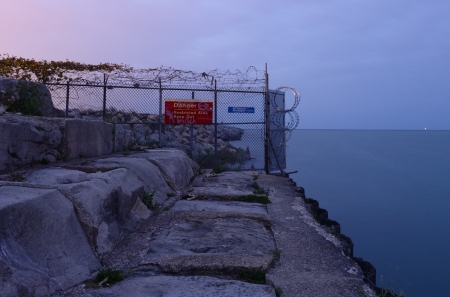 Port of Illinois – Foreign Trade Zone (photo: R. Borcila)

El taller quiere abrir una reflexión cartográfica sobre cinco escalas de la experiencia: la intimidad, el territorio urbano, la nación, el continente y el mundo. ¿Cómo atrevesamos estas escalas? Y ¿cómo nos atrevesan? ¿Cómo sentir, analizar, representar y exprimir los espacios y tiempos de la globalización? Sobre todo, ¿cómo transformar este juego de escalas?
Cuatro días / cuatro pistas:
1. Cartografía cognitiva
Introducciones. Presentación del seminario movil “Deriva continental.” Lectura de un texto clásico: “El Posmodernismo como lógica cultural del capitalismo tardío,” por Frederic Jameson. Ejemplos de varias tentativas de cartografía artística. Lectura del texto “Cronopaisajes,” por Angela Melitopoulos y Maurizio Lazarrato; elementos visuales del proyecto Timescapes.
Diapositivas de ese día aquí.
2. Arte y infraestructura
Lectura del libro “Fish Story” de Allan Sekula. Comentarios sobre la pelicula: “The Forgotten Space.” Actualización de un concepto de Walter Benjamin: “la imagen dialéctica.” Primer acercamiento al sistema contemporaneo de los transportes globales.
3. Analisis y expresión
Lectura del texto “Investigaciones extradisciplinares,” por Brian Holmes. Discusión de las nociones de “disciplina” y de “profesión.” ¿Sobrepasar las disciplinas, o pasar a través de ellas? Ejemplos de arte extradisciplinar. La máquina compleja de la investigación colectiva.
4. Escala continental
Lectura del texto “Do Containers Dream of Electric People?” por Brian Holmes. Percepción y análisis de la circulación norteamericana. Ejemplo de Monterrey. Crisis y cambio al nivel continental.
El taller se ubica en el territorio urbano de Monterrey. Cada uno puede participar sobre la base de su experiencia de la ciudad y de las demás escalas. Cada uno puede señalar, mostrar, explicar otros ejemplos de investigaciones geográficas y artísticas pertinentes. En la medida de lo posible, vamos a organizar unas visitas a los sitios industriales y de transportes en Monterrey, para tocar de la mano a la infraestructura de la globalización.
****
Algunas lecturas suplementarias:
Brian Holmes, La personalidad flexible (una crítica de la cultura neoliberal en 2002)
Claire Pentecost, Notes on the Project Called Continental Drift (muy buen texto sobre Deriva continental)
Rozalinda Borcila, Riding the Zone (texto muy agudo sobre la logística y la vida indocumentada en EEUU)
Keller Easterling: Zone: The Spatial Softwares of Extrastatecraft (sobre las zonas de excepción en todo el mundo)
]]>
As a child I wanted to go into advertising. I had a love affair with the advertising industry. And this is why I am in a position to judge its merits. The anti-hierarchical structures and rhizomes of late capitalism are its successful ad campaign. Modern capitalism has to manifest itself as flexible and even eccentric. Everything is geared towards gripping the emotion of the consumer. Modern capitalism seeks to assure us that it operates according to the principles of free creativity, endless development and diversity. It glosses over its other side in order to hide the reality that millions of people are enslaved by an all-powerful and fantastically stable norm of production. We want to reveal this lie.
Letter from Nadezhda Tolokonnikova to Slavoj Žižek, read the rest here.
]]>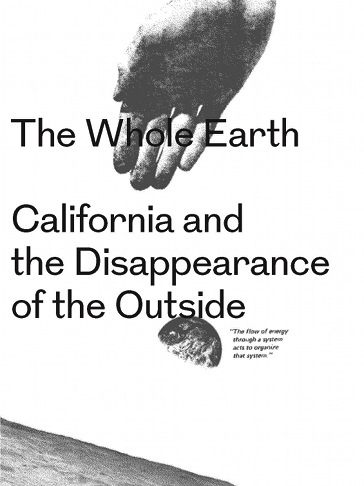
The world is big, the ocean is wide, and sometimes you hear of events you know you’ll miss and would like to have gone to some summer afternoon. Well, that’s how close I got to the Whole Earth exhibition at the Haus der Kulturen der Welt in Berlin. Fortunately it’s possible to catch the lectures, here. For the catalogue, just click on the image above.
A conversation about it arose on Nettime, particularly about Fred Turner’s book From Counterculture to Cyberculture: Stewart Brand, the Whole Earth Network, and the Rise of Digital Utopianism. I read the book when it came out, thought it was great and once met the author, whom I found worth listening to. However in the book and even more, in its reception, there is a kind of simplification or reduction of the counter-cultural moment, and therefore, of what cultural politics can achieve. This kind of reduction has become widespread and I think it is connected to a further misunderstanding of what’s at stake in some of the most important struggles of the technological societies, which are epistemological struggles, struggles over what counts as truth and the procedures used to get there. At the same time, there is also a reason for for this misunderstanding, and a good one: people are immensely disappointed by promises that did not deliver, or rather, by civilizational processes that delivered something else, under the cover of promises, attempts, questions, artworks, movements, revolts and so on. That’s what Turner’s book really shows, through the career of Stewart Brand in particular, and that’s why it’s so interesting. A decade ago I myself attempted to tease out that kind of reversal of promises, in The Flexible Personality; so I’m still attuned to the whole question.
In the Nettime thread, one participant caught my attention with a comment about how people in France “did not buy into the counterculture, prefering to stick to good old-fashioned agonistic politics.” It seemed like a good place to intervene:
…I lived a long time in France and engaged with collective struggles there, so I appreciate where you’re coming from. I also grew up in the Bay Area in the Seventies with the Whole Earth Catalogue in the house – in other words, thoroughly imbued with the Californian Ideology – and I think Fred Turner’s book is great, it’s full of fabulously precise and curious history about real people who are more commonly and less generously treated as myths. Yet in certain respects, his thesis is a bit too pat. As I recall it, his treatment of early counterculture/ cyberculture is reminiscent of something like Boltanski and Chiapello’s treatment of Deleuze & Guattari, or indeed, of “artistic critique” in general, in their book “The New Spirit of Capitalism.” In both of these otherwise impressive works, the authors write as though the worm of Neoliberalism were already in the Sixties’ fruit, and what we mistook for a sweet taste was actually a time-delay poison. Adam Curtis adopts a similar strategy in films like “The Trap”; and the list could go on. I think life is more complicated and more ambivalent than that.
Certainly in the US, the good old agonistic politics of the labor/capital confrontation was dead in the water after WWII, and in France – as Boltanski and Chiapello show so well – that kind of politics was institutionally paralyzed from the 1968 Grenelle accords onward, which used historic salary hikes to split union labor away from the student movement and literally buy its acquiescence to the subsequent processes of automation, flexibilization and outsourcing that are common to all the fully industrialized countries. The structuralization of right-left conflict, its neutralization within a far larger and more powerful system of bureaucratic management, was a reality of the postwar period whose consequences we can still observe around us. The good old days were not necessarily better. In fact, they were what so many people rebelled against.
Today it is often said that the quest for liberation, expressed in many different ways from third-worldism to psychedelia via second-order cybernetics, finally amounted to nothing more than the freedom theorized by Milton Friedman, the freedom to choose a product on a market, or maybe an identity-position in a surveilled and overcoded network. This is to argue at once too little, and too much. Too much, because such a judgment renders the challenges that the cyberneticians and counter-culturalists faced entirely unrecognizable: one can no longer see, for instance, how figures such as Bateson and Von Foerster, who had clearly been complicit with the power structure of the Second World War, strove in the Sixties and especially in the Seventies to render cybernetics, not just self-reflexive and meta-theoretical, but above all, strictly useless for the military, pointing either towards an ecological care for the planet (in Bateson’s case) or to an ethics of respect for the possibilities of the other (in Von Foerster’s). One could say even more compelling things about the Chilean cyberneticists, Maturana and Varela, whose notion of autopoiesis has everything to do with the effort to create an autonomous socialist project in a hemisphere dominated and overdetermined by the political-economic coercion of the United States. Deleuze and Guattari’s readings of the potentials for subversion lying within the very mainstream of what they call “royal science” are a reflection on exactly these threads of cybernetic history. The so-called “hippie” version of cybernetics springs from an intense epistemologial struggle over the uses of high-level technical, scientific and philosophical knowledge; and even if none of the cyberneticists was really a hippie, still it’s to the counter-culture’s credit that its participants recognized this struggle and tried to embody it in a more popular, daily-life sort of way.
But time passes, all that is far far behind us now, and what has actually been wrought by computerized capitalism is far more intense, detailed and terrifying than any simple caricature of Friedmanite neoliberalism – or Deleuzo-Guattarian nomadism, for that matter – can possibly convey. Tarring cybernetics with such brushes is too little. Sixties’ liberationism was everywhere based on an ontology of authentic experience and an openness to, or at least a yearning for, the encounter with the wholly other. That was the desire behind the fascination with “open systems.” In the present, twenty years after the invention of the World Wide Web, identity has been fractalized into the rival and strictly parcellary functions of hundreds of different companies and organizations, all using coded messages and screenic techniques to vie for some part of your attention, your energy, your money, your activity, your drives, your dreams – whose basic characterstics they have already captured by surveillance. The very idea of an “identity position” becomes quaint in this context. Post-modern schizophrenia and “self-shattering” is no longer the work of a “patient, immense and methodical derangement of all the senses” a la Rimbaud. Instead it is the calculated result of corporate strategies.
For Bateson, ecology was about “organism plus environment,” by which he meant the natural environment in all its multifarious interdependencies. For the hardliners of military cybernetics – true AI believers like Herbert Simon – it sufficed to create the proper environment in order to generate the organism of your choice, a theorem which is daily proven by human behavior in shopping malls, airports, social networks, war games and so-called creative cities. To be sure, for a real determinist there is ultimately no separation between the organism and the environment, so the former might have to be tweaked a little as well; and why not, if you have the power to do it? As Simon wrote in a telltale phrase, “If the inner system is properly designed, it will be adapted to the outer environment, so that its behavior will be determined in large part by the latter, exactly as in the case of ‘economic man.’” In that one little sentence, the cat comes out of the bag: we see that the great neoclassical subject of truck and bartering homo economicus has never been ‘natural’ in the Scottish-enlightenment sense of Adam Smith, but instead, always a cultural construct fitting into purpose-built markets. Twenty years on into massive immersion in capitalist networks, how far have we been redesigned? How well do we now adapt to the outer environments that are offered us, whether on the web, in urban spaces, in corporations, in universities, at borders or on battlefields?
In my own case, the lucid answer would be: far more than I would like. That said, I still agree with what Ted Byfield wrote not long ago on this list: “I don’t think it’s safe, wise, or shrewd to rely on nostalgic assumptions about the boundaries of the self.” The gender and culture-bending struggles for liberation, to which Ted alludes in that phrase, have left behind many valuable possibilities in the networks. Let’s use ’em for a new kinds of political resistance and political proposals in the present and for the future.
best, Brian
]]>I’m no different from anybody else. I don’t have special skills. I’m just another guy who sits there day to day in the office, watches what’s happening and goes, ‘This is something that’s not our place to decide, the public needs to decide whether these programs and policies are right or wrong.’ And I’m willing to go on the record to defend the authenticity of them and say, ‘I didn’t change these, I didn’t modify the story. This is the truth; this is what’s happening. You should decide whether we need to be doing this.’
With these words, and throughout the above interview with The Guardian, Edward Snowden has taken a stand. He’s an average computer geek who never finished high school and learned his trade on the job, working for the US national intelligence agencies. Like thousands of other people within those agencies he was able to watch, day by day and in excruciating detail, the creation and development of immense surveillance capacities, operated by the US government against its own citizens and against hundreds of millions of innocent people around the world. Like so many others in his shoes, he worried about the possibilities of misuse that are latent in these massive surveillance capacities. He foresaw the day when they would be appropriated by political or military leadership at a moment of crisis, and used not against terrorists or enemies of democracy, but against political opponents, against principled critics and against other average individuals seeking to defend their constitutional rights. In advance of that moment, he did the real duty of citizens and persons of conscience. He made public the documents proving that the state, and specifically, the National Security Administration, is spying on me and you.
Until the current policy changes, my identity, the words I write here and the fact that you chose to read this page are known to the US government. If we are unable to change the surveillance policy of the United States, there is every chance that the simplest gestures of critical inquiry, both public and private, can and will be used against us. Facebook, Google, Microsoft, Apple, Amazon, Skype, PalTalk and undoubtedly all the other major providers of “cloud computing” services, as well as all the major US cell-phone companies, will be the witnesses of the prosecution.
Since the days of DARPA’s Total Information Awareness project, the existence of this global spying program has been widely suspected. Since the revelations by NSA whistleblower William Binney at the Hackers On Planet Earth conference in 2012, it was clear that a massive surveillance machine had in fact been built, and was being operated by the NSA and by defense corporations such as Booz Allen Hamilton. Now the open secret has become a public fact, thanks to the disclosure of classified information by a courageous individual. In his interview with Glen Greenwald – which in my view is among the most powerful ethical documents of this young century – Edward Snowden looks us all in the eye and asks, what are we going to do about this situation? As Americans in particular, can we live and enjoy the privileges of life in this society, while knowing that the price of those privileges is complete subjection to the state?
Bradley Manning could be demonized – or just discounted as a loser – because he was a queer guy on an obscure military base, aided and abetted by a notorious hacker organization, Wikileaks, which is called outlaw and criminal by the US State Department. Edward Snowden, on the other hand, is as close to the technocratic heart of the American government as anyone could get. Crucially, he is very close to its most fair, honorable and reasonable components. Clearly he respects Manning and Wikileaks, since he has chosen a similar path. Yet his address to the public is far more direct, since he has openly identified himself and assumed responsibility for his actions in advance. With his disclosures, critique has moved from the margins to the center. The US intelligence agencies are now involved in a dilemma as profound as that of the Cold War, when the proliferation of double agents began to undermine the trustworthiness of any intelligence whatsoever. Of course there is a decisive difference. The double agent of the Cold War was split between allegiance to two rival sovereigns. Today’s leaker is split between his or her allegiance to the Administration or the Constitution. Are we subjects or are we citizens?
Like Bradley Manning, Edward Snowden poses a monumental threat to the security of the United States surveillance establishment. It is the threat that we the people will act, not as the complicit agents of a dark and secretive power, but as the public bearers of universal human rights and responsibilities:
Anyone in the positions of access with the technical capabilities that I had could suck out secrets, pass them on the open market to Russia; they always have an open door as we do. I had access to the full rosters of everyone working at the NSA, the entire intelligence community, and undercover assets all over the world. The locations of every station, we have what their missions are and so forth. If I had just wanted to harm the US? You could shut down the surveillance system in an afternoon. But that’s not my intention. I think for anyone making that argument they need to think, if they were in my position and you live a privileged life, you’re living in Hawaii, in paradise, and making a ton of money, ‘What would it take you to leave everything behind?’
The greatest fear that I have regarding the outcome for America of these disclosures is that nothing will change. People will see in the media all of these disclosures. They’ll know the lengths that the government is going to grant themselves powers unilaterally to create greater control over American society and global society. But they won’t be willing to take the risks necessary to stand up and fight to change things to force their representatives to actually take a stand in their interests.
And the months ahead, the years ahead it’s only going to get worse until eventually there will be a time where policies will change because the only thing that restricts the activities of the surveillance state are policy. Even our agreements with other sovereign governments, we consider that to be a stipulation of policy rather then a stipulation of law. And because of that a new leader will be elected, they’ll find the switch, say that ‘Because of the crisis, because of the dangers we face in the world, some new and unpredicted threat, we need more authority, we need more power.’ And there will be nothing the people can do at that point to oppose it. And it will be turnkey tyranny.
We aren’t there yet. But we are at a turning point. There is now an historic chance to begin a broad-based movement against abusive government surveillance. This movement will build upon the sturdy foundations provided by thousands of people who have documented and denounced the construction of the global spy state. Its only chance is to construct a counter-power that redefines and reasserts democratic rights for the twenty-first century. As of this week, thanks to Edward Snowden and everyone who follows in his footsteps, that chance has ceased being a faint glimmer of hope. It has become a real possibility.
..
]]>
Stop Foreclosures – Barcelona (photo Marcelo Expósito)
.
An elder woman with a yard-long wooden spoon stirs a huge pan of paella bubbling over a ring of blue flame. Wine bottles pop, music pulses from the loudspeakers and the neighborhood gathers around long tables set up in the street. Today – May 18, 2013 – eleven families are celebrating their departure from the squatted building where they’ve spent the last eighteen months. The bank that owns it, Caixa Catalunya, has been forced into granting them five-year leases in other homes left empty by the crisis. This is a major victory for the Platform of People Affected by Foreclosures, known as the PAH (Plataforma de afectados por hipotecas). For the first time, they are rehousing people at a “social rent” of 150 euros per month. It’s a benchmark. The idea is to create new rights from the ground up, in defiance of rapacious economic practice and repressive legislation.
In a country with 27% unemployment, two million vacant housing units and a foreclosure rate of some five hundred per day, the PAH is a rising political force. According to recent national polls, an overwhelming majority finds it more competent to resolve the housing crisis than either of the two main parties, the conservative PP and the pseudo-socialist PSOE, whose ratings have fallen to historic lows. Here as in the rest of Southern Europe, the popping of the real-estate bubble led to a banking collapse, government bailouts, the specter of national insolvency, European rescues, a flood-tide of austerity measures and finally, a deep crisis of legitimacy affecting the entire political mainstream. How that all happened is a revealing bit of history. What happens next could change the course of the global capitalist system.
.continues here…