


| CARVIEW |
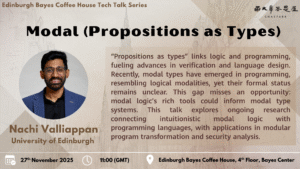
Event Title: Modal (Propositions as Types)
Speaker: Nachiappan (Nachi) Valliappan
Dates: Thursday, 27th November 2025
Time: 11am (GMT)
Location: Edinburgh Bayes Coffee House (4th floor Bayes Center, EH8 9BT)
Join Online:https://app.huawei.com/wmeeting/join/97172374/EBLvR69PyCciIQAbMEtNCHM4PJYNA1XrY
Meeting ID:97172374
Passcode:507513
Talk Abstract:
“Propositions as types” is a slogan that refers to the one-to-one correspondence between propositions in formal logic and types in programming language theory. The discovery of this correspondence in the twentieth century opened the gates for cross-disciplinary exchange of ideas and has since had an enormous impact on the mutual development of formal verification tools and programming languages. In recent times, however, programming language research has seen a rise in the development of so-called “modal” types whose status is yet to be settled from the perspective of logic. These appear, at the surface level, an awful lot like modalities in modal logic, but much has remained unclear on the matter. This gap in the propositions-as-types correspondence is a lost opportunity: modal logics enjoy a rich suite of analysis tools that could be readily ported to modal type systems via the correspondence. This talk is about ongoing research in the conjunction of intuitionistic modal logic and programming languages to bridge this gap, and the potential applications of this research in modular program transformation and security analyses.
Speaker:
Nachiappan (Nachi) Valliappan is a Royal Society Newton International Fellow in the Laboratory for Foundations of Computer Science at the University of Edinburgh.
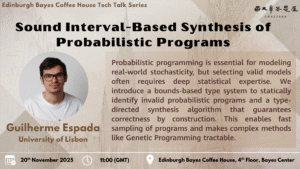
Event Title: Sound Interval-Based Synthesis of Probabilistic Programs
Speaker: Guilherme Espada
Dates: Thursday, 20th November 2025
Time: 11am (GMT)
Location: Edinburgh Bayes Coffee House (4th floor Bayes Center, EH8 9BT)
Join Online: https://app.huawei.com/wmeeting/join/96296184/ihsFKR3egE2YzZOkWHrI7TIfWGtAe2bCN
Meeting ID:96296184
Passcode:100424
Abstract:
Probabilistic programming has become a standard practice to model the stochasticity inherent in modeling the real world, and to analyse behavior of nature in different scientific disciplines. However, domain practitioners also need to be experts in statistics in order to select which probabilistic model is suitable for a given particular problem. Additionally, automatically selecting the model is challenging due to the large search space, mostly occupied by invalid programs that may only be detected in a subset of executions.
We propose a bounds-based type system to statically identify invalid probabilistic programs and a type-directed synthesis algorithm that guarantees correctness by construction. The resulting system allows for fast sampling of programs and enables application of techniques that previously suffered from the complexity of synthesis, such as Genetic Programming.
Bio:Guilherme Espada earned his M.Sc. in Computer Science from the University of Lisbon (Faculdade de Ciências) in 2020. He is currently pursuing a Ph.D. at LASIGE, University of Lisbon, where he authored research on grammar-guided genetic programming, symbolic regression, and type systems.
]]>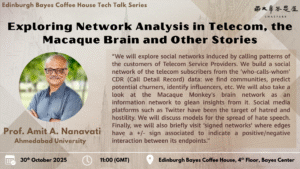
Event Title: Exploring Network Analysis in Telecom, the Macaque Brain and Other Stories
Speaker: Prof. Amit A. Nanavati
Dates: Thursday, 30th October 2025
Time: 11am (GMT)
Location: Edinburgh Bayes Coffee House (4th floor Bayes Center, EH8 9BT)
Join Online: https://app.huawei.com/wmeeting/join/98718641/aygjCvYF0uw08IwFj6UMR8dkxAplu4FQQ
Abstract: We will explore social networks induced by calling patterns of the customers of Telecom Service Providers. We build a social network of the telecom subscribers from the “who-calls-whom” CDR (Call Detail Record) data: we find communities, predict potential churners, identify influencers, etc. We will also take a look at the Macaque Monkey’s brain network as an information network to glean insights from it. Social media platforms such as Twitter have been the target of hatred and hostility. We will discuss models for the spread of hate speech. Finally, we will also briefly visit “signed networks” where edges have a +/- sign associated to indicate a positive/negative interaction between its endpoints.
Bio: Amit A. Nanavati is a Professor at Ahmedabad University and was a visiting researcher at the Informatics Forum (Feb – July, 2025). Prior to this, Amit was a part of IBM Research (2000-2016) and IBM GTS Innovation Labs (2016-21). Amit led the Telecom Research group on The Spoken Web and SNAzzy projects. The Spoken Web project received the National Award 2009 for Technological Innovation/Best Applied Research Aimed at Improving the Life of Persons with Disabilities given by the President of India. The SNAzzy project won an Outstanding Science Accomplishment Research Division Award in 2015. His 2008 paper “Social Ties and their Relevance to Churn in Mobile Telecom Networks” won the EDBT Test of Time Award in 2018. He became an ACM Distinguished Speaker in 2014, and an ACM Distinguished Scientist in 2015.
]]>Join us for this exciting talk by Dr. Adrien Bousseau, senior researcher at Inria Université Côte d’Azur in the GraphDeco group. In this talk, Dr. Bousseau will share his research on how the geometric language and drawing techniques implicit in sketches can be used to automate modelling from 2D to 3D.
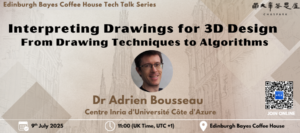
Event Title: Interpreting Drawings for 3D Design – From Drawing Techniques to Algorithms
Speaker: Dr. Adrien Bousseau
Dates: 9th July 2025
Time: 11:00-12:00 (UK Time, UTC +1)
Location: Edinburgh Bayes Coffee House (4th floor Bayes Center, EH8 9BT)
Join Online: https://www.chaspark.com/#/live/1157038585460486144?multi=en
Abstract: Designers draw extensively to externalize their ideas and communicate with others. But drawings are currently not directly interpretable by computers. To test their ideas against physical reality, designers have to create 3D models suitable for simulation and 3D printing. However, the visceral and approximate nature of drawing clashes with the tediousness and rigidity of 3D modeling. As a result, designers only model finalized concepts, and have no feedback on feasibility during creative exploration.
The long term goal of our group is to bring the power of 3D engineering tools to the creative phase of design by automatically estimating 3D models from drawings. However, this problem is ill-posed: a point in the drawing can lie anywhere in depth. Our originality is to exploit drawing techniques that designers developed to communicate shape most efficiently. Each technique provides geometric constraints that help viewers understand drawings, and that we shall leverage for 3D reconstruction.
Bio: Adrien Bousseau is a senior researcher at Inria Université Côte d’Azur in the GraphDeco research group. He completed his PhD at Inria Rhône-Alpes and his postdoc at UC Berkeley. Adrien Bousseau conducts research on image creation and manipulation, particularly drawings and photographs. His work has included image stylization, image editing and relighting, vector graphics, and sketch-based modeling. He received one of three 2011 Eurographics PhD awards for his research on expressive image manipulation, as well as a young researcher award from the French National Research Agency (ANR) for his work on computer-aided drawing.
He received an ERC Starting Grant and a Proof of Concept Grant to work on drawing interpretation for 3D design.
]]>Title: Maximus: A Modular Accelerated Query Engine for Data Analytics on Heterogeneous Systems
Speaker: Marko Kabić | ETH Zurich
Location: Online
Time: 05/07(Wed) 13:30-14:30 (UTC+01:00)London
External: https://app.huawei.com/wmeeting/join/95709180/ML6masIeHafOBZ9P8HZysSWGQt3RA4okX
Meeting ID: 95709180
Passcode:375969
Registration: https://www.smartsurvey.co.uk/s/3N8U7J/
Abstract:
Several trends are changing the underlying fabric for data processing in fundamental ways. On the hardware side, machines are becoming heterogeneous with smart NICs, TPUs, DPUs, etc., but specially with GPUs taking a more dominant role. On the software side, the diversity in workloads, data sources, and data formats has given rise to the notion of composable data processing where the data is processed across a variety of engines and platforms. Finally, on the infrastructure side, different storage types, disaggregated storage, disaggregated memory, networking, and interconnects are all rapidly evolving, which demands a degree of customization to optimize data movement well beyond established techniques. To tackle these challenges, in this paper, we present Maximus, a modular data processing engine that embraces heterogeneity from the ground up. Maximus can run queries on CPUs and GPUs, can split execution between CPUs and GPUs, import and export data in a variety of formats, interact with a wide range of query engines through Substrait, and efficiently manage the execution of complex data processing pipelines. Through the concept of operator-level integration, Maximus can use operators from third-party engines and achieve even better performance with these operators than when they are used with their native engines. The current version of Maximus supports all TPC-H queries on both the GPU and the CPU and optimizes the data movement and kernel execution between them, enabling the overlap of communication and computation to achieve performance comparable to that of the best systems available, but with a far higher degree of completeness and flexibility.
Bio:
I am a PhD student in Computer Science in the Systems Group at ETH Zurich (Switzerland), supervised by prof. Gustavo Alonso. During the studies, I did an internship at Hewlett-Packard Labs. Before commencing my PhD studies, I worked for several years at Swiss National Supercomputing Centre (CSCS). My research focuses on data management systems for data analytics on heterogeneous hardware.
]]>Title: Applied Programming Language Theory at Scale
Speaker: Nick Benton
Time: 05/01(Thur) 11:00-12:00 (UTC+01:00)London
Location: Bayes Coffee House Bayes Centre 4th Floor, 47 Potterrow, Edinburgh EH8 9BT
External: https://app.huawei.com/wmeeting/join/94300732/e63CVQfGjz0pwKxkIYXCGkFCiy8Toyd5T
Meeting ID: 94300732
Passcode: 362414
Registration: https://www.smartsurvey.co.uk/s/3N8U7J/
Abstract:
Facebook’s codebase is powered by a language called Hack, a typed evolution of PHP. We’ll dive into the story of how programming language theory shaped Hack’s design and implementation, and the new theory we developed along the way. We’ll also describe the challenges and compromises involved in evolving a language in active use at enormous scale.
Bio:
Nick Benton recently retired after 8 years as a software engineer and engineering manager at Meta in London, working mainly on the Hack language and the Infer static analyser. Prior to that, he spent 18 years at Microsoft Research in Cambridge.
His research ranges from proof theory and categorical logic, through semantics of programming languages and static analyses, to programming language design and compiler implementation. His thesis was on strictness analysis and he has since worked on topics that include term calculi and categorical models for linear logic, MLj and SML.NET (optimizing compilers from SML to the JVM and .NET with extensions for interlanguage working), Polyphonic C#/Cω (C# with join-calculus concurrency and XML/relational data constructs), monads and effect systems, models for dynamic allocation, compositional compiler correctness, mechanically formalized logics for reasoning about machine code programs, and reactive programming.
Nick has a degree in Mathematics and a PhD in Computer Science, both from the University of Cambridge, and is a Fellow Commoner of Queens’ College.
]]>
Title: Practices of Using Small and Large Language Models for Entity Resolution
Time: 04/28(Mon) 13:00-14:00 (UTC+01:00)London
Location: Online
Speaker: Zeyu Zhang | University of Amsterdam
External: https://app.huawei.com/wmeeting/join/95886293/MipIlMdSMCMSGacGvUoquknvJnJSqHfS0
Meeting ID: 95886293
Passcode: 505536
Registration: https://www.smartsurvey.co.uk/s/3N8U7J/
Abstract:
While Large Language Models (LLMs) excel at knowledge reasoning tasks, they face significant challenges in formal mathematical theorem proving due to data scarcity and strict logical precision requirements. This talk introduces the DeepSeek-Prover series, highlighting how automated dataset construction and reasoning annotations have effectively transferred knowledge from data-rich to data-scarce domains, achieving state-of-the-art results in formal proofs. Additionally, formal theorem proving will be discussed as an ideal benchmark for evaluating rigorous reasoning capabilities of language models.
Bio:
Zeyu Zhang is a third-year Ph.D. student at the INDElab, University of Amsterdam. He finished his bachelor and master study from the Harbin Institute of Technology (HIT) and the Eindhoven University of Technology (TU/e), respectively. Zeyu’s research focuses on tabular data understanding, spanning from conventional machine learning models to large language models.
]]>
 Visual Storytelling – Maintaining narrative coherence across modalities
 Instructional Video Understanding – True comprehension of procedural knowledge