Since 2001 the “Global War on Terror” has become a household phrase that has set the political, economic, and ideological agenda for the US and its accomplices. The GWoT has done less to keep people safe from terror as it has to grow the reach of US militarism and imperialism and terrorize people across Southwest Asia to Africa, throughout the Global South, and here in the United States. The terrorizing of Black, Indigenous, and people of color (BIPOC) communities in the US by police is another expression of this ideological war that shares the same tools and strategies of surveillance and control.
The 2000s saw the rise of profits and prominence of US Big Tech. While tech corporations like Google, Amazon, Microsoft, Facebook, and Twitter became more and more a part of our everyday lives, these same companies were providing tools to the US military and government to help fuel their war on Muslim communities. From databases to drones, US Big Tech is complicit in and has profited from this never-ending war against Muslims at home and abroad.
Big Tech’s U.S. contracts:
Key Takeaways
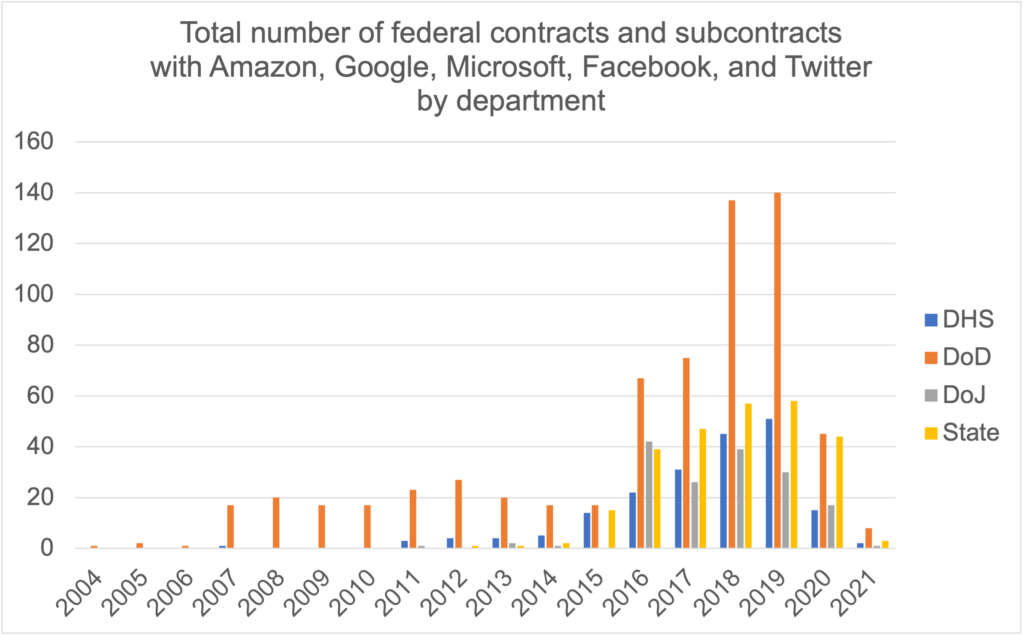
→ From 2004 to today, Big Tech corporations have seen a huge climb in federal demand for their services, particularly from the Pentagon and Department of Homeland Security.
Amazon and Microsoft in particular pulled ahead in recent years, with Amazon signing nearly five times and Microsoft signing 8 times as many federal contracts and subcontracts in 2019 compared to 2015. Google doubled their federal contracts and subcontracts by 2016. Facebook also doubled their contracts and subcontracts between 2015 and 2016 alone.
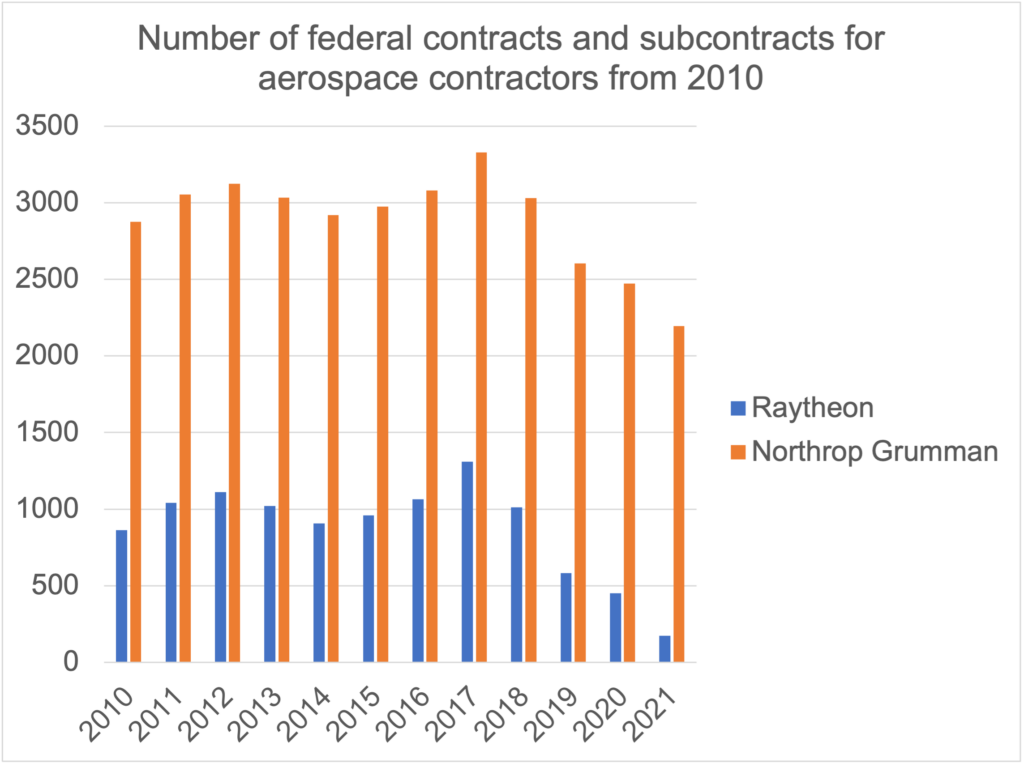
Growth in demand for Big Tech during the GWoT far outpaced that of traditional contractors, like aerospace contractors Raytheon and Northrop Grumman. Since 2010, both contractors have seen more moderate fluctuations and even a decline in the number of contracts and subcontracts with the federal government.
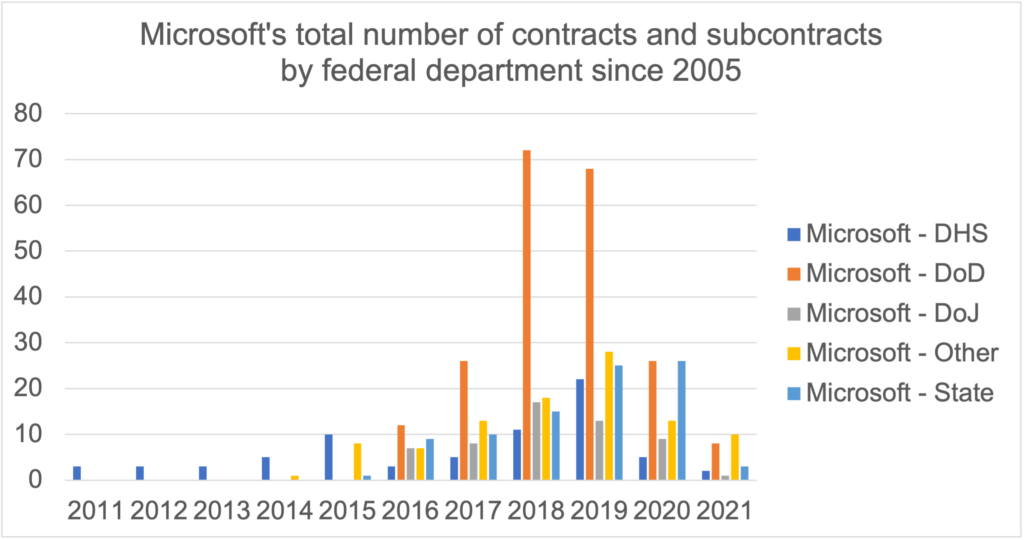
The Pentagon and Department of Homeland Security in particular saw enormous growth in the number of contracts and subcontracts they secured with Big Tech since 2004. From 2007 to 2019, DHS contracts and subcontracts with these tech corporations increased 50 fold. During the Trump administration from 2017 to 2019, the Pentagon nearly doubled their contracts and subcontracts with these tech corporations, dwarfing the growth in DHS, DoJ, and the State department’s contracts.
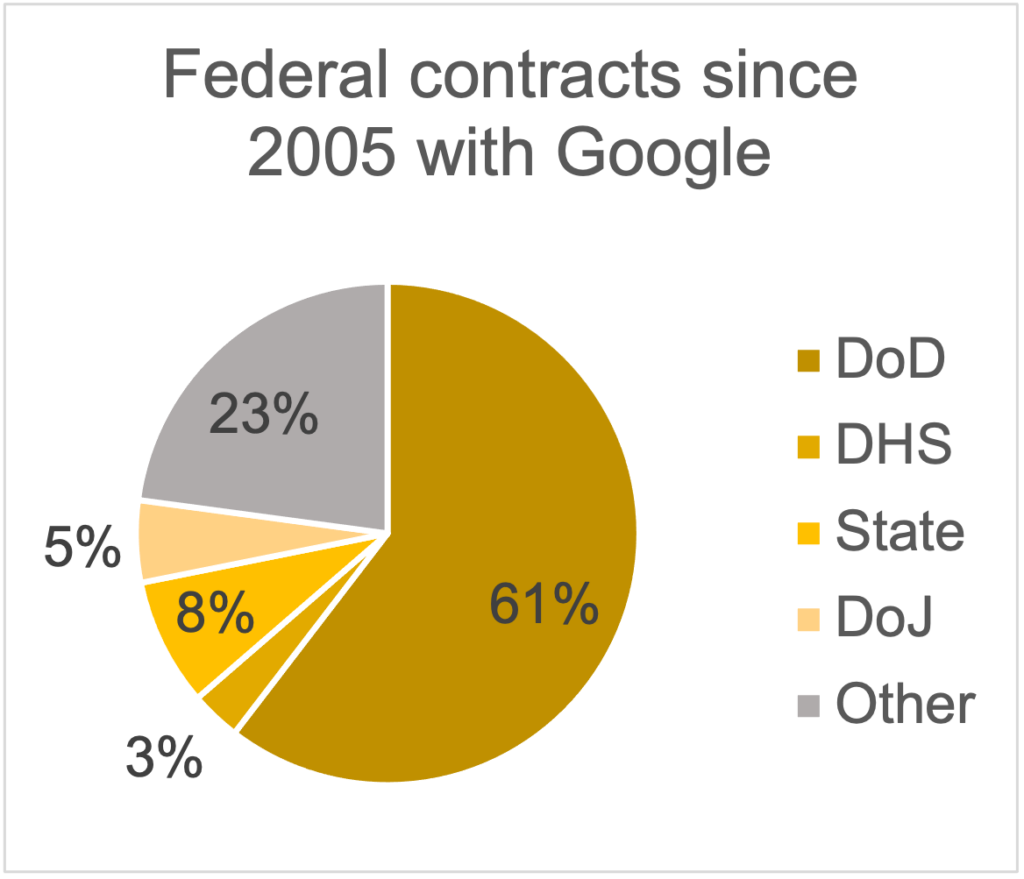
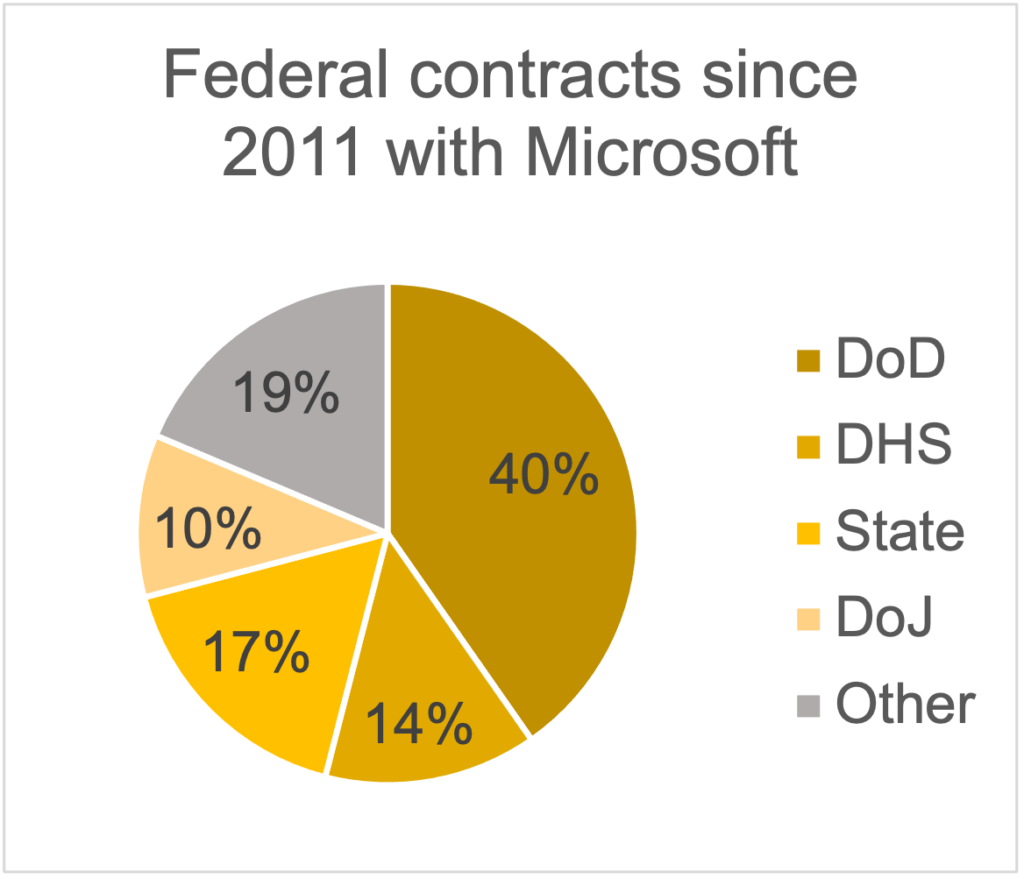
→ Amazon, Google, and Microsoft hold the majority of their contracts with agencies central to the Global War on Terror.
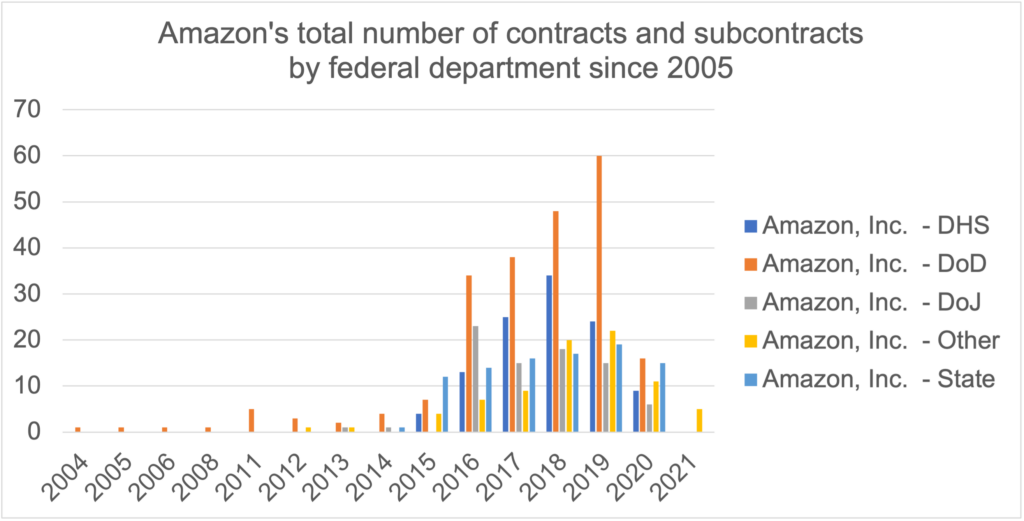
Compared to their contracts with all other departments, Amazon had the most dramatic climb in the number of contracts and subcontracts with the Department of Defense, with totals increasing 20 fold from 2012 to 2019. From 2015 to 2018, Amazon’s contracts with DHS increased nearly 9 fold. Overall, 86 percent of all of Amazon’s government contracts and subcontracts since 2004 have been with agencies central to the Global War on Terror.
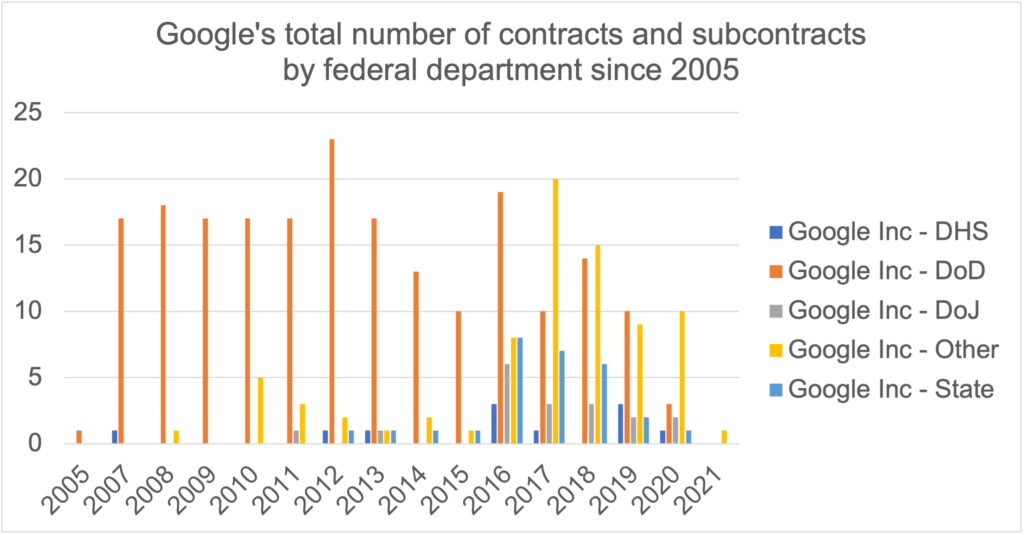
Google held more contracts and subcontracts with the Department of Defense than Amazon and Microsoft from 2004 to 2015, mostly for cloud computing services and GPS software. Overall, 77 percent of all of Google’s government contracts and subcontracts since 2005 have been with agencies central to the Global War on Terror.
Microsoft experienced a leap in defense contracts during the Trump administration, with contracts and subcontracts increasing nearly 6 fold in just two years from 2016 to 2018. Overall, over 81 percent of all of Microsoft’s government contracts and subcontracts since 2011 have been with agencies central to the Global War on Terror.
Previous
Next
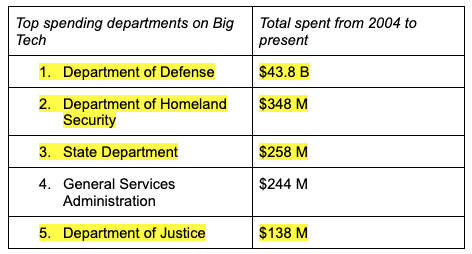
Four of the top five federal agencies that have the highest demand for Big Tech services are all central to foreign policy or were established as a direct result of the Global War on Terror. Since 2004, these agencies have spent at least $44.5 billion on services from Big Tech.
→ When the US chooses war over aid, Big Tech profits.
The Department of Homeland Security and Department of Defense have collectively spent at least $44B on services from Amazon, Google, Microsoft, Facebook, and Twitter. That same amount of money could:
Provide critical food and nutrition aid to the entire population of Afghanistan 15 times over.
Distribute over 108 billion pounds of food to people in Yemen.
Ensure access to shelter, healthcare, food, and water to the entire population of Iraq 26 times over.
→ Microsoft has successfully grown its cloud computing business with DHS and is poised to take on their even bigger cloud computing contracts.
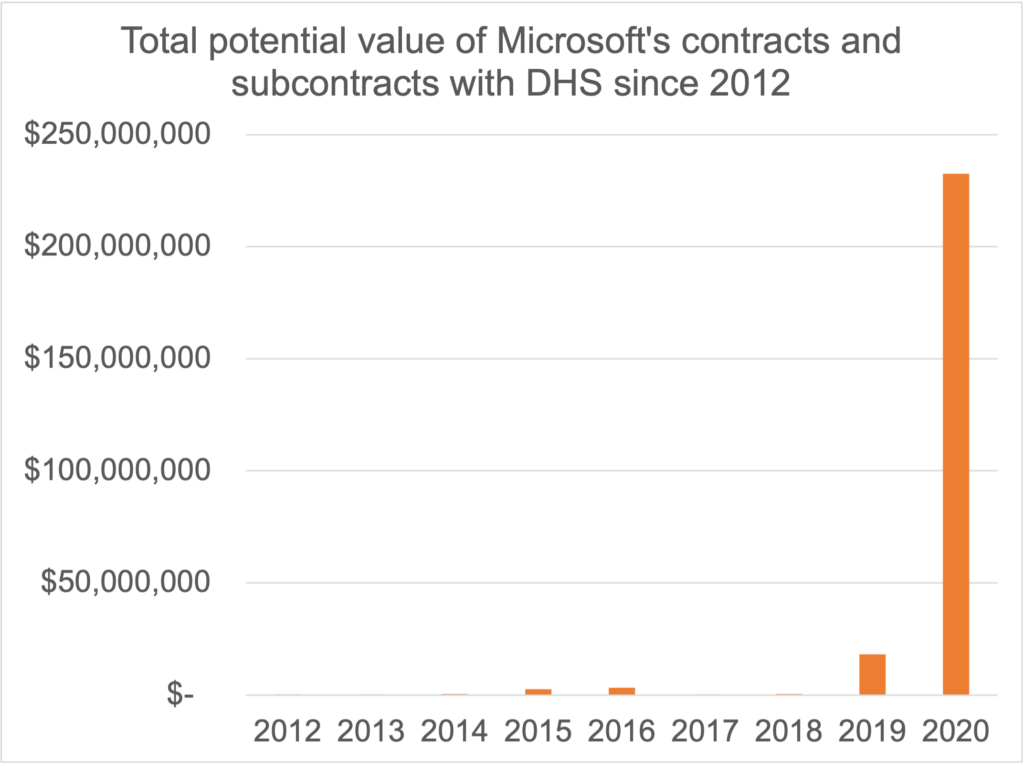
Microsoft, which has been contracting with DHS since 2005, has steadily increased its cloud computing and IT services contracting with DHS until it won a five year, $230M contract in 2020. Other potential contracts could spell enormous revenues for Microsoft, be it billions of dollars through an upcoming cloud computing contract that the Pentagon explicitly stated would be well-suited for Microsoft, or a 10-year contract worth $3.4B for a DHS data center that the agency announced earlier this year.
→ Though Big Tech contracts may seem small, their impact is significant.
Just one month after Trump instituted the third version of the Muslim ban in September 2017, Facebook sold $350,000 worth of advertising to promote, among other things, federally-funded “Extremism Watch” news outlet that covers “stories on violent extremism trends” in largely Muslim-speaking countries. The outlet’s current Trump-appointed director is a known anti-Muslim bigot who in 2010 accused Muslims of “intellectual suicide.” Considering Facebook is the world’s third most visited site and over 2.7B people use Facebook daily, $350,000 worth of ads has the potential to influence billions of people.
Methodology:
The above figures reference Big Tech contract data pulled from Tech Inquiry’s US government contracts explorer and subcontract data from Tech Inquiry’s 2020 analysis. Although these databases are the most comprehensive collection of publicly available government contracts, they do not include information on many more, possibly significant contracts that are not fully disclosed publicly for reasons that are unclear. Therefore, the figures represented here are very likely an underrepresentation of the total contracts and subcontracts and their potential values that these corporations hold. Raytheon and Northrop Grumman data from USAspending.org. Dollar amounts refer to total potential contract value.
Revolving Door Yearbook
Our research has found hundreds of people who have moved between jobs at the Departments of Defense, State, Homeland Security, and Justice, as well as the FBI and National Security Agency. Each of these government agencies have played a major role in carrying out the GWoT and/or dealt with issues of privacy, national security, intelligence, military, and tech development for the government. In addition, major figures with these GWoT US agencies now have major roles in Big Tech.
Examples include:
Jared Cohen, who worked at the State Department before moving onto Google where he founded Jigsaw. One of Jigsaw’s first projects was to develop counterrorism tools for social media platforms that until recently focused solely on Muslim actors.
Steve Pandelides, who worked for the FBI for over 20 years, including at the National Counterterrorism Center and Operational Technology Division and is now Director of Security at Amazon Web Services.
Joseph D. Rozek, who played an integral role in the creation of DHS and is now Executive Director for Homeland Security and Counterterrorism for Microsoft, where he is responsible for developing and implementing a strategic business plan in the area of homeland security, counterterrorism, and information sharing.
Nicholas Rasmussen, who was the Director of the National Counterterrorism Center and in now Executive Director of the Global Internet Forum to Counter Terrorism, which was founded by Facebook, Microsoft, Twitter, and YouTube with the goal of “disrupting terrorist abuse of members’ digital platforms.” It has been criticized recently for not focusing enough on white supremacists and other far right groups and mirroring the same problem of the social media platforms relying exclusively on US government terrorist lists that almost exclusively target Muslim actors.
>>> Hover over each profile picture to find out where they are now.
Steve Pandelides
PAST POSITION:
FBI, November 1999-March 2021 including National Counterterrorism Center and Operational Technology Division
CURRENT POSITION:
Director, Security at Amazon Web Services
March 2021-Present
Christine Halvorsen
PAST POSITION:
FBI, March 2013-April 2019 including Deputy Assistant Director for the FBI’s Counterterrorism Division
CURRENT POSITION:
Amazon Web Services Senior Technical Business Development Manager Mission Acceleration Team
Strategic Account Executive, Artificial Intelligence and Machine Learning
Jana Kay
PAST POSITION:
DOD, 2005-2007, 2009-2018, including Strategist for Global War on Terrorism; 2007-2009 Strategic Planner, National Counterterrorism Center
CURRENT POSITION:
Amazon Web Services Cloud Security Strategist, 2018-Present
Kelli Andrews
PAST POSITION:
DHS, 2007-201
DOJ, 2011-2021 (Counterterrorism and National Security)
CURRENT POSITION:
Microsoft, U.S. Government Affairs team, Senior Director, Cybersecurity and Lawful Access Policy, June 2021-Present
Michael Keegan
PAST POSITION:
DOJ + DHS + State, 2009-2020, including Counterterrorism and National Security
CURRENT POSITION:
Microsoft, Deputy Director, National Security Law, 2020-Present
Joseph D. Rozek
PAST POSITION:
Special Assistant to the President and Senior Director for Domestic Counterterrorism, 2005-2005
CURRENT POSITION:
Microsoft Executive Director Homeland Security and Counterterrorism, 2005-present
John Turner
PAST POSITION:
FBI, 2004-2018, including Deputy Assistant Director, Intelligence Directorate
CURRENT POSITION:
YouTube, 2018-Present, Director of Intelligence, Trust & Safety
David Tessler
PAST POSITION:
Treasury, 2010-2017, Senior Advisor to the Under Secretary for Terrorism and Financial Intelligence
State, 2017-2019
CURRENT POSITION:
Facebook, public policy manager on the Dangerous Organization team, 2019-present
Nick Lovrien
PAST POSITION:
CIA, 2006-2011, CounterTerrorism Operations Office
CURRENT POSITION:
Facebook, Chief Global Security Officer, 2013-Present
Brian Fishman
PAST POSITION:
West Point, 2005-2009, Director of Research, Combatting Terrorism Center
CURRENT POSITION:
Facebook, Director, Counterrorism and Dangerous Organizations, 2016-Present
Nicholas Rasmussen
PAST POSITION:
National Security Council,
including as Director for Regional Counterterrorism, 2001-2004, 2007-2012
National Counterrorism Center, including as Director, 2004-2007, 2012-2017
CURRENT POSITION:
Global Internet Forum to Counter Terrorism, 2020-Present (founded by Facebook, Microsoft, Twitter, and YouTube)
Jared Cohen
PAST POSITION:
State Department, Policy Planning Staff, 2006-2010
CURRENT POSITION:
Jigsaw (Google), Founder and CEO, 2016-Present
Director of Google Ideas, 2010-2016
With such a growing close relationship between these agencies and these companies, that includes the increasing number of contracts, it wouldn’t be a surprise that US counterterrorism priorities then become Big Tech priorities as these Big Tech companies seek to prioritize the needs of these agencies over the needs of its users.
In response to the 9/11 attacks, the US government set in motion 20 years of policy decisions targeting Muslim, Black, and brown people in the name of fighting terrorism that continues through today. As with the wars before it, the Global War on Terror (GWoT) created massive and unprecedented demand for tech to support the building of sprawling surveillance systems, pilotless deadly drones, and virtual border walls. This demand helped to create the data economy and the tech industry as we know it, helping to launch tech companies from tiny at-home operations to trillion-dollar “Big Tech” as we know it. Listed are 20 years worth of war policies targeting Muslim people and people of color at home and abroad and instances of Big Tech rising to the occasion to help build out the Global War on Terror.
Note: These timelines are focused only on the landmark policies and contracts between Big Tech and the federal government that characterize the GWoT. It does not explicitly include the countless horrors and deaths that have occurred as a result of these policies, nor the many instances of impacted communities leading the resistance to these policies.