


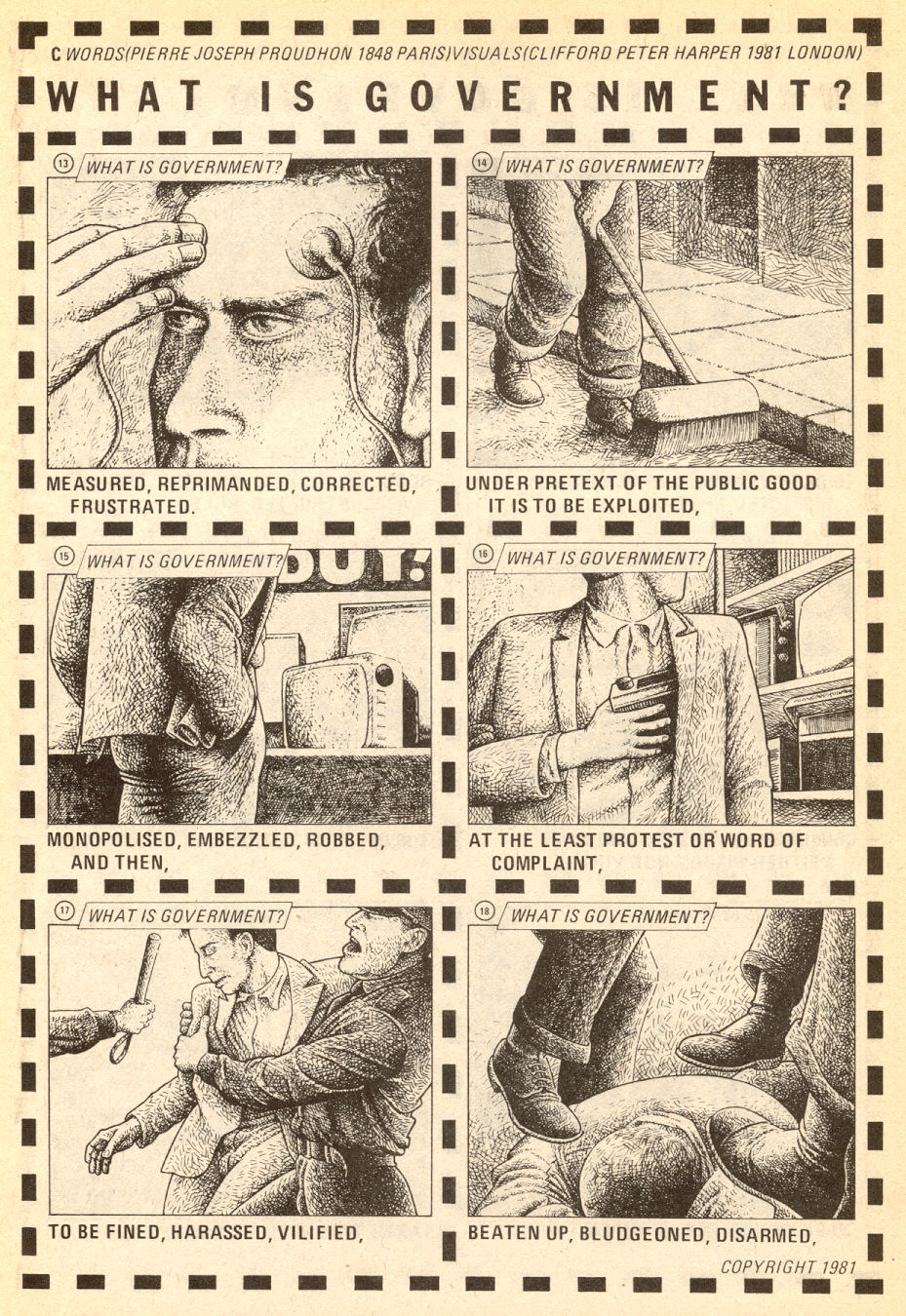
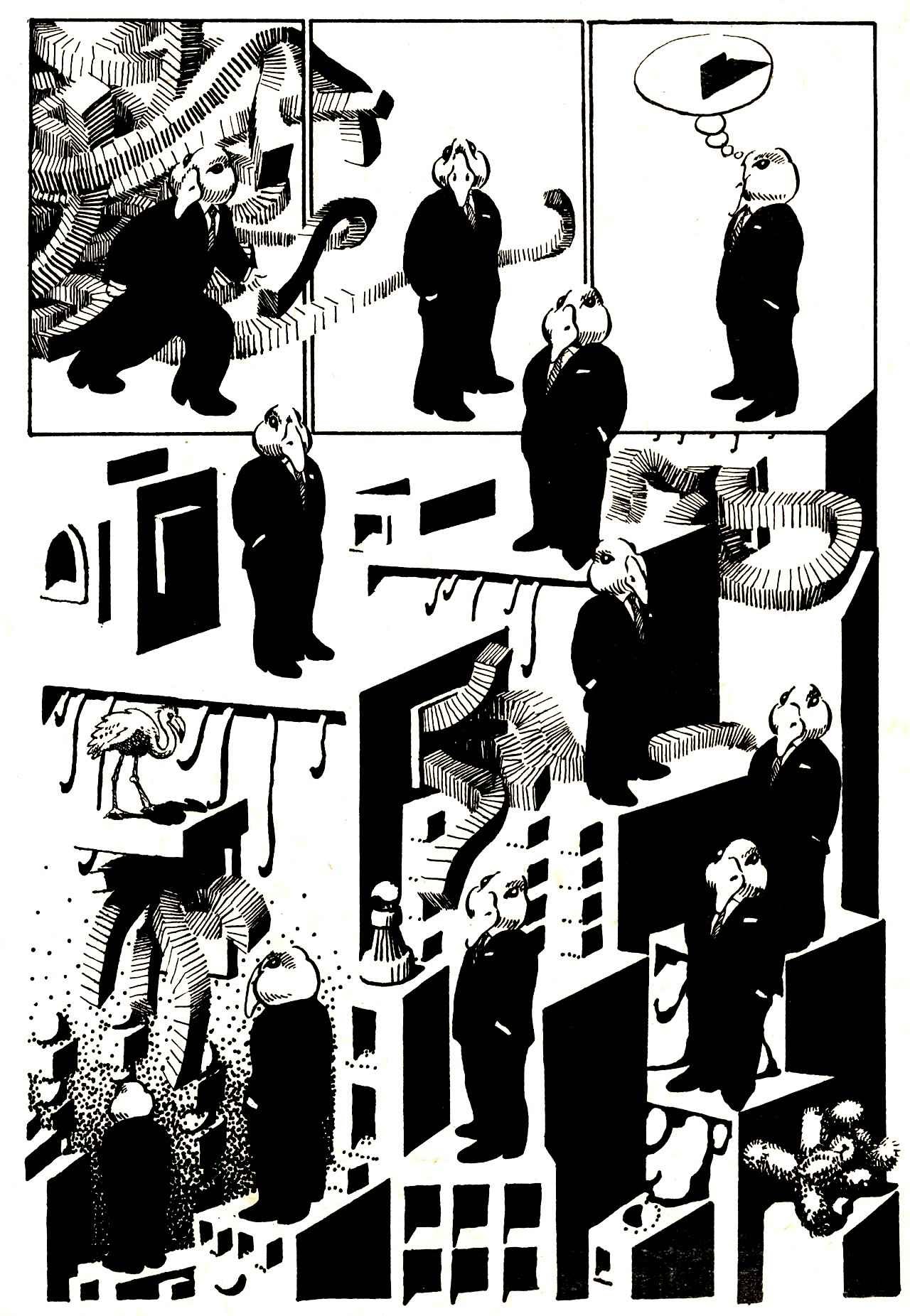
From “What Is Government?” by Clifford Peter Harper, a visual adaptation of text by Pierre Joseph Proudhon. Published in Anarchy Comics #3, July 1981, Last Gasp Comics.
| CARVIEW |
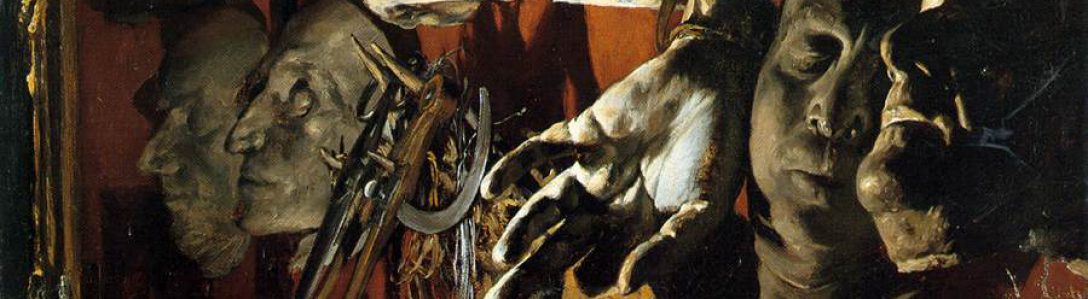
From “What Is Government?” by Clifford Peter Harper, a visual adaptation of text by Pierre Joseph Proudhon. Published in Anarchy Comics #3, July 1981, Last Gasp Comics.
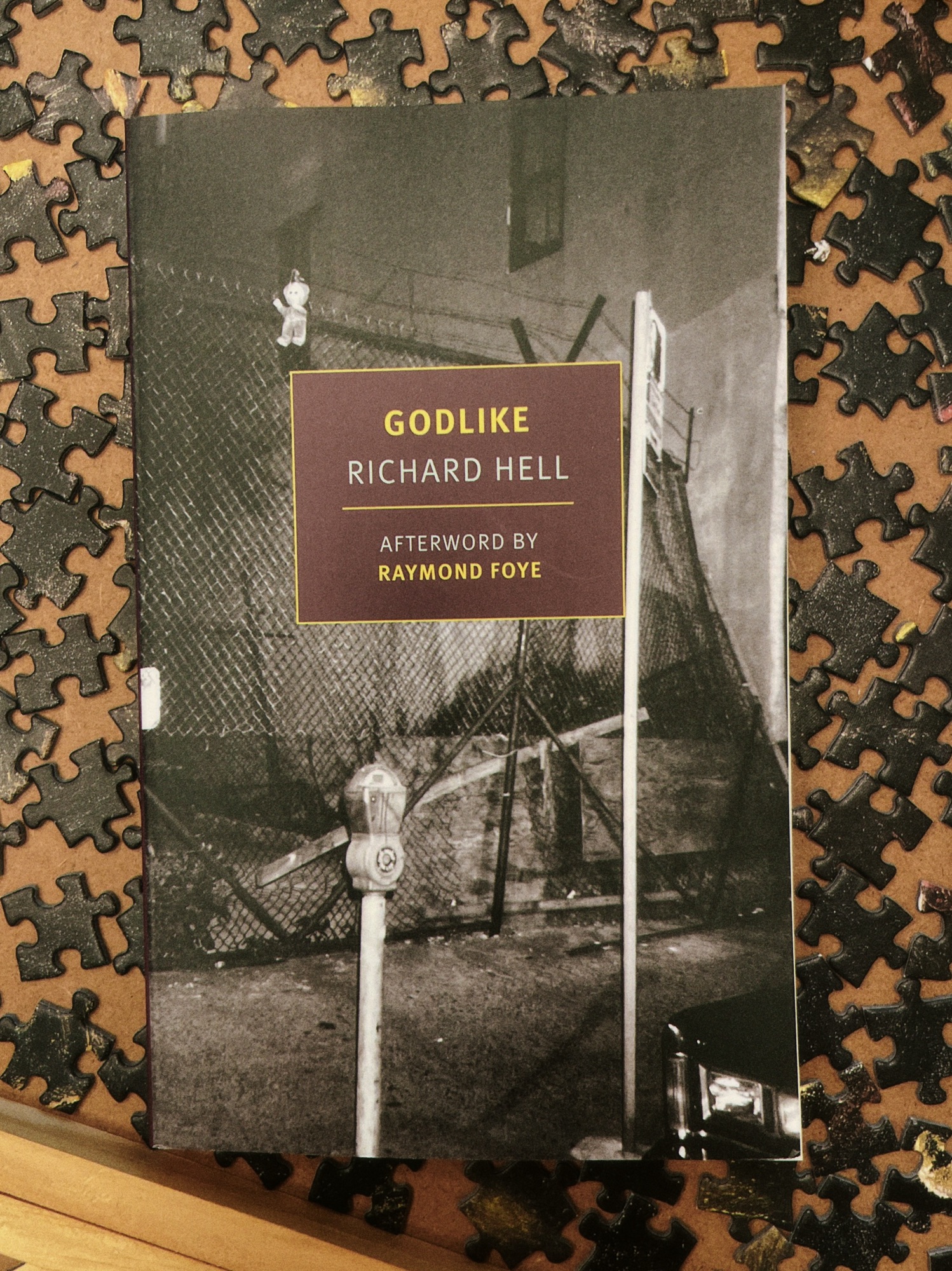
Richard Hell’s 2005 novel Godlike is getting a new printing from NYRB. Godlike reimagines the volatile Verlaine–Rimbaud dyad as a 1970s No Wave New York collision of art, desire, and language language language. Symbolist rebellion transmutes into downtown punk nihilism, drugs, and poetry. This corrosive Künstlerroman was originally issued by Dennis Cooper’s Little House on the Bowery (an imprint of Akashic books). Read the description/blurb at NYRB; here’s a taste from Chapter 15, around the middle of the novel:
They spent the greatest amount of their time together reading and writing and sometimes talking in T’s apartment. These were probably their best times too despite being experienced largely as tedium. They preferred the times of thrills, but the thrills grew out of the tension; and the mild, mildly restless, half-frustrated times of the many nights and late afternoons of doing almost nothing in T’s apartment, or walking the streets without direction, were their true lives.
T’s room was like some kind of glum office in its lack of daylight and its featurelessness, but with the little pictures now tacked on the walls, and the typewriter and sheets of paper, and the drugs, it got some character. He’d picked up a few stray pieces of furniture on the streets, including a table and three chairs, crates for shelves, and a beat-up old oriental rug. There was a secondhand portable record player too and a few albums.
They drank coffee and beer and sometimes codeine cough syrup and sometimes smoked some grass or snorted a little THC or mescaline and every once in a while a tiny bit of heroin, but mostly they lay around and lazily, impatiently goofed and wrote and complained, goading each other. Sometimes in the middle of the night one of them would go out for a container of fresh ice cream from Gem’s Spa. They’d go to a movie sometimes, or wander the rows of used bookstores on Fourth Avenue, or drink in a bar, but most of t he time was spent in the dim back apartment.
The days and nights were as endless as wallpaper patterns. Boredom and irritation were normal and lengthened out into sometimes-mean giggles and into pages of writing. Writing was their pay. Books were reality. The room was a cruder dimension-poor annex to the pages of writing. The writing, as casual as it was—smeared eraseable typing-pages with revisions scribbled on and crumpled pages of rejected tries—was the brightly lit and wildly littered universe erupting out from the dark, poor, inexpressive room.
How odd is it to have as a purpose in life the aim of treating life-in the medium created for the purpose of coldly corresponding to it, words—as raw material for amusing variations on itself? Sometimes T. and Paul fantasized about this, imagining themselves as godlike philosopher poets encouched in the advanced civilization, languorously sipping their fermented grain as they spun ideas and mental-sensual constructions of life-language in the air for the pleasure of their own delectation.
“Even Greenland”
by
Barry Hannah
I was sitting radar. Actually doing nothing.
We had been up to seventy-five thousand to give the afternoon some jazz. I guess we were still in Mexico, coming into Mirimar eventually in the F-14. It doesn’t much matter after you’ve seen the curvature of the earth. For a while, nothing much matters at all. We’d had three sunsets already. I guess it’s what you’d call really living the day.
But then, “John,” said I, “this plane’s on fire.”
“I know it,” he said.
John was sort of short and angry about it.
“You thought of last-minute things any?” said I.
“Yeah. I ran out of a couple of things already. But they were cold, like. They didn’t catch the moment. Bad writing,” said John.
“You had the advantage. You’ve been knowing,” said I.
“Yeah. I was going to get a leap on you. I was going to smoke you. Everything you said, it wasn’t going to be good enough,” said he.
“But it’s not like that,” said I. “Is it?”
The wings were turning red. I guess you’d call it red. It was a shade against dark blue that was mystical flamingo, very spaceylike, like living blood. Was the plane bleeding?
“You have a good time in Peru?” said I.
“Not really,” said John. “I got something to tell you. I haven’t had a ‘good time’ in a long time. There’s something between me and a good time since, I don’t know, since I was was twenty-eight or like that. I’ve seen a lot, but you know I haven’t quite seen it. Like somebody’s seen it already. It wasn’t fresh. There were eyes that used it up some.”
“Even high in Mérida?” said I.
“Even,” said John.
“Even Greenland?” said I.
John said, “Yes. Even Greenland. It’s fresh, but it’s not fresh. There are footsteps in the snow.”
“Maybe,” said I, “you think about in Mississippi when it snows, when you’re a kid. And you’re the first up and there’s been nobody in the snow, no footsteps.”
“Shut up,” said John.
“Look, are we getting into a fight here at the moment of death? We going to mix it up with the plane’s on fire?”
“Shut up! Shut up!” Said John. Yelled John.
“What’s wrong?” said I.
He wouldn’t say anything. He wouldn’t budge at the controls. We might burn but we were going to hold level. We weren’t seeking the earth at all.
“What is it, John?” said I.
John said, “You son of a bitch, that was mine—that snow in Mississippi. Now it’s all shot to shit.”
The paper from his kneepad was flying all over the cockpit, and I could see his hand flapping up and down with the pencil in it, angry.
“It was mine, mine, you rotten cocksucker! You see what I mean?”
The little pages hung up on the top, and you could see the big moon just past them.
“Eject! Save your ass!” said John.
But I said, “What about you, John?”
John said, “I’m staying. Just let me have that one, will you?”
“But you can’t,” said I.
But he did.
Celeste and I visit the burn on the blond sand under one of those black romantic worthless mountains five miles or so out from Mirimar base.
I am a lieutenant commander in the reserve now. But to be frank, it shakes me a bit even to run a Skyhawk up to Malibu and back.
Celeste and I squat in the sand and say nothing as we look at the burn. They got all the metal away.
I don’t know what Celeste is saying or thinking, I am aso absorbed myself and paralyzed.
I know I am looking at John’s damned triumph.
“News”
by
Grace Paley
although we would prefer to talk
and talk it into psychological the-
ory the prevalence of small genocides
or the recent disease floating
toward us from another continent we
must not while she speaks her eyes
frighten us she is only one person
she tells us the terrible news we
want to leave the room we may not
we must listen in this wrong world this
is what we must do we must bear it

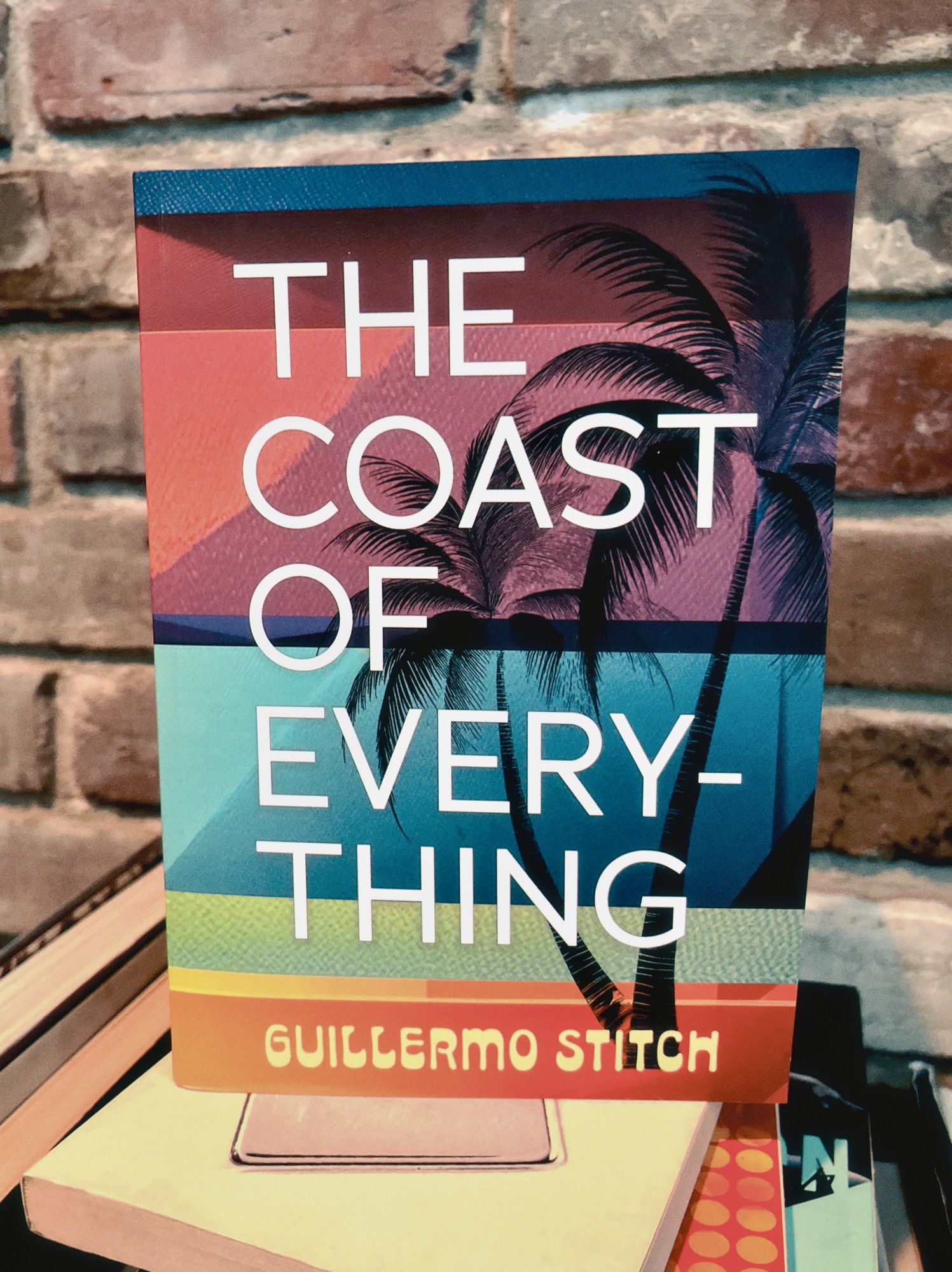
Guillermo Stitch’s follow up to 2020’s Lake of Urine is The Coast of Everything, an enormous seven-hundred-and-something pager that with a matryoshka doll (decon)structure. I really liked Lake of Urine, a zany, slapstick surreal adventure story. The Coast of Everything of course intrigues me. It’s also pretty big! It’s been staring at me for a few weeks now, daring me to plunge into something deep. (I’ve been reading only short stories and nonfiction so far this year — story collections by Joy Williams and Robert Bingham, and a depressing and engrossing book called The Fort Bragg Cartel by Seth Harp.) So anyway, I dipped in this afternoon, read the preamble, I suppose you would call it, and then dug into the first of what I take to be connected/nested novellas, “The Tale of the Enchanted Road.” I plan to keep swimming.
Indie publisher Sagging Meniscus’s blurb:
To find the center, begin at the edge…
A daughter’s devotion parts her from her father. A dutiful soldier sentences his daughter to a loveless exile and her mother to madness. With her last breath a dying woman exhales the whole world. A young girl with a broken body holds it up.
Their nested stories bleed into one another: tributaries in search of a common sea; parched souls in search of an oasis; ink racing through blotting paper.
A book with no ending and endless beginnings, The Coast of Everything—the long-awaited second novel from the author of Lake of Urine—is an astonishing masterpiece, epic, unfurling, baffling and beguiling. A gumshoe noir, a space opera; a multiverse melodrama, an adventure; a leap of faith, a call to prayer and a call to arms. It is a notification of our first duty wherever our humanity is threatened: to persist.
Includes two free recipes.
I’ve concluded that whiteness is an American invention. In Europe people have their cathedrals, ancient towns and cities, paintings, opera houses, that have been there for centuries. They have their roots. They’re secure. In the United States we have people who call themselves ‘white.’ They don’t say they’re Irish, or French, or German, or Swedish . . . just white.
The white middle class, however, is in more trouble now than the blacks were thirty years ago. With all the big migrations, this country is not going to be all-white, all English-speaking, in a few years. Of course these migrations, changes, are enriching their culture. But they don’t see it that way. The white middle class has a settler mentality: very paranoid, insecure, embattled. They become more and more isolated. What this class forms at this point in time is a group of people who call themselves white and who feel that their experience is the only permanent, historically viable experience, that everyone else’s—Afro-American, Latin, whatever—is just a short term fad. This point of view affects American education, politics, culture, the psyche.
The white settler culture can’t relate to other cultures. There’s more resistance to cultural change in the United States than in almost any country. But just as there’s transformation, now, from the old technology to a high technology, there’s a transition going on from a settler to an international culture, and this only increases the white settler’s sense of being embattled, and increases anxiety and paranoia.
From persons who are spokespersons for this settler culture, you aren’t going to get an accurate reading of reality. It’s too paranoid. It’s appropriate they have a white settler cowboy for a leader. But I feel sorry for Reagan. I think what’s happened to him is probably the worst tragedy since what happened to the salesman in Arthur Miller’s play. It’s pathetic that he’s been used as he has. He’s just another expendable front man.
The white male can’t rule the roost anymore. He’s in a terrible position. The kind of power he had is disappearing, and looked at over the longer historical view, he didn’t even have power that long. It’s become difficult to be a white man. I didn’t think I’d ever hear myself say that…
A white man…is some kind of homogenized, standardized profile that occurred in the United States. It began in a Yankee puritanical ideal that these old patriarchs, codgers, elders, who formed our leadership class, men like the Mathers and Jonathan Edwards who built the Ivy League schools our leaders—like George Bush, for instance—went to, a man who’s just ignorant, who talks about voodoo economics. Being a white man is an ideal that comes out of that matrix. I guess you would call it ‘patrix.’ All white men—and white women—are supposed to mold themselves in that ideal. They’re supposed to give up their ethnic roots—Polish, Irish, French—and become some kind of bland homogenized… supermen. Some kind of Rocky, the white male wish fulfillment. There’s a lot of narcissism, too, in the white man’s ideal. But this white macho swaggering stuff, the Yankee ideal and old Puritan myth of self help, discipline, self-sufficiency—all that transcendental moralizing you get with Emerson—it doesn’t work in this world. It worked at a time when a man could go out and hunt and fish and raise cattle. But now, more and more white males can’t make it, can’t do it, can’t be successful at it. And then they start striking out.
From “A Conversation with Ishmael Reed” with Judith Moore. First published in Express: The East Bay’s Free Weekly, 18 Feb. 1983; reprinted in Conversations with Ishmael Reed, 1995, UP Mississippi.
From “Dr. Deluxe” by J. Gaccione (signed as Chicken Delight), published in Yellow Dog #17, March, 1970, The Print Mint.

The following essay is from Rediscoveries II, a 1988 “gathering of essays by novelists…asked to rediscover their favorite neglected work of fiction.” Ishmael Reed’s overview of John Williams’ 1982 novel !Click Song motivated me to track down a copy of the book. And while elements of Reed’s typically prickly essay are dated in their contemporaneous references, the essay’s thrust — that the Invisible Empire persists — is as timely as ever. Read more on Rediscoveries II at Neglected Books.
Ishmael Reed
on
John A. Williams’ !Click Song
The Ku Klux Klan may appear to be clownish, and inept to some, but they have one thing right. They do represent an “Invisible Empire,” of which, the kind of monkeyshines that go on in places like Forsyth County belong to those of a small ignorant outpost. On the day that some joker held a sign warning of welfare disaster if blacks moved into the county, a New York Times columnist and a book reviewer spread the same lie about welfare being an exclusively black problem, yet, I doubt whether demonstrators will march on the editorial offices of the Times.
Klan thinking goes on in the editorial rooms of our major newspapers, in the film, and television studios; and in the public schools, and universities whose white male supremacist curricula are driving Hispanic, and black children out of education. One hears Ku Kluxer remarks in places that present themselves as the carriers of “Western civilization” like National Public Radio where,recently, a man congratulated a musician for using the saxophone as a “serious” symphonic instrument. “Up to now,” he said,
“the saxophone has merely been used to make ‘jazzy howls.’ ” In “the Invisible Empire,” George Shearing will always receive more recognition than Bud Powell, Paul Cummings more recognition than Cato Douglass, and racist mediocrities will always get more publicity and praise than John A. Williams. Continue reading “Ishmael Reed on John A. Williams’ !Click Song” →
“Lamb Chops, Cod”
by
Diane Williams
She had stopped insisting that they have heart-to-heart conversations, but for stranded people, they had these nice moments together, and he had his professional enjoyment at the newspaper. He approved the issues there with a scientific mind and he made quite a contribution. He was a consultant in the field of efficiency.
She should have appreciated that, I guess. I don’t know—she felt lonely.
After dinner, he would go into his room and sometimes read or do his engraving or follow up on his stamp collection or solve math problems from that year’s baccalaureate examination. Once he told me that once a year he reread Our Man in Havana. It had something to do with Havana. You know—petty things—I guess my mother wanted full attention, not for him to have private time by himself. I don’t know what my mother did when she was in her room. She was working. She was working a lot. She devoted herself to family matters, making trouble. But I am convinced that she did love him extremely and after he died she said that that was the fact.
Then they had golf together and they did trips. There was a French newspaper that would invite him to solve a technical problem. He was amazing that way.
They would playact around the occasion of having dinner. I’m not sure, but I’m afraid that they did it for every dinner. She would put on her best gown and wear the diamond ornament, which she felt free to pin anywhere on her garment if it was necessary for the brooch to cover up a soiled spot.
He wore black lacquer pumps, silk stockings that went up under the knees. His breeches were tied under the knees and he would have tails and white tie on. My mother would provide the basic meal—cod or lamb chops. He would provide—he loved to go to the store that was similar to Fortnum and Mason and buy smoked salmon, cheese, fruit in season, asparagus. They had cocktails at five o’clock. They would listen to the news and then they’d sit down to the table, light the candles. They would have their little feast together. Then after the meal, he’d sit down and do work in his room. His French was very good, so sometimes he translated manuals from French or the other way around. And before bedtime, they’d have a cup of tea together with a cookie.
He loved an existence of this kind and to eat food.
He died while he was still glossy and smooth at the dinner table between the fish with dill—a great favorite—outstanding with butter—and the boiled blue plum dumplings.
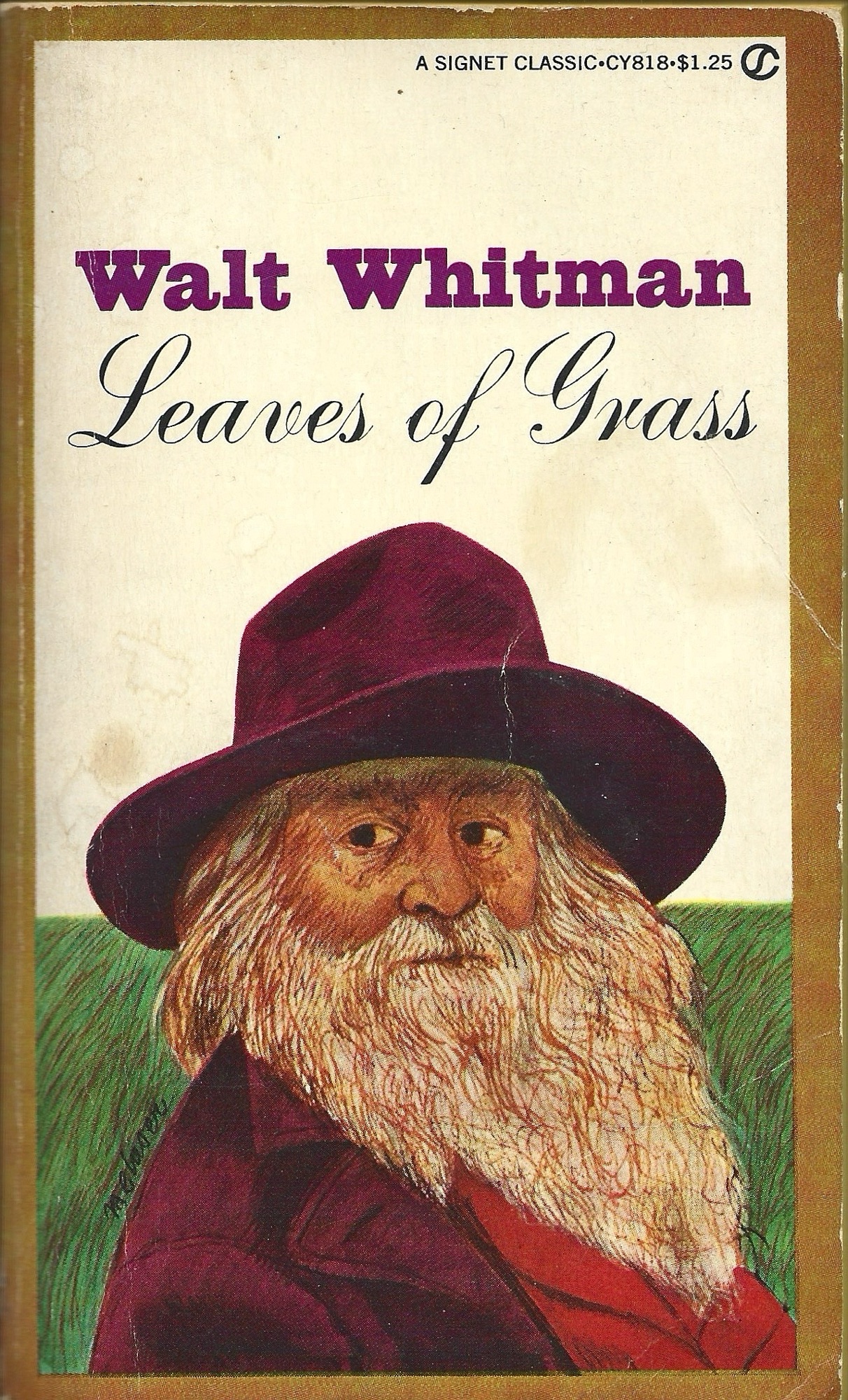
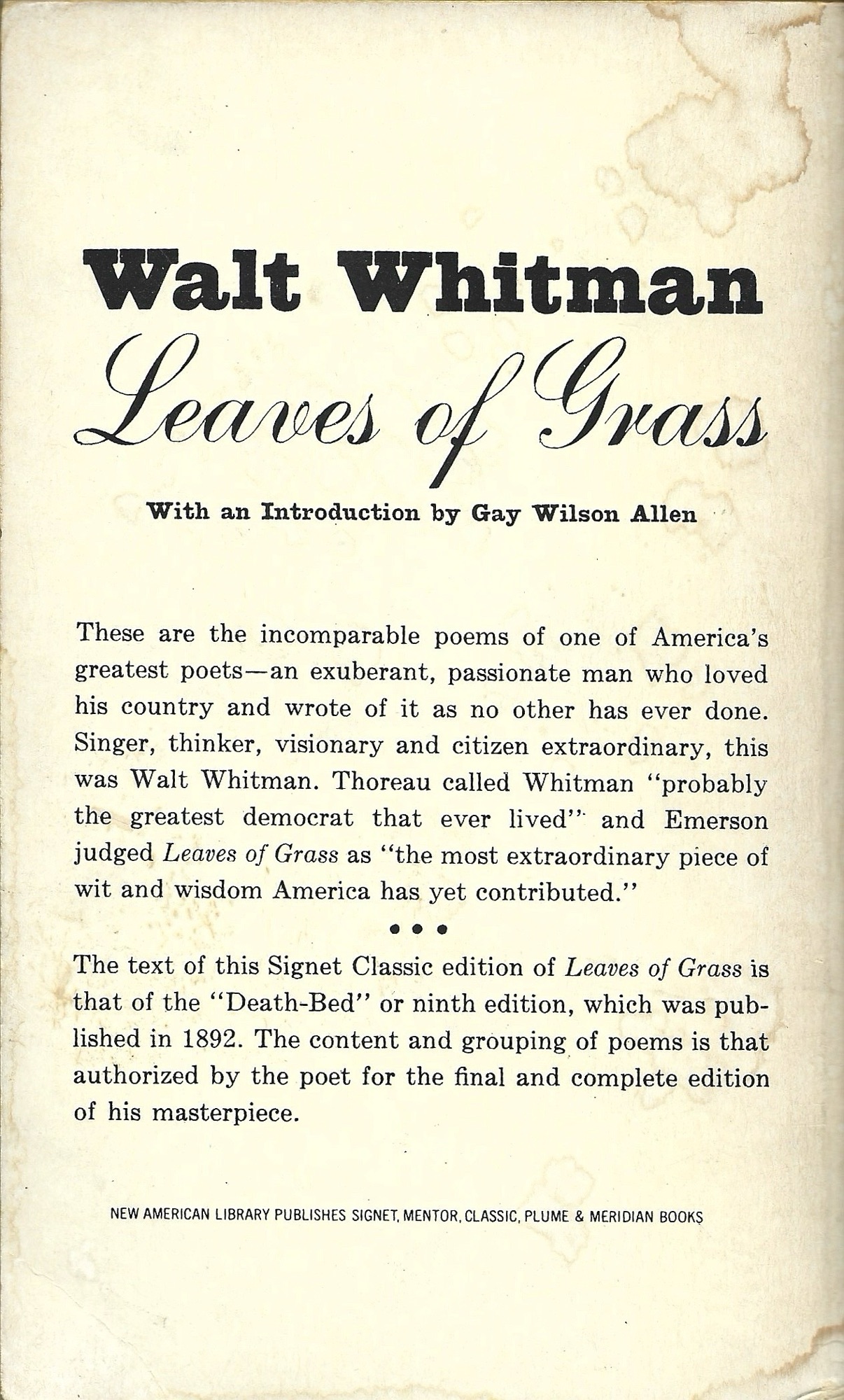
Leaves of Grass, Walt Whitman, 1892 (9th ed.), Signet Classics (no print date; 1958 copyright on Gay Wilson Allen’s introduction). No cover artist or designer credited. 430 pages.
Trying to find some hopeful green stuff woven in the New Year; hell, at this point I’m even open to the idea of the Lord dropping a handkerchief so we might ask, Whose? Seems more like the uncut hair of graves lately. My grass is thirsty.
“On the Beach at Night Alone”
by
Walt Whitman
On the beach at night alone,
As the old mother sways her to and fro singing her husky song,
As I watch the bright stars shining, I think a thought of the clef
of the universes and of the future.
A vast similitude interlocks all,
All spheres, grown, ungrown, small, large, suns, moons, planets,
All distances of place however wide,
All distances of time, all inanimate forms,
All souls, all living bodies though they be ever so different, or in
different worlds,
All gaseous, watery, vegetable, mineral processes, the fishes, the
brutes,
All nations, colors, barbarisms, civilizations, languages,
All identities that have existed or may exist on this globe, or any
globe,
All lives and deaths, all of the past, present, future,
This vast similitude spans them, and always has spann’d,
And shall forever span them and compactly hold and enclose them.
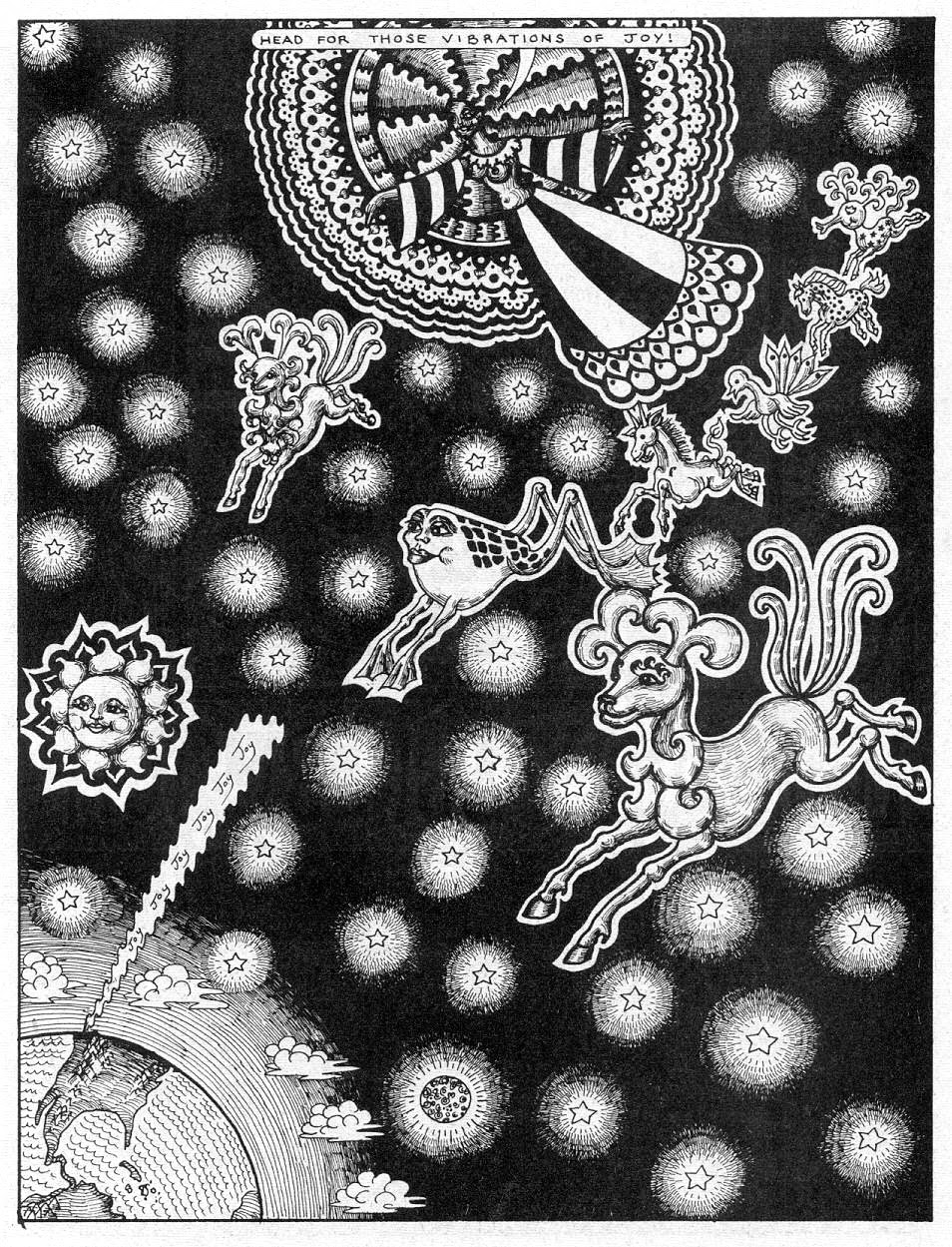
From “Real of Karma Comix” by Barbara “Willy” Mendes, published in All Girl Thrills, March, 1971, The Print Mint.
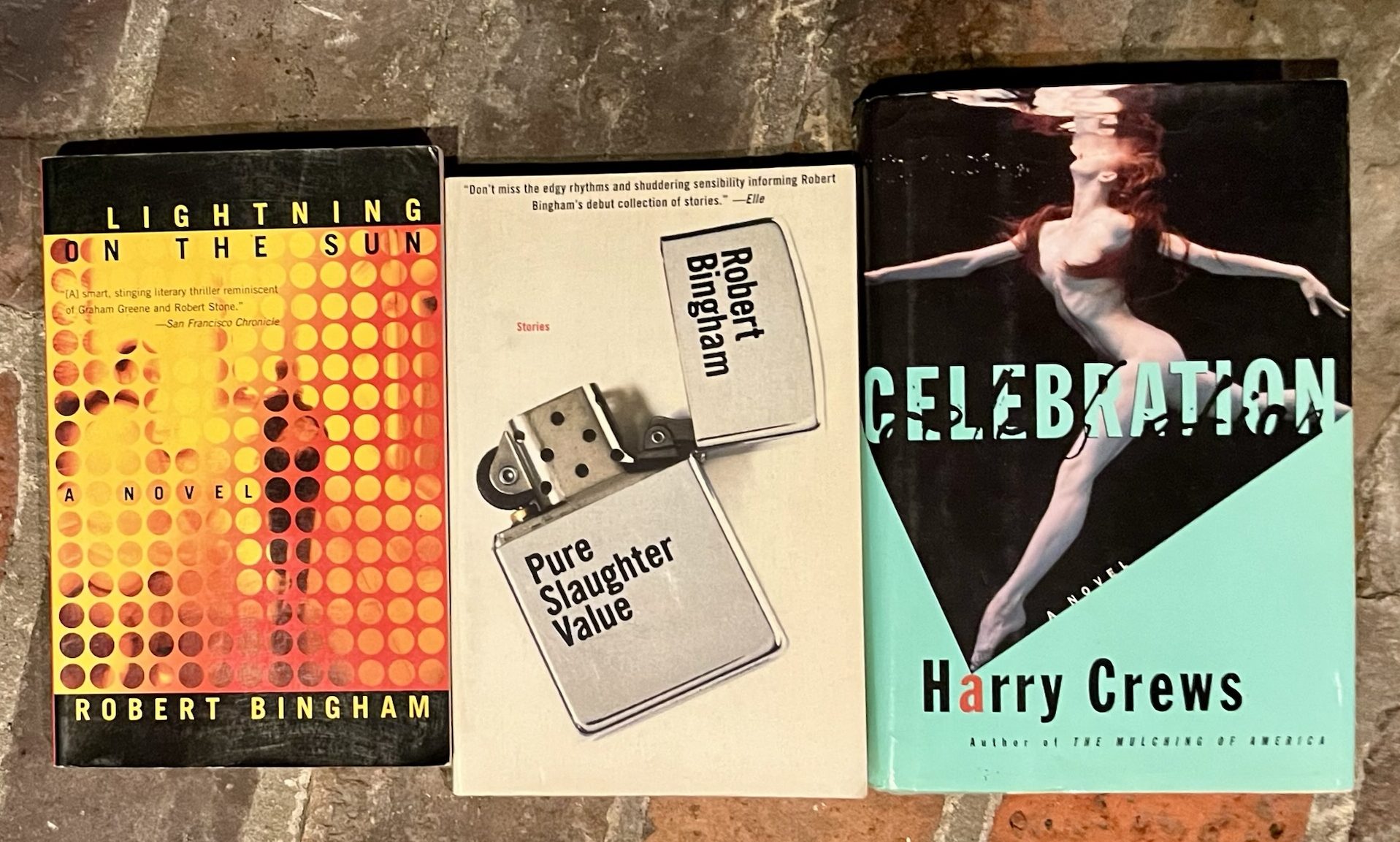
I finally gave in and picked up Robert Bingham’s books, the novel Lightning on the Sun and the collection Pure Slaughter Value.
Bingham was one of the founders of the literary magazine and press Open City. Open City published David Berman’s collection Actual Air in 1999. Bingham was friends with Berman and the Pavement boys. He was also the wealthy scion of an old Louisville family. He o.d.’d in ’99. Both Malkmus and Berman eulogized him in song — SM in “Church on White,” the Silver Jews in “Death of an Heir of Sorrows”:
I wish I had a rhinestone suit
I wish I had a new pair of boots
But mostly I wish
I wish I was with you
I think what really plugged the Bingham back into my brain was going through a July 1999 issue of SPIN magazine. I was looking for something else, but I found an old Pavement profile in which Bingham shows up early with bobo hockey tix. From the profile:
Pavement are standing outside Madison Square Garden, shouldering their way through tens of thousands of burly hockey fans. There’s a sold-out game about to start—the Rangers vs. the Mighty Ducks—and cops, peanut vendors, and entire families in matching red-white-and-blue Rangers jerseys mill about, blocking the sidewalk. “We’ve never gone to a hockey game together,” says bassist Mark Ibold. He is unceremoniously shoved aside by a squall of kids bearing cotton candy. “Usually we go see baseball games.”
Pavement pal Robert “Bingo” Bingham, a New York fiction writer, grows increasingly nervous as they approach the arena. He bought the band scalped tickets, an offense he’s been nailed for once before. “Should we come up with a fall-back strategy?” he says.
“Don’t sweat it, Bingo,” says bandleader Stephen Malkmus, still wearing the track suit and squash shoes he threw on this morning while awaiting clean laundry. The band is determined to get in, as percussionist Bob Nastanovich has already phoned his bookie to bet on the Rangers. “We don’t much care for the Ducks,” Nastanovich says.
“They’re all Steve Garveys,” adds the clean-cut Malkmus. Nastanovich takes a final drag from his Marlboro, then leads the group through the throngs to the ticket line. They cruise right in, home free—until a security squad catches up with them moments later.
“You aren’t going anywhere with those,” a guard says, motioning at the ticket stubs in Bingo’s hand. “They’re fakes.”
“Oh, please,” Bingo says. He knows they’re scalped, but fakes? A bit stunned, the band takes a look. “Well, yeah,” Ibold says. “I can see that.”
The printing is all faded and off-register.
“Mine looks like it was perforated with a cookie cutter,” says Nastanovich. Upon further inspection, they realize they all have the same seat.
Meanwhile, the Garden crowd is going ballistic. Christopher Reeve has just been wheeled onto the ice for the opening ceremony. Security hems and haws for a while, and finally takes pity on Pavement. A bearded fellow rests a cozy hand on Bingo’s arm. “You tell me who you bought these from,” he says, “and if he’s still out there, we’ll bust the fucker.”
Bingo hangs his head. “I don’t remember,” he mutters, and ambles off. Pavement trudge back to the street, reassuring their friend that the night is still young. They end up viewing the game at a nearby sports bar, and work on getting stinking drunk. Nedved is benched. Gretzky is checked. The once formidable Rangers lose handily, 4–1. Nastanovich looks up from his Bass Ale and shakes his head, laughing. He just lost $100.
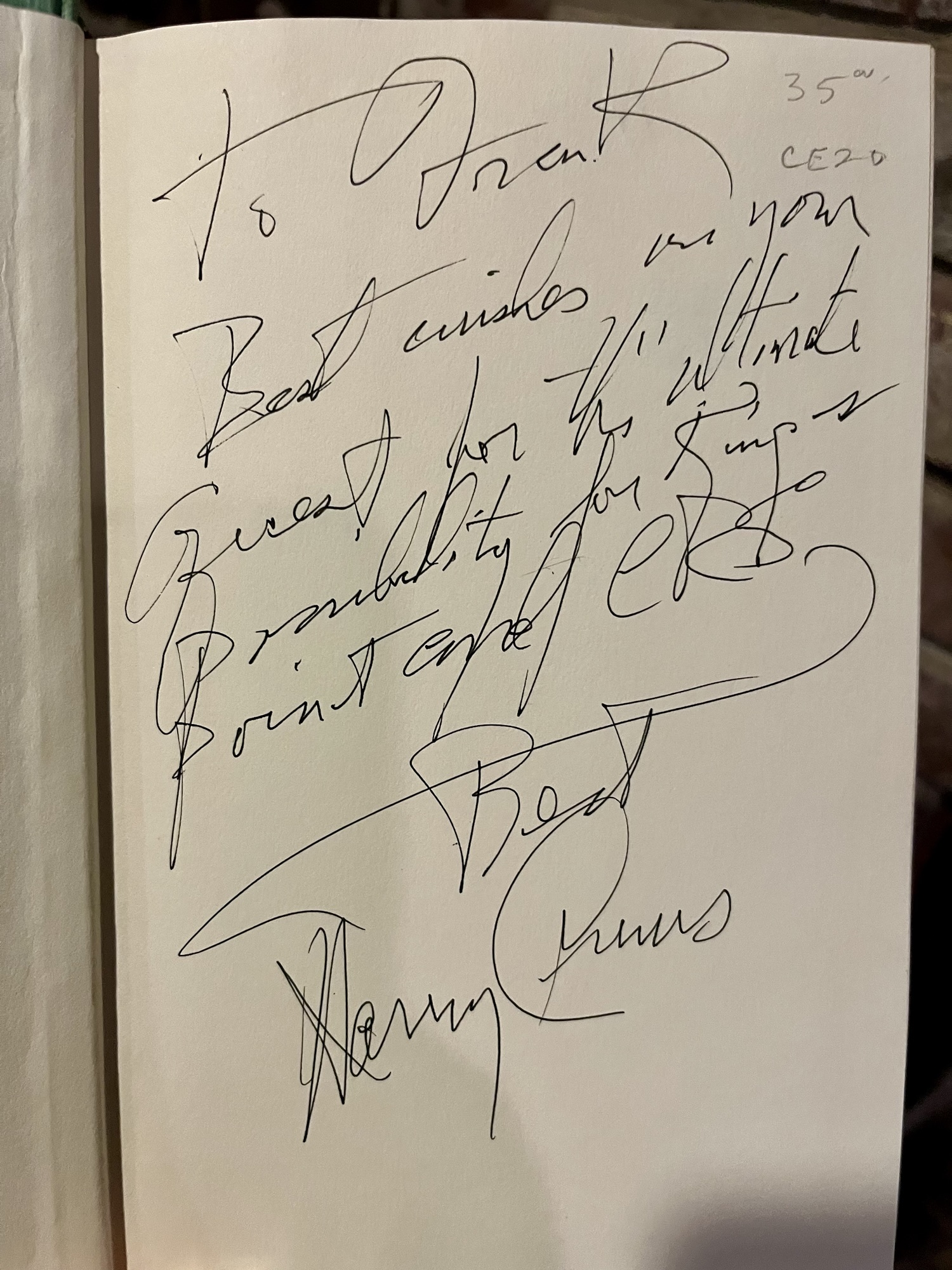
I also couldn’t resist a signed copy of Harry Crews’ 1998 novel Celebration.
If you can make out the inscription, let me know. I think it’s to Frank, who was on the ultimate quest for…?
“Wedding Night”
by
Henri Michaux
translated by David Ball
from The Night Moves
When you come home on your wedding day, if you stick your wife in a well to soak all night she is flabbergasted. Even if she had always been vaguely worried about it . . .
“Well, well,” she says to herself, “so that’s what marriage is like. No wonder they kept it all so secret. I’ve been taken in by the whole business.”
But since her feelings are hurt, she doesn’t say a thing. That’s why you can plunge her into it for a long time, over and over, without making any trouble in the neighborhood.
If she didn’t understand the first time, it’s not very likely that she’ll catch on after that, and you have a good chance of being able to continue with no problems at all (except for bronchitis) if you really want to.
As for me, since I suffer even more in other people’s bodies than in my own, I had to give it up right away.
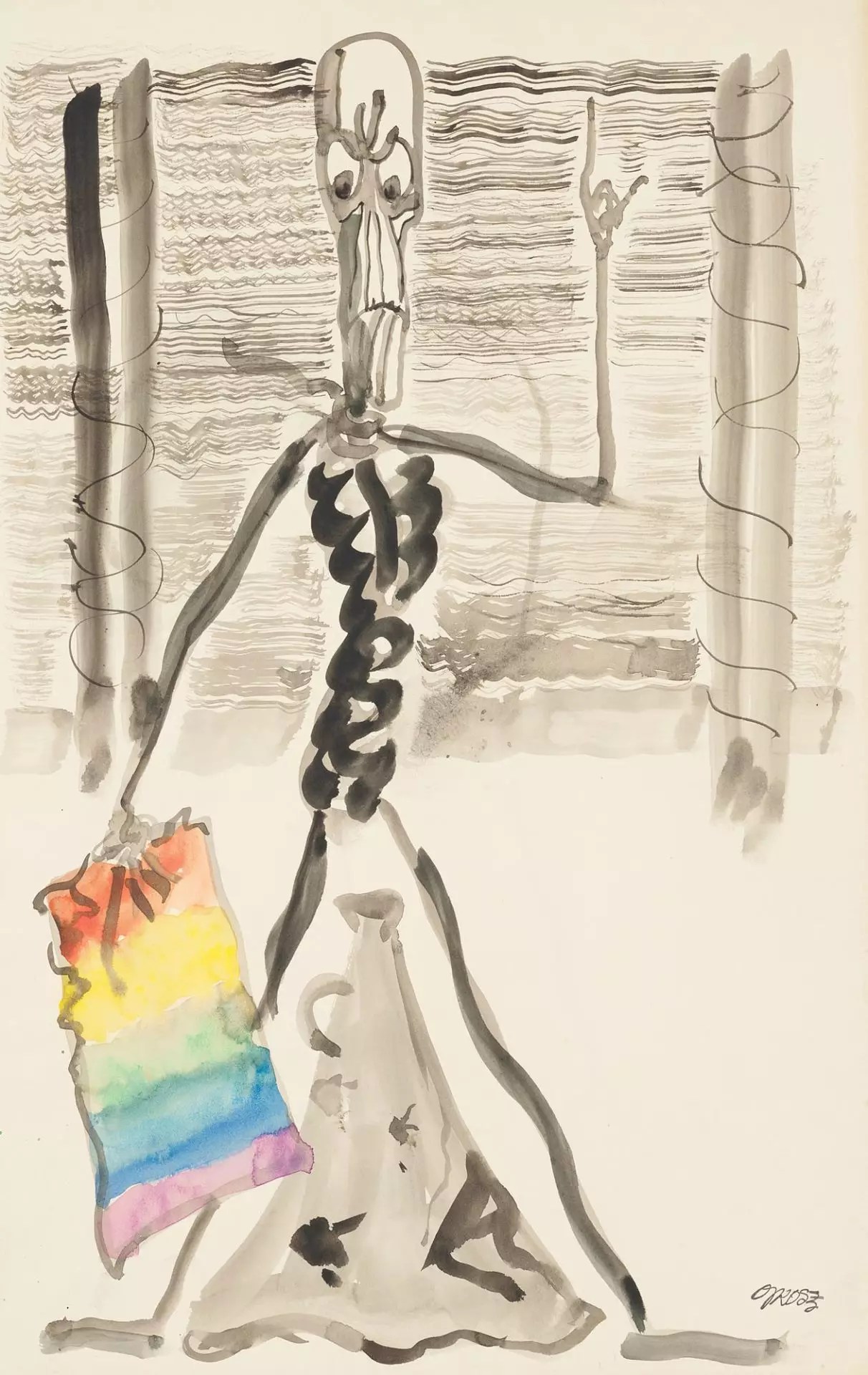
Stickman, 1946 by George Grosz (1893-1959)

Alasdair Gray, 1934-2019
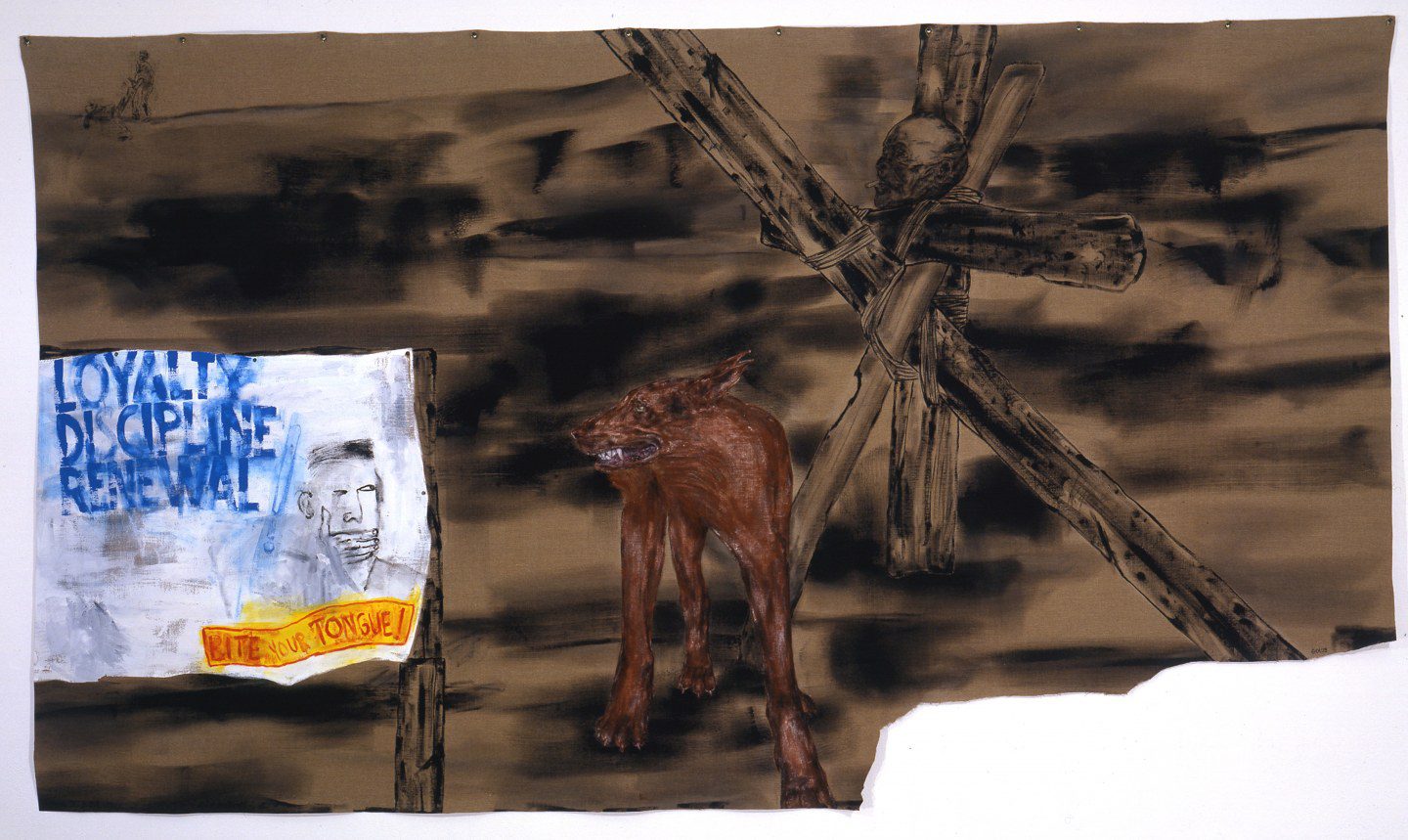
Bite Your Tongue, 2001 by Leon Golub (1922-2004)

 Biblioklept