


| CARVIEW |

*Examining the Past, Present, and Future*
Lineup Card
Rich Lederer • Baseball Beat
Patrick Sullivan • Change-Up Jeremy Greenhouse • Touching Bases Dave Allen • F/X Visualizations Sky Andrecheck • Behind the Scoreboard Marc Hulet • Around the Minors Al Doyle • Past Times Retired Uniforms: Bryan Smith • WTNY Joe Sheehan • Command Post Jeff Albert • The Batter's Eye RSS Feed Home Recent Entries
» Putting Together a Reality Team
» Historical Hall of Fame Vote Comparisons: 2012 » An All-Christmas Team » The New-Look Angels » John Denny: The Forgotten Cy Young Award Winner » Money Isn't Everything » What Would It Take to Hit .400 in the 21st Century? » Halos Heaven » Brandon McCarthy's Breakout Season » Link-o-Rama Best of Baseball Beat
Abstracts From the Abstracts
1977 Baseball Abstract
1978 Baseball Abstract 1979 Baseball Abstract 1980 Baseball Abstract 1981 Baseball Abstract 1982 Baseball Abstract 1983 Baseball Abstract 1984 Baseball Abstract 1985 Baseball Abstract 1986 Baseball Abstract 1987 Baseball Abstract 1988 Baseball Abstract Bert Blyleven Series
Meeting Up and Hanging Out with Bert
The Results Are In And... Aficionado Heavily Invested in Blyleven Latest on Blyleven's Chances for the HOF The Internet Zealot Responds 400 Down and 5 to Go... Bert Be Home By Eleven? Blyleven's Forgotten Season (1973) HeyMan, Your Comments Don't Hold Water The Waiting is the Hardest Part Another Addition to the Blyleven Series Search for the Truth As Dominant as His HOF Contemporaries Listen, Buster A Larger Step for Blyleven Answering the Naysayers (Part Two) Another Small Step for Blyleven Q&A: Blyleven on the Twins The Majority Rules, Right? It's All Dutch to Some The Hall of Fame Case for Bert Blyleven Q&A: Blyleven on Felix Hernandez Clemens Rocketing Up Charts Poz: An Interview With a KC Star A HOF Chat with Tracy Ringolsby Up Close and Personal A Peek Into the Mind of a HOF Voter Answering the Naysayers It's That Time of the Year (Again) "If Cooperstown is Calling..." The Bert Alert One Small Step for Blyleven... Only the Lonely Exclusive Interviews
Lee Sinins
Alex Belth David Pinto Will Carroll Mike Carminati Aaron Gleeman Joe Sheehan Jay Jaffe Jeff Peek Tracy Ringolsby Joe Posnanski Bill James Part I, II, III Jon Lalonde Chuck Tiffany Dayn Perry Fay Vincent Nate Silver Bullpen
Rich Lederer
The Odd Couple (with Alex Belth)
The Most Three Wise Men (roundtable by Alex Belth) Infrequently Asked Questions (interview with Matt Welch) Interview (Orioles Think Tank) Bernie and the Yanks (Bronx Banter) Hope and Faith: How the LAA Win the World Series (Baseball Prospectus) NL West (The Soul of Baseball) Greatest Living Hitter? (Sports Illustrated) Roundtable: 2008 HOF Ballot (Armchair GM) Patrick Sullivan
Designated Hitters
David Bromberg (Q&A: John Denny)
Mark Armour (H. Killebrew and Versatility) Joe Lederer (Soundtrack of a Prospect) David Bromberg (Clemente's Autograph) David Bromberg (Woody Fryman) D. Baumstein (WAR Against Age: Pitchers) Doug Baumstein (The WAR Against Age) Doug Baumstein (A Lifetime on the Road) John Fraser (Pick Six) Mark Armour (How to Score More Runs?) Bill Parker (What Opening Day Tells Us) Stan Opdyke (Pat Rispole) Chris Jaffe (Evaluating Baseball's Mgrs) Stan Opdyke (Baseball Radio in NYC, 1953) A. Nathan (Performance of Baseball Bats) Michael Weddell (Edgar Martinez/HOF) Jon Weisman (100 Things Dodgers Fans...) Stan Opdyke (Connie Mack and Vin Scully) Eric Walker (Evaluating Run Production) Brent Mayne (The Intangibles of Catching) Chris Moore (Best Fastballs in Baseball) Dave Baldwin (The Batter’s Brain) Shawn Haviland (Ivy League to MLB) Larry Granillo (Walking Off) Rob Iracane (Solo HR Won't Break You) Tommy Bennett (Charm of AM Radio) Harry Pavlidis (Johan Santana's Fast Start) John Walsh (WAR and Remembrance) Eric Walker (Precisely Inaccurate) Bob Timmermann (As They See 'Em) Geoff Young (Unicycles and Delusions) Baseball Analysis at Tufts (Groundballers) Baseball Analysis at Tufts (GB Out Rates) G. Rybarczyk ('09 Hit Tracker Projections) Joe Lederer (Curt Schilling/HoF) Conor Gallagher (Hall of Fallacies) Chris Green (Jim Rice, HoF, the Numbers) Shawn Hoffman (Baseball's Bear Mkt?) Paul Anthony (Manny Syndrome) Ross Roley (World Series Odds) B. Timmermann (Catcher's Interference) R.J. Anderson (Waiting the Hardest Part) Maury Brown (Cubs, MLB, and Cuban...) Myron Logan (Dee-Fense, Dee-Fense) Craig Calcaterra (Frivolity, Part I, Part II) Chad Finn (Ode to Baseball Cards) David Cameron (Mariners Foibles) Chris Dial (Chipper Jones) Pat Lederer (Memory Lane) David Appelman (Clutch Pitching) Bob Rittner (DH) Jonathan Mayo (Roger Clemens) Lisa Winston (My Son-in-Law...) Russ McQueen (The Yellow Hammer) Bob Rittner (I'm OK, You're OK) Mark Armour (In Defense of the HOF) Pat Jordan (Friends) Dan Levitt (Analysis of Terry Ryan) Doug Baumstein (Trading Econ 101) Ross Roley (Runner's Reluctance II) Ross Roley (Runner's Reluctance I) Mark Armour (No-Longer Lovable Sox) Bruce Regal (Stealthy and Wise) Brian Gunn (Roid Monster) Current/McEvoy (Value of the SB) John Rickert (Sinister Thefts) Nate Silver (Sabermetrics) David Vincent (Home Run Production) Joe P. Sheehan (Enhanced Gameday II) Mark Armour (An Ode to Sport) David Gassko (All-Time Worm Burners) Joe P. Sheehan (Enhanced Gameday) John Walsh (When Titans Clash) Fox/Williams (Quantifying Coaches II) Fox/Williams (Quantifying Coaches I) Jacob Luft (Bull Durham Rant) Chad Finn (Strat-O-Matic) Lisa Winston (Rotisserie Baseball) Dave Studeman (Baseball Stats) Steve Treder (Roger Craig) Marc Normandin (Jeff Bagwell) D. Appelman (Expanding Strike Zone) Jeff Sackmann (Worst MiL Defenders) Jeff Sackmann (Best MiL Defenders) Maxwell Kates (Van Lingle Mungo) David Appelman (Pitch Location) Kent Bonham (Danny Ray Herrera) Glenn Stout (Two Baseball Poems) Bruce Regal (The Challenge Round) Mark Lamster (Barry & Ty) Geoff Young (NL West) Tom Lederer (The Ryan Express) Brian Erts (Great Leap Forward) David Pinto (Parity and the N.L.) Jacob Luft (Fathers and Daughters) Jamey Newberg (Pete's Sake) Jeff Albert (A. Jones Swing Analysis) Jeff Albert (A-Rod Swing Analysis) Keith Law (Death, Taxes, and Waivers) Peter Abraham (Tales of Torre Tales) Larry Borowsky (Let 'er Rip II) Dan Levitt (Empirical Analysis of Bunting) Jonah Keri (If I Met Warren Cromartie...) Bob Klapisch (War Stories) Bob Timmermann (John F. Kennedy HS) Kent Bonham (Aluminum Adjustments) Al Doyle (More Than Superstars) Ross Roley (Instant Replay) David Vincent (Barry Bonds Homers) Chad Finn (Our Favorite Obscurities) Bill Deane (1979 NL MVP) Mark Armour (Rise/Fall of Artificial Turf) Jeff Angus (Wally Moon Camp) David Berri (Money and Baseball) Larry Borowsky (Baseball w/o the #s) Derek Zumsteg (The Irrational Market) David Regan (Free Agent Contracts) Peter Schmuck (Steroids and the HOF) David Appelman (Pitchers, Pitch by Pitch) Dan Fox (Swinging, Taking, Fouling, Etc) Patrick Sullivan (Study of NYY CF/BOS LF) Will Leitch (Baseball Journalism) Jeff Sullivan (Pitcher Release Points) Steve Treder ('69-'70 Giants) Maury Brown (Charlie Finley) John Brattain (Bob Johnson) Bob Klapisch (The Case for Bert Blyleven) Jeff Peek (Pride and Prejudice) Dayn Perry (Bert and Warren) Rob Neyer (If Don Sutton Was Great...) Lisa Winston (Minor League Memories) Alex Belth (Otis Redding Was Right) David Cameron (Long Live the King) Jeff Angus (Baserunning Study) Bert Blyleven (Baseball Playoffs) Boyd Nation (Not a Prospect List) James Click (Batters-Baserunners Study) Jeff Shaw (Why I Love Baseball) David Gassko (BIP/BFP Fielding Study) Jay Jaffe (Milwaukee Sausage Race) Jamey Newberg (Remember When) Bob Klapisch (Press Box to the Mound) Dan Levitt (Predictive Value of BB) David Vincent (Official Scorer) Jon Weisman (Rick Monday) Larry Borowsky (Let 'er Rip) Will Carroll (Fictional Short Story) Bob Timmermann (Japanese Baseball) Cyril Morong (Best Pitching Seasons) Sean Forman (Monte Carlo Win-Loss) Brian Gunn (My Little Blue Book) Joe Lederer (My Dad and Baseball) Bill Deane (Bob Gibson, 1968) Mark Armour (1977 Yankees) Darren Viola (Retrosheet) David Pinto (RFK) Dayn Perry (Brave Heart) Matt Welch (Dave Hansen) Kevin Kernan (Jack McKeon) Tom Lederer (Dodgers Road Trip) Steve Lombardi (Slider) Studes (Picturing Baseball) Mike Carminati (Luck of the Drawl) Eric Neel (Vin Scully) J.C. Bradbury (Leo Mazzone) John Sickels (Bill James) Search Baseball Analysts
Archives
By Category:
Around the Majors Content Only
Around the Minors Content Only Baseball Beat Content Only Baseball Beat/Change-Up Content Only Baseball Beat/WTNY Content Only Behind the Scoreboard Content Only Change-Up Content Only Change-Up/Around the Majors Content Only Command Post Content Only Crunching the Numbers Content Only Designated Hitter Content Only F/X Visualizations Content Only Past Times Content Only Saber Talk Content Only The Batter's Eye Content Only Touching Bases Content Only Weekend Blog Content Only WTNY Content Only By Month:
February 2012
January 2012 December 2011 October 2011 September 2011 August 2011 July 2011 June 2011 May 2011 April 2011 March 2011 February 2011 January 2011 December 2010 November 2010 October 2010 September 2010 August 2010 July 2010 June 2010 May 2010 April 2010 March 2010 February 2010 January 2010 December 2009 November 2009 October 2009 September 2009 August 2009 July 2009 June 2009 May 2009 April 2009 March 2009 February 2009 January 2009 December 2008 November 2008 October 2008 September 2008 August 2008 July 2008 June 2008 May 2008 April 2008 March 2008 February 2008 January 2008 December 2007 November 2007 October 2007 September 2007 August 2007 July 2007 June 2007 May 2007 April 2007 March 2007 February 2007 January 2007 December 2006 November 2006 October 2006 September 2006 August 2006 July 2006 June 2006 May 2006 April 2006 March 2006 February 2006 January 2006 December 2005 November 2005 October 2005 September 2005 August 2005 July 2005 June 2005 May 2005 April 2005 March 2005 February 2005 January 2005 December 2004 November 2004 October 2004 September 2004 August 2004 July 2004 June 2004 May 2004 April 2004 March 2004 February 2004 January 2004 December 2003 November 2003 October 2003 September 2003 August 2003 July 2003 June 2003 Reference
Organizational Stats
Arizona Diamondbacks Bat / Pitch
Atlanta Braves Bat / Pitch Baltimore Orioles Bat / Pitch Boston Red Sox Bat / Pitch Chicago Cubs Bat / Pitch Chicago White Sox Bat / Pitch Cincinnati Reds Bat / Pitch Cleveland Indians Bat / Pitch Colorado Rockies Bat / Pitch Detroit Tigers Bat / Pitch Florida Marlins Bat / Pitch Houston Astros Bat / Pitch Kansas City Royals Bat / Pitch Los Angeles Angels Bat / Pitch Los Angeles Dodgers Bat / Pitch Milwaukee Brewers Bat / Pitch Minnesota Twins Bat / Pitch New York Mets Bat / Pitch New York Yankees Bat / Pitch Oakland Athletics Bat / Pitch Philadelphia Phillies Bat / Pitch Pittsburgh Pirates Bat / Pitch St. Louis Cardinals Bat / Pitch San Diego Padres Bat / Pitch San Francisco Giants Bat / Pitch Seattle Mariners Bat / Pitch Tampa Bay Devil Rays Bat / Pitch Texas Rangers Bat / Pitch Toronto Blue Jays Bat / Pitch Washington Nationals Bat / Pitch All-Star Links
Official Websites
News and Notes
Baseball News Blog
Baseball Newstand ESPN Baseball Fox Sports Baseball Pro Sports Daily Roto World The Roto Times USA Today Baseball Reference and Analysis
Baseball Almanac
Baseball America Baseball Archive Baseball Contracts Baseball Cube Baseball Graphs Baseball Library Baseball Musings Player Database Baseball Page Baseball Primer Baseball Prospectus Baseball Reference Baseball Statistics Baseball Truth Boxscore Central Diamond Mind Baseball Doug's Stats FanGraphs Fast Balls (pitchfx catalog) Hardball Dollars Hardball Times Hit Tracker Retrosheet Rotobase/Rotoblog Stat Corner STATS Tango on Baseball Yahoo Sports MLB Web Gems
Bill James Primer
Sabermetric Manifesto (Grabiner) Pitching and Defense (McCracken) Pitching and Defense (Tippett) Transactions Primer (Neyer) Baseball Stats (Batter's Box) Prospect Report (Cameron) Pitcher Workloads (Sheehan) Goodbye to Old Baseball Ideas (Rickey) Columnists
Baseball Blogs
Around the Majors
Athletics Nation Baseball Crank Baseball Musings Baseball-Reference Blog Batter's Box Big League Stew Bronx Banter Catfish Stew Cub Town Dan Agonistes Dodger Thoughts DRays Bay Ducksnorts Futility Infielder Halos Heaven Inside the Rockies It Might Be Dangerous Knuckle Curve LoHud Yankees Blog Lookout Landing Management by Baseball Metaforian Metsgeek Mike's Baseball Rants Only Baseball Matters Redbird Nation Red Reporter Sabernomics (Braves) Seth Speaks ShysterBall 6-4-2 (Angels/Dodgers) The Book TheCubdom The Cutting Edge The House That Dewey Built The View From The Bleachers Tiger Blog U.S.S. Mariner Viva El Birdos Where's Kernan Minor Leagues
Arizona Fall League
BA Player Finder Cal Leaguers Jamey Newberg JDM's Scoresheet Baseball Minor League Baseball Minor League Park Factors Minor League Splits No Pepper Sickels' Minor League Ball Warm October Nights Amateur
Boyd's World (College)
Cape Cod Baseball League College Baseball Blog College Baseball Insider Collegiate Baseball Newspaper College Splits College Splits Blog Dirtbags Baseball (Long Beach State) NCAA Baseball NCBWA Team One Baseball (High School) Texas A&M & Baseball Historical
Cuban Baseball
House of David Jim "Mudcat" Grant's Web Page Negro League Baseball Players Assoc Negro Leagues Baseball Museum 1919 Black Sox Pacific Coast League Philadelphia Athletics Historical Society Shoeless Joe Jackson Society SABR-L Archives Walter O'Malley Miscellaneous
Forums
Credits

Ticket Center
Tickets to Baseball -
Premium Red Sox Tickets - Tickets to Marlins Games - Cardinals Game Tickets - NY Yankee Tickets - Tickets Oakland Athletics - Dallas Cowboys Tickets - Arizona Cardinals Tickets - Tickets Seattle Seahawks - Buffalo Bills Tickets Online - Tickets to Dolphins Football
Buy Boston Red Sox tickets,
Philadelphia Phillies tix,
NY Yankees tickets,
NY Mets tickets, and
MLB All Star game tickets at ABC tickets
Not sure where to find the best online sportsbooks? Start your search with PlayersJet.
Get deals at SportsMemorabilia.com on baseball apparel, including Phillies jerseys and more for adults and children.
Shop the largest selection baseball equipment on sale at Sports Unlimited. Check out tons of baseball gloves, youth baseball gloves and catchers gear from Rawlings, Wilson, Nike & Under Armour.
2011 Draft Order
Courtesy of Baseball America
First-Round: 1. Pirates (57-105) 2. Mariners (61-101) 3. Diamondbacks (65-97) 4. Orioles (66-96) 5. Royals (67-95) 6. Nationals (69-93) 7. Diamondbacks (for B. Loux) 8. Indians (69-93) 9. Cubs (75-87) 10. Padres (for Karsten Whitson) 11. Astros (76-86) 12. Brewers (77-85) 13. Mets (79-83) 14. Marlins (80-82) 15. Brewers (for Dylan Covey) 16. Dodgers (80-82) 17. Angels (80-82) 18. Athletics (81-81) 19. Red Sox (from DET for Martinez) 20. Rockies (83-79) 21. Blue Jays (85-77) 22. Cardinals (86-76) 23. Nationals (from CWS for Dunn) 24. Rays (from BOS for Crawford) 25. Padres (90-72) 26. Red Sox (from TEX for Beltre) 27. Reds (91-71) 28. Braves (91-71) 29. Giants (92-70) 30. Twins (94-68) 31. Rays (from NYY for Soriano) 32. Rays (96-66) 33. Rangers (from PHI for Lee)Supplemental First Round: 34. Nationals (Dunn) 35. Blue Jays (Downs) 36. Red Sox (Martinez) 37. Rangers (Lee) 38. Rays (Crawford) 39. Phillies (Werth) 40. Red Sox (Beltre) 41. Rays (Soriano) 42. Rays (Balfour) 43. Diamondbacks (LaRoche) 44. Mets (Feliciano) 45. Rockies (Dotel) 46. Blue Jays (Buck) 47. White Sox (Putz) 48. Padres (Garland) 49. Giants (Uribe) 50. Twins (Hudson) 51. Yankees (Vazquez) 52. Rays (Benoit) 53. Blue Jays (Olivo) 54. Padres (Torrealba) 55. Twins (Crain) 56. Rays (Choate) 57. Blue Jays (Gregg) 58. Padres (Correia) 59. Rays (Hawpe) |
« The Blueprint? | Home | Getting Wright »
Sinister Thefts
By John Rickert
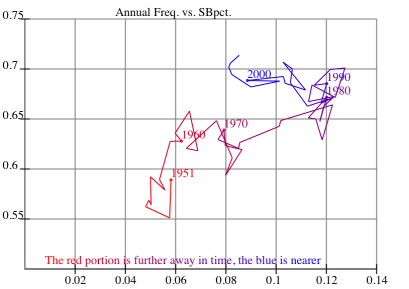
In a recent broadcast, Joe Morgan mentioned that a base-runner who is able to read the pitcher can find it easier to steal off a left-handed pitcher because lefties are slower to the plate then righties. If this is so, then it ought to show up in the results. To start, I went to retrosheet.org to look at some splits. What were Joe Morgan's totals? He is listed as stealing 520 bases in 645 attempts vs. RHP (80.6%); and 167 out of 204 vs. LHP (81.9%). Next, I estimated the number of opportunities as singles plus walks - certainly not a perfect measure, as pitching changes sometimes occur (I suspect that this is a small effect) and often 2b is occupied (perhaps a larger effect, though it ought not differ by more than a few percent between LHP and RHP), but it should offer a decent approximation. Pro-rating per estimated opportunity (Eopps), Morgan's totals were: vs RHP: .213 SB and .051 CS vs LHP: .149 SB and .033 CS If Morgan found lefties easier to steal on, it seems odd that he'd steal only 2/3 as frequently against LHP. His success rate suggests that he might have been able to read LHP well enough to only go when he had a good chance of success, but the fact that he ran less often is in conflict with a general "easier to steal" claim. Let's start by trying to set some context. What patterns do base-stealers have? I'll look at the frequency (attempts divided by estimated opportunities) and stolen-base percentages for all players. The graph shows the frequency of attempts vs. the success rate starting in 1951, the first year that both leagues counted caught stealing (CS). (Data from baseball databank) For example, in 1951, the SB frequency was .0582, and the SB pct. was .589; in 1952, the frequency was .0576 (nearly the same), but the SB pct. dropped to .551, causing the path plotted to plummet nearly straight down. The SB pct. then increased fairly steadily through the 1950s, reaching a new equilibirum in the .60-.66 range. At that point, the frequency began to rise rapidly as Luis Aparicio and Maury Wills experienced success, moving the path to the right. With Lou Brock's record-breaking performance in 1974, the frequency rose beyond .100, and the greater emphasis on the cerebral aspects popularized by folks like Brock and Morgan led to a new rise in the SB pct., which passed .667 for the first time in 1980. By this time, Tim Raines and Rickey Henderson were entering the picture, and steal attempts reached a new equilibrium in the .112-.127 range, while SB pct. gradually improved from .65-.67 in 1975-84 to .67-.70 in 1985-1994. As the new offense-friendly parks entered the league and the home run explosion started, the frequency began to drop, while success rates continued to rise, reaching .700 in 1995. In six of the last seven years, the frequency of steal attempts has been in the .081-.090 range, while SB pct. has risen each of the last four seasons (from .682 in 2002 to .694, .702, .706, and .714), making it appear that we are in the middle of a new transition.
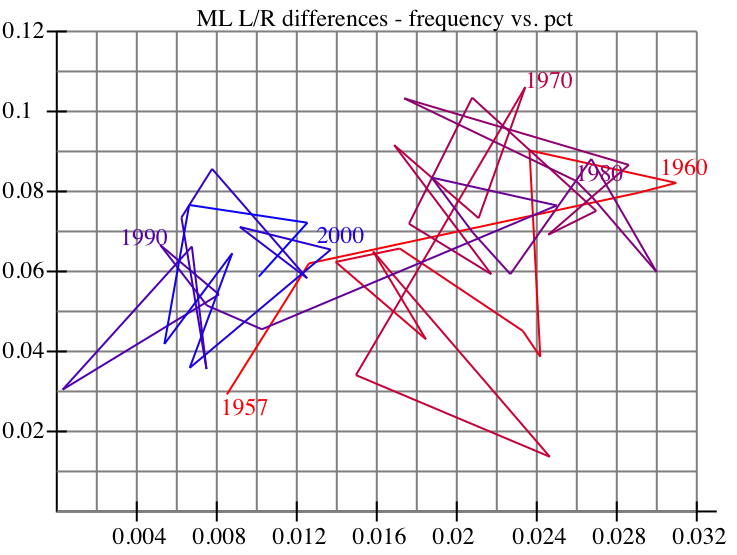
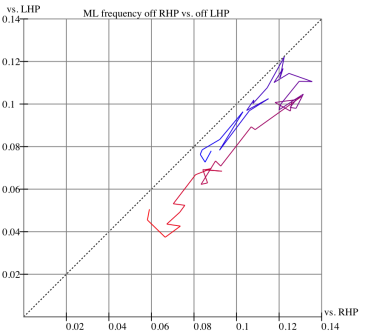
Plotting the SB vs. left / SB vs. right paths on the same graph produces a tangled web. So instead, let's look at the differences, R - L, for both frequency and success rate. This is still rather tangled, but it does seem to show that the difference between LHP and RHP has diminished in recent years. In 1962, the RHP frequency was .073, the LHP frequency .049, making a difference of .024 in the frequencies. Despite stealing less often against LHP, the difference in SB pct. against LHP (.618) and RHP (.657) was one of the lower totals of that era. The difference in frequencies stayed in the .020-.030 range until the late '80s, when the frequency of attempts vs. LHP began to rise, topping out in 1992 at .1224 vs. RHP and .1221 vs. LHP, a difference in frequency of only .0003, the left most point plotted on the freq. vs. pct. graph below. The frequency differences seemed to have stabilized around .010, much lower than the differences seen 20-30 years ago. During this time, the difference in SB pct. appears to have decreased as well. Thirty years ago, differences like those of 1977 were typical, the SB pct. vs. RHP was .647, vs.LHP it was .578, a difference of .069. SB pct. differences were generally in the .060-.080 range then. But in the last twenty or so years, the difference in SB pct. has been in the .040-.080 range, with the 2006 difference of .058 (.728 vs. RHP and .760 vs. LHP) representing a typical difference in success rates. Overall, success rates have increased in the last 50 years, but sucess rates against LHP have increased even more than success rates against RHP. The LHP advantage in holding base runners appears to have decreased, runners are stealing against them at frequencies and success rates that are closer to those of RHP than they were a generation ago.
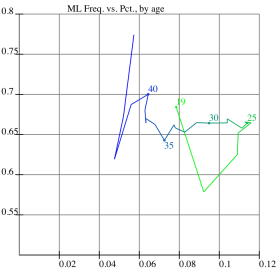
A related question pops up regarding the interplay between experience and aging. As players get more experience, many presumably learn ways to improve their success rate, but they also slow down. So next, we'll take a look at the Freq/Pct graph based on the players' age as of July 1. Young players steal more frequently, through age 25, and then gradually taper off. The sucess rates are pretty consistent, except for a drop during the initial increase in frequency, and a rise during the rare steals by older players. It's not clear to me whether this is due to player experience, or a bias in created by removing the lesser players.
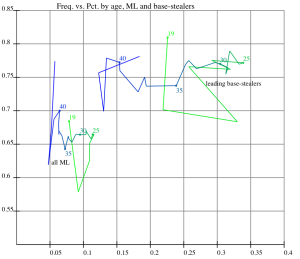
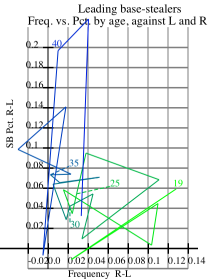
Do these same trends hold for the leading base-stealers? To consider this, I took a look at the players who stole at least 300 bases in the retrosheet years (1957-1998, 2000-2006). There were 26 of these. A look at their aging patterns shows that it is similar to those of the general base-runner, except that the base-stealers stayed near their peak rate for several more years than the average player. As the base-stealers aged, their relative frequency of attempts versus LHP seems to increase, but their success rate drops. This makes it unlikely that more experienced base-stealers are picking up extra cues against LHP.
Here are the rates for the 26 base stealers, their average, and the overall major league average for 1957-98, 2000-06.
Most of the leading base-stealers stole more frequently and more successfully against RHP. But several ran more often against LHP, and Joe Morgan, Tommy Harper and Vince Coleman had a higher SB pct. against LHP. The leading stealers relative frequency of attempts was a little higher, 90% as frequently as against RHP, while the general population attempted steals only 85% as often against LHP, but the difference in success rates was nearly identical, 6.7% vs. 6.5%. This is consistent with LHP being tougher to run on in general. But are there LHP who are easier to run on than RHP? 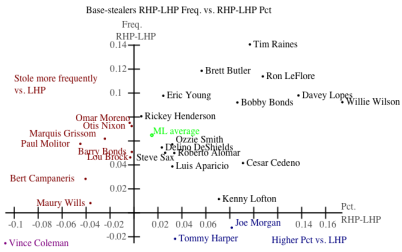
To look at base-stealing from the "who's pitching?" perspective, I went through the Retrosheet team rosters, which conveniently include pitchers' SB/CS/PO data in the fielding data (for example, for the 1975 Red Sox). Breaking these into left- and right-handed pitchers gave the following totals: Hand Est.Opps SB CS Pickoff Freq. SB Pct. RHP 1284662 89828 41938 6437 .1026 .682 LHP 533131 28812 17894 6151 .0876 .617 Other than a slight increase in Freq. and SB pct. for pitchers near 40, the aging patterns graphs were pretty flat. Next, I considered pitchers with at least 1000 estimated opportunities. There were 400 RHP and 177 LHP. These RHP saw stolen-bases attempted at a rate of .1037, while the LHP were at .0884, rates nearly identical to those of all pitchers. The SB pct. were slightly lower against these pitchers, .660 vs. RHP and .592 vs. LHP. Are there left-handed pitchers that are among the easiest pitchers to steal on? The answer... very few. The graph here shows these 577 pitchers, plotting frequency vs. SB pct. The extremes are represented by Dwight Gooden whose frequency was .205 and SB pct. was .780. The highest SB pct. was against Mark Clear at .872, with runners going at a frequency of .174. The least-run-on pitcher was Whitey Ford, with a frequency of .025, one steal attempt for every 40 estimated opportunities, and a SB pct. of .385. The lowest opponents SB pct. was turned in by Billy Pierce at .341. Pierce's frequency was also low, at .031. Most of the hard-to-steal-on pitchers are left-handed, most of the easy-to-steal-on pitchers are right-handed. 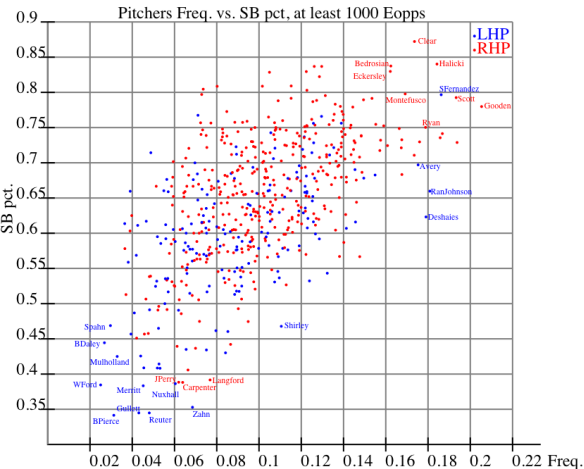
What about Morgan's statement that LHP are slower to the plate? If so, perhaps most base-stealers aren't reading the pitcher well enough to take advantage of the slower delivery. Until Retrovideo comes along, we won't be able to answer this definitively, but now that several World Series broadcasts are available on DVD, maybe we can start to study the question directly. Conveniently enough, one of the DVDs available is the 1975 World Series. Watching the Series, I discovered that the broadcasters said that Morgan claimed to be able to read the Red Sox pitchers, and that he wouldn't get caught stealing again - he wasn't. During game seven, the claim was made that Morgan had picked up something in Bill Lee's delivery and had passed the information on to Dave Concepcion and Ken Griffey. But when they got to first, there were three pitches on which they were heading back to first when the pitch was delivered - not exactly a great jump to get. On the other hand, when Morgan stole second during the game, he started for second base less than a tenth of a second after Lee began his delivery home, allowing Morgan to steal second standing up. That's a very quick jump. There's the anecdotal evidence. How long do the pitchers take to deliver the pitch? I looked at all games in the 1975 World Series, and portions of games 5 and 6 in the 1986 World Series. To measure the time to the plate, I took the time from when the pitcher first started stepping toward home until the time the pitcher released the ball. I timed pitchers who were working from the stretch and found that most take about the same amount of time in the stretch whether or not there is a runner on first with second open. Without doing a detailed study, I found only two exceptions in the few games that I looked at: Firstly, with Joe Morgan on first with second base open, Luis Tiant knocked nearly a quarter of a second off his delivery time. Secondly, in the 1986 World Series, Roger Clemens dropped about a tenth of a second off his delivery time with a runner on first and second open, relative to his other pitches from the stretch. The graph below shows the delivery times that I recorded for pitchers pitching from the stretch in the 1975 World Series and the 1986 World Series (games 5 and 6). Again, pitchers who throw with their right wing are in the red state, and those who throw with their left wing are in the blue state. The bars represent two standard deviations on the estimation of the mean time. 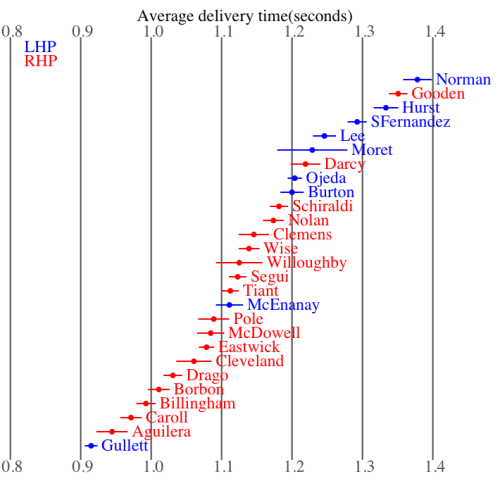
The average of the mean delivery times for the 18 RHP was 1.10 seconds, for the 9 LHP, 1.21 seconds. Some of the extremes here are notable. Dwight Gooden has the highest attempt frequency during the past 50 years as well as the season with the most opponents stolen bases, 60 in 1990. The second highest single season total is 56 by Gooden in 1988 and Floyd Youmans in 1986. Sid Fernandez was the easiest LHP to run on in the last 50 years, with both the highest frequency of attempts and highest SB pct. among all LHP with at least 1000 estimated opportunities. Don Gullett is tied for the second lowest opponent SB pct (at least 1000 estimated opps) behind Billy Pierce's .341 (for 1957-1964). Gullett and Kirk Rueter were at .345. (Rueter's 1999 data is not available.) Gullett's delivery times may be related to his low steal rate. More study is needed. Out of curiousity, I checked to see how a young Joe Morgan ran against a young Don Gullett. Morgan was on first base three times with second open, and did not attempt to steal. In summary, what did I find?
John Rickert teaches mathematics at the Rose-Hulman Institute of Technology, and joined the Society for American Baseball Research in 1983 after reading John Davenport's Baseball Graphics and Bill James' Baseball Abstracts. |
Comments
The key is IF the runner can read the pitcher. I take from this data that lefties can be harder to read. This makes sense because unlike right handed pitchers, when the front foot leaves the ground and the back foot remains on the rubber he can still come to first. I don't think Morgan's statement and your research are in conflict.
Posted by: orangeandblueblood at May 17, 2007 4:51 AM
Interesting study, but Joe Morgan will never believe all this stuff if he finds out you used computers to figure it out.
Posted by: Bird at May 17, 2007 8:22 AM
What graphing utility did you use to plot figures 1-6?
Posted by: Dan at May 17, 2007 11:55 AM
You have to include pickoffs when analyzing lefties and include that as a CS! If you don't all of the numbers versus LHP are misleading. As well, you have to include balks and consider that as a succesfull steal.
Posted by: MGL at May 17, 2007 1:47 PM
I would imagine the biggest reason for the differenial in the time it takes lefties to deliver the ball is the fact that they dont have to commit to deliver the ball to the plate the moment they start their delivery. Andy Pettite is a perfect example. He delays committing to the plate for as long as possible. That is why he is one of the best at pick-offs.
Posted by: vttex at May 17, 2007 2:00 PM
Dan: A long time ago, a friend of mine convinced me that it would be useful to learn how to write postscript. So I had the analysis program output the approriate postscript code to a file, then converted the .ps to .png
MGL: You're right. My excuse is that I didn't have those data for the baserunners, so to make the numbers directly comparable, I used just SB/CS. A more complete study using the play-by-play should include the pickoffs and balks, and probably compile wild pitches, passed balls, throwing errors, and extra bases advanced on singles and doubles (ideally, broken down by location of the hit).
vttex: That doesn't explain the difference in time for non-steal stretch situtations. I suppose this could be checked by analyzing the motion in more detail. I didn't notice a significant difference in the structure of the stretch in steal vs. non-steal situtations, but I didn't look for it either. I guess I'll need to get those Yankess World Series DVDs sooner. I do notice that after leading the league in pick-offs his first 3 years, Pettitte's pick-offs plummeted precipitously, his last year with the Yankees showed 13SB, 1CS, 0 pick-offs. But he's still 8th among all pitchers with at least 1000 estimated opportunites, and first among those with 2000 opps.
Posted by: jrickert at May 17, 2007 5:55 PM
The bottom line is that it depends on what you mean by "easier to steal."
Versus a righty, you take off as soon as the pitcher so much as budges his left leg. Then it is a race between the speed of the pitcher to release the ball and the speed of the catcher to catch it and get it to second.
Against a lefty pitcher, the dynamic is completely different. If you wait until the pitcher lifts his leg and you determine that he is going home, you will generally be nailed. If you go on "first movement" AND THE PITCHER ENDS UP GOING HOME because you either somehow knew that or you just took a guess, you will usually be safe because a lefty pitcher is indeed slower than a righty on the average.
The problem is that runners get picked off and caught stealing all the time when they go on first contact. Either they are wrong in thinking that they knew that the pitcher was going home or they took a shot and it didn't work out. Either way, the number of caught stealings plus pickoffs compared to SB and balks is substantially higher against lefty pitchers than against righty pitchers. If I were in charge of a team, I would simply tell my baserunners never to steal versus a lefty. I would also tell them that that means never to get picked off either (IOW, pay attention and watch your lead).
So, when you say, "It is easier to steal against a lefty," which many (if not most) broadcasters besides Joe Morgan say, that statement must be qualified. It means that if you "guess" right, you will be safe almost all the time. But overall, you (all runners combined) will in fact fare WORSE against a lefty pitcher than a righty. Whether that means that lefties are "harder to run against" is a matter of semantics.
Again, while the crux of the analysis in the article is great, without the CS and the PO (and the errors on throws over to first), the results of ANY analysis are meaningless, regardless of the reason why the author did not include them. Technically to do any SB analysis, you also have to include what happens on a batted ball when the runner is attempting a steal and also what happens with the pitcher/batter matchup when a potential basestealer is on first. Existing research has suggested that the net effect of a basetealer on the batter/pitcher matchup is about a wash (no net effect) because the batter probably gets more fastballs/strikes, he takes some pitches that he would ordinarily not take, the pitcher and defense may get distracted, and the batter may get distracted or otherwise be out of his usual "rhythm."
One fascinating thing that we found in the research for The Book was that there appeared to be a huge difference in the effect of a basestealer on the batter/pitcher matchup depending upon the age/experience of the batter, suggesting that older more experienced batters kmow how to maximize (or perhaps minimize the distraction) that effect while the younger players are doing SOMETHING that adversely affects their performance (such as taking too many pitches or letting themselves get distracted or losing their focus).
Posted by: MGL at May 17, 2007 6:25 PM
Maybe a follow-up conversation w/ Mr. Morgan is in order. He might have learned to read/steal off of lefties as his career progressed, which became more important as his speed declined. The numbers over the last five years or so of his career might be revealing?
Posted by: BWJ at May 18, 2007 9:31 AM