


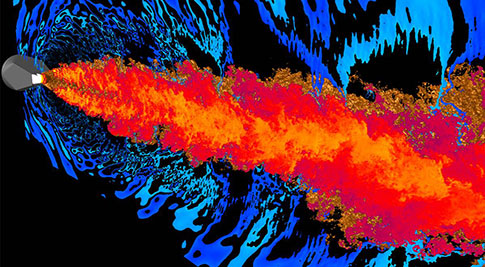
ASC integrates the work of the three National Nuclear Security Administration (NNSA) Defense Programs laboratories—Los Alamos National Laboratory, Lawrence Livermore National Laboratory, and Sandia National Laboratories—and university researchers nationally into a coordinated program administered by the NNSA.
The Predictive Science Academic Alliance Program (PSAAP) is the primary mechanism by which the NNSA’s ASC program engages the U.S. academic community in advancing science-based modeling and simulation. In 2025, nine PSAAP IV centers were established with a primary focus on the following areas:
- Discipline-focused research to further predictive science and enabled by effective exascale computing and data science technologies;
- Mathematics and computer science (CS) technologies and methodologies to support effective exascale computing in the context of science/engineering applications (development and demonstration);
- State-of-the-art machine learning (ML) and data science technologies for predictive science and engineering (utilization and advancement);
- Predictive science based on verification, validation, and uncertainty quantification (VVUQ) for large-scale simulations; and
- Workforce development of the next-generation computational scientists.
Predictive Simulation Centers (PSCs) focus on scalable application simulations, targeting large-scale, integrated multidisciplinary problems. PSCs develop and demonstrate computer science technologies and methodologies that will advance Exascale computing, and demonstrate integrated, verified, validated predictive simulation with uncertainty quantification.
Focused Investigatory Centers (FICs) are tightly focused on a specific research topic in either a science/engineering discipline, or an Exascale enabling technology, of interest to NNSA’s mission.
Predictive Simulation Centers
 |
University of FloridaCenter for Multiscale Modeling of Multiphase Combustion |
 |
Massachusetts Institute of TechnologyCenter for the Exascale Simulation of Coupled High Enthalpy Fluid-Solid Interactions |
 |
University of MichiganCenter for AI-enabled Exascale Prediction of Long-time Events in Multimaterial Shock-assisted Chemical Reactions |
 |
Oregon State UniversityCenter for Advancing the Radiation Resilience of Electronics (CARRE) |
 |
University of VirginiaCenter for Stochastic Simulations of Ablative Geometries with Error-Learning in Space and Time |
Focused Investigatory Centers
 |
Brown UniversityCenter for Information Geometric Mechanics and Optimization (CIGMO) |
 |
University of California at San DiegoCenter for Simulation and design of Heterogeneous Architectures for Performance and Energy absorption (SHAPE) |
 |
Michigan State UniversityHigh Order Plasma Turbulence Modeling for Z-Pinch |
 |
University of New MexicoCenter for Optimized Modern Parallel Adaptive System Software (COMPASS) |


