

|

|
| CARVIEW |
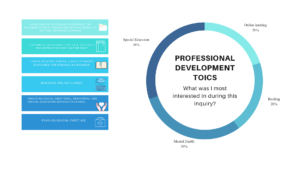 A graphic representation of the free professional development for pre-service teachers that I completed.
When I began my inquiry project, I wanted to have a list of valuable free professional development resources for pre-service teachers. I specifically wanted to find topics we weren’t covering in our first semester courses. We have a lot to learn, and not every topic and specific situation can be covered in our classes. Hearing ideas from educators outside Canada can also be valuable, as they might have new ideas or different perspectives, although it’s important we keep in mind that what works where they are might not translate to what will work here.
One factor that motivated this was a self-assessment we completed in our 352 class, where we identified what types of students we didn’t have as much confidence teaching. As I completed my assessment, I realized I had never worked with students with mental health challenges (that I was aware of). I also had never been in a classroom setting where I worked with students with learning disabilities. I wondered: how could I support these students? Thankfully, I didn’t have to worry, because we talked about how we could differentiate our learning for different students in all of our classes!
What did I learn from this inquiry project?
Other than what I learned specifically for the inquiry, I learned about time management, self-paced learning, and myself! Everything I did for professional development was self-paced. Although it sounds like it will be less stressful, it can actually be more stressful because you have to motivate yourself intrinsically, and you control how much you work or don’t work. In the worst case scenarios, you can completely overload yourself or do nothing at all. I did both, and that’s okay. Learning takes time, so we need to be as patient with ourselves as we would be with others. All we can do is try our best!
As much as I wanted to, I wasn’t able to do everything that I planned. An example of this comes from last week, when I wanted to explore Microsoft’s Student Teacher Education Program.
Due to time constraints, however, I decided to look around edWeb more instead, and look into some of the many free webinars they offer. I’m glad I did!
I watched one webinar on how we can use portfolios in the classroom and another on teaching students with dyslexia!
I was already interested in using portfolios as a way to assess students in my future classroom, and watching the webinar helped me become a little more informed on how we can use them. Bonus: the teacher leading the webinar was from Canada! As for teaching students with dyslexia, I really didn’t know anything before I watched the webinar. I feel a little more confident that I would be able to teach dyslexic students now, although I still have a lot to learn! Being able to take a short quiz to check your understanding after watching is also a nice addition to their free service.
How can we do this in the future?
Some of the best ideas I learned were from my classmates and the excellent teachers and students at my Wednesday field experience. Professional development is not only something you can do at home, but something you will do in school. Our 780 seminar leaders mentioned how they complete inquiry projects into topics in education, so it’s safe to say that inquiry is something we will be doing in the future as teachers! This inquiry taught me that it’s okay to not know everything. It’s okay to take things at your own pace, too. When I become a teacher, I need to remember this. It’s also important to remember this process if I assign an inquiry project to students. Exploring our interests in a topic shouldn’t be stressful; it’s an opportunity to look into what we’re curious about. I’m really interested in how we can support students with reading challenges, English Language Learners, and educational technology! This course introduced me to a lot of interesting new tools, and I want to learn more about using technology in the English classroom in a meaningful way!
What I Would Recommend Someone Else
- Be realistic. You can’t learn everything, even if you’re really interested in the topic.
- Take your time! You don’t need to feel guilty for not doing what you thought you would.
- Try something new! You never know what you’ll discover.
Looking back at my inquiry, I think I’d tell myself to take it easy. Even though it doesn’t look like I used a lot of different professional development resources, some of the online courses lasted many hours. Completing one a week, on top of an already packed schedule, was difficult at times. I don’t regret my choice to pursue this topic, though, because I feel more confident. I’m excited to see what kinds of inquiries I’ll do in the future. What else will inspire me?
I hope you find many topics you’re passionate about, and that you remember to pace yourself while you do your own inquiries.
Thank you for reading and being a part of my learning journey. It’s been a long semester, but it’s been my favourite one so far.
Talk to you later!
Amber
]]>
When I first began this inquiry project, I only wanted to focus on free online courses that offered professional development. I felt like I needed to use something that was structured like a typical course because I learn better that way. After struggling to work on my inquiry project for a few weeks, I decided I needed a new approach.
I searched for some new free professional development activities pre-service teachers could look into, but I had a hard time. Then, in the middle of searching, I found edWeb. They offer free online webinars for educators, and they’ve worked with many different organizations and educators. I realized that at the beginning of this inquiry, I hadn’t kept an open mind. While I have had experiences where I’ve listened to something and not retained what I learned, I’ve also had experiences where I’ve retained more.
After reflecting on this, I decided to watch this webinar on reading strategies, as this is a topic I’m interested in. I’m so glad I did! It was only an hour long, so I found it to be less overwhelming. It also gave me some great insights into reasons why students might have reading challenges, and strategies we might want to use to help them. I think this will definitely be of help to any pre-service or current teacher, as you never know who will be in your class!
Until next time!
]]>
Finally! I’ve made some progress on my inquiry project this week! Success! I’m not as happy as I could be with the amount of progress I’ve made, but I have made some progress! I completed a short online course on de-escalation techniques for teaching online from The Society for the Prevention of Teen Suicide this week. There’s no estimated time to complete posted, and I can’t remember how long it took me personally to complete. Looking back, I would estimate ten to twenty minutes?
After taking this short course, I feel more reassured that I would be able to de-escalate situations if I was teaching online due to the pandemic.
Here are some helpful de-escalation techniques:
- Seeing the student’s point of view
- Avoiding getting the last word in
- Offering to do something differently
- Telling a disruptive student that you want to speak with them after class
- Offering the student some choices on what they want to do
This is a resource this course suggested for more de-escalation strategies.
See you next week!
]]>
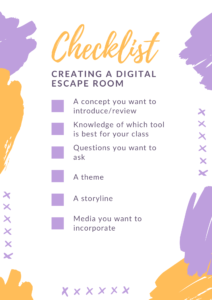
This week’s topic was super interesting! It was also relevant to my partner project, as we’re creating a digital escape room! Discussing it as a group in class would’ve been great, but we ran out of time. Although we only touched on digital escape rooms a little during this class, I found seeing an example of a digital escape room in class helpful.
It was also great to try a digital escape room out from a student’s point of view, especially using it as a tool for review, which is what my partner and I are planning on creating! Until I viewed Rich’s digital escape room, I had planned to only create an escape room on Google Forms. After viewing Rich’s escape room, I think I want to try to create a “room” component for my digital escape room on Google Slides!
]]>
This week we worked on 3D printing using Tinkercad! Following along with Rich’s tutorial made creating a keychain a lot less intimidating than it seemed at first! Rich also introduced us to Thingiverse! This website has readymade models to import into Tinkercad, which I think would be useful for implementing in a K-12 classroom!
As a future English Language Arts teacher, I think a great use of this would be to include it in a novel study, especially at a middle school level. Students could use a 3D printer to create a few artifacts that are important to a character, and then explain their significance. We had a similar component, minus the technological aspect, for a book report assignment when I was in grade six. I think incorporating 3D design and printing would be an interesting way to help them build new skills while engaging with text!
]]>
Welcome back! This week has been just as crazy as last week. For my inquiry project this week, I’ve decided to think about what I can do better to progress on my inquiry project.
The possible options I‘ve identified:
- Change my inquiry project
- Break up longer courses into more manageable chunks
- Take shorter courses
I didn’t think changing my inquiry project was possible until someone mentioned in class this week how they needed to change their inquiry project. This is a possible idea for me. I could choose something else that wasn’t so time intensive. On the other hand, I do like my topic. I’m happy with what I’ve chosen for my inquiry project, and I think it’s important work.
Another idea is breaking up longer courses into more manageable chunks. No matter how much I want to dedicate eight hours a week to this project, there have been some weeks where this is just impossible. Right now, I’m not sure how I would format the blog posts if I chose this route. Would I talk a little about the course each week and my impressions so far? I think this would make sense, but I also recognize that sometimes it can be difficult to talk about certain courses to that extent.
Another possibility would be to simply take shorter courses. This might be difficult, as some of the courses I’ve identified as interesting are quite long. Other courses simply do not have an estimated time for completion. This could prove challenging, as I would not know how long it could (possibly) take.
What option do you think is best?
]]>
I wasn’t able to get any work done on my inquiry project this week. We’ve had so many assignments and work recently, I feel a bit overwhelmed and burnt out. Even though I tried to make time for my inquiry project this week, I didn’t manage. Next week, I will identify some possible next steps so I can have success.
Thank you for visiting!
]]>
This week we had the opportunity to participate in an EdCamp! I’d never heard of EdCamps before this class, and I was really interested to see what they looked like! Instead of a typical conference where presenters give lectures, EdCamps are more participant-centred. For our EdCamp, we had a list of possible themes, and then chose between the top four topics. While we were allowed to move between groups, my group stayed the same throughout the discussion.
In my group, we talked about the use of storytelling in the classroom. As a future English Language Arts teacher, I’m obviously interested in this topic! I also wondered how colleagues with different teachable areas would approach this theme. During our discussion, we agreed that storytelling could be incorporated into all disciplines. Taking the opportunity to tell a story can make a personal connection with the students, as well as motivate them to be more engaged in class.
Giving students the opportunity to tell a story can also empower them! One link I shared with my group was for the Victoria Storytellers’ Guild. They not only provide storytellers who will speak to classes, but provide resources on how to tell a story. This could be helpful for encouraging storytelling in the classroom among students!
]]>
We had the privilege of a guest speaker coming in to talk to us last week. Jeff Hopkins is a former school superintendent and the founder of the Pacific School of Innovation and Inquiry. We took a (virtual) tour of PSII, and then had a question and answers section with Jeff Hopkins. Students at PSII learn through inquiry projects as opposed to traditional methods, which affords students more choice than in a typical classroom. Another interesting aspect of PSII’s model is that students are not given percentages or letter grades, but are assessed based on a model that the school created.
Inquiry based projects give students the opportunity to customize their learning. By being given the power to choose, students feel empowered, take risks, and learn to take responsibility for themselves. Students are also more engaged, due to being able to choose subject matter that interests them! One thing that gives me pause, though, is that learning is completely based on inquiry projects. Many of our education courses have stressed the importance of giving different kinds of assignments and instruction, to both engage students as well as support the different ways students learn. I wonder if only having students learn using inquiry projects can hurt them in some way.
Jeff Hopkins mentioned during our question and answers session that many of his former students would share their university experience with him, and they felt that university was boring. Learning via inquiry projects became the norm for them, and deviating from that left them not feeling challenged in their courses. While this could show how well they’re prepared for university, as many students struggle to acclimatize to university, this does not ensure they’re prepared for success. Boredom in the classroom can translate into apathy towards what they’re studying, as well as low marks. For many students, academic performance determines whether or not they receive scholarships or the ability to participate in work study. This leads us to the question: is there too much of a good thing?
Inquiry based projects give students the opportunity to customize their learning. By being given the power to choose, students feel empowered, take risks, and learn to take responsibility for themselves. Students are also more engaged, due to being able to choose subject matter that interests them! One thing that gives me pause, though, is that learning is completely based on inquiry projects. Many of our education courses have stressed the importance of giving different kinds of assignments and instruction, to both engage students as well as support the different ways students learn. I wonder if only having students learn using inquiry projects can hurt them in some way.
Jeff Hopkins mentioned during our question and answers session that many of his former students would share their university experience with him, and they felt that university was boring. Learning via inquiry projects became the norm for them, and deviating from that left them not feeling challenged in their courses. While this could show how well they’re prepared for university, as many students struggle to acclimatize to university, this does not ensure they’re prepared for success. Boredom in the classroom can translate into apathy towards what they’re studying, as well as low marks. For many students, academic performance determines whether or not they receive scholarships or the ability to participate in work study. This leads us to the question: is there too much of a good thing?
]]>