“what has a (positive) existence serves for profitable adaptation, and what has not that for (actual) usefulness”
Lao Tzu; Tào Té Ching; from Chapter 11, translation by James Legge
Nature
In my opinion aikido is a study of the nature of Nature. Nature is both outside and inside us. In my early life I used scientific method to explore the Universe outside myself, with mathematics and theoretical physics. The most fundamental principles, which all the laws of nature are built on, was what I was trying to understand. In these days I am using aikido to study the very same nature, by looking inside of myself.
The original idea for this blog started as an article I started writing in 2007, focusing on how to use restrictions to develop freedom. As I continuously changed my formulations the article was not nearing completion, and after 5 years I transformed the article into this blog.
The paradox about studying freedom is that we are not getting free, without pre-deciding what we would like to study. Even if we are free to do any form we would like to do, we still can’t get around the fundamental principles: The Nature; The Tào.
Very often when we are asked to do jiu waza, which is a practise without so many restrictions, we end up repeating patterns from our mind and body, and are not free at all. How many times did we ever see, or perform ourselves, jiu waza, where it became merely a randomized demonstration of that person’s favorite forms of their favorite katas? In jiu waza, kihon should not appear, right? Just randomizing the order of the songs on an album does not change the songs which are played from the CD. It is not like listening to the band jam live. Experiencing them improvising together. They are using their musical mastery to respect the musical principles, to play correct, however composing something never played before.
Photo from Vanadis Aikidoklubb
Aikido and music are extremely similar in nature. We can’t do anything imaginable and expect high quality. But when we understand the principles, Nature (both in music and in aikido), we can do something new. We can decide what to do. This is freedom.
What I do not consider freedom is the allowance to perform our favorite form, and the permission to neglect forms which we dislike. We are seeking freedom from our own mind. Not freedom from other people’s minds. We are free from other people’s minds, always. However, because we are a slave of our own mind, we might follow other people’s minds, even though we really don’t have to. Our like and dislike is what we need to look out for.
Freedom from Nature is fantasy. We will never do that. Nature, or Táo, is not something we believe in or doubt. Nature is. Nature will do what nature does. It does not matter if we believe one thing or another. Nature will still “work”, even if nobody believes in it. So when we speak of freedom we have an understanding that we will be free within some restraints. We will not break the laws of thermodynamics. So even in freedom without our own restrictions, we will be somewhat restricted by Nature.
Definitions of the forms
What do I mean by forms in aikido? I guess there are different opinions about what the forms are and what the purpose is of the forms. I guess we can in general summarize three type of view of what the forms (we could call them katas or techniques) are in aikido:
Examination curriculum
Weapons
Kata
There are of course aikidokas in between these categories, and some that have a different view on the forms. But I have found that these three are the major groupings in the view of what the forms of our art are, and what they are for.
We do have a group of people in the aikido society not really studying aikido. They mostly just want to have gratification from the society for doing progress. When getting a grade they are disinterested in studying for a while until the next examination is around the corner. The kata is just a means to an end. The curriculum is all it is. It is studied for pleasing the grading committee. They do as they are told, and are frustrated every time there are disagreements in the society about how a form should be performed, because this means that they need to study more than one way to do the kata. This is frustrating, because it will cost more time to get the results they want, than just studying one form until they can perform the kata sufficiently good to pass the test.
Photo from budojapan.com
Then we have another group of people who have created a shit-storm in social media. They think of the forms in aikido as weapons to be used to defend themselves against evil people. They proclaim that they have skills to fight using the forms, and start discussions with people from outside aikido, defending the martial value of the forms in aikido. However, whatever we fight, we strengthen, and it is almost impossible to express what we do nowadays, without having people looking for Bullshido and McDojos, commenting, thinking we are all in this group. Even a recent post with children learning high falls had comments from people thinking that we are trying to fight, when I think it seems very clear that we are doing something else.
I do understand the misunderstanding. Some of the things we do looks like punches, if we don’t know anything about either subject. And the nature of the human mind is to defend whatever we identify with. So here we are. In Scandinavia we have a popular term called budo-sport, trying to explain something unknown is, by using another unknown word? Is this some kind of trauma?
Also we have the word attack. In the world an attack is defined as something done with the intent of causing harm or killing, or destroying, whatever we are attacking. In aikido it is the initial parts of the ukemi, setting ideal conditions for study. The same word. Different meaning. Even inside aikido people have no clear distinction what the difference is. Usually this happens by participants who never did any other martial arts than aikido, but not exclusively. In Judo, for example, when they go for the arm bar, they do everything they get the opportunity to do to break the arm, but stop when the partner submits. Their intent is to break the arm. So it is an attack, until the fight is over by the loser signaling, to save themselves from a serious injury.
Photo from aikijournal.com
In aikido we cooperate. It is more like professional stuntmen making things look good. Both parts are contributing to the performance. We do it together. Nobody is attacking. Nonetheless we call katate dori and all the other forms for initiating a kata an attack. It is nothing wrong with that, as long as we and the person we are communicating with, know what the word attack means in this context.
Pressure testing is a concept I would like to speak more about later, but this is one of the things appearing in this group of people. In the extreme cases people are trying to “fix” aikido. Because the kata is difficult to perform in a fight, they change it into a jiu jitsu technique, to justify that “their aikido” “works”.
The forms in our society
In all societies we have different systems. These systems are in my opinion based on the mind and not on Nature. We have to respect the existence of these systems. We can choose to do what we want and need to do, but we have to position ourselves to the systems, because we will otherwise be positioned by them.
Lao Tzu writes good things about leadership, but in the systems of the world, the principles he speaks about is usually not followed. The consequences are what we can see in the news, in human history, and in the health of our planet. Even in aikido we have the same effects. The world outside is infecting the aikido society. People want power.
Because the forms in society is based on the mind, I don’t consider it a physical form which is useful to study, beyond having a clear example for the insanity of the human mind. The forms based on Nature are more interesting for me.
Kata
In my opinion, aikido is nature, and the forms are there for the purpose of studying nature. We are learning about ourselves and the world around us.
First we are studying how to position ourselves and to become aware about the outer parts of our body. We study with our teacher, with a mirror and in front of a camera, to become aware about structure and alignment of our limbs.
At the next level we are becoming aware about the inner parts of our body, like our breath, shapes of our shoulder and chest area, bones inside our body, inner alignment. This development has no end. We can become aware of more and more subtle things in our body.
Photo by Saku Dojo
The next level is to raise our awareness about our mind. We spent a lot of time to study our body, to a high degree of precision. This awareness can be also used to study our mind. Our mind and body is very intricately connected. Tension in our body is very often related to “problems” originating in our mind. Often our body makes our mind visible to us.
Using the forms, or kata, as I often choose to call them, to study our body is the foundation to the inner development. We are studying nature, but in aikido, in my opinion our study is to look into ourselves, instead of looking outwards into the Universe to find the secrets.
Pressure testing, if we understand what it means, is always good. But trying to compete with our partner is not going to help us. However, discussing something important to us with a person with an opposing view, without having our pulse rise with a single beat pr minute, is useful. We can pressure test our awareness by keeping our inner peace under adverse conditions. But we don’t have to do this in our keiko. Life will pressure test us at some point anyway. In my opinion, in the keiko, we should focus on improving our performance in the forms.
Practising without forms
I know that there is the temptation of practising freedom by playing without forms. But it is a very ambiguous situation, difficult to extract information from. As there is no difference from one to the other situation, we don’t learn anything from nature. If we are restricting ourselves to follow a form, we will immediately have a clear picture of what is happening inside ourselves.
I mentioned earlier the attempts to “fix aikido” by changing the forms to succeed more easily in our movements. This is something which goes against the purpose of the keiko. We are supposed to make use of the difficulties to grow, instead of just changing the assignment into something less challenging, to prevent the difficult moments.
The worst, I guess, is to presume that our form will be soft. When we are a beginner doing a form, we will fail in being soft. Not because we don’t try, but because we need the hours to know how to move inside, to become more fluid, less substantial, more perceptive to the situation. If we compromise our integrity to just make sure that we succeed in our ego-goal: to be soft, we abandon the form, integrity, and the path. And our softness is not really soft anyway. Because as soon as we meet an obstacle we have no idea what to do.
When I was first starting aikido I was taught to tense out my fingers in a strange shape learned from a photo. No explanation for this form was given. But in all movements we had to keep our “kamae” in front of ourselves. The only explanation was to keep our hands up at all times, to block, if our partner decides to strike us. Then stiffness was explained as ki. Very quickly this became unnatural and we abandoned this form.
Photo by emptymindfilms.com
Nowadays, based on principles, the form has returned, but without tension. And I understand the reason and the purpose for the form. The hand position is not everything, of course, but it gives us a way to study something intangible.
The first thing we do when we want to become soft is to collapse our arms, because hands and arms are what we use most of the time. In my opinion the outer structure should be quite rigid to create the integrity of our position. The softness should come from our inner parts. By keeping the integrity of the arms we will have the sensation of stiffness, which we can use to remove stiffness from our forms, without merely collapsing our arms. We would like to keep the function, but finding action-less activity in our form.
The principles
Aikido is a complex subject. There is a lot different subjects to study. However, if we try to at least structure the subjects into some categories we could try to divide the areas into clearly different concepts, which in each contains several sub areas of study. In my opinion aikido can be expressed as three qualities:
Kindess
Integrity
Economy
Number one is kindness. We can’t do anything without kindness. We should not only not hurt our partner physically in our keiko. We should be practising in a safe manner, considering the condition of the partner. Sometimes we have injuries, and we have friends in aikido with all kinds of ages and bodily conditions.
The kindness includes the mental and psychological aspects as well. If we see a friend doing something incorrectly, as uke and as tori, what separates an aikido instructor from a bully is how we deal with this. If we just see the problem but don’t know the reason for the symptoms, I would recommend not mentioning the symptoms, because it is for sure remarked already. If we see the underlying reason for the symptom and know how to solve it, then, and only then should we consider how to instruct our friend.
Photo from tsubakijournal.over-blog.com
Integrity is a fundamental part, and I guess it could be considered the form itself. Both uke and tori should be exact in our positions, both by ourselves, and in relation to our partner.
Economy is also a natural part of nature. The river will flow a certain path. The integrity of the terrain gives the river its natural way, and it is always the most economical path to the sea. Likewise our kata should, within the limitations of the form, be as economical was possible.
The forms give us a challenge: to perform the movement with respect to these three principles.
Or as Lao Tzu so cleverly expresses in chapter 11 of Tào Té Ching: We build the form, but it is the emptiness we find useful (the walls of the room are necessary, but it is space inside we live in).
The wave
Forms are hazardous, because the mind will grasp onto it. It could start to identify with it. And the pitfalls could be to think that the form could be used to fight others, or using it to promote ourselves. The forms within the aikido society is even more destructive in nature. I would go as far as to say that they are not forms of nature, but rather forms of the mind.
However, forms have a purpose. What that purpose is, is up to us ourselves to decide.
A nice way to look at forms is as a wave.
Photo by Aikido Vinohrady, from October 2014
The wave coming through us: The form does not originate in us, but merely passes through us. Just as the ocean does not itself generate the wave. The wave is caused by causality, and is flowing through the ocean. This is an idea which maybe can’t help us directly when we are stuck pushing at our partner or trying to lift our arm. However, it is a powerful way to change perspective. The system is bigger than just us. First of all there is the partner, which is also part of the movement we are doing, and there is the whole world around us. This understanding will make our mind act in a different way, and this might help us to make use of forms without being captured by them?
The Tao of Heaven works in the world like the drawing of a bow. The top is bent downward; the bottom is bent up. The exess is taken from, and the deficient is given to.
The Tao works to use the excess, and gives to that which is depleted. The way of people is to take from the depleted, and give to those who already have an excess.
Lao Tzu; Tào Té Ching, from Chapter 77, translated by John H. McDonald
Ilhabela September 2024. Photo by Dhyan Fortin.
I will return to my previously visited theme of action which is actionless today. There are a lot of formulations in Tào Té Ching for wu wei, or actionless activity. In many translations it is translated as not doing anything. What is written in the text, I will not say(because I have no idea), but I find inspiration in the idea of a process which refrains from activity causing action (pushing from the human side).
I would say that the first half of chapter 40, quoted in my previous post about this theme, gives us a quite clear idea of what wu wei is. According to the Arthur Waley translation it reads:
“In Tao the only motion is returning; The only useful quality, weakness.“
In my opinion this could very well be the earliest formulation of the Second Law of Thermodynamics I have seen! More than 2200 years before the heat engine experiments inspired physicists to formulate the physical law which dictates the direction of time in the universe!
Ilhabela September 2024. Photo by Dhyan Fortin.
I also love that in Chapter 77 we find a comparison to the Way Nature works, and the opposite way the human mind works. If a human makes an investment, we expect our investment to grow. We have constructed a system, contrary to one of the most fundamental laws of the Universe, where the rich will take from the poor continuously. It was the same 2500 years ago, as it is today. The human mind did not change, and of course, the Way will never change.
So what is the Second Law of Thermodynamics? It is one of those laws which is very difficult to write down precisely, because it has so incredibly many formulations, and most of them are long and not very relevant for aikido. But basically it states that the total disorder in the Universe is always increasing over time. In other words the natural flow of anything, water, electrons, stars, you name it, goes from a higher potential towards a lower potential. You could also say that the Universe moves from a less likely state, towards a more likely state.
Ilhabela September 2024. Photo by Dhyan Fortin.
You can imagine a sand castle on the beach. Things will happen over time, and the result will not be a sand castle forming at the beach from the motion of the sea and the wind. If humans built it, over time the sand will return to the more likely state, with lower potential energy. The Way of Nature: Tào.
This is one of the most fundamental concepts in physics, no matter which genre of physics we are delving into, thermodynamics, classical mechanics, statistical mechanics, fluid mechanics quantum physics, quantum field theory, and so on…
And I might imagine you thinking by now, how does this tie into what we do in aikido?
Ilhabela September 2024. Photo by Dhyan Fortin.
Before getting to my point, I would like to remind you of a very old computer game, called Pac-Man. It is a pizza with a slice missing looking like a face with an open mouth. And this face is going through a maze filled with tasty morsels to eat, and monsters to run away from. Once we have eaten all the food on one level, a new level loads and Pac-Man continues to run away from the monsters, and try to eat all the food there. The neediness and fear never ends.
We are one. We are whole. We don’t feel whole. We don’t have thoughts of a whole. But if we have a moment of serenity we might see the reality of it. But the rest of the time, we feel like a Pac-Man. Something is missing inside of us. We need something external to complete us. A piece of the sector has been cut away from us and is hiding beyond our goal, whatever our goal is. It could be ikkyo, it could be a job we are applying for, or a partner we are interested in.
Ilhabela September 2024. Photo by Dhyan Fortin.
The sensation of incompleteness originating in our mind makes us susceptible to being affected by a lot of conditions we don’t control. We are scared of things! We need things! While in reality we have no reason to fear or chase after anything. We are already complete.
The difference is that if we approach our challenges as a complete person we have a much greater chance for success, compared to if we run around like Pac-Man running away from monsters, running towards the food, in my opinion.
Because we are not needy, or scared. We are functioning at our maximum capacity at all times. We never think weird thoughts, or have weird emotions, hence we never do weird things. Like pushing the partner’s elbow during ikkyo.
Ilhabela September 2024. Photo by Dhyan Fortin.
In my opinion, our desire to do it, and our fear of not being able to do it is the exact same thing, and this is what I can see standing in our way when we practise ikkyo.
The will to do ikkyo makes us move forward; The fear of not being able to do ikkyo, makes us more rigid: Thus we are causing a pushing force on our partner. From the uke’s side it is the same. We can feel the partner invading our space. We desire our space, and don’t see the greater perspective, that our space has shifted, so we cling on to the old position. Or we are scared of the pushing from our partner, so we push back to stand our ground.
Ilhabela September 2024. Photo by Dhyan Fortin.
As you know, pushing the partner in front of ourselves is maybe the number one mistake in ikkyo, omote. The further we move our partner forward, the furher we have to run after them to pass them in the ikkyo movement. Or, if we have a more experienced partner we will just push into their integrity, and nothing will happen at all.
In ikkyo we push. In shiho nage we pull. We always did, and to some extent we always will. However, over the years, hopefully we will find ways to push and pull a little bit less. When we practise with partners with way more experience than us, and also when we practise with beginners, we will immediately realise if there is any pollution of fear and desire left in us. It really applies to both roles of the interaction. If we are perfect we can do both roles with any partner, and it will never be a problem.
Ilhabela September 2024. Photo by Dhyan Fortin.
The inside realisation is the only way forward really. There will always be partners who are stronger, faster, more athletic, and technically better than us. However, the quality of being completely free from desire and fear: free from the mind; In total acceptance of the Way the Universe works, is really something remarkable. And it gives qualities which will enhance our life outside the dojo.
Enjoy your keiko! Aikido makes people happy (I always write this, and in my opinion the only way to be happy is to be in the state free from wanting and being scared of things)!
The reason for great distress is the body. Without it, what distress could there be?
Translation by Stefan Stenudd
The only reason we suffer hurt is that we have bodies; if we had no bodies, how could we suffer?
Translation by Arthur Waley
What makes me liable to great calamity is my having the body (which I call myself); if I had not the body, what great calamity could come to me?
Translation by James Legge
I always found this part from Chapter 13 of Táo Té Ching very inspiring. According to Arthur Waley, the word “body” in Chinese, shên, can have two meanings: “the physical body” or “the concept self”. What does this mean? What does the word “self” mean?
Ilhabela, Brazil January 2024
Our most basic way to identify our self, is our physical body, I guess. When we say me or I, as a child, we speak of our body. Our identity is inseparable from our physical appearance at this point of time. Of course only a very short time later our physical body has changed a lot, but we might be stuck for a long time with this idea of who we are. And if someone asks us if this person is you when showing us a photo ourselves in the past, we might start to get some idea that yes, it is still me, even though the body is different, because we are older at this time.
Most people will reach the point of maturity where we realise that who we are is a bit more deep rooted than the body. We did not choose who our parents are, or which time or which culture to be born into. It is just a throw of the dice deciding which body we end up with.
Our next identification, as we grow slightly more mature, is usually the mind. We will naturally have some opinions and emotions about different situations and subjects. There are patterns happening to us based on our body, and on the history we have experienced up to this point in our life.
The Gosphel, Heresia and the Serpent from Gustav Vasa Church. I must admit taking the picture from Wikipedia, even though this is just 20 meters from Vanadis Aikido Dojo
As we already discussed, the genetics coming from our ancestors, what we inherit through the body, were not chosen, so therefore it is not personal. Also, what happens to us in our childhood and early life is a natural consequence of where and when we were born and which situations we find ourselves in. So our mind is just as far from personal as our physical body.
If we are not our body, and not our mind, who are we? We do have a body, yes; we also do have thoughts and opinions, yes; and in a way bridging our body and our thoughts, we have emotions. All of the above are random, in the meaning that they were not chosen by us. Is it who we are? Is this our self? Maybe, many will say that yes, this is who we are. And they are willing to fight their friends, and kill them, because they are in conflict with what their friends consider that their self is.
It really does not matter if it is political views, nationality, religion, or any other random classification based on our definition of self. The result is that we end up defending this self (the fake one in my opinion). Killing our friends. Attacking each other. Because we think that ourselves are different from themselves.
Ilhabela (North coast), Brazil, january 2024
Because we are inflicted by thoughts and emotions telling us that the one we see in our inner eye is our enemy. At some level we would be able to see the person if they happen to be in front of us. This is the tool of a politician. It is easy to ask a soldier to kill an enemy they know only by their conspiring whispers. It is a different situation if the soldiers already know each other.
However, at a lower level our mind would even prevent us from seeing the reality because everything is filtered through our distorted view of the world around us. We do not even see them even if they are right there, because our mind blinds us from observing the real world. If we could see we will know that this is our friend. This disease is causing us to perform violence to our friends.
Naturally our friend have the same disease. They perceive us as a threat and will be attacking us. This mutual sickness is feeding itself, because hostile acts breeds more hostility. As we consider each other enemies, and we are always looking at ways of defending the self, there is eternal war.
We arm ourselves. We want to defend our “self”. We build armies and plot, and build up our image of who we are, as something separate from who they are.
The trial of Bruno Giordano by the Roman Inquisition. Bruno was burned at the stake (on this day) February 17th 1600 at Campo de’ Fiori in Rome. Image taken from Wikipedia.
Imagine two armed people meeting in a dark alley. Both are trained to the highest level in drawing and shooting, and they both have the best equipment available. They have been trained to look for hostility in the other. They see each other. They immediately see that the other is not a police officer, and they seem to be armed. Where are the hands of the other, and where are their own hands?
When these two both draw their guns and kill each other. Who’s fault would it be? They were triggering each other to draw at the same time. Was it the alley’s fault, that it was dark there? Or was it the fault of the person making the guns, or producing the ammunition? Or was it the fault of the people teaching them how to shoot? Or does the fault lie with the basic flaw in the mind that we want to defend what we define as our “self”? In reality they were both headed to the same restaurant, their wife or husband waiting for them at neighbour tables.
The mind is responsible for all the factors, except for the natural darkness of some alleys. It makes all environments dark because it prevents us from seeing reality, but some actual darkness will always be in some places. As long as there is light, there will be shadow.
Awareness keiko, with Gatão and Tantō in Ilhabela in January 2024. Photo by Joana Corbett da Silveira.
In my opinion our path, or road, in the practice we are doing every day, is to increase our awareness about what is happening inside of ourselves. By being aware of what is going on inside, we have a basis for peaceful communication with ourselves. Not denying thought or emotion, but acknowledging that they are there, and respecting that this is the state we are in, at this moment.
This peaceful interaction with ourselves gives us a fundament to be able to act peaceful in our interaction with the world outside ourselves, even if some of the ones we are in contact with does not share our level of awareness. By seeing the causality of mind state and action, we have understanding when someone is doing something which might be considered not ideal. We understand that nobody can do otherwise than what the mind dictates, until we have the level to see what is going on in ourselves.
Most important of all, we have the freedom to choose independently of our mind when we realise that our thoughts and emotions are guiding us to act insanely.
Ignatius of Loyola trampling on a heretic, Jesuitenkirche in Vienna, picture from Wikipedia.
We are relinquishing our self, by realising in our keiko, a deeper meaning of self. Maybe our self is life itself? What this is I would not be able to say. However, we could start by realising that our self is something which does not require defence. The reality is still true, no matter how distorted people’s opinion is about it is. There is no threat to neither reality, nor life itself.
Our body will die, so will our mind, with all its opinions and emotions. Even everybody who ever met us will die, and we will be forgotten. But life is always present. Just as it is in us now, like it was ten or thirty years ago, even though our body consisted of different physical material back then, and were quite physiological different from now. Life was there then, now, and until life goes on without our body. We can’t kill life, we can’t defend life. Is this our real self?
Keiko with Joana, in Ilhabela January 2024
Since before I stepped on to the tatami, my opinion has been that aikido is the opposite of self defence. It is based on my experience. It has been solidified by my practise. Still, there are no problems practising with people doing self defence (they are quite few, in the part of the aikido world where I go most frequently, but they do exist). They have different experience and different training, so naturally their opinion will differ from mine.
This is no problem. We should practise together. We probably have different definition of some words, we might follow different principles in our physical keiko. However, it is fascinating to study how to do our keiko in a way that can satisfy our needs to proceed on our way. Our path of “The Art of Peace”, as the Founder of Aikido, Morihei Ueshiba called it.
Ilhabela, Brazil, January 2024
Now, I do not read Chinese, so whether the original sign in Tào Té Ching means body, or self, I would not know. However, I enjoy the observation of Arthur Waley that the word could have both meanings. No matter if that statement is correct or not, it awoke my curiosity, and sparked the fire for this little project of mine: To relinquishing the fake self, while nurturing and rejuvenating the body and the mind, getting in touch with whatever our real self could be.
A master of deception Who takes you by the hand Then leads you to the palace of the damned He pulls the strings inside you And plays upon your fears Your final scream is music to his ears
Robert Halford – Evil Never Dies
What is the meeting point in a verbal interaction? Is there such a thing? Lately I have been pondering upon the concept of the meeting point in a general sense; Not merely in our positional play in our physical structure on the tatami, but our meeting with people in the real world, even over the phone. In my experience, if the partners does not agree upon a meeting point, no exchange will happen.
Photo by Natasha Pankovych from the seminar with Ariga Kaname sensei in Bratislava in October 2023
A common problem in a conflict is that the two parts are blindly focusing on one single aspect, with no attention to the view of the other part. This tunnelvision is a common effect of the human mind, I guess. Sometimes we are so single-mindedly focused on the problem that even if a number of possible solutions are right there in front of our eyes, we will never be able to see them. So the “time-aspect” is of paramount importance as well ass the “space-aspect”. If we are lost in the past or the future, we are absent in the present moment, where all the solutions can be found.
In some cases, one part involved in the conflict has a more developed awareness. By being aware of what the mind is doing, they can still see the world around them, and even if the other part has a too low awareness to see anything outside their own emotions and thoughts, the higher level person could meet them where they have their attention or lead them to a reasonable location for a meeting point.
Photo by Natasha Pankovych from the seminar with Ariga Kaname sensei in Bratislava in October 2023
Christian Tissier sensei said something some years ago which has stuck in my mind: “If the partner does not accept the point, it is not a point.” So if two parts in a conflict are both trying to communicate through their separate meeting points, they will not get anywhere, because they are both having monologues, not a dialogue, because the phone line is going to different connecting places, and they are not speaking to each other, even though they are both speaking.
I have experienced this a number of times, and many times I have been part of this situation. My workplace is a very interesting laboratory for this kind of study (I work in the reception of a big dental clinic). Sometimes even though we see where our partner is, we can’t really meet them. And a great deal of the time we don’t have the level to even see the situation outside the maze of thoughts and emotions.
Photo by Natasha Pankovych from the seminar with Ariga Kaname sensei in Bratislava in October 2023
One situation I find myself in often is that once I shift my own attempt for a meeting to where my partner is, they evade my meeting by starting speaking of an entirely different topic. And every time I shifted to meet them, they kept jumping to a different theme. My theory is that I was mistaken about what the real meeting point was, and saw merely the outer physical contact point of our conversation. It does, to a certain degree, require a mutual level of awareness to come to a point where an exchange is possible.
One can still to a certain degree help the other achieve a higher level. Vice versa, a low level is contagious. So it does benefit the situation a lot if at least one part can see what our respective mind is doing, and through this, being able to observe the world outside ourselves, and noticing the partner, and their meeting point, because we do need to meet somewhere to have a meeting.
Photo by Natasha Pankovych from the seminar with Ariga Kaname sensei in Bratislava in October 2023
In music there are a lot of technical principles, scales, or modes, which transmits different emotions (ionian, dorian, phrygian and so on). In a way music and aikido are very similar in nature, because we are using technical principles to transmit emotions. Of course, in music this communication also is happening between the musicians, but with sound it gives the audience a more complete impression of what is going on compared to in aikido, where we use touch as the transmission medium.
Even in the relatively simple katas we perform with our friends in the dojo is sufficiently complex to easily get confused when analysing the meeting point. The first thing to notice would be that the meeting point is not always the same as a contact point. We might have many contact points, but there is always only one meeting. There are several levels of the meeting happening. But in all levels, and all categories, the partners needs to be in agreement about what the meeting point is.
Photo by Natasha Pankovych from the seminar with Ariga Kaname sensei in Bratislava in October 2023
Of course, this is not something we have to think about during our time on the tatami, because it will happen naturally in our movements. If we have a problem, we will experience the problem. And the grace of the keiko is that by continuing to study, we will close in on this theory with our movements, even if we did not think about these things. Just as a good melody in music can be found without knowing anything about musical theory.
In my opinion, aikido is more than just a physical activity, to keep ourselves fit. It is something which should benefit the world outside the tatami. Thus, it would be interesting to analyse these things, to find similarities with what we face, for example at work, on the phone, with a customer, a colleague, or a person from a different company. The meeting point becomes relevant.
Photo by Natasha Pankovych from the seminar with Ariga Kaname sensei in Bratislava in October 2023
A huge aspect of the meeting point is to be present in the world we live in at this moment. Very often our attention is drawn towards what has happened in the past or towards something we imagine will happen in the future. Even if we are discussing past events, or planning the future with our partner, it is fundamentally important to be in a realistic respect to what is, right now. Because no matter what has happened, or no matter what we want to achieve, the current situation is where we have to start from. No excuses, like “It should be like this!” will work, because what is, is the way it is, right now. And there is nothing we can do about that.
When we find ourselves in a situation at work where we feel stuck. We do understand that an exchange needs to happen for us to get on with our jobs, but we are just not able to. There is the time dimension, where the mind can be holding grudges, or we are acting out of fear or desire for some fantasy future situation. Or we just can’t see the meeting with our partner, because we are blinded by our assumptions, judgement and other pollution from our mind. No matter how hard we try we are just not able to meet our partner. Just as when I was shifting to meet my partner, and my partner was evading me (from my point of view) to a different subject because I did not have the level to see the real meeting point.
Photo by Natasha Pankovych from the seminar with Ariga Kaname sensei in Bratislava in October 2023
We could say that just like the scales and modes are describing a theory for what will sound good in music, the meeting on the tatami could be described as a fulcrum. We have an exhalation phase, we are closing in on the fulcrum, and an inhalation phase, where we are moving away from the fulcrum. At the same time we will have rotations around the fulcrum in any direction.
It is a bit like the gravitational interaction of masses meeting in space. There is a gravitational pull between all masses at all times, but as the masses close in on each other, they start to affect each other more. So they move towards each other, move around each other, and fly apart, with a fulcrum as the meeting point. Their centre of mass might never reach the location of the meeting point, but rather swing around it, closing in, and moving out again. Otherwise we would have a collision, and mechanically, the same principles would apply.
Photo by Natasha Pankovych from the seminar with Ariga Kaname sensei in Bratislava in October 2023
A fulcrum can move, it can even be subject to accelerations. However, in this case it is a relative fulcrum which a part of a bigger system, with more parts, also following the nature of fulcrums, moving in, moving out and rotating around a common centre point, which is the meeting point of the entire system.
A fulcrum protects the integrity of the partners. There is no way we can interact with our partner by pushing, pulling or twisting. Both partners have integrity, and the integrity is needed for the principle to be valid.
So what happens if we try to “violate the meeting point”? We will experience that our partner becomes “heavy”. Even if our partner is not physically resisting us, we will find difficulties in performing our movements. If we use leverage, timing and maybe superior strength, we still might be able to succeed in our movement, but “the lightness of touch” we have with our partner if we conserve the fulcrum, will be lost. And I guess this kind of experience will not help us in the world outside the dojo. You can’t solve a conflict with a person on the phone, or even across a desk, with physical strength.
Photo by Natasha Pankovych from the seminar with Ariga Kaname sensei in Bratislava in October 2023
There is a principle in tào which I prefer to call actionless activity (wu wei). This quality is sometimes translated as non action, or choosing the path of minimum effort. This quality is very interesting, because it is the only way we can have fulcrum conservation. In my opinion “actionless activity” is a good way to describe it, because “actionless” specifies that the action is always neutral, and “activity” means that we are active (not passive).
This is a hard challenge for the mind. We need to be present in the meeting. This means that we can’t run away from things which we fear; And it means that we can’t cling to things which we desire. Just being present in the meeting point, NOW. This is what is.
Photo by Natasha Pankovych from the seminar with Ariga Kaname sensei in Bratislava in October 2023
Very often our focus tends to shift to what tori is doing, and what tori should or should not do, and so on, while neglecting the role of uke. Both partners are part of a martial interaction. If one part moves, it has consequences for all other parts. If one side moves their tanks to strike, the opposing side will not stay in their current position, if the integrity of their ranks are compromised by the movement of the other side. If in chess our opponent moves a piece and will be able to strike at our piece on the next move, we need to reconsider our positions.
In aikido we are doing it together, so it is not like in war or in chess. However, the martial nature is still there. So when tori moves, uke should, in my opinion, continuously be searching for the best position, and not asking themselves: “Do I have to move?” (no you don’t, but then it would not be a martial arts any more, when the partner have the position for a significant strike, and will not because we don’t knock down our friends in aikido).
Photo by Natasha Pankovych from the seminar with Ariga Kaname sensei in Bratislava in October 2023
What is all of this good for? Why overanalyse and create theories about what is indescribable? The Way that can be described is not the general way. I guess, for at least me, it gives inspiration for the study. It is nice to have different aspects to focus on from year to year. We still study the same movements every day of the year. The theory brings spice to our aiki-food. I guess, at least for me, it is also important to relate all our study in the tatami to the actual world outside the dojo.
Besides, in many kata our contact point(s) are quite distant from our meeting point. So it really helps the understanding of the movement to be aware of where the centre of the movement is. As an example in irimi nage or shiho nage the contact point is in the height of our noses, while our meeting, in my opinion is in between our front hips. It does help our technique to be aware of this.
Photo by Natasha Pankovych from the seminar with Ariga Kaname sensei in Bratislava in October 2023
The most interesting moments, the situations where we learn the most, is when we meet partners who are not easy to practise with. This goes both for aikido and in life outside the dojo. We have to study, both the physical form, but even more the awareness of what happens in our mind when we encounter an obstacle.
In my opinion we should never ask our partner to change something, neither as uke nor as tori (unless it is a matter of safety). Every situation is an opportunity to discover new things. And yes, most of the useful things, which can make a change, are what happens inside of us. We can’t stop the greater conflicts in the world with our choices. The development of our species have to start with how we deal with the people we happen to meet. And aikido, in my opinion, is a kinder garden, an educational system for dummies in how to deal with conflicts, and how to live peacefully.
Do you need what I need? Boundaries overthrown Look inside, to each his own
Do you trust what I trust? Me, myself and I Penetrate the smoke screen, I see through the selfish lie
J. Hetfield
From the very beginning of my aikido journey I was told about keeping the beginner’s mind. Both my day to day teachers, which did aikido a few years at that time, and the professional teachers I met, who did aikido for a lifetime, spoke of the concept of shoshin. At a first glance, of course, this makes sense. To not become arrogant; To not consider myself an expert; To not stop learning. I considered it as a natural door to learn more. As a beginner this was never a challenge, and to this day those parts (I did not at that time see all the parts) has not been obstructing my road.
However, I think that there is a lot more to this concept than what initially meets our eye. Otherwise the professional teachers would not have spoken of shoshin as such a profound quality. All of them explained it in a way which I could not, at that time, relate to. I guess this subject passed out of my field of study, for a while.
Humboldt Penguin at Atlanterhavsparken in Ålesund December 2022
At the time of the passing of T. K. Chiba sensei, a video interview with him was released. What I perceived from that video was that his most important recommendation to the future generations of aikidokas was to keep shoshin. Even though I never met this teacher personally (I only had contact with his students), I was inspired to put some emphasis into researching, for myself, what shoshin really means, for me. Presently I am also interested in how the concept of shoshin can help support us in the world outside the dojo.
According to wikipedia sho means initial, and shin means mind. So the translation I was given as a beginner: the beginner’s mind, is understandable. The mindset is open for new information, for learning.
Calligraphy taken from Atlantic Aikido, Galway
But does this mean that the state of a person who never did any practise, at all, is of higher quality, than that of one who has been studying all their lifetime? This seems to be a paradox? Why practise at all, if we already have the quality we are seeking in the first place? Why strive for a lower quality than that which we already start with? We could of course escape that koan by saying that we are procuring other qualities, and in that process we should strive to preserve the initial one. I guess that would explain it, to a certain level.
What is easy for the beginner is to receive new information, because there is less content in their mind already, in this field of study. There is less past experience of this kind. Even if a beginner are dreaming of what comes in the future, it is not yet based on past experience, so the dream is easily “exorcised” by exposure to the present moment in the keiko. The beginner will more easily have the keiko as a support, or anchor, to stay present in the current situation, more so than the more experienced practitioner, which is more heavily restricted by the inner propaganda and censorship of the mind. I will explain what I mean by propaganda and censorship below.
The challenge will arise when there is an extensive amount of past experience and knowledge in our system during keiko (or in life). The shoshin is lost when our past memories triggers the mind into generating a projection of our past into a future time, where we will have an expectation of what is going to happen. What we expect might not happen. And the most problematic part is, of course, that our expectation is so strong, that even if it did not happen, we would interpret, and filter, the information we have from the situation, to fit our idea of “what should have happened”. For a scientist this is a calamity!
Above Vigra Airport in December 2022
When the mind has a “reservoir” of information, it tends to label the information to reduce the amount of processes needed to perform a simple task. So if a teacher shows shiho nage, we will not see what the teacher is showing. At the moment our system recognise something we experienced in the past, we will immediately shut down and perform the same thing “we always do”.
Similarly, when we meet our partner to study we might fall into the same trap. It might even happen with the same partner we do keiko together with every single day. And more frequently it would occur during our first meeting with somebody new, at a seminar. The mind still tends to standardise the meeting to what we experienced in the past. Predicting the future, or rather, most likely, constructing a fantasy. As I mentioned before, if the current situation does not fit with our expectation of what the situation “should be”, the mind will hide the parts which contradicts our idea, and put more emphasis, on the parts which actually supports our view. It enhances whatever fits with the initial mind and suppresses whatever contradicts it. So in this way, the words “initial mind” means the exact opposite of what we are discussing here.
We should always be watchful of these things, as words has a way of oversimplifying things. As we saw above. Initial mind can mean many different things, even completely opposite things. We may argue the logic of both interpretations of the word. However, in this particular case the situation is trivial, because it is obvious for us that the word just turned the whole thing around for us. The more intricate situations on the tatami though, might be more perilous. Furthermore, in the complexity of life outside the dojo it is an immense challenge to not get trapped by the mind in this way.
Sjøholt on Christmas Eve 2022
I mentioned the mental labelling, and the mind’s tendency to protect it’s initial idea, protecting it’s “self”. A consequence of this “self protection” (or “self defence”) is the random preferences we tend to fall into, over time. We like this and we dislike this. From the start we just experienced it all for the first time, and some things we enjoyed more than other things. However, we still did not have time for investing our enjoyment in one thing naturally leading us to abhorring it’s opposite.
Sometimes two partners on the tatami have so different preferences (what we like and dislike), and ideas of what we think we should do, that we will experience a conflict. It could really be anything, but I will try to give just a few examples:
During katate dori one might put more emphasis on keeping a complete grab, while the other might put more emphasis on the integrity of the position (in some situations we have to choose a distribution between these two qualities, like 70% – 30%, so they may appear to us as opposites if the partner chooses the other way around);
One might be seeking to strengthen their posture by having a lot of pressure between uke and tori, while the other might be trying to remove more and more, making the contact between the partners more like we are one body working together (these might be perceived as opposites);
There might be a disagreement about which parts of the kata should be performed by uke and which parts should be performed by tori (even though we are agreeing on the form of the kata we have a disagreement about who to do what);
And last, but not least, there might be a disagreement of the actual physical form of the kata (there are a multitude of ways to perform each kata, and there is no lack of aikidokas who will defend the way they learned it as if it were a threat to their life if somebody do it differently).
The otters Nusse, Muffe and Pia at Atlanterhavsparken in Ålesund December 2022
So how do we use the concept of shoshin to help us keep our feet on our journey? In one way, there is no way to lose our way, because whatever choices, or mistakes, we make, and wherever we might go, it is where we have to go, to continue. If we “fail” we will experience some unpleasant situations, and we will have a “kick in the butt” (literarily or figuratively speaking) to evolve to a higher level.
However, some suffering is avoidable, if we already have the level for it. If we have the required level, we can see the activity of the mind during these little “conflicts” on the tatami. They are really small, you know, considering the major conflicts in the world outside. We are children playing in the kinder garden, gaining experience to deal with the “grown up life” outside the dojo.
Once we have the awareness, the simple observation and making a decision which leads to a productive keiko is extremely easy. The life in the dojo is really not that complicated. Outside the tatami however, the situations is very often very complex and intricate. On the level of manifestation there are no correct or incorrect answers. However, if we at least start from a state where we can see the situation, we might be better off than if we blindly follow whatever happens inside of us.
And to return to my initial question? What is shoshin, or a beginner’s mind? And does really a beginner have a beginner’s mind? So let’s take the second question first. No, they don’t, generally (there could of course be exception, but in that case they are usually not a beginner, as they received it from some other study). The beginner is able to manifest the outer form of shoshin even though they do not possess the quality, because the situation is new for them. In other aspects of life they do not have this “superpower”, so a beginner does not generally have a beginner’s mind, in my opinion.
The sunset seen from Atlanterhavsparken in Ålesund December 2022
As to what shoshin is, which we could describe by words, can easily be misleading, because, words have different meaning and association for different people. In my opinion shoshin is a level of awareness of the reactions of the mind. The mind is constantly clouding our vision of what is going on around us. If we are able to see the process of thoughts and emotions and their “haze equilibrium” of defensiveness, we can see the world around us in a different way. We have the freedom to make a choice. Or at least a higher degree of freedom than if we lack shoshin.
In Roppokai Daito Ryu we very often practice in larger groups, doing kakari keiko. One person is throwing the whole group in the role as tori and then shifting to the uke role, and so on. In this situation it becomes super apparent for everybody waiting in line (the ukes), who can see the eyes of tori, if they have shoshin or not. It is like it says in the Bible with the speck and the log in the eye, it is easier to see it happening to others, than to realise when it is happening to ourselves. When shoshin is lost, the eyes get “stiff”. This of course also becomes apparent in the waza we perform, as we will have difficulties with many partners.
Our “idea” of the movement does not fit with the experience from our partners, and in this situation the meeting is changing very rapidly, as every partner is different, and they are arriving in a flowing succession. This way of doing the keiko is one of many ways to check our level of shoshin. The past is not valid in the future. Actually the past is just a memory in the mind and the future is a fantasy from the mind. The only real thing is the now.
Ice crystals in the air at Hökmossen in Stockholm, in December 2022
We all have our ideas and our opinions. The ideas and opinions are connected with emotions, about “our” philosophy, and the “other” way of thinking. There is an illusion that there is an eternal fight, between Good and Evil, and all of us wants to be on the side of the good. We will fight the evil. We will kill the Enemy!
The whole idea of self defence is internalised in this system. The idea of always having a bigger “gun” than “the other”. It is the same with individuals and the collective: religion, political views, nationality and so on. These brands we put on ourselves is of course imaginary. But until we see that, they are more real for us than anything.
Prestefjøra in Sjøholt June 2022
The system in the world is based on the idea of fighting the evil. We can see it in social media as well, reflecting exactly the reactions of the politics of the world, as well as how we speak. If somebody we brand as one particular category does something “bad” we immediately side ourselves with the other category, judging everybody we put that brand on, polarising the world into “friends” and “enemies”, not realising that it was this very effect which caused the crime in the first place.
We might even think that it would be an evil act to not react to evil? Yes, I see the logic in that, but what action would be constructive, in this situation? Hate caused a problem, and we solve it by adding our hate, including a lot of individuals who was not part of the crime?
Even in the situation where this individual did something “evil”. How do we deal with the situation? This individual incident is reflecting the state of the world as a whole. “No! It is not! This one is EVIL!” Well, sometimes totally “normal people” act in ways which most of us would consider insane, and they are too many to be considered an anomaly. I will not get into the details now, but check out the collections of photos from my previous post. Inattention to our mind can lead us astray in disastrous ways, and it is really just a play of dice which way it will turn.
Frafjord in Norway, April 2022
So how do we deal with the problem? I have no solutions on the outer level for the immediate problem. Neither is it my field of interest (actually I don’t think it can be solved on that level, but you are welcome to try). The solutions I see are inside of ourselves.
It is not really a philosophy. It is not an idea. It is not something to be argued about back and forth, and to become another subject for separation and conflicts. Either we are interested in awareness, or we are not. There is no right way to do it, or a wrong way to do it. It is simply attention. We can use a lot of different words for it. We can get into fighting about which words are right, getting lost before we have started. There are no ideas. Nothing to defend or fight against. Either we can see our thoughts and emotions, or we will be fighting what we consider is “evil”, while what we consider “evil” is fighting us, because it considers us “evil”. Nobody wants to be the “bad guy”.
The cool part is that attention spreads. It affects everybody we meet, just as inattention does. So one “mindful” person will make a shift in the world for the better in a positive way. There will still be people without attention, but they will be fewer, and they might even have a little more attention than if they only met people reacting to their acts of inattention.
Berlin in June 2022
It is some kind of philosophy obliteration. It is the end of treasuring ideas. It is the end of War. The ideas will still be there, but nobody will be fighting over which one is better.
But what I am writing now is also an idea you might say? This is not an idea for more discussion about which idea is correct. My words will naturally be selected like this (because of my history, practice and experience), but they are not important. The word “mindfulness” is not a word I appreciate, because it is kind of counter intuitive, but I will not waste time protesting against it, as it is a known concept, and more people would understand the situation than if I use the word awareness, attention or presence, maybe? The same goes for all the words I use. The words are not important. The idea is not important. The attention (or whatever word we choose for it) is important.
However, then comes the next trap which triggers discussion: Does this have anything to do with aikido?
Prestefjøra in June 2022
Maybe it does, maybe it does not? I found this through aikido. It is one of the gates into this realm, and maybe it is one that is more accessible to great amounts of people than other things. It brings so much joy in the initial stages, when we might have no attention, and we get there without an effort?
Why this is important is self explanatory. War, violence, rape, abuse, addiction, etc. is consequences of inattention. To survive as a species beyond the two next generations we need to change. That is my opinion. That can be discussed. But it is not important. However, that is why I do it. Naturally you have the right to have your own reason for doing aikido, just as I have my reason for it.
What is aikido? I guess it is different for everybody. We all see something different in it, and we have different reasons for doing it. For a long time I had no idea why I needed to do it every day. And there was no problem. I knew what was right, but it took a long time to be able to have words for it.
Sjøholt on Midsummer Eve 2022
Aikido is a gate towards a world in peace. We may use it, if we are willing, and if we are ready for it. And the best part is that even if we are not, the gate will still be there.
Father, forgive them, for they know not what they do
Luke 23: 34 – Douay Rheims Translation
The past few years I have had a project, in my study, based on the second half of Chapter 67 of Tao Te Ching, by Lao Tzu. There are a lot of various translations to English. And in my point of view they are all valuable as a source, but neither variation of choice of words are the ultimate one (and the same could be said about the quote above). Of course, from the technical point of view, a translation should keep the original text intact, conserving the message of the author intact. However, for me, who can’t read the original Lao Tzu text, the focal point is merely if it inspires, or not, at my current situation on my aiki road.
This chapter mentions three treasures, and I believe these three are kind of fundamental to have present at all times in aikido. I previously wrote a post about the seven virtues of the samurai. I guess this is pretty much the same idea, but in a more condensed form.
At the highest level, I guess, is to realize that no idea (any formulation of words or thoughts) can capture this universal principle, without in itself violating the principle by making an idea of it, and giving it a name.
I will change the order of the treasures, saving the first one to last.
Photo from iStock
The Second Treasure: Economy
Alternate words for it could be (but is not limited to) “Frugality”, “Simplicity” or “Moderation”.
I guess, when we start our study of the basic forms in aikido, this is usually the first one to appear to us as a valuable principle, or treasure, to cultivate. It is true that some variants of basic forms, in order to teach management of distance, integrity and posture, we are doing things in a non economical way. However, that is only a step on the way to keeping what we learned, and transforming our kata into a movement which is economical.
As we proceed in our study we are removing more and more of the more rigid form we learned at first. Maybe the teachers did not tell us to do it in an uneconomic way at first, but that was the only way for our mind to grasp the content, so it simplified the principle down to an idea, to have somewhere to start. And it also is a common pedagogical trick, to first present a more uneconomical, simple, form, at first, and then as we continue to study it, we remove more and more, making it more and more economical.
Economy contains a lot of other principles. If either one of them is lacking it would waste energy. The paradox is that those values I mentioned above, often being taught by making rigid, uneconomical movements, are all necessary to make an economical movement.
I did not practice jiu jitsu a lot, so I will not make too strong statements about what they are doing, but seems to me a big part of the study. To make it stronger, it seems natural that it needs to be more economical. Spending less, to get a higher effect.
Picture from the cover of the album Atomic Bomb by G-Dub
The study of this treasure continues also outside the tatami. In my opinion, the stuff we do should benefit the world we live in. How do we interact with ourselves? That question becomes the core of the more advanced objective: How do we interact with others around us?
From the beginning, our identity are our thoughts, our emotions, our “labels”: nationalty, political, gender, religion, occupation, viewpoint on a matters that seems important to us, the list goes on and on. By experiencing interaction with people with the same identification pattern (mind oriented identification) we will find that the only ones we can peacefully, or rather economically, interact with, are the ones with the same identification as ourselves.
In many cases, if we are not into studying economy as a treasure, we simply select to interact only with those individuals who are equal to ourselves, to avoid unpleasant confrontations, and ruckus, in our lives. We simply escape, or run away from every interaction with people who’s identification differs from our own. Is it economical? Well, as long as we never meet these people, at all, yes, but there is no development. And we will meet these people, eventually, and if we did not start our study before, we will be forced into it at that point.
I was myself mainly interacting with people with similar labels until fairly recently, and I was unaware about this. However, life brought me into a position where I was forced to deal with everybody, and I was unable to run away, or hide from certain people. It taught me a lot about myself. The thing is, I probably learned aikido more from life than the study on the tatami during the last decade, but without the foundation from the dojo, I would not be prepared for this.
Picture from Rare Historical Photos, from the Karl Hoecker album Laughing at Auschwitz
In aikido we are practising with everybody, and it is relatively simple. We are all there to study. We all came to the dojo; We are all wearing the same uniform; We are all following the same etiquette. So we are already a quite uniform group studying together. Even here conflicts do appear sometimes. However, outside the dojo, not every body we meet will follow “our rules”. They follow “their rules”, and we might not think that their rules are fair, just as they might not agree that our rules are fair. And we are not allowed to touch!
All interactions in life usually have a more or less formal purpose. At least in professional life this is true. There are some specific task we should do together with “our partner”, or ” our partners”.
The economical way is to simply solve our task, together with our buddy. However, very often we will find that there is a lot of resistance in the one we are trying to work together with. And she/he will find that there is a lot of resistance in us. So in the end it does not really focus on the solving of the problem. There will be a lot of distortion caused by our “stiffness” in the mental movements. So instead of being focused on the task which we were set out to do, we are fighting against each other, trying to win over the other. So prevailing becomes the priority, and the “kata” which we started out with, is forgotten.
This is a thing which is only learned by failing, multiple times. And we could always blame the other. However, if we are interested in economy, we should maybe study the inside of ourselves? Trying to find out what is in our way. It will appear, at first, that the partner is the obstacle, because the real obstacle, inside of us, is naturally pointing to something outside (which we cannot change).
Photo from Rare Historical Photos: SS auxiliaries poses at a resort for Auschwitz personnel, from the Karl Hoecker album Laughing at Auschwitz 1942
These things are difficult to learn while it happens, but after a conflict, we can go through the parts and find out what happened. With repetition, with many different people, and by constantly looking for a way to move mentally in a more economical way.
And yes, there is a huge obstacle for those of us who are already so powerful so that whenever somebody stands in our way we will merely brush them aside without a problem. There is never any challenge. The door to a more economical way of interaction with ourselves is open, but as there is no apparent need, we will never look what is on the other side of that door. We will always win so we will never develop.
In aikido this is much more apparent than in real life. Most people who just merely use their muscles to wrestle their partners to the ground move on to different activities, or start to study, within a very short time. In real life this is not so apparent. Many people will never face big enough challenges in their life, to be interested in this economy, until a disaster happens later in life, and then the opponent might be cancer, and all their strength and power counts for nothing, because this adversary can’t be bought, or scared away with all the prowess of the world.
It could be as simple as a red light in traffic when we are in a hurry. The red light is random, so there is no malice to us as a person. However, it is easy to get triggered to a lot of useless mind activity just by this. Very, very uneconomical, right? And with a person, a partner, it is even more easy to perceive the problem as something outside of ourselves. And as long as we run away from our problem inside, we will always be running away.
Returning to the actual keiko. Our first study might be to try to be straight, in the correct distance and we make sure that the structure of our body parts are aligned in a strong position. We are static in that position, and it is a good position. We study it, we are perceptive, and aware. Then we move to the next position in the kata, and study that position. Those perfect positions, where we would want somebody to take a photo, is all that our mind can see, at that point.
Photo from Rare Historical Photos: , from the Karl Hoecker album Laughing at Auschwitz, Josef Mengele and friends having a retreat at Solahütte, a break from their “work”
However, the photographer might take the picture in between those “pose moments”, right? What happens then? Well, we might not be so happy with that picture, right?
In moving from one “perfect point” to the next passes an infinite number of points. If we want economy, they should all be perfect. However, the only way to do that is to relinquish the initial idea from our mind of what the kata is (this position, this position, this position… or this movement, this movement, this movement…).
However, if nobody took a picture of us, or even more extreme wake up call, if we never saw a video of ourselves, we would maybe continue for a long time to study our “perfect positions” without being aware about what happens in between.
In aikido we are getting aware of our positions, physically in space. We are making our body move more economically. However, the awareness about the activity of our mind is a natural development of the bodily presence.
We might easily question what we hear, from others. And of course we should. We should always check everything which is important for us, for ourselves. Study it and find out how it works. However, we should also do this with our mind. We should question our thoughts. We should question our emotions. If we blindly follow them, we might end up alright now and then, but we could easily get lost.
The second treasure, economy, contains a lot more, of course. However, these are the main parts which are inspiring me right now, in my study of aikido, and study of life, which is basically a study of myself.
Picture from Wikimedia: Adolf Hitler’s speech in the Reichstag, 30th of January 1939
The Third Treasure: Humility
I would actually prefer to use the word “Meekness”, but no translations I have read used that word. Besides, my personal objection to the word “Humility” is probably only because in my mind the word “humility” is too similar to the word “humiliation”, which is a totally different thing (which has nothing do do with the treasure which we now discuss). A similar erroneous association could probably be made between the words “meekness” and “weakness”. However, just because the words resemble each other in pronunciation they might contain totally different things.
Other translations use a longer phrase basically stating a reluctance, or refraining from, taking precedence of others, or to be foremost of all under heaven, and so on. Anyway, the words are not important, but the principle which they are all pointing at, are valuable.
The reason I mention the association with similar sounding words in connection with this one is that it is not as clear as economy on what the treasure actually is. There is a trap, kind of, as we have seen, with regard to the word, and in the idea of the mind, of humility. What is humility?
Ego, the way is use that word, is the image we have of ourselves, when we are not aware of it. If we are aware of it the image, it is nothing more than an image, and it is not going to affect our choices. We will not react to situations based on our identification. So our Ego is our unawareness about our view on ourselves. There are different ways to use this word, so I will just clarify what I mean by that word before we proceed.
Ego is both the positive and the negative in our self image. Very often we have some positive parts, which we appreciate, and some negative parts, which we shun, if we can. Some of us are burdened with more negative, and some of us are burdened with more positive. What is a better or worse starting point, I do not really know.
A normal misconception about humility is that being humble is to think lowly of oneself. In my opinion this is quite the opposite of humility, just the same way as thinking highly of oneself is. Always downplaying our value, our skills, our achievements, is just as much Ego as bragging about them is.
I guess humility is to spend less effort thinking about ourselves and our position in the world, rather than thinking negative about ourselves. Humbleness is a natural quality of advanced experience. It is an expression of confidence. Being confident means that we have no need to neither add nor subtract anything, from just being. We are.
Photo by Pablo Gonzalez, AFP, taken December 15th 2019, the railway entrance to Auschwitz II- Birkenau
So humbleness, has nothing do do with humiliation, or being humbled. Like I mentioned, it is rather a natural consequence of confidence. However, a certain kind of confidence. Here the words can be used in different ways.
A high level form of confidence does not derive from being better, or having more, or knowing more, or being of higher status, than others. And so on. Humility is very often coinciding with a high level of experience, or skill. Although we will eventually lose the skill and the Ego-related confidence (the “I am better than you confidence”), the real confidence will remain: The Humbleness.
How do this relate to the life in the dojo, and the life outside? For me, once more, it starts with the interaction with my own mind. Having a peaceful interaction with my mind gives a foundation to having a peaceful relation with other minds.
In the dojo, everything is more simple, mostly because we are all following a certain pattern of form of behaviour. Outside it is often confusing, because everything is far more complex.
If we are confident in ourselves we have no problem with accepting imperfections, both in ourselves, and in others. There is no urge to correct our partners. There are no complaining chatter in our mind regarding what we ourselves, or others, do. No judgmental thoughts. No anger. No reactions. Merely awareness of the emotions and thoughts.
One might ask how does this improve our waza? Well, about that, it is kind of the chicken and the egg koan. Which came first? Our waza will be improved by the quality humility, but once we have the treasure the skill level of our physical play with our friends on the tatami becomes irrelevant for us.
Photos by Rare Historical Photos: Reichserntedankfest rally 1934
But this humility might take the physical appearance of confidence as nothing can stop what we do when we are doing keiko. A humble aikidoka are able to proceed on their aiki road, no matter who stands in their way. They will proceed, and the obstacle with be “unobstacled”, and are able to without their obstacles continue on their aiki road. No words are ever needed. Just keiko.
If we are traveling to different countries, and meet different cultures, and practice with aikidokas from different schools, we are likely to meet aikidokas who do things slightly differently from ourselves. This could even happen in our home dojo. How do we deal with this? Do we need to disturb our keiko together to express the content of our mind to our partner? Or do we have the confidence to accept the situation that is, and find a way to proceed with the keiko, starting from what is?
The situation might be developing from the other side as well. Our partner might criticize us for our ways. That might easily trigger non confident students into defending, and criticizing the partner in return.
However, there is nothing to defend, is there? Aikido is, no matter what opinion any of us has about it. It is a universal principle, and it does not require me to defend it from accusations. However, if we are identifying with what is being criticized, we will feel threatened, although we do not see how this came to be. We just feel fear, anger and frustration, and react to it by striking back.
Humbleness is also to see the limitations in ourselves and in everybody around us. Nobody can be expected to act at a higher level of awareness than what they have exactly at that precise moment. Seeing this clearly gives an understanding of how the behaviour of the partner is originating in something they are not able to control. Just as we sometimes are not able to control what happens inside of ourselves, leading us to make mistakes, it happens to others. The only reason we can see it more clearly in others, is that we have the third person view of it, making it easier to see outside the maze of the mind. That is if we are not in the maze of our own mind at the time.
Photo by Heinrich Hoffmann, Rare Historical Photos: Hitler rehearsing his public speeches in front of the mirror
The same goes outside of the tatami, of course. If we are confident/humble we are able to act natural in a hierarchical world filled with people who play with power. I mean, we can’t change the world before we first change ourselves, so complaining about how it is, by thoughts, and by words, is not going to improve the world around us. However, by understanding how the mind controls us, it is easier, somehow to deal with our “training partners” in life outside the dojo.
The Ego´s view of the world is that it is the single hero in a world filled with villains. And it actually does not matter if we have a negative self image or positive self image. If we are fighting something, we see ourselves as the hero and our adversary as the villain. This does not really make much sense for those that have a negative self image, but our ugly bad image of ourself, becomes a hero in some bizarre reality where we are battling “evil”, even though the very image of ourselves might be that we are “evil”.
Humbleness gives us the overview, the confidence, as I frequently have called it in this post, to see this effect in ourselves, and act according to the situation. And to not react to our immediate thoughts and emotions passing through at that moment.
I guess a lot more could be said of humility, however let us now move on to the first treasure from chapter 67 of Tao Te Ching.
Photo by Creative Commons: Nuremberg Rally in 1934. Hitler, Himmler and Lütze in the front
The Third Treasure: Compassion
This is maybe the one which adds the new level to aikido, which is missing in many other arts. There are a multitude of translations of this quality. I also gain inspiration from the words “Love”, “Kindness”, “Gentleness”. They fit very well to my study, at this time. “Mercy” and “Pity” are also translations frequently used, and although they do not give the same inspiration for me, right now, in my aikido study, they still are just as valid as a translation of the original text.
Like we actually started to touch in the previous part, when we realize that everything a person is doing is according to their current level of awareness of the mind, we are starting to realize the futility of discussing free will. I mean, we did not choose our body, neither did we choose our gender, our nationality, or the time and culture to be born into. Neither did we choose our mind nor how it is going to develop from childhood on. We stuck our hand in the bag and what we grab is what we get. That is all we can expect from our choices. We could have become “a murderer”, “a rapist” or even Adolf Hitler. And until we arrive at the level of questioning our own mind. There would have been nothing we could have done about it. Nada.
As long as we are run by the mind, we are blindly following our emotions and our thoughts. Until the moment we are starting to question what the content of our mind is, and where it came from, we have no free will.
Photo by Rare Historical Photos: Gudrun Himmler visiting her daddy, Heinrich, at “work”, at Dachau concentration camp
This realization makes it possible to forgive. Nobody can be expected to do things above their skill level in any field. Presence is no exception. So what we received when we were born determines our starting point. And until there comes an opening, and we have the reason, and curiosity, to look what is on the other side of that door, we are on a one way street going straight, wherever. Hitler or a saint? Who would know? Maybe our victims would know?
So here we come back to the correction of others part. When I did my mandatory military service, about two decades ago, I joined to help kill Nazis, should there be a need to do so, again (Norway was occupied by the Nazis during WWII). My only solution was to just kill them all, every single one, of the ultimate enemies of the world, and there would be no more evil in the world.
I guess aikido has been developing me a bit, spiritually, since then. I don’t believe in violence any more.
We see the same effects as the Holocaust happening again and again in the world, mostly in less extreme cases, but still. Those perceived as different are still being labelled and treated with hostility. The idea, or ideology, is replaced in these cases, but it always returns to a difference of opinion and of mind, as well as physical differences.
I am not going further into politics, because it is neither an interest of mine, nor is it the subject of this blog. However, awareness is.
Photo by Rare Historical Photos: Nazi rally in Buenos Aires, April 10th 1938
Sometimes we meet people who are challenging to have interaction with. On the tatami in a smaller degree, and outside the dojo to a greater degree. These challenges are the ones who develop us to the next level. Very often we realize after an interaction if we have erred. At the moment we were in the interaction we were “blind to it”. Sometimes we remain blind, even, for a long time after. And some, of course, would remain blind forever. Aikido opens the door, but unless there is a demon chasing after us, we might never consider what lies beyond that door (the spiritual part).
However, when we are still (after the thoughts and emotions has calmed down after a conflict), we can see how our thoughts and emotions worked against us, and caused problems which would not have been there, if we were present at the time. However, we can’t expect to have acted differently, because we were at that level, at that time, and things played out exactly as they did. Judging ourselves, or others for this, is futile.
Actually that is a new situation for consideration. It is a new challenge where we can fail or succeed. Looking what what happened, understanding the mechanics of the mind. Are we attacking our past selves for what happened, and is our past self defending itself against our judgmental self? Either we realize that neither of these selves are who we are, and seeing that the only road ahead is towards a higher level of consciousness, or we continue to feel shame, guilt and remorse, until we forget (the actual event) what has happened.
Anyway, there is a huge difference, of course, between the magnitude of gassing people in a concentration camp, and throwing them in an unfriendly way on the tatami. However, the difference lies in the quantity, not in the quality. And we were merely lucky enough to not end up as one of those. We did nothing to deserve the better situation. We just put our hand in the bag, the moment we came to this world, and we happened to not become Josef Mengele.
So it is quite apparent why this kind of study is useful. What if we are a Josef Mengele, and we don’t know? I mean he probably thought that he was a good guy, right? The spiritual part of our study is to find out, at every moment, and receive the three Treasures.
Photo by Rare Historical Photos: Nazis rallying at The Cathedral of Light 1936
So both Humbleness and Compassion also have the common trap that we have to accept whatever is wrong in the world. And of course we should not accept what is wrong. We have to heal the parts which is broken. However, to fix it, we first have to understand how it became like that, how the mechanics works, and see all the consequences of any act.
To take it to the extreme: even if we kill all the “Bad Guys”, they will be replaced by new “Bad Guys”. As Eckhart Tolle so elegantly puts it: “Whatever you fight, you strengthen, and what you resist, persists.” And it seems to me to fit very well with the history of the world.
So if we are an aikido teacher and we walk around in the dojo observing the class, we might see something which draws our attention in the keiko. The question is what are we drawn to, and which part is drawn to it. We should be aware that any beginner can point to a flaw in a technique, and after a few months, and by looking at the pictures in a book from a high level practitioner, anybody can say, it should be done like that. Yes, it might very well be that it should be done like that, but there lies about forty of fifty years of keiko in between the level of the aikidoka in that book and the student in front of us. Maybe our only attraction to say something is the same as the people commenting on YouTube videos. They can only say that it is wrong, and nothing more, and it is not useful for anybody, because we don’t have an understanding for how to get from, what is, to that image in the book, if that is what we are limiting our goals to.
Photo by Rare Historical Photos: Nazis rallying at The Cathedral of Light 1936
And even if we ourselves can do what is shown in the picture, and maybe even we are the person in the picture (or rather we were the person in the picture some years ago)? Can we help the person in front of us go from their current state, to the next one, leading forward on the aiki road.
And if we know how to proceed, we would refrain from using humor at the cost of the one who made the mistake, right? Because it is an effective way to make the mistake clear, and make sure everybody remembers it. However, it is not kind. Guilt, shame and remorse are drawing us further into the realm of the mind, making it difficult to proceed to the outside.
In the second treasure, economy, we mentioned integrity. This is a very interesting concept in aikido, I think, because we are striving both for uke and tori to have full integrity, at all times. In economy it fits, because the cogs needs their integrity for the machine to work. If the cogs are broken the machine will not function properly.
However, in the first treasure, compassion, it is even more interesting, because the one being thrown will be given integrity in the throw. I guess that is why it feels so great to experience aikido throws, compared to being exposed to martial arts focusing on breaking the posture of the one being thrown? Because we are falling with our integrity intact. Maybe, I do not know?
And this concept is even more fascinating in real life. If we have an interaction, or even when we have a conflict, both partners should receive a feeling of integrity of their values and position during the interaction. So in dealing with people around us, we should not only not use violence against them, but also take care of their mental state. It is a great challenge. And it starts with our own mental state; With our awareness.
When we ourselves are conscious about our thoughts and emotions; in constant observation of them; always questioning the sanity of our mind. From that point we might be able to make a positive change in the world. Presence breeds presence. Reactiveness triggers more reactiveness in those around us. If we want somebody else to change their ways, they should not change out of fear of us. They should change because they themselves wakes up and realizes what is right and what is wrong. However, there are no easy solutions for the complex problems of the world.
Photo by Rare Historical Photos: Nazis rallying at The Cathedral of Light, “a few” of them are saluting, or so it seems
Presence
Like I mentioned earlier, I see that all these treasures actually can be summed up as only one, in this thematic. There are of course a lot more to this part of Tao Te Ching, but for the parts which inspired me in my study.
In my opinion chasing after virtues just because of an idea of the mind will not work. Being economical for the purpose of gaining more and to become powerful. Being humble to become respected and in secret hope to be made a leader. Or being friendly and treat people nicely, just because we expect kindness in return, or so that we can tell ourselves that we are a “Good Guy”.
It will be the same with our aikido and our life. However, in aikido we will clean such stupid ideas away quite quickly. We will not really find economy, because this economy is hidden. Our humbleness is not real, and it will be revealed easily because we hold on to each other and study deeply, so nobody will follow us, no matter how humble an act we would put on. And being kind just because we expect kindness in return. Well, guess, what? After meeting a few people, that balloon will rapture and the air will go out. Not everybody will be kind in return.
However, presence gives all of these treasures naturally. Not because we are seeking them. By seeking them, we are almost certainly pushing them away. By quiet observation of ourselves during the keiko, we gain the ability to observe ourselves during more complex situations in the real world. There are no simple solutions to most of the problems out there, but at least we are better prepared for whatever is coming if we have the inside awareness.
Photo by Heinrich Hoffmann, Rare Historical Photos: Hitler rehearsing his public speeches in front of the mirror
I would like to add a part, just in case. I express myself about a lot of things which I know very little about, out of necessity, to express some things which I do know a few things about, so if anybody would actually read this, please take my words at that level. The stuff I am studying is difficult to put into words (it is easier to express through the grab). This is just a public extension of my personal note book from the keiko. I am absolutely not suggesting to anybody what they should be doing, or should not be doing. These are my thoughts from the keiko, today. Tomorrow I will have moved on, to something similar, or something entirely different. However the road is always the same.
Also, the “happiness” I speak of in the statement: “Aikido makes people happy” is not just merely positive emotions. I call it happiness, but it could just as easily be called “serenity”, “peace”, “love”, or “presence”. But it does not sound as cool.
“A man of consequence though he travels all day Will not let himself be separated from his baggage-wagon, However magnificent the view, he sits quiet and dispassionate.”
Tao Te Ching Chapter 26 by Lao Tzu Translation by Arthur Waley
Endo sensei had a single advice for me over many years which was totally mystical for me. And I must admit I did not pay much attention to it, because it did not seem relevant for me.
He asked me to refrain from laughing during keiko. I believe it was a the one advice he kept repeating every time we met. And I could not understand. I had fun, so I was laughing. I had no idea what he meant, because he clearly did not mean that we should not have positive feelings in the keiko. And I thought laughing was connected with that.
Also, I thought that chapter 26 in Tao Te Ching was ancient advice for traveling with luggage. And it is good advice. However I missed the deeper meaning of it.
A heavy laden baggage wagon. Picture from Pinterest.com
I am of course not stating that I now understand what Endo sensei’s advice means, or that I understand Tao Te Ching. But I did find a new level to explore from these two pointers, or road signs, which they gave me.
In my opinion aikido is something which should benefit life outside the dojo. Not only with the benefits of doing physical exercise, and by doing something social, and doing something which is enjoyable. All of the above are clearly beneficial for life outside the actual keiko, but aikido are one of those magical things opening portals into stuff we might not even be interested in initially. We don’t have to read a single book, or sit in meditation to arrive at this state. Without any effort we are suddenly at the doorstep to achieving a heightened sense of presence.
So what is presence? It is a word that could have a lot of different meanings, I guess, like all other words.
By presence I mean to have attention to our own thoughts and emotions. Those two parts of our mind are connected, and are constantly affecting each other. Triggering each other, back and forth. Most of the time, in almost everybody this pretty much goes on below our level of awareness. Thus we end up getting upset, hurt, angry, aggressive and so on, causing un-peaceful behaviour in the world.
Zazen is great. However it might not be for everybody. At least not from the start. Picture from Chochobuda.com
When we see something inside, if our mind is reacting to what it can see, we are missing this reaction to our reaction (what we saw in the first place). Even if we see something, as long as there is a reaction to it, it is not presence. We need to get to the bottom of that well to have our back to something solid, and have an observation without judgement about what we see.
So what does this have to do with aikido? Well, first of all, aikido has the potential to give us this quality, without ever having to pay the bill for it. And of course, if we have an ambition to achieve a beautiful and powerful waza, this state would of course naturally improve the level of our skills in our art. However, this is just a relatively irrelevant bonus effect. And once we achieve this state, our ambition is not that important any more.
What really does make a difference in the world is that, in this state, we avoid all the suffering caused by the mind, which is probably more than 90 % of the suffering happening in our daily lives. We will experience peace, love and serenity. Another word for this, which I prefer, is happiness. Although I should probably clarify that I do not mean the happiness derived from the sensation of pleasure.
This not something we can explain to somebody. The tao you can tell somebody is not tao at all. Neither is the aikido you can explain to somebody aikido.
Picture from Lone Wolf And Cub. Illustration by Goseki Kojima.
There is a difference between feeling the emotion of happiness, and experiencing the peace of being outside the mercy of the emotions. And there is no contradiction between having positive emotions and having this state. However, if we are expressing our pleasant emotions outwardly in an unconscious way, and have no attention to what is happening, we are at the mercy of whatever emotion should appear inside. It will control how we act, and how we behave towards people we interact with.
To have freedom of choice, we need presence. Without presence there is no choice.
Of course if we assume that we are our mind, then it is, but there is no choice there. The choice was made by genetics and history, and there is no difference between our choices and the choices of a rapist, a murderer, or Adolf Hitler (those are just labels, by the way, it is not who they are). With presence there is a choice. However, that is a high level, and nobody can be expected to act on a higher level that what one has at the time when we make a choice. The rest is left to chance and luck.
Aikido turns monsters into people. We turns into people ourselves, the practitioner. In the same transformation it changes how we see the people around us as well. And this is just two consequences of the same process. The thing is, if we see everybody around us as monsters, we will be a monster ourselves as well.
Sandor Clegane and Sansa Stark. From the The Game of Thrones by George R. Martin. Illustrated by Arantza Sestayo.
The classic world view of humans are that we are the the one hero in a world of villains. Us against the “bad guys”. So we are each other’s “bad guys”. This view of the world will of course result in violence and wars.
So by gaining awareness about the activity of our own mind we will shift the nature of the world around us.
Some may object that aikido is not such an utopia. Just look at what is happening in the aikido world, right? Of course, the aikido world is a world in miniature, consisting of all kinds of people. All kinds.
So if we by aikido mean the aikido society, the way the world has shaped it, yes. The world is like the world is. The mind is in charge, outside the dojo, and in the dojo.
There are many roads towards presence. Aikido is one of them. One suiting well for those who want an effortless and fun road towards a better world. Maybe?
Does it require something? Not really. We just keep on practising, every day, and eventually we achieve a higher and higher awareness about ourselves.
Marv from The Hard Goodbye, by Frank Miller.
And laughing is still good. It is far preferable to being lost inside our own mind by having a conversation with our training partner. It is always a challenge not becoming identified with our our opinions at the time when we are stating them for somebody with an opposing mental position.
From the positon, or state, of laughing, we are at least relieved from tensions, both in the body and the mind. The next level however is to be steady at the peaceful state even if we are experiencing joy. That is when we are always keeping track of our luggage. No matter what happens.
I mean, it is easier to start studying these things when everything is pleasant, joyful and friendly. It becomes useful when the mind is dark, when there is fear, and when we encounter somebody else with dark emotions and violent thoughts. The founder of aikido, Morihei Ueshiba, called his art “the Art of Peace”.
We should keep our mental positions, our opinions, but we should not worship them. We should keep our thoughts, and express them whenever it is useful, but we should not be engulfed in them. We should value our emotions, but rather than allowing ourselves to drift around randomly in them, we should stay anchored in something beyond their level. We are sitting on the heavy luggage cart. Observing everything. Everything!
We could call it serenity. We could call it peace. We could call it happiness. I call it happiness.
But if it is Heaven’s way to take from those who have too much and give to those who have not enough, this is far from being man’s way. He takes away from those that have not enough in order to make offering to those who already have too much.
Excerpt from Arthur Waley’s translation of Tao Tê Ching, chapter 77
In the katas we practice every day, there are a lot of points of exchange between the partners. And in many of these points the exchange happening is unfair. Tori gains more than they give up, and uke gives up more than they receive. The kata of course is a historical artifact handed down through history, and comes from a way of thinking which is not very peaceful.
Maybe an exception is katate dori tai no tenkan. Where none of the partners are treated unfairly. At the end position the position of uke is almost better than it was before the exchange. There are more possibilities for different kinds of movement. However in the end position of ikkyo there is no doubt that an unfair exchange must have happened somewhere, because the martial position of uke is not as good as it was in the initial position of the kata.
I was wondering in which ways do these unfair exchanges happen?
It could happen by habit. We did the kata thousands of times without being conscious of what is going on. Both tori, and uke, is accepting the exchanges, unfair as they are, without even noticing it.
It could happen by leverage. Leverage could magnify the power of tori, allowing tori to force uke into a bad position. It could also happen by one being physically stronger than the other.
It could happen by deception and timing. Tori might be fooling uke by pretending to do one thing, and at the opportune moment in reality doing something else. This might break the posture and position of uke, leaving tori free to exploit the advantage, either by leverage or just simply taking away support which they pretended to be there to trick uke. It could also happen by one partner being physically able to move faster than the other.
It could happen by economy. Very often the one who practiced longer is moving more economically than the one who has shorter experience. In addition, in many katastori is leading uke in a longer path around, so that uke arrives too late. This can be used to break the posture of uke. Just as with timing, this could also be compensated by physical speed of the person.
By aware acceptance of the kata.
There could of course be combinations of these different categories, and in most cases they are combinations of several out of them working together. It is not the art of peace, until we reach the final point, where we accept the kata for what it is, and we are aware of all the intricate exchanges happening in each part of the kata.
“Guernica” by Pablo Picasso. Photo from Mayoral Magazine.
To always seek a way to dominate the other is also a valid way to practice. However, the most experienced, the most fit, and the most clever, will always defeat the weaker. This is the way of the world. The one with the bigger gun is always exploiting the ones with less technology. This is the way that will in the end kill us all. It is not going to be a problem to practice aikido in that way though. Because we change the roles. After being tori four times, we are uke four times. And at some point we will come to the realisation that something is happening during the exchange which we can study in more detail.
I remember Christian Tissier sensei elegantly expressed a quite vital point related to this. “If the partner does not accept the point (of exchange), it is not a point.” And there is the simple reality of it. The partner needs to accept everything we do, and they will only accept it if it something beneficial for their part. That is the limit.
By the way, I am of course not suggesting that we change anything. Aikido is perfect, just the way it is. It is a paradox that we are studying these katas, which are in history an art of war, and we are closing in on the art of peace, using them as a road. I guess it is like a word. The word is not what it is pointing to. Neither is the kata. The kata is from the manifested world, but it is pointing to something beyond.
Some years ago SeishiroEndosensei was teaching us about the difference between two different ways to use our vision in budo. He called it Ken and Kan sight. Ken is concentrated, like a laser on one specific point or line. Kan is equally attentive to the whole angular range of vision available to us, which is around 180 degrees, in both the horizontal and the vertical dimension.
We spent a fair amount of time exploring the Kan way of using our eyes. The Ken sight is very natural to us, because from childhood our eyes naturally focus on whatever our hands are doing, ignoring what happens around (because it is not a priority in that situation). And during our school years our eyes are being conditioned to using Ken sight quite extensively.
Seminar with Endo sensei in Púchov in July 2012. Photo by Tomáš Švec.
It is very hard for us to settle into the Kan way of using our eyes. Especially when we are waiting with somebody is in front of us, and we have no idea what time they will attack shomen uchi, and vice versa for uke the moments before the attack. Our eyes will naturally focus on ourpartner in both roles of the exercise. It takes some practice to keep the eyes calm and free. We can see everything in the whole cone of vision with equal attention to all of it.
There were some other exercises we did during Endosensei‘s seminars, which I felt was related to this. However, I could never describe the relation except that it was connected by the calm and serene feeling I achieved by doing these exercises. The second set of exercises was having a partner lifting one’s arms up, while tori extends them down. We still do these exercises during the seminars, from katate dori, from morote dori/katate ryote dori or from ushiro ryote dori.
Seminar with Endo sensei in Púchov in July 2012. Photo by Tomáš Švec.
What is connecting these quite physically different exercises? A great many things, I guess. However the one appearing to me these previous weeks was that in the extending the arm down exercise, we are in a situation where we are forced to be attentive to our emotions at the present moment. We also do that with our vision in the shomen uchi exercise for Ken and Kan sight, but in the grabbing exercise our vision is of less importance. I realized that even there the Ken and Kan concept exist, but not restricted to the sense of sight.
Very often when I try to have attention, I concentrate on the activity of the mind. Once I sense a movement all my perception will zoom in and focus on what is happening there. I try to capture the thoughts, and hold on to the emotions.
A good image of what I was trying to do is trying to grab water form the river with my hands. As soon as I start closing my fingers around the water it keeps running between my fingers and flows away. I try it again, and again, and again. Where did it go?
Seminar with Endo sensei in Prague in October 2011. Photo by Pavel Novák.
The mind movements always seems to appear where I am not looking. My mental stare of concentrated attention is wildly chasing the activity around. And every time I try to “catch it”, to keep it in my field of awareness, it flows somewhere else.
Vision is probably the most fundamental sense for many of us, so it is a good way to start practicing this idea of expanding our field of view, to achieve Kan vision. However, we can do this with all our senses, in the same way, for hearing, smell, feeling and taste.
If we transfer the idea of Ken and Kan to the mental world, the principles are still valid. Instead of focusing my attention, trying to grab some water from the river, and squeezing it with my mental hands, I step back and see the whole river. I can see the flow of all of the river, from it’s origin to the point where it flows into the ocean, at the same time.
Seminar with Endo sensei in Prague in October 2011. Photo by Pavel Novák.
Another image I have is that especially emotions, and even thoughts have different “frequencies”. So if we are listening to the wrong frequency, we would miss the signal, which of course is there anyway, just because we are focusing our attention at the wrong scope of frequencies. If we pay attention to the whole spectrum, we can get a more complete knowledge of what is really there.
I have found that I can be both sad and happy at the same time. I can be excited and have a feeling of anxiety and unease simultaneously. And even if I focus my attention on what I prefer to see, there is a dark shadow lurking behind me.
From the moment I wake, and even before I wake up, the radio is on upstairs. Thoughts keep coming. Where do they come from? Very often I believe the underlying emotion, in the background is generating the flow of thoughts. One example could be that an underlying emotion of unease and anxiety could cause the mind to create a setting, a scene and a plot, for those feelings. It could be a nightmare!
Seminar with Endo sensei in Prague in December 2009. Photo by Pavel Novák.
So without knowing it, in my life situation, I have tried to push these things away, by filling up my life until I don’t have time to sleep enough, and in doing so, I suppress some of the mind activity.
It works in some kind of way, of course, but it is not good for health to alway be deprived on sleep. And I never face my enemy, but keep running away from it.
Another way of running away from our mind is using TV or social media to keep ourselves busy, to escape from our own thoughts, by having other’s thoughts occupying the space.
Seminar with Endo sensei in Prague in December 2009. Photo by Pavel Novák.
Anyway, at some point it is time to stop running, and facing ourselves. This is budo.
Of course this is easy in the dojo. We are all friends, and our emotions are usually quite harmless. Whatever we find is not so scary. We may start there. And the two sets of exercises are just examples. This applies to everything we do in aikido, whichever kata we do. However, the real challenges lurks around the corner, when we step outside the dojo, into the world. Very often the darker parts of ourselves comes to the surface when we are challenged outside the dojo.
The principles are the same though. So by using Kan sight to observe our mind we will always be connected to life itself. Which gives us that feeling (not emotion, but feeling, from beyond our form) we can recognise from our keiko.
Seminar with Endo sensei in Prague in December 2009. Photo by Pavel Novák.


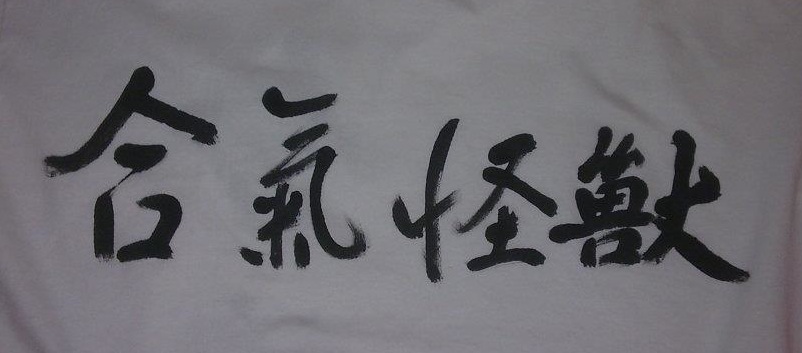


 Thoughts from the Keiko