It’s not necessarily a word you want to hear in the context of cancer. I’m already the exception: to the rule that breast cancer is an older person’s disease, to the typical course of a thirty-something’s life, to the idea that a generally healthy lifestyle will always protect you from illness.
But in this case, exceptional was an unqualified good.
I’ve written before about my bone density — in fact, my most recent post (from, ahem, two years ago) was about how I’d improved my bone density. But. This year’s DEXA scan confirmed it: My bone density is normal. No more osteopenia. No more red on the scan image. Six infusions of Zometa, four years of tamoxifen (though obviously that’s not its main purpose), nearly four years of regular running, and a couple years of semi-consistent weightlifting were enough to counter the bone density loss from chemo and Lupron.
We talked about something else today, too: my new schedule. I’ll now be seeing my oncologist yearly, and her nurse practitioner in between. That’s also what I’ll be doing with my surgeon. Because that’s what happens when you’re lucky enough to make it nearly five years past diagnosis and four-plus years since switching from active treatment to maintenance: You’re deemed lower risk, and you don’t need to be surveilled as closely.
I’ll still get mammograms and MRIs every year, of course. I’ve got an MRI coming up next month, on September 11 of all dates.
Last year’s MRI was a doozy. It showed an “enhancement” in my sternum, a spot where breast cancer is known to return and spread. The nurse practitioner’s face was grim when she told me, and I was terrified. Recurrence felt imminent. I spent a good three or so weeks sitting in the unknown, wondering if a Stage IV diagnosis was coming. I had a chest CT and a full-body bone scan and the news was better than I’d dared hope: not cancer, just osteoarthritis. Degenerative joint disease in my sternum. I’ll take it, I said to the universe. My only symptom is an occasional twinge in that spot, but it doesn’t hurt. It’s not cancer. It’s not cancer.
With any luck, this year’s MRI will be the most boring scan ever. No new hot spots, no enhancements, nothing lighting up where it shouldn’t. Unexceptional.
Well, well, well. Turns out an old dog can learn new tricks! And by “old dog” I mean “my bones,” and by “learn new tricks” I mean “regain lost density.”
Which is my unnecessarily complex way of saying that the combination of tamoxifen + Zometa has brought my bone density back from the brink of osteopenia, baby! I’m dense AF!
Me ol’ spine. This is a crappy screenshot from the results of my first DEXA exam. My spine was in the normal range back then; only my hips were problematic.
In case you, dear reader, have forgotten the finer points of my treatment regime and the complex medical rationales behind said regime, a recap:
My cancer was hormone receptor-positive (basically, it fed on estrogen and progesterone). Therefore, I need to shut down the flow of said hormones in my body so any remaining cancer cells have nothing to eat. For two years and a few months I’ve been taking tamoxifen to do just that; my daily pills prevent any breast cancer cells from binding to estrogen. I also get injections every three months to keep my ovaries dormant so that they don’t produce estrogen. This combination means I am in medically-induced menopause. (There is another class of medication that serves a similar purpose: Many BC patients take an aromatase inhibitor rather than tamoxifen because AIs might be associated with slightly better disease-free survival rates.)
Every six months, I get an infusion of Zometa (zoledronic acid), which has been shown to reduce the risk of bone metastases for early-stage breast cancer. Current research suggests that four infusions offer the best protection, and I’ve had three so far. I’ll get my final one in December.
The cool thing about both tamoxifen and Zometa is that they help build bone density… which is something I needed! Two years ago, I had my first DEXA bone density scan to get a baseline measurement. Chemo can negatively affect bone density, as can aromatase inhibitors, so my doctor didn’t want to prescribe me an aromatase inhibitor if I already had low bone density. Lo and behond, my first DEXA scan showed a few spots in my hips that were riiight on the edge of osteopenia (the precursor to osteoporosis). So that’s why my doctor went with tamoxifen — a bone strengthener — rather than an aromatase inhibitor — a bone weakener.
So! Here we are, two years down the line, and a second DEXA scan shows that tamoxifen and Zometa have done [part of] their jobs and strengthened my bones. My hips are back in the green, on the healthy side of dense. Hooray.
…now, here’s where I admit that I actually got my DEXA scan back in July. I wrote this post immediately after getting my results, and then failed to share it. Why? I don’t know. I sometimes feel funny about posting here because to the outside world, my cancer is a thing of the past. Yet for me, it’s ever-present.
I don’t mean that in a dramatic, woe-is-me sort of way. It’s just… true. Here is a short list of Things that Remind Me I Had Cancer:
The pills I take every day
The injections I get every three months
The bloodwork I get every three months to ensure I’m actually in menopause
The infusions I get every six months
My scars
My growing pile of pants that don’t fit anymore, because I’ve gained weight from tamoxifen (Note! This is a neutral statement of fact. I am very comfortable with my weight gain.)
My six-month scans (mammograms and MRIs)
The photos from That Time, which occasionally pop up and jar me
The fact that I am almost halfway through a graduate program that will lead to a career change, all because of my cancer
Etc.
So, y’know. If I post here, and it seems weird, I hope you’ll forgive me. I’m not dwelling on the past; I’m moving through the present. And right now, my present includes celebrating a nice little win: dense bones. Yeahhh, baby!
I hit a very personal and unique milestone in October: I prepared and cooked broccoli.
To understand why this mundane-seeming moment was actually meaningful, you have to picture me, sometime in March 2021, on the evening of a chemo infusion. Steven had cooked dinner, as he did just about every night during those days. He’d made some kind of seitan dish, served with homemade rye bread and steamed broccoli. Y’know, #justveganthings.
Zucchini and broccoli pre-roasting.
The side effects hadn’t hit yet, of course, but apparently there was plenty of action going on inside me ol’ body. Because a few days later, I realized I’d developed an extreme aversion to just about all the elements of that unfortunate dinner, but especially the smell of baking bread (!!!) and the sight and taste of broccoli.
I assume that whatever aspect of chemo causes nausea was at work in my body, but the IV meds they give you to pre-empt nausea prevented me from feeling it. But the body really does keep the freakin’ score, because it knew. Somewhere deep inside my brain a neuron fired and connected the sensation of nausea to the food I ate that night.
That damn aversion lasted SO FREAKING LONG. More than a year. And broccoli—once a key part of my diet—no longer found its way into our fridge.
Roasted and ready to be devoured.
So that’s why I was so excited when I purchased and cooked broccoli last October. (Though not excited enough to write about it till now, apparently.) Roasting has always been my favorite way to prepare broccoli, and I was thrilled that my body did not reject it. No clench of the stomach or gurgle of nausea. Just appreciation for the lil trees.
Of course, there have been more meaningful milestones since then: my second cancerversary in November. Two years from my surgery. Two years from my first day of chemo.
So, uh, I don’t wanna brag or anything, but… when I saw my surgical oncologist earlier this month, she described my appointment as “boring.” *hair flip emoji*
In Cancerland, “boring” is exactly what you want to be. Forget drama, forget surprises — we want nothing but the most predictable, basic, run-of-the-mill situations imaginable. I’ll never forget when I met with my surgeon for the first time post-diagnosis. She was great — patient, caring, clear — but she didn’t pull any punches. She told me what she anticipated my treatment plan would entail, but then added that my plan might change because “breast cancer in young patients often behaves strangely.”
I appreciated the caveat and the candor. I hungered for accuracy, for straight talk, for just the facts, ma’am. But of course, it was a little nerve-wracking to hear.
Modeling the paper gown at my MRI.
So when my surgeon told me last month that my bilateral MRI results were “pristine,” and that everything felt “normal” during my clinical breast exam, and that our appointment had been “boring,” I took her words at face value. Then she told me that, from here on out, I’ll be alternating between seeing her (when I get MRIs) and seeing her nurse practitioner (when I get mammograms). I felt a twinge of disappointment at that news. I really like my surgeon, and I enjoy catching up with her. She remembers details about my life and we always have pleasant conversations during my appointments.
So yeah—knowing that I’ve “graduated” from needing to see her, specifically, every six months makes me feel a bit sad. But also? It makes me feel pretty damn good. Bring on the boring.
Don’t worry; no bad news here. Last month I started a new maintenance treatment: Zometa, or zoledronic acid. I learned about it from a couple of my online cancer buddies who’ve also taken it after a similar diagnosis. Zometa is often prescribed to stage IV folks with bone mets (metastases) to slow or reduce damage to the bone, but it’s also been shown to help prevent bone mets from forming in the first place for early stagers like me. I brought it up with my oncologist a few months ago, and she said she’d also been considering offering it to me. She was happy to prescribe it if I wanted it. Did I ever!
My philosophy on preventative/maintenance treatments at this point is bring. it. on. I’m young, with plenty of years left (*crosses fingers; knocks on wood*). I want to give myself the best shot I can at a disease-free future. Zometa has few significant side effects and only needs to be given once every six months for two years. That’s an easy yes from me!
Yes, I was sitting right next to the trash can. Make of that what you will.
So that’s how I found myself back in the chemo chair for a 20-minute infusion in early July.
Well, not quite. There was an intermediate step: getting clearance from my dentist. Because I kinda-sorta exaggerated. Although Zometa doesn’t have too many common side effects, it has one rare but rather grim possible outcome: osteonecrosis of the jaw. Also known as your jawbone rotting away and dying from the inside out, potentially revealing bone fragments to the world at large. So that’s… cool. Anyway, my dentist OK’d the treatment because I don’t have any dental issues and/or need for dental surgery in the near future (*crosses fingers; knocks on wood*).
…and that’s how I found myself back in the chemo chair.
Well, not really “back,” because I received treatment at a different location from the one where I got chemo last year. (That location is closed due to pandemic-related staffing concerns. Yikes.) A very friendly nurse got my IV placed, and when he flushed it, I got that oh-so-familar tang in my mouth. He described it as licking a tin can, and he wasn’t wrong. It’s metallic, acrid, and extremely recognizable. The body is strange: I received chemo through a port, yet I always tasted the pre-infusion saline flush in my mouth. I get the same sensation and taste when a peripheral IV is flushed, and it brings me right back to those chemo feels.
Anyway, the infusion itself was not particularly eventful. The most exciting part was when the elderly woman next to me nodded off and made some very audible groans in her sleep. (She was a hoot, though—she heard my nurse explaining the Zometa infusion to me and asked, “Oh, are you a chemo virgin too?!” It was with a strange mix of pride and disbelief that I explained, no, I actually had chemo last year but I’m receiving a different infusion now. Like… what? What is my life? How did I get here?!)
After the infusion, I got my quarterly Lupron Butt Dart™ and was on my way. That night, the Zometa side effects set in: shivers, chills, headache, pounding heart, body aches. I’ve heard that most folks only get them after the first infusion, so we’ll see. They were fleeting and mostly dissipated by the following evening.
And thus ended my Zometa experience. Of course, the fun never ends, because I had my first post-active-treatment breast MRI last Friday, and I’ll meet with my surgeon on August 8 to go over the results. I’m feeling pretty Zen about it, though. My surgeon has warned me that MRIs are sensitive and might result in false positives, so I know it’s likely that I’ll have to get something biopsied in the years to come. It’s a price I’m willing to pay, because I’d rather know what’s going on than trust the less-accurate diagnostic abilities of a mammogram. Que sera, sera.
There’s a scary thing that happens, when you’re diagnosed with cancer.
Before cancer, you think you’re a rational person, someone who understands that life is short and that tragedy—a distracted driver; a clump of misbehaving cells—could strike at any moment. You don’t take life for granted. You pursue the activities that bring you joy; you try to live in alignment with your values. But you still play a game with yourself, one that protects you from life’s hardest truths. The game goes something like this:
You read a story about someone—someone like you, maybe—who was unlucky enough to get hit by one of life’s great tragedies. The incurable disease, the drunk driver, the stray bullet. The logical, rational part of you recognizes that the person could be you. “There but for the grace of god,” and all that. A shiver passes through you; you’re chilled by the possibilities. And then that other, not-so-logical part of you takes over. “Well,” she says, “That couldn’t happen to me. That person is different from me, because of <insert strange, illogical, and overwrought rationalization here.> Me, though, I’m safe. I’m good. That won’t happen to me.”
I played the game. You probably do, too. On the one hand, I accepted, in the abstract, that any number of horrible things could happen to me. When I was younger I used to fear these things—the cancer, the kidnapping, the murder-by-stranger—so much that I couldn’t sleep at night, waves of dread washing over me as I imagined a future of suffering. And yet this other side of me, the protective one, played the denial game. When confronted with specifics, I came up with excuses about why some bad thing couldn’t really happen to me.
And then I got cancer. For real.
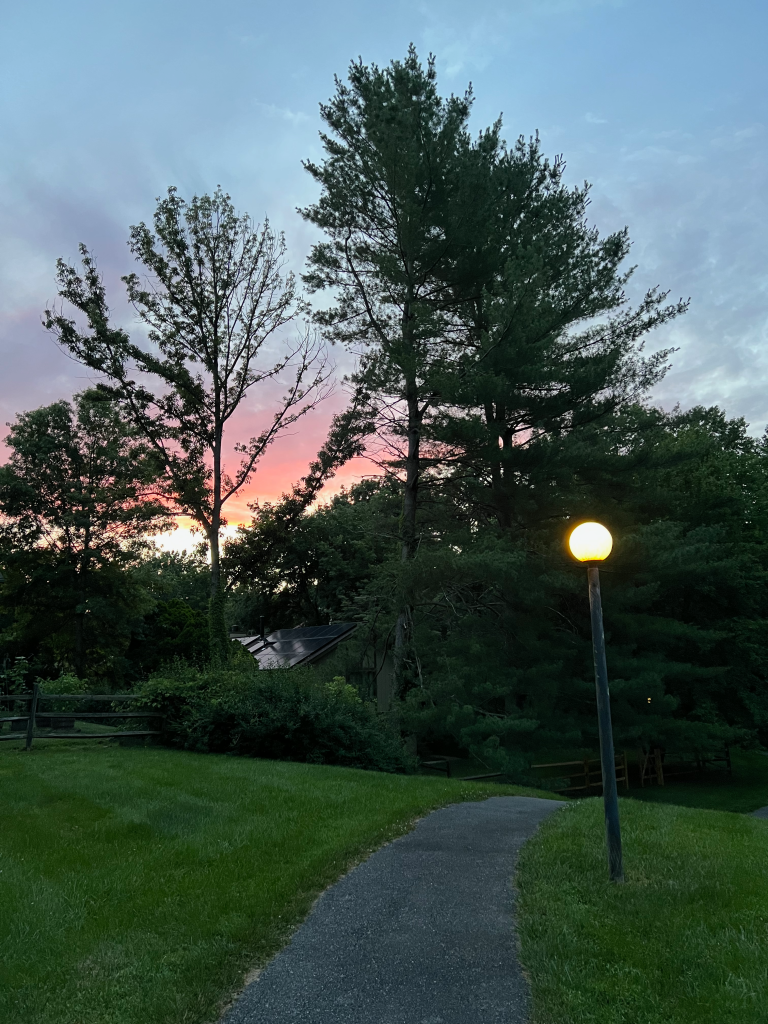
Gratuitous sunset shot to balance out the heavy content!
The first time I met with my surgeon, she gave me some advice: “Stick to reputable, medically-focused, fact-based websites if you want to look up something about cancer. Do not go on cancer blogs. Do not read random cancer stories. Do not go on Facebook cancer groups.” That way lie the horror stories, the tales of misdiagnosis and under-diagnosis and the “I thought I was cancer-free but turns out it was everywhere.” That way lies danger, and dread, and so much fear.
Reader, I tried to follow her advice. I did. But I also craved other people’s stories. I was a 33-year-old with invasive cancer! None of my friends could relate. I have two first cousins who also had breast cancer relatively young, but even they were in their 40s and had kids, teenagers and twenty-somethings, when they were diagnosed. I was 33, with no kids, and needing to confront all sorts of hard new truths about my body and my fertility. I connected with a few other people around my age, friends of friends, but I needed more.
So I went online. I followed Instagram accounts and joined relevant subreddits. I read stories from other cancer patients, ones kinda like me, with experiences kinda like mine. And sometimes they helped; they gave me insights or perspectives I couldn’t find elsewhere. But mostly… they scared me.
Other people’s stories would put fears in my head that hadn’t been there before. “My metastases felt like a muscle ache,” one person wrote. Cue me—experiencing bizarre achy pains after finishing chemo—spiraling. “I was told my early-stage cancer was gone but then a year later we found out it had spread,” someone else wrote. Cue me—an early stager—suddenly wondering if my surgeon should’ve removed more lymph nodes rather than the one sentinel node, because what if the cancer was in THOSE nodes, the ones she left inside?! What if it skipped my nodes entirely and is making itself at home in my bones and lungs and liver RIGHT NOW?!
I’d be reading a fiction book (blessed escapism!) and suddenly a character’s sister would die on the table during breast cancer surgery. At the library I’d thumb through a nonfiction book about cancer (just testing the waters) and my eye would zero in on a terrifying statistic (“<insert scarily large percentage here> of women with early-stage breast cancer already have microscopic cancer cells in their bone marrow at diagnosis”). I’d click through Instagram tags and suddenly be reading about a thirty-something who thought she was all good after cancer only to discover, three years later, that it was in her bones. “I was healthier than ever; I was playing tennis and running and working for a nonprofit,” she wrote. Cue me—a thirty-something who took up tennis last summer and enjoys running and also works for a nonprofit—feeling that shiver, that chill, that rise of sheer terror and dread.
The stories! They could be about me! After cancer, the denial game didn’t work anymore. I couldn’t (ir)rationalize away the possibility of tragedy. The tragedy was coming from inside the house. It had been here all along. I was the tragedy.
Here’s the other thing about stories: We create them all the time, in big ways and small, even when we’re not fully aware that we’re doing it.
Receive an email from your boss, asking you to hop on a Zoom call in an hour, without any context? I bet you’ll tell yourself a story. She’s going to fire me; someone complained about me; I did something wrong! (Maybe you’re more optimistic: I’m getting a promotion!) You’ll probably spend that hour spinning stories, teasing out possibilities, maybe even carrying out full-on hypothetical conversations with your boss. You’ll imagine the look on your face when you hear the news; you’ll think, “How will I tell others that this happened to me?”
*insert metaphor about paths/light/darkness here*
When you get cancer, this story-telling compulsion kicks into overdrive. It is so, so hard to hear you have cancer and not know the details: the staging, the treatment plan, even who your doctors will be. Your brain spins breathtakingly detailed stories about what’s going to happen to you; you spiral down imaginary paths. Usually those stories aren’t good ones; those paths are dark and cobwebbed and lined with grim-faced specters breathing down the back of your neck. Even later—after you know what’s going on with your cancer, after you’re done with active treatment, after your doctors say you’re good—your brain still tells you stories. Because one story—one really scary story—already came true. So you keep on telling yourself more stories, where the cancer returns (or never really left, to be precise), or you get another cancer, or or or or or.
And those stories? They take a toll. They will eat you up from the inside, curdle your brain, reduce your psyche to a weeping mess. That story you told yourself about your boss, the one where you just knew she was going to fire you—didn’t it make your heart race when you imagined it? Didn’t you feel real physical sensations, even though the story was entirely in your head? I bet it brought your mood down. I bet it made your day a little darker. Even though, in all probability, your boss just wanted to chat about a new work-from-home policy your company is rolling out. Something totally (dare I say it?) benign.
But you told yourself another story, and you let its attendant emotions overrun you.
When she told me to avoid other people’s stories, my surgeon was reminding me of something at once breathtakingly simple yet immensely powerful: that my story is my own. It’s something I’ve been trying to internalize recently, as I sit with the immense weight of what I’ve gone through over the past year and a half. Nobody has a cancer story quite like mine, because nobody’s cancer is identical. Nobody’s! And I mean that literally, not figuratively: Our tumors are unique, with their own genetic makeup and markers. Our bodies respond to treatment in different ways; our healing happens on different paths. Even statistics—chance of local recurrence, chance of distant recurrence, five-year survival rate—tell just one story, a story that is the aggregate of individual stories. I’m not a statistic, and a statistic can’t tell my story. I’m not the thirty-something tennis player who runs and works at a nonprofit and is now stage IV; our stories might have some similar elements, but they are not identical.
My chemo-bald head was filled with anxiety and stories!!!
I can’t know what happens next in my story.
What I can do is this:
I can choose not to tell myself stories about things that haven’t happened yet, about what if and maybe this and when inevitably that. I can ground myself in the moment, in what’s happening right now.
I can choose not to believe that someone else’s story is any reflection on my own (regardless of how alike we are, as protagonists).
I can make my story the best version it can be. I can fill it with friends, and food, and family, and animals, and travel, and things that make me happy and make the world a better place. I can—deliberately, with care and love and attentiveness—write my own damn story.
11:03 p.m. on a Monday night in late March. I’m lying on the couch, delaying going to bed by playing game after game of Octordle. It’s a chilly evening—there’s a low of 20˚F predicted—but I’m not cold, not even a little bit. In fact, I’m boiling. My face and torso are covered in a shimmering sheen of sweat as I fan myself ineffectually. I don’t really need to do that, though. The heat will pass soon. As I go about my nightly routine—take pills, wash face, brush teeth—I’ll probably feel chilly, even. I’ll get in bed, cocooned in the covers, and hope I fall asleep before the next hot flash hits.
They feel a bit like vertical waves, my hot flashes. They start in my face and cascade down my body; I always know one’s about to hit when I feel that telltale heat blossom across my forehead. For a few minutes, I’m roasting. My face is flushed and I swear I can feel my own heat radiating off my body. Surely there’s a way to harness this heat, I think. It’s just going to waste here!
Actual photo of me experiencing a hot flash.
The hot flashes could be worse. I’ve heard of folks waking up in pools of sweat, or experiencing brief yet intense mood swings. And, yeah, I know they’re a part of life for about half the population, so it’s not like they’re a unique malady. But still. Still. I’m 35 freaking years old. I shouldn’t be experiencing them at all.
Look, don’t get me wrong. The hot flashes aren’t majorly disruptive to my life or anything. But they are a daily reminder that, hey, I’m not your average 35-year-old. Every time I wake up sweating in the night, every time I kick off my socks for some relief, every time I yank off my sweatshirt and throw off my cozy blanket and look at my red, sweaty face in the mirror, I’m reminded that I’m getting ovarian suppression injections and taking tamoxifen because I HAD CANCER. ME. ME!
So many people, when first learning of my diagnosis, had some variation of the following to say: “I’m so glad you caught it early. I hope your treatment is minimal and then you can move on with your life and forget about this bump in the road.” And even in those early days, even when naive Old Me had no idea what was in store, even then I knew that this was not a bump in the road or a minor pothole I’d forget about later. I knew it was a chasm opening up in front of me, a surprise sinkhole, a freak fissure. But I understood why people said it. It was intended as a comfort, not to minimize my experience. It was meant to give me hope as I navigated treatment, to remind me that normalcy might still exist for me. I get it.
And yet. If someone were to say a variation on that line to New Me, I would have real difficulty not emitting some kind of rude snicker/choke/splutter/anguished cry. Because there is just no way that I can “move on” when the physical, mental, and emotional fallout of this disease is with me every single day. I’m not going to move on and pretend this never happened. I’m just not! I’m moving laterally, and forward, and around the chasm, but not without carrying the weight of cancer with me and not without being reminded that, hey, the chasm still exists. And that’s OK. It doesn’t mean I’m in constant emotional distress or anything; it just means that I am choosing to acknowledge the uncertainty of life and the fact that this really horrible thing happened to me. Ignoring pain doesn’t make it go away. It doesn’t.
Plus, there’s this: Although I think it’s gross to talk about silver linings when it comes to life-threatening disease, I’d be lying if I said I haven’t extracted some good out of my experience (more on that in a future post). I can’t learn from my experiences if I choose to forget them. And that’s part of the reason why I will not be moving on or forgetting about “this time in my life.”
And even if I wanted to forget… the hot flashes would remind me.
In November 2020, during the strange, liminal time between my diagnosis and my first appointment with my surgeon, when I didn’t know many details about my cancer or how it would be treated, Steven and I got a half-cord of firewood delivered from a local nursery. They came and dropped it off in our driveway, dumping it unceremoniously from the bed of a truck one evening. The firewood, of course, could not stay in the driveway. It needed to be moved, stacked into a rack under shelter of the carport, the excess packed into our shed.
It was a tough job, but somebody had to do it. I decided that somebody would be me. Single-handedly, I would haul every last log up the driveway and find it a home.
Maybe a third of the pile?
A cord of firewood, according to Ye Olde Internet, weighs between 2,000 and 3,000 pounds. So a half-cord—which comprises about 350 individual pieces of wood—can range anywhere from 1,000 to 1,500 pounds.
It wasn’t far from the pile to the rack, maybe three or four yards. But still, it takes a while to carry 350 pieces of rough, splintery wood, to find the perfect spot for each piece, to maximize space and keep the stack tight and well-managed. The wood arrived in late afternoon, and as the pale November sun set, I made progress on the pile. Back and forth, pile to stack to pile to stack to pile. Over and over and over again. I stripped off layers of clothing as I went, my body warming to the task despite the cool evening. I declined offers of help; after beginning on my own, I wanted to finish on my own.
It was fully dark by the time I was done. I was sweaty, and my arms ached, and bits of wood clung to my clothes, but I felt good.
You don’t need a degree in psychology to figure out why I attacked the wood pile with such fervor, such determination. Just 10 days earlier, I’d gotten the news nobody ever wants to get: I had cancer.
One week I was a healthy, hale, hearty 33-year-old, with a regular weightlifting habit and a newfound feeling of power and strength in my body. The next week, I was a cancer patient.
Cuddling a friend’s dog during the post-diagnosis, pre-staging Twilight Zone time.
The two were not—are not—mutually exclusive, of course. You can be healthy and strong and still have cancer. Nothing had really changed in the moments after I got my diagnosis—the cancer had already been there while I was settling into my fitness groove—but of course now I knew about it, knew that it was inside me, growing.
And that was pretty much all I knew. Ask any cancer person about what point in their diagnosis and treatment was the worst, what point caused the most existential terror, and they’ll probably say it was the time between diagnosis and coming up with a treatment plan. All the worst-case cancer situations seem possible in those days, and unless you are truly capable of embodying those elusive living-in-the-moment Zen vibes and/or have no imagination, you run through those situations in your head on a daily—if not hourly—basis. One way I kept myself at least moderately grounded was by moving my body, by doing yoga and doing yardwork—and hauling firewood—to remind myself that I was still here, still present, still alive. (The other way? PILLLLLS, BABY!)
I tried to keep my body active all throughout treatment. Although my weightlifting fell by the wayside, I did yoga every single damn day throughout my entire course of active treatment. Sure, during the worst of chemo, that yoga was barely more than gentle stretching, but hey—I was moving. I went for frequent walks, too, sometimes with my pups and sometimes without. Some days I felt so weak I could barely make it up the slightest of inclines without Steven placing a hand at my back, gently guiding me upward. But I kept going and I kept moving.
Fast-forward to now. March 2022. I’m sixteen months out from diagnosis and six months out from starting a new habit that I really hope will stick: I’ve become a runner.
I know, I know.
Before I laced up the ol’ (and I do mean ol’) sneakers for my first run in September, I had Very Strong Opinions on running: namely, that it sucked. It was torture by another name. It was for masochists who secretly hated themselves. It was emphatically not for me.
I’d dabbled with running years ago, back in 2014. I did a couch-to-5K program with moderate success, culminating in running a 5K with Steven and my mom. I remember feeling so proud after finishing that race, because I’ve never been sporty or athletic and the fact that I had stuck with a training program and run a damn race was fairly momentous. But truthfully? I didn’t really enjoy it. The race was fine, but training for it? Meh. I experienced no runner’s high. I never lost myself in the repetition, the rise and fall of my feet, over and over again. It was just… tolerable.
OK, that’s being charitable: It was tolerable at best; torturous at worst. Still, I registered for a 10K and started training, determined to keep going. But a really nasty upper respiratory infection sidelined me for weeks, and I didn’t end up running the 10K. I never got back into the habit. My running days were over, and I’d tell anyone who mentioned running in my presence that I considered it a thing of my past. I’d tried it, but it wasn’t for me. In fact, I considered it torture. Running is for masochists and fitness freaks. End of story.
And then I got cancer. And then I started tamoxifen and Lupron. And then I went into menopause. And then my blood pressure—responding to the sudden drop in estrogen—went bonkers. We’re talking readings of 155/100 at my oncologist’s office when I’d go in for my Lupron injection. Readings that made the oncology nurses do double-takes. Readings that had me on the phone with my angel of a primary care practitioner, having her talk me down from my fear that I was one stressful moment away from a stroke. Readings that sent me into a panic spiral, and then sent me to my cardiologist. Readings that, while they were often normal and healthy, were sometimes very much not normal and not healthy, spiking to scary highs when I was anxious (or sometimes when I was not anxious). And that’s how I ended up, at the age of 34, on a beta blocker to regulate my blood pressure. Sigh.
In an effort to combat said high blood pressure and help prevent cancer recurrence, I knew what I needed to do: incorporate more cardio in my life. My dad has been running for years now and my mom runs occasionally. One of my best friends was training for her second marathon. Runners were all around me! The bar to entry was so low—you just put on some sneakers and go!—that I felt compelled to at least give it a shot. So one day in late September, Steven and I headed outside and ran.
I did a mile and a half that first day, shocking myself. Even more shocking? I enjoyed it.
I haven’t really stopped since.
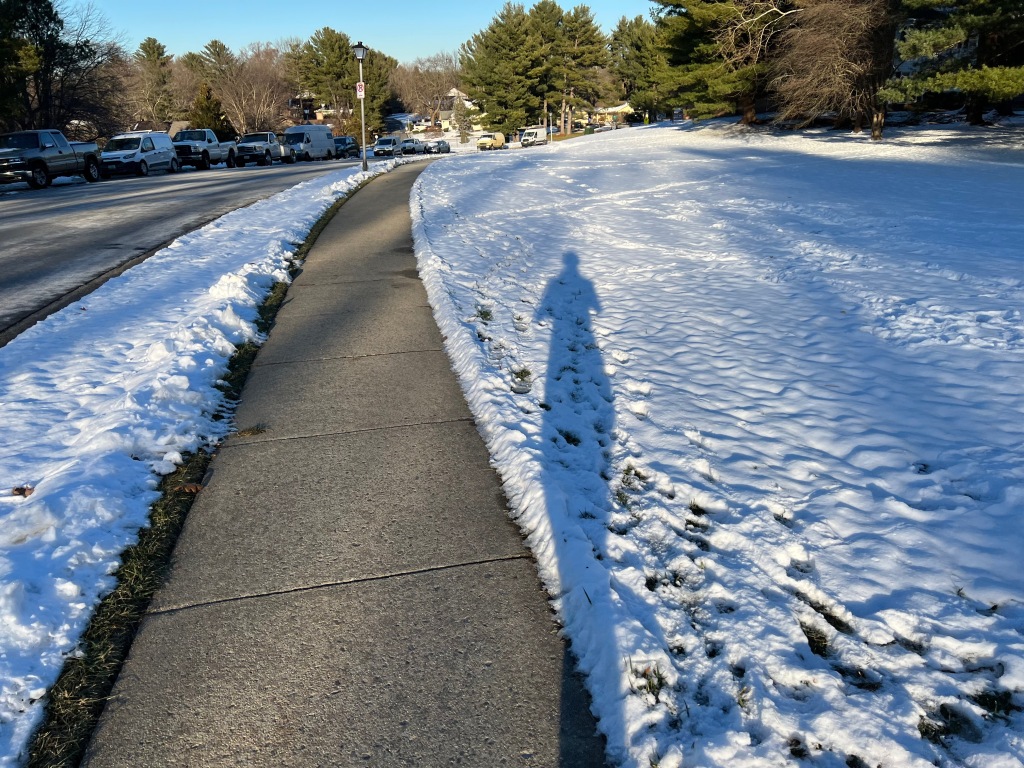
A snowy run.
The thing about running is that it really, truly is mostly a matter of mental strength. I know, I know. I used to roll my eyes when I heard or read anything along those lines; I thought it was trite and probably not true. After all, I thought, if your lungs aren’t strong and your heart isn’t strong and your legs aren’t strong, what the fuck does it matter if your mind is strong?! And, sure, you do need a certain amount of stamina and physical strength to run (although I’d argue that even short distances, even slow paces, even walking breaks are totally fine, and you can still consider yourself a runner if you avail yourself of those tactics, as I sometimes do!). But the mental fortitude? Yeah, it’s really freakin’ important.
I know it’s true because it’s the only way to explain my current love affair with running. Eight years ago, I was undoubtedly in better physical health; I was in my mid-20s and, um, I hadn’t just gone through treatment for cancer. Yet running was torturous back then. When I first started running this time, I was just four months out from finishing active treatment, dealing with all sorts of physical maladies from surgery, chemo, radiation, and the onset of good ol’ medical menopause. My body was a mess! Yet running was legitimately enjoyable even during that first mile and a half, and I’m pretty damn sure it’s because my trusty little brain—the same one that took a real psychological beating during cancer—is stronger than ever.
In the past, physical discomfort sidelined and derailed me. If I felt out of breath or physically uncomfortable during a run, Old Me might’ve stopped. But New Me knows that I am so much more capable than I give myself credit for. I had cancer, for fuck’s sake! I can run three, four, five, six miles, no problem. So these days, when I start feeling unpleasant during a run, I ask myself a few questions:
Are you *actually* in pain, or are you feeling some discomfort from pushing your body beyond what it normally does?
Are you *actually* in pain, or are you just feeling disheartened by the ridiculous hill you’ve just started up?
Are you *actually* in pain, or are you reaching for a mileage goal you’re afraid you might not be able to attain, so you’re thinking it’d be easier to quit rather than to try and fail?
And the thing is… I’m rarely in pain! I’m rarely sitting in real physical discomfort. So when I check in with myself, when I ask myself what’s really going on, more often than not I realize I’m perfectly physically capable of whatever is making me want to quit. And that knowledge is really freaking powerful. I know that I just need to focus on what I’m doing in that moment. No worrying about what comes next, or what my pace is, or about how high that damn hill is. One step at a time, one foot in front of the other, and soon I’ve reached the top of the hill and it’s all smoooooth and easy from there on out.
(And when I am in pain or I am truly feeling bad? I cut my run short or take a walking break. No shame, no recriminations. Because I’ve already learned to be easy with myself, to give myself grace, and that lesson is sticking with me.)
So that’s how I know that, yep, it’s true: Running is about mental fortitude. And after going through treatment for cancer, I have really built up that strength. Not all the time, not every day, but enough so that when little things start to bother me, I remind myself that they are just little things—no need to waste my energy on them. I can let them go, let my feet carry me forward, and let my mind rest.
These days, running is not torturous. It is glorious. Every single step I take reminds me that I am still fucking here. I am moving forward. I am strong.
“Hold my hand,” my surgeon says. “Take a few deep breaths of the oxygen.”
I am splayed out in an operating room. It is obscenely bright; two large circular lights shine above me as healthcare professionals move with haste and purpose around the room, and around me. One nurse straps automated compression machines onto my legs; another fiddles with my pulse ox monitor; the anesthesiologist examines my IV placement. I’m lying down, though, and I can’t see them. I can only hear their bustle, feel their energy.
“I’m going to start putting in the first drug,” the anesthesiologist tells me from somewhere behind my head. The IV is in my left hand, bumped up against my wrist bone. It took a “special IV girl” and a child-sized needle to place it, and the anesthesiologist says it’s a little slow but it’ll do—better than placing a new one.
I can’t see much from my vantage point. I’ve got an oxygen mask on my face and I’m staring upward, into the lights. My glasses are somewhere else, safely stowed in my bag of clothes. My arms and hands are splayed out, one by the anesthesiologist and the other gripping my surgeon’s hand. I can’t see her but I feel her, both the physical heaviness of her warm hand on mine and the indefinable presence of her body near mine. I admire the way she exudes both confidence and kindness in equal measure. I admire the way the hand that is currently giving me comfort will soon expertly wield a scalpel, will slice through flesh and tissue and muscle to remove both my tumor and the lymph node voted Most Likely to Succeed in Growing Cancer Cells.
“This drug’s going to feel a little spicy going in,” she tells me. “Take deep breaths.”
I do. I breathe so deeply, sucking in the oxygen that my anxiety-ridden body has craved for months. As the oxygen euphoria hits I wonder why I haven’t been breathing deeply since the mask went on a minute ago. Come on, I think, you had this amazing delicious sweet perfect air delivery system on your face but you didn’t take advantage of it?!
I breathe and I hold my surgeon’s hand and I wait for the burn in my veins but it never comes. I’m already asleep.
Last month, on November 11, Steven and I took the day off from our respective jobs and drove three hours each way to pick up a cake.
Something about the camera angle makes my hand look ginormous!
I’d ordered my custom cake weeks in advance. I wasn’t celebrating a birthday, or a wedding anniversary, or anything conventional like that. No, I was in rural Pennsylvania—Bethlehem, in fact—to pick up a cancer cake.
The online cancer community—and particularly the AYA (adolescent/young adult) cancer community—collectively believes in celebrating every cancer milestone you damn well feel like. Why? Well, survivorship is hard, cancer is an asshole, and cake is always a good idea. Especially cakes with darkly humorous messages on them.
Hence my cancer cake, which helped me commemorate (“celebrate” is too strong a word) the one-year anniversary of my diagnosis. One year since everything in my life went topsy-turvy. One year since I crashed right into some hard truths about myself, and illness, and life in general. One year since the old me got left behind, waving forlornly from a path that wasn’t mine to walk.
I think of her sometimes, the old me, the one who got a call saying, “Good news—your biopsy was negative for cancer!” For her, November 11 is just a fun palindromic date, not the day everything changed. For her, cancer is still something that happens to other people. She’ll never experience the absolute terror that comes with a cancer diagnosis. She doesn’t know what it’s like to sit, exposed, in an exam room while a surgeon stares at your chest. She’s never wondered what her pre-op nurses’ smiles look like behind the masks they wear because of the pandemic. She doesn’t know the taste of a saline flush, that acrid tang that mysteriously appears in the mouth as a nurse cleans out a port. She doesn’t feel a twinge in her ribs and immediately suspect cancer is silently taking over her entire body. She’s an innocent, in so many ways.
But she’s also so ignorant of so much. She doesn’t know the freedom that comes when you decide to live life on your own terms, when you say “fuck it!” to the expectations, big and small, that people and society set for you. She doesn’t know that life is infinitely more enjoyable when you stop sweating the small stuff. She doesn’t—can’t—truly appreciate every little beautiful horrible painful happy moment of her life and the people in it. And she doesn’t know the joy of ordering yourself a fancy vegan cake from your favorite fancy vegan bakery and cutting into it with some dear friends to celebrate the fact that one year on, you are still here.
Mood lighting, because why not.
So here’s to me, the new me and the old me, and to cake. Especially cakes that look dark on the outside but have funfetti on the inside. I’m not sure how I’ll top this cake for my two-year cancerversary in 2022, but I’m sure gonna try.








 St. Agatha's Curse