


| CARVIEW |
Forming my inquiry around supporting teachers during curriculum changes contains many of the Teacher EducationCore Competencies. For example, I have demonstrated an understanding of the complexity of teaching and learning (Personal and Professional Preparation). This has been shown through dialogue about the struggle of finding time in a busy schedule as a teacher to even be able to educate oneself further. Additionally, I recommended giving teachers designated time to form Communities of Practice (Community Engagement) which encourages collegial collaboration and independent learning. Similarly, I demonstrated an understanding of how learners learn in order to cultivate effective learning environments (Exploring and Enhancing Pedagogy). This was completed through researching the BCTF website and referring to statistics from a 2017 Self-Assessment Survey posted online.
Connect your inquiry to courses, observations, assignments, discussions and reflections
I connected most of my inquiry to research and observations made from the 2017 BCTF Self-Assessment survey. Although, the reason for choosing my topics was formed through discussions with teachers during the Wednesday school visits and self-reflections in the afternoon seminars.
Describe how Wednesday field experiences guided the inquiry process
Wednesday field experiences provided the opportunity to speak with active teachers which are the demographic surrounding my inquiry. I was able to gain a better understanding of some of the challenges that are faced by teachers with the curriculum changes and hear their opinions on the changes, the resources made available to them, and their self-assessed competence levels.
Articulate how your thinking related to your inquiry developed over the term and describe how that has happened
Initially, at the beginning of the semester, I wasn’t even familiar with the term Inquiry Project. My inquiry started first as a thought about how a teacher in the field would be able to adapt to curriculum reform without formal training such as the PDP program. This led to insightful conversations with educators to hear their thoughts on the matter and how they feel about their own pedagogy. I was under some time constraints for selecting a project and this had been the most in depth topic that I had discovered during my observations so I decided to pursue it further.
Discuss overall learning relating to inquiry AND how this will be relevant to your future teaching or sharing with colleagues
I have learned how to engage in meaningful conversations with future colleagues and participated in professional development spaces. For example, during J blocks I have sat in on two department head meetings which has given me a better understanding of the dynamic between staff members. I better understand how administrators and faculty connect with one another and the challenges that can occur relaying information between the two. I believe that I understand how to collaborate with colleagues in a professional setting and know the appropriate protocol or bringing up concerns to admin.
Consider what you will explore more related to your inquiry
I concede that I need to do more research into what exactly goes on during a Pro-D day to better assess how the time could be managed better or if Communities of Practice is something that could be implemented. I’m uncertain as to how much autonomy the educators have or if the time is mandated by the District or Ministry of Education.
Author: Aaron Larnder
References:
Photo by Andrew Neel on Unsplash
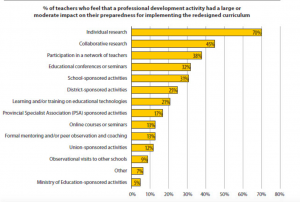
Correlating this data, it seems that the Ministry needs to re-evaluate their materials and provide much more useful resources. Despite this assessment, it seems that teachers are still finding ways to become competent without the direction of the government systems in place.
If I were making decisions at the Ministry level, it would be to invest resources and Pro-D day time specifically towards allowing teachers the opportunity to network and share resources and knowledge.
In my research, I came across a term called Communities of Practice (CoP). Which in essence, are groups of people who share a common passion for something they collectively do and meet up regularly to learn how to improve from one another. A CoP is usually formed between colleagues to collaborate and share different perspectives through dialogue. Often this takes the form of conversations but quickly can lead to action planning and real changes. What makes a CoP effective is the mutual respect between colleagues, a growth mindset and shared purpose.
I believe that this type of approach could be very useful as a resource sharing platform but also an opportunity for staff members to connect in a meaningful, professional environment. This model agrees with the self-assessment survey conducted by the BCTF in 2017 which showed that teachers felt independent research and collaboration with colleagues was the most effective way to form self-efficacy.
In saying this, I still believe that the Ministry of Education needs to vamp up their current resources and do a better job supporting educators. Some of the biggest critiques from teachers was the lack of responsiveness on behalf of the Ministry once feedback was provided. Many educators are feeling hopeless and discouraged to continue to be a part of the change process because they aren’t receiving enough acknowledgement for their suggestions. If the Government believes that the new curriculum changes are important, then more resources need to be invested into training educators to be competent.
I haven’t concluded how this would actually work but potentially a week-long paid Ministry workshop that shows teachers how to use the new curriculum and immerses the teachers in this pedagogy would be my simplest recommendation.
For those of you unfamiliar with of the new curricular changes, I have embedded a video directly from the Ministry of Education that gives an overview of their recommended model below.
Author: Aaron Larnder
References:
Martha McAlister, B. S. W. The Creative Nature of Communities of Practice. https://www.kpu.ca/sites/default/files/Transformative%20Dialogues/TD.9.2.9_McAlister_Creative_Nature_of_CoPs.pdf
Photo taken from: https://catlintucker.com/2018/10/communities-of-practice/
Video from: https://www.youtube.com/watch?v=RTx_3zjjtvA&feature=emb_title
]]>My subject area is in Biology so I have gathered resources catered to my future profession goals
Examples of Curricular Overlaps
Life Sciences 11 – Binomial Nomenclature, First People’s knowledge on classification
- Introduce a lesson on Linnaeus’ Binomial Nomenclature and how that is the accepted mode of organizational hierarchy in Western Science
- Compared to Indigenous naming systems grouping of plants based on their uses; medicinal, ceremonial, edible, poisonous, etc. Also, the name of a plant may change with the season depending on if it is flowering or not.
Environmental Science 11 – human actions and their impact on ecosystem integrity
- Caribou and bison migratory disruptions due to humans
- Indigenous importance of these animals culturally
Energy flow through ecosystems
- Salmon life cycles and how salmon carcasses are important for nutrient dynamics
- Importance of Salmon to Indigenous People’s
Now as far as assessing these lessons, from my readings, it has been recommended to use formative assessment and have students engage in hands-on activities. Most of the outlined goals are for students to form connections between the First People’s way of life and their own understanding of nature.
Lesson Plans templates have been recommended to follow a 7E model:
Engage, Explore, Explain, Elaborate, Evaluate, and the addition of Environment and Elders
Some potential lesson planning questions and direction for each heading:
Explore: What 1 or 2 Inquiry Questions will you focus on
Explain: Introduce the learning goals for the lesson
Elaborate: Ask questions guiding the new learning
Evaluate: Ask questions that provide opportunities to show that they understand the key concepts studied
Engage: What do you already know, and what would you like to know about the topic
Environment: How does this topic relate to the place we are living and studying
Elders: How did your experience learning from an Elder differ from traditional learning
Indigenous Resources:
FNESC – Secondary Science First Peoples Teacher Resource Guide
PUBLICATION-SCIENCE-FIRST-PEOPLES-Secondary-TRG-2019
BC Government/FNESC/Ministry of Education – Facilitators Workshop Guide
continuing_our_learning_journey_facilitators_guide
Author: Aaron Larnder
References:
- BC’s New Curriculum. ( 2019) Retrieval date: October 16th, 2019. Government of BC website: https://curriculum.gov.bc.ca/curriculum/indigenous-education-resources
- Photo by Stéfano Girardelli on Unsplash
A few things to consider
- 2,344 respondents out of 36,672 teachers
- 37% of respondents have between 11-20 years of experience, 29% have 21-30 years
- 43% of participants taught grades 10-12 in the last year with the breakdown of most participants in the following subject areas taught:
English Language Arts (32%) Social Studies (30%)
Science (24%) Mathematics (22%)
Self Assessments of Valued Importance
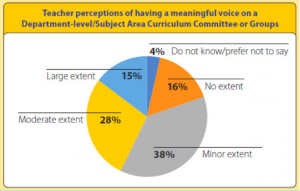
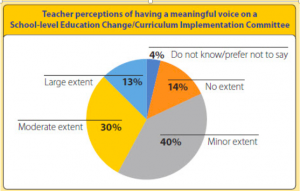
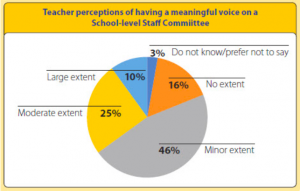
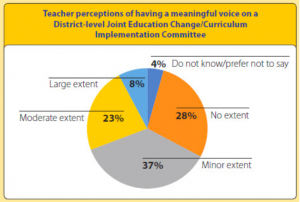
From the data, we can see that teachers feel that they have little to no voice in their own school departments and the percentages get worse as we extend to staff committees and beyond to the district level.
Here were some comments by teachers in the anonymous survey:
“ It has doubled my work load—was on every committee available to be a strong voice for teachers but it made no difference since the powers at large did their own thing anyways. I was heard, but no action was taken to reduce teacher work load. Next year I am not volunteering on any educational change committee since I am not wasting my time any more.”
“I am not sure that the spirit of collaboration has been mutual.”
“It has felt-top down. Teachers are told what will happen by admin, and when we raise questions, they don’t know much and have to go back to the district or ministry for clarification. We need to slow down the process.”
This graph shows that teachers feel that the most worthwhile professional development opportunities to implement the redesigned curriculum occur when they produce their own materials or collaborate with colleagues. Astoundingly, the workshops put on by the Ministry of Education were voted the least useful in the self assessments.
Here were some comments made by teachers about sending feedback to the Ministry:
“Our department wrote an eloquent letter to the Ministry when they requested feedback. We spent weeks writing our thoughts and concerns and we were never given any feedback or response of what happened with our feedback.”
“I would like to know that the feedback we have been giving the Ministry is actually being considered.”
.. and comments about the Ministry led Professional Development Workshops:
“We have these tiny meetings [related to assessment and curriculum implementation] for a few hours during Pro-D days that are months apart and generally raise more questions for me rather than giving me insight and understanding or practical knowledge on how to do this.”
“Endless meetings…jargon-filled discussion…nobody to clearly identify a goal and a process and a possible assessment strategy.”
“The single day pro-d sessions are not useful to improve my learning or implementation of new curriculum.”
Author: Aaron Larnder
References:
British Columbia Teacher’s Federation Curriculum Change and Implementation Survey. (2017) Retrieval date: October 15th, 2019. BCTF website: https://www.bctf.ca/CurriculumSurvey/
Photo by Element5 Digital on Unsplash
]]>I first tried Scratch earlier in the semester and was able to create this small project (below) for a potential Technology Inquiry Project. I spent roughly 3 hours navigating the website and watching tutorial videos until I became competent enough to put something of use together. The application is designed for younger students and it limited in its functions which I found frustrating. The scope of use is not advanced enough for much professional purposes but I enjoyed the challenge of extending my knowledge and practicing a new skill.
The second application was Grasshopper where I worked on completing the tutorial. I found this application less exciting than Scratch or Hour of Code because the products of the tutorial weren’t as creative and I had no choice in what I was creating given the time constraints. I built some flags and changed variables within the coding. It felt more like coding because I was able to type in text rather than drag pre-set code into the workspace. I think in my beginner capacity this was detrimental to my experience because it was more complicated than I needed and didn’t catch my interest. I quickly moved to another website

Finally, I tried my luck at Hour of Code. This gave me a lot of flexibility for what I wanted to learn. I took a 10 step tutorial on making a flappy bird game and was able to make alterations to the backgrounds, characters, point schemes, speeds, and gravity. This was a lot of fun and upon completion granted me a certificate of completion that I could print off

I think there are several positive outcomes to having a face to face learning experience. It keeps accountability on the students to have a teacher in the room and stops students from hiding and avoiding being engaged. In high school, I had a video conference Calculus class without a teacher in the classroom and many students would cheat on tests because they could be outside the camera view.
Should an instructor’s preference override accessibility? or student preference of modality?
I believe that the students should have autonomy over their form of learning and it is the teacher’s job adapt. If the teacher is only willing or able to provide the material in a single mode then they are not properly suited to be an educator. A large portion of the job is being able to adapt as time passes and stay current with new modes of learning.
Does/should modality bias exist?
Modality bias definitely exists as certain educators feel more confident providing information through their preferred mode. Similarly, students are going to have preferences for receiving information and completing work that is assessed. I believe a balanced approach to learning is best so that sometimes students can perform work in their preferred way but also are challenged to expand their knowledge in new forms.
Should we allow flexibility in modality accessibility (e.g. multi-access)? What are the implications?
I think there are times where this may be appropriate but should not always be given as an option. Videoconferencing is a very useful task that will transfer to the workforce as corporations are increasingly globalizing and it is not feasible to meet in person. It is important for students to receive information from new modes so they are practiced at adapting and the workforce won’t be as shocking of a transition.
Photo by Drew Beamer on Unsplash
]]>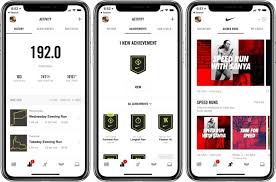
Although many of my friends use Strava, I still have some friends on the Nike Run App to compete against in runs and daily or monthly challenges. I don’t have the stamina that I once did but smaller goals of completing one 5km run per week is achievable and great for my overall health. Additionally, it increases my steps for the day! This past month I have averaged over 8,000 steps a day which was my initial goal and amounts to ~5-6 km per day in walking. I went swimming this morning with friends at 730AM (too early for me) but forced myself out of bed and now I am pleased with my earlier efforts. Waking up early increases my productivity in the early morning and gives me motivation through the afternoon. In the evenings, I am satisfied with my body of work and can relax knowing that I accomplished something that day.
Featured Photo by Andrea Leopardi on Unsplash
]]>
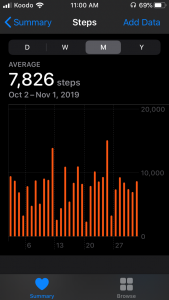
Here are some picture from my phone that shows my weekly steps and my monthly step count from October to November.
This has been something that I can find success in completing and allows me to free my mind or multitask by listening to music, podcasts or secondary languages. My partner and I have been more regularly walking together and it is helpful for keeping consistent.
On Fridays, with three other friends, I have been swimming for 45 minutes at Mckinnon gym at UVic campus. This is actually considerably more tiring than I remember from my younger years of taking swimming lessons. Treading water, playing basketball in the deep and and swimming lengths create a full body workout that make me famished upon completion. Something that doesn’t happen after lifting weights and only occurs after a long run when glucose stores have been depleted. I have enjoyed changing up the routine and trying activities that I didn’t use to give priority.
Cover Photo by Goh Rhy Yan on Unsplash
]]>Here is a popular Minecraft Channel on Youtube – Click
As well as a Beginners Tutorial Guide
]]>
Today’s topics:
Mindfulness, Inclusivity for students with designations, and Who was your favourite teacher and why.
I chose the inclusivity group because I felt it was a topic that I wasn’t informed about and I wanted to hear the opinions of my peers on the topic. As a future educator, I will have students with designations in my classroom. Hearing about best practices and ways to incorporate an education assistant effectively gives me more confidence moving forward.
I enjoyed the EdCamp style and would be interested in joining an EdCamp Seminar in the future if hosted within the districts of Vancouver Island. For more information about EdCamp visit the link here
]]>