











This book for me ranks as one of the most important books I have ever read. It takes a scientific approach to the analysis of violence in humans (and other primates) over the millennia. Pinker dives deep into facts regarding violence in pre-state and "civilized" societies and matches those norms and trends against our current understanding of psychology and shifting moral codes. The book is exhaustively referenced and he supports each argument with well researched data. Steven Pinker is one of those rare and brilliant thinkers who is able to discern motivators and trends in extremely complex data sets and relate those findings in a way that the rest of us can comprehend. The book should be required reading of every politician, teacher and religious leader if not every high school student because I believe its importance to society can't be overestimated. Because of its import, it is also a commitment. I found myself re-reading many passages in the book several times to fully comprehend its meanings; but its payoff in revelations is absolutely worth it.
A truly stunning achievement!
A more in depth review........
This is a brilliant and epic analysis of the history of violence in human societies and presents a compelling argument for why violence in all its ugly iterations has declined, though not smoothly, over the past 5,000 years and particularly in the past 60.
It's an exhaustively researched book with lots of credible data to back up its claims. It's one of those few books that challenge one's fundamental assumptions about what is fact and what is fiction about our selves, our nature and our history. It challenges long held beliefs about human behavior in family, groups, tribe, community, society, culture and nation. It demonstrates how specific identifiable forces, both innate and exogenous, have been at the root of violence over the ages. But it also shows how the "better angels of our nature" have worked to modulate those forces through a complex development of an increasingly higher social and emotional intelligence. Even with the recent epidemic of mass shootings in the U.S., the proliferation of weaponry and civil wars, Pinker makes a convincing argument that we've never lived in more peaceful times.
Pinker follows a fascinating trajectory of our social and moral evolution and demonstrates how far we've really come, especially over the past few centuries. Even with the horrors of the wars of the 20th century, the slope of violence and aggression in world societies has been on an accelerating decline. With a long and sordid history of war, genocide, murder, torture, infanticide, human sacrifice, witch burnings, corporal and capital punishment, slavery, child abuse, abduction, serial killing, violent crime, racism, discrimination and animal abuse, human civilization is indeed living in a different era.
He credits the increasing pacification of human civilization to a process of intellectual and social evolution that has driven us toward a more self aware, reason based, peacefully cooperative, morally fair existence. He shows that through the science of ideas, certain stabilizing forces and philosophies such as democracy, centralized government, open mass media, education, science, technology, feminism, trade and commerce have elevated the rights of the individual and expanded our circles of empathy making violence less sensical. He supplements this analysis with a look at the neuroscience behind human behavior via game theory and current psychological research demonstrating the physio and psychological mechanisms behind power, aggression, hatred, dominance, honor, revenge, social position, group think, cooperation and competition.
He shows how evolutionary biology explains the logic of violence and its genetic motivators but also how we're wired for empathy and cooperation. He walks us through a long, detailed history of social custom, symbolism, male dominance ritual and conflict and through a scientist's lens exposes the culprits in our biological and social dynamic that have been at the roots of aggression over time. He also examines how concepts such as glory, honor, valor, national pride, holy land, mother land, eternal good, utopia, pure evil and religious ideology have wrought more misery on human lives than any other forces. Although he acknowledges the role some religions had in promoting civilizing forces such as marriage, moral compass, self-restraint and love-of-fellow-man, he believes the negative side effects of male dominant religious ideology and jealous-god worship outweigh its benefits in a rational society.
Through man's difficult and often horrific journey over 5 milennia Pinker illuminates key modifiers, pressures and motivators that seem to have played both positive and negative roles in our harrowing trip to modern times. Pinker states that "...aggression is the output of several psychological systems that differ in their environmental triggers, their internal logic, their neurobiological basis and their social distribution."
He shows how our nature as highly social animals plays a critical role in what we choose to value. Citing various psychological research he demonstrates how differently individuals behave while in a group, often acting in complete opposition to what they personally believe in order to fit in, be accepted or move the apparent goals of the group forward. He shows the mechanisms behind mob rule, group think, loyalty to family, tribe and god and shows how these innate human characteristics can be manipulated to accept shockingly inhumane behavior on the part of individuals, tribes, nations and ideologies.
Pinker cites some of the more significant breakthroughs in our moral development such as during Europe's Enlightenment period in the 17th and 18th centuries which brought forth philosophers, writers and artists who challenged traditional thought and through reason and and rational analysis introduced new ideas regarding the rights of the individual. He also cites mid 20th century acts such as the Declaration of Human Rights which led to a cascade of Rights Revolutions including civil rights, women's rights, children's rights, homosexual rights and animal rights which continue to unfold to this day.
Pinker believes that those who claim that the 21st century western world, especially the US, has degraded into a pool of permissive, licentious immorality have their heads where the sun don't shine. He calls out the Republican right in the US and their warped sense of traditional values and romantic notions of a more civilized past and shows how their value score card is an archaic vestige of a different and LESS moral society. He shows the correlation between intelligence (especially abstract thinking), access to information, cosmopolitanism and moral behavior. He shows how and why "red state America" holds onto these antiquated mindsets and why the coasts and cities of the US are considered "blue", vote Democrat, and are more progressive.
Pinker doesn't predict the future and states that it can all come unraveling in an instant due to the unpredictability of egomaniacs and the volatility of religious extremists in unstable regions of the world, but he remains optimistic. He believes there is enough positive momentum due to six decades of expanding empathy and cooperation due to technology, mass communications, education and global trade to put the odds in our favor. He also believes there's evidence that IQs are increasing worldwide, particularly abstract reasoning intelligence. He references several studies that show IQ score increases from 1901 to the present in dozens of countries. He credits cognitive environmental effects (literacy) and secondarily possible genetic selection effects.
Pinker asks point blank if it's fair to say that our ancestors were morally retarded and he answers emphatically Yes! "Though they were surely decent people with perfectly functioning brains, the collective moral sophistication of the culture in which they lived was as primitive by modern standards as their mineral spas and patent medicines are by the medical standards of today. Many of their beliefs would be considered not just monstrous, but in a very real sense, stupid. They would not stand up to intellectual scrutiny as being consistent with other values they claimed to hold and they persisted only because the narrower intellectual spotlight of the day was not routinely shone on them."
Pinker's thesis for why violence has declined along with his forward optimism is derived from his perspective on evolutionary biology and its sub discipline neuropsychology. He believes because of homo sapiens' unique sociability, intelligence and communication skills we've adapted beyond the need for pervasive violence; it makes less sense. But through his convincing indictment of the culprits within our makeup he warns that civilization needs to maintain elaborate regulators within our social systems to keep our lesser angels in check.
| CARVIEW |
Select Language
HTTP/1.1 301 Moved Permanently
Server: Server
Date: Sun, 18 Jan 2026 05:28:32 GMT
Content-Type: application/json
Content-Length: 2
Connection: keep-alive
x-amz-rid: 1YFEG2FCD3R0NEZZZKQB
x-amzn-RequestId: 555042d7-daec-4663-bfef-e6705e59d4c2
Location: https://www.amazon.com/dp/0143122010/ref=cm_sw_r_cp_ep_dp_dFiTybC98BVA5
Vary: Content-Type,Accept-Encoding,User-Agent
Strict-Transport-Security: max-age=47474747; includeSubDomains; preload
HTTP/2 200
content-type: text/html;charset=UTF-8
date: Sun, 18 Jan 2026 05:28:32 GMT
vary: Content-Type,Accept-Encoding,User-Agent
x-frame-options: SAMEORIGIN
server: Server
x-amz-rid: Y128S6DMRVMNR0S6CYZB
set-cookie: session-id=141-1955751-2143131; Domain=.amazon.com; Expires=Mon, 18-Jan-2027 05:28:32 GMT; Path=/; Secure
set-cookie: session-id-time=2082787201l; Domain=.amazon.com; Expires=Mon, 18-Jan-2027 05:28:32 GMT; Path=/; Secure
set-cookie: i18n-prefs=INR; Domain=.amazon.com; Expires=Mon, 18-Jan-2027 05:28:32 GMT; Path=/
set-cookie: lc-main=en_US; Domain=.amazon.com; Expires=Mon, 18-Jan-2027 05:28:32 GMT; Path=/
set-cookie: sp-cdn="L5Z9:IN"; Version=1; Domain=.amazon.com; Max-Age=31536000; Expires=Mon, 18-Jan-2027 05:28:32 GMT; Path=/; Secure; HttpOnly
cache-control: no-cache, no-transform
accept-ch: ect,rtt,downlink,device-memory,sec-ch-device-memory,viewport-width,sec-ch-viewport-width,dpr,sec-ch-dpr,sec-ch-ua-full-version-list
x-content-type-options: nosniff
p3p: policyref="https://www.amazon.com/w3c/p3p.xml",CP="CAO DSP LAW CUR ADM IVAo IVDo CONo OTPo OUR DELi PUBi OTRi BUS PHY ONL UNI PUR FIN COM NAV INT DEM CNT STA HEA PRE LOC GOV OTC "
content-security-policy-report-only: default-src 'self' blob: https: data: mediastream: 'unsafe-eval' 'unsafe-inline';report-uri https://metrics.media-amazon.com/
content-security-policy: upgrade-insecure-requests;report-uri https://metrics.media-amazon.com/
x-xss-protection: 1;
accept-ch-lifetime: 86400
content-encoding: gzip
strict-transport-security: max-age=47474747; includeSubDomains; preload
x-cache: Miss from cloudfront
via: 1.1 10bad5640499b6b4e82e61d8de4bb8d2.cloudfront.net (CloudFront)
x-amz-cf-pop: BOM78-P4
alt-svc: h3=":443"; ma=86400
x-amz-cf-id: QQjaiebIsRiO0uAavxSYxGszvVZ9KfpfXsceIsu53AUhL45L02DNqg==
The Better Angels of Our Nature: Why Violence Has Declined: Pinker, Steven: 8601300108858: Amazon.com: Books


 Categories
New & Trending
Deals & Rewards
Best Sellers & More
Memberships
Communities
More
More

 Audible sample
 Books with Buzz
Discover the latest buzz-worthy books, from mysteries and romance to humor and nonfiction. Explore more

 Ships from and sold by Amazon.com.Ships from and sold by Amazon.com.Ships from and sold by Amazon.com. Details

Customers find the book engaging and compelling, noting it reads like a novel, and one customer mentions it's a must-read for those interested in history.Customers praise the book's meticulous research, noting its impressive collection of statistics and descriptions, and how it breaks down the facts in a scientific manner.Customers find the book enlightening and life-changing, providing excellent insights into humanity and being extremely profound, with one customer noting it offers an uplifting perspective on mankind's progression.Customers appreciate the book's exploration of violence reduction, particularly its historical perspective and comprehensive coverage of related issues.Customers find the book thought-provoking, praising its continual ideas and erudite approach.Customers appreciate the writing style of the book, finding it easy to understand and well-written, with one customer noting it is a great book.Customers find the book uplifting and reassuring, noting that humanity has become exponentially more peaceful.Customers find the book's length negative, describing it as long and tedious to read.


 Categories
Recently Visited
Top Categories
All Categories
Top Categories
Fiction
Nonfiction
Recently Visited
Recently Visited
Recently Visited
Recently Visited
Memberships
Recently Visited
Recently Visited
Your Books
Download the free Kindle app and start reading Kindle books instantly on your smartphone, tablet, or computer - no Kindle device required.
Read instantly on your browser with Kindle for Web.
Using your mobile phone camera - scan the code below and download the Kindle app.

Audible sample Follow the author
Get new release updates & improved recommendations
Something went wrong. Please try your request again later.
OK
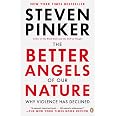
The Better Angels of Our Nature: Why Violence Has Declined Paperback – Illustrated, September 25, 2012
by
Steven Pinker
(Author)
Sorry, there was a problem loading this page. Try again.
{"desktop_buybox_group_1":[{"displayPrice":"INR 915.40","priceAmount":915.40,"currencySymbol":"INR","integerValue":"915","decimalSeparator":".","fractionalValue":"40","symbolPosition":"left","hasSpace":true,"showFractionalPartIfEmpty":true,"offerListingId":"zAYP6rAu7iR0Huvjo2GYGgv29W0tk9SBS%2BmCI%2BkqsiEFJXmKJvoo4nGlcX3uESTJY0Kz%2FQDcV9o4MaxUlhXci%2BJCoCI1pD9Lpgkokdu%2BH%2BrZ3ii%2Flriw3ScXgCEZaDpd9kKpQkxKXnwNh9qRaqwT8A%3D%3D","locale":"en-US","buyingOptionType":"NEW","aapiBuyingOptionIndex":0}]}
Purchase options and add-ons
“If I could give each of you a graduation present, it would be this—the most inspiring book I've ever read." —Bill Gates
A provocative history of violence—from the New York Times bestselling author of The Stuff of Thought, The Blank Slate, and Enlightenment Now.
A provocative history of violence—from the New York Times bestselling author of The Stuff of Thought, The Blank Slate, and Enlightenment Now.
Believe it or not, today we may be living in the most peaceful moment in our species' existence. In his gripping and controversial new work, New York Times bestselling author Steven Pinker shows that despite the ceaseless news about war, crime, and terrorism, violence has actually been in decline over long stretches of history. Exploding myths about humankind's inherent violence and the curse of modernity, this ambitious book continues Pinker's exploration of the essence of human nature, mixing psychology and history to provide a remarkable picture of an increasingly enlightened world.
- Print length832 pages
- LanguageEnglish
- PublisherPenguin Books
- Publication dateSeptember 25, 2012
- Dimensions6 x 1.8 x 9 inches
- ISBN-100143122010
- ISBN-13978-0143122012
Discover the latest buzz-worthy books, from mysteries and romance to humor and nonfiction. Explore more
Great on Kindle
Great Experience. Great Value.
Putting our best book forward
Each Great on Kindle book offers a great reading experience, at a better value than print to keep your wallet happy.
Explore your book, then jump right back to where you left off with Page Flip.
View high quality images that let you zoom in to take a closer look.
Enjoy features only possible in digital – start reading right away, carry your library with you, adjust the font, create shareable notes and highlights, and more.
Discover additional details about the events, people, and places in your book, with Wikipedia integration.
Get the free Kindle app: 

Enjoy a great reading experience when you buy the Kindle edition of this book. Learn more about Great on Kindle, available in select categories.
Frequently bought together
This item: The Better Angels of Our Nature: Why Violence Has Declined
INR915.40INR915.40
In Stock
+
INR832.84INR832.84
In Stock
+
INR1,042.41INR1,042.41
In Stock
Total price: $00$00
To see our price, add these items to your cart.
Try again!
Added to Cart
Choose items to buy together.
What other items do customers buy after viewing this item?
Page 1 of 1 Start over
Customers also bought or read
Page 1 of 1Start over
- The Blank Slate: The Modern Denial of Human Nature
 PaperbackINR1,155.81INR1,155.81INR 1,056.92 delivery Mon, Feb 9
 - When Everyone Knows That Everyone Knows . . .: Common Knowledge and the Mysteries of Money, Power, and Everyday Life
 HardcoverINR1,360.84INR1,360.84INR 1,065.09 delivery Tue, Feb 10
 - How the World Really Works: The Science Behind How We Got Here and Where We're Going
 HardcoverINR1,541.38INR1,541.38INR 1,050.57 delivery Mon, Feb 9
 - Factfulness: Ten Reasons We're Wrong About the World--and Why Things Are Better Than You Think
 PaperbackINR726.69INR726.69INR 1,018.82 delivery Mon, Feb 9
 - Bleeding Out: The Devastating Consequences of Urban Violence--and a Bold New Plan for Peace in the Streets
 HardcoverINR1,361.75INR1,361.75INR 1,041.50 delivery Tue, Feb 10
 - Code of the Street: Decency, Violence, and the Moral Life of the Inner City
 PaperbackINR1,349.96INR1,349.96INR 987.97 delivery Tue, Feb 10
 - Nations and Nationalism in a Global Era
 PaperbackINR2,835.09INR2,835.09INR 991.60 delivery Tue, Feb 10
 - The Goodness Paradox: The Strange Relationship Between Virtue and Violence in Human Evolution
 PaperbackINR1,814.46INR1,814.46INR 949.87 delivery Mon, Feb 9
 - The Selfish Gene: 40th Anniversary Edition (Oxford Landmark Science)#1 Best SellerGenetics
 PaperbackINR1,158.53INR1,158.53INR 1,010.65 delivery Mon, Feb 9
 - The Origins of Political Order: From Prehuman Times to the French Revolution
 PaperbackINR1,156.72INR1,156.72INR 1,050.57 delivery Tue, Feb 10
 - The Darker Angels of Our Nature: Refuting the Pinker Theory of History & Violence
 PaperbackINR2,664.53INR2,664.53INR 1,083.23 delivery Tue, Feb 10
 - Language, Cognition, and Human Nature
 PaperbackINR1,778.17INR1,778.17INR 1,102.28 delivery Mon, Feb 9
 - Evil: Inside Human Violence and Cruelty
 PaperbackINR1,167.61INR1,167.61INR 1,037.87 delivery Tue, Feb 10
 - Why Liberalism Failed (Politics and Culture)
 PaperbackINR1,013.38INR1,013.38INR 941.70 delivery Mon, Feb 9
 - Moral Tribes: Emotion, Reason, and the Gap Between Us and Them
 PaperbackINR1,249.26INR1,249.26INR 981.62 delivery Mon, Feb 9
 - The Law of Peoples: With “The Idea of Public Reason Revisited”
 PaperbackINR2,812.41INR2,812.41INR 904.51 delivery Mon, Feb 9
 - The Last Utopia: Human Rights in History
 PaperbackINR2,358.80INR2,358.80INR 964.39 delivery Jan 27 - Feb 12
 - Sapiens [Tenth Anniversary Edition]: A Brief History of Humankind#1 Best SellerHistory of Civilization & Culture
![Book cover Sapiens [Tenth Anniversary Edition]: A Brief History of Humankind](https://m.media-amazon.com/images/I/41heRvvFOtL._UX300undefined_.jpg) HardcoverINR1,885.22INR1,885.22INR 1,317.30 delivery Mon, Feb 9
HardcoverINR1,885.22INR1,885.22INR 1,317.30 delivery Mon, Feb 9 - The Moral Animal: Why We Are, the Way We Are: The New Science of Evolutionary Psychology
 PaperbackINR1,051.48INR1,051.48INR 1,031.52 delivery Mon, Feb 9
 - The Righteous Mind: Why Good People Are Divided by Politics and Religion
 PaperbackINR1,158.53INR1,158.53INR 1,044.22 delivery Mon, Feb 9
 - The Rise of Organised Brutality: A Historical Sociology of Violence
 PaperbackINR3,175.30INR3,175.30INR 1,041.50 delivery Mon, Feb 9
 - Eichmann in Jerusalem: A Report on the Banality of Evil (Penguin Classics)
 PaperbackINR1,451.57INR1,451.57INR 922.65 delivery Mon, Feb 9
 - Behave: The Biology of Humans at Our Best and Worst#1 Best SellerScience Education Charts & Posters
 PaperbackINR1,025.17INR1,025.17INR 1,137.67 delivery Mon, Feb 9
 - The Genetic Book of the Dead: A Darwinian Reverie
 HardcoverINR1,587.65INR1,587.65INR 1,229.30 delivery Mon, Feb 9
 - The Great Delusion: Liberal Dreams and International Realities (Henry L. Stimson Letures)
 PaperbackINR1,034.24INR1,034.24INR 1,018.82 delivery Mon, Feb 9
Loading...
From the Publisher
The Better Angels of Our Nature: Why Violence Has Declined


Editorial Reviews
Review
“If I could give each of you a graduation present, it would be this—the most inspiring book I've ever read."
—Bill Gates (May, 2017)
A Mark Zuckerberg "Year of Books" Pick
"My favorite book of the last decade is [Steven] Pinker's Better Angels of Our Nature. It is a long but profound look at the reduction in violence and discrimination over time."—Bill Gates, founder of Microsoft
"For anyone interested in human nature, the material is engrossing, and when the going gets heavy, Pinker knows how to lighten it with ironic comments and a touch of humor. . . . A supremely important book. To have command of so much research, spread across so many different fields, is a masterly achievement."—The New York Times Book Review
"An extraordinary range of research . . . a masterly effort."—The Wall Street Journal
"Better Angels is a monumental achievement. His book should make it much harder for pessimists to cling to their gloomy vision of the future. Whether war is an ancient adaptation or a pernicious cultural infection, we are learning how to overcome it."—Slate
Praise for THE STUFF OF THOUGHT
Praise for THE BLANK SLATE
“An extremely good book—clear, well argued, fair, learned, tough, witty, humane, stimulating.”—Colin McGinn, The Washington Post
—Bill Gates (May, 2017)
A Mark Zuckerberg "Year of Books" Pick
"My favorite book of the last decade is [Steven] Pinker's Better Angels of Our Nature. It is a long but profound look at the reduction in violence and discrimination over time."—Bill Gates, founder of Microsoft
"For anyone interested in human nature, the material is engrossing, and when the going gets heavy, Pinker knows how to lighten it with ironic comments and a touch of humor. . . . A supremely important book. To have command of so much research, spread across so many different fields, is a masterly achievement."—The New York Times Book Review
"An extraordinary range of research . . . a masterly effort."—The Wall Street Journal
"Better Angels is a monumental achievement. His book should make it much harder for pessimists to cling to their gloomy vision of the future. Whether war is an ancient adaptation or a pernicious cultural infection, we are learning how to overcome it."—Slate
Praise for THE STUFF OF THOUGHT
“The majesty of Pinker’s theories is only one side of the story. The other side is the modesty of how he built them. It all makes sense, when you look at it the right way.”— The New York Times Book Review
“Packed with information, clear, witty, attractively written."—The New York Review of Books“Engaging and witty …Everyone with an interest in language and how it gets to be how it is—that is, everyone interested in how we get to be human and do our human business—should read THE STUFF OF THOUGHT.”— Science
Praise for THE BLANK SLATE
“An extremely good book—clear, well argued, fair, learned, tough, witty, humane, stimulating.”—Colin McGinn, The Washington Post
“Sweeping, erudite, sharply argued, and fun to read…also highly persuasive.”—Time
About the Author
Steven Pinker is the Harvard College Professor of Psychology at Harvard University. A two-time Pulitzer Prize finalist and the winner of many awards for his research, teaching, and books, he has been named one of Time's 100 Most Influential People in the World Today and Foreign Policy's 100 Global Thinkers.
Excerpt. © Reprinted by permission. All rights reserved.
PREFACE
This book is about what may be the most important thing that has ever happened in human history. Believe it or not—and I know that most people do not—violence has declined over long stretches of time, and today we may be living in the most peaceable era in our species’ existence. The decline, to be sure, has not been smooth; it has not brought violence down to zero; and it is not guaranteed to continue. But it is an unmistakable development, visible on scales from millennia to years, from the waging of wars to the spanking of children.
No aspect of life is untouched by the retreat from violence. Daily existence is very different if you always have to worry about being abducted, raped, or killed, and it’s hard to develop sophisticated arts, learning, or commerce if the institutions that support them are looted and burned as quickly as they are built.
The historical trajectory of violence affects not only how life is lived but how it is understood. What could be more fundamental to our sense of meaning and purpose than a conception of whether the strivings of the human race over long stretches of time have left us better or worse off? How, in particular, are we to make sense of modernity—of the erosion of family, tribe, tradition, and religion by the forces of individualism, cosmopolitanism, reason, and science? So much depends on how we understand the legacy of this transition: whether we see our world as a nightmare of crime, terrorism, genocide, and war, or as a period that, by the standards of history, is blessed by unprecedented levels of peaceful coexistence.
The question of whether the arithmetic sign of trends in violence is positive or negative also bears on our conception of human nature. Though theories of human nature rooted in biology are often associated with fatalism about violence, and the theory that the mind is a blank slate is associated with progress, in my view it is the other way around. How are we to understand the natural state of life when our species first emerged and the processes of history began? The belief that violence has increased suggests that the world we made has contaminated us, perhaps irretrievably. The belief that it has xxi decreased suggests that we started off nasty and that the artifices of civilization have moved us in a noble direction, one in which we can hope to continue.
This is a big book, but it has to be. First I have to convince you that violence really has gone down over the course of history, knowing that the very idea invites skepticism, incredulity, and sometimes anger. Our cognitive faculties predispose us to believe that we live in violent times, especially when they are stoked by media that follow the watchword “If it bleeds, it leads.” The human mind tends to estimate the probability of an event from the ease with which it can recall examples, and scenes of carnage are more likely to be beamed into our homes and burned into our memories than footage of people dying of old age.1 No matter how small the percentage of violent deaths may be, in absolute numbers there will always be enough of them to fill the evening news, so people’s impressions of violence will be disconnected from the actual proportions.
Also distorting our sense of danger is our moral psychology. No one has ever recruited activists to a cause by announcing that things are getting better, and bearers of good news are often advised to keep their mouths shut lest they lull people into complacency. Also, a large swath of our intellectual culture is loath to admit that there could be anything good about civilization, modernity, and Western society. But perhaps the main cause of the illusion of ever-present violence springs from one of the forces that drove violence down in the first place. The decline of violent behavior has been paralleled by a decline in attitudes that tolerate or glorify violence, and often the attitudes are in the lead. By the standards of the mass atrocities of human history, the lethal injection of a murderer in Texas, or an occasional hate crime in which a member of an ethnic minority is intimidated by hooligans, is pretty mild stuff. But from a contemporary vantage point, we see them as signs of how low our behavior can sink, not of how high our standards have risen.
In the teeth of these preconceptions, I will have to persuade you with numbers, which I will glean from datasets and depict in graphs. In each case I’ll explain where the numbers came from and do my best to interpret the ways they fall into place. The problem I have set out to understand is the reduction in violence at many scales—in the family, in the neighborhood, between tribes and other armed factions, and among major nations and states. If the history of violence at each level of granularity had an idiosyncratic trajectory, each would belong in a separate book. But to my repeated astonishment, the global trends in almost all of them, viewed from the vantage point of the present, point downward. That calls for documenting the various trends between a single pair of covers, and seeking commonalities in when, how, and why they have occurred.
Too many kinds of violence, I hope to convince you, have moved in the same direction for it all to be a coincidence, and that calls for an explanation. It is natural to recount the history of violence as a moral saga—a heroic struggle of justice against evil—but that is not my starting point. My approach is scientific in the broad sense of seeking explanations for why things happen. We may discover that a particular advance in peacefulness was brought about by moral entrepreneurs and their movements. But we may also discover that the explanation is more prosaic, like a change in technology, governance, commerce, or knowledge. Nor can we understand the decline of violence as an unstoppable force for progress that is carrying us toward an omega point of perfect peace. It is a collection of statistical trends in the behavior of groups of humans in various epochs, and as such it calls for an explanation in terms of psychology and history: how human minds deal with changing circumstances.
A large part of the book will explore the psychology of violence and nonviolence. The theory of mind that I will invoke is the synthesis of cognitive science, affective and cognitive neuroscience, social and evolutionary psychology, and other sciences of human nature that I explored in How the Mind Works, The Blank Slate, and The Stuff of Thought. According to this understanding, the mind is a complex system of cognitive and emotional faculties implemented in the brain which owe their basic design to the processes of evolution. Some of these faculties incline us toward various kinds of violence. Others—“the better angels of our nature,” in Abraham Lincoln’s words—incline us toward cooperation and peace. The way to explain the decline of violence is to identify the changes in our cultural and material milieu that have given our peaceable motives the upper hand.
Finally, I need to show how our history has engaged our psychology. Everything in human affairs is connected to everything else, and that is especially true of violence. Across time and space, the more peaceable societies also tend to be richer, healthier, better educated, better governed, more respectful of their women, and more likely to engage in trade. It’s not easy to tell which of these happy traits got the virtuous circle started and which went along for the ride, and it’s tempting to resign oneself to unsatisfying circularities, such as that violence declined because the culture got less violent. Social scientists distinguish “endogenous” variables—those that are inside the system, where they may be affected by the very phenomenon they are trying to explain—from the “exogenous” ones—those that are set in motion by forces from the outside. Exogenous forces can originate in the practical realm, such as changes in technology, demographics, and the mechanisms of commerce and governance. But they can also originate in the intellectual realm, as new ideas are conceived and disseminated and take on a life of their own. The most satisfying explanation of a historical change is one that identifies an exogenous trigger. To the best that the data allow it, I will try to identify exogenous forces that have engaged our mental faculties in different ways at different times and that thereby can be said to have caused the declines in violence.
The discussions that try to do justice to these questions add up to a big book—big enough that it won’t spoil the story if I preview its major conclusions. The Better Angels of Our Nature is a tale of six trends, five inner demons, four better angels, and five historical forces.
Six Trends (chapters 2 through 7). To give some coherence to the many developments that make up our species’ retreat from violence, I group them into six major trends.
The first, which took place on the scale of millennia, was the transition from the anarchy of the hunting, gathering, and horticultural societies in which our species spent most of its evolutionary history to the first agricultural civilizations with cities and governments, beginning around five thousand years ago. With that change came a reduction in the chronic raiding and feuding that characterized life in a state of nature and a more or less fivefold decrease in rates of violent death. I call this imposition of peace the Pacification Process.
The second transition spanned more than half a millennium and is best documented in Europe. Between the late Middle Ages and the 20th century, European countries saw a tenfold-to-fiftyfold decline in their rates of homicide. In his classic book The Civilizing Process, the sociologist Norbert Elias attributed this surprising decline to the consolidation of a patchwork of feudal territories into large kingdoms with centralized authority and an infrastructure of commerce. With a nod to Elias, I call this trend the Civilizing Process.
The third transition unfolded on the scale of centuries and took off around the time of the Age of Reason and the European Enlightenment in the 17th and 18th centuries (though it had antecedents in classical Greece and the Renaissance, and parallels elsewhere in the world). It saw the first organized movements to abolish socially sanctioned forms of violence like despotism, slavery, dueling, judicial torture, superstitious killing, sadistic punishment, and cruelty to animals, together with the first stirrings of systematic pacifism. Historians sometimes call this transition the Humanitarian Revolution.
The fourth major transition took place after the end of World War II. The two-thirds of a century since then have been witness to a historically unprecedented development: the great powers, and developed states in general, have stopped waging war on one another. Historians have called this blessed state of affairs the Long Peace.2
The fifth trend is also about armed combat but is more tenuous. Though it may be hard for news readers to believe, since the end of the Cold War in 1989, organized conflicts of all kinds—civil wars, genocides, repression by autocratic governments, and terrorist attacks—have declined throughout the world. In recognition of the tentative nature of this happy development, I will call it the New Peace.
Finally, the postwar era, symbolically inaugurated by the Universal Declaration of Human Rights in 1948, has seen a growing revulsion against aggression on smaller scales, including violence against ethnic minorities, women, children, homosexuals, and animals. These spin-offs from the concept of human rights—civil rights, women’s rights, children’s rights, gay rights, and animal rights—were asserted in a cascade of movements from the late 1950s to the present day which I will call the Rights Revolutions.
Five Inner Demons (chapter 8). Many people implicitly believe in the Hydraulic Theory of Violence: that humans harbor an inner drive toward aggression (a death instinct or thirst for blood), which builds up inside us and must periodically be discharged. Nothing could be further from a contemporary scientific understanding of the psychology of violence. Aggression is not a single motive, let alone a mounting urge. It is the output of several psychological systems that differ in their environmental triggers, their internal logic, their neurobiological basis, and their social distribution. Chapter 8 is devoted to explaining five of them. Predatory or instrumental violence is simply violence deployed as a practical means to an end. Dominance is the urge for authority, prestige, glory, and power, whether it takes the form of macho posturing among individuals or contests for supremacy among racial, ethnic, religious, or national groups. Revenge fuels the moralistic urge toward retribution, punishment, and justice. Sadism is pleasure taken in another’s suffering. And ideology is a shared belief system, usually involving a vision of utopia, that justifies unlimited violence in pursuit of unlimited good.
Four Better Angels (chapter 9). Humans are not innately good (just as they are not innately evil), but they come equipped with motives that can orient them away from violence and toward cooperation and altruism. Empathy (particularly in the sense of sympathetic concern) prompts us to feel the pain of others and to align their interests with our own. Self-control allows us to anticipate the consequences of acting on our impulses and to inhibit them accordingly. The moral sense sanctifies a set of norms and taboos that govern the interactions among people in a culture, sometimes in ways that decrease violence, though often (when the norms are tribal, authoritarian, or puritanical) in ways that increase it. And the faculty of reason allows us to extricate ourselves from our parochial vantage points, to reflect on the ways in which we live our lives, to deduce ways in which we could be better off, and to guide the application of the other better angels of our nature. In one section I will also examine the possibility that in recent history Homo sapiens has literally evolved to become less violent in the biologist’s technical sense of a change in our genome. But the focus of the book is on transformations that are strictly environmental: changes in historical circumstances that engage a fixed human nature in different ways.
Product details
- Publisher : Penguin Books
- Publication date : September 25, 2012
- Edition : Reprint
- Language : English
- Print length : 832 pages
- ISBN-10 : 0143122010
- ISBN-13 : 978-0143122012
- Item Weight : 1.75 pounds
- Dimensions : 6 x 1.8 x 9 inches
- Best Sellers Rank: #41,642 in Books (See Top 100 in Books)
- Customer Reviews:
About the author
Follow authors to get new release updates, plus improved recommendations.
Steven Pinker is one of the world's leading authorities on language and the mind. His popular and highly praised books include The Stuff of Thought, The Blank Slate, Words and Rules, How the Mind Works, and The Language Instinct. The recipient of several major awards for his teaching, books, and scientific research, Pinker is Harvard College Professor and Johnstone Family Professor of Psychology at Harvard University. He also writes frequently for The New York Times, Time, The New Republic, and other magazines.
Customer reviews
4.5 out of 5 stars
4.5 out of 5
3,817 global ratings
How customer reviews and ratings work
Customer Reviews, including Product Star Ratings help customers to learn more about the product and decide whether it is the right product for them.
To calculate the overall star rating and percentage breakdown by star, we don’t use a simple average. Instead, our system considers things like how recent a review is and if the reviewer bought the item on Amazon. It also analyzed reviews to verify trustworthiness.
Learn more how customers reviews work on AmazonCustomers say
Customers find the book readable and meticulously researched, with one noting it's a must-read for those interested in history. Moreover, the book receives praise for its excellent insights into humanity, thought-provoking content, and easy-to-understand writing style. Additionally, they appreciate its coverage of violence reduction, highlighting it as one of the least violent times in history, and its uplifting message that humanity has become more peaceful. However, several customers mention the book's length as a drawback.
AI Generated from the text of customer reviews Generated from the text of customer reviews
Generated from the text of customer reviewsSelect to learn more
246 customers mention readability, 195 positive, 51 negative246 customers mention "Readability"195 positive51 negative
"As usual, a great read. A bit different from his last two, but still full of facts and references. Makes one feel better about the world." Read more
"...analysis, but it reads like 3 PhD theses strung together.......very interesting but I labored to get through." Read more
"...the world we live in and are looking for a ray of hope, it is a good read and worth your time" Read more
"Exhaustively researched and very enlightening. This is not light reading but you will emerge from having read this book with a much more clear view..." Read more
234 customers mention research quality, 209 positive, 25 negative234 customers mention "Research quality"209 positive25 negative
"This well researched and presented study shows the decline of violence world wide since 1400 and acceleration since WWII...." Read more
"...the time and focus because it includes a massive amount of data, analysis and solid theory about why violence in our world is decreasing - yes,..." Read more
"...I found it very insightful. It changed my mind on many issues and deserves comparison with Jarred Diamond's work...." Read more
"Pinker provides a well documented but still accessible understanding of human nature and how it is changing over time...." Read more
120 customers mention enlightenedness, 117 positive, 3 negative120 customers mention "Enlightenedness"117 positive3 negative
"...He is able to weave history, politics, psychology, and ideas from the Enlightenment into a coherent story of how a multitude of factors built on..." Read more
"A truly masterful, convincing and spectacularly inter-disciplinary proof of The hypothesis that civilization and the enlightenment are responsible..." Read more
"...It is enlightening in two important ways to compare this Pinker book with the world-impact book titled "Silent Spring" by Rachel Carson...." Read more
"...book engrossing, reasonable, and -- so rare in this day and age -- encouraging." Read more
120 customers mention violence reduction, 105 positive, 15 negative120 customers mention "Violence reduction"105 positive15 negative
"...books I have ever read: shocking, informative, enlightening, and provocative. This book is not for the prudish or over- religious...." Read more
"Learning that violence has declined and understanding the factors that lead and contribute to this decline could be the most important things to..." Read more
"...present a convincing case that humans are becoming more humane and less violent, more repulsed by the cruelty that was common, say, in the Middle..." Read more
"Changed my thinking about violence. The world is a safer place now, but confusingly humans continue to do distasteful things to each other." Read more
82 customers mention thought provoking, 78 positive, 4 negative82 customers mention "Thought provoking"78 positive4 negative
"...pschylogy studies I've heard about over the years, this book is an insightful and thought provoking dive into the forces driving down violence over..." Read more
"...Extremely enlightening and thought provoking, even when I disagreed with the writer. Sometimes difficult to read and redundant, but worth the slog." Read more
"This is an incredible, thought provoking book and Pinker supports his premise with impressive evidence. Should be required reading for all." Read more
"...I enjoyed hearing how paleontology, sociology, political philosophy, and neurophysiology contributed to the explanation of why this amazing, and..." Read more
77 customers mention writing style, 72 positive, 5 negative77 customers mention "Writing style"72 positive5 negative
"Interesting, well written but while he convinces me with the basic premise that violence has declined over time I am not entirely convinced of the..." Read more
"This is an excellent book that is very well written and surprisingly engaging given that it is densely packed with information and material...." Read more
"...Good writing and academic psychology often aren't used in the same sentence, but it's clear why this and other of Dr. Pinker's books have been..." Read more
"This is a book I wish I could have liked. I admire Pinker’s easy writing style and erudition abundantly displayed in some of his earlier books..." Read more
53 customers mention uplifting message, 50 positive, 3 negative53 customers mention "Uplifting message"50 positive3 negative
"...While dark reading at times, ultimately it is uplifting and optimistic about the tremendous progress humanity has made and is still capable of...." Read more
"...his argument is compelling, and because his discussion of morality, empathy, self-control, and rationality, which concludes the book, sparkles with..." Read more
"The Better Angels of Our Nature..book..." Read more
"...his best book, Pinker makes a compelling case that we live in the most peaceful, violence-free period in history, and that there is a clear long-..." Read more
65 customers mention length, 15 positive, 50 negative65 customers mention "Length"15 positive50 negative
"This is a long book, and not always an easy read - Pinker draws on a huge amount of evidence in making a complex and controversial argument, so the..." Read more
"Loved this book and was sad when i finished it. Although it is a very long and thorough book, it is well worth the time and effort to read it to the..." Read more
"...The book is long and academic, which I enjoy, but his argument consists of two basic points -- exposing the past as depraved, and viewing the..." Read more
"...The book is long, detailed, and full of graphs, charts, and statistics, but that is because it has to be - for the Conventional Wisdom insists that..." Read more
Reviews with images
5 out of 5 stars
Inspiring story of my son. I could fell your ...
Inspiring story of my son. I could fell your pain in the reading. I just knew the son and man you presented to the world. You’ve gotten through your difficulties. More importantly was how you gotten through them with faith and faith in action. The apple doesn’t fall from the tree. Both your grandfathers said the Rosary daily. My dad said the Rosary everyday since come back from World War II. You inspired me to do writing by the writing exercises in “Spiritual Fitness Writing Exercises” in your book.
Thank you for your feedback
Sorry, there was an error
Sorry we couldn't load the review
Top reviews from the United States
There was a problem filtering reviews. Please reload the page.
- Reviewed in the United States on December 2, 2013Format: KindleVerified Purchase
- Reviewed in the United States on October 9, 2012Format: HardcoverVerified PurchaseOne of these days I'm going to sit down and make a list of the Top 100 nonfiction books that everyone absolutely must read if they really want to understand the world we live in. And, when I do, this book by the noted experimental psychologist and cognitive scientist Steven Pinker will definitely make the Top Ten. In fact, I'm even tempted to say that this might very well be the most important book of the 21st century thus far.
Okay, I'll admit that I might be just a little bit biased in this assessment, because this book deals, in large part, with my two main areas of study as a political scientist: international relations, with a focus on war and international security, and comparative politics, with a focus on political development and modernization. In fact, this book bridges these two topics by showing how modernization has helped make the world more peaceful. (And if you don't believe that the world is a lot more peaceful today than it was at any time in the past, you really do need to read this book.) When I was in grad school (where I studied under John A. Vasquez and James Lee Ray, two of the world's leading experts on war and peace, both of whom are cited in Pinker's book) my main focus was on the scientific study of international militarized conflict, using quantitative methods such as statistical analysis and game theory in order to better understand why nations go to war and what it takes to maintain the peace. This particular subfield of international relations (which is sometimes referred to as "peace science") aims to identify historical patterns and trends in international conflict, to find variables that correlate well with war (or with peace), to assess the probability that an international crisis will escalate to the use of military force, and to evaluate foreign policy alternatives to see which are more likely to provoke war and which are more likely to promote peace. Although peace science is usually viewed as a subfield of international relations (which is itself a subfield of political science), it is really an interdisciplinary field that draws on a number of different academic disciplines, from political science, to sociology, to psychology, to econometrics, to mathematics, to systems engineering and beyond (in fact, the generally recognized "founder" of the field, Lewis Fry Richardson, was a physicist, mathematician, meteorologist, and psychologist). And peace scientists no longer limit themselves to studying international conflict alone, but are now applying their methods to the study of civil wars, ethnic conflict, terrorism, and other forms of politically-motivated or "group-on-group" violence. Over the past few decades, peace science has discovered a number of things about what leads to war and what keeps the peace. Unfortunately, the general public is largely unaware of these discoveries because they haven't been well publicized -- at least not until now. In this book, Steven Pinker tries to bring some of the key findings of peace science research to the public's attention.
Although a number of excellent scholarly works have been written by researchers in the field of peace science, most of these are aimed specifically at an academic audience that is accustomed to reading and interpreting quantitative research. These texts tend to be highly technical and rather dry; and most of them presume that the reader already has a strong background in the fundamentals of the subject. So they are unlikely to be of much interest to lay readers. And even the few books on the subject that are written so as to be reasonably accessible to non-specialists still tend to be written in the academic style of the scholar, rather than the more relaxed style of the popular writer; so they're unlikely to find their way to the top of any bestseller list. But this book is different. It was written specifically for a general audience rather than for professors and grad students; so it tries to keep the tone light and informal, avoiding the arcane language of statistics in favor of simple descriptions and visual illustrations. You don't need to know what a "chi-square" or a "Pearson's r" is in order to understand the research findings summarized in this book. All you need is university-level English literacy and the ability to follow a trend line on a graph. That's one reason why, if I had to recommend just one book for anyone interested in finding out the most important lessons we've learned from the scientific study of war and peace, this is the book I'd have to recommend -- not because it's the best, or the most comprehensive, or the most in-depth; but because it's the most accessible. (Of course, I intend this as no slight to any of my colleagues and former professors who have written their own books on the subject -- in particular my dissertation advisor, John A. Vasquez, whose seminal work, "The War Puzzle", which has recently been revised and updated as "The War Puzzle Revisited", is one of the best books ever written on the causes of war, and is worth reading even if you have no background in international relations. Yet, I still feel that Pinker's book is more accessible to lay readers.)
You might find it a bit strange that I would recommend a book by Steven Pinker as your introduction to peace science. After all, Pinker is not generally recognized as a "peace scientist" in the strictest sense of the term -- i.e. he has not devoted his career to studying the causes of war. Rather, he is a world-famous experimental psychologist and cognitive scientist who is best known for his work on how the mind works and, especially, how it processes language. His previous books (which are well worth reading, by the way) have all focused on these subjects. This new book is Pinker's first foray into the field of peace science. But he does an excellent job of summarizing what peace science has discovered about war and peace in language that is clear and easy to understand; and he manages to put the findings of peace science into a larger context of what is known about violence in general -- a topic that is perhaps best explored by a psychologist such as Pinker. Perhaps more importantly, Pinker is an excellent writer who is able to present scientific findings to a general audience in a way that makes sense, but without in any way "dumbing down" the material. Unlike many other academic writers, Pinker's writing style is engaging and entertaining -- his tone is conversational rather than professorial -- and yet he is careful to give proper citations for every substantive point he makes (he includes 41 pages of end notes, and 33 pages of bibliography). I should also note that Pinker is very thorough in his analysis. This is a very lengthy tome, running for nearly 700 pages (not counting the front matter, end notes, bibliography, etc.). It may take you a while to read; but it's worth every minute; and, if you're anything like me, you'll actually enjoy it.
Since my background is in peace science, my review has thus far focused on what Pinker has to say about war. But that's just one part of what this book is about. This is really a book about violence -- all types of violence, both large scale and small -- and war is just organized violence on an extremely large scale. War is arguably the most important form of violence; but it's not the only form. As it is usually understood, "violence" can include anything from full-scale war, to limited military action, to genocide, to ethnic conflict, to government oppression and human rights abuses, to religious persecution, to slavery, to terrorism, to lynching and other hate crimes, to murder, to capital punishment, to torture, to rape, to spousal and child abuse, to assault, to dueling, to bullying, to animal cruelty, to the spanking of naughty children. Scholars who study international conflict tend to focus on the unique geopolitical factors that lead nations to send soldiers into battle -- factors that are not relevant to our understanding of violence committed on smaller scales. But might it be possible that the root causes of large scale violence are to be found in the very same pathologies of human nature and human culture that give rise to honor killings, witch hunts, blood sports, hazing rituals, and even bar fights? Pinker believes that it is; and he marshals a considerable body of evidence to support that view.
He argues that all acts of violence, regardless of their scale, begin with decisions made by individuals; and, like all decisions, the decision to use violence is the product of cognitive processes that take place in our brains. And understanding how these cognitive processes work is Steven Pinker's particular area of expertise. Based on this understanding, Pinker is able to show how our brains make the decision of whether or not to use violence, and what factors influence this decision. There are a number of factors that work to push us towards using violence, and a number of other factors that work to restrain us from using violence. Some of these factors are internal (or internalized), such as our natural instincts for self-preservation, our moral values, and our capacity for empathy, self-control, and rational thought. Other factors are external, such as the norms of the society we live in, the constraints imposed on our behavior by various social institutions, and the specific demands of the situation we happen to find ourselves in at any given time. A violent act is the end result of a complex cognitive process -- most of which takes place below the level of our conscious awareness -- which takes all of these internal and external factors into account. That's why violence is not a constant. Sometimes people are violent; sometimes they're not. An individual might use violence under certain circumstances but not under others. Some people are more prone to violence than are others. Some places experience more violence than do others. And some historical periods have been more violent than have others. Violence is variable. It waxes and wanes in response to various influences. Understanding these influences is the key to understanding violence of all kinds, and how to bring it under control.
Violence will always be a part of the human experience; but it need not be its defining feature. We'll never completely eliminate violence from our world -- there will always be occasional muggings, rapes, murders, human rights violations, acts of terrorism, and even wars -- but we can reduce these things to the point where people need not live in constant fear for their safety. And we've already made a lot of progress in this direction. Using a wealth of statistical evidence, Pinker shows that we are living in what is perhaps the least violent period in the history of the human race. All forms of violence -- everything from war, to genocide, to religious persecution, to murder, to rape, to capital punishment, to torture, to animal cruelty, to the spanking of children -- are at historically low levels; and most of them have been in a state of nearly constant decline for centuries (with a few temporary setbacks in the 20th century). This may be hard for many people to believe, since our popular culture and the 24-hour news media are constantly bombarding us with images of violence, and since most people have a rather poor grasp of history; but if you take an objective look at the level of violence we see in the world today compared to the level of violence our ancestors lived with in centuries past, it becomes quite clear that we are now living in a golden age of relative peace and security that our great great great great great grandparents could never have imagined.
What is the cause of this decline in violence? This is the main question that Pinker tries to answer in this book. I won't attempt to summarize his findings here -- it's better if you read Pinker's argument, and the evidence he presents in support of it, for yourself. But I will say that it has a lot to do with my second field of study: political development and modernization. The world is becoming less violent as it modernizes and becomes more politically developed. This also helps to explain why some parts of the world are much more violent than others, even today, since political development has not been uniform around the globe. The least developed countries tend to be the most violent, and the most developed tend to be the least violent. You might suspect that this is simply a matter of economics -- i.e. that violence is a byproduct of poverty, so richer countries would tend to be less violent than poorer countries -- but it's actually a lot more complicated than that. (After all, the United States is a very rich country; but it's a lot more violent than Canada, Western Europe, and other parts of the First World.) So the real explanation has more to do with politics and culture than with economics. I'm not going to try to summarize in a few sentences what Pinker spent nearly 700 pages trying to explain -- you really do need to read the book for yourself -- but I will note that Pinker's theory is consistent with what we know about political development and modernization, and is certainly consistent with my own personal views on the subject. I think that Pinker's explanation for why violence has declined over time is essentially correct, and needs to be taken seriously.
If you want to understand the historical decline of violence you really must read Pinker's book. I would recommend it to almost anyone. However, I ought to point out that there are things in this book that some people may find disturbing or offensive. For one thing, in order to fully convince the reader that the world is much less violent today than at any time in the past, Pinker catalogues, in gruesome detail, forms of brutality that were quite commonplace at one time, but that are simply unimaginable today. He describes sadistic methods of torture and public execution that were once deemed perfectly just and proper, but that utterly shock the conscience of the modern reader. He discusses military tactics that were considered perfectly normal centuries ago, but that would be condemned as war crimes or acts of genocide today. He even talks about various acts of animal cruelty that our ancestors would have viewed as entirely unremarkable, such as the common pastime of torturing cats to death, which was a popular form of public entertainment in Medieval Europe. The book also includes very frank discussions of rape, domestic violence, and abuse, which may not be suitable for some readers, who may find some of this material disturbing, or perhaps even triggering. Some readers may even be offended by some of the things that Pinker has to say. He is not a fan of "political correctness", and refuses to censor himself or to sweep inconvenient truths under the rug simply to appease those who might not like what he has to say. He is willing to challenge the conventional wisdom if it is not supported by adequate evidence; and he even has the temerity to debunk some of the popular myths about violence that routinely get cited as "facts" in the media, in public discussions about violence, and even (sadly) in academic literature. Pinker's objective in this book is to set the facts straight, even if he has to ruffle a few feathers in the process. He has some harsh words for religion, which are bound to offend some believers. While he does not condemn religion wholesale in the manner of the so-called "New Atheists" like Richard Dawkins and the late Christopher Hitchens, he does strongly criticize the ancient moral codes that many of the world's major religions are built on. Pinker draws our attention to the many barbaric passages in the Hebrew Bible (Old Testament) that, for example, command God's "chosen people" to slaughter every man, woman, and child in the cities they conquer; that prescribe death by stoning as the appropriate punishment for all manner of petty offenses and unconventional sexual proclivities; and that even permit men to own slaves and to obtain wives and concubines by abducting and raping foreign women. Pinker is careful to point out that most modern Jews and Christians ignore these troublesome passages, and utterly reject them as guides to moral behavior in the modern world. He insists that his purpose in highlighting the flaws in the biblical conception of morality is not to cast aspersions on modern-day believers, but simply to illustrate how far we've come in our understanding of right and wrong -- particularly when it comes to the use of violence and how we treat other human beings -- since the Hebrew Bible was written. But he does call our attention to the dangers of trying to base one's morality on these ancient texts, which reflect pre-modern values that most people today -- including most contemporary Christians and Jews -- would find not only abhorrent, but ungodly. So, some believers will likely take offense at Pinker's comments, especially if they're not accustomed to viewing their faith traditions and their scriptures with a critical eye. But you can't please everyone; so it's better just to speak the truth as you see it, and not worry about who might take offense. That's what Pinker does; and I have to admire him for it.
Anyway, this is one of the best books I've read in years. I highly recommend it.
Top reviews from other countries
-
 らるぷReviewed in Japan on November 12, 2016
5.0 out of 5 stars 読んで良かったと真に思う1冊
Format: PaperbackVerified Purchase”今”を生きる我々は、20世紀の二つの大戦を筆頭とする戦争、紛争、内乱、暴力の歴史、冷戦後の世界の新たな混迷を目の当たりにしてきて、つい「昔は良かった/良かったんじゃないか」的なノスタルジアや、「長い歴史の中で、人類は発展、進化すればするほど、破壊的、暴力的になってきている/なっていくんじゃないか」という悲観的な考えをどこか持っている。
しかし、ピンカーは、人類は、過去(昔)いかに暴力的であったか、しかも、それがいかに残酷、凄惨、身近なものであったか? そして、それが、長い年月/歴史の中で、長期的視点で、いかに”量的”、”質的”に劇的に減少/低下してきているか、なぜそうなってきたのか?を、豊富なデータとあらゆる角度からのアプローチで検証し説明しきっている。。。まさに大作である。
「なぜそうなってきたのか?」をしっかり認識することが、現代社会を形作っている我々一人一人にとって重要だと痛感させられた1冊。
総数約800頁、本編部分だけでも700頁に達っし、一部、自分に縁遠い分野の単語も出てくるので、読破するのに1ヶ月強と時間は要したが、文章は平易で、内容は興味深くカロリー満点であるため、飽きずに快読。
この本に限らずだが、英語原著で読むことを敬遠する人が多いかもしれないが、著者が訴えたいことを直接感じれる。少しでも、歴史、社会、政治等々に興味のある方には、是非おすすめしたい1冊である。
著者に感謝。
- Wallenius JaakkoReviewed in the United Kingdom on November 9, 2011
5.0 out of 5 stars Has violence really declined dramatically?
One just rarely meets a book that can fulfill all of your reading-needs at the same time. This book by Steven Pinker is one of them.
I love books that can give brand new insights even to the things that I already know. This book is choke full of brand new insights into very familiar things.
I love information and facts and this book is filled to the brim with new information and facts.
I love writers who have close personal relationship with the information that they do present. Steve Pinker has a very passionate relationship with his data.
I love books that contain Big History, or books that look at the big and to the naked eye often quite invisible big trends that really change our societies and this book is Big History at its best.
I also love writers who use language to convey ideas and not to show off their craftsmanship or knowledge of tall words. Steven Pinker is one of those writers who just wants his reader to understand what he is writing. I just love this rare trait when I meet it in writers.
This is book with its 800 pages is without doubt Steven Pinker's opus magnum. (Thus far, at least...) It draws together many threads from his earlier works. It happens to an extent that a recent reading of his other works makes some parts seem even too familiar.
However, they are necessary parts of the whole, as this book forms a single argument and this argument is for many difficult to accept as it runs against all conventional wisdom. We are bombarded by the media hour after hour, day after day, year after year with images of violence and destruction. Steven Pinker really needs to march all available forces of science to counter this immense trend.
Steve Pinker argues basically for 800 pages that violence in the world has been diminishing for a long time. He uses dozens and dozens of well-documented and well-researched studies to prove his point. If fact, this book is a wonderful tour to the literature that covers all aspects of human aggression.
This book is truly cross-scientific. The boundaries of scientific disciplines are not of importance for Steven Pinker when he is in search for truth. Neurology, psychology, social psychology, sociology are all covered.
Steven Pinker does not limit himself to retelling of the findings of others, but he has the courage to interpret them against a bigger picture. All good science starts with a strong hypothesis. Steve Pinker does show without any doubt that his hypothesis of overall diminishing of violence is not just speculation, but is based on extremely wide and solid set of scientific facts.
I heartily agree with his thesis that an effective and fair rule of law is one of the central factors in diminishing violence. The medieval societies with their honor culture and highly ineffective systems of feudal government just were not at all as safe places for humans as modern democracies, even if their they meted out cruel and brutal punishments indiscriminately.
The main point of course is that the rule of law must be universally accepted in a society and it must be fair and just for it to have an effect on the level of violence. Even the harshest and cruel police-states have failed miserably in achieving similar stages of security as such societies where most members of the society agree on general outlines of government and have the ability to change governments when they fail.
I really think that his central ideas and findings are quite to point, but I beg to differ with him in certain individual findings. For example, I don't just buy it, when he claims that the counter-culture with the overt disrespect for authority and disdain of self-control would have been even the main reason for the rise in violence in the USA from the 60's to 80's.
I think that here the correlations just could go the wrong way, as maybe the rise of a new kind of drug-culture brought about the changes in culture. I think that the very same drug-culture drove millions of people beyond the boundaries of law, where personal violence is all too often the only way to survive.
The turf-wars, drive-by-shootings or random killings were perhaps caused by the physical drug-culture and not the popular culture, which could just have followed the changes in reality a few steps behind.
Overall, Steven Pinker gives much credence to a Civilizing Effect that starts from good table-manners and spreads from the upper classes downwards. I must say that I don't really think that even here the causality could at least partly go the other way round. A rise in living standards just could make people imitate the behavior of the upper classes.
However, what is important, he also very strongly appreciates also the role of humanism that has in my mind been the decisive factor in the process.
I think he forgets to mention how already the early Greek humanists influenced Christians. They in turn had a new kind of attitude towards violence and shedding blood for fun, that was a common pastime in the Roman Empire.
Of course, the Christian totalitarianism did later on lead to burning of witches and heretics. Extremely cruel and bloody criminal punishments were widely used in Christian societies. Hangings were a popular form of public entertainment even in the most pious states.
The philosophers, writers and scientists of the Age Of Enlightenment were carriers of a new kind of humanistic thinking that saw value in every human life. This kind of concepts had been quite foreign before their time.
For me, it is quite odd that Steve Pinker does not use the concept of zeitgeist or the spirit of the time in this marvelous book, even if the changes he is describing in many different phases are just changes in zeitgeist: the way the world was seen was changing.
Another failing in my eyes is his inability to accept the basic fact the thermonuclear weapons themselves in their absolute destructiveness were the reason why we did not have the third world. I think that he tries to tip-toe his way around this problem in a very round-about way.
Of course, accepting that men can develop so fearsome weapons that men cannot use them anymore can sound like accepting these monstrous weapons, but I think that a scientist should be able to face the facts, even if he does not like them.
Humanism was naturally not the only force a plays here. Also the spread of humanistic thinking was aided incredibly by the invention of the printing press and cheap books.
The ensuing rise in the general level of knowledge had its effect, but Steven Pinker believes that the simple ability to be able to look at the minds of other people through novels did much to spread the levels of empathy and sympathy up in a society.
It is of course impossible to give even a rough outline of a book with 800 pages of densely packed information. I can only suggest that you read by yourself. The time used in this book will be well spent, as the reader will have a much clearer picture of very many human developments.
(Originally published in my blog at: [...])
- John R. BatesReviewed in Australia on December 22, 2024
5.0 out of 5 stars Probably one of the most important books I've ever read
A very thought provoking and extremely well researched book. I'd love to know if the author's opinions have altered at all with the dramatic changes in world affairs since this book was published.
- LucasReviewed in Brazil on August 27, 2025
5.0 out of 5 stars Book
Format: PaperbackVerified PurchaseJust perfect.
- A. VolkReviewed in Canada on October 15, 2011
5.0 out of 5 stars Not perfect, but a very thorough look at violence and human nature
Format: HardcoverVerified PurchaseThis is the second time in a short while that I've read a book by a famous psychologist that turned their attention to a new topic- evil/violence. This time it's Steven Pinker, a cognitive/evolutionary/linguistic psychologist, who decides to turn to the topic of evil and violence. The result is, in my opinion, a really good piece of work. The scope of the topics covered is reflected in its 700+ page length, with around 30 pages (small font) of references. Clearly, if nothing else, Pinker has done a LOT of reading on the topic. Briefly, the book argues that human violence has declined over time and outlines social and psychological reasons why that's so.
Almost the first half of the book is spent discussing the evidence for how violence has declined in the form of homicides, torture, war, genocide, and terrorism. Frankly, as someone who's read a lot of anthropological accounts of violence, as well as historical accounts, I didn't need to be convinced of this. We live in a candy cake la-la land compared to just about any of our ancestors. The section on torture alone is enough to make your toes curl. Water-boarding in Gitmo was (is?) terrible, but it's a walk in the park compared to the regular torture methods of medieval Europe. Or the Mongols, Huron, Iroquois, Aztecs, etc. War, especially larger wars, have all but disappeared since WW2. For all these data, Pinker tries to offer explanations why. For example, Pinker is reluctant to give much credit to nukes for the drop in wars since WW2, but I have to disagree with him here. Nukes bring something to the table that's entirely new- Mutually Assured Destruction. They take the uncertainty out of war (e.g, Hitler's Soviet gamble) and replace it with certain death for both winner and loser. No thanks!
Overall, Pinker points to three main social forces driving these drops in violence. First, reason as a result of The Enlightenment. In the face of reason, violence generally seems wasteful, futile, and/or morally questionable. No doubt that's had a significant effect. It's hard to argue that being more educated, more thoughtful, and more rational aren't related to lower average levels of violence. Second, the Leviathan of the state has usurped the need for people to defend themselves with lethal violence, allowing for much lower levels of overall violence. This removes a lot of incentives for homicides, particular over honor (which Daly & Wilson have shown to be so powerful). Finally, democracy and commerce have opened up countries within themselves and made them more open and dependent on others. Commerce is not a zero-sum game, so it's in everyone's interest to trade rather than to fight. "Make money, not war" is a quote from the book. This is all very Hobbesian. It's also very obvious to me. Like a lot of Canadians, I question why we are spending money on a stealth fighter when the only people we'd need a supersonic stealthy jet against are either our neighbors, serious trading partners, or have nukes to retaliate with. For the same reason, I find that the talk of a US/China war in the future is ridiculous. Who would buy China's goods and who would hold US debt? Not to mention that if one got a serious upper hand the other could just nuke them to even the score. It's silly to even think about.
The rest of the book focuses on psychological reasons behind individual behaviors that have led to this drop in violence. This section of the book is adequate, and certainly covers the major social and evolutionary psychology theories of violent behavior. But I wish more of the book focused on this, as we have much better experimental data on things like Milgram's study than we do on the causes of 18th/19th Century wars. I also wish this area had been fleshed out more, as ultimately, the causes of wars, homicides, and other kinds of violence are individual human beings. Only by understanding individuals can we fully understand the larger forces that also contribute to violence. Pinker does make some tentative hints about the future, but generally notes that explaining the past is hard enough without trying to explain the future. I'd argue that a good theory is predictive as well as explanatory, so this is a bit of a cop-out in my opinion, even though he does offer modest predictions. So it's a humble cop-out, given the scope of the topic, the difficulty of prediction, and his newness to it, but still a bit of a cop-out.
Overall then, this is a very good book that is packed with data. I'm sure just about anyone who reads it will find statistics, arguments, and/or theories they don't quite agree with. I certainly did. There's also areas I'm sure you'll feel could have been better explained. I certainly did too. But the sheer amount of information and explanatory effort, combined with a relatively open and honest scientific/historical approach to the topic makes this a very good read indeed. Whether you agree 80-90% with Pinker (like me) or more like 50-60% with him, there's a lot of meat on the bone here to work over in one's mind. And as Pinker notes, "blood sells" when it comes to media. Violence is a topic that interests almost everyone, and for very good reason- we don't want to be victims of it! This book offers two great antidotes for that fear. First, we live in what is overall the most peaceful period of human history. Second, the book offers some really solid numbers and theories into which people can sink their rational teeth and start seriously thinking about the topic. Because as good as the trend has been, I think we'd all agree that we'd like to see serious violence (i.e., much more than a good hockey hit) continue trending all the way down to zero!


 |
Your recently viewed items and featured recommendations
After viewing product detail pages, look here to find an easy way to navigate back to pages you are interested in.
Get to Know Us
Make Money with Us
Amazon Payment Products
Amazon Music
Stream millions
of songsAmazon Ads
Reach customers
wherever they
spend their time6pm
Score deals
on fashion brandsAbeBooks
Books, art
& collectiblesACX
Audiobook Publishing
Made EasySell on Amazon
Start a Selling AccountVeeqo
Shipping Software
Inventory Management
Amazon Business
Everything For
Your BusinessAmazonGlobal
Ship Orders
InternationallyAmazon Web Services
Scalable Cloud
Computing ServicesAudible
Listen to Books & Original
Audio PerformancesBox Office Mojo
Find Movie
Box Office DataGoodreads
Book reviews
& recommendationsIMDb
Movies, TV
& Celebrities
© 1996-2026, Amazon.com, Inc. or its affiliates
