


Astrofest 2025
October 17 – 23, 2025.
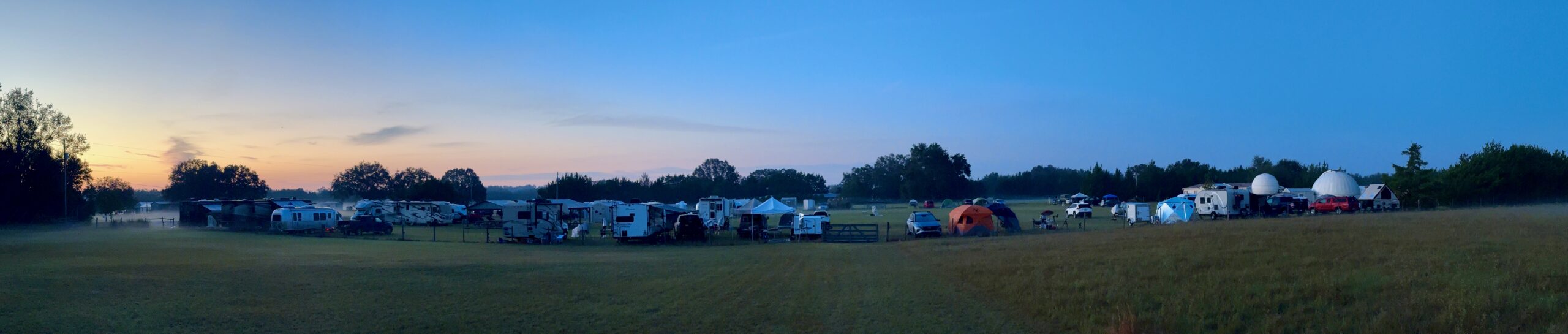
Welcome to the Chiefland Astrofest at one of the best observing sites in the country, the Billy Dodd Memorial Field in the Chiefland Astronomy Village. If you have never attended a Chiefland Star Party, get ready for some of the finest observing and imaging in the USA. If you are a regular visitor to our place, welcome back. The Chiefland Astronomy Village’s great weather, dark skies, on-site facilities, and the line-up of great speakers all add to the unique Chiefland experience.
On top of that, Chiefland Astronomy Village has the distinction of being virtually insect free. Nights in October are generally clear and cool, with temperatures at night of 55˚ – 65˚ F and 70˚ – 80˚ F during the day.
The Chiefland Astronomy Village is located near the west coast of Florida, one hour west of Gainesville and two hours northwest of Orlando. It enjoys moderate temperatures and plenty of comfort. The observing field boasts a beautiful array of amenities. First and foremost, it is dark. The private five-acre field features showers, a clubhouse, restrooms, a picnic area, electricity, and more. The ground is flat, providing easy setup of equipment, tents, and RVs. It also offers 360 degrees of unblocked horizon.
Registration
Registration has closed.
Food Vendor
Our very popular food vendor from 2024 is making a return and taking orders for meals.
Please click here to see menu details and place your orders. -All orders must be placed by September 30th.
Contact nachoconcessions@gmail.com for any questions.
Star Party Shirts
Batch #1 has closed – Batch #2 runs through September 13th, no orders will be accepted after this date.
Click here to order: https://www.bonfire.com/chieflandastrofest2025/
Astrophotography Contest
Astrofest is an official partner in ToupTek’s Global Astrophotography Contest.

Chiefland Star Prize: A special category has been created just for Chiefland Astronomy Village/Astrofest participants. The winner will receive a set of 1.25″ LRBG + SHO Filters and a ticket for Astrofest 2026.
Entries must be submitted by October 10th. Be sure to indicate your entry is from Chiefland Astronomy Village.
Thank you to Bill Williams, Patrick Freeman, Jamie Kenas, and Joe Haldeman for serving as judges for this competition.
For more information and to enter please click here: https://www.touptek-astro.com/Astrophotography-Contest-2025/
Schedule
Sunset is around 6:40 pm, astronomical dusk ends at 8 pm, and twilight starts at 6:30 am.
Friday, October 17, 2025: Arrival Day, arrive before sunset at 6:54
- Registration from noon to 6 pm
- Noon: The field opens early for RV arrivals
- 2:00 pm: The field opens for all arrivals
Saturday, October 18, 2025
- 10:00 am – 2:00 pm, Swap Meeting
- 3:00 pm – 3:50 pm, Keynote Presentation:
Dr. John Panek, NASA Goddard Space Flight Center
“The Nancy Grace Roman Space Telescope.” - 4:00 pm – 4:20 pm, Presentation
Dr. Richard G. Hennig, Chiefland Astronomy Heritage Museum
“Project Alvan – Restoring the Vision of 1885.”
Sunday, October 19, 2025
- Raffle prizes will be set-up in the pavilion on Sunday afternoon. Prize viewing and ticket deposit into the prize bins will be available afterwards.
- Raffle of Donated Prizes 1:00pm
- Dinner of burgers, brats, potato salad provided 5:00 – 6:00.
Monday, October 20, 2025
- 3:00 – 3:50 pm, Presentation
Dr. J. Andreas Howell, Alachua Astronomy Club
“From Pixels to Light Curves: Using Seestar to Observe Eclipsing Binaries.” - 4:00 – 4:50 pm, Presentation
Alex Curry FRAS, CoFounder, Telescope Live
“How to (Easily) Capture the Cosmos – Even if You Know Nothing About Astrophotography”
Tuesday, October 21, 2025
- 3:00 – 3:50 pm, Presentation
Tom Field, Founder and President, Field Tested Systems, LLC
“You can almost touch the stars – An Introduction to Astronomical Spectroscopy.” - 4:00 – 5:50 pm, Presentation
Dr. Anthony Gonzalez, University of Florida
“Next Generation VLA”
Wednesday, October 22, 2025
- Second Swap Meeting
Thursday, October 23, 2025
- Departure by noon
- If you plan to stay longer, make sure you have signed the waiver and paid the donation to support the Billy Dodd Observing Field.
Speakers

Keynote Speaker
Dr. John Panek: Engineering and Science of NASA’s Roman Space Telescope
NASA Goddard Space Flight Center
Abstract: Dr. Panek will provide a look at our next flagship mission to survey the sky in infrared light and demonstrate technologies needed for future large coronagraphs.
About the Speaker: John Panek is a Senior Mission Systems Engineer at NASA/Goddard Space Flight Center with 27-years of experience in aerospace engineering for a range of efforts from science instrument technology development, large mission concept architecture and design, payload preparation at the launch pad, and mission control operations after launch. He is currently Deputy Mission Systems Engineer for the Space Weather Next L1 Series, a joint NASA/NOAA project with observatories launching in 2029 and 2032.

Dr. J. Andreas Howell: From Pixels to Light Curves: Using Seestar to Observe Eclipsing Binaries
Alachua Astronomy Club
Abstract: Join us under Florida’s pristine dark skies for a hands-on journey into the fascinating world of variable star observation with the Seestar smart telescope. This session is designed for amateur astronomers eager to contribute meaningful scientific data using Seestar. It will also be valuable for anyone using a one-shot color camera for astroimaging.
We’ll begin by exploring how to choose the best variable stars to observe—considering brightness, variability type, and scientific significance. Next, we’ll dive into using the Seestar telescope, covering setup, imaging techniques, and best practices for capturing high-quality data.
Once the images are collected, we’ll walk through the data analysis process, demonstrating how to use PixInsight’s new VariableStarObserver tool to extract photometric measurements. Finally, we’ll explain how to obtain your personal observer initials and submit your findings to the American Association of Variable Star Observers (AAVSO), allowing you to contribute to real scientific research.
Whether you’re new to variable star observing or a seasoned astronomer looking to integrate smart telescope technology into your workflow, this presentation will help get you started to make meaningful contributions.
Bring your Seestar if you have one, and let’s turn photons into data under the Florida night sky!
About the Speaker: Dr. Andy Howell has spent a lifetime chasing the ever-changing light of the cosmos. From naked-eye stargazing to tinkering with the 8-inch reflector he built as a teenager, to commanding the mighty 60-inch at Mt. Wilson, Andy has always had his eyes on the stars. He holds degrees in Earth & Planetary Science from MIT and Caltech and earned a PhD in Industrial Engineering from Georgia Tech—because uncovering the secrets of the universe requires good engineering.
His career took him to the front lines of space defense, where he tracked orbits and safeguarded the skies for the U.S. Air Force’s Space Defense Center. But even with cutting-edge military technology at his fingertips, he never lost his love for the flickering beacons of variable stars. Now retired, Andy channels his passion into the digital age, wielding the tiny yet formidable Seestar smart telescope to collect scientifically valuable data for the American Association of Variable Star Observers.
Whether through massive observatories or palm-sized tech marvels, Andy Howell’s mission remains the same—deciphering the ever-shifting rhythms of the universe, one photon at a time.

Dr. Anthony Gonzalez: The Next Generation Very Large Array
University of Florida
Abstract: The Next Generation Very Large Array (ngVLA) is a planned
astronomical observatory set to operate at centimeter and millimeter
wavelengths, aiming to significantly surpass the capabilities of existing
telescopes like the Jansky VLA and the Atacama Large Millimeter Array (ALMA).
This next-generation observatory is being developed by the U.S. National Radio
Astronomy Observatory (NRAO) in collaboration with the international scientific
community. The ngVLA’s proposed design includes approximately 244 antennas
each 18-meters in diameter, with an additional 19 antennas of 6-meters for short
baselines. It’s designed to provide high surface brightness sensitivity and
exceptional imaging fidelity across angular scales from around 1-arcsecond
down to sub-milliarcseconds. The frequency range of the observatory will span
from 1.2 GHz to 116 GHz. The signal processing center will be located at the
existing VLA site in New Mexico, with extended baselines stretching across North
America. The ngVLA will pursue five key science goals, including imaging the
formation of solar system analogues, probing the initial conditions for planetary
systems and life with astrochemistry, charting the assembly and evolution of
galaxies, using pulsars to study fundamental physics, and understanding the
formation and evolution of black holes. The ngVLA is currently in the design and
development phase, with the prototype antenna delivered in April 2025 and
construction underway. The project completed its Technical Conceptual Design
Review in July 2022. Full scientific operations are anticipated to begin around
The ngVLA is expected to significantly advance our understanding of the
Universe by enabling new discoveries in astrophysics.
About the Speaker: Dr. Anthony Gonzalez is a professor in the Astronomy Department at the University of Florida (UF). After receiving his B.Sc. in Astronomy at the California Institute of Technology in 1995, he went on to receive his M.Sc. in Astronomy at the University of California, Santa Cruz (UCSC) in 1997 followed by his PhD in Astronomy and Astrophysics at UCSC in 2000. He spent one year at the Harvard-Smithsonian Center for Astrophysics as a CfA Fellow. He subsequently spent three years as a National Science Foundation Astronomy and Astrophysics Postdoctoral Fellow at UF before taking a faculty position at UF in 2005.
His research focuses on the growth and evolution of structure in the universe, with an emphasis on galaxy and galaxy cluster evolution. A significant fraction of his work involves large extragalactic surveys, which are used to find rare objects (e.g. high redshift galaxy clusters) and measure evolution of the properties of the general galaxy population. He is also interested in observational cosmology and has in the past worked on projects to demonstrate the existence of dark matter and to conduct a census of baryons in nearby galaxy clusters. He is participating in the Euclid mission, is a member of the TEMPLATES Early Release Science team for the James Webb Space Telescope, and is using the Hubble Space Telescope to study intracluster light.
Dr, Gonzalez is also a member of the Next Generation Very Large Array (ngVLA) Science Advisory Council (SAC). This council is the interface between the scientific community and National Radio Astronomy Observatory (NRAO), providing feedback and guidance directly to the Next Generation VLA (ngVLA) Project Office on issues that affect the scientific design for the ngVLA.

Tom Field, “You can almost touch the stars – An Introduction to Astronomical Spectroscopy.”
Founder and President, Field Tested Systems, LLC
Abstract: Even if you wanted to touch a star, they’re all impossibly distant. In
spite of these great distances, astronomers have learned an enormous amount
about stars. How? The most common method to study the stars is called
spectroscopy, which is the science of analyzing the colorful rainbow spectrum
produced by a prism-like device. Until recently, spectroscopy was too expensive
and too complicated for all but a handful of amateurs. Today, though, new tools
make spectroscopy accessible to almost all of us. You no longer need a PhD,
dark skies, long exposures, enormous aperture … or a big budget! With your
current telescope and FITS camera (or a simple web cam or even a DSLR
without a telescope) you can now easily study the stars yourself. Wouldn’t you
like to detect the atmosphere on Neptune or the red shift of a quasar right from
your own backyard?! This talk, with lots of interesting examples, will show you
what it’s all about and help you understand how spectroscopy is used in
research. Even if you are an armchair astronomer, understanding this field will
enhance your understanding of the things you read and the night sky.
About the Speaker: Tom Field was a Contributing Editor at Sky & Telescope
Magazine for ten years. He is the founder of Field Tested Systems and the author
of the RSpec software (www.rspec-astro.com) which received the S&T “Hot
Product” award. A pioneer in the field of amateur astronomical spectroscopy, Tom
aims to demystify that field and make it accessible to all. He promises to open
the door for you to this fascinating field!

Alex Curry FRAS, “How to (Easily) Capture the Cosmos – Even if You Know Nothing About Astrophotography
Co-Founder, Telescope Live
Abstract: In this talk, Telescope Live Co-Founder Alexander Curry will show you how, using a global network of remote scientific telescopes, you can get into, improve and perfect your astrophotography post-processing skills. Telescope Live provides you with the largest privately owned archive of astronomical data, with hundreds of hours of exclusive tutorials to help you improve your post-processing regardless of experience, software and most importantly, access to clear skies! Alex will also show you how you can get started right away with free datasets and tutorial resources.
About the Speaker: Alexander Curry is the co-founder of Telescope Live, a cloud-based platform that gives astrophotographers access to a global network of professional telescopes. With a passion for deep-sky imaging and astrophotography education, Alex focuses on building tools and experiences that make remote astronomy more accessible and engaging for users worldwide.
SPONSORS & RAFFLE PRIZES
If you are a vendor and interested in sponsoring Astrofest, please email us at chieflandastro@gmail.com.
Current sponsors:


Raffle Prizes from our Sponsors
If you are interested in sponsoring Astrofest 2025 and providing a raffle prize, please contact us at chieflandastro@gmail.com.


Sky Max 127 Virtuoso GTI


Orange Blossom Special
Star Party 2026


One Year Subscription


$300 Gift Certificate
$200 Gift Certificate
$100 Gift Certificate


Okie-Tex Star Party 2026

(2) $100 Gift Certificates

(5) APT One Year Licenses


dbOptic Software

Click here to read about Astrofest 2023 and Astrofest 2024 and see some of the pictures in our Gallery.