


I have a soft spot for 1960s space hardware, but the lunar rover is my favorite. It was designed to meet a ridiculous set of limitations, and achieved amazing success. Jared Owen’s new video breaks down how it was built, how it worked, and why it’s worth remembering:
MPU 829: Tech That Worked in 2025 →
This week on Mac Power Users, David and I reflect on what went well in their tech stacks, touching on Apple silicon, the company’s default apps, AI tools, home automation, and networking.
Five Apps I Used in 2005
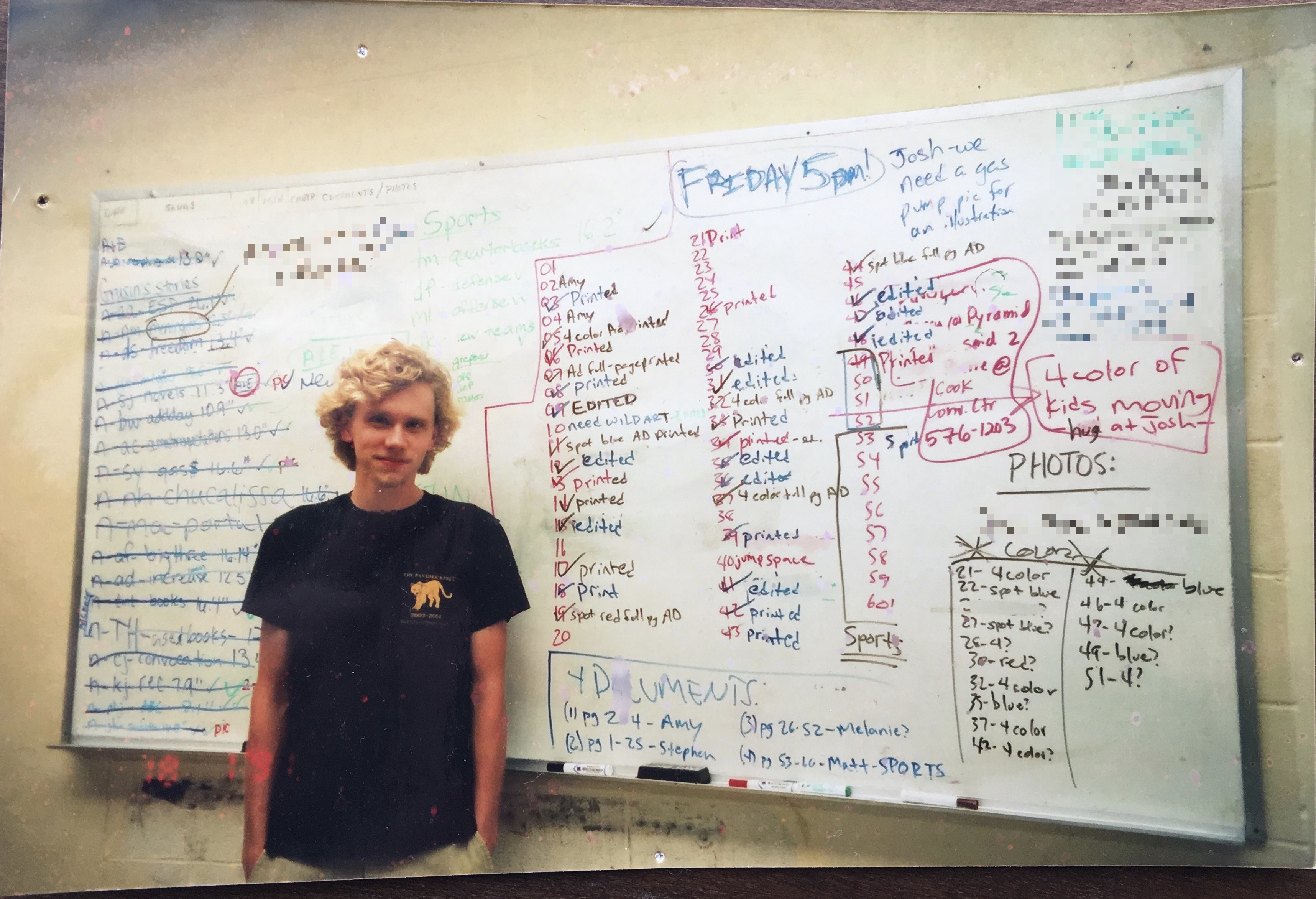
Yours truly in The Daily Helmsman newsroom as a freshman in August 2004. Names and phone numbers have been redacted to protect people who probably don’t remember me at all.
Twenty years ago, I was halfway through my first sophomore year of college1 and loving it. Moving into the dorm in August 2004 marked the first time I had access to the real Internet (not just AOL or Juno), and I dove into being a Mac nerd. I spent time on the Apple Discussion Boards and OS X forums across the web to learn everything I could about the PowerBook on my desk and what it could do.
Reflecting on that time, here are some of the apps I was using:
Adium
One of the first things I did when I got to college was set up an AOL Instant Messenger account. I was the last of my friends to do so, but I quickly jumped in. I chatted with friends and classmates, and set some super emo away messages.
iChat had launched in 2002 with Mac OS X Jaguar, but it took until Leopard for Apple to add tabbed chats. This meant that every open chat you had spawned its own window. Even on a 15-inch PowerBook, that would quickly spiral out of control.
Chax was a third-party app that added a bunch of functionality to iChat — including tabs — but I had stability issues with it. So, instead, I turned to Adium.
If you used a Mac in the early 2000s, Adium probably holds a special place in your heart. It worked with AIM and a wide range of other chat services and offered tabbed chat windows.
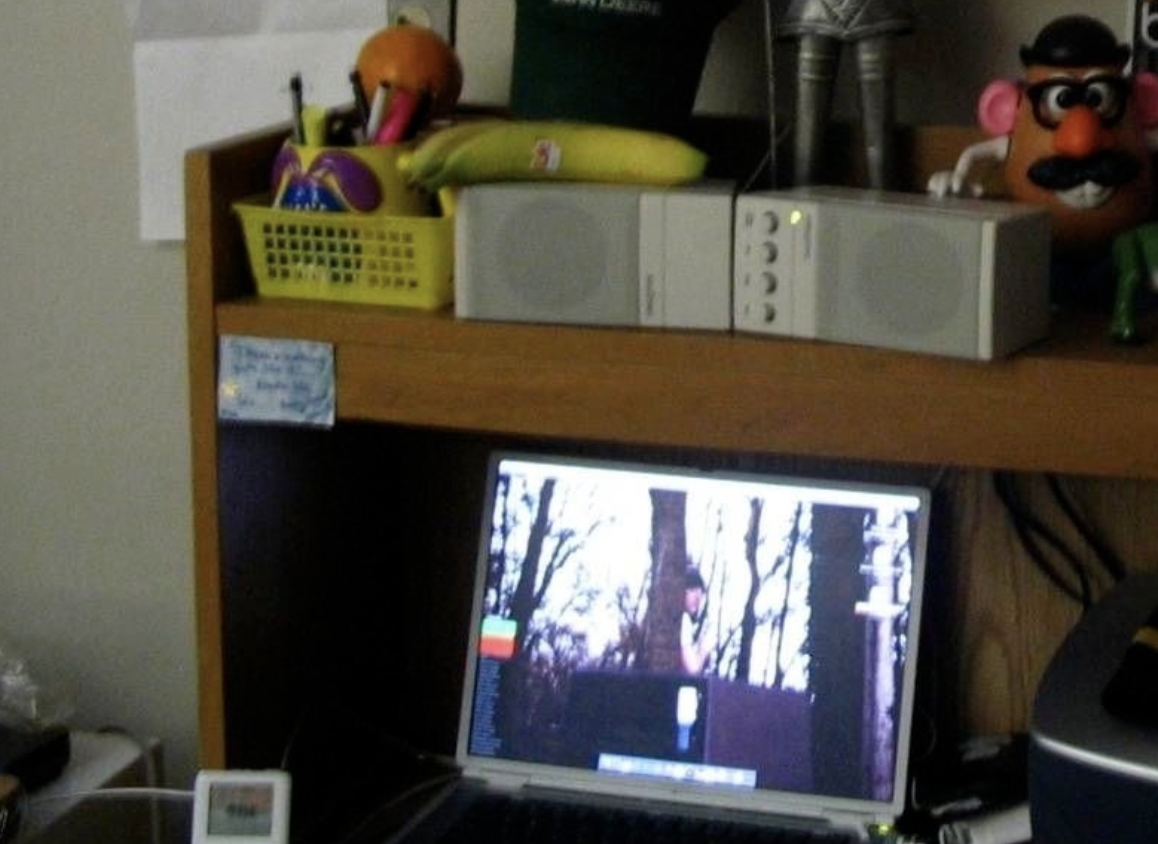
Adium’s real strength was its customization options. Users could change the icons, emoticons, sounds, chat styles, buddy list layout, and much more. As you can see in this one terrible photo of my dorm desk, you can see that I had online buddies in green, away buddies in red, and offline buddies showing up in black:
Camino
Safari was a few years old by the time I was in school, but I wasn’t a huge fan. Instead, I used the beloved Camino, which was described by its creators like this:
Camino combines the awesome visual and behavioral experience that has been central to the Macintosh philosophy with the powerful web-browsing capabilities of the Gecko rendering engine. Built and tested by thousands of volunteers, Mozilla’s Gecko brings cutting-edge innovations and capabilities to users in a standards-friendly and socially responsible form.
Sure, you can use a typical web browser, with typical features. Or you can use a browser that “also” supports the Mac. Or you can use a browser you have to pay for. What if there was one that offered everything, for free?
That browser is Camino. Camino makes your web experience more productive, more efficient, more secure, and more fun. It looks and feels like a Mac OS X application should, because it was designed exclusively for Mac OS X and the high standards set by Mac users. You’ll see the entire internet the way it was intended. Camino is the browser that gets out of your way, and that means Camino users need not worry about things they shouldn’t have to.
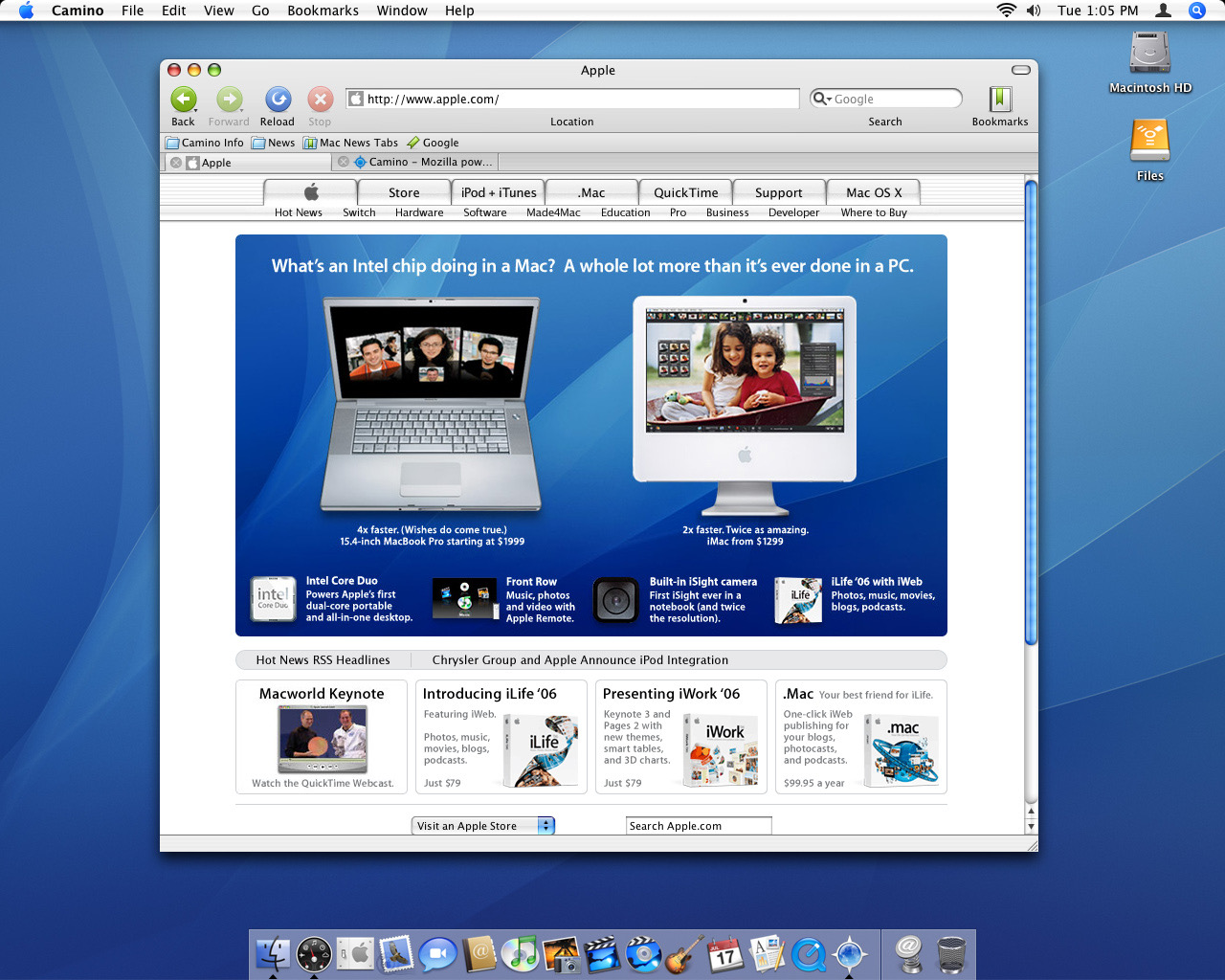
With an Aqua interface and the heart of Firefox under the hood, Camino was fashionable and fast. Here’s a screenshot of version 1.0.3 or so:
Chicken of the VNC
When I said that I used a PowerBook in my early college years, that is only part of the truth. I also had a Blue and White Power Mac G3 under my desk that I used as a “server.”
I put server in quotes because I really just used it as a backup target for my laptop; it didn’t run Mac OS X Server or provide any real services.
I ran it headless, so to access it, I used a VNC client called Chicken of the VNC. That is the best name any application has ever been given other than CalZones (RIP). It let me quickly access the Blue & White from anywhere on campus with just a few clicks.
Microsoft Entourage
Student email at the University of Memphis ran on Exchange, and connecting to the mail server via IMAP in Apple Mail was pretty janky. Since I refused to use webmail, I turned to a cracked version of Microsoft Entourage, the company’s email and personal information manager for the Mac.
This let me access my email in an actual application, like a gentleman. Later in college, I experimented with various hand-me-down Palm Pilots and even a PocketPC. I used various versions of Palm’s HotSync and The Missing Sync to get data in and out of Entourage.
Vienna
Being a young nerd in the early 2000s meant that I loved reading the web via RSS. To do so, I would have turned to NetNewsWire, but I couldn’t afford the commercial version, so instead, I used the freeware RSS client Vienna. It wasn’t nearly as nice as NetNewsWire, and as soon as I came across the free — and awesome — NewsFire in 2008, I jumped ship to that. That was the beauty of RSS, and why it’s still special today.
The More Things Change…
It was wild to think about this list and consider the fact that I still have solutions for all of these categories today. Now it’s Messages/Slack/Discord instead of Adium, Safari instead of Camino, and Apple’s built-in screen sharing features instead of Chicken of the VNC.
Entourage has been replaced by a set of apps including Mimestream, Calendar, Contacts, Notes, and Reminders. Vienna is still around, but now I read RSS with ReadKit.
I even still have that old Blue and White G3. It’s sitting on a shelf in my office across from my desk.
- I was in college from August 2004 until May 2011, and I have a Bachelor of Fine Arts in journalism to show for it. I changed majors from graphic design after two years, which meant basically starting over. After the fall semester of 2007, I went to school part-time until I finished, slowly chipping away at my degree. My official transcript from the University of Memphis is six pages long. ↩
Mac Power Users 828: Revisiting Keyboard Maestro →
This week, David and I talk through our uses of Keyboard Maestro, diving deep into automation, text expansion, and more.
Connected 583: The 2025 Annies →
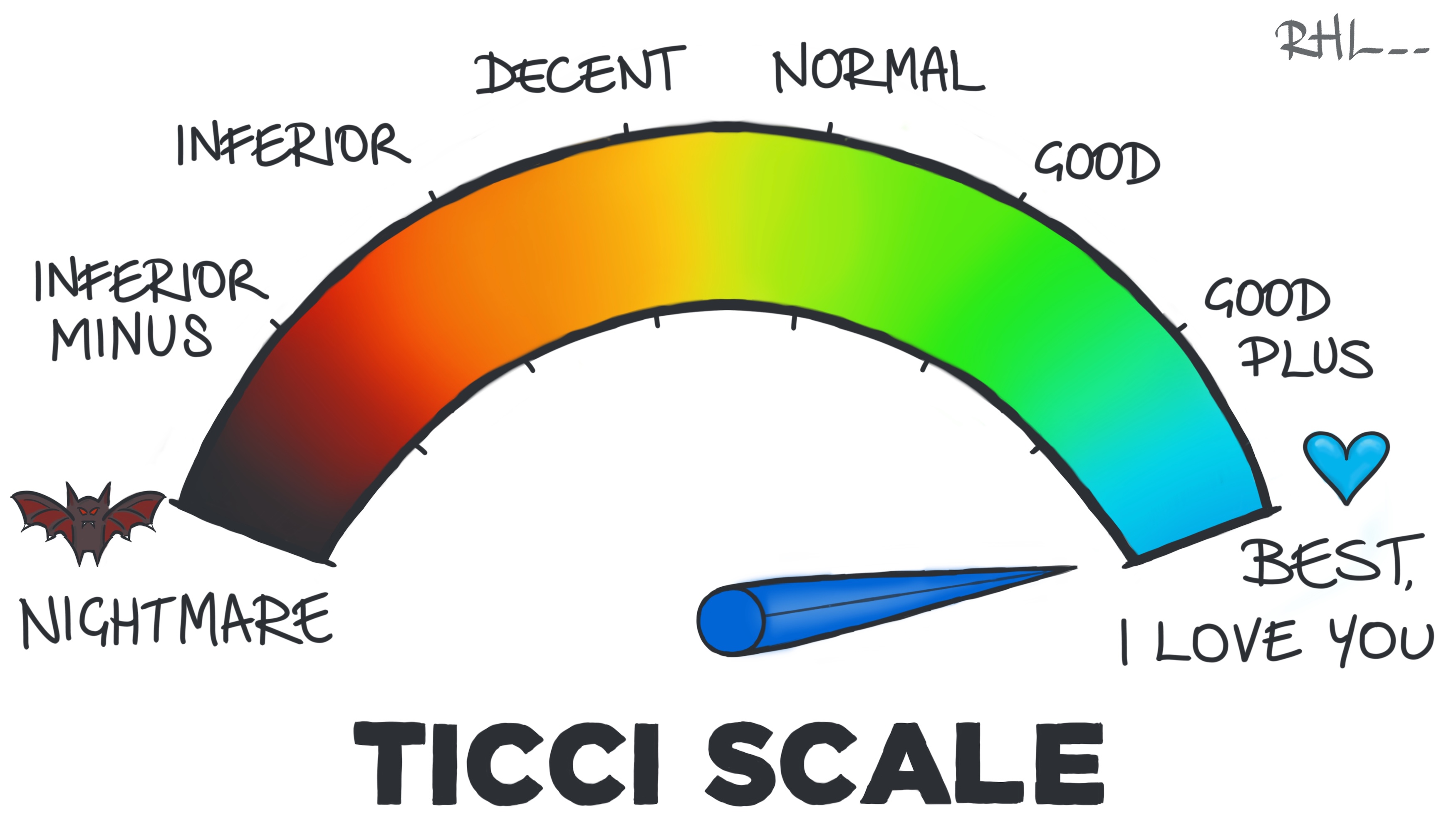
The year is coming to an end, and to celebrate, Federico, Myke, and I score each month with the only unit of measurement that matters — the Ticci Scale:
Four Winners and Losers of Apple’s 2025
Apple’s year is just about done, so it’s time to pick some high and low points.
Winners: UI Experts on Social Media
macOS Tahoe, iOS 26, and their cousins will go down in history for being the releases that introduced Liquid Glass.
One of Apple’s stated desires with this design language was to unify its platforms with one universal look and feel, as shown off in the image at the top of the company’s press release about Liquid Glass:

Liquid Glass created a tidal wave of opinions about Apple losing its way, forgetting about accessibility, and trying to distract from its AI woes.
Now that iOS 26 is rolling out to the masses, we’re back at it, with folks posting screenshots and links to their Substack. Apple tweaking the design as updates to the OS Class of 26 come out is only pouring fuel on the fire.
I like Liquid Glass and I’m well aware of its issues, but the whole thing is just exhausting.
Loser: Apple’s AI Efforts

The further we get from WWDC24, the more bonkers it seems that Apple announced so many Apple Intelligence features that were nowhere near ready. The company clearly felt pressure to jump into AI features but wasn’t ready. In the time since, the company has been shuffling teams around and publishing research, but the features that have shipped are fairly lackluster. The promised next-generation Siri is still not here, and if reporting is to be believed, Apple doesn’t yet have its own technology to power it. Yikes.
Winner: The iPhone Lineup

The current slate of iPhones is super impressive. The base iPhone picked up some amazing features, including an always-on display and ProMotion. It’s the best no-adjective iPhone Apple has ever shipped.
The iPhone Air is an amazing feat of engineering. I’ve been using one as my daily for a while now, and cannot believe how much I love this phone. I was rather cool on it in my review due to the trade-offs its thin design demands, but every time I pick it up, I smile.
In that review, I wrote:
One look at the iPhone 17 Pro should tell you that Apple is very willing to make an iPhone with the opposite trade-offs than the Air. Apple seems more willing than ever to offer its customers options, and I don’t think we should do anything to discourage that, even if it leads to hard decisions when standing in the Apple Store.
The iPhone 17 Pro and Pro Max eschewed the previous jewelry-like design of previous Pro models and traded it out for something much more utilitarian. It’s chunky and bold, all in the name of housing Apple’s best camera system in the device. It has a bunch of features that mere mortals will never use, but for pros making content with their phones, this one is a real winner.
PLUS IT COMES IN ORANGE. I mean… come on!
Losers: Aficionados of Large Desktop Macs

It’s a tale as old as time, but the “current” Mac Pro is too old and too expensive for what it is.
…but at least it exists, which is more than what can be said for a professional-grade iMac. I adore the current iMac, but it doesn’t fill the space the 5K iMac and iMac Pro once did.
Apple’s solution for users who want a powerful Mac with an Apple-made display is the Mac Studio paired with a Studio Display or Pro Display XDR, both of which are also too old and too expensive for what they are.
Winners: Aficionados of Small Desktop Macs

The Mac Studio got a nice upgrade earlier this year and now rocks the M4 Max and the new M3 Ultra chip. While this raised a bunch of questions about Apple’s silicon strategy, there’s no doubt the Studio continues to be a beast.
The Mac mini did not receive an update this year, but the 2024 redesign continues to impress. I finally got my hands on one just a couple of weeks ago to replace the M1 Mac mini I was using as a home server. The small size is really impressive, and I think the M4 and M4 Pro are going to feel plenty fast for a long time.
Loser: Apple’s Budget for Legal Fees
Apple continues to find itself at odds with governments around the world over its handling of the App Store, third-party software and hardware integration, and more. The tug-of-war Apple is playing over things like App Store commissions could end up fundamentally changing how the company’s products work, but it seems unwilling to concede meaningful ground.
Loser: The Developer in Charge of Updating Apple’s Leadership Webpage
This year has brought a lot of change at the top of Apple. Sabih Khan became COO when Jeff Williams announced his retirement. John Giannandrea is also retiring, with his previous role being carved up between Mike Rockwell, Amar Subramanya, Craig Federighi, Sabih Khan, and Eddy Cue.
Lisa Jackson and Katherine Adams are both leaving early next year, with Jennifer Newstead taking over their respective roles.
Alan Dye, whose departure did not garner a press release, is headed to Meta, to the joy of many folks in the Apple world.
(Thankfully, Johny Srouji seems to be staying put.)
All of this is happening with a clock ticking in the background as Tim Cook is reportedly handing over the reins sometime in 2026, probably to Apple’s Senior Vice President of Hardware Engineering, John Ternus:

Some of these executive-level changes are probably long overdue, but it’s still wild to see it starting to take place.
Winner: Yours Truly

I’m going to take a rare victory lap here and say that my writing on Tahoe’s initial Finder icon spurred Apple to change it. I know some folks wanted more, but I think the current icon works within the context of Tahoe’s redesign.
I have it on good authority that my blog post from the day of the keynote was quoted at the highest levels of the company when the uproar was discussed. I’m pretty proud of that, and it goes to show that blogging can still change the world… or at least an icon.
Ford Has Steered Its Former EV Truck and Plant Plans in to a Ditch

Back in 2021, Ford unveiled the F-150 Lightning, an all-electric version of its venerable pickup. A single $100 payment would get your name on the truck’s waiting list, and production was expected to begin in 2022.
Despite being a twice-over Toyota Tacoma fanboy, I was excited about this announcement. The F-150 has been America’s best-selling truck for like 400 years, and making it electric seemed like a great way to get EVs into garages that would otherwise never see one. I even sent Ford $100.
Early Signs of Trouble
Once the trucks hit the street, it was clear that there were concerns. While the powerful truck could pull just about anything, towing (or even driving with heavy loads) drastically cut into the Lightning’s range. Being based on an F-150 made a lot of sense on paper, but it meant that less hardcore mid-sized truck owners who may never run into the range-while-towing challenges weren’t going to look at it due to its size.1
Then there were the cultural issues. Some Americans saw the rise of EVs as a liberal movement, and the Lightning was a bad fit in their eyes. This friction is not unique to Ford, but it was a factor that the company didn’t attempt to manage at all.
Over time, the Lightning became more expensive and less popular, to the point that production pauses were ordered. The trend was troubling, but I kept hoping it would do well for a partially selfless reason:
Ford was coming to town.
Blue Oval
…well within a short drive of town. In the fall of 2021, Ford announced Blue Oval, an enormous facility about 30 minutes from Memphis. Ian Round, Bill Dries, and Rob Moore broke the news for The Daily Memphian:
Partnering with a South Korean company, SK Innovation, Ford announced a $5.6 billion investment and 5,800 direct jobs at the Haywood County site, between Memphis and Jackson.
At a press conference Monday, Sept. 27, Gov. Bill Lee said it was “the largest single investment in this state’s history.” Lee, along with executives from Ford and SK Innovation, will be in Memphis Tuesday morning to make the announcement and share more details.
We’re going to come back to SK Innovation, but let’s get back to that 2021 article for now:
“West Tennessee will lead the future of the automotive industry,” Lee said. “We are excited about what this means for the people of Tennessee.”
The state is providing $500 million in incentives, which state Economic and Community Development Commissioner Bob Rolfe said was an appropriate investment.
Rolfe said the incentives will take the form of grants rather than tax breaks. The state expects the project to contribute $3.5 billion each year to the gross state product, creating 27,000 jobs directly and indirectly, not including construction. Those jobs are expected to bring in more than $1 billion in annual earnings.
“I don’t think in our wildest dreams we could have identified a greater global brand,” Rolfe said.
Construction of the 3,600-acre campus, which Lee said will begin before the end of the year, is expected to create 32,000 jobs.
Blue Oval is huge. Once the land was cleared, my Dad and I drove up there to check it out and joked that you could see the curvature of the Earth across the site. Today, that land is populated with a series of enormous buildings. The scale of the thing is unlike anything I’ve ever seen in West Tennessee.
Ford was clear from the start that the Lightning would not be built in Tennessee, but that production would remain at Michigan’s River Rouge complex. As the Lightning shared a bunch of parts and body panels with the internal combustion version, that made perfect sense to me.
Besides, the purpose of Blue Oval promised to be more exciting than a truck the world already knew about. Instead, the new plant was going to build a new electric truck and be home to facilities for building new and recycling old EV batteries.
All of that is in the background of this week’s news.
Changes at Blue Oval
Let’s circle back to SK Innovation’s partnership with Ford at Blue Oval. On December 11, it was announced that the joint venture was coming to an end. Kirsten Korosec at TechCrunch wrote about the news:
Four years ago, Ford and South Korean battery maker SK On struck a deal to form a joint venture and spend $11.4 billion to build factories in Tennessee and Kentucky that would produce batteries for the next generation of electric F-Series trucks.
The factories live on; the joint venture will not.
SK On, a subsidiary of SK Innovation, said Thursday it reached an agreement with Ford to end the joint venture. The two companies will divide the assets: Ford will take ownership and operation of the twin battery plants in Kentucky, while SK On will operate the factory at the massive BlueOval SK campus in Tennessee.
SK On said it will maintain a strategic partnership with Ford centered on the Tennessee plant, according to Bloomberg.
When reached for comment, a Ford spokesperson told TechCrunch the company was aware of SK’s disclosure and had nothing further to share at this time.
This news made waves locally as well. Sophia Surrett at The Daily Memphian wrote:
The separation, subject to regulatory approvals, is expected to be completed by the end of the first quarter of 2026.
“This strategic decision enables both companies to each focus on their core strengths, enhance operational flexibility and respond more effectively to market dynamics,” according to a statement released by SK On.
Ford would not comment.
The BlueOval City facility, under construction, will become SK On’s second wholly owned U.S. plant with SK Battery America in Commerce, Georgia.
Ford’s lack of comment had many folks in my neck of the woods nervous. Blue Oval is already behind schedule, and with the Lightning (and the overall EV market) in trouble, some wondered if a new electric truck was even feasible.
That brings us to yesterday’s news. Let’s start with the plant. Those battery facilities will be repurposed to build “Energy Storage Systems,” and more than 1,600 people will lose their jobs in the transition, even though Ford is promising that some 2,100 jobs will be added back to the plant once its overhaul is complete.
(These changes mean that the U.S. government will be modifying the $9.63 billion loan it awarded Ford and SK to support the joint venture.)
The bigger news for Blue Oval is that the not-yet-opened plant will be retooled to build gas-powered trucks. Sophia Surrett:
Ford Motor Co. on Monday, Dec. 15, announced it is scrapping plans to build electric trucks at BlueOval City and instead will build gas-powered trucks there, beginning in 2029.
Ford’s $5.6 billion BlueOval City in Stanton, Tennessee, was initially to be the site of its Tennessee Electric Vehicle Center, where its Model T3 electric truck would be built.
Now, the facility is being renamed the Tennessee Truck Plant, where “affordable” gas-powered models will be produced.
This pivot is expected to cost Ford $19.5 billion and push Blue Oval’s opening date to sometime in 2029, a full four years later than originally planned.
So, to recap, in the last few days:
- Ford and SK have ended their joint venture to produce and recycle EV batteries.
- Ford did not comment on the change.
- Ford announced a massive change for Blue Oval’s already-announced production and timeline
This news has been disappointing to my friends and family, some of whom live within miles of Blue Oval. They don’t all think EVs should be the future, but they can agree that having thousands of new jobs in West Tennessee is a good thing.
Ford’s pivot away from EVs should not be surprising, nor should the incredible hoops the company jumped through to make the news seem positive:
Ford Motor Company today announced a series of actions to sharpen its Ford+ plan,2 executing a decisive redeployment of capital to meet customer demand and drive profitable growth.
The company is shifting to higher-return opportunities, including leveraging its U.S. manufacturing footprint to add trucks and vans to its lineup and launch a new, high-growth battery energy storage business. As part of these actions, Ford no longer plans to produce select larger electric vehicles where the business case has eroded due to lower-than-expected demand, high costs and regulatory changes.
This approach prioritizes affordability, choice and profits. Ford will expand powertrain choice — including a range of hybrids and extended-range electric propulsion — while focusing its pure electric vehicle development on its flexible Universal EV Platform for smaller, affordable models.
“This is a customer-driven shift to create a stronger, more resilient and more profitable Ford,” said Ford president and CEO Jim Farley. “The operating reality has changed, and we are redeploying capital into higher-return growth opportunities: Ford Pro, our market-leading trucks and vans, hybrids and high-margin opportunities like our new battery energy storage business.”
Under this new direction, Ford expects “approximately 50% of its global volume will be hybrids, extended-range EVs and fully electric vehicles, up from 17% in 2025.”
In 2021, when the Lightning and Blue Oval were announced, Ford said “40% of its sales globally to be electric vehicles by the end of this decade under a new plan to increase investment in EVs to $30 billion through 2025,” according to Michael Wayland at CNBC.
Grounding the Lightning
Beyond the changes at Blue Oval, Ford also announced changes for the F-150 Lightning:
Ford Motor Company today announced the next generation of the F-150 Lightning, a truck engineered to redefine what an electric pickup can do.
Leveraging advanced Extended Range Electric Vehicle (EREV) technology, the next-generation F-150 Lightning will offer the best of both worlds: the seamless, instant power of an electric powertrain and the freedom of a generator-backed estimated range of more than 700 miles.
Unlike a traditional hybrid, the F-150 Lightning EREV is propelled 100 percent by electric motors. This ensures owners get the pure EV driving experience they love – including rapid acceleration and quiet operation – while eliminating the need to stop and charge during long-distance towing. Like the current F-150 Lightning, the next-gen version will also offer exportable electricity that can power everything from work sites to camp sites to homes during a power outage.
“The F-150 Lightning is a groundbreaking product that demonstrated an EV pickup can still be a great F-Series,” said Doug Field, Ford’s chief EV, digital and design officer. “Our next-generation F-150 Lightning EREV will be every bit as revolutionary. It delivers everything Lightning customers love – near instantaneous torque and pure electric driving. But with a high-power generator enabling an estimated range of 700+ miles, it tows like a locomotive. Heavy-duty towing and cross-country travel will be as effortless as the daily commute.”
In short:
- The battery-only F-150 Lightning is gone.
- The next Lightning — which has neither an announced price or launch date — will be an EREV.
- Like its predecessor, this truck will not be built at Blue Oval.
That is a lot of news,3 and it’s all part of Ford “following customers to drive profitable growth.”
The Lightning is ending production, and while Ford will not commit to any details about production or availability, the EREV news is interesting.
If you are not familiar, EREVs are electric vehicles with a small gas engine onboard to keep the battery charged. Their range can be incredible, as you can keep the wheels turning as long as you have gas in the tank.
Ironically, this news comes three months after RAM did the same thing. Ford is far from the first company to talk about these drivetrains, never mind actually shipping them.
Ford’s press release goes on to directly address concerns people have had about the Lightning, including its range with and without a trailer behind it. Whether or not customers will ever benefit from such a truck remains to be proven.
It’s Personal
When Ford announced the Lightning in 2021, I wrote:
I really like this approach: taking a regular, super-popular vehicle and turning it into an EV is a reasonable approach. I fully anticipate that my Toyota Tacoma will be the last internal combustion vehicle I own.
I want to live in a world where I could go buy an affordable, mid-sized electric truck if an asteroid hit my garage and totaled my pickup. I love everything about the Rivian R1T, but it’s too expensive. Toyota has announced an electric Hilux for some markets, but it’s not coming to the U.S. While the Lightning was too big for me, Ford was likely the first major brand to offer a mid-sized electric truck. Having it built in my backyard would be a bonus.
There are a bunch of startups looking at this market, but uhhhh, I don’t want to sign up for something that turns out to be a Fisker Ocean with a pickup bed.
If I didn’t want to buy another pickup, my options are much better. Siblings Kia and Hyundai are both shipping impressive EVs. The Chevy Bolt is coming back, and some electric Volkswagens can be bought below MSRP every day of the week.
I am not the only bearded dude who may look for a truck with a battery in it over the coming few years. Ford should have its new EREV Lightning on lots as soon as it can, and then work to deliver a full EV version that can meet the needs of more people when the time comes.
But…
The EREV’s Timing
…the automotive industry takes years to change. The time it took the Lightning to go from announced to on sale doomed it. The rest of the world includes silly things like the economy and energy costs and environmental concerns and a political system that drastically changes between administrations.
When the Lightning finally made it into the world, the world had changed around them. What was a promising look at the future could never survive the present.4
Will the same thing happen to EREVs? By the time they really arrive, will the market be ready to move past them?
EREVs will provide a bridge until companies are ready to return to the business of fully electric cars and trucks.
After all, many customers have legitimate reasons to pick an EREV over an EV. That said, many customers would be delighted with an EV if they tried one and if they were less expensive. It may not matter to me or you, but a lot of people need something with a huge and reliable range.
This is not all bad news. It’s easy to see the upsides of EREVs. They take gasoline to run, but far less gas than vehicles with an ICE under the hood. They contribute to pollution, but are far more efficient than the V6 or V8 they probably replaced. From one point of view, EREVs are an improved version of hybrid powertrains, which are readily available at every dealership in America today.
Ford and others turning to EREVs would be a bigger loss if more Americans were already in an EV, but that’s not true yet. Given the card we’re being handed, EREVs may be our future for a while. It is disappointing, but at least it’s not a full retreat to purely gas-powered vehicles.
I remain hopeful that when Ford returns to a place willing to build full EVs, my state will be a proud part of that work. I just hope it’s sooner rather than later.
- And yes, I hear you. Trucks like the F-150 won’t fit on roads in many countries, and their high front ends can be dangerous for pedestrians. I get it, but that’s not the point of this particular blog post. ↩
-
Its name may sound like a doomed streaming service, but Ford+ dates back to 2021, when the company announced plans to modernize itself. The plan included splitting Ford’s EV efforts into a new company division, Ford Model E, and focusing on “new customer-centered business segments are redefining customer value, while at the same time reducing cyclicality, improving capital efficiency, and generating profitable growth and strong free cash flow.”
Whatever that means. ↩
-
The press release also included a statement about Ford’s plans for its battery energy storage system business. It read:
“Ford is launching a new business, including sales and service, to capture the large demand for battery energy storage from data centers and infrastructure to support the electric grid. Ford plans to repurpose existing U.S. battery manufacturing capacity in Glendale, Kentucky, to serve the rapidly growing battery energy storage systems market. This strategic initiative will leverage currently underutilized electric vehicle battery capacity to create a new, diversified, and profitable revenue stream for Ford. The company also plans to invest roughly $2 billion in the next two years to scale the business.”
It also included a note about Blue Oval that said, “Last week, Ford, SK On, SK Battery America and BlueOval SK entered into a joint venture disposition agreement. Under this mutual agreement, a Ford subsidiary will independently own and operate the Kentucky battery plants. SK On will fully own and operate the Tennessee battery plant.” ↩
- The headwinds EV maker are facing right now aren’t all organic. The Department of Energy has backed out of a huge list of clean energy efforts, and Trump’s One Big Beautiful Bill Act ended the $7,500 tax credit tied to buying or leasing an EV. Ideally, the EV market could stand on its own without government help, but big changes often need time, and time takes money. ↩
Sponsor: Magic Lasso Adblock: YouTube Ad Blocker for Safari →
Do you want to block all YouTube ads in Safari on your iPhone, iPad, and Mac?
Then download Magic Lasso Adblock – the ad blocker designed for you.

As an efficient, high-performance, native Safari ad blocker, Magic Lasso blocks all intrusive ads, trackers, and annoyances, delivering a faster, cleaner, and more secure web browsing experience.
Magic Lasso Adblock is easy to set up, doubles the speed at which Safari loads, and also blocks all YouTube ads; including all:
- video ads
- pop-up banner ads
- search ads
- plus many more
With over 5,000 five-star reviews, it’s simply the best ad blocker for your iPhone, iPad, and Mac.
And unlike some other ad blockers, Magic Lasso Adblock respects your privacy, doesn’t accept payment from advertisers, and is 100% supported by its community of users.
So, join over 350,000 users and download Magic Lasso Adblock from the App Store, Mac App Store, or via the Magic Lasso website.
Mac Power Users 827: Every Two Months or So →
On this feedback episode, David and I revisit the smart home, iPadOS 26, the lack of a big iMac, charging stations, and much more.
Seriously, much more:

Connected 582: The Biggest Chunk of the Smallest Chunk →
The guys catch up on more Apple leadership changes and talk about music streaming services before the alarm goes off for another round of The Quizzies.
On Connected Pro, my initial review of the Analogue 3D.
State Department Goes Back to Times New Roman for… Reasons →
I promise this is not from The Onion, but rather Michael Crowley and Hamed Aleaziz at The New York Times:
Secretary of State Marco Rubio waded into the surprisingly fraught politics of typefaces on Tuesday with an order halting the State Department’s official use of Calibri, reversing a 2023 Biden-era directive that Mr. Rubio called a “wasteful” sop to diversity.
While mostly framed as a matter of clarity and formality in presentation, Mr. Rubio’s directive to all diplomatic posts around the world blamed “radical” diversity, equity, inclusion and accessibility programs for what he said was a misguided and ineffective switch from the serif typeface Times New Roman to sans serif Calibri in official department paperwork.
In an “Action Request” memo obtained by The New York Times, Mr. Rubio said that switching back to the use of Times New Roman would “restore decorum and professionalism to the department’s written work.” Calibri is “informal” when compared to serif typefaces like Times New Roman, the order said, and “clashes” with the department’s official letterhead.
They continue:
Mr. Rubio’s directive, under the subject line “Return to Tradition: Times New Roman 14-Point Font Required for All Department Paper,” served as the latest attempt by the Trump administration to stamp out remnants of diversity initiatives across the federal government.
Then-Secretary of State Antony J. Blinken ordered the 2023 typeface shift on the recommendation of the State Department’s office of diversity and inclusion, which Mr. Rubio has since abolished. The change was meant to improve accessibility for readers with disabilities, such as low vision and dyslexia, and people who use assistive technologies, such as screen readers.
Update: John Gruber has published the entire memo, writing:
It seems clear to me that The New York Times did Rubio dirty in their characterization of the directive.
Having read the full memo, it’s hard to disagree.
Sponsor: Audio Hijack from Rogue Amoeba →
The audio experts at Rogue Amoeba are back to sponsor 512 Pixels this holiday season with Audio Hijack, their powerful app for recording any audio on your Mac.

Audio Hijack’s tagline is short and sweet: Record any audio. With it, you can save audio from any app, any device, or even from your entire system. Record podcasts, capture streaming audio, archive audio calls, or grab sounds from games and videos. If it makes sound on your Mac, Audio Hijack can record it.
There’s so much more. Use the built-in Transcribe block for local, secure transcription of audio without relying on any cloud services. Schedule recordings for live broadcasts you don’t want to miss. Even use it to create your own live streams.
Whether you’re a podcaster, musician, content creator, or just someone who needs to save audio from time to time, Audio Hijack is a gift that keeps on giving.
You can try Audio Hijack with a fully functional free trial before you buy. And as a 512 Pixels reader, you can save 20% on Audio Hijack through the end of this year. Just enter discount code 512HOLIDAYS in Rogue Amoeba’s online store.
My thanks to Rogue Amoeba for sponsoring 512 Pixels, and for making audio on the Mac so much better.