3 Quarks Daily Is Looking For New Columnists

Dear Reader,

Here’s your chance to say what you want to the large number of highly educated readers that make up 3QD’s international audience. Several of our regular columnists have had to cut back or even completely quit their columns for 3QD because of other personal and professional commitments and so we are looking for a few new voices. We do not pay, but it is a good chance to draw attention to subjects you are interested in, and to get feedback from us and from our readers.

We would certainly love for our pool of writers to reflect the diversity of our readers in every way, including gender, age, ethnicity, race, sexual orientation, etc., and we encourage people of all kinds to apply. And we like unusual voices and varied viewpoints. So please send us something. What have you got to lose? Click on “Read more »” below…

NEW POSTS BELOW THIS ONE

Read more »

Friday, January 16, 2026

Rooms that Remember: Space in Japanese Horror

by Amir Zadnemat

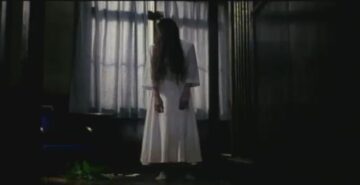
Still from the 1998 Japanese supernatural psychological horror film Ringu directed by Hideo Nakata and written by Hiroshi Takahashi, based on the 1991 novel by Koji Suzuki.

Japanese horror rarely treats space as neutral background. Rooms, corridors, and thresholds do not simply contain events; they remember them. In many films, especially those that extend the legacy of kaidan jidaigeki into the present, architectural space functions as a kind of soft archive—absorbing gestures, voices, and injuries, then releasing them slowly back into the frame. Terror is not what enters the house; it is what the house has learned to hold.

This begins with an older grammar of place. In Edo-period ghost tales, the home is not a private refuge but a node in a dense network of obligation. Walls are thin, doors slide, and status is legible in the arrangement of rooms. Violence and humiliation unfold in spaces that never fully close. When a servant is beaten in a back corridor or a wife is cast out into a side yard, the architecture witnesses the act. Later, when a ghost reappears in that same corridor or at that same threshold, she is less an intruder than the room’s own memory made visible.

What distinguishes Japanese horror from many Western haunted-house narratives is this refusal to separate space from social structure. The cursed location is not evil in itself; it is overdetermined. A stairway is oppressive because it has channeled generations of unequal encounters up and down its steps. A tatami room feels haunted because it has seen too much bargaining, too many apologies offered in place of real repair. The supernatural does not burst through the floorboards; it condenses out of an atmosphere already thick with unspoken history. Read more »

Little Addie’s Last Fight

by Steve Szilagyi

“A little man is a whole man as well as a great man” – Montaigne

Adolph Wolgast is born on a farm in 1888. Chores make him strong. The company of lumbermen makes him tough. “Little Addie” is not tall. But he can spin his arms like a windmill. And if you are in his vicinity, you’d better hope your chin isn’t in the way.

After knocking down everyone worth fighting in his hometown, Addie hits the road. He is 16. He hops freights, works in sawmills, fights in improvised rings. Falls in with a guy named “Hobo” Dougherty.

“Those are my pork-and-bean years,” he chuckles about his youthful wanderings many years later. By then he can afford to laugh—wearing a bearskin coat that cost a thousand dollars, owning a ranch up in Oregon. A popular man, the lightweight champion of the world. “The most likeable little pug you’re ever going to meet,” one sportswriter called him. And yet—though he has no way of knowing it—Addie is already well along the road that ends in a hospital for the insane, where, on a darkling plain swept with confused alarms of struggle and flight, he will face one last grim fistic encounter in the dark.

Little Addie and his buddy Hobo Dougherty land in Grand Rapids in 1906, where they fall in with the fight crowd. He gets taken on as a sparring partner in a gym. The older boxers don’t like him. He doesn’t play pit-a-pat. Once he’s put on the gloves, he doesn’t see any reason he shouldn’t knock the other fellow down.

Fight promoters like the boy’s aggression and put him in the ring. Addie goes pro. He gets booked on undercards. Sometimes he makes as much as $5 a fight. He fights in saloons, “athletic clubs”, basements, vacant lots. Betting is rife. It is cockfighting with humans. Read more »

New Semester: Prose & Verse Wanted, No Machines Allowed

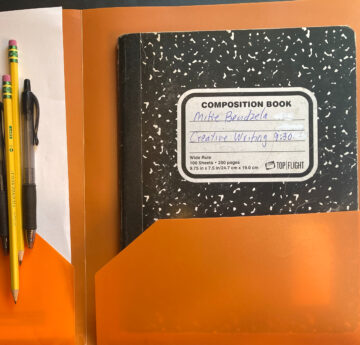
by Mike Bendzela

The important thing to remember about “extraordinary popular delusions” (in Charles Mackay‘s words) is that there is nothing you can do about them. And they are legion. The best you can do is avoid them, and this takes diligence and a certain resolve: The subject gets changed. The screens go off. No television comes near your eyeballs. The radio is switched to a music station. “Social” media are eschewed. And when people needle you about your lack of engagement, you ignore them. Whose approval do you think you need anyway? Let the rowdies enjoy their bandwagon in peace. I’m wondering whether the time will come when the shiny new plagiarist technologies undermine themselves to the point that nothing seen on a screen will be trusted anymore, when electronic becomes a synonym for fake. It’s an open invitation to reclaim such quaint sensual pleasures as face-to-face conversation and the scratch of pencil against paper.

Bogus seems to be the new name of the game: One pops in an assignment description, and out pops a tidy little poem with one’s name in the byline, ready to be safely uploaded to the class website. Therefore, in my writing classes I am taking steps to get away from screens, which means increasing the use of paper and pens/pencils. One must walk forward into the past. One learns that to be a writer one scribbles and fails, scribbles and fails. For the same reason that most business ventures shutter and most species go extinct, most writing never sees the light of publication. The learning is in the doing, not in the dung heap at the end of the process. Why take a cooking course if you are just going to order out? Why take a technical rock climbing class (as I did as an undergraduate geology major) if you are only going to hire a helicopter to fly you to the top of the peak?

Gosh, how does my online article about this subject square with itself ?? It may make for an interesting classroom discussion of irony and paradox. The class is the process. This article? The dung heap at the end of the process. Read more »

Thursday, January 15, 2026

Time Is Braided

by Mary Hrovat

Image of a pocket watch and chain partially buried in sand.We sometimes say that someone is living in the past, but it seems to me that the past lives in us. It lives in our houses; it lies all around us. As I write this, I’m sitting on the couch under two blankets crocheted by my grandmother, who was born around the turn of the 20th century. The laptop sits on a folded blanket that came from Mexico via a friend years ago. And that’s just the surface layer. My closets and file cabinets are also full of the past.

I’ve thought about the ways that objects can keep the past alive, to some degree, by conjuring other times. Even as a child, I was inclined to save things that seemed to mark a particular moment that had meaning for me. As Mary Oliver put it, I’ve tried to “keep as I can some essence of the hour, even as it slips away.” I do this in part by keeping journals, but I’m also fond of saving things that call to mind certain times or places or people.

A friend who retired last year expressed a conundrum that’s familiar to me. He has time now to sort through the things in his house, and he’s thinking about which emotionally meaningful books and art he wants to keep, and which he’d like to pass along to others. “I don’t want to lose the fondness,” he said, “but I’m not sure if I need the things.” I understand the need to sometimes let go of things that have meant a lot to me, and the need to leave space (physical and emotional) for growth and change. Some things, though, are so charged with meaning that it’s hard to imagine ever letting them go. Read more »

The Cleaning Crew Part II: Soaring

by Thomas Fernandes

Figure 1 : Griffon vulture in flight credits Samuel Saulnier

Part I can be seen here.

Being obligate scavengers, vultures are highly dependent on finding carrion, an unpredictable and patchy resource. This sometimes means going without food for two to three weeks while actively scouting 200 km per day. Unlike other animals that evolved strategies to enable them to secure food by hunting, vultures have evolved remarkable adaptations for energy conservation, enabling them to survive extended fasting periods.

Energy expenditure arises from three main sources: basal metabolism (organ function), thermoregulation, and activity such as flight. Vultures basal metabolic rate is already 40% lower than expected for birds of their size even if the mechanism behind it remains unclear. The second component, thermoregulation, can usually increase metabolic cost by ~15% under moderate conditions. However, vultures are exposed to extreme temperatures, from the intense desert heat on the ground to the very cold of high-altitude flight and desert night.

In other desert birds, when heat rises too much, they resort to panting to dissipate heat (as birds cannot sweat). This strategy is very energy intensive, increasing the metabolic rate drastically as the temperature rises,  up to 150% in the most extreme case. In addition, this strategy uses water, again not ideal in deserts. If we approximate panting to the increased respiratory rate in flying pigeon it would cause an 8 fold increase in respiratory water loss which represented 30% of total water loss during flight.

Vultures instead rely on passive thermoregulation strategies, much like insulating a house reduces energy used in active air conditioning. Read more »

Wednesday, January 14, 2026

A Brief History of US Foreign Policy in Numbers Killed

by David J. Lobina

In a previous post, I joked that one of the most annoying things about living in an American world is the cultural hegemony that US soft power sort-of imposes everywhere. In that piece, I was concerned with the connotations that political concepts such as liberalism and libertarianism receive in US commentary, as these meanings vary to how these terms have been traditionally understood in Europe, where they originated, and some shifting of meaning has taken place in European discourse recently because of American influence, especially, as ever, in the UK (similarly for fascism, and even worse, sadly; see here). In the event, I did note in the article (endnote 1) that I was joking: the worst thing about living in an American world is US imperialism, with all the violence that derives therefrom.

More recently, in a series of posts on the legacy of Francisco Franco (last here), the Spanish dictator who provoked a civil war and then ruled Spain for close to 40 years, I argued that Franco’s actual legacy is the staggering number of dead people he left behind, many of whom were executed and buried in mass graves, their remains unlocated to this day.

Putting these two strands together, and in the context of the recent, blatant violation of Venezuelan sovereignty and the kidnapping of its head of state by US forces, I couldn’t help but feel that the human cost of the raid was not being discussed enough in most commentary. Yes, there are many important ramifications and some interesting discussions out there regarding previous US interventions in the region (here and here), the mostly meek response of US media (here), or the role of Venezuelan oil in all this (here), but one issue is usually mentioned only in passing: more than 50 people lost their lives in the raid, many of whom were simply doing their job, and some were in fact just bystanders (here and here).

And so I thought that instead of adding to contemporary commentary and write about this or that political aspect of the raid, I would this time post a list of conflicts the US has been involved with since the second world war, along with the number of people killed in these conflicts. Read more »

Welcome to the Year of Dreaming

by Peter Topolewski

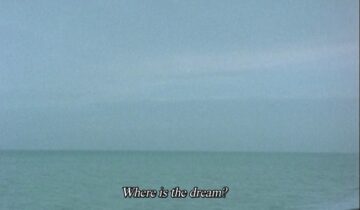
A still from the 1989 film Perdues dans New York by director Jean Rollin

Happy New Year, and not soon enough. Out with the old. Good riddance, too. The laundry list of doom and gloom from 2025 looks long. If you shake out the cobwebs, and gaze back across December and the months prior, the list keeps unfurling. No let up, it seems. Time to forge ahead, buck up, steal yourself for good times. As tech commentator James Meigs recently put it, “…don’t listen to the naysayers. The future is coming and it’s going to be great.”

No denying that, the future is coming. It’s always coming.

Might need to squint a bit to get around his assumption that past science and tech advancements ensure future success, but we’re all team players here. Don’t dig too deep into the specifics of, say, how “AI will make our lives better and our economy massively more productive.” Makes holding the line tougher. What with the industry’s business model built on intellectual property theft. The absence of any foreseeable profits doesn’t help, nor does OpenAI’s plan to spend $150 billion over the next four years to get ChatGPT to answer our queries. That doesn’t include the cost of the building or improving our little AI friend, just the cost to operate it.

The finances might give the impression AI is a botched socialist pipedream, but it’s no such thing. Nor is it a horribly inefficient project run by inept government bureaucrats. AI is the domain of hard-hearted capitalists who know better than anyone how to create and capture value. Take their word for it. Ignore past promises about breakthroughs. Those were so 2025. Elon Musk, the brain behind the AI company creatively named xAI, has a new one for 2026: Grok, the company’s chatbot, has a 10% chance of reaching artificial general intelligence when it launches later this year.

What’s that mean? Read more »

Tuesday, January 13, 2026

Raphael’s School of Education

by Scott Samuelson

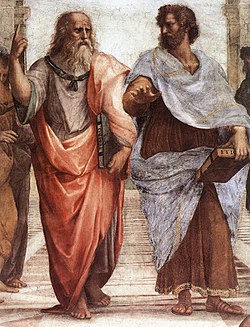
Raphael, School of Athens (1509-11). Detail of Plato and Aristotle. Click here to see the whole image.

Once I’ve hung a picture on the wall, I pretty much never look at it again. It goes right from the forefront of my mind to the background of my room. It’s only when a guest comments on it that I bother to see it again.

A similar thing can be said for iconic works of art. We see them so often that we don’t bother to look at them anymore. A good example is Raphael’s School of Athens, especially its central scene of Plato and Aristotle in conversation. It’s used to illustrate pretty much every article concerning philosophy in the popular media. When we see it, we think “philosophy” or maybe “classics” and move on.

Art historians aren’t much better. They love the game of guessing who each figure in the School of Athens is modeled on or is supposed to represent. Instead of seeing “philosophy,” their great advance is to see “Michelangelo” and “Heraclitus.” As fun and minorly informative as the guessing game can be, it still sees the painting as a cheap allegory.

I started taking a fresh look at the School of Athens when I had to teach it as part of a study abroad course to Rome. The more I looked at it, the more I started to see it as a compelling and comprehensive philosophy of education. To my surprise, I’ve found that it illustrates the complexity of what I aspire to as a teacher. Read more »

America’s Imperial Boomerang Era

by Mindy Clegg

The late Renee Good right before she was killed by an ICE agent.

Just a scant few days into the new year and our supposedly anti-war peace president has greenlit what some are calling an unprecedented attack on another country: we bombed Venezuela, killing up to 40 and kidnapped their sleeping president and his wife (who apparently got roughed up in the process). They are currently sitting in a jail cell in New York City facing drug and weapons charges. Some people are shocked (just SHOCKED) that a man who ran on ending our endless wars is presiding over such a brazen intervention into the affairs of a foreign country. Those who believed Trump would not use American military might in the same way as his predecessors… well Jamelle Bouie has something to say about that:

One thing to remember about the far right is that they lie about almost everything except the most cruel things they have planned. The language of the MAGA movement on both the people and countries of Latin American have long been cruel, jingoistic, and violent. Imperialism is nothing if not those very things. While Trump’s openly violent language and some of his foreign policy actions seem out of step with previous post-war and post-Cold War presidents as they soften the realities of the American imperialism, they are not entirely out of step with our imperial history. What we’re seeing is an attempt to return to more naked forms of imperialism, rather than the somewhat softer imperialism of the Cold War. To understand our present Trumpian moment, we need to understand a couple of facts. First, that America is and has been an imperial power and second, that imperialism takes on many forms, some softer than others. Possibly, the very real damage being done by this destructive administration will make clear American imperial history. But that will necessitate people understanding the nature of American imperialism historically and just what we mean by Trump’s specific version of American imperialism. Read more »

Perceptions

Sughra Raza. Bey Unvaan. January, 2026.

Digital photograph.

On the Pulse of Morning

by Maya Angelou

A Rock, A River, A Tree
Hosts to species long since departed,
Marked the mastodon,
The dinosaur, who left dried tokens
Of their sojourn here
On our planet floor,
Any broad alarm of their hastening doom
Is lost in the gloom of dust and ages.

But today, the Rock cries out to us, clearly, forcefully,
Come, you may stand upon my
Back and face your distant destiny,
But seek no haven in my shadow,
I will give you no hiding place down here.

You, created only a little lower than
The angels, have crouched too long in
The bruising darkness
Have lain too long
Facedown in ignorance,
Your mouths spilling words
Armed for slaughter.

The Rock cries out to us today,
You may stand upon me,
But do not hide your face.

(Excerpt; more here)

Enjoying the content on 3QD? Help keep us going by donating now.

Monday, January 12, 2026

The Minotaur is Patient: a Schizothemia

by TJ Price

It’s a few days before Christmas, but it doesn’t feel like it. The weather app I use has subtitled the forecast for the holiday with a cheeky “feels more like Spring than Christmas,” and the temperature is hovering around seventy degrees Fahrenheit. I’m visiting family down in Cape Fear, and my nephew, all of four years old, sits rapt and silent for approximately ten minutes before abruptly transforming into a firecracker of noise, babbling and shrieking, a whirligig that hurls itself at the legs of whoever happens to first verify his existence. I’m probably reading into it, but it looks for all the world to me like a sudden paroxysm of solipsistic terror—as if he has been seized by the irrational and intrusive thought that (despite the empirical evidence of nearby voices and bodies moving to and fro in the kitchen) he is feeling a kind of doubt in his own ability to adequately integrate with the rest of us. 

I understand this feeling, I think. As a child, my family would bring me over to my grandmother’s house and conduct conversations that floated austerely over my head. Sometimes that height was intentional, positioned as such because they wanted it out of my reach, like the medicine they kept on the top shelf of the bathroom cabinet. Sometimes it was because they wanted to abstract complexity to the extent that it would befuddle me and discourage any continued questioning. (The joke was on them—more often than not, such behavior would only deepen my urge to decode those encryptions, even if it often led to frustratingly reductionist statements in the form of tautology like “because that’s just how it is.”) I felt the terror of being excluded then not because something secret held any kind of promise or hope, but rather signified the coming of a threat against which I was unable to prepare. If I could not have defenses mounted to face obvious menaces, how could I be on guard against proverbial Greeks bearing gifts?

Read more »

Numbers, Percentages, and Hyperbole – Trump Is a Poster Boy for Innumeracy

by John Allen Paulos

Oy. Where to start? Let me begin with a recent abuse involving percentages. Trump’s absurd claims about price declines of more than 100% have elicited a lot of well-deserved derision. How could someone with an undergraduate degree in business from Wharton make these mathematically impossible claims?

And why would the billionaire Commerce Secretary Howard Lutnick attempt to show that Trump’s claims might be made to look rational. That’s an easier question. Toadyism.

Lutnick’s effort is a laughable, but perhaps superficially appealing “explanation” for claims about percentage declines of more than 100%

Here’s a cleaned up account of the mistake: Say an item sells for $100 at a given point, but for whatever reason after some time it sells for $20. Consumers at the later time, would be right to note that for the $20 price to rise to its earlier price of $100 it would have to rise by 400%.

Now an innumerate politician who might be supported by a rich yes man would be quite wrong to claim that at the later time the price had declined by 400%. That, of course, remains nonsensical (it declined by 80%), but it is perhaps a compelling conclusion for those whose knowledge of basic math is on a par with their fluency in Kazakh. Read more »

Poem by Jim Culleny

I am Hawk

I ride a thermal, wind-lifted under sun
which I think must be eternal, I fly!
I’m on my breakfast glide, I am beauty,
but infernal to who in open fields might run

I’m soaring on the wind
I’m searching like a drone
I’m laser-eyed, I hunger.

You watch me glide alone in sky
You watch me slide and circle
You watch me take a sudden dive
You watch me pull in wings and hurtle
like a spear to kill; only though, to keep
myself alive. In that I’m not like humans
who
also so kill for power,
and gold, and,
 pride.

Jim Culleny 4/17/22

Enjoying the content on 3QD? Help keep us going by donating now.

Sunday, January 11, 2026

Restless Bones: How Our Treatment of Human Skeletons Reveals the Politics of the Body

by Amir Zadnemat

In almost every medical school in the world, there is a cupboard—or a quiet back room—full of bones. The skulls are numbered, the femurs stacked like firewood, the ribs threaded onto metal wire. Officially, they are “teaching aids”. Unofficially, they are the remains of actual lives, reduced to objects that can be ordered from a catalogue.
We are used to this sight in photographs and films. The skeleton in the anatomy lab is so familiar that it has become a cliché. But if you pause for a moment, a much more disturbing question emerges: how did those bones get there, and what does their journey say about the way we value—or fail to value—human bodies?

The answer is not only a matter of medical history. It is a window onto something larger: the politics of who is allowed dignity, who becomes “material” for science, and whose remains can be moved, displayed, or even sold without much public concern. To look closely at the skeleton is to see, beneath the neat language of progress, a long story of power.

From memento mori to medical specimen

For most of human history, bones were not neutral. They were sacred relics, moral warnings, or traces of the dead who still had a claim on the living. Medieval European churches were filled with skulls and femurs carefully arranged into chapels of bones. Their purpose was not scientific. They were there to remind the living of their own mortality—memento mori—and to keep the dead within the orbit of the community. Read more »

12 Classic Novels That Made Me A Better Writer

by Eric Schenck

2025 was a good year for books. 

One of my New Year’s Resolutions in 2025 was to read a classic novel each month of the year. And I’m happy to say I succeeded.

While I’ve learned quite a bit from these books, one of my “meta goals” with the resolution was to become a better writer. And I think I have. Below you will see each of the 12 books I read, and the main lesson that each book taught me.

Want to get better at writing? Curious what some of the best novels ever written can teach you about it? This article is for you.

A few notes before I start:

  • I tried to include a mix of nationalities, genders, and “era written” in my picks. Are these the 12 best books of all time? I don’t know. But they are a good mix. You might disagree. And that’s alright.
  • My interpretation of these books (and the lessons I took from them) are mine alone.
  • I’ve tried not to include any spoilers. 

With that out of the way-

Let’s get better at writing. Read more »

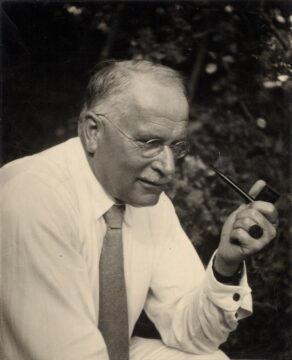
Making the Invisible Visible: Plato and Jung on Archetypes

by Gary Borjesson

Carl Jung, c. 1935

It is the first week of the new year, a time traditionally given to reflecting on the year past and the year to come. Reviewing, summing things up—all those top 10 lists—and making resolutions. Having slowly gained more knowledge of what is stable in my disposition (for better and worse), I’m less tempted to dream of radical reinvention or even self-improvement. Depending on my mood, this can feel like self-acceptance or defeat.

One way of describing the situation is to say that I’m getting to know what Carl Jung described as the archetypal aspects of my psyche. Jung acknowledged that his account is a paraphrase of Plato’s description of the psychic patterns that structure our experience. For Jung these emerge from the collective unconscious, a realm beyond immediate conscious awareness. Plato’s Socrates locates them in an analogous place, the Underworld. These archetypes guide our lives in some respects, but they’re not the only forces at work. For Socrates and Jung, we exercise our power to be truly self-determining through getting to know the patterns that guide our lives, but do not determine our fates.

In honor of the birth of a new year, I want to share the story Socrates tells at the end of the Republic, about how souls come to choose the lives into which they’ll be reborn. For those familiar with depth psychology, this myth of Er (as the story is called) will be strikingly resonant.

A friend once told me he’d spent years trying to make himself into a scholar, and by the world’s eyes he had succeeded. But it never felt like a fit to him. Eventually he realized that, whatever his conscious intentions, he had the instincts and desires of an artist. (His academic articles kept wanting to become stories!) Denying this part of himself had generated internal conflict. So, rather than work against his natural wiring, he started finding ways to be an artist in his work and life. Read more »

Friday, January 9, 2026

Personhood, Virtual Wantons, and Online Bullshit

by Rachel Robison-Greene

We spend much of our lives—perhaps more time than we realize—interacting with non-persons online. We ask for help from artificial customer service representatives. Some of us accept friend requests from bots and are, thereafter, influenced by the content they post. This is a momentous change to the nature of the public square. For most of human existence, discourse occurred between persons. That is no longer true. Philosophers spend much of their time thinking about whether it will ever be possible for artificial intelligence to be conscious. For many purposes, however, the question of whether artificial intelligence exhibits or could ever exhibit personhood is a much more important question.

The philosopher Harry Frankfurt has much to say about what it is to be a person. Persons are beings who use their second order volitions to guide their first order desires. To see how this works, consider the case of a woman who desires a slice of cake. Suppose that she is avoiding sugar. Accordingly, she has a second order desire to refrain from eating the cake. When she is successful in getting her second order, reflective desires and volitions to guide her first order desires, she exhibits personhood. That is, when she does what she wants to do because the wants to want to do it, her will is free and she acts as a person. A being that never used second order desires to guide first order desires would be what Frankfurt calls a wanton. Frankfurt imagines a wanton as a being who merely acts as their impulses dictate, never reflective on whether they’d like those impulses to be different or whether they should attempt to modify their impulses. He says,

I shall use the term “wanton” to refer to agents who have first-order desires but who are not persons because, whether or not they have desires of the second order, they have no second-order volitions. The essential characteristic of a wanton is that he does not care about his will. His desires move him to do certain things, without its being true of him either that he wants to be moved by those desires or that he prefers to be moved by other desires. (Frankfurt 1988, 16)

Frankfurt offers non-human animals and very young children as examples of wantons, acknowledging that there may be others. This new virtual type of wanton isn’t a being swept away by impulse. The “first order impulses” of an algorithm are simply to do what it is programmed to do. There is nothing seductive or addictive about these impulses that make them irresistible. The impulses simply must be unreflectively followed. This makes the virtual wanton a special kind of hazard in the public square. Read more »

“By The Book” — My Way

by Barbara Fischkin

Since its debut in 2013, I have been a fan of “By the Book,” a “Q and A” feature, in The New York Times Book Review. Google AI describes it as a look into “select authors’ reading habits and favorite books.” I’d always been so eager to read the text, that it was only recently I noticed the pun in the title. A word play on a phrase I had used umpteenth times to push sales, after the first of my three books was published in 1997. Duh.

Late last year one of those “select, authors did a slight stumble over the often-posed question about who to invite to a literary dinner party. He said he had been reading the feature for years—which I took as a big hint that he had long hoped to be a subject one day. I don’t know any writers who wouldn’t jump at the chance, myself included.

For me, one major problem: My last book was published in 2006, seven years before this feature appeared. Like many writers, my heart and soul are joyous about my successes yet tainted with bitterness and blame. In regard to my lack of a fourth book, I blame the editor—and supposed friend—who refused to acquire an in-depth look at the children of the autism surge growing into adulthood, as was my elder son. A similar tome, written by Washington insiders, was a Pulitzer prize finalist. With a little less bite, I blame the handful of non-writers with great stories, who chickened out when it came to partnering with me to write their books. To be fair they did this after editing, book proposals and early chapters were written—and after they paid me for my work. But when it came to publicly telling their stories, they got cold feet.

Most of all, though, I blame my current obscurity on myself and on a manuscript-creature titled The Digger Resistance. My yet unborn historical novel. Read more »